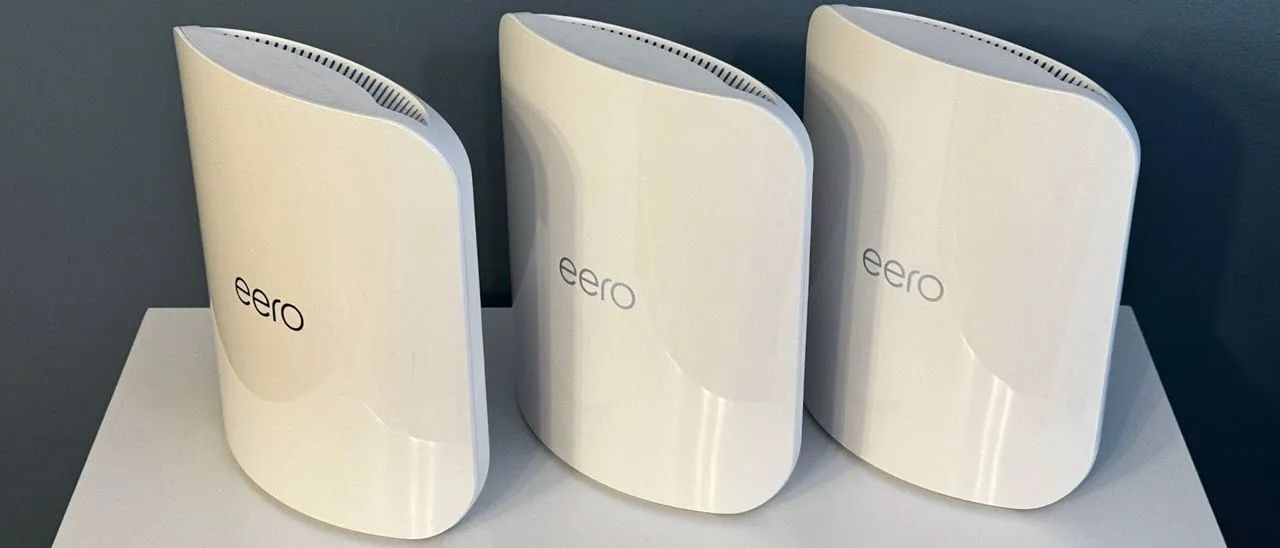
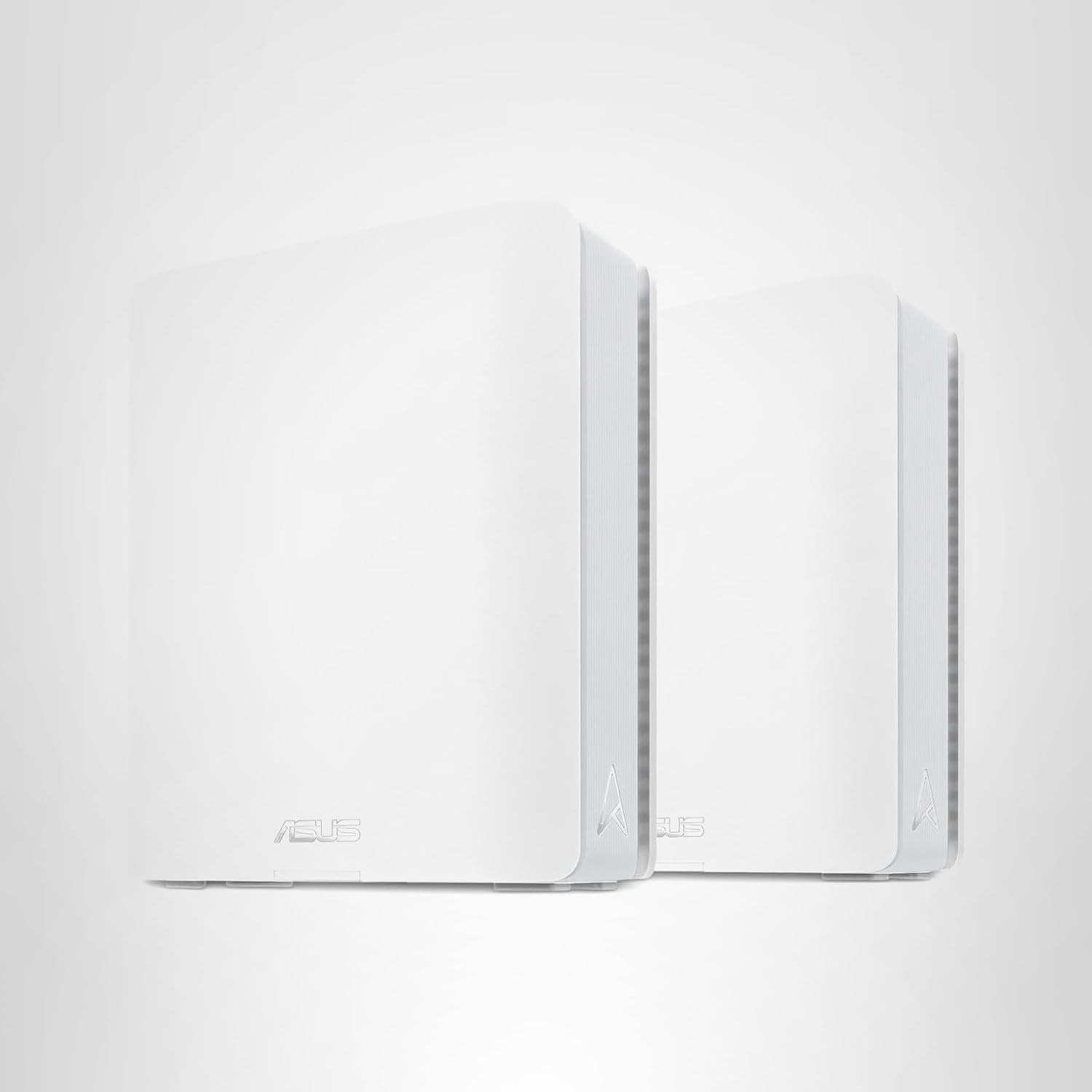
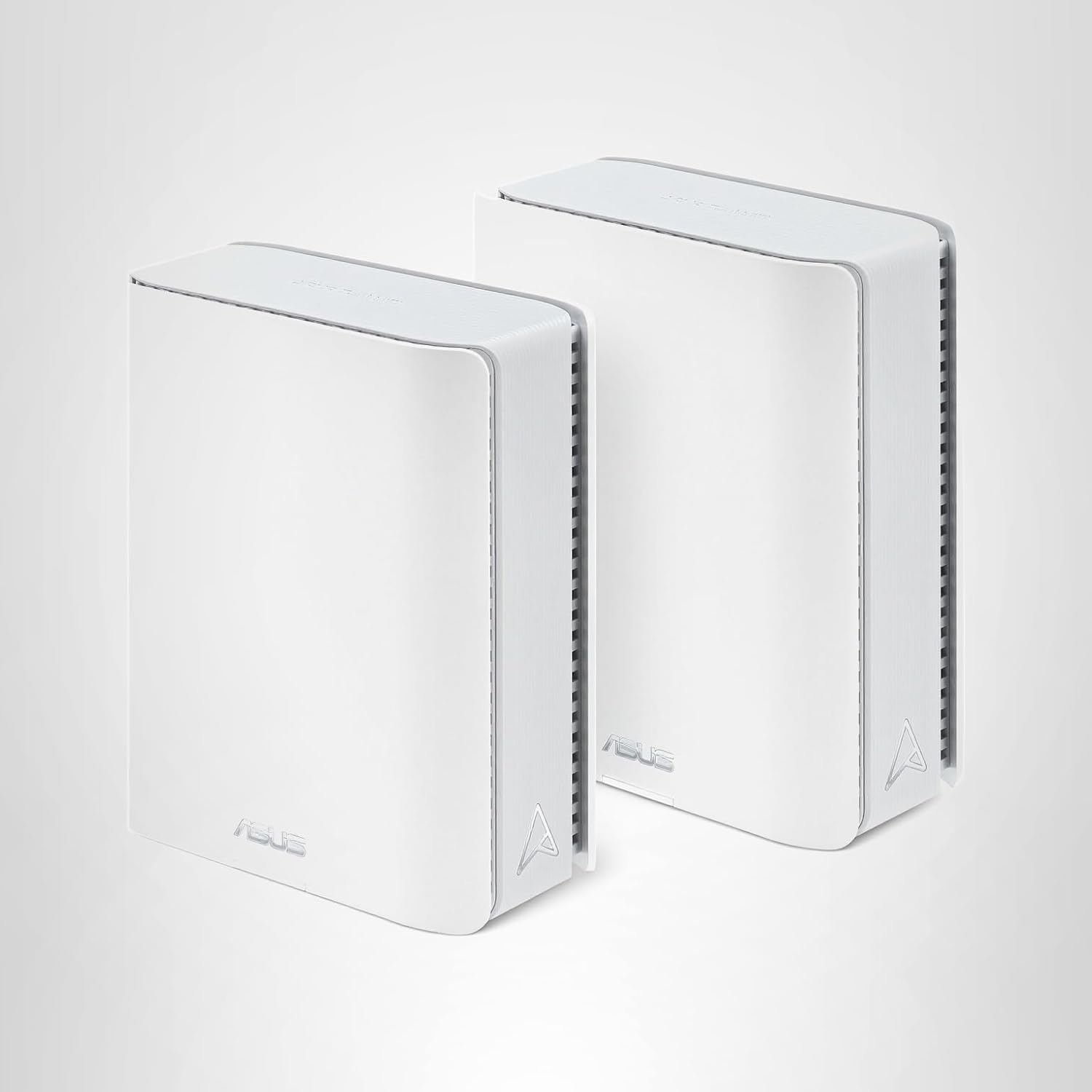
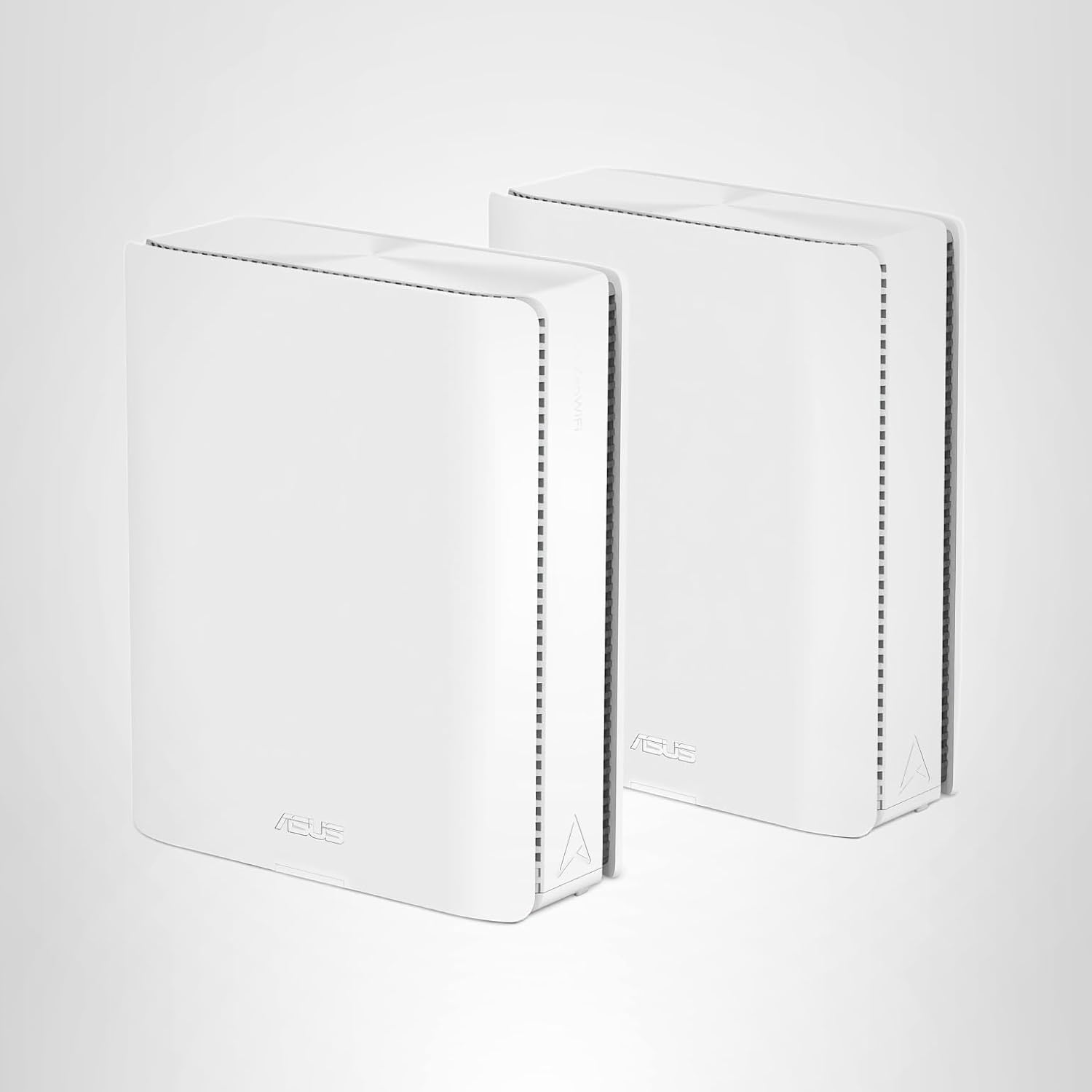
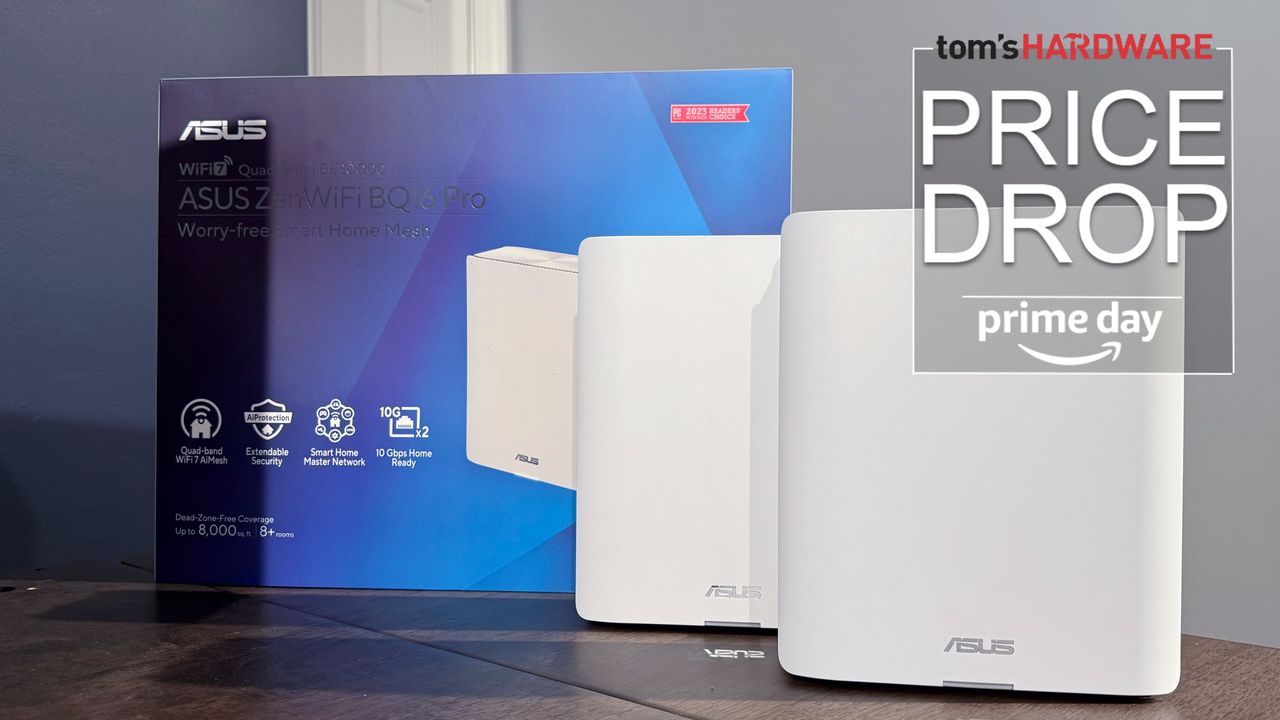
2026 has been a trying year for router manufacturers, as the Federal Communications Commission (FCC) has subjected leading companies to strict oversight and outright bans. As an olive branch of sorts, the FCC has handed out "conditional approvals" to be included on the Covered List to companies that have jumped through all the necessary hoops to satisfy the commission's concerns. Asus is the latest company to secure that approval, which was confirmed in an FCC notice issued this week.
According to the FCC, the following Asus networking products have been granted conditional approval:
RT Series
ROG GT Series
OG Strix GS Series
TUF Gaming Series
ExpertWiFi Series
ZenWiFi Mesh Series
5G MiFi Series
Wireless repeaters
Wireless access points
In other words, Asus' entire wireless networking portfolio is cleared for sale in the U.S., with the conditional approval granted until March 6, 2028 (18 months from the date of issuance). The FCC explains, "We find that each of the Conditional Approvals constitutes 'a specific determination' by [Department of War] that such devices do not pose risks to U.S. national security."
This latest move by the FCC is a welcome sigh of relief for Asus, a Taiwanese company with an extensive networking portfolio and some of the best Wi-Fi routers. More importantly, Asus is ready to unleash a whole new generation of Wi-Fi 8 products over the next year. Wi-Fi 8 promises significant reliability and quality-of-life improvements across a wide range of wireless devices, so having a front-row seat to the transition from Wi-Fi 7 to Wi-Fi 8 is pivotal for Asus.
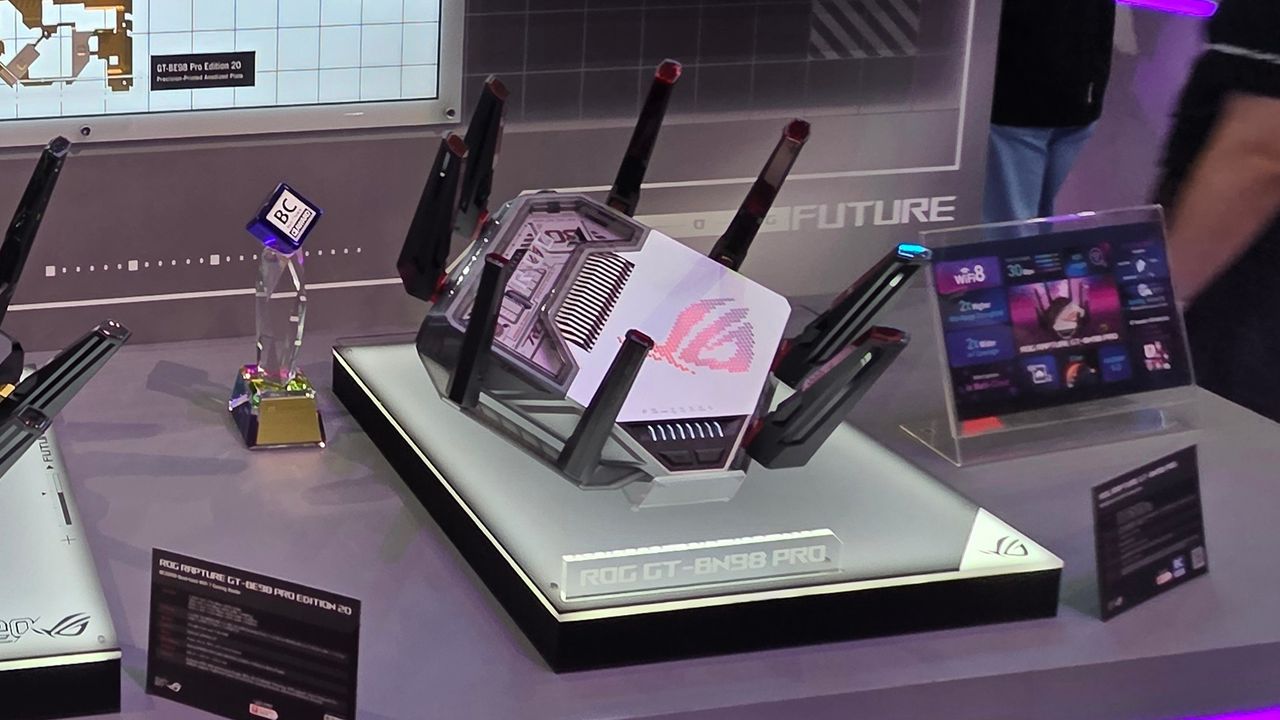
We've already seen a concept ROG NeoCore Wi-Fi 8 router from Asus at CES this year, and the company announced its first consumer Wi-Fi 8 router, the ROG Rapture GT-BN98 Pro, in June. The ROG Rapture GT-BN98 Pro is promising a 2x uplift in real-world throughput compared to its current-generation Wi-Fi 7 products.
Asus joins Netgear and Amazon Eero/Leo on the conditional approval list. The largest player in the U.S. wireless router market is TP-Link, and it still hasn't gained FCC approval. The U.S. government has been reluctant to give its blessing, and a war of words has been brewing over alleged Chinese ties despite TP-Link Systems Inc. being headquartered in California. As a result, the company has not confirmed a release date for its newly announced Wi-Fi 8 "Ultra" routers in the U.S.
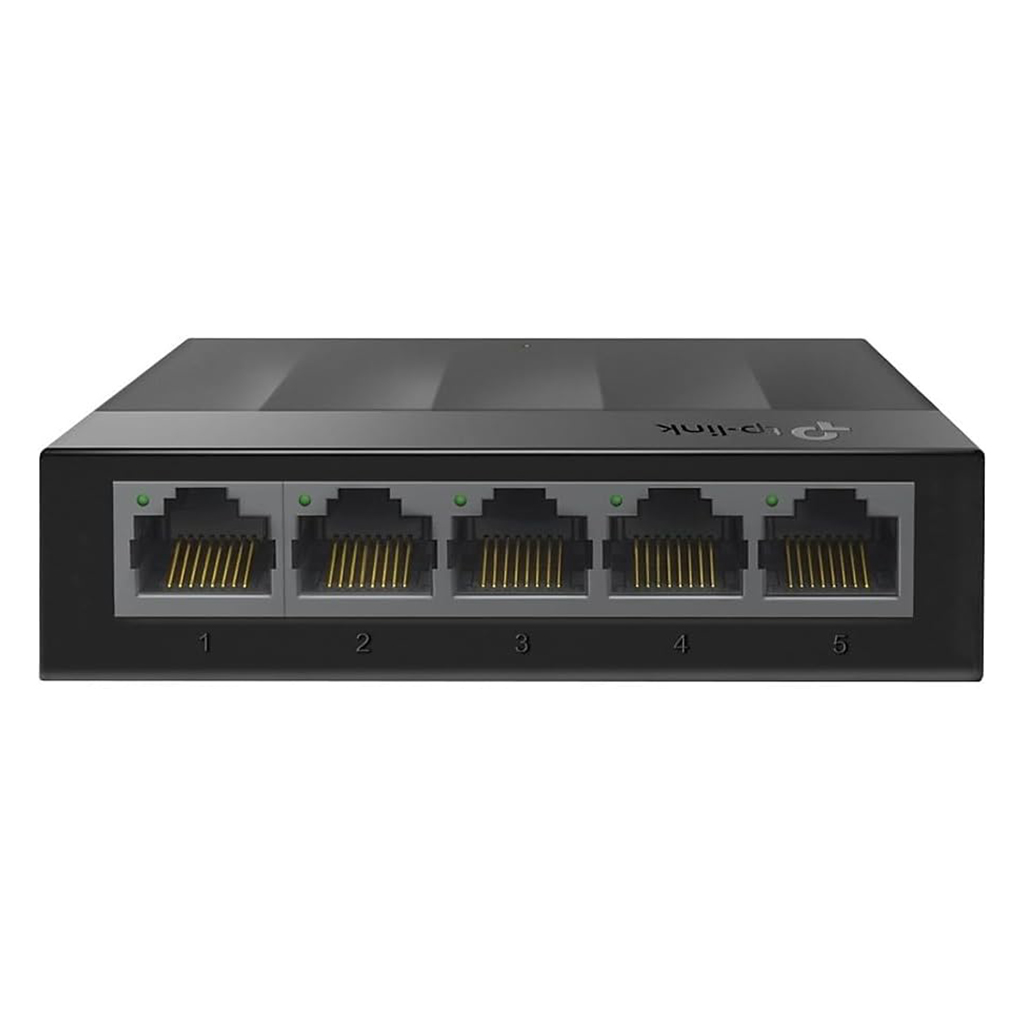
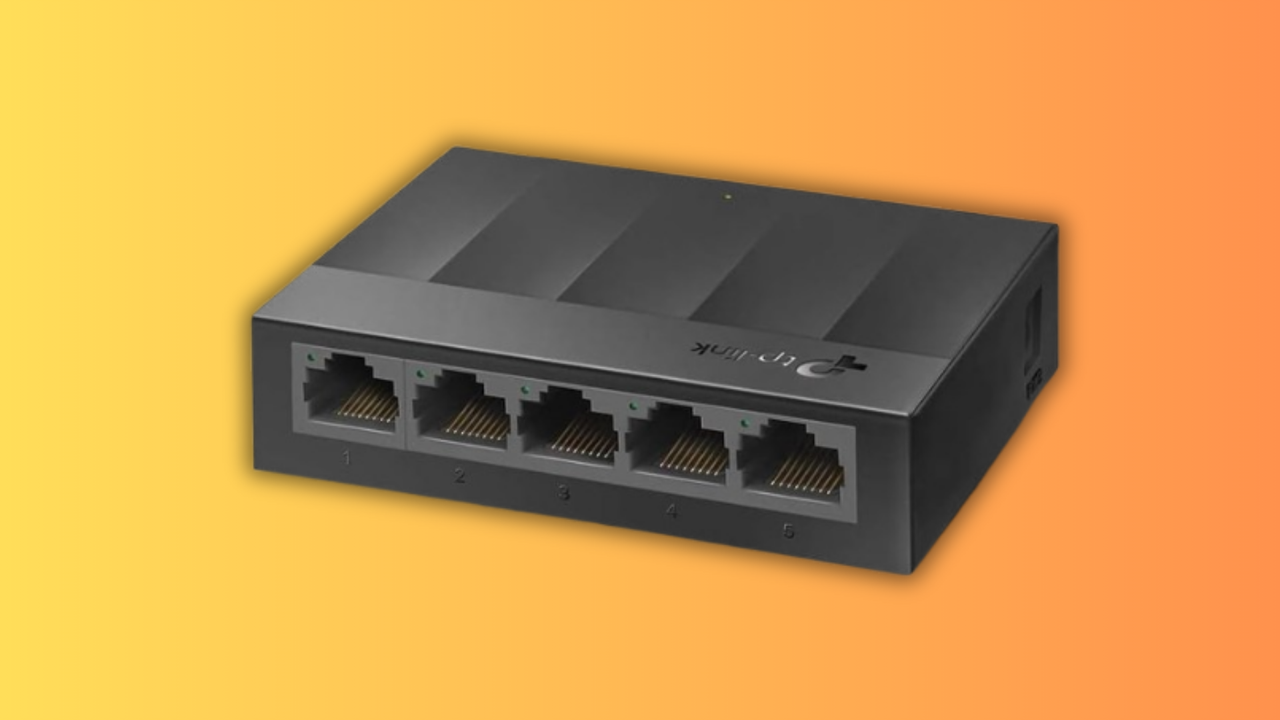
A bad network connection at home or in your office doesn't have to be permanent, because you can grab a wired upgrade for less than $10 right now. This gigabit TP-Link switch is down to $9.98, but only for a limited time.
This TP-Link switch does often vary in price, according to Camelcamelcamel's data, but under $10 is a good deal price for this model. A network switch like this will unlock extra Ethernet ports on your wired network and will plug straight into your existing router. There isn't a better alternative to a wired LAN connection for maxing out the bandwidth on your internet connection, especially if you want to play games or stream 4K video.
Speed is the ultimate value of this TP-Link Litewave 5-Port LS1005G switch, too. You're getting gigabit Ethernet speeds, meaning you don't have to worry about lag or slowdowns if your internet connection is fast enough. This is an unmanaged switch, so there's no need for you to configure it or navigate a difficult setup process. Just switch it on, plug it in using your router or modem's WAN port, and you'll be able to use the four remaining ports.
The TP-Link Litewave 5-Port Gigabit Ethernet Switch LS1005G provides four additional Ethernet ports, delivering reliable, high-speed wired internet for your gaming PC, NAS, console, TV, and other connected devices.View Deal
Measuring just 2.8 x 3.5 x 0.9 inches in size, you won't need a lot of space for this TP-Link switch, and you should be able to place it in a convenient location near your router or around your home with a long enough cable. It's silent, with no fans, so it won't interrupt you while you're gaming or streaming, either.
You won't find a better plug-and-play solution for a beginner than an unmanaged wired network switch like this one. The downside is that it won't offer the same level of customization, with managed switches offering more features and configuration settings at a higher price. This TP-Link Litewave LS1005G is going to be fine for most users, though, and it'll work with almost any Ethernet-capable device you own without any issue, including PCs, laptops, NAS drives, games consoles, IP cameras, and even another router or Wi-Fi extender.
Rather than deal with a slow, laggy connection, paying $9.98 for this TP-Link Litewave 5-port LS1005G switch can be a quick and immediate upgrade to your wired network. The limited-time deal won't last for long, so if you want to grab it for under $10, you'll need to be quick.
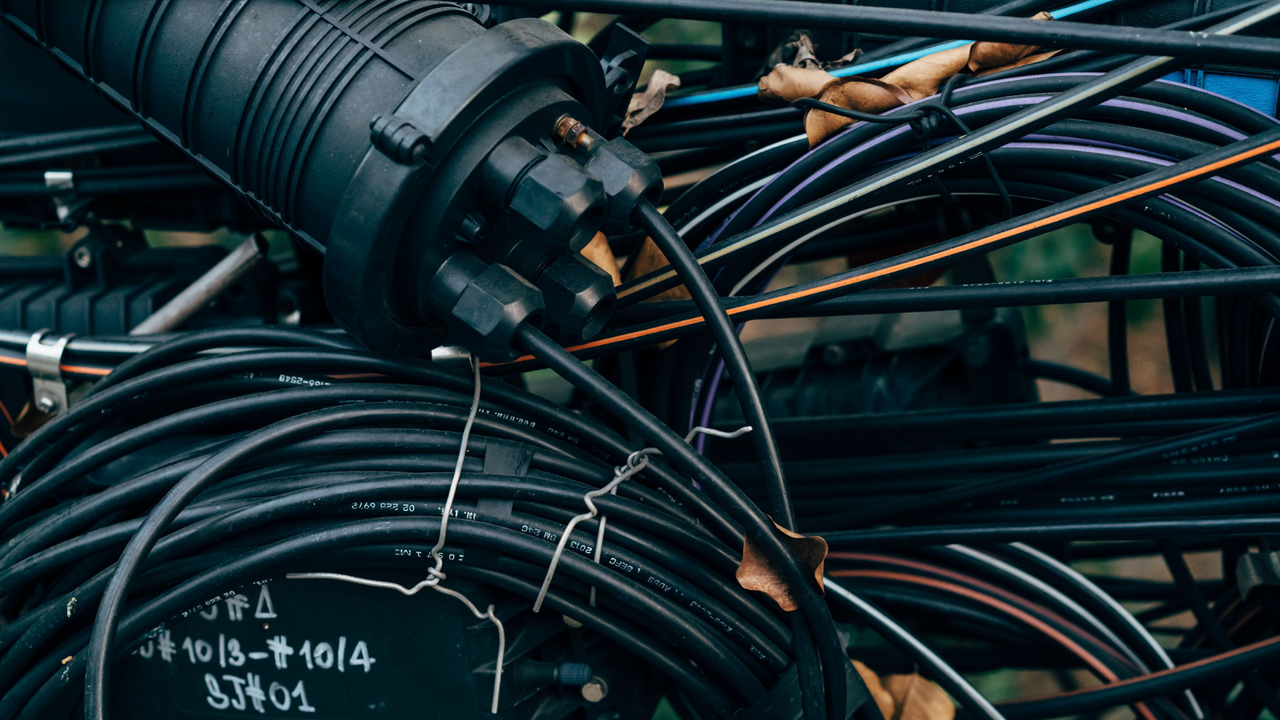
BT, the UK’s largest telecommunications provider, is slowly upgrading its entire network to fiber, with the company looking to move residential endpoints away from copper, and it seems that it will make a killing when it recycles its old cables. According to The Guardian, the company has signed a deal with EMR, one of the largest cable recycling companies in the country, for the recovery of around 200,000 tons of copper over a span of four years. Although the total value of the deal is unclear, the latter has also already paid more than USD 134 million (GBP 99 million) to the telecoms company for a few thousand tons of copper. Aside from the deal with EMR, BT and its subsidiary, Openreach, could also sell the recovered copper directly on the spot market.
More than 22,000 metric tons have already been recovered from the system since BT started its network upgrade, with the metal costing around USD 8,500 per metric ton on the market. If the company sold all that material in the open market, it would have made revenue of USD 187 million. However, the massive AI-driven demand for copper has pushed prices to a record high of more than USD 14,000 per metric ton. The upgrade work is expected to continue well into the 2030s, with Openreach estimating that it could still recover up to 200,000 metric tons of material. That means the company could make an estimated USD 2.7 to 2.8 billion just from the sale of these old network cables.
The AI boom is pushing up demand for several industries — from high-tech products like memory and storage chips and jet engines to “exotic” materials such as rare earth elements and glass cloth fibers. Most people will not equate copper to AI data centers, especially as the PCBs used in their servers often contain so little of the metal, relatively speaking. AI data centers are also switching to optical interconnects and silicon photonics, meaning the internal networks of these data centers will increasingly rely on fiber optics.
However, data centers are forecast to use 194 gigawatts of power by 2035, and all this power can only be transferred via metal cables. While you can also use aluminum wires to transmit power, copper is often the preferred choice for its stability, better electrical conductivity, increased durability, and superior thermal performance. So, as AI hyperscalers expand their operations and build more data centers, the demand for copper wires will also increase accordingly. Utility providers will also need to purchase more cables as they upgrade the grid to deliver the electricity needed by the AI infrastructure.
The AI-powered boom for copper material is a win-win situation for BT, Openreach, and their subscribers. The people will now get end-to-end fiber connections in their homes, hopefully giving them better speed and reliability, while the providers are basically getting a discount on the upgrades that they’re making on their networks.
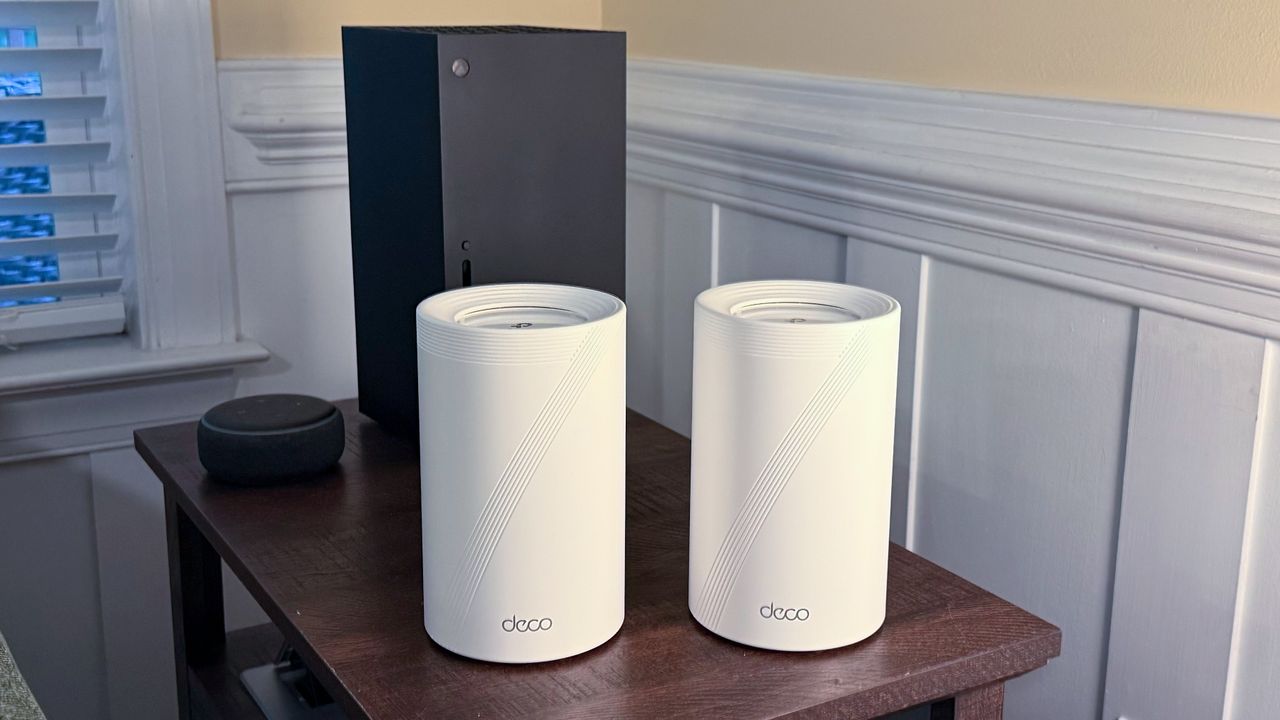
Earlier this year, TP-Link announced its intentions to launch the first members of its Wi-Fi 8 (802.11bn) networking family. At the time, the company revealed that it would first launch a standalone Archer 8 consumer router this fall, followed by a Deco 8 mesh router. And right on cue, TP-Link stated today that the Archer 8 Ultra BN19000 tri-band router will launch on September 30.
TP-Link is going light on the details at this time, but this is what we know so far. The Archer 8 Ultra BN19000 will come equipped with 18 internal antennas and deliver up to 19 Gbps aggregate wireless speeds. In addition, it will have 10 Gbps wired connectivity, though we don’t know whether that includes WAN and LAN ports or just the latter.
For users who require broader coverage in larger homes or offices, the Deco 8 Ultra BN22000 tri-band mesh router offers aggregate speeds of up to 22 Gbps and includes 10 Gbps wired connectivity. TP-Link typically sells its mesh systems in two- or three-pack configurations, and the Deco 8 Ultra BN22000 3-pack covers up to 9,800 square feet. Unfortunately, the Wi-Fi 8 mesh system won’t be available until Q1 2027, according to TP-Link.
TP-Link plans to expand its Wi-Fi 8 portfolio by Q2 2027 with a new Roam 8 travel router, along with range extenders and PCIe/USB client adapters. Although we don’t know which specific chipsets will power Archer 8 Ultra, Deco 8 Ultra, and other unannounced Wi-Fi 8 devices, the company says its products will use hardware from Broadcom, MediaTek, and Qualcomm.
Wi-Fi 8 is shaping up to be more of a quality-of-life improvement over Wi-Fi 7 than a substantial theoretical speed improvement. Put simply, Wi-Fi 8 hardware devices should be able to come closer to fulfilling the real-world performance metrics that Wi-Fi 7 devices originally promised.
To this end, TP-Link says that its so-called StabilityEngine leverages core Wi-Fi technologies including Enhanced Long Range (ELR) and Distributed Resource Units (DRU). These features together help improve wireless connectivity, primarily for low-power IoT devices that are typically positioned at the edge of your home’s wireless coverage. There are also additional technologies at play, such as Unequal Modulation (UEQM) and Modulation and Coding Schemes (MCS), to ensure uninterrupted wireless traffic in high-interference situations.
A new design language is also being ushered in with the Archer 8 and Deco 8 products, which was teased during TP-Link’s May 2026 announcement. “We stopped building a piece of networking equipment and started designing for the home,” explained TP-Link industrial design chief Gary Chang. “When a router’s design becomes something people want to display, it ends up exactly where it performs best.”
What remains unclear is how or when these new Wi-Fi 8 products will launch in the U.S. As of today, TP-Link has yet to obtain FCC approval to release all-new products in the country. Unlike competitors Amazon and Netgear, which received conditional approval from the FCC Covered List, the U.S. government is still playing hardball with TP-Link. For its part, TP-Link only says that preorders for the Archer 8 Ultra will open in “select regions” on September 30.
A fiber-optic cable strung across the Drake Passage could pull Antarctica's research bases off satellite links and hard-drive shipments and onto the global network after Chile's finalized feasibility study concluded last week that the crossing is technically viable. Salience Consulting and Pioneer Consulting ran the study for telecom regulator Subtel, and development bank CAF financed it, with partial support from the China-initiated MCDF Finance Facility. It recommends an instrumented cable carrying a dedicated fiber pair to each Antarctic landing, naming two Chinese firms among the six suppliers Subtel canvassed. Antarctic research data still leaves the continent physically, on hard drives ferried out by ship and plane "in suitcases full of hard drives," said Juan Pablo, a team leader in the pre-feasibility study.
The study weighs a minimum configuration serving three facility groups around King George Island and the northern Antarctic Peninsula against an optimal configuration with nine Antarctic landing points, an option that Reports 2 and 3 recommend. The nine-landing version would connect research bases run by Chile, Argentina, Brazil, the United States, and the United Kingdom, all fed from landings at Punta Arenas and Puerto Williams in southern Chile and routed across the Drake Passage. Reporting from The Maritime Executive puts the minimum build near $370 million and the optimal build at roughly $620 million.
The study lists four features that separate the project from a commercial cable: Drake Passage weather, ice scour at the Antarctic landings, installation methods uncommon in Antarctica, and a plan to embed SMART sensors that measure ocean-bottom temperature, pressure, and seismic acceleration for climate and tsunami monitoring.
Each Antarctic landing would get a dedicated fiber pair rated at 15 to 30 Tbit/s through space-division multiplexing, with each base free to pick its own transmission equipment. To clear ice scour to about 340 meters of depth, the design calls for horizontal directional drilling at the Antarctic landfalls and double-armored cable, with installation spread across three austral summers inside the December-to-January weather window.
Subtel's request for information went to Alcatel Submarine Networks of France, Japan's NEC, U.S.-based SubCom, the UK's Xtera, and two Chinese firms, HMN Technologies and FibreHome. HMN Technologies is the former Huawei Marine Networks, sold to Hengtong after U.S. sanctions and placed on the Commerce Department's Entity List in 2020, and Washington has spent years working to keep it off Pacific cable routes. The study acknowledges this, listing the geopolitics of project financing and procurement restrictions among its critical risks and recommending "neutrality by design," dark fiber, and user-controlled transmission gear so no operator can read another's traffic.
The study stops short of recommending construction, calling instead for a phased path that resolves the financing and political questions before the expensive supply contracts are signed. Chile has sent the reports to its Ministry of Foreign Affairs, which is expected to bring them to the country's Antarctic Policy Council, and any build would need agreement from the other Antarctic states whose bases sit on the optimal route.
TP-Link has a rather expansive family of Wi-Fi 7 mesh routers, and it can often be confusing to keep up with the growing assortment. We’ve tested several Deco Wi-Fi 7 mesh routers over the past three years, and they’ve offered class-competitive performance and a well-designed app for controlling all aspects of the network.
Today, we’re taking a look at the Deco 7 Pro BE13000, which is one of TP-Link’s tri-band “whole home mesh Wi-Fi 7” systems. It’s also a rather interesting option, as it’s exclusively available at Costco as a 3-pack. With a selling price of $399 and coverage for up to 8,100 square feet, the Deco 7 Pro BE13000 has stiff competition among the best Wi-Fi routers.
Design of the TP-Link Deco 7 Pro BE13000
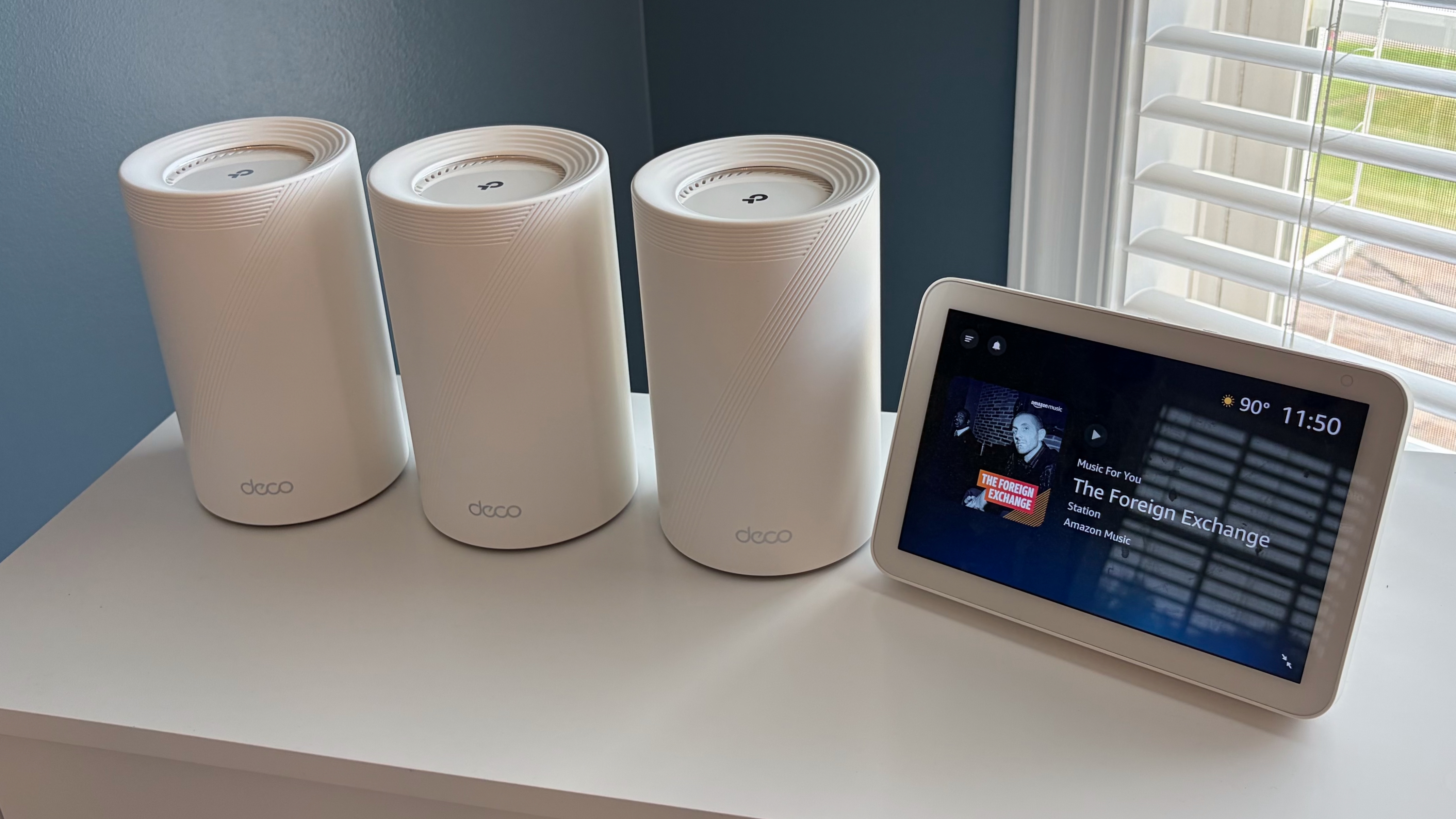
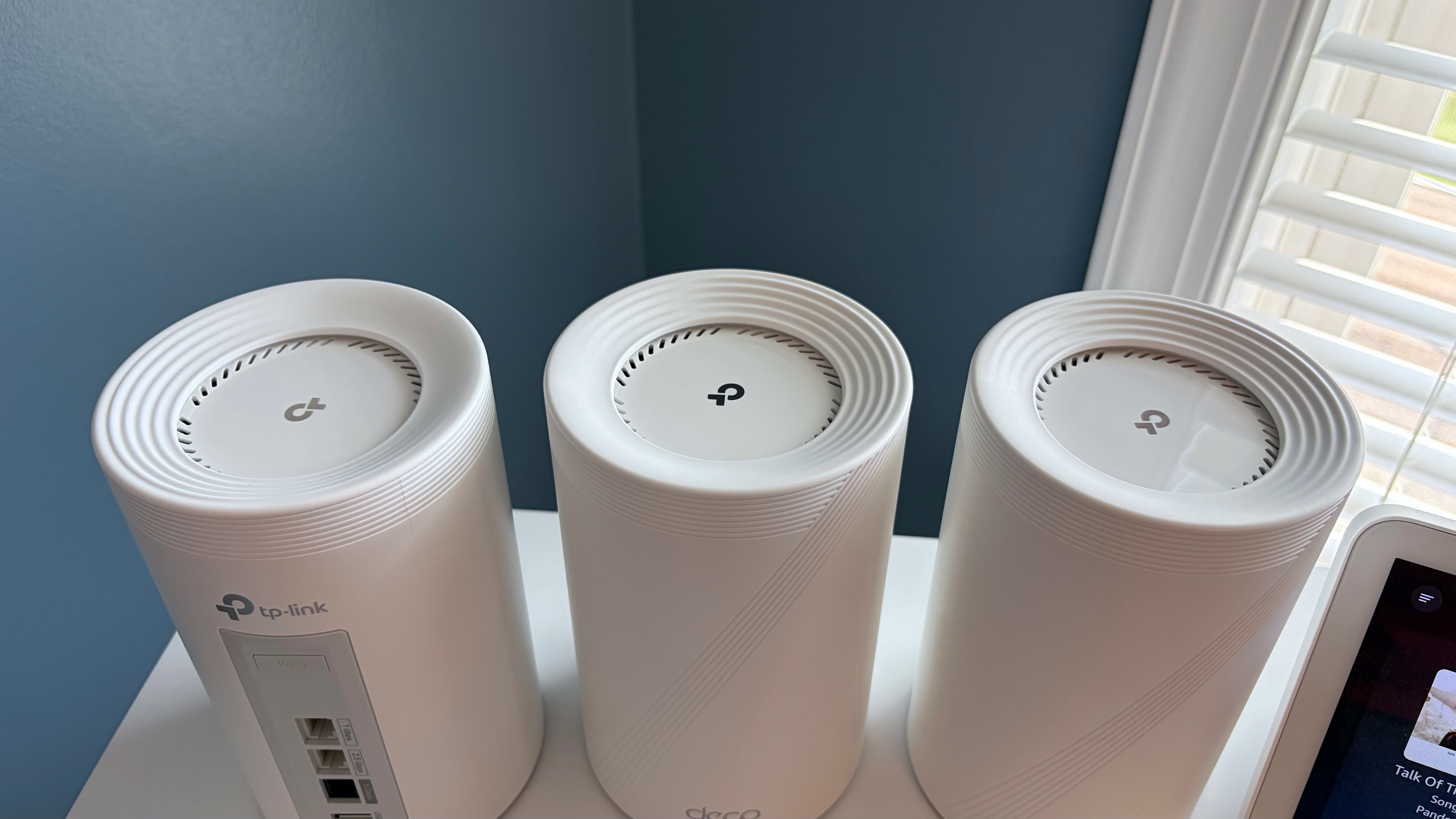
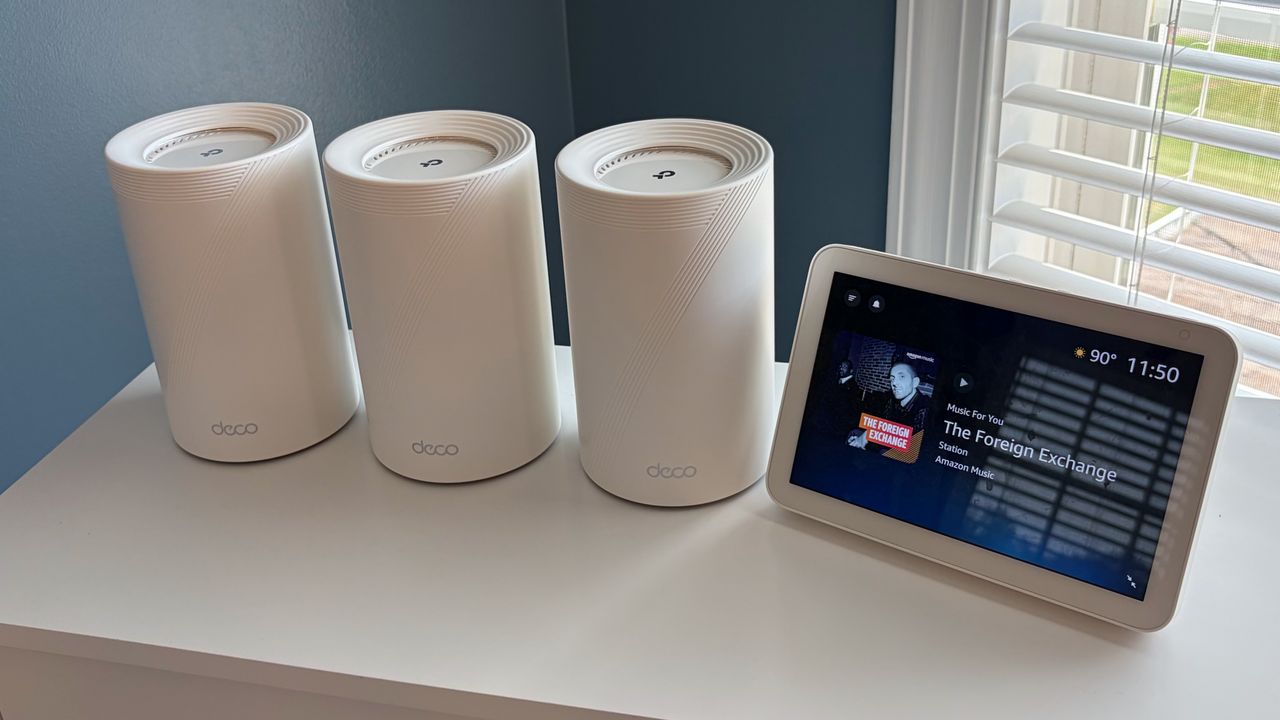
Like all other members of TP-Link’s tri-band Wi-Fi 7 mesh family, the satellites on the Deco 7 Pro BE13000 are white cylinders measuring 4.23 inches in diameter and 6.93 inches in height. A stylized “7” is molded into the plastic, and the top of the unit features the TP-Link logo under a clear circular cover. Looking down, the molded concentric circles give the impression that the logo suggests a splash in a puddle of water.
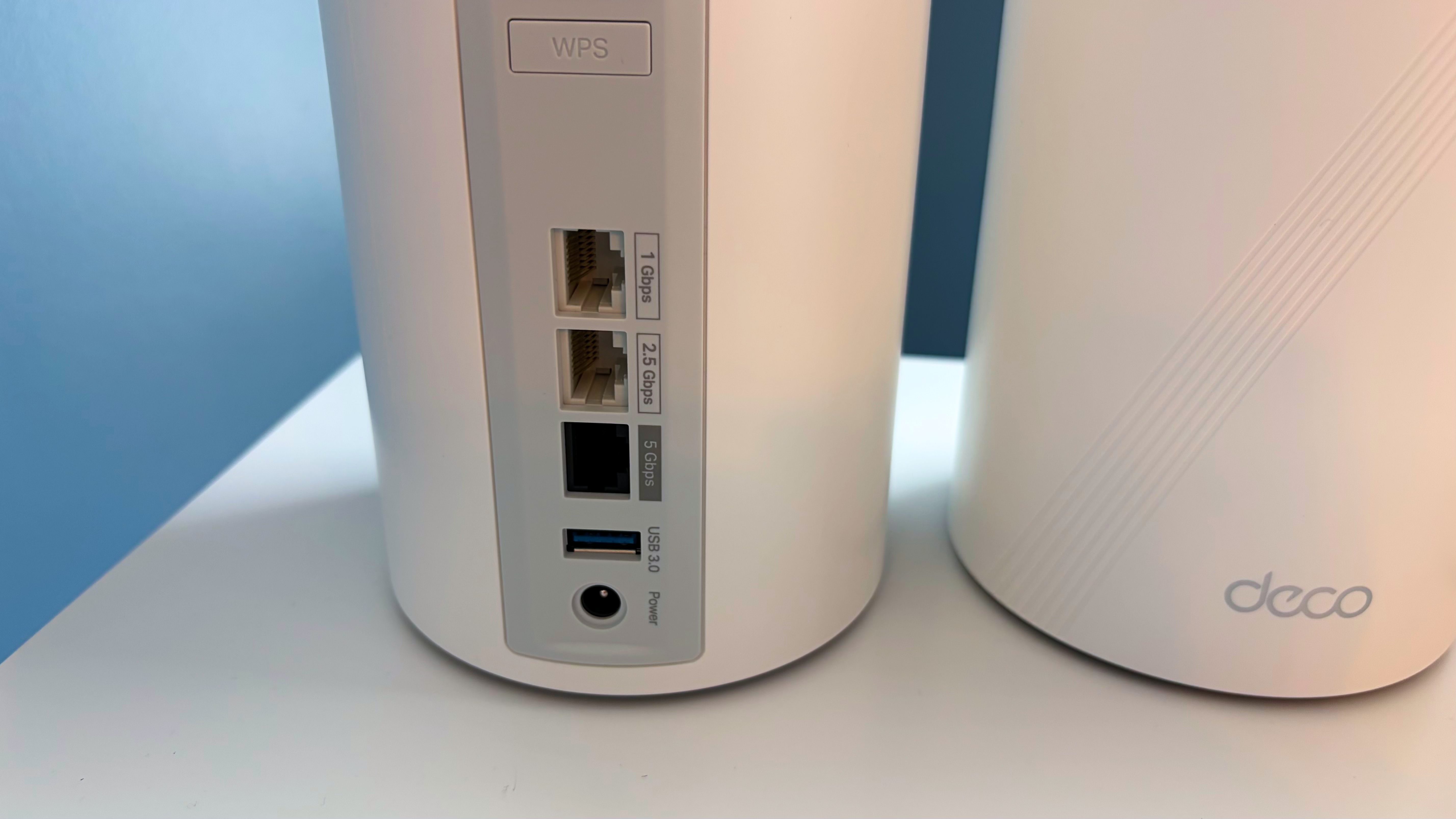
Beneath the stylized 7 on the front of the satellite, there’s “deco’ branding, and below it is a status LED. It blinks blue during setup, is solid green when the satellites are online, and stays solid red if there’s a connectivity problem. Out back is where things get a bit interesting. The slightly lower-positioned Deco BE63 features four 2.5 GbE LAN/WAN ports. The Deco 7 Pro BE13000, on the other hand, only has three LAN/WAN ports, and they’re oddly spec’d. You get one GbE, one 2.5 GbE, and one 5 GbE port.
Tom's HardwareTom's HardwareTom's Hardware
Personally, I would have preferred four LAN/WAN ports: two 2.5 GbE and two 5 GbE. At the very least, the single GbE port should have been replaced with a 2.5 GbE port. In addition to the LAN/WAN ports, there’s also a USB 3.0 port for storage. The port allotment is the same across all three wireless nodes.
TP-Link Deco 7 Pro BE13000 Wi-Fi 7 Mesh Router Specifications
The setup process for the Deco 7 Pro BE13000 is rather straightforward and is accomplished solely via the TP-Link Deco smartphone app for iOS or Android. Before getting started, you'll need a TP-Link account, which enables remote management of your network when you're not at home.
I started the setup regimen by placing the three wireless nodes throughout my house, trying to keep them as evenly spaced as possible. Next, I plugged each node into power. Since all of the wireless nodes are identical, the first one that you plug into your modem will serve as the main router. In this case, I plugged the node in my office into my fiber modem. The setup program asked me to bring my phone close to the router, and it was quickly found; then the configuration process began.
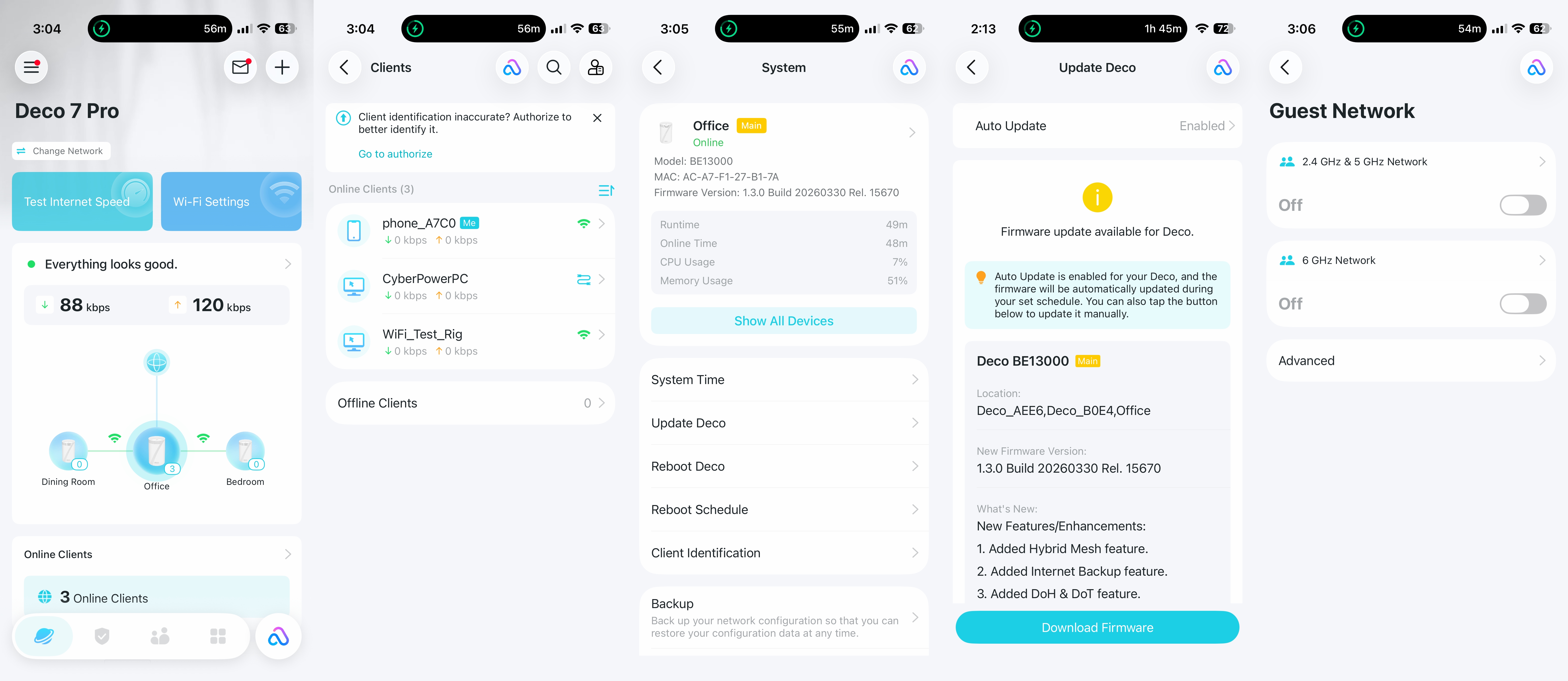
For simplicity, I created a single network, using Deco 7 Pro as the SSID. This single SSID encompasses 2.4 GHz, 5 GHz, and 6 GHz bands. You can also enable MLO, Guest, and IoT networks with further granular controls for the bands that you want to make available. For example, you can limit the Guest network to just 2.4 GHz and 5 GHz traffic (or, only one of the two) at any time. If you want to give guests access to the 6 GHz band, you can do that as well.
After completing the setup (which took under 5 minutes), the network was fully operational. I then went into the advanced settings to check for any firmware updates. One was available, so I downloaded it and installed it across the three wireless nodes.
TP-Link Deco 7 Pro BE13000 Software
TP-Link’s Deco and Tether apps continue to be among the best thought-out and well-rounded apps for wireless routers. And that’s a good thing, because the Deco 7 Pro BE13000 cannot be configured using a traditional desktop web browser – it’s exclusively controlled via the app.
The router homepage provides relevant at-a-glance information about your network. Front and center are your main router and its two satellite nodes. The diagram also shows how the satellites are connected to the main router, which, in this case, is via a 5 GHz/6GHz wireless backhaul. Current upload/download activity is shown, along with a green status light indicating “Everything looks good.” If there were an issue with your network, there would be a red status light and an explanation of what was amiss. You can also see how many devices are actively connected to the network.
(Image credit: Tom's Hardware)
The Security tab offers some basic features without requiring the paid Security+ subscription. However, these are simply quick links to features that are buried in the Advanced settings tab. For example, you can control network access on a per-device basis with Network Access Control and Device Isolation. Camera Security lets you limit internet access to your smart cameras.
Upgrading to the Security+ subscription services gives you more features, including Web Protection, Intrusion Protection, Antivirus, VPN access, and password management (among other security-related features). Security+ costs $35.99/year, while the Total Security Package is $129.99/year. As I've mentioned ad nauseam, I have to applaud Asus for providing most of the features (minus the VPN) for free with its AsusWRT platform.
TP-Link offers parental controls that let you create individual profiles for your children's devices. For $17.99/year, you can enable Advanced Parental Controls, including SafeSearch, YouTube restrictions, bedtime controls, offline control, and more. However, all of these subscriptions seem a bit much for a consumer router. We should note that the Total Security Package includes Advanced Parental Controls. The More tab opens access to the full complement of network settings, from Wi-Fi settings to WPS control, firmware updates, VPN access, and Network Optimization (for optimizing your mesh network to avoid household radio interference).
TP-Link Deco Pro 7 BE13000 Performance
Our wireless client system consists of a Windows 11 Home desktop system with an MSI Herald-BE Wi-Fi 7 adapter. Our testing server was a Windows 11 Professional desktop with a 10 GbE network card connected to the 5 GbE port on the main Deco 7 Pro BE13000 router.
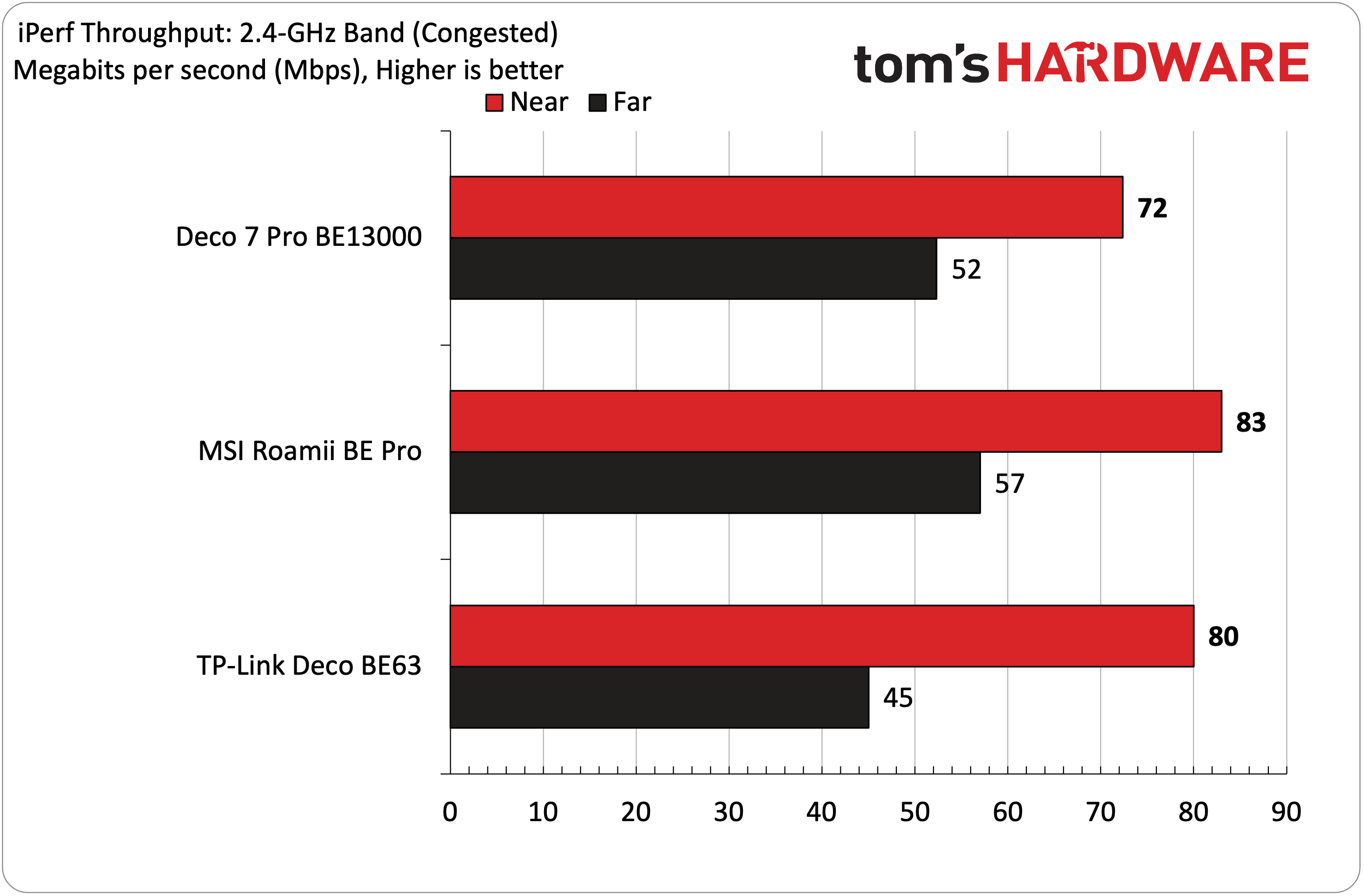
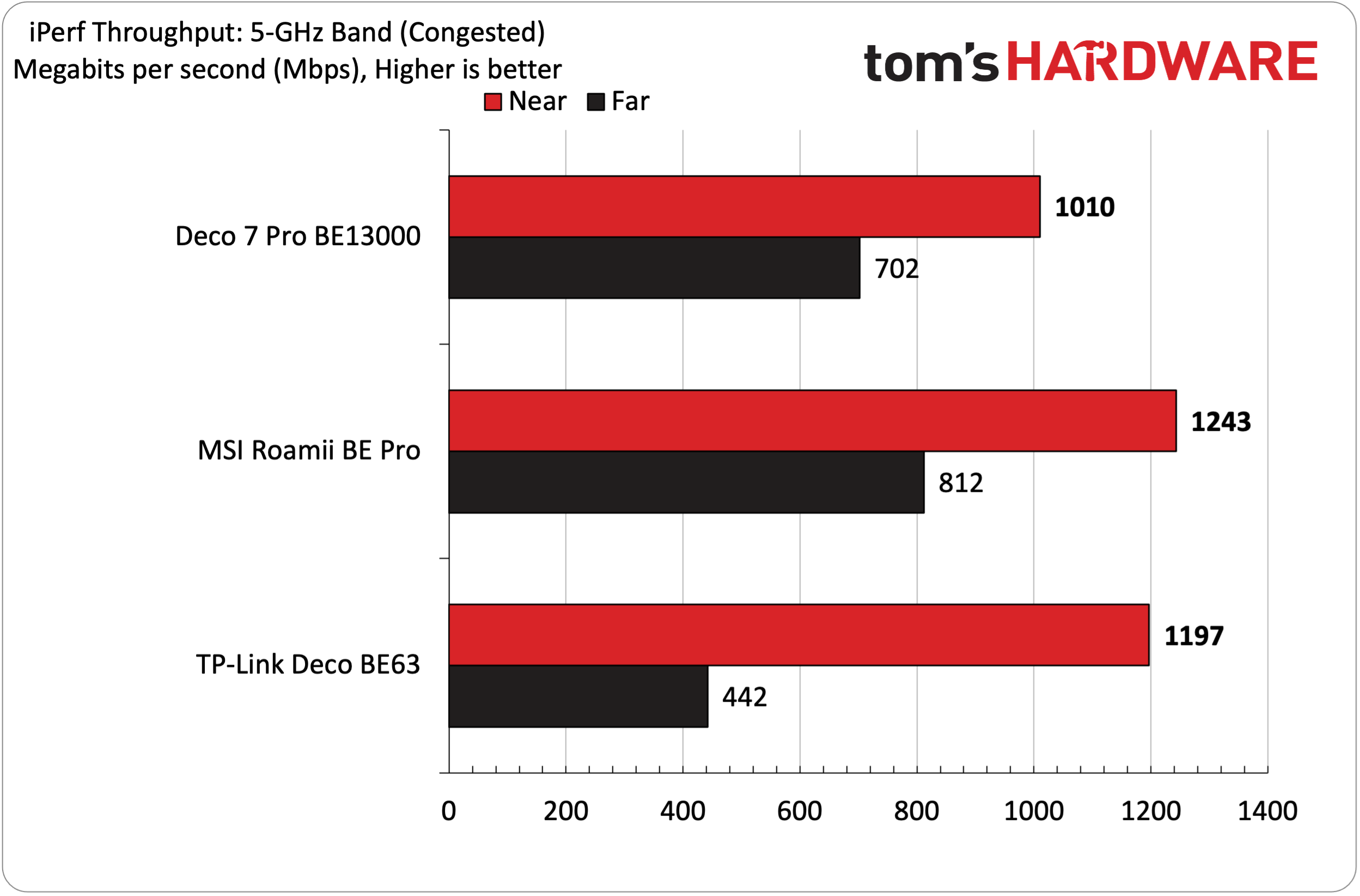
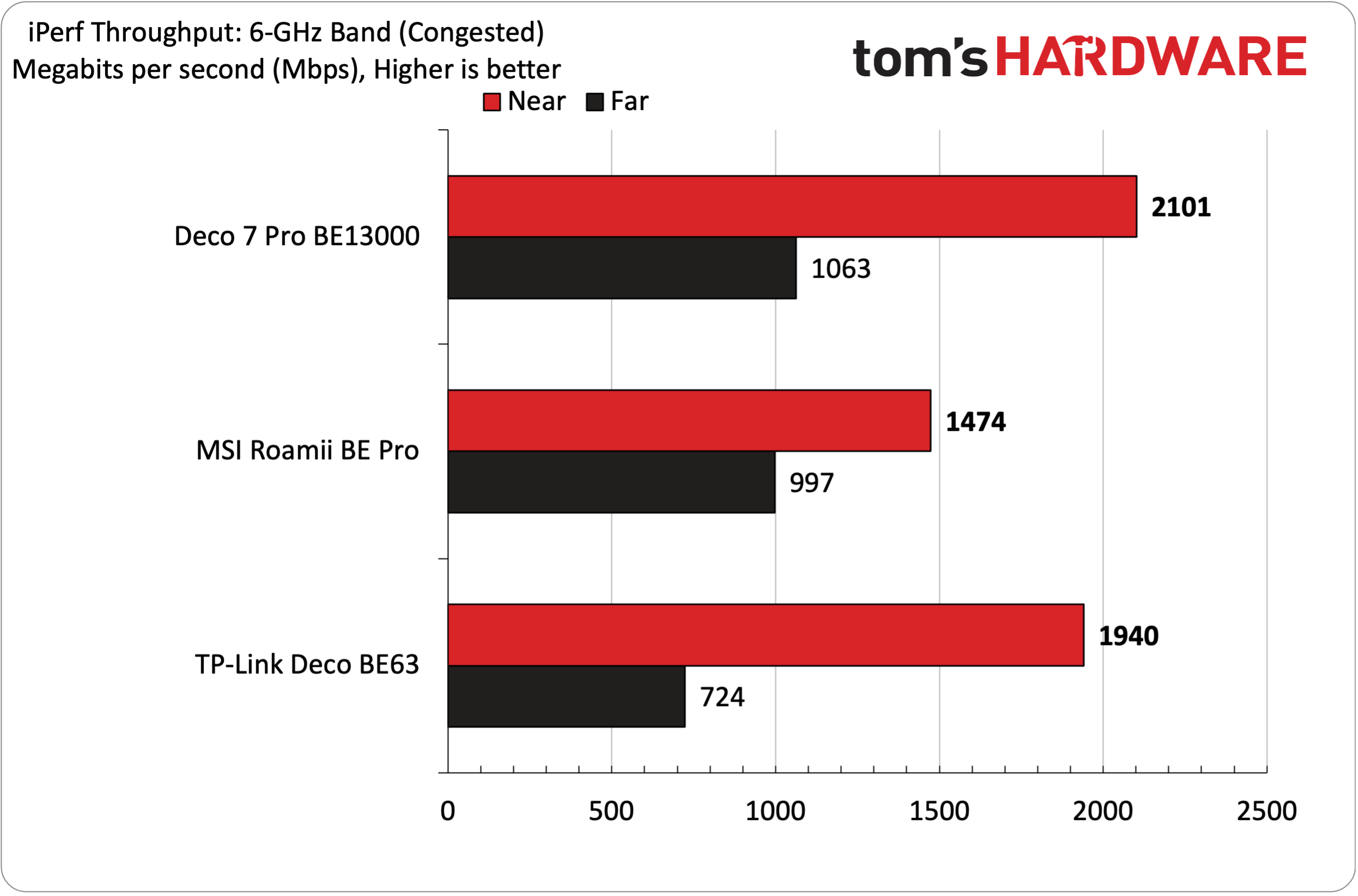
The iPerf3 tests are conducted at six feet and 25 feet (from the main router), with and without traffic across the network. In the congested traffic tests, we add six wireless clients streaming 4K YouTube videos evenly across all bands.
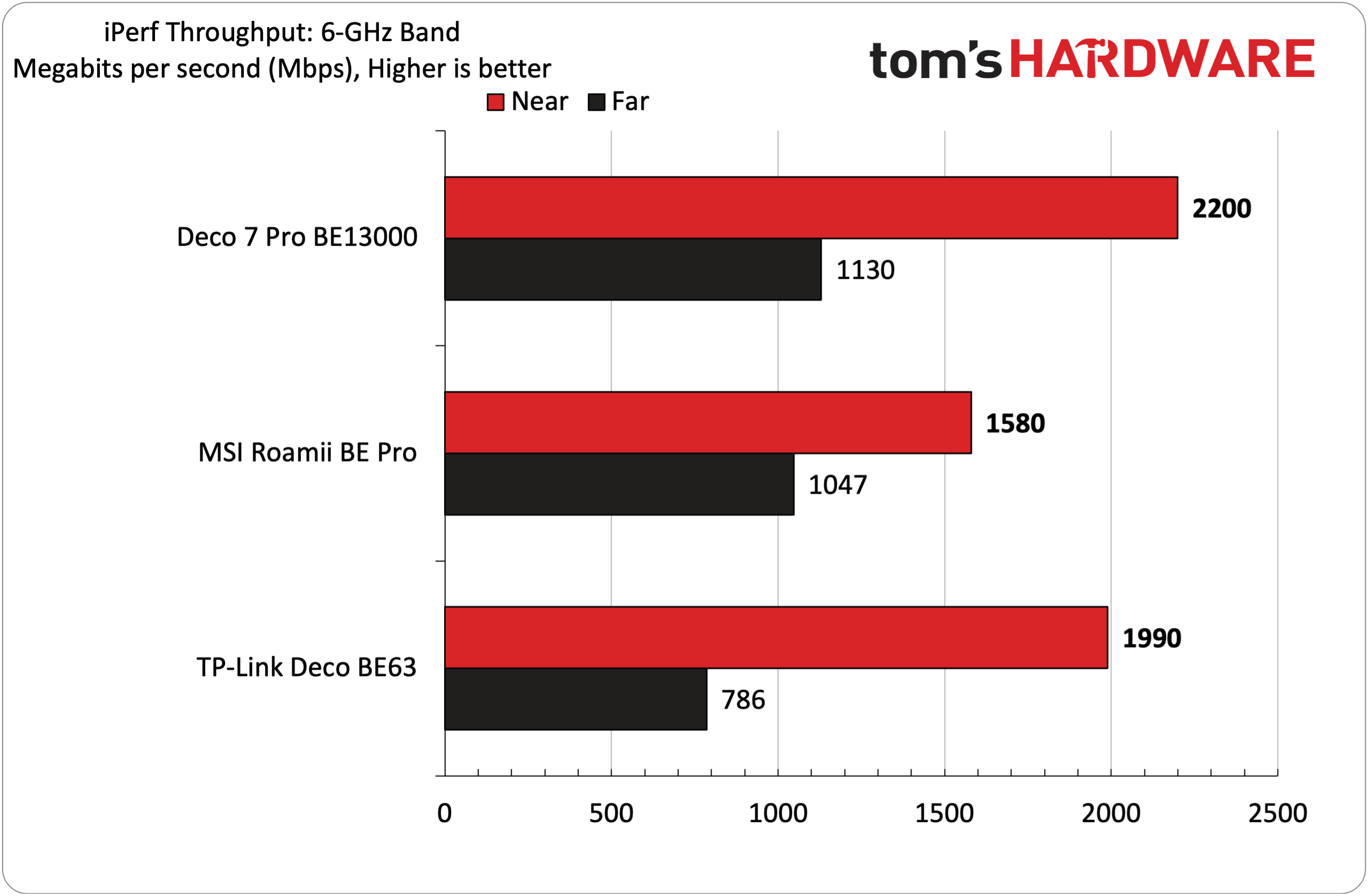
The Deco 7 Pro BE13000 proved to be the best performer on the 6 GHz band in both uncongested and congested testing. The router reached 2,200 Mbps at 6 feet and pulled roughly half that at 25 feet, with no additional traffic on the network. This put it comfortably ahead of the MSI Roamii BE Pro and just ahead of the Deco BE63. It was a similar situation with congested traffic, as the Deco 7 Pro BE13000 was still able to maintain over 2,100 Mbps at close range and nearly 1,100 Mbps at 25 feet.
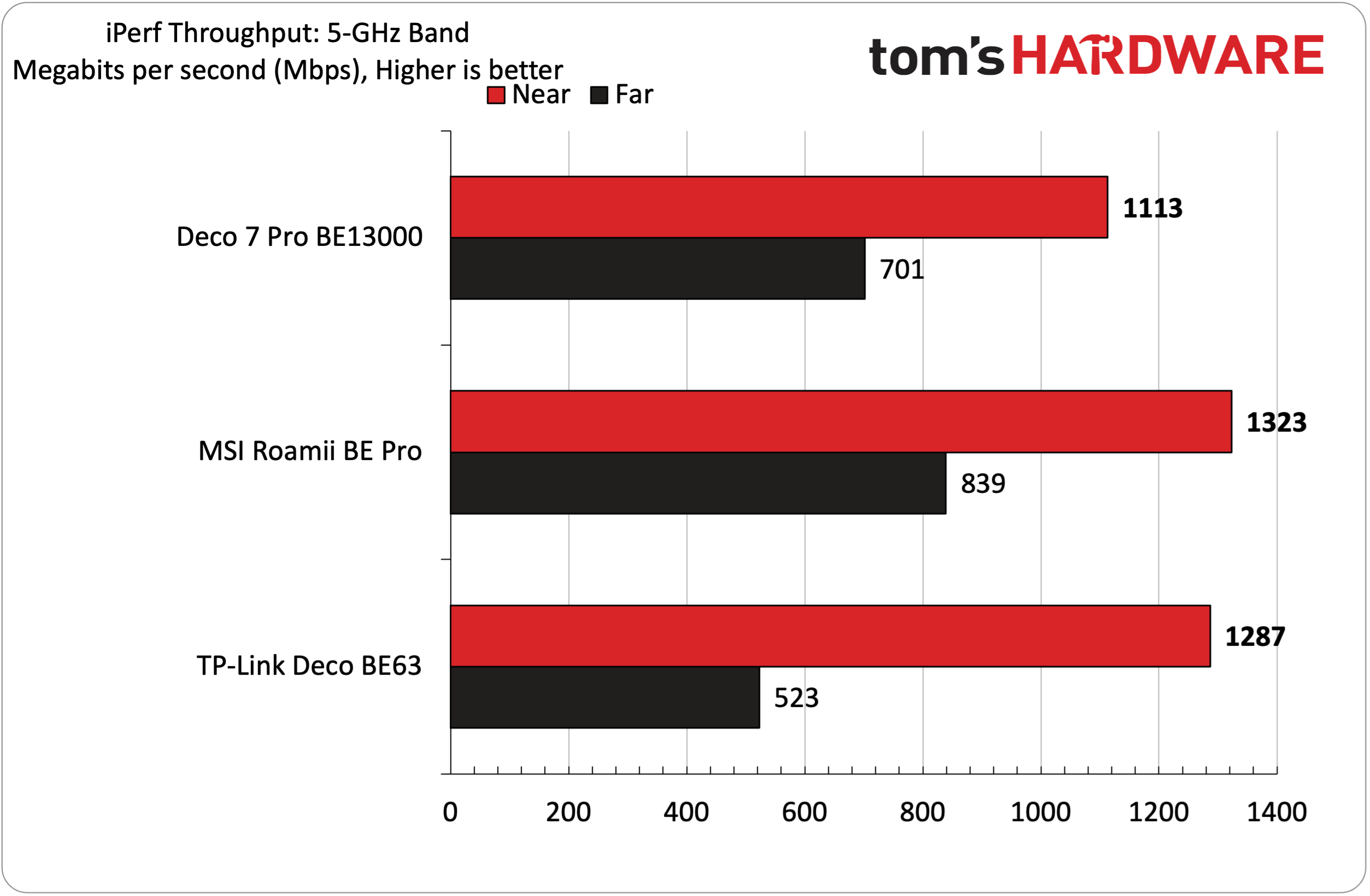
During testing on the 5 GHz band, the Deco 7 Pro BE13000 couldn't quite keep up with its two rivals. We saw 1,113 Mbps at six feet and 701 Mbps at 25 feet during the uncongested test. That put it in third place at close range and second place at long range. Those rankings held firm with congested traffic, with the Deco 7 Pro BE13000 still pulling over 1,000 Mbps at six feet.
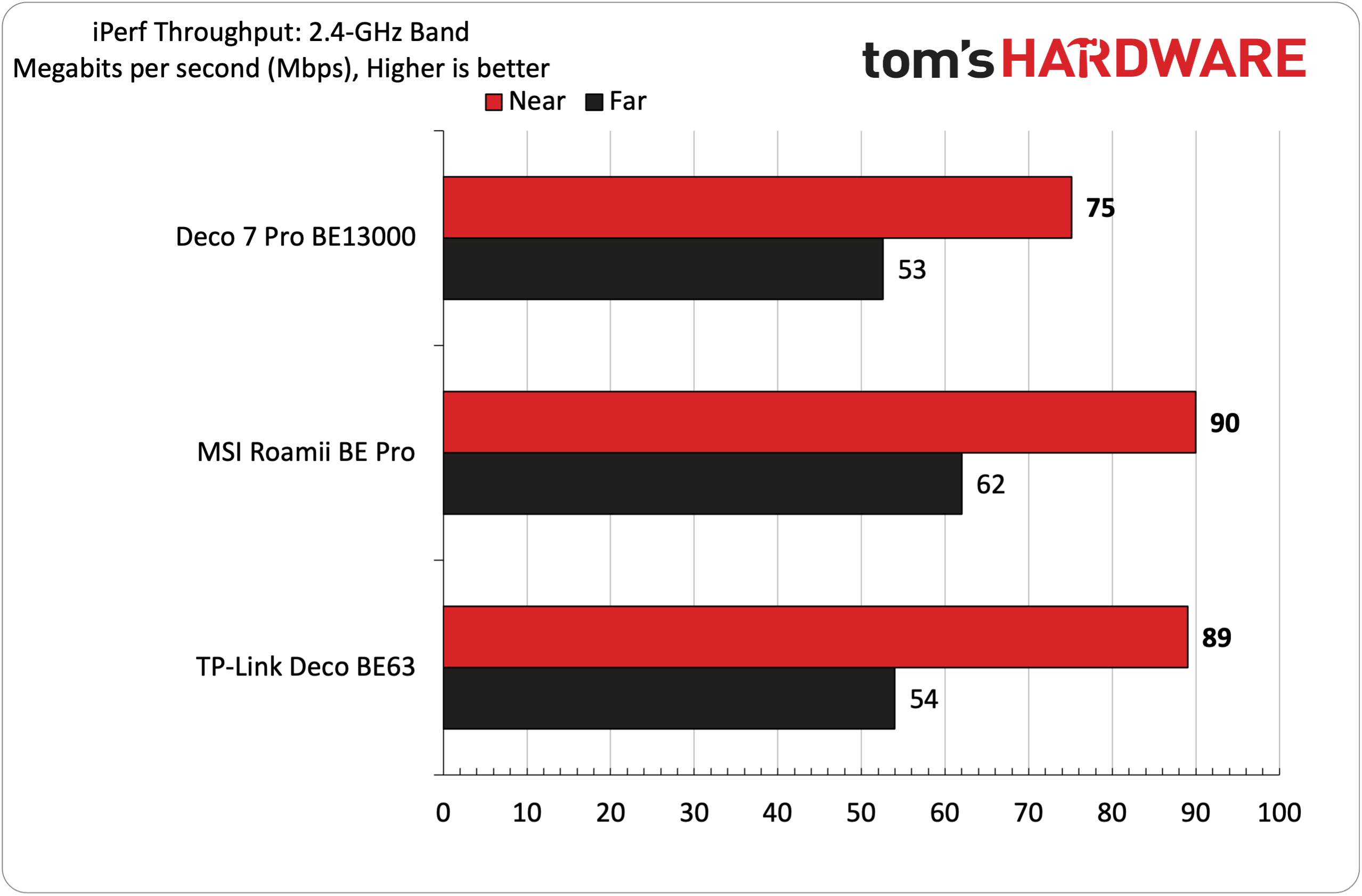
The Deco 7 Pro BE13000 once again found itself in last place during the 2.4 GHz band testing, falling roughly 15 Mbps shy of the Roamii BE Pro and Deco BE63 at close range with uncongested traffic. Things were a bit closer when we moved out to 25 feet, with the Deco 7 Pro BE13000 nearly matching its Deco BE63 sibling (53 Mbps versus 54 Mbps). With increased network traffic, the performance differential between the routers narrowed, although the Deco 7 Pro BE13000 still lagged slightly.
Bottom Line
The Deco 7 Pro BE13000 is a bit of an odd duck in the TP-Link mesh router family. While its 6 GHz performance is commendable and superior to that of the cheaper Deco BE63, it couldn’t quite reach its more affordable rivals on the 5 GHz and 2.4 GHz bands. With that said, the Deco 7 Pro BE13000 is by no means a poor performer – it just isn’t a standout across the board.
A bit more confounding is its port layout. Although it’s higher-positioned than the Deco BE63, it comes with one fewer LAN/WAN port. And while you do gain a 5 GbE LAN/WAN port, what you’re left with is a GbE LAN/WAN and a 2.5 GbE LAN/WAN. At this price point, TP-Link shouldn’t be putting GbE LAN/WAN ports on its mesh routers.
Finally, we come to the subscription services required to enable features such as web protection, intrusion protection, and antivirus. You’re looking at upwards of $129.99/year for the Total Security Package. Other router manufacturers like Asus give you those tools for free, which should definitely factor into the pricing equation for the Deco 7 Pro BE13000.
If the extra security protection isn’t appealing to you (or if the built-in tools are sufficient for your needs), the $399 price tag for three nodes is a good value, especially given the 8,100-square-foot coverage.
With the pervasiveness of Flock cameras and the public’s backlash against surveillance technology that can track their movements under seemingly lax oversight, Comcast hopes consumers will be more receptive to monitoring activities inside the home. This week, Comcast announced Xfinity Shield, which it claims offers first-of-its-kind “intelligent home protection” courtesy of your seemingly mundane Wi-Fi router.
While the best Wi-Fi routers on the market are supposed to give you higher connection speeds, extended coverage, and enough capacity to handle all of your wireless devices, Comcast is tapping into a little-used aspect of Wi-Fi signals. Called Wi-Fi Motion, it monitors the signal strength and interference between your Wi-Fi router and connected devices. By measuring these frequency signals, it can detect if someone is moving around in your house. When unauthorized activity is detected, the router can instantly send an alert to your phone.
You could achieve the same intruder detection using traditional motion sensors in your home, or even an off-the-shelf security camera, but Wi-Fi Motion doesn’t require you to purchase additional hardware to function. However, since it’s only relying on changes in frequency signals, we’d imagine that it won’t offer as much granularity in motion detection, and it could even be more prone to false positives.
This isn’t exactly new technology, as we reported on Wi-Fi routers being used to detect humans in a room over three years ago. At the time, researchers at Carnegie Mellon University used a TP-Link Archer AC1750 router to track human movement and positions in a room.
(Image credit: Comcast)
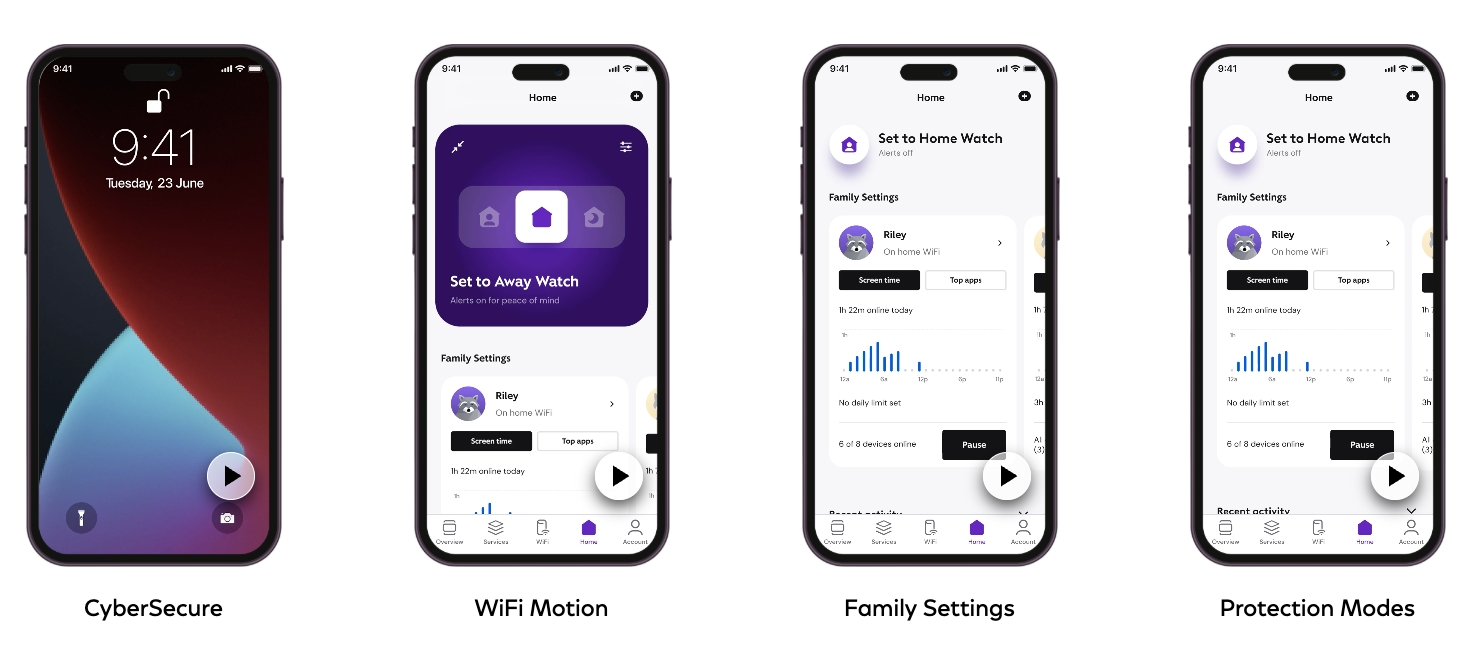
With that said, we must be clear that this feature is opt-in by default. You will need to use the Xfinity app to enable Wi-Fi Motion, then enable alerts to monitor for suspicious activity. The app also provides three protection modes for monitoring: Home Watch, Away Watch, and Dark Watch.
Wi-Fi Motion is just one pillar of Wi-Fi Shield, which is a subset of Xfinity Shield. The other two pillars are Xfinity CyberSecure, which provides automatic protection for devices against phishing attacks and malware, and Family Settings, which allows you to manage screen time for individual devices. Wi-Fi Shield is available free of charge to Comcast customers with Advanced Xfinity Gateways. If you want additional protection, Comcast offers Shield Select for $15/month. Shield Select includes an indoor camera, a window/door sensor, cloud storage for captured video footage, and 24/7 emergency response support.
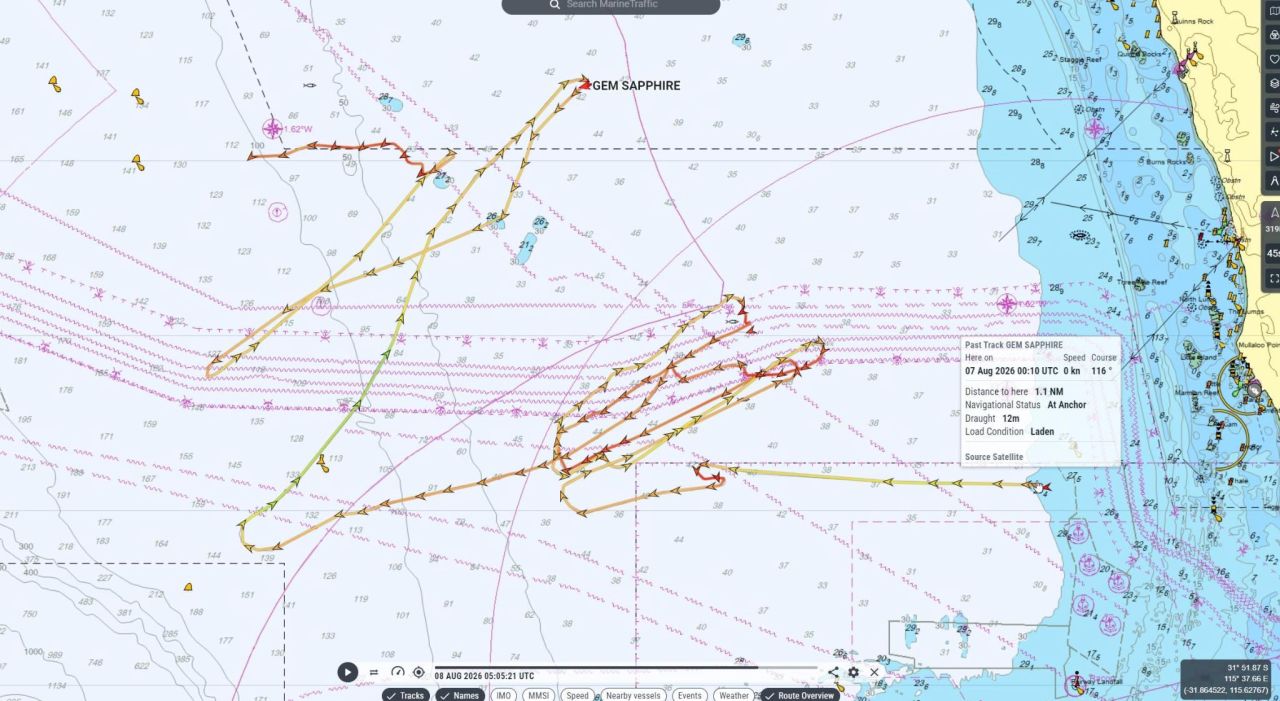
The founder and CEO of Subco, a company that owns several undersea cables servicing Australia, said that two of its cables — Indigo-West, connecting Perth to Indonesia and Singapore, and Indigo-Central, which has endpoints in Victoria, Tasmania, and New South Wales — reported shunt faults in close succession, with the detected problems also appearing to be in close proximity to each other. According to Bevan Slattery’s LinkedIn post, the errors occurred at around the same time that a vessel was traversing the area. In a statement, Australian Federal Police told Tom's Hardware that it had received a report of a crime and was investigating, strongly hinting the cables may have been cut in an act of sabotage.
“Earlier tonight: Shunt faults on two systems (Indigo West and Indigo Central) straight after each other and in close proximity to each other. Remarkably this also happened in the Submarine Cable Protection Zone off Perth Australia. Coincidently some suspicious/coincidental activity from a vessel near the location and timing of the shunts occurring,” Slattery said in his post. “This is a concerning development. Partially because submarine cables are the digital lifeblood of our nation, but also because this could very well turn out to be the second such incidence in a Federally declared cable protection zone. This maybe a coincidence, but it’s important for the Australian Federal Police (AFP) to investigate the issue urgently.”
"The AFP has received a report of crime in relation to this matter," the force told Tom's Hardware. Further stating, "This report is currently being assessed based on the information provided. Further comment will be made at an appropriate time."
Australia established the Cable Protection Zone in 2007, with the one near Perth extending 51 nautical miles from the shore at depths of over 6,500 feet (2,000 meters). Despite that, it seems that something has damaged the cables, as they reported shunt faults. A shunt fault is when the insulation of a conductor has been broken, allowing it to unintentionally contact another conductor or the ground, resulting in a short circuit. While there is no proof yet, Slattery shared the track of a marine vessel on his post, which was allegedly within the approximate area of the faults when they happened.
Nation states have been cutting undersea infrastructure as part of gray zone warfare, with Russia and China suspected of sponsoring these activities. For example, Finland has been hit twice by undersea cable disruptions in the past couple of years, which has led to the prosecution of some of the crew members of the suspected vessels. Taiwan has also increased its naval patrols around its undersea cables, especially as a Chinese “research vessel” has been seen lurking above a cable that connects the island nation to the U.S. It’s unclear what caused the shunt faults in two of Australia’s undersea cables, but the incident happened at around the same time that the National Security College of the Australian National University released a report highlighting the growing threat that submarine cables face in the modern world.
The Greenlink Connector, which costs $580 million (GBP 430 million) and connects Ireland to Wales via an undersea power cable, was rerouted after scores of Harry Potter fans complained that it would go through the grave of the beloved house elf “Dobby.” According to The Guardian, project manager Simon Ludlam pointed out in a BBC interview that the cable would transition underwater at Freshwater West. Unfortunately, Ludlam was unaware that this was the filming location for the site where the Harry Potter character was buried in the movie franchise. When the BBC aired the clip, the project began receiving hundreds of calls about the site.
Ludlam recounted to The Guardian a discussion with a colleague when they told him, “Apparently, we’re going to go straight through Dobby’s grave.” He answered, “Dobby? Who’s Dobby? I don’t know Dobby.”
It seemed that the project manager was in disbelief when it was finally explained that Dobby is the freed house elf who was killed in the process of rescuing Harry Potter and his friends in the last book. “He is a fictitious character in a fictitious book — the whole thing is fictitious. What are you talking about?” Ludlam said, after which his colleague replied, “No, it’s very, very serious.”
In the end, the company working on the project acquiesced to the demands and concerns of the Harry Potter fans and rerouted it. “A lot of people were very happy about that, and the project is now going [ahead], and Dobby’s happy,” the project manager said.
The Shell Cottage, where Dobby is buried, is on the outskirts of the fictional town of Tinworth, in Cornwall, but the original film series shot the scene in Freshwater West. Many Harry Potter fans leave stones marked with “Here lies Dobby, a free elf,” as a nod to the epitaph that the titular hero left on his grave. The National Trust, which owns the land, has previously warned pilgrims not to do so, as the area is ecologically sensitive, but it seems that people still do so.
The fans’ resistance to having Dobby’s “grave” desecrated seemingly prevented the undersea cable from going through the area. It was instead rerouted in an area that was close to some Bronze Age remains and urns, which, ironically, are associated with human burial.
Undersea cables are crucial infrastructure connecting distant locations for sending information, power, and other crucial resources. Many of them face increasing threats, especially in areas that face geopolitical pressure, like Taiwan and the Baltic Sea, which is why companies are creating technologies to help detect intentional tampering. It seems the one thing this particular project's planners did not take into account is the passion of Harry Potter fans.
A new video shared by Newsweek shows Taiwan’s Coast Guard warning a 200-ft long Chinese-flagged research vessel to change course. The Chinese ship was observed “lurking over [a] US-Taiwan undersea cable,” according to the source.
Hovering over these submarine cables is a clear sign of intelligence gathering, according to Windward, a maritime analysis platform that responded to Newsweek’s questions about the Chinese research vessel’s behavior. The particular cable under its bows was the 8,000-mile Pacific Light Cable Network (PLCN) fiber-optic system. This high-speed cable connects Taiwan and the U.S., as well as the Philippines. Interestingly, the same cable was going to connect Hong Kong, but was rerouted because of American fears over Chinese snooping.
While research vessels like the one warned to change direction by Taiwan’s Coast Guard in the video are sometimes described as ‘civilian,’ Beijing’s military-civil fusion policy blurs the distinction. Moreover, this 200-ft Chinese ship has something of a history in disputed waters. Newsweek says the same vessel has been observed around the Paracel Islands (claimed by China, Taiwan, and Vietnam) and the Spratly Islands (claimed by China, Taiwan, Vietnam, the Philippines, Malaysia, and Brunei).
Focusing back on the concerns about internet cable espionage, or even sabotage, Chinese-flagged vessels have been noted for such behaviour before. “Chinese-flagged vessels have been linked to several cable incidents in recent years,” notes Newsweek. Furthermore, incidents aren’t confined to East Asia, with “suspected sabotage in the Baltic Sea and damage to cables around Taiwan.”
China and Taiwan remains a flashpoint on the geopolitical stage, heightened by the island's outsized role in the global technology and semiconductor market, owing primarily to the success of TSMC. Undersea cables have also grown in recent years to become a vital point of infrastructure for nations, and a source of potential weakness against acts of sabotage.
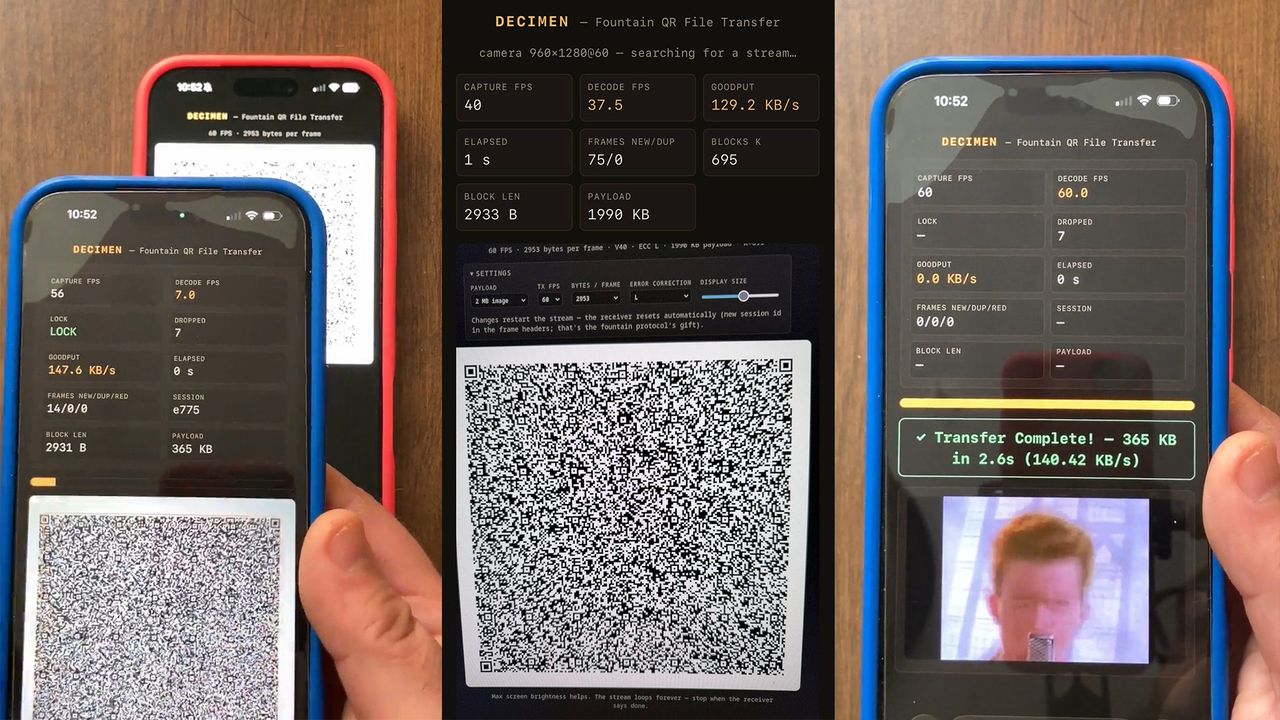
A developer has created a proof-of-concept data transfer system that shuns any dedicated app requirement and neatly sidesteps mandatory networking, pairing, or giving permissions beyond camera access. Instead, the method transmits information between devices by streaming data via rapidly updating QR codes at up to 60 FPS via the browser your smartphone already has. The test info shared by developer bashalarmistalt on GitHub backs claims that these transfers can run at up to 190 KB/s. This low-friction two-device screen-to-camera data transmission technique is dubbed Decimen Optical Transfer: fountain-coded QR file transfer.
The GitHub project is linked to by Redditor Alstroph, who seems to be the same person. We’ve chosen to embed the Reddit post about the Decimen Optical Transfer solution above, as it includes an illustrative video of a QR code-driven data transfer.
Bashalarmistalt/Alstroph says they used Claude Code to build this cached web app, which simply runs on both smartphones within the browser, with camera permissions given. They explain that they came up with the idea behind Decimen Optical Transfer to create “a phone-to-phone file transfer option without requiring the phones to be on the same network.” After a modicum of chin stroking, they settled upon the possibility of using “rapidly flashing QR codes” to brew up this proof-of-concept.
Far more detailed information about the project is available in the GitHub repository, linked above. There we also read that the use of ‘fountain codes’ was instrumental to the technique, ensuring missed frames and retransmission quirks don’t hinder the data transfer process. Also, it is explained that every streamed QR code frame is self-describing, as a “20-byte header carries the session ID, sequence number, block count/size, file length, and a hash.”
Hints are provided for tuning Decimen Optical Transfer performance with the PoC solution. The dev used an iPhone and the Apple ProMotion camera with stacked codes; they achieved ~128 KB/s handheld data transfers. The data rate could climb to ~186 KB/s speeds if both the sender and receiver devices were positioned absolutely stationary.
The Decimen Optical Transfer software is distributed under the generous MIT license. Bashalarmistalt is aware that there have been several prior projects but asserts the concept behind their Claude Code-aided solution was arrived at independently. We’ve also covered QR code-based data storage tech numerous times. For example, Cerabyte famously uses microscopic QR codes for its ultra-long-life ceramic storage.
How cheap can you build a hardware-based ad-blocking DNS filter? "Free," if you're willing to salvage some used hardware that's being thrown away. What if you aren't so lucky? In the era of the RAMageddon, even a Raspberry Pi will cost you a couple hundred bucks. But you know, you don't even need something that powerful. In fact, you can use a $5 microcontroller to build a fully functional ad-blocking filter with over 500,000 domains blocked and around 10ms latency.
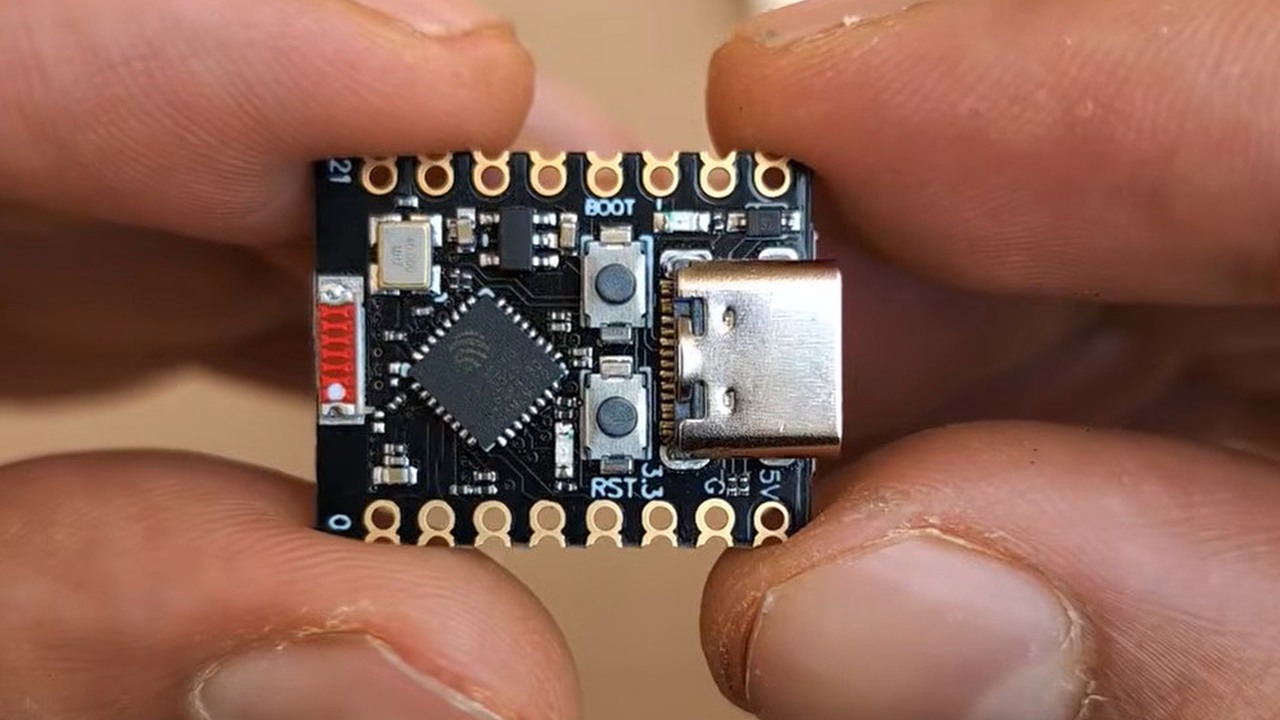
We know that's possible because Egyptian full-stack developer ZedAxis (@M-Abozaid on GitHub) has already built one. Using an ESP32-C3 "SuperMini" board, he's created a backup DNS for his home network that still provides ad blocking. His primary router is a Pi-hole, which is a Raspberry Pi running specialized software to manage DHCP addressing and DNS resolution with integrated ad-blocking. The SuperMini serves as a backup when the Pi-Hole is rebooting or otherwise unavailable.
The specific ESP32-C3 SuperMini board that ZedAxis used. (Image credit: ZedAxis/YouTube)
Strictly speaking, we haven't seen ZedAxis' creation in action, but there's no reason to believe it doesn't work. The ESP32 family of embedded Wi-Fi-enabled microcontrollers is a well-known quantity, and this functionality is by no means outside the realm of its capabilities. In fact, this specific trick allows the use of the ESP32-C3, which is a cost-reduced version of the chip that doesn't have the 8MB of PSRAM found on some higher-end models. (There are MANY variants of the ESP32.)
Instead, the ESP32-C3 used by ZedAxis has just 400KB of RAM, and 4MB of flash memory. With these limited specifications, he wasn't able to store a plaintext blocklist of any real size; it's simply too much data. So, he did what any enterprising hacker would do: he started hashing the data to reduce its size. Using 40-bit FNV-1a hashes, because 32-bit would give too many collisions and 64-bit wastes too much space, he can store some 537,000 domains in the flash memory of the device.
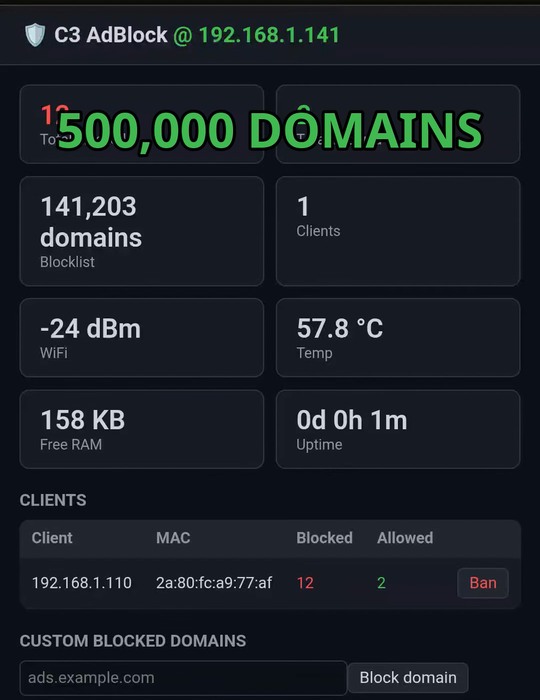
The project includes a rudimentary GUI where you can see some statistics and configure custom domains for blocking. (Image credit: ZedAxis/YouTube)
The clever part isn't really the hashing, though. Rather than storing the domains themselves, the build process downloads one or more public blocklists, strips out duplicate entries and comments, hashes each remaining domain into a 40-bit value, sorts the resulting list, and writes the finished database into the ESP32's flash memory. When a DNS query arrives, the device hashes the requested hostname the same way and performs a binary search against the sorted hash table. If it finds a match, the request is blocked. Otherwise, the query is forwarded to an upstream resolver. According to ZedAxis, the finished firmware uses only around 50KB of RAM while answering blocked lookups in roughly 10 milliseconds.
There's another neat compromise hiding in the design, too. The ESP32 normally reserves enough flash memory to hold two complete copies of its firmware, allowing over-the-air (OTA) updates without risking a failed flash leaving the device unbootable. If you don't care about wireless firmware updates, you can reclaim that second firmware partition for the blocklist database instead. With OTA support enabled, the project tops out at around 250,000 blocked domains. Give up OTA, and that jumps to roughly 537,000 domains on a microcontroller that you can usually buy for the price of a fast-food lunch. ZedAxis describes the price as $2; I wasn't able to find SuperMini boards any cheaper than about $5 US, but at that price there's not much need to quibble about the difference.
Of course, this isn't meant to replace a proper Pi-hole or AdGuard Home installation. The ESP32 project has a rudimentary dashboard, but it doesn't provide detailed per-client statistics, historical query logs, or all the knobs and dials that make those platforms attractive. Instead, it's designed as a tiny insurance policy. It sits quietly on the network, sips only a few dozen milliamps of power, and if the primary DNS server disappears for a reboot or a power outage, clients still get filtered DNS responses instead of falling back to whatever resolver the router happens to have configured.
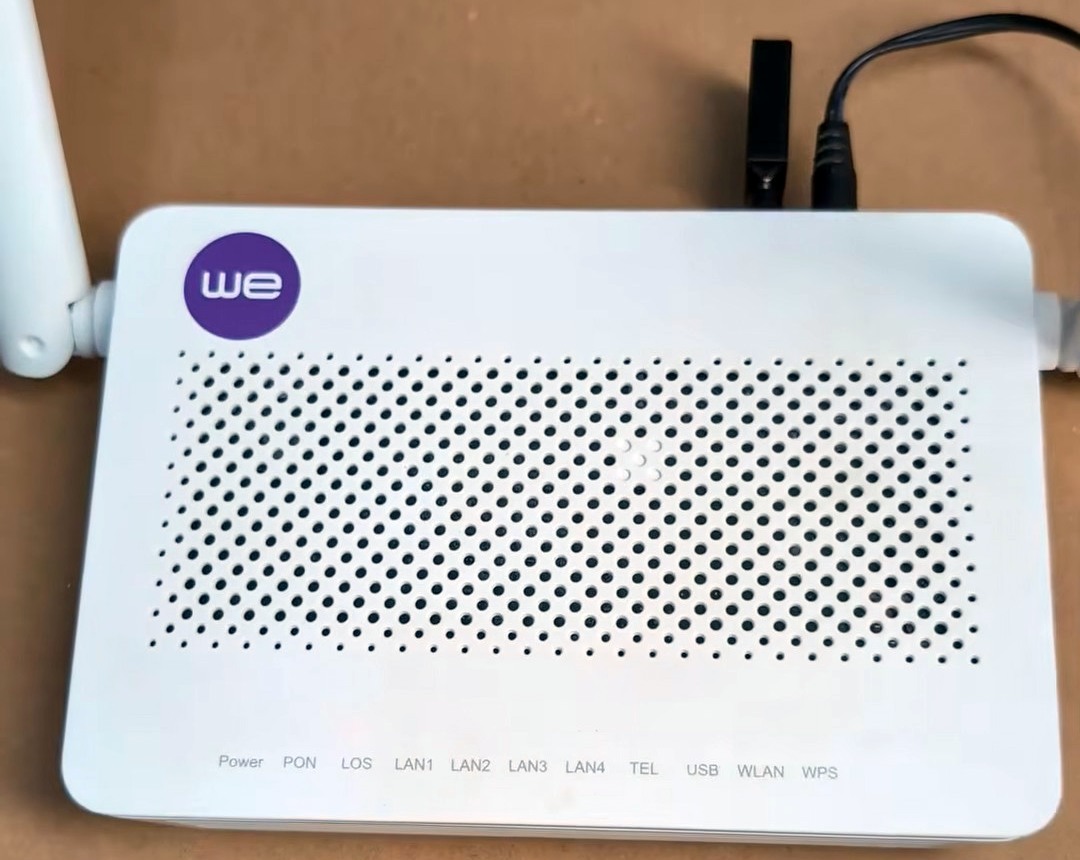
The backup ad-blocker is barely noticeable plugged into the creator's home gateway. (Image credit: ZedAxis/YouTube)
My favorite detail is that ZedAxis powers the whole thing from the USB port on the back of his ISP-provided fiber gateway, a Huawei OptiXstar home fiber gateway. The USB connection isn't carrying any data; the totality of the integration is the router saying "here's 5 volts" and the ESP32 replying "thanks." It's just that the port is a convenient power source for a device so small it practically disappears behind the router. All communications are carried out through the ESP32's integrated Wi-Fi adapter.
I have no idea whether projects like this will ever become common. Probably not, because most people who want network-wide ad blocking will still buy a Raspberry Pi, a used mini PC, or run AdGuard Home in a virtual machine. Still, it's refreshing to see somebody look at a $5 microcontroller with 400KB of RAM and decide, "Sure, that'll do."
The SpaceX satellite internet service Starlink has just introduced its latest residential kit, letting users connect to the satellite network using a smaller and lighter terminal. The company announced the Starlink V5 on X, saying that it could hit up to 375+ Mbps for “streaming, video calling, gaming, and more.” It’s currently available in select areas only, though, with wider availability expected later as the company ramps up production.
Download speeds
Antenna
Field of View
Dish Weight
Environmental Rating
Operational Temperature
Mounted Wind Speed
Snow Melt Capability
Average Power Consumption
Power Indicator
Starlink V5
Up 375+ Mbps
Electronic Phased Array
110 degrees
2.4 lbs. (1.1kg)
IP67 Type 4
-22 deg F to 122 deg F (-30 deg C to 50 deg C)
165 mph (265 kph)
Up to 1.6 in. per hour (40mm per hour)
35 to 50 watts
LED / Starlink Top Face
Standard 4
Up to 400+ Mbps
Electronic Phased Array
110 degrees
6.4 lbs. (2.9kg)
IP67 Type 4
-22 deg F to 122 deg F (-30 deg C to 50 deg C)
60 mph (96 kph)
Up to 1.6 in. per hour (40mm per hour)
75 to 100 watts
LED / Router Face Plate
Mini
Up to 300+ Mbps
Electronic Phased Array
110 degrees
2.43 lbs. (1.1kg)
IP67 Type 4
-22 deg F to 122 deg F (-30 deg C to 50 deg C)
60 mph (96 kph)
Up to 1 in. per hour (25mm per hour)
25 to 40 watts
LED / Starlink Rear Face Plate
The new unit is significantly smaller and lighter than the Standard 4 used in most home deployments, and brings it close to the Starlink Mini, which is designed for both fixed and portable use. However, the Starlink V5 still requires a router (included), whereas the Mini can work without one, providing a wireless connection using its built-in Wi-Fi antenna. Still, the former is faster, offering speeds of up to 375+ Mbps. Although this is 25 Mbps slower than the 400+ Mbps that the Standard 4 is rated for, it’s still higher than the up to 300+ Mbps that SpaceX has set for the Mini.
The changes that SpaceX made to the Starlink V5 would make it much easier to set up, which is especially helpful for users who prefer to DIY their Starlink setup. Another interesting update to the new terminal is that it can handle faster wind speeds while mounted despite being lighter than the Standard 4. This should help it withstand tougher meteorological conditions, especially in areas frequently battered by storms and tornadoes.
(Image credit: Starlink)
The much lower average power consumption, which is just about half of what the previous-generation Starlink terminals consumed, would also help power stations last longer, making it ideal for keeping communications alive, especially during emergencies. This is exactly what Japan is experimenting with, as Tokyo has started putting up Starlink antennas on fire hydrant signs to provide emergency Wi-Fi.
Although SpaceX and its owner, Elon Musk, are no strangers to controversy, Starlink has proven useful in various situations. Aside from being useful for first responders in disaster zones, it also helped Ukraine stay connected during the height of Russia’s invasion of the country in 2024. It has even gotten to the point that China simulated a Starlink blockade over Taiwan because of how useful the service is in keeping a government online and communicating with its allies during times of distress.
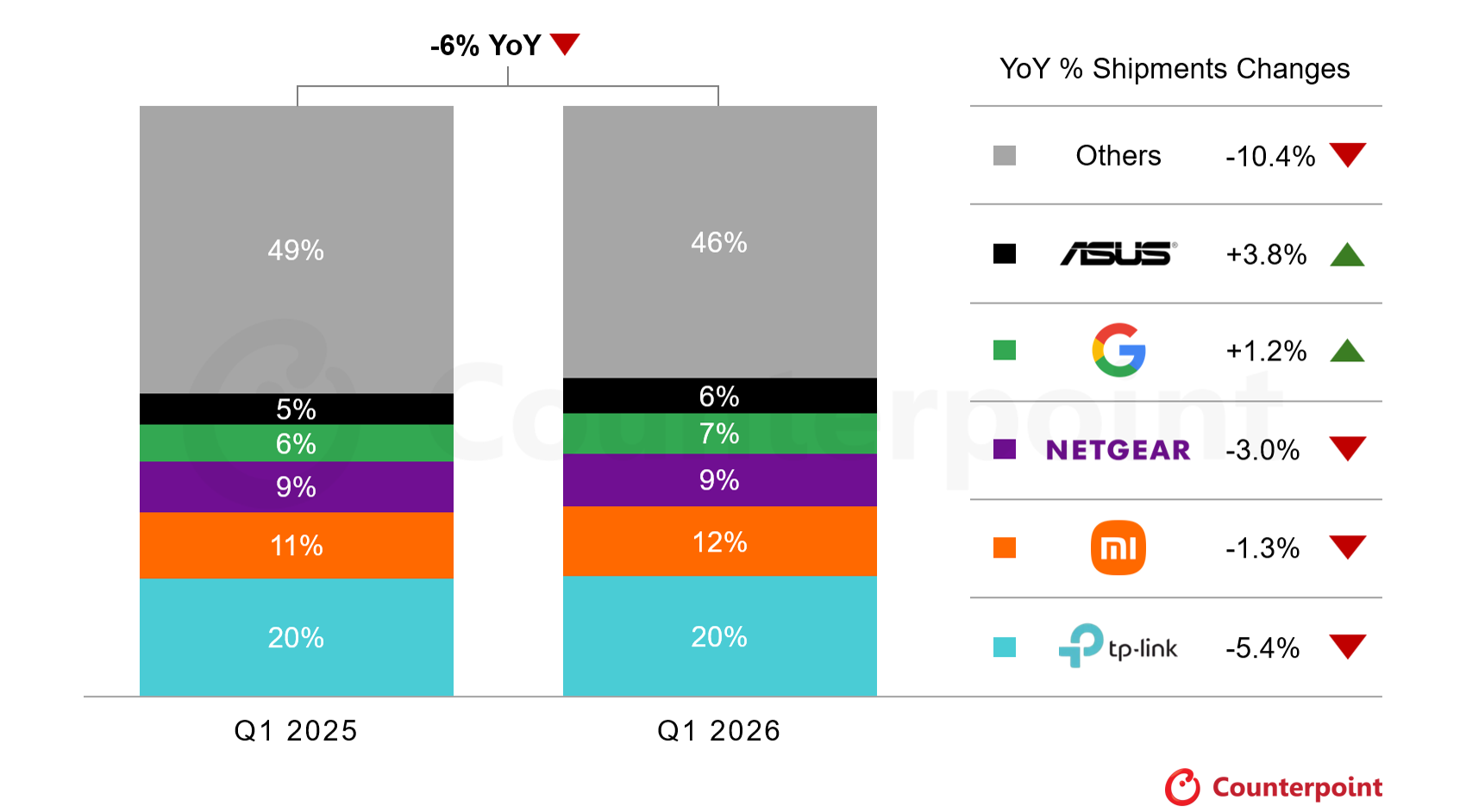
The Wi-Fi router market is facing headwinds as consumers pull back on spending. According to a new report from Counterpoint, we’re witnessing a softening in global consumer Wi-Fi router shipments, with a 6 percent YoY decline in Q1 2026. This decline follows an explosion of market growth during the COVID-19 pandemic, when consumers upgraded their Wi-Fi hardware to enhance their work-from-home capabilities.
Counterpoint notes that global Wi-Fi router shipments peaked in 2021, which was at the height of consumer hardware spending during the pandemic. There were some positive points in the report, with Asus and Google seeing global shipment increases of 3.8 percent and 1.2 percent, respectively, during Q1 2026. However, Xiaomi had a 1.3 percent shortfall, Netgear was down 3 percent, while TP-Link fell by 5.4 percent. Counterpoint also notes that “Others,” which includes dozens of other hardware vendors whose sales aren’t significant enough to be broken out individually, fell by 10.4 percent.
Since 2021, global shipments have declined by almost 34 percent, and a couple of factors explain this turn of events. For starters, many people who upgraded their Wi-Fi hardware in 2021 or 2022 simply see no reason to shift to newer technology. Even though the best Wi-Fi routers use the Wi-Fi 7 (802.11be) standard, offering multi-gig speeds across the 6 GHz and 5 GHz bands, those performance benefits are not enticing consumers on the sidelines because of rising costs for more essential goods.
(Image credit: Counterpoint)
Another reason global shipments of consumer routers have seen a steady decline is that ISPs have become more adept at bundling higher-end networking hardware with their services. Whether you’re signing up for new fiber, cable, or 5G home internet service, ISPs are including routers with integrated Wi-Fi 6, 6E, or 7 wireless connectivity. For customers with non-demanding network needs, this ISP-provided hardware is sufficient. For example, T-Mobile provides a Wi-Fi 7 gateway with its $60/month 5G home internet plan and a Wi-Fi 7 gateway plus a mesh extender with its $70/month plan.
Speaking of mesh systems, this is one of the few bright points for hardware vendors. Counterpoint notes that mesh Wi-Fi systems have seen significant growth as consumers seek to blanket every area of their homes with wireless coverage to support a substantial number of connected devices. Amazon’s Eero and Google’s Nest mesh Wi-Fi router systems were called out specifically for their strong performance (driven in part by high brand recognition and heavy sales promotions). The gaming router segment also bucked the decline in the broader Wi-Fi router market, as online gaming enthusiasts seek a competitive edge with lower latency and higher available network bandwidth.
There’s a possibility we could see a rebound in sales in the second half of 2026 and into early 2027 as the first Wi-Fi 8 hardware enters the market. However, Wi-Fi 8 is seen as more of a quality-of-life upgrade than another leap in performance over previous Wi-Fi generations.
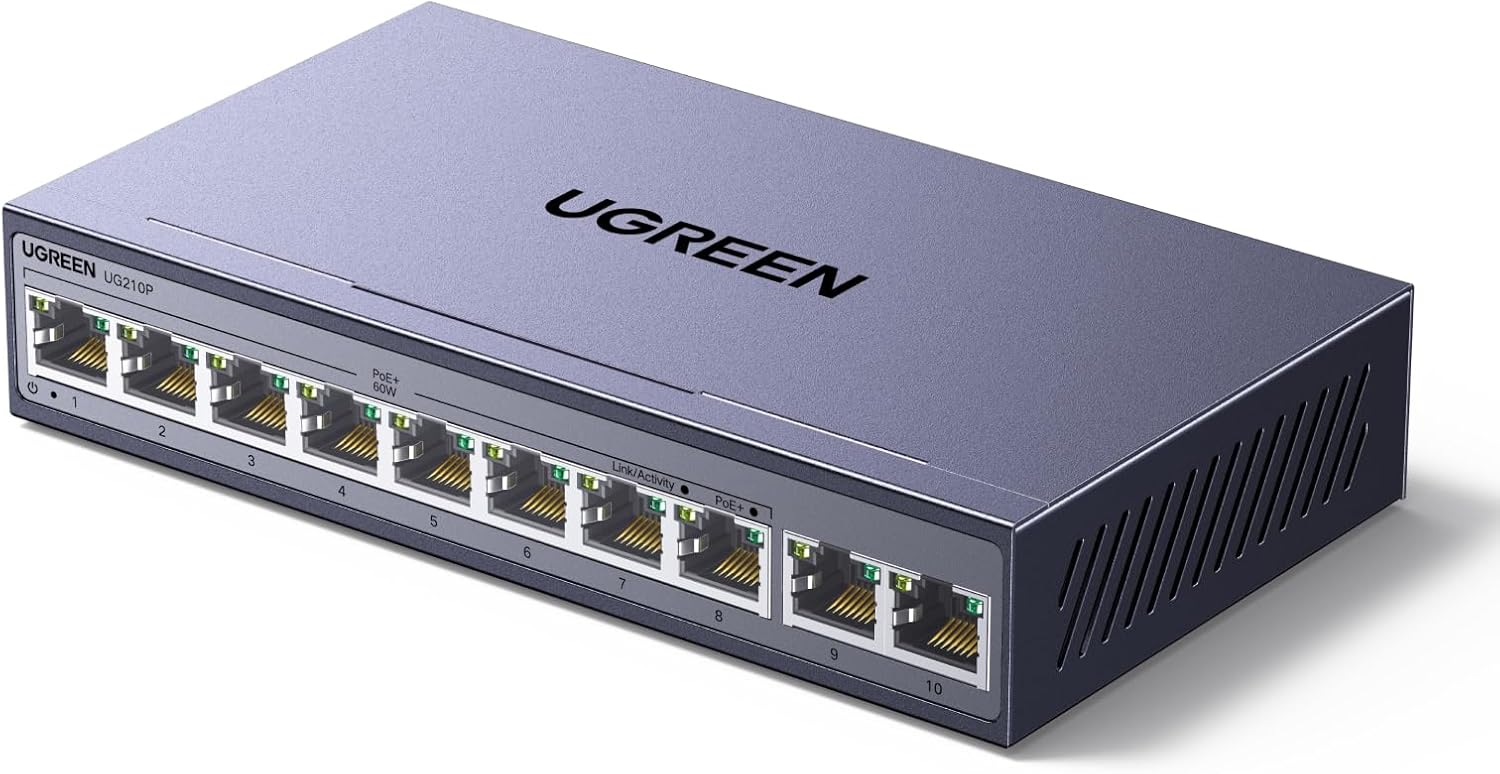
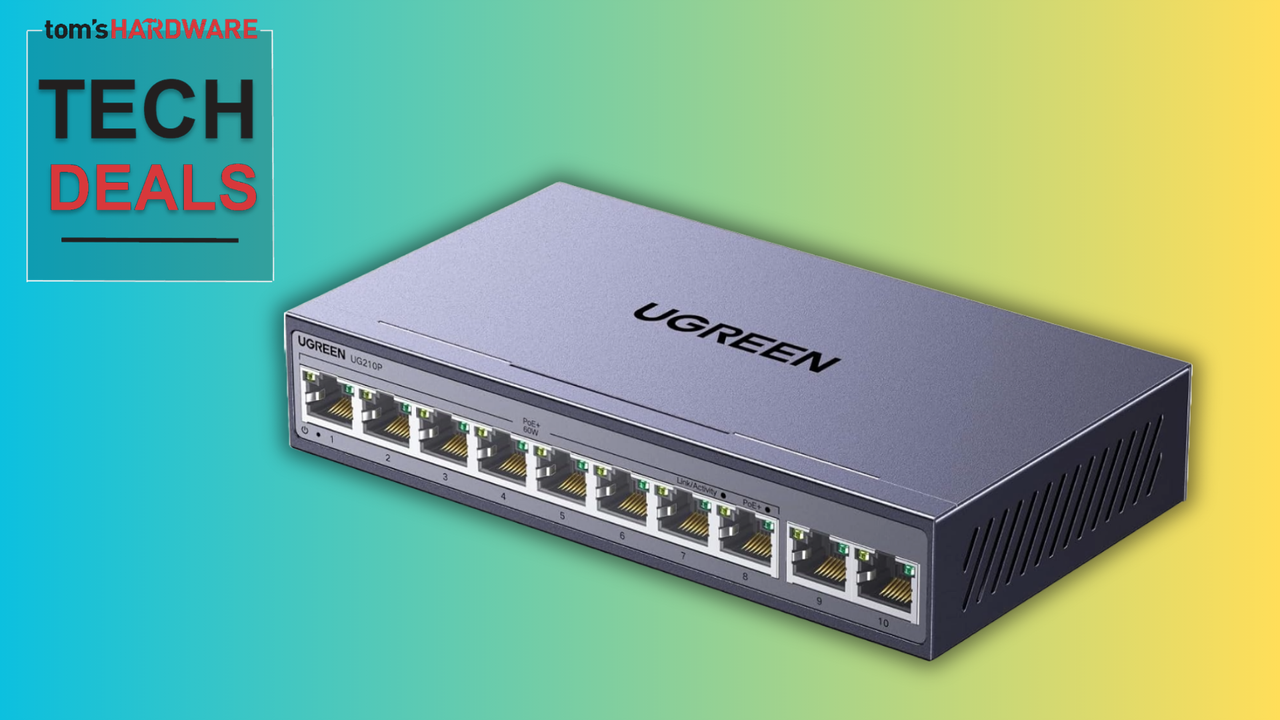
A Power-over-Ethernet switch is a must-have addition for a home network if you're thinking about seriously kitting it out with cameras, WiFi extenders, and other smart home tech. Luckily, a budget-friendly Ugreen 10-port PoE+ switch is on sale for just $37.97 on Amazon right now. That's a new record low for this model, giving you eight extra PoE+ ports (and 10 total) for your network at a lower cost than many of its rivals.
Ugreen is a brand that feels ubiquitous on Amazon these days, with decently priced and well-designed hardware on sale, from wall chargers to peripherals, including network switches like this one. This 10-port switch offers the PoE+ standard (IEEE 802.3at) that offers up to 30W of power per port.
That means faster, newer devices can connect to this switch, delivering both power and data over a single Ethernet cable. The switch supports 60W in total, but it works in a cascade system. If power draw exceeds 60W, it'll shut down ports to prevent overload, from port 8 down to port 1. It auto-detects PoE devices, too, so it won't inadvertently short out a normal network device like your PC or laptop. It also supports an extended power delivery mode that lets you connect devices up to 820 feet away.
The Ugreen 10-port PoE+ network switch offers Gigabit speeds and 30W per-port of power over each Ethernet cable across eight different ports, with two ports used as uplink ports for data connection to your main network.View Deal
This is the ultimate device for supporting a smart home network. PoE switches are useful for network-attached cameras, additional WiFi extenders, and smart home hubs and sensors. This Ugreen switch is unmanaged, so a huge setup process isn't required here, and it should work immediately with your existing kit. That means it lacks the extra customization that a more expensive managed switch can offer, but for most users, that won't be a problem.
It'll work with almost any Ethernet-ready device you own, too, even those that don't take advantage of the power delivery provided by this switch. That includes laptops and PCs, NAS drives, game consoles, printers, and TVs.
Another important feature here, too, is speed. This switch offers gigabit speeds across your network, meaning you can banish lag and WiFi latency issues while you're gaming and streaming. An Ethernet connection using this switch will help you to max out the bandwidth provided by your internet provider, with the switch offering two uplink ports that you can use to connect to your existing network.
Fanless, with built-in lightning protection, and compressed into a compact chassis just 6.6 x 3.7 x 1.3 inches in size, this Ugreen PoE+ switch is the ultimate home network upgrade. The $37.97 sale price for this 10-port Ugreen switch is available for a limited time only, however, so if you're interested, you'll need to order it soon.
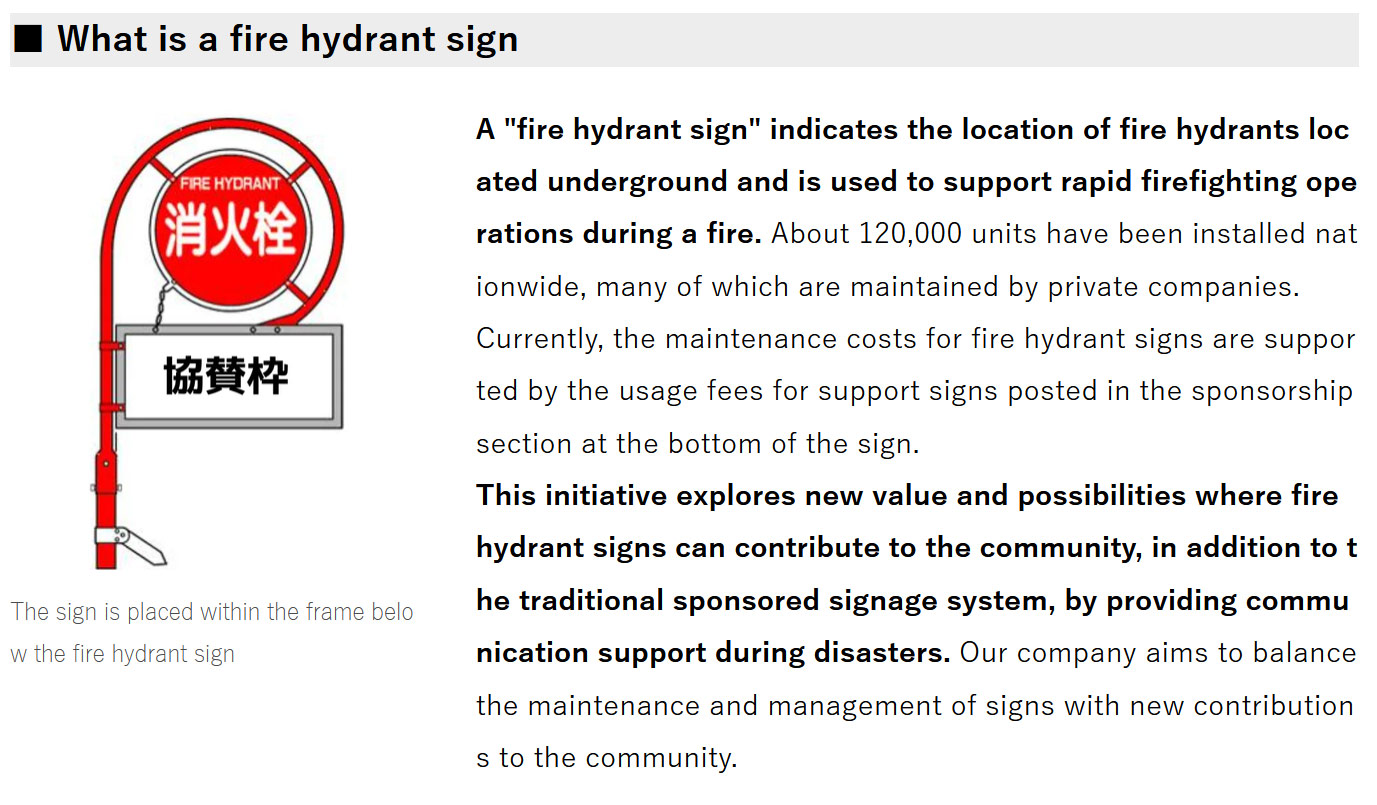
Japan’s Fire Hydrant Sign Co., Ltd. has demonstrated an expansive Wi-Fi network that melds its established infrastructure of street signs with Starlink satellite broadband antennas. The big idea is that this network could provide important, if not essential, fallback connectivity in the event of a natural disaster knocking out fiber, mobile masts, and so on. Japan sits on the intersection of multiple tectonic plates and is prone to earthquakes, tsunamis, and volcanic eruptions – as well as some extreme weather.
On Thursday, the Fire Hydrant Sign Co. completed a technical demonstration of a Starlink-supported Wi-Fi network in the vicinity of its Kanagawa Branch. Each sign, a common item of street furniture in residential neighborhoods, can become a dual-purpose emergency water supply sign and ‘communication hub.’ In the top image, you can see two example installations with the Starlink antenna atop a pole beside the traditional circular fire hydrant signage.
One of the key strengths of this initiative is that where the Fire Hydrant Sign Co. has a sign, no extra land or structures are required to set up the pole to host a Starlink antenna. Japan has 120,000 fire hydrant signs nationwide, with the trial taking place near Kanagawa province, near Tokyo.
Fire hydrant sign explainer (Image credit: Japan’s Fire Hydrant Sign Co., Ltd. PRTimes)
Somewhat surprisingly, fire hydrant signs are largely maintained by private companies in Japan. They make some money via the advertising space on a sign directly below the one indicating the emergency water source location. Adding Starlink to them could provide the aforementioned disaster relief, as well as other monetization opportunities.
The Fire Hydrant Sign Co. behind this trial says that it will consider collaboration with local governments, regional companies, and related organizations to roll out this initiative, now proven to be useful. It isn’t only going to be useful in the event of a disaster; the company foresees demand during power cuts, local large-scale events, and other opportunities where more Wi-Fi connectivity options are desirable.
In some press release ‘small print,’ the firm says that its successful trial doesn’t mean that a Wi-Fi service will eventually be launched. It was a technical demo, and it also states that Starlink wasn’t a partner or collaborator in any official capacity.
Chinese firm Yangtze Optical Fiber and Cable Joint Stock Limited Company (YOFC) announced on June 16 that it had successfully completed the world’s first field trial of hollow-core fiber (HCF) wavelength-division multiplexing (WDM) capable of 1.2 Tb/s per wavelength over an ultra-long unrepeatered span. The trial — conducted in collaboration with state-owned China Telecom and optical equipment maker Dekoli — achieved an unprecedented aggregate transmission capacity of 51.3 Tb/s over roughly 128 miles (206.5 km) without signal regeneration.
These figures, which the collaborators describe as a new world record for unrepeatered WDM capacity-distance performance without remote-pumped amplifiers, were achieved using only erbium-doped fiber amplifier amplification. The demonstration was carried out under the framework of the National Key Laboratory for Advanced Manufacturing and Application Technologies of Optical Fibers and Cables.
The success of this trial marks a major leap forward in optical communications. What separates it from earlier HCF results is the combination of capacity, distance, and amplification approach in a live network rather than a lab. China Telecom had previously demonstrated 1.2 Tb/s over a single wavelength, back in July 2024, but only over a 20-kilometer span.
Elsewhere, researchers have pushed unrepeatered HCF spans past 300 kilometers, but at far lower capacities. Pulling 1.2 Tb/s per channel over more than 200 kilometers on a commercial cable, using only conventional erbium-doped fiber amplifiers (EDFAs) rather than the remote-pumped boosters typically needed to extend unrepeatered reach, is the remarkable new achievement YOFC claims.
Hollow-core fiber is a next-generation optical data transmission medium that is rapidly emerging as a leading candidate for high-capacity, low-latency networking. Unlike conventional optical fiber, which guides light through a solid glass (silica) core, HCF guides light through an air-filled channel. This structural difference offers several advantages. Light travels roughly 1.5 times faster through air than through glass, cutting latency. Furthermore, the air core sidesteps some of the nonlinear distortion and dispersion baked into silica. YOFC has previously claimed that its hollow-core fiber technology can deliver 31% lower latency, 47% faster transmission speeds, and near-zero optical nonlinearity compared with conventional solid-core fiber.
In theory, HCF's air core would enable it to carry far more data over far greater distances with fewer amplification points. The trade-off has always been loss. Commercial hollow-core fiber has historically run at higher attenuation than mature silica fiber, limiting how far a signal can travel before it needs a boost. This limitation has been narrowing, with the trial's 200 km-plus unrepeatered span being the latest milestone.
The collaborators achieved this through two main innovations: one at the system level and the other in the amplifier hardware. At the system level, they used a self-developed optimization scheme for per-wavelength rate and channel power allocation. Rather than pushing every wavelength at the same data rate and power, the system adapted each channel to the link conditions, enabling hybrid transmission across multiple data rates, channel spacings, and power levels. The companies say this helped reduce capacity losses caused by gas-absorption peaks inside the hollow core, a quirk specific to guiding light through air rather than glass.
On the hardware side, the researchers built a high-power amplifier using a cascaded dual-gain-unit architecture and a multi-element doping design, achieving a maximum output of 33.5 dBm (roughly 2.24 W) while maintaining flat gain across the operating band. That higher-power, flatter amplification helped stretch an unrepeatered span without resorting to the remote-pumped amplifiers the team was trying to avoid. Because pushing that much power over a live optical link carries a real risk of failure, the system was wrapped in safeguards, including optical-path power anomaly detection, automatic interlock shutdown, and alarm-linked response mechanisms to catch faults before they damage equipment.
The stakes in this trial, and in HCF more broadly, tie directly to the AI buildout. As hyperscalers race to stand up ever-larger GPU clusters, the network linking those clusters, inside data centers and across the long-haul links between facilities, is fast becoming the bottleneck. HCF's lower latency lets operators site facilities farther from expensive, power-constrained hubs without a speed penalty, while its capacity headroom helps move the enormous traffic AI training and inference generate. The same properties make it attractive for latency-sensitive workloads like financial trading.
That promise is already pulling in serious money, mostly from the West. Microsoft, which moved early via its 2022 Lumenisity acquisition, struck manufacturing deals with Corning and Heraeus in September 2025 to scale production across Azure. AWS has developed its own HCF, claiming a 30% latency improvement over standard fiber, and says it wants more than it can currently get. Corning also has fiber deals with Microsoft, Meta, and Lumen, and is expanding in North Carolina with Nvidia's backing. Trials like YOFC’s are closing existing gaps toward full, widespread HCF deployment, though China's progress largely sits outside the Western supply chain now forming.
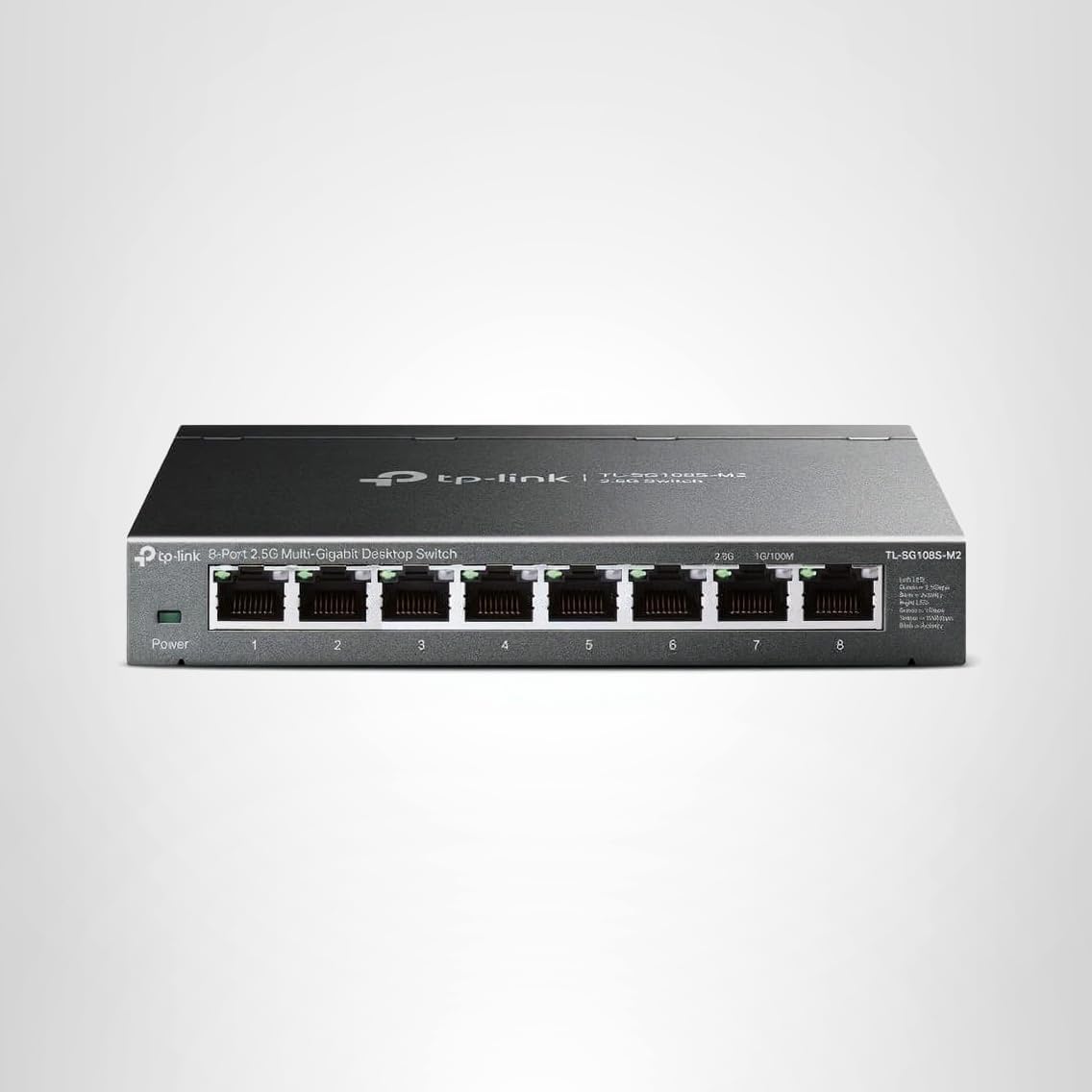
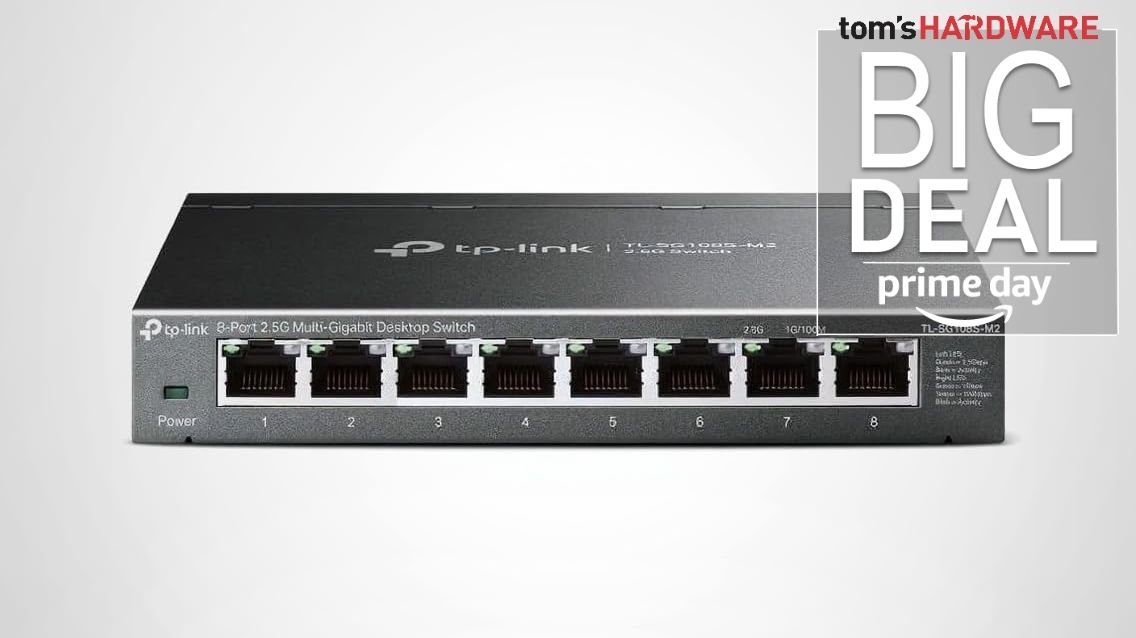
The TP-Link TL-SG108S-M2 is an unmanaged 8-port 2.5 GbE switch, which would make an excellent addition for your home network or small office. The TL-SG108S-M2 carries an MSRP of $79.99, but there’s a Prime Day sale at Amazon that drops the price to just $49.99.
The sub-$50 price tag is definitely eye-catching, and it caught my attention. I bought a UGREEN 6-port 2.5 GbE unmanaged switch back in October for $59.97, and here we have an 8-port unmanaged switch for $10 less.
The TL-SG108S-M2 offers 40 Gbps of switching capacity and supports devices at 100 Mbps, 1 Gbps, or 2.5 Gbps speeds. View Deal
The TL-SG108S-M2 offers 40 Gbps of switching capacity and supports devices at 100 Mbps, 1 Gbps, or 2.5 Gbps speeds. In other words, it’ll be well-suited to handle just about any of your networking needs, from plugging in a wired desktop PC to connecting a NAS, to wiring up a workgroup printer, to even extending your network wirelessly with an access point. And you can do all of this using Cat5e cabling.
You won’t have to worry about the switch taking up a lot of space, as it only measures 6.22 x 3.98 x 1 inches. So you should easily be able to tuck it away behind your monitor on a desk, or banish it to a corner under your desk. Or, if you prefer, it has mounting points on the bottom for attaching it to the wall. The casing is all-metal and passively cooled, so you don’t have to worry about introducing any additional noise into your tranquil home office.
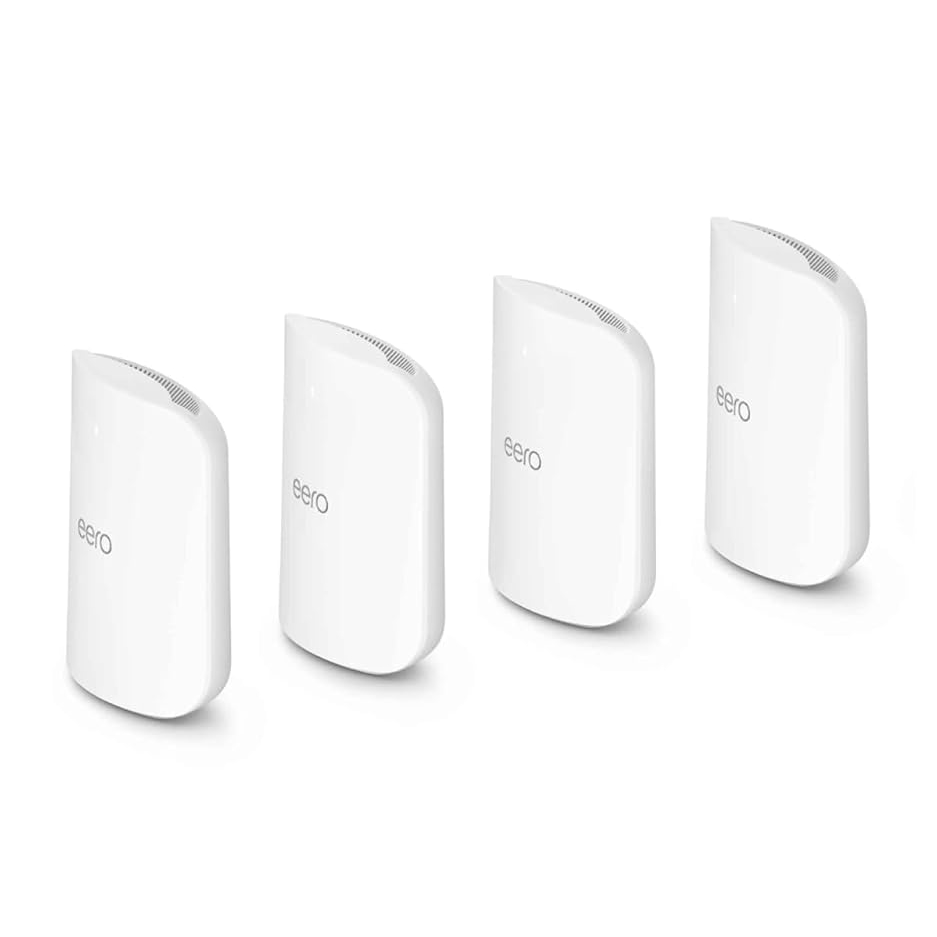
The Amazon Eero Max 7 was one of the very first Wi-Fi 7 routers that arrived on our test bench way back in November 2023. At the time, Wi-Fi 7 was still a relatively new standard, and chipset production hadn’t kicked into full gear. As a result, those early systems were incredibly expensive, with the MSRP of the Eero Max 7 3-pack we reviewed at a staggering $1,699. What a difference two and a half years makes — Amazon is now selling the Eero Max 7 4-pack for just $1,149.99, representing a dramatic 50 percent price cut.
It’s not often that we see a 50 percent reduction on a current-generation wireless router, let alone the flagship model. With that said, you do get a lot for your outlay, which we admit is still quite high despite the price cut. The Eero Max 7 is a tri-band Wi-Fi 7 mesh router with a 2x2 2.4 GHz band (688 Mbps), a 4x4 5 GHz band (8,647 Mbps), and a 4x4 6 GHz band (11,530 Mbps). The four satellites communicate via a wireless backhaul, though you can use a wired one for improved performance.
The Eero Max 7 is Amazon's flagship Wi-Fi 7 mesh router system. This is a 4-pack, with each node featuring two 2.5 GbE ports and two 10 GbE ports.View Deal
Each node is decently equipped with respect to ports, with two 2.5 GbE ports and two 10 GbE ports, any of which can be used for WAN. However, do note that you won’t find a USB port on either node for adding storage.
To make things as simple as possible for consumers, the Eero family of routers (including the Eero Max 7) features an app-only approach for setup and management. That means you can’t manage the network from a desktop computer and must rely on your smartphone for tinkering with settings. Perhaps that’s for the best, because you also don’t have nearly as many settings to manage as with other wireless routers. For example, the Eero Max 7 only supports Smart Connect and doesn’t let you create custom SSIDs or separate the bands. You also have limited control over Guest accounts.
But for someone who wants to get a network up and running in a few minutes and not have to worry about it again for the next three or four years, the Eero Max 7 is about as “hands off” as you can get with a modern wireless router.
The Eero Max 7 is currently available as an Amazon Prime-exclusive Lightning Deal with 16% units claimed as of this writing.
During this week’s Amazon Prime Day 2026 festivities, several router manufacturers have offered deep discounts on their products, including Netgear and TP-Link. Not to be left out, Asus is getting in on the action with its ZenWiFi BT and BQ family of Wi-Fi 7 mesh routers. For example, the ZenWiFi BT6 2-pack is priced at $297, which is a 20% discount off its MSRP. You can also look at our Best Amazon Prime Day Wi-Fi router deals 2026 for more deals on Wi-Fi 7, Wi-Fi 6E, Wi-Fi 6, and mesh routers.
The ZenWiFi BT6 is the entry point for Asus’ tri-band Wi-Fi 7 routers, with the 2-pack covering up to 5,800 square feet. The mesh system supports up to 9.4 Gbps (688 Mbps at 2.4 GHz, 2,882 Mbps at 5 GHz, and 5,762 Mbps at 6 GHz). Each wireless node includes a single 2.5 GbE WAN port, three GbE LAN ports, and a single USB 3.0 port.
The next step up is the ZenWiFi BT8, with the 2-pack currently on sale for $374 (36% off). This home mesh system increases cumulative speed from 9.4 Gbps to 14 Gbps and gives you an extra 100 square feet of coverage. The boost in speed comes from a 3x3 5 GHz radio (4,323 Mbps) and a 3x3 6 GHz radio (8,643 Mbps). You also get enhancements to the onboard ports: while the 2.5 GbE WAN remains, you also get a 2.5 GbE LAN alongside two GbE LAN ports and a USB 3.0 port.
The ZenWiFi BT6 includes two wireless nodes, each with a 2.5 GbE WAN port, three GbE LAN ports, and tri-band Wi-Fi 7 support.View Deal
The ZenWiFi BT8 includes two wireless nodes, each with two 2.5 GbE ports, two GbE LAN ports, and tri-band Wi-Fi 7 support.View Deal
Asus brings performance to the table with its ZenWiFi BT10 mesh system. It includes two wireless nodes, each with dual 10 GbE LAN/WAN ports onboard and tri-band Wi-Fi 7 support.View Deal
The ZenWiFi BQ16 Pro is the flagship mesh router from Asus, offering 30 Gbps wireless speeds across quad bands. You'll also find a healthy selection of 10 GbE ports.View Deal
Going even further up the Asus Wi-Fi 7 mesh ladder brings you to the ZenWiFi BT10, priced at $579.99 (16% off) for the 2-pack, which steps up cumulative speeds to 18 Gbps and brings total coverage to 6,000 feet . This time around, the 5 GHz and 6 GHz radios jump to a 4x4 arrangement, delivering up to 5,764 Mbps and 11,529 Mbps, respectively. The number of onboard ports has declined, though you do get a 10 GbE WAN, 10 GbE LAN, a single GbE LAN, and a USB 3.0 port.
Finally, for those needing the ultimate in speed and flexibility, there’s the ZenWiFi BQ16 Pro. It’s available with a 16% discount, bringing the 2-pack down to $928.99 instead of $1,099. This mesh system has all the bells and whistles, including enough power to cover up to 8,000 square feet. It’s also a quad-band system (it has two 6 GHz bands), with all radios operating at 4x4, supporting up to 30 Gbps. This means that the 2.4 GHz, 5 GHz, 6 GHz-1, and 6 GHz-2 max out at 1,376 Mbps, 5,764 Mbps, 11,529 Mbps, and 11,529 Mbps, respectively.
Asus also didn’t skimp on the ports, as you’ll find a 10 GbE WAN/LAN, 10 GbE LAN, GbE WAN/LAN, two GbE LAN, and a USB 3.0 port.
All of the ZenWiFi routers run Asus’ excellent AsusWRT software, which is highly configurable and includes built-in malware protection and device management (something that Netgear and TP-Link charge you extra for). The routers can also use their USB ports for storage or to connect to a cellular internet connection via a USB 4G/5G dongle or a smartphone.
These deals aren’t likely to last long, so strike while the iron is hot.
 登录
登录