普通视图

发现新文章,点击刷新页面。
昨天以前首页

AZZA PSAZ-750G ATX 3.1 power supply review: An adequate budget 750W unit

2026年9月13日 21:30

AZZA is one of those brands that has been around far longer than its shelf presence suggests. The company is the PC-components arm of Linkworld Electronic, and it has spent the better part of two decades selling cases, coolers, chassis fans and power supplies into the value end of the market, mostly through regional distribution rather than the big review-sample circuit. That low profile cuts both ways. AZZA has never had the marketing budget to overpromise the way larger brands do, but it also has never had to answer for its power supplies in public the way brands like Corsair or Cooler Master routinely do. Like almost every brand in this segment, AZZA designs none of their units themselves but buys platforms from (usually Chinese) OEMs and puts its own sticker on the side.

The PSAZ series is AZZA's mainstream ATX line, and the PSAZ-750G is the 750W Gold-badged member of it. The unit we have is marked ATX 3.1 and PCIe 5.1 Ready on the box, carries a native 12V-2x6 connector, and is rated for its full 750W at 40°C ambient. It ships with a 2-year warranty, which is a statement all by itself. The platform comes from Helly, a manufacturer that supplies a number of platforms and we meet their products frequently in mainstream units. What makes the PSAZ-750G interesting is not the specification sheet but the badge on it: the box, the label and the retail listings all carry the 80 PLUS Gold logo, and AZZA has not put a PSAZ unit through 80 PLUS certification since 2015. That claim, more than anything else, is what this review has to settle and determine whether it deserves a spot in our list of best power supplies.

Specifications and Design

AZZA PSAZ-750G ATX 3.1 Power specifications ( Rated @ 40 °C )

RAIL

+3.3V

+5V

+12V

+5Vsb

-12V

MAX OUTPUT

20A

20A

62A

2.5A

0.3A

100W

100W

744W

12.5W

3.6W

TOTAL

750W

AC INPUT

100 - 240 VAC, 50 - 60 Hz

MSRP

$78

In the Box

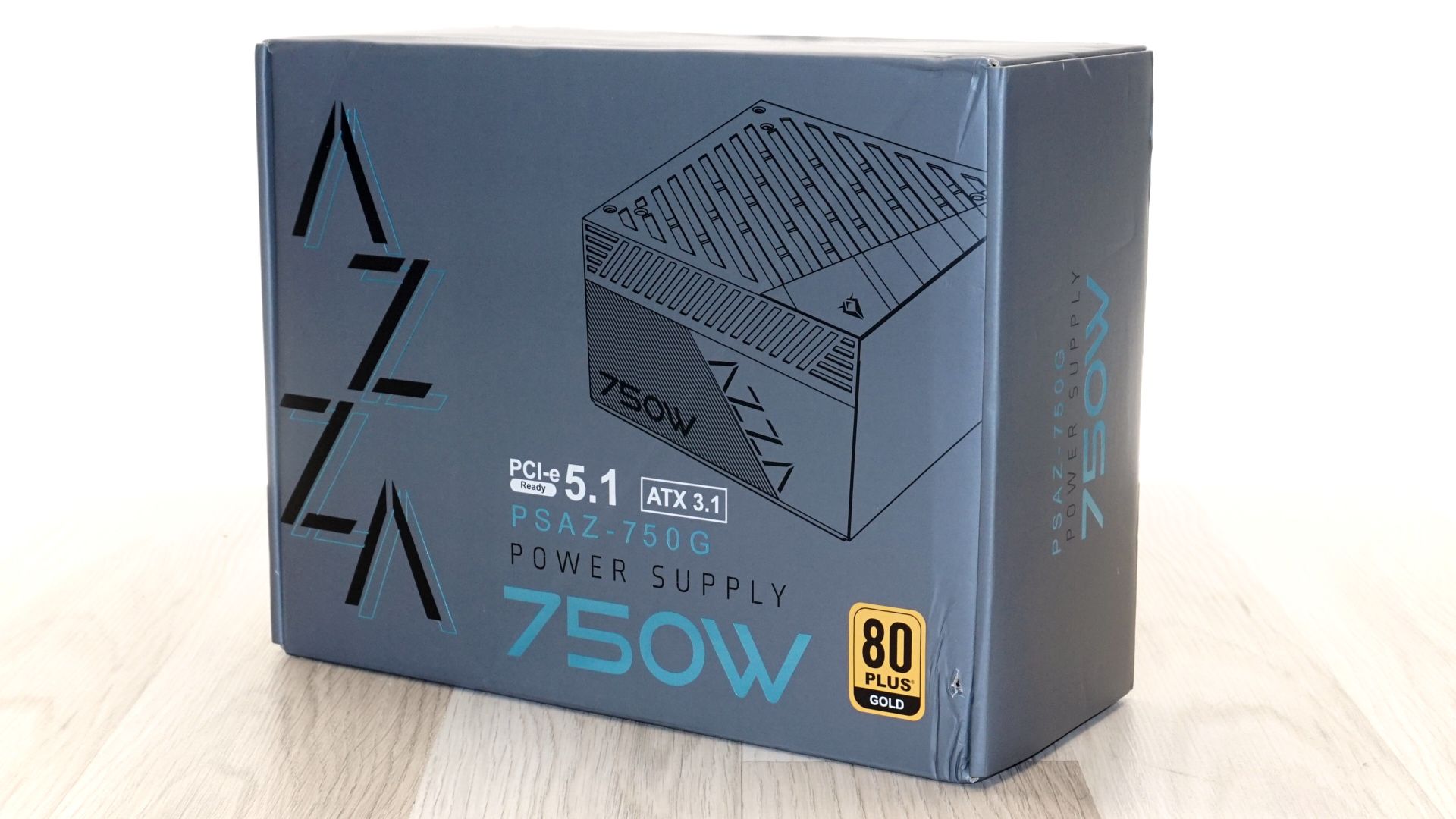
Packaging is plain and inexpensive, and honest about it. The sleeve is a flat slate-blue with the AZZA wordmark rendered as three large outlined chevrons on the left, a line drawing of the unit on the right, and the model and wattage stacked underneath. The badges run along the lower half - PCI-e 5.1 Ready, ATX 3.1, and the 80 PLUS Gold logo in its usual gold square. The unit sits inside between two moulded protective inserts, with the cables bundled beside it.
AZZA PSAZ-750G ATX 3.1

(Image credit: Tom's Hardware)

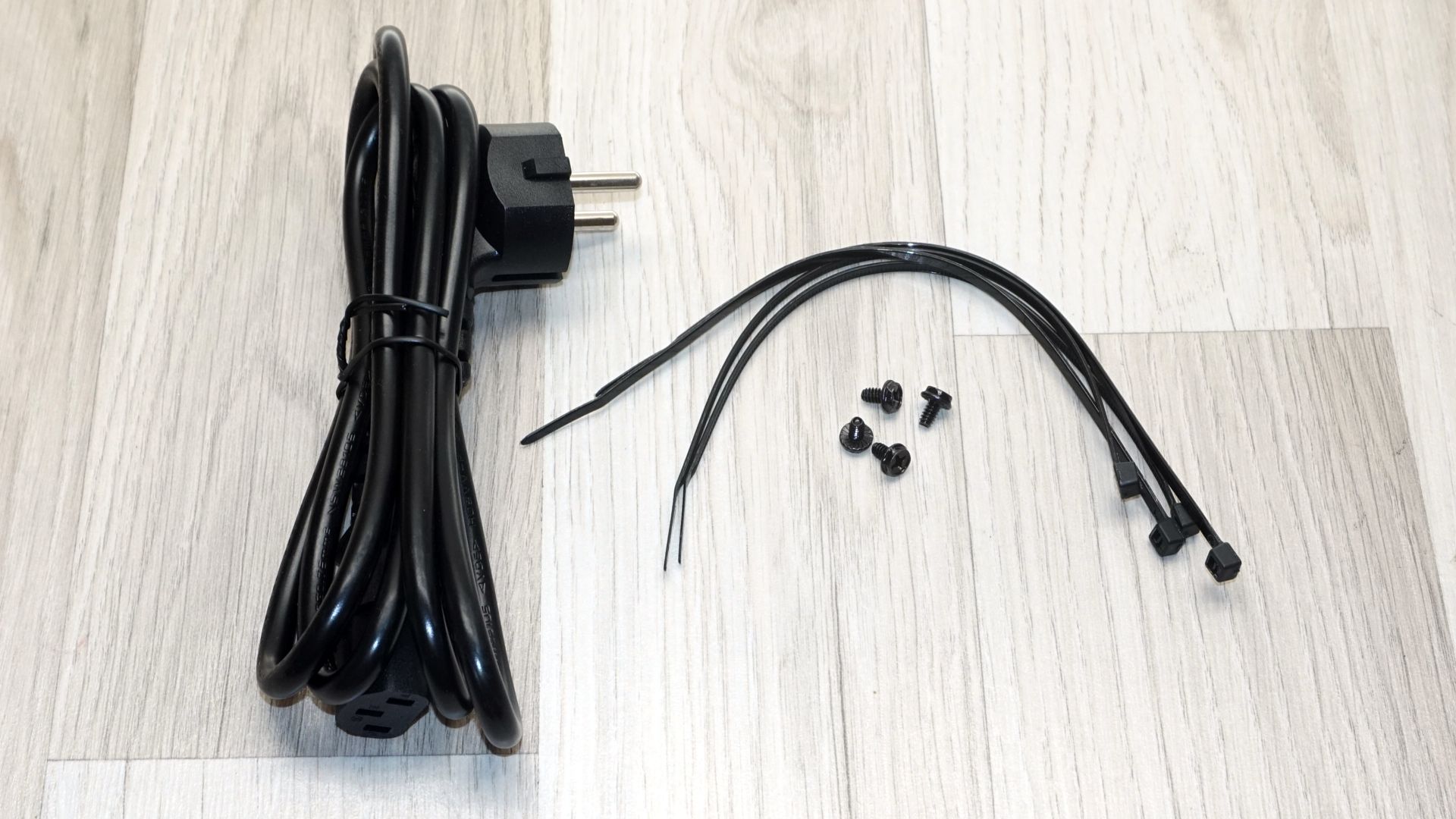
The bundle is as thin as it gets. There is the AC power cord, four mounting screws and four black zip ties. No Velcro straps, no cable combs, no pouch, no tester, and nothing in the way of printed documentation beyond what is on the box itself. At $78 for a 750W unit, none of that is unreasonable, but it is worth noting that the four zip ties are doing real work here. With a hardwired cable set there is no way to leave unused cables out of the case, so whatever routing tidiness you get, you will be building yourself.
AZZA PSAZ-750G ATX 3.1

(Image credit: Tom's Hardware)

The cables themselves are better than the accessory list implies. All of them are black nylon-sleeved rather than the flat ribbon type common at this price, sleeved right up to the connector housings, and the wire gauges look appropriate throughout. The 12V-2x6 cable is a native run from the PCB rather than an adapter, and it is printed with a 450W rating along its length, which is the single most important thing to know about this power supply before you buy it. That is enough for a mid-range card, and not enough for a 500W+ flagship, regardless of what the 750W on the box suggests. There is no dual-color keying on the connector, so seating it correctly is on you.

AZZA PSAZ-750G ATX 3.1

Connector type

Hardwired

Modular

ATX 24 Pin

1

-

EPS 4+4 Pin

2

-

EPS 8 Pin

-

-

PCI-E 5.1

1

-

PCI-E 8 Pin

3

-

SATA

6

-

Molex

2

-

Floppy

-

-

External Appearance

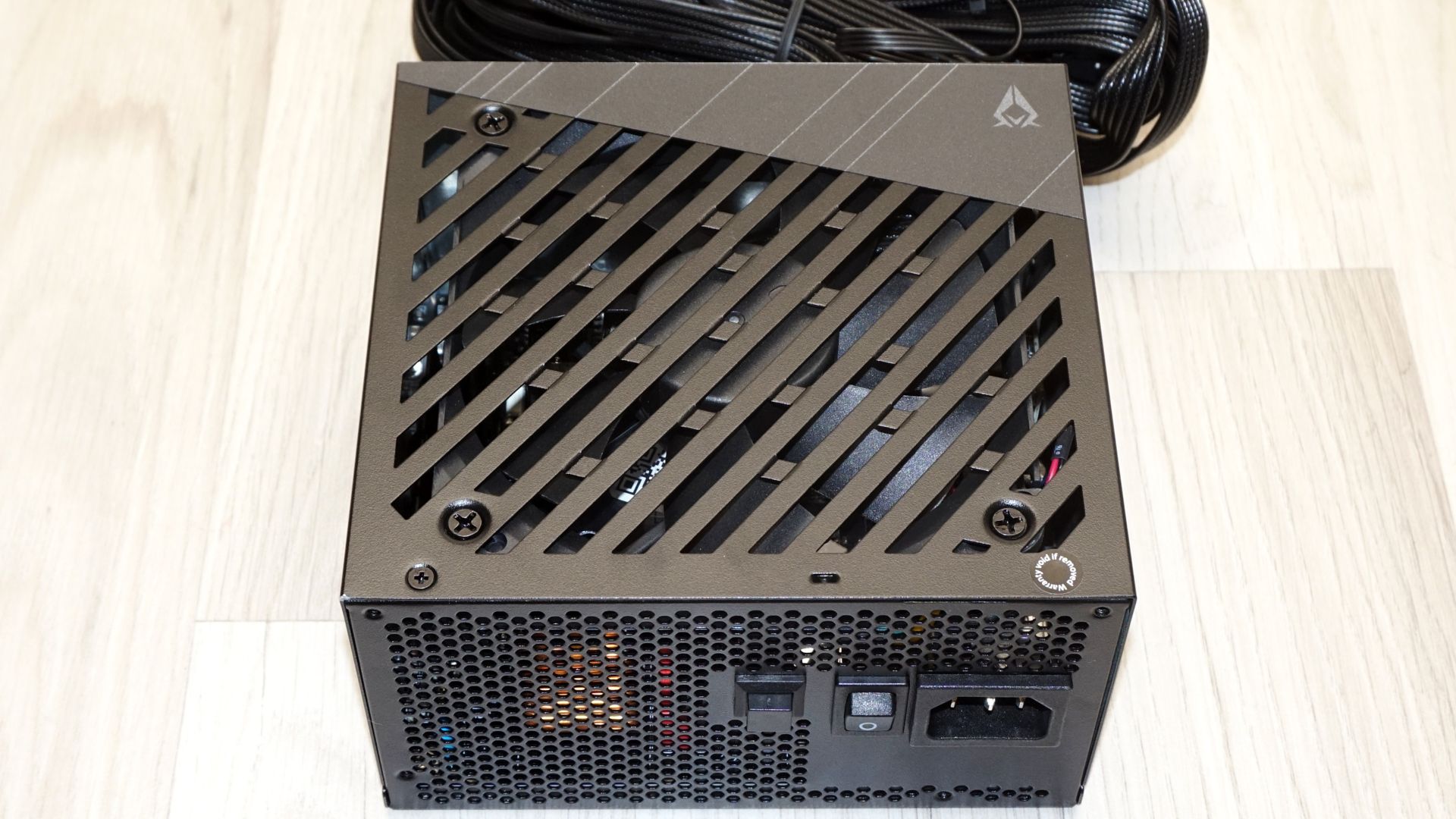
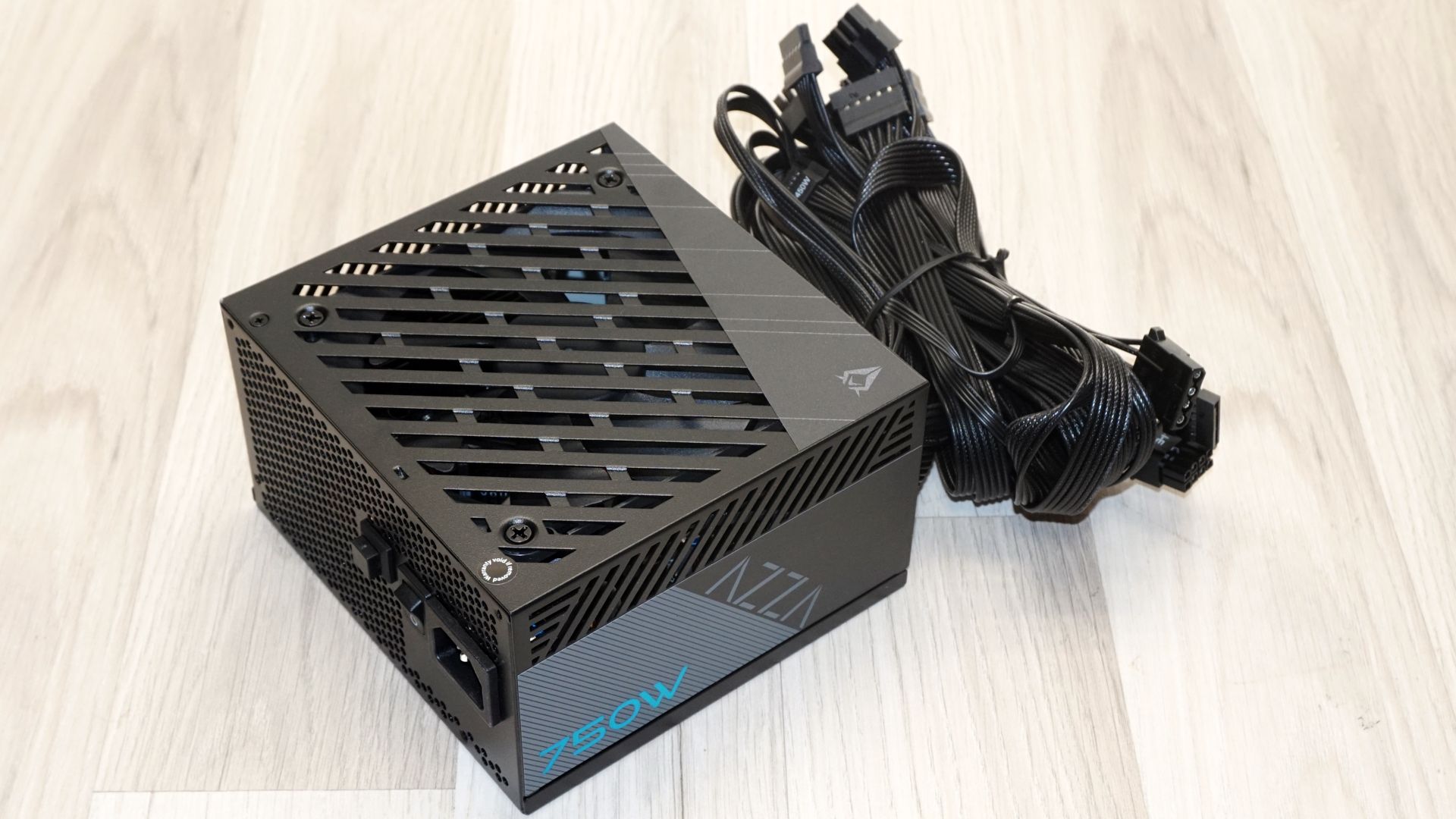
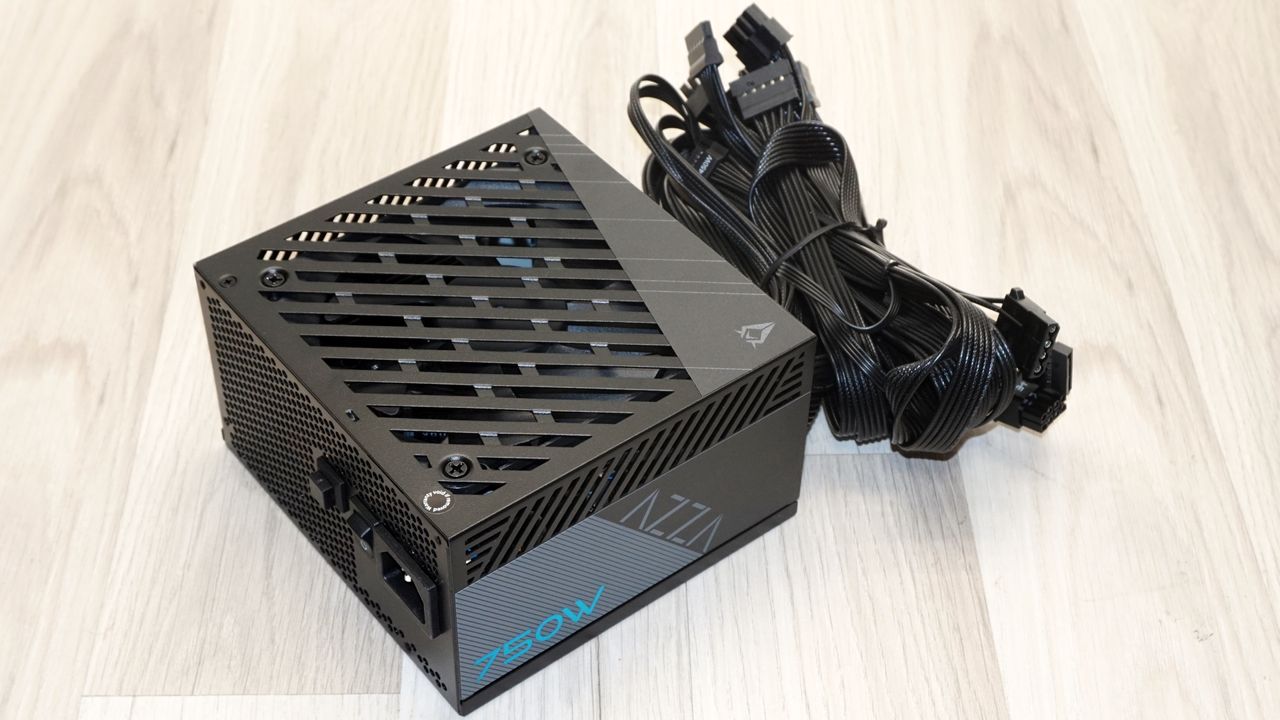
At 150 x 86 x 140 mm the PSAZ-750G is a standard-depth ATX unit, and 140 mm means it drops into essentially any case that takes an ATX supply, with enough clearance left over to deal with the fixed cable loom. The chassis is finished in a dark grey-brown matte paint and it is a better finish than the price would predict. The top face carries a slotted grille with wide diagonal bars over the fan, cut off at one corner by a plain triangular panel bearing the AZZA logo and a few thin pinstripes. It is a restrained, slightly industrial look, and the diagonal grille bars do restrict airflow area more than a wire or honeycomb grille would, which increases noise.
AZZA PSAZ-750G ATX 3.1

(Image credit: Tom's Hardware)

The side panel carries the only color on the unit: a grey hatched rectangle with the AZZA wordmark in outline and 750W set in a bright cyan that matches the box. The top side holds the specifications label, and it is worth reading. It lists the ATX 3.1 and PCIe 5.1 Ready marks and, again, the 80 PLUS Gold logo.
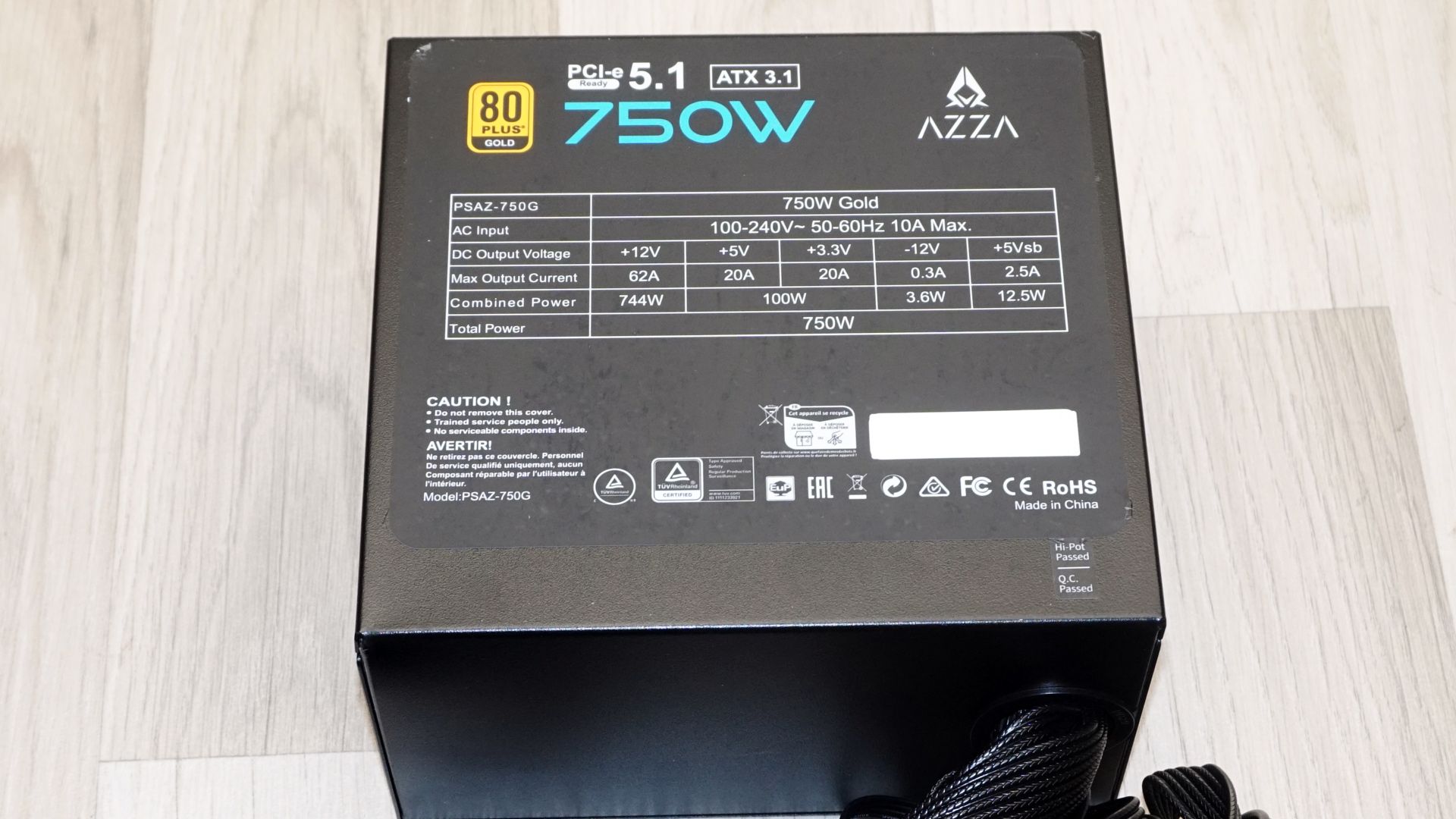
AZZA PSAZ-750G ATX 3.1

(Image credit: Tom's Hardware)

The rear face is a hexagonal honeycomb exhaust panel with the AC receptacle, the main I/O rocker, and a second, smaller square button beside it. That button is the hybrid fan mode switch: press it and the semi-passive behavior is disabled, so the fan runs continuously from idle rather than waiting for load. It is a feature several units at three times this price still omit, and it is faintly odd to find it here. The front face is solid, with the fixed cable loom leaving through a single rubber-grommeted opening. There is no modular bay, no LED, and no other features.
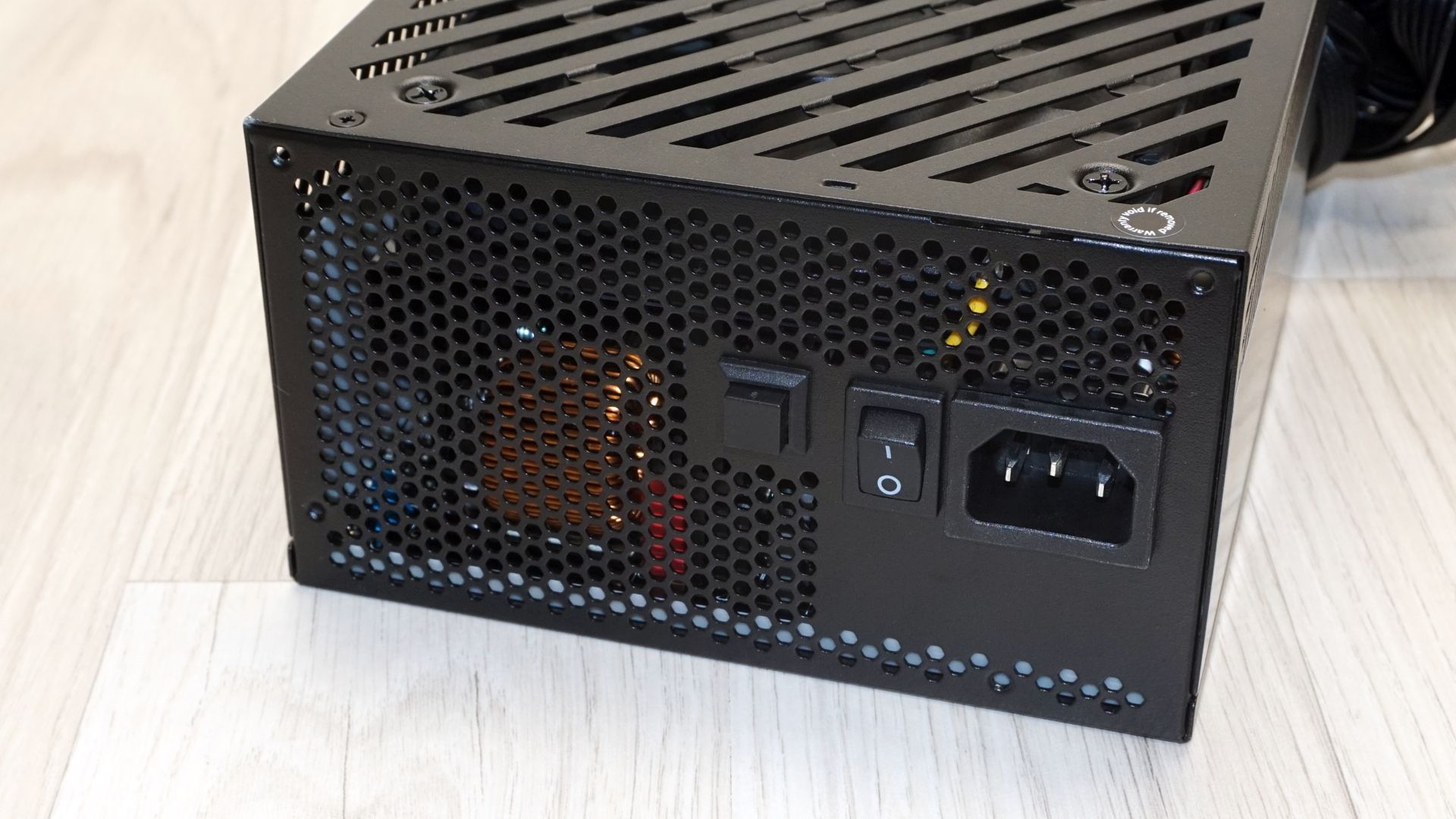
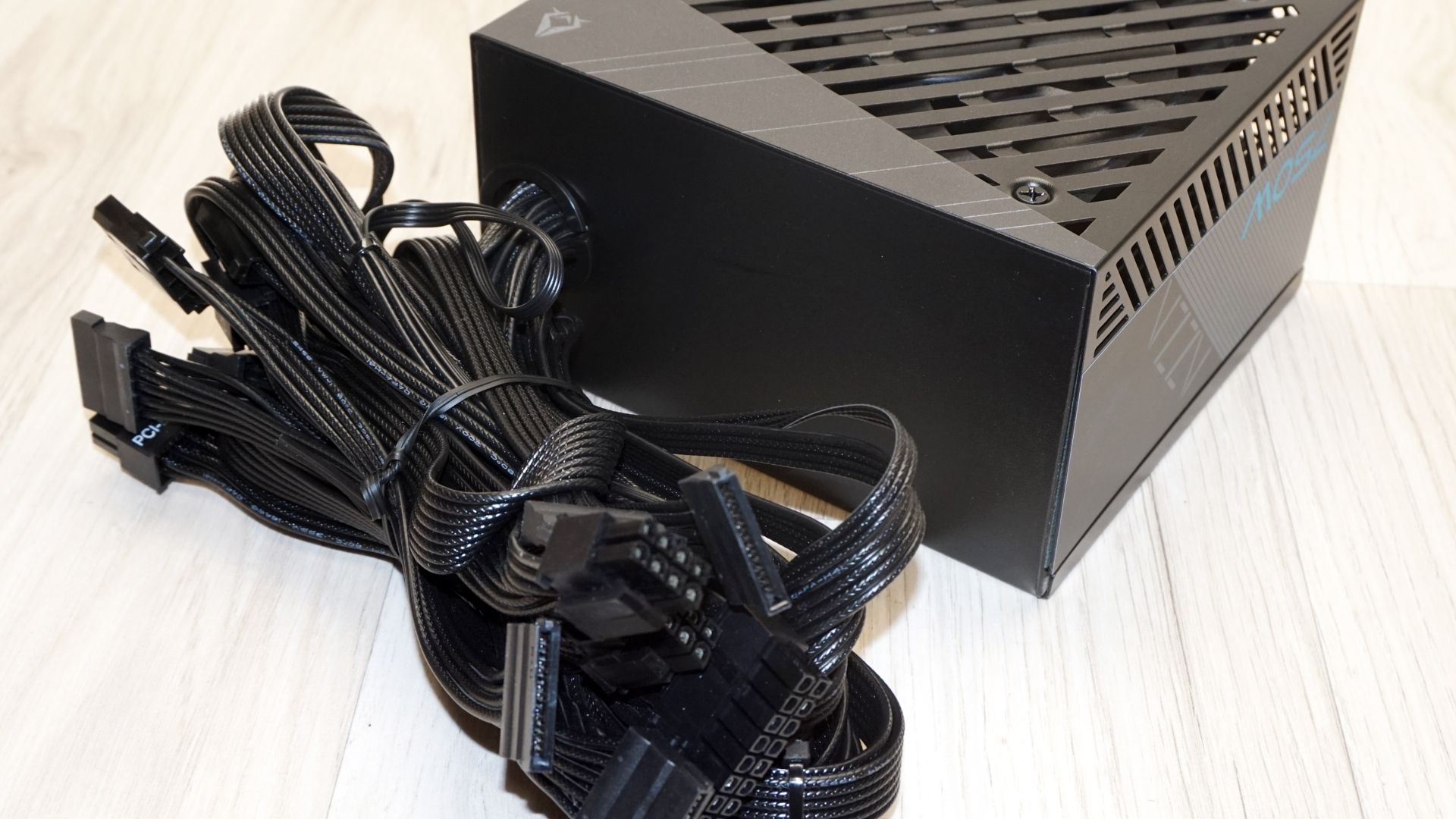
AZZA PSAZ-750G ATX 3.1
Tom's Hardware
AZZA PSAZ-750G ATX 3.1
Tom's Hardware

Internal Design

Cooling comes from a 120 mm Yate Loon D12BH-12, a ball-bearing fan rated at 12V and 0.60A. Yate Loon publishes this model at 2300 RPM, 89 CFM and 41 dB(A) at full speed, which puts it firmly in the high-airflow, high-noise half of the catalogue. Ball bearings are a durability advantage over the sleeve-bearing fans that usually appear at this price, and given the 2-year warranty that matters - a fan that outlasts the coverage period is the minimum bar. What it is not is a quiet fan, and the platform leans on it hard, as the hot-box results below make clear.
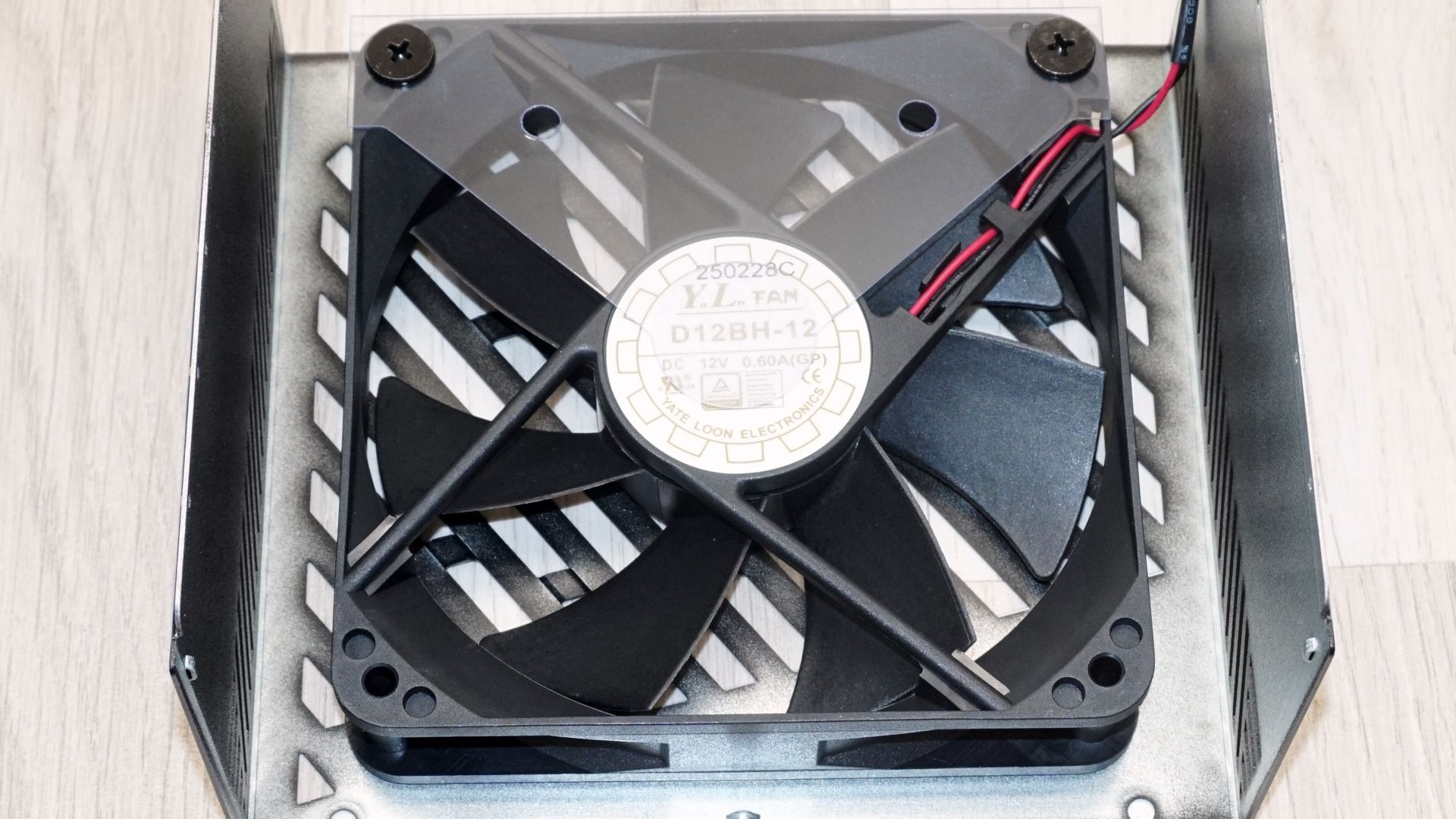
AZZA PSAZ-750G ATX 3.1

(Image credit: Tom's Hardware)

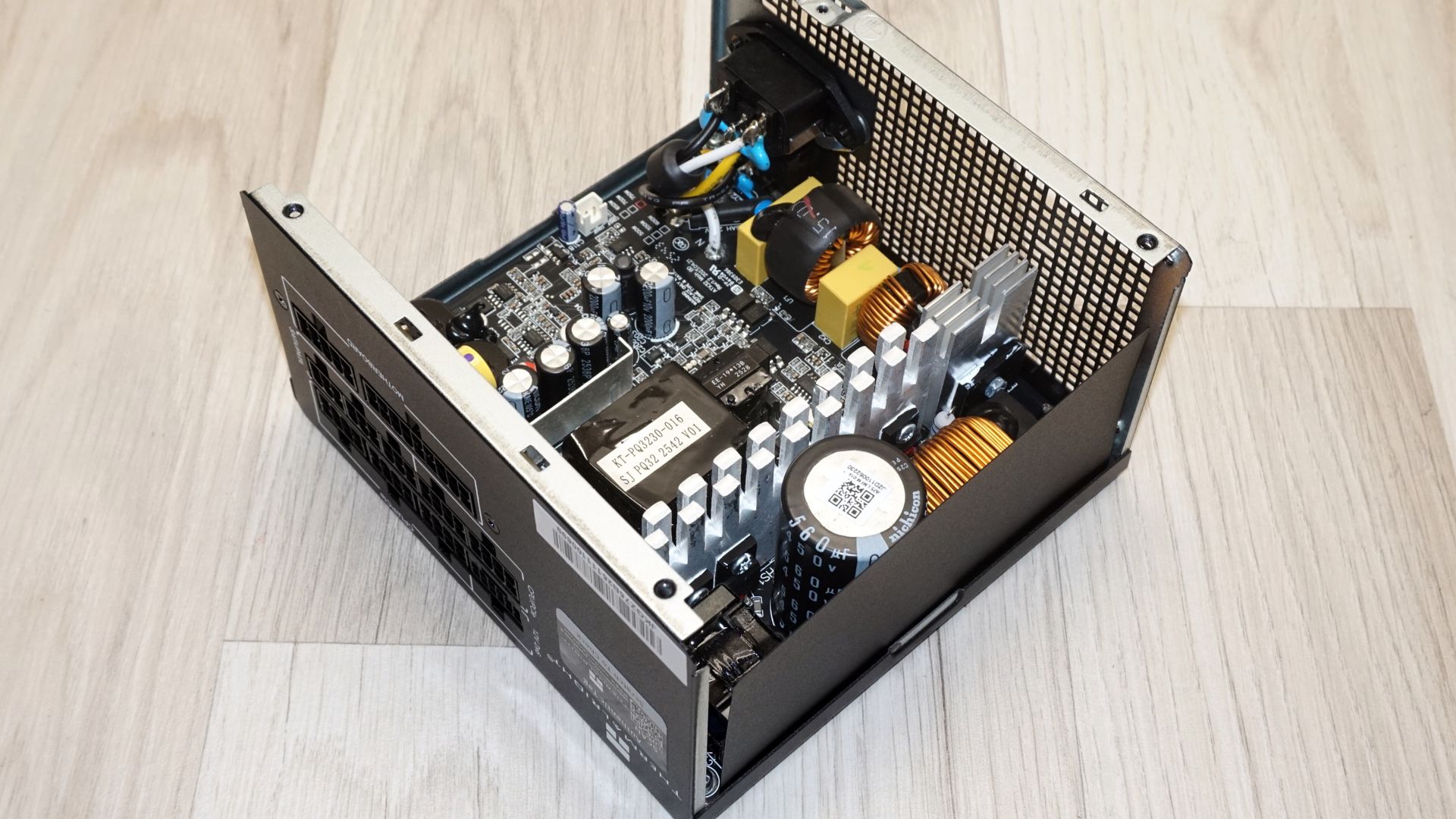
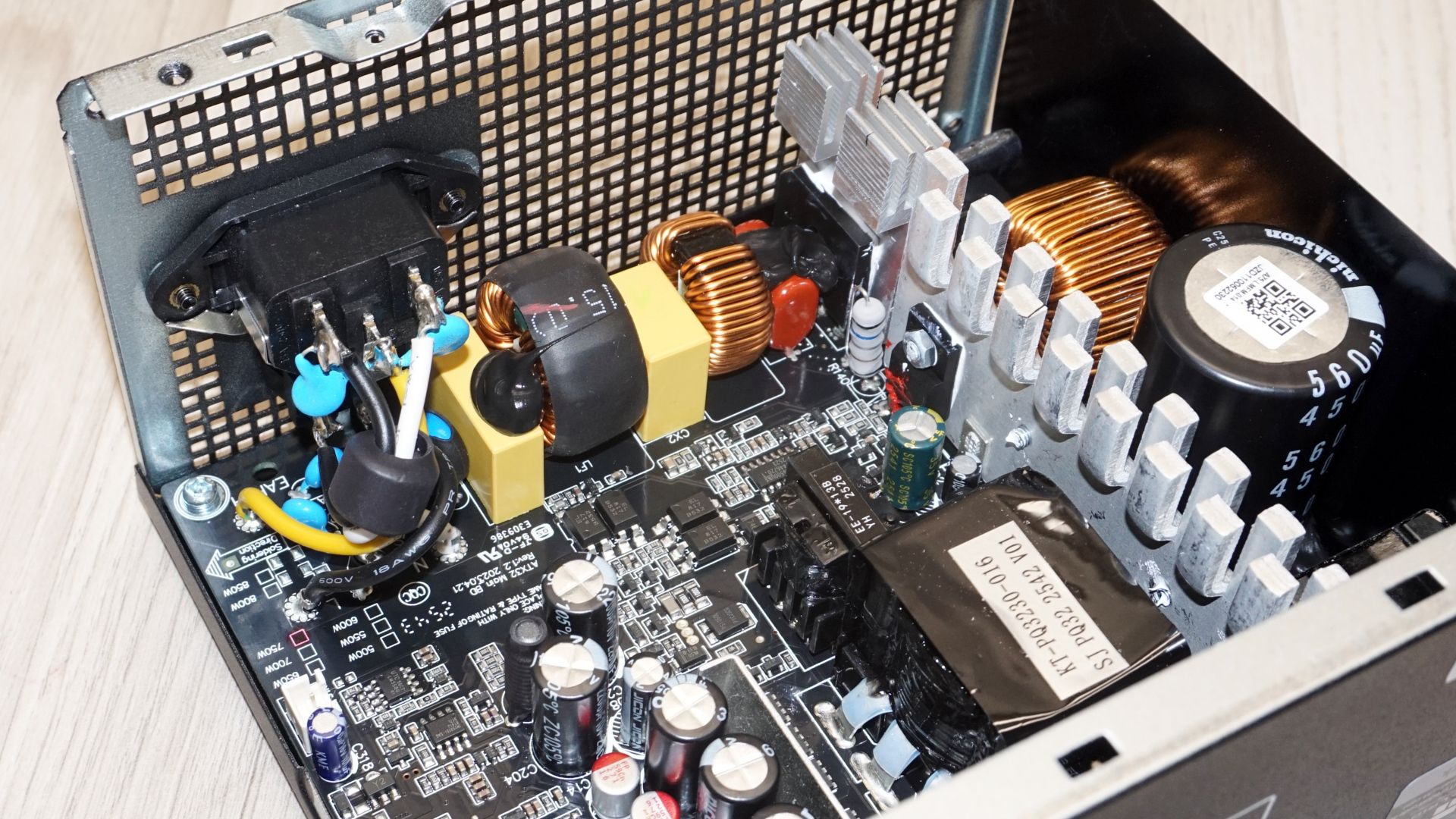
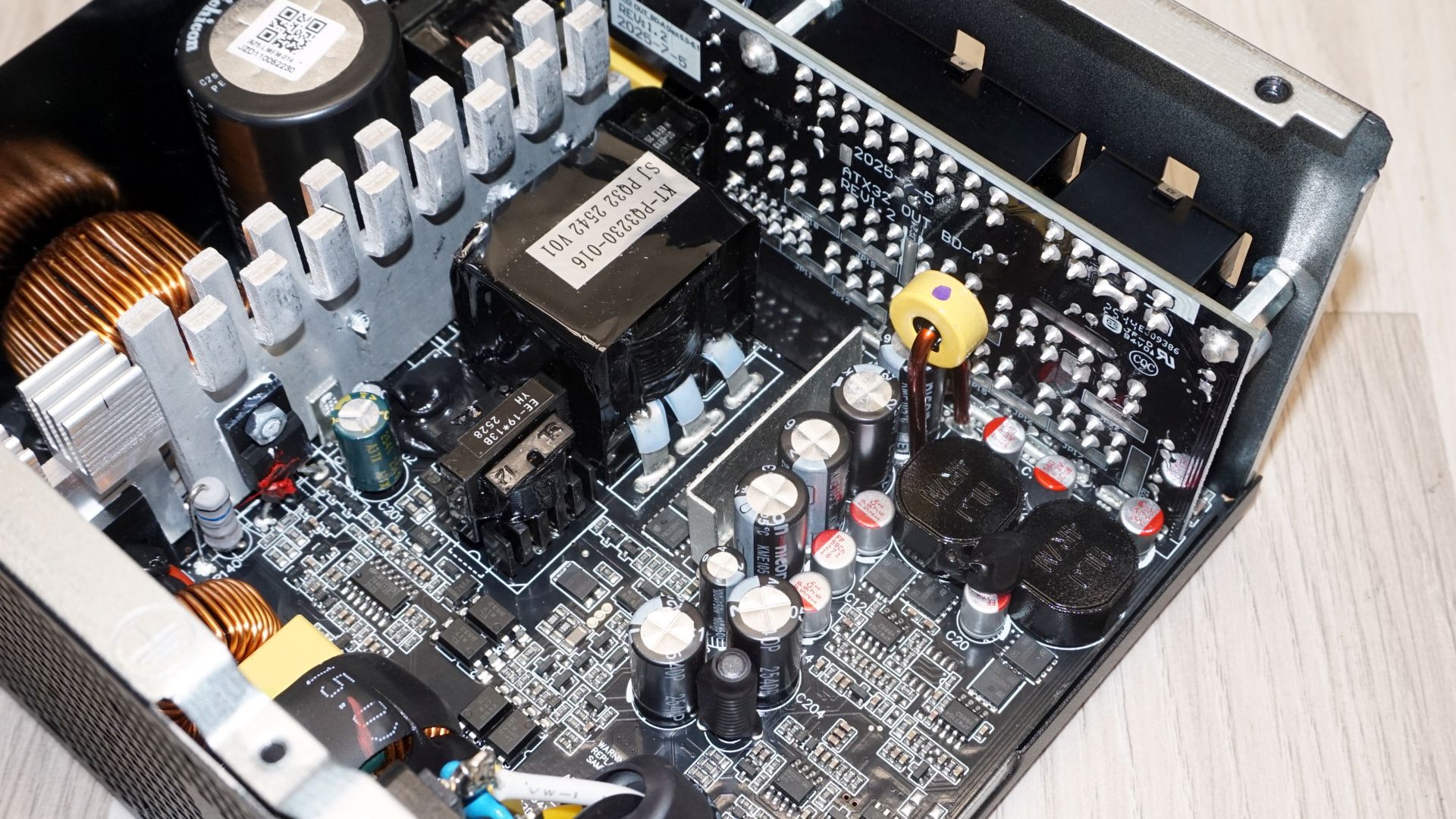
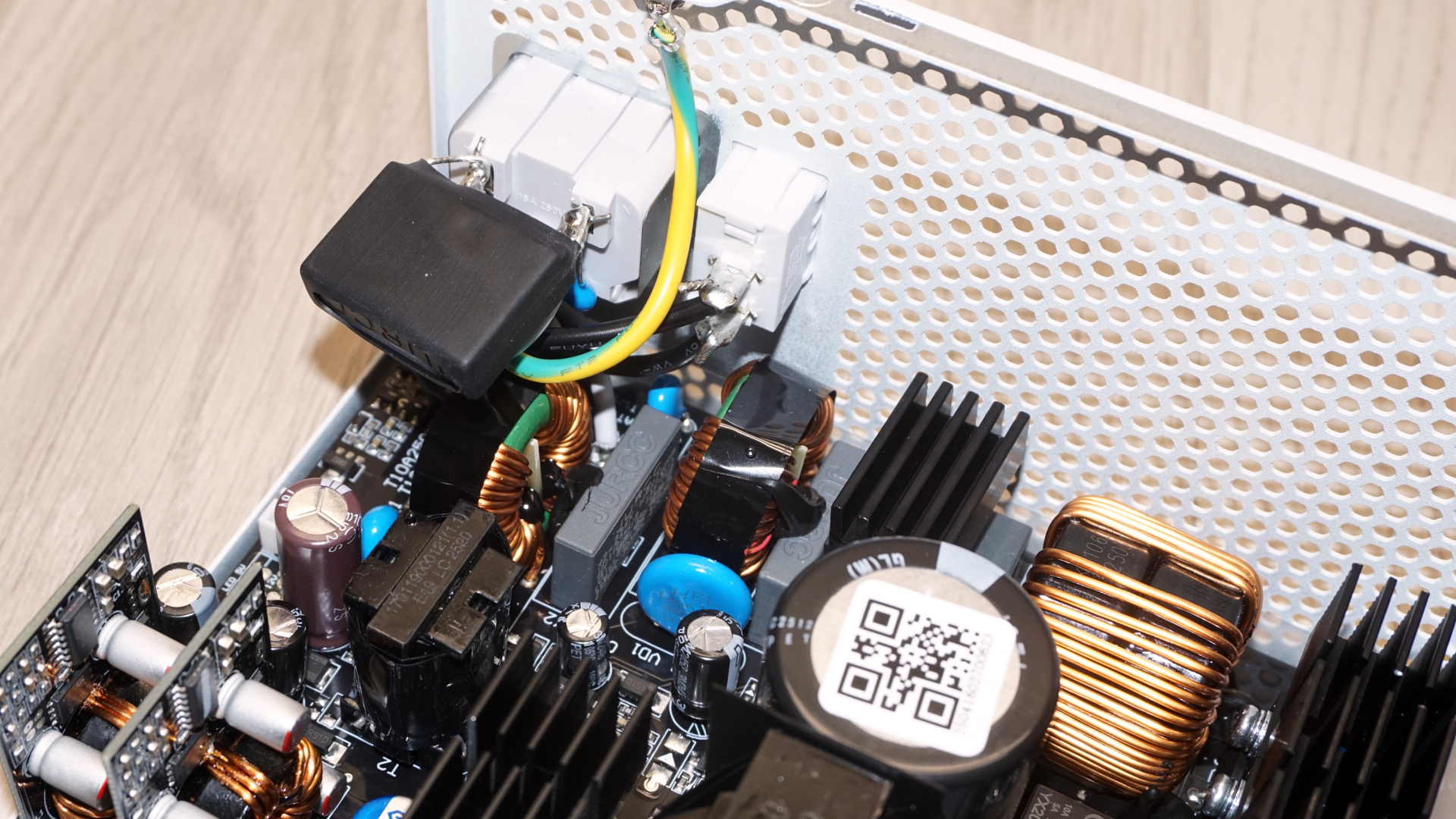
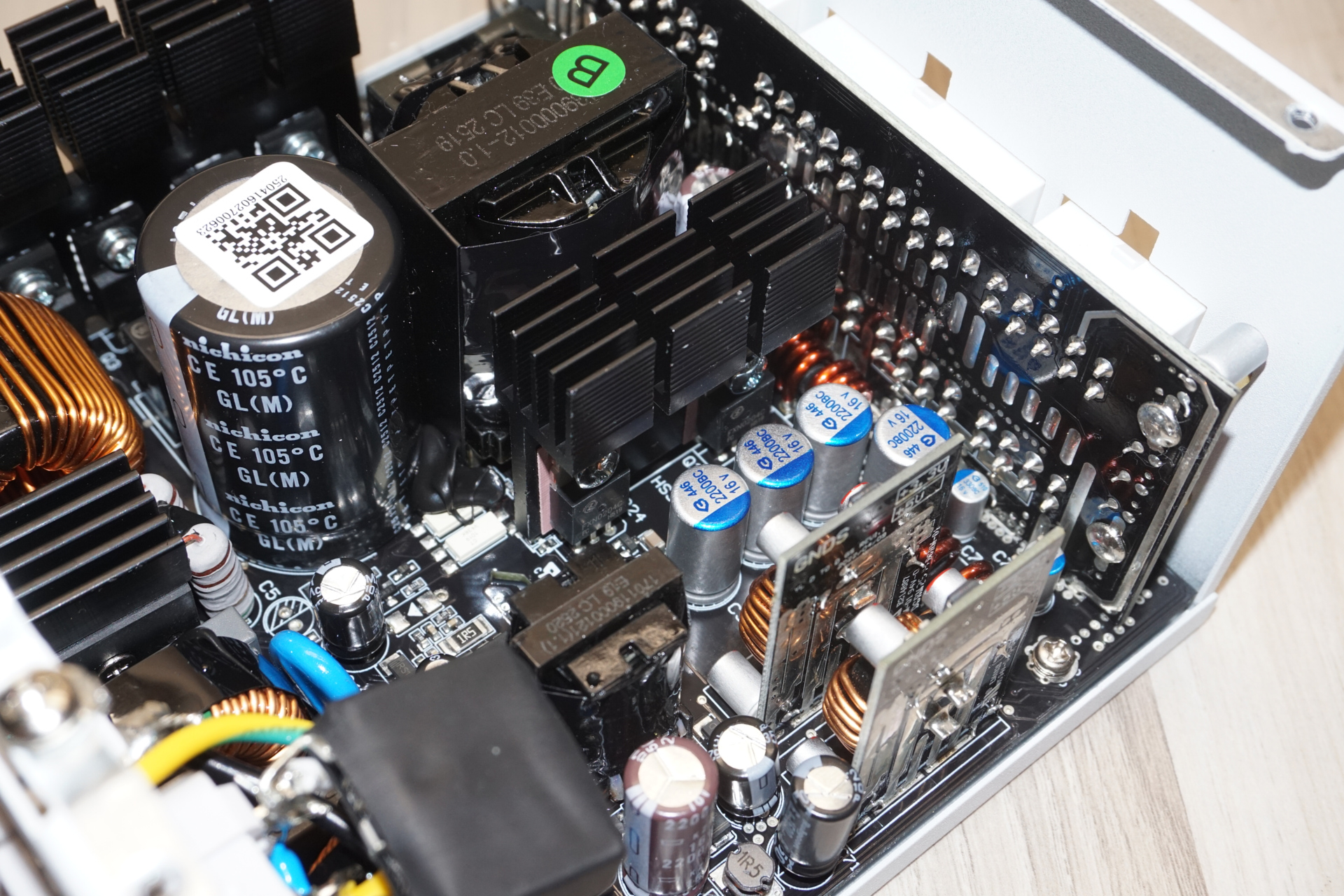
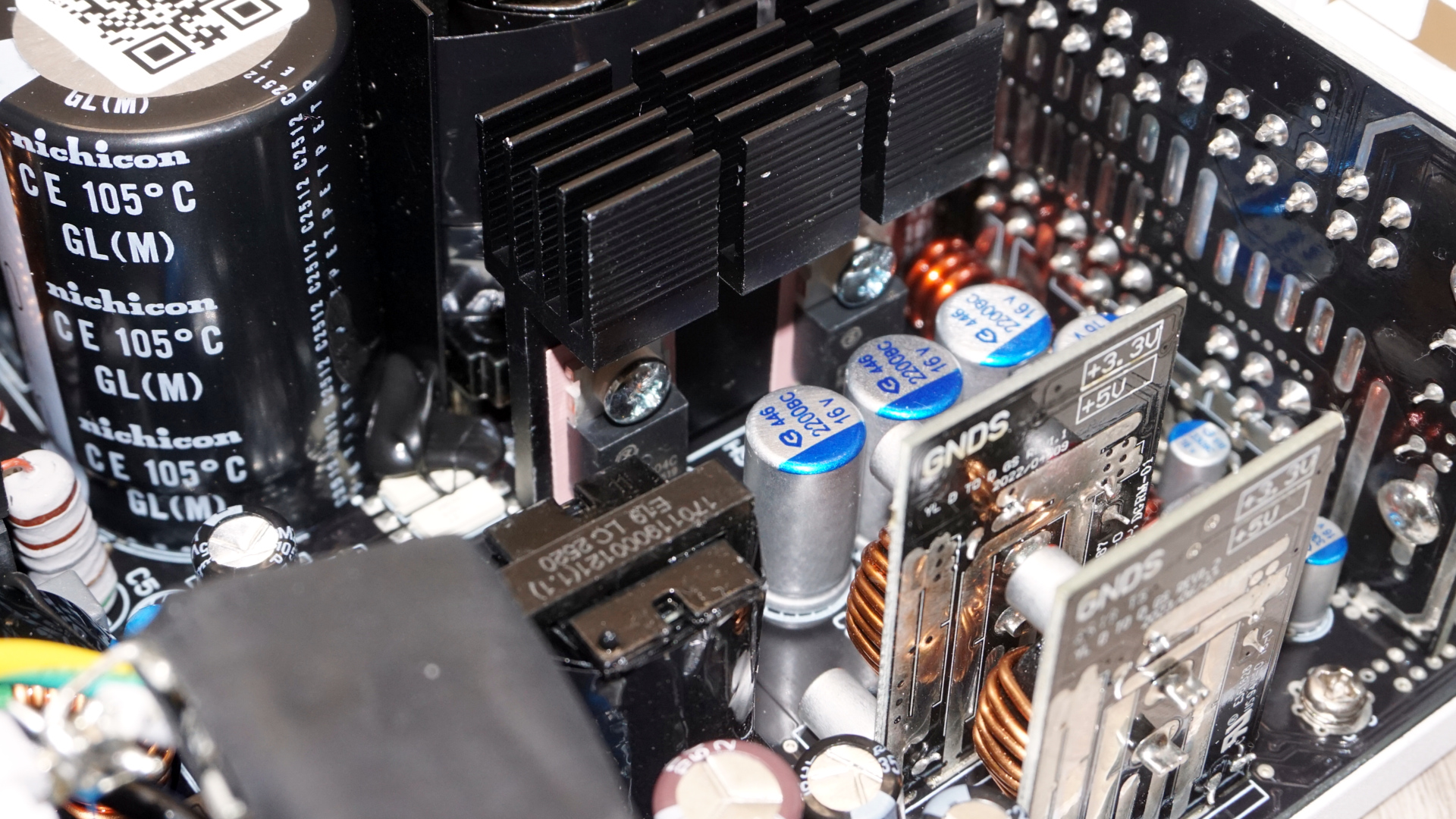
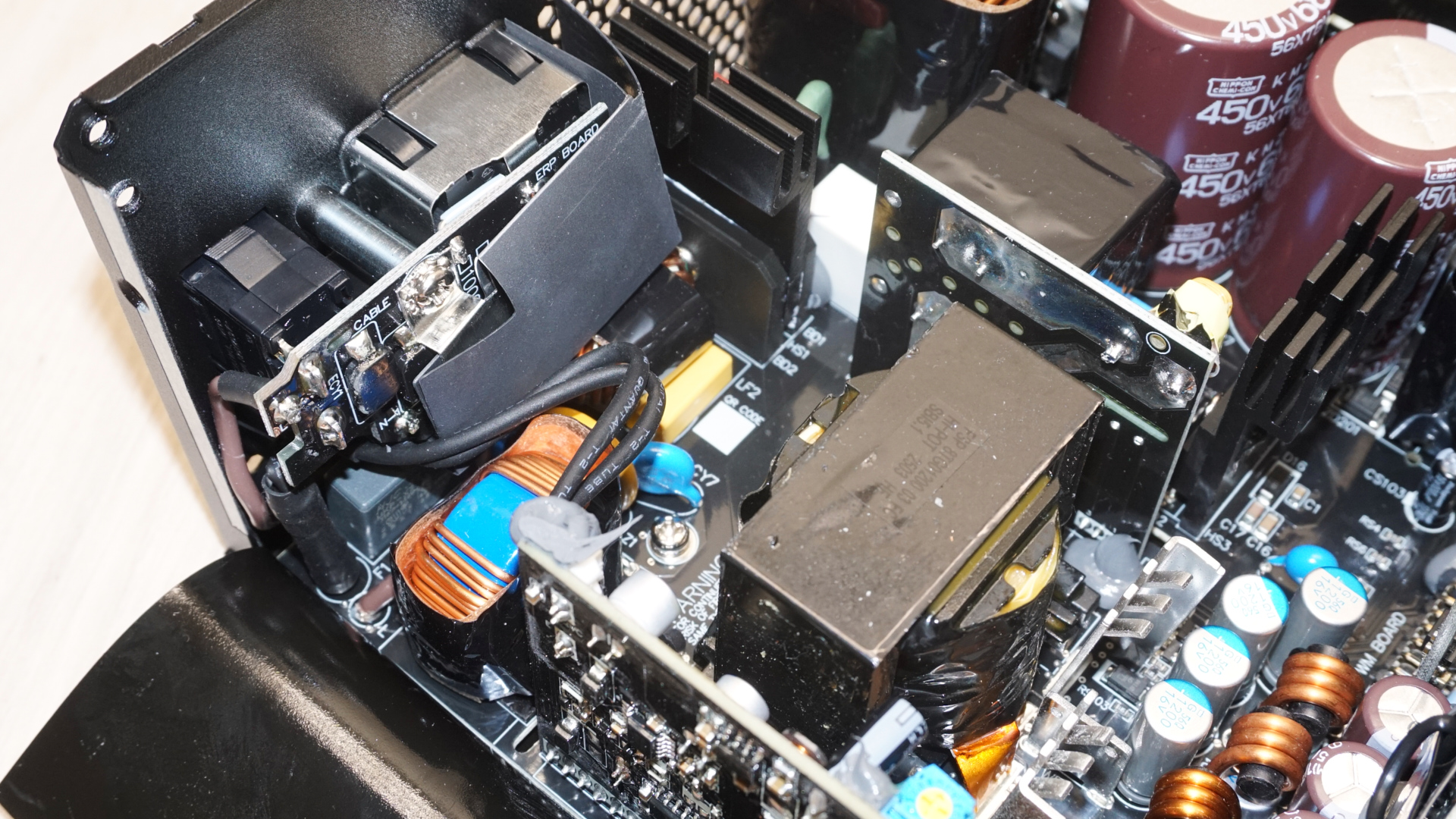
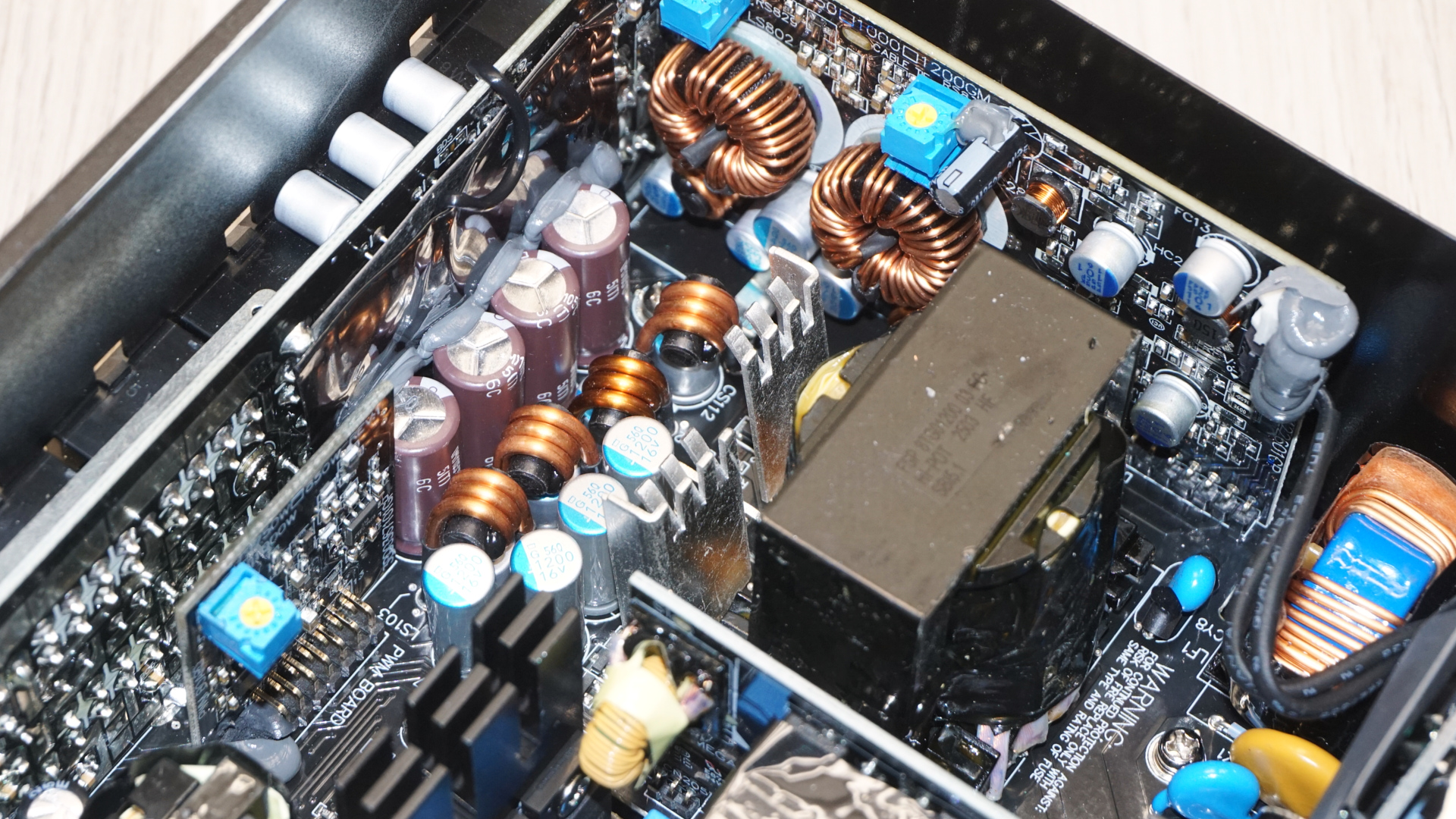
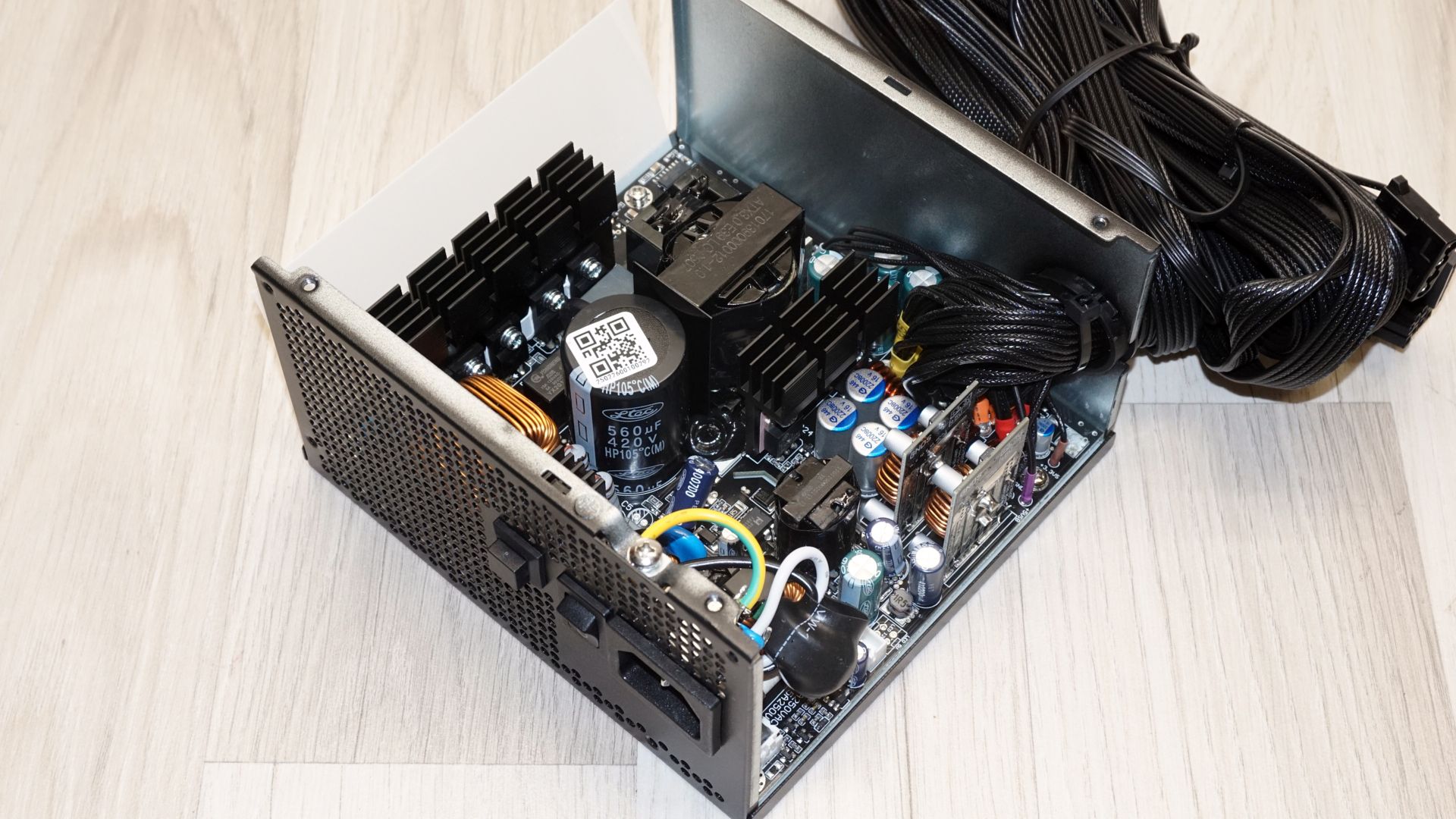
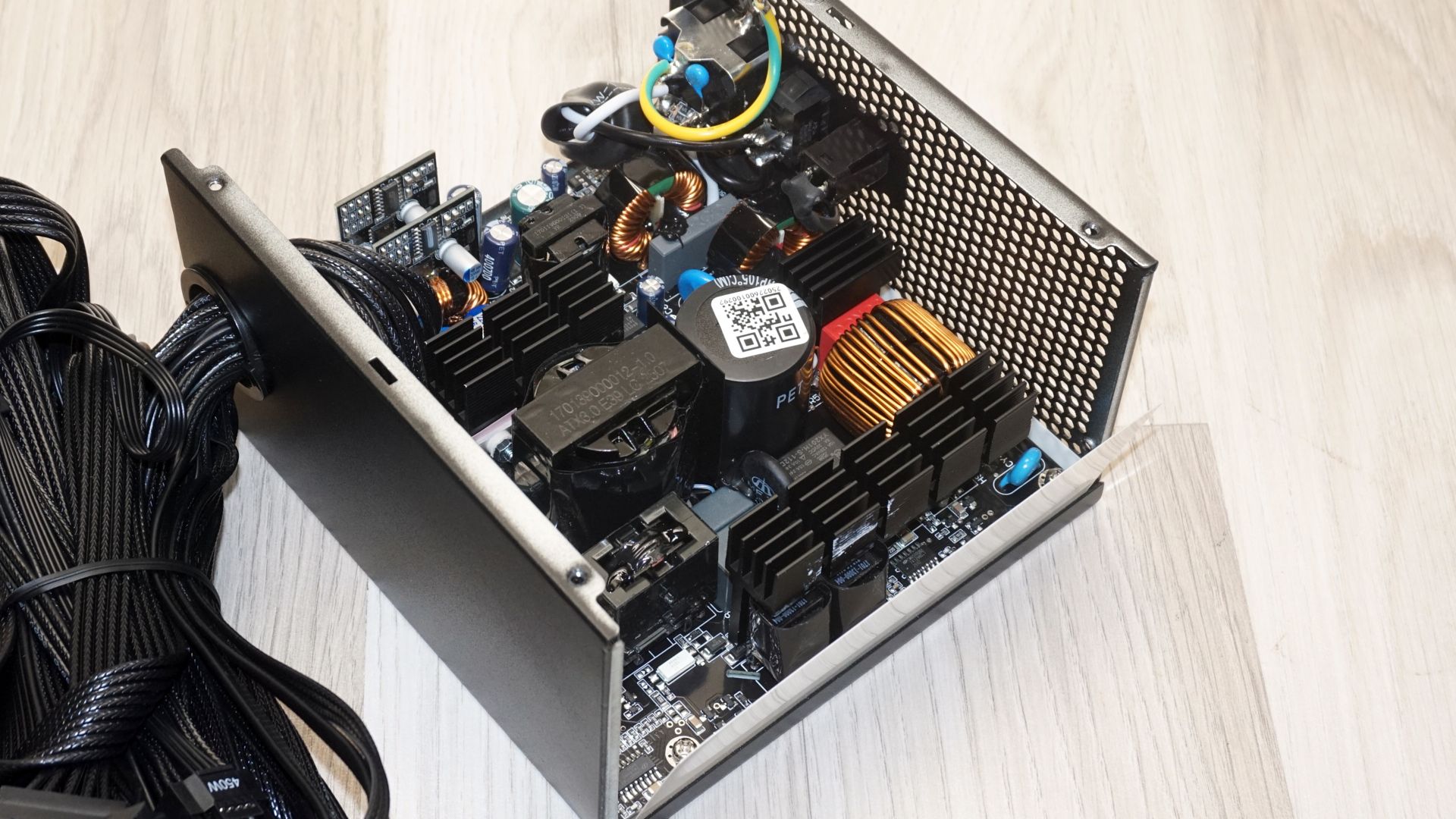
The platform is a Helly design and is similar to the platform Phanteks AMP GH series is using - but that is where the similarities end. The layout is clean and reasonably modern, with the main PCB carrying the primary and secondary stages and a pair of small vertical daughterboards near the front handling the minor rails. Heatsinks are generously sized for the class, dark-anodised finned extrusions rather than the bent aluminium strips that budget platforms often make do with, and the board is well populated with silicone glue on the taller components. The main transformer is marked ATX3.0 on the bobbin, which is a small reminder of how recent the 3.1 revision on the box actually is.
AZZA PSAZ-750G ATX 3.1
Tom's Hardware
AZZA PSAZ-750G ATX 3.1
Tom's Hardware

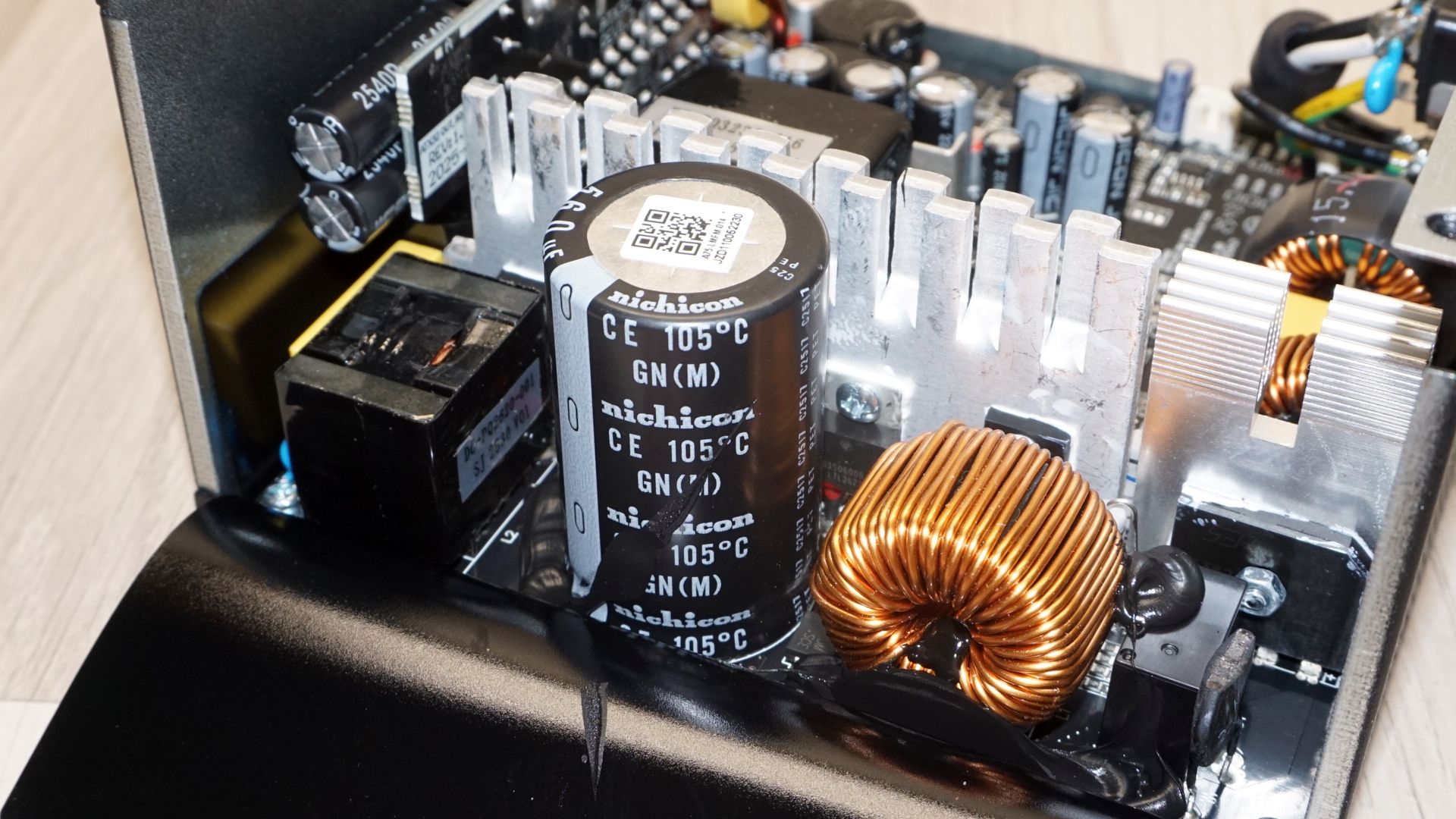
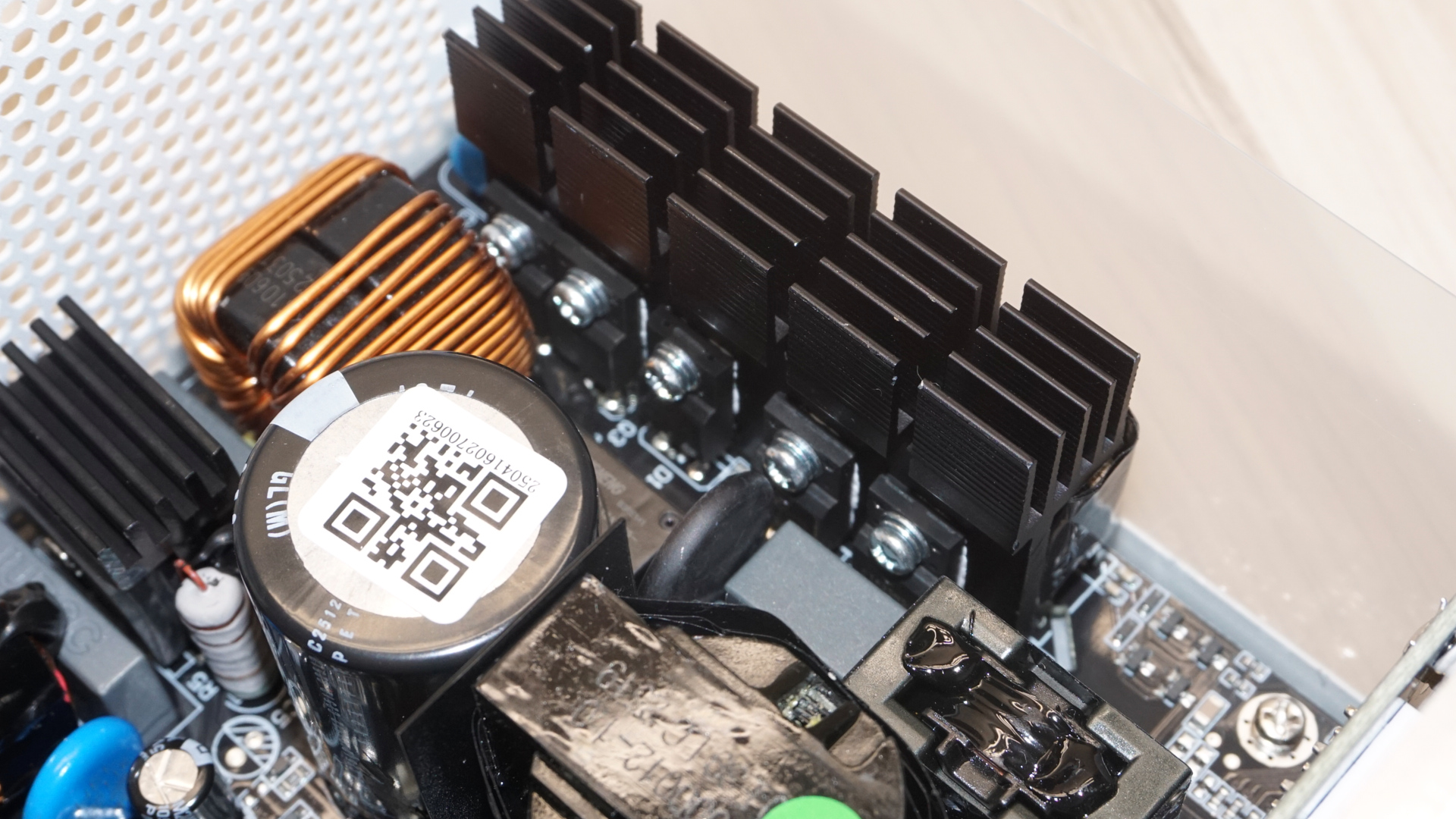
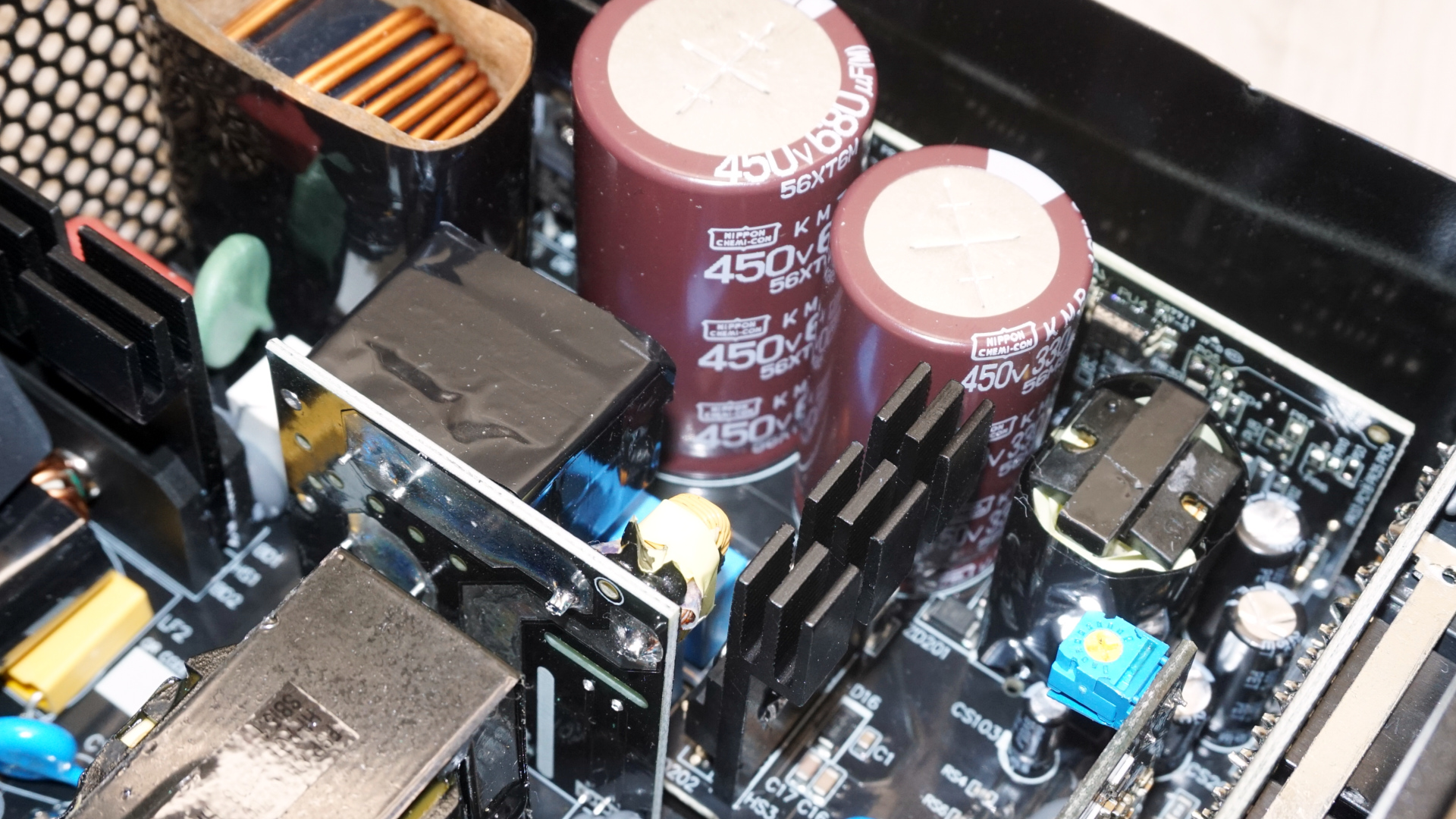
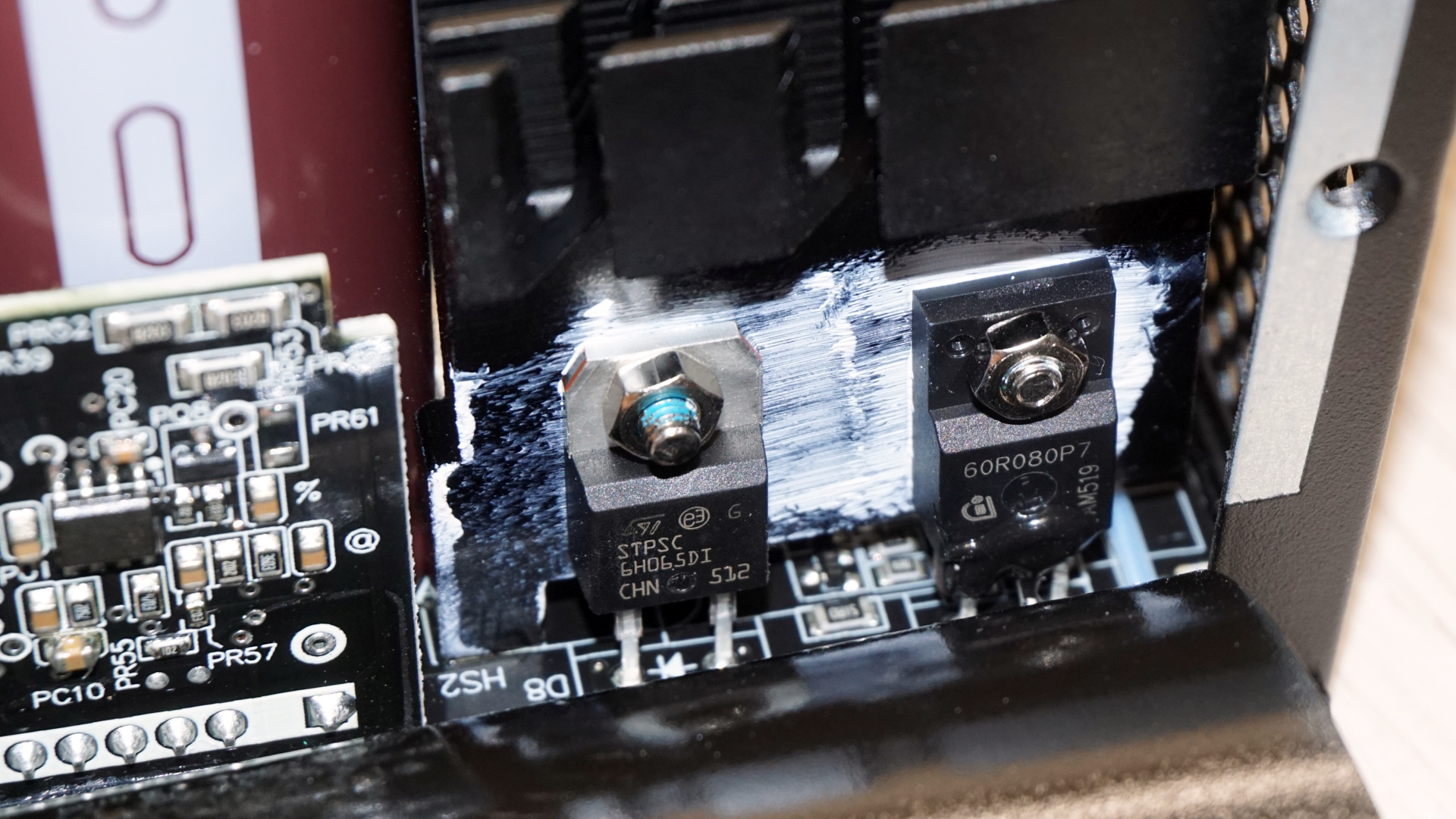
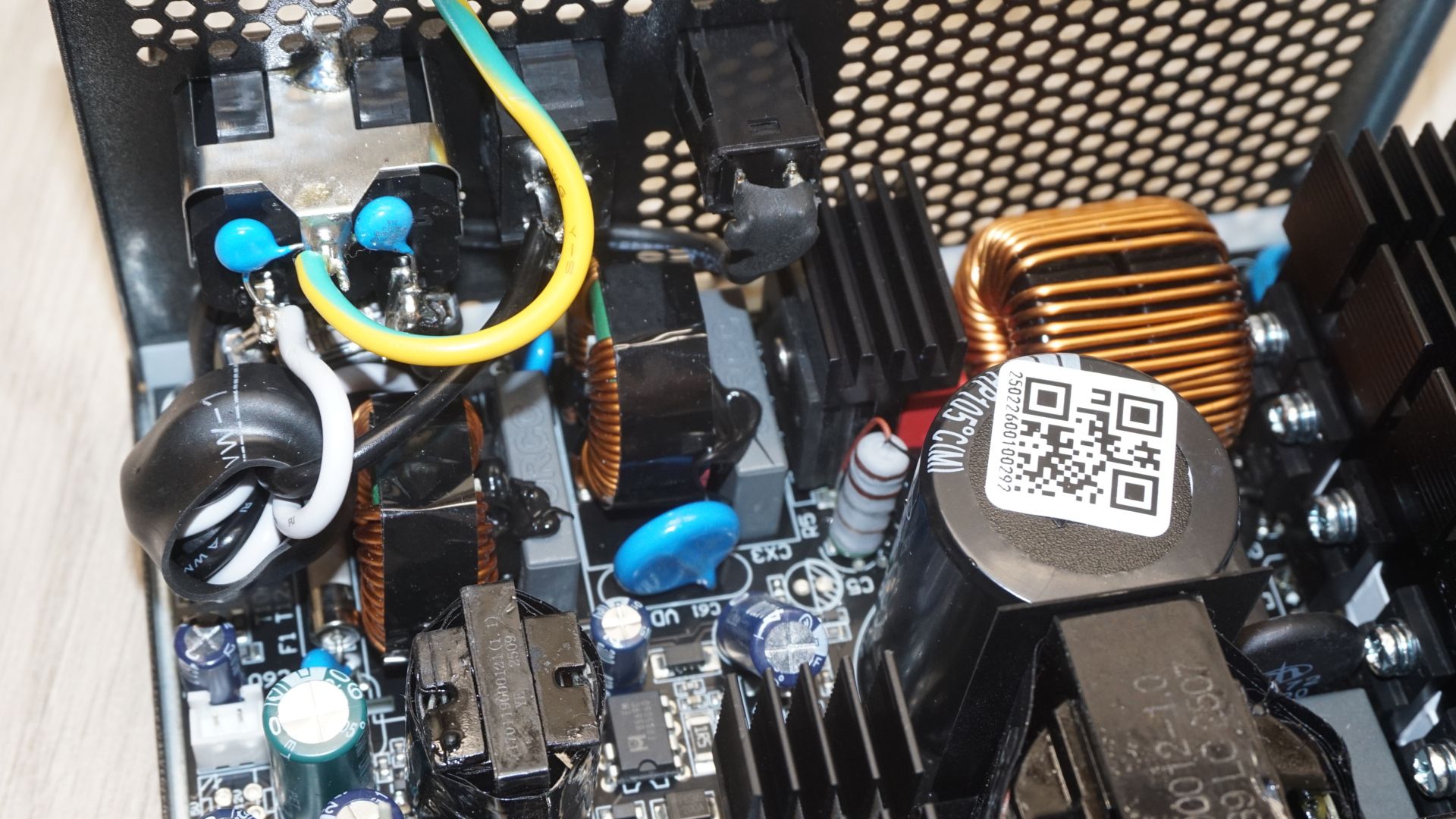
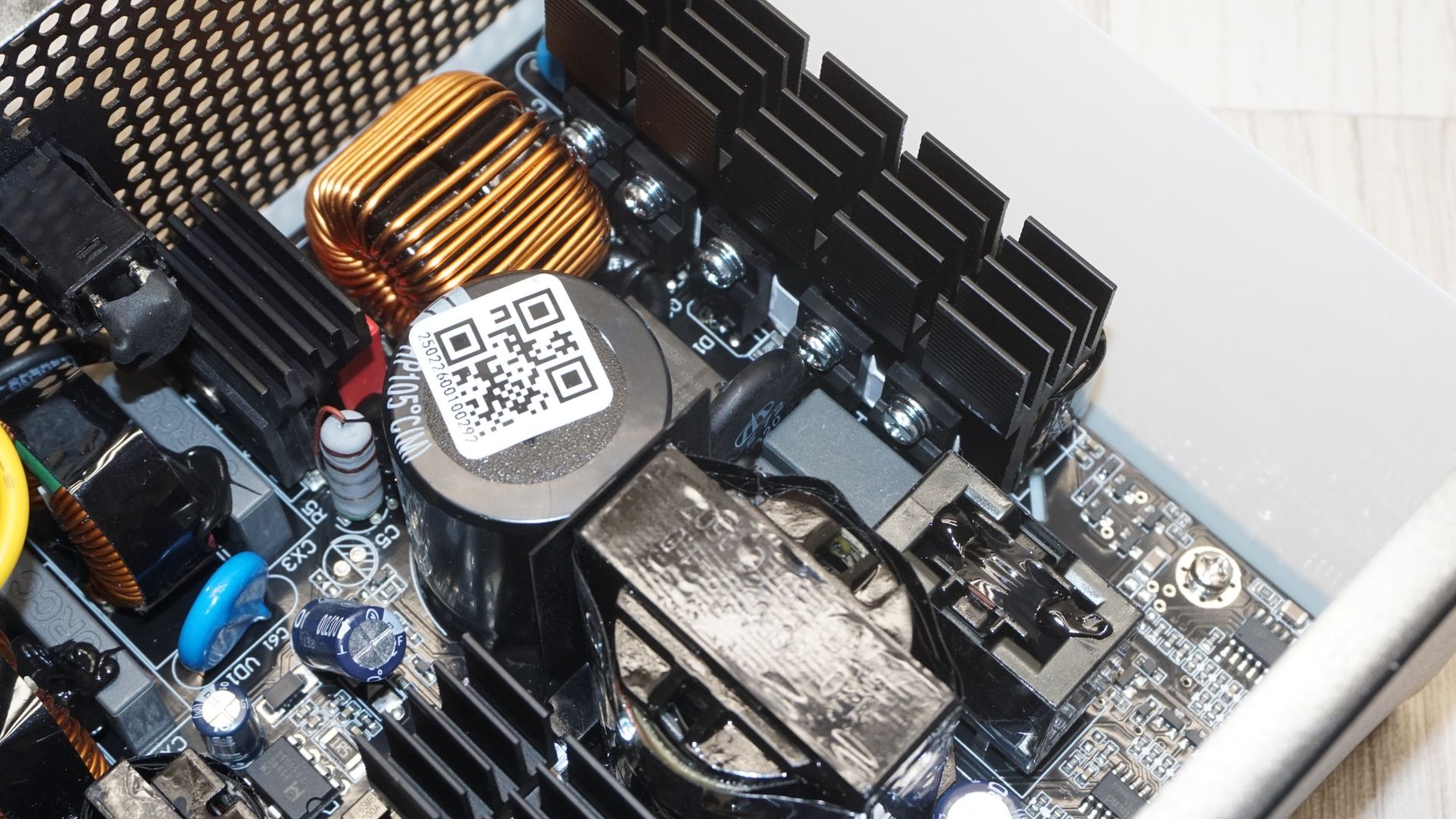
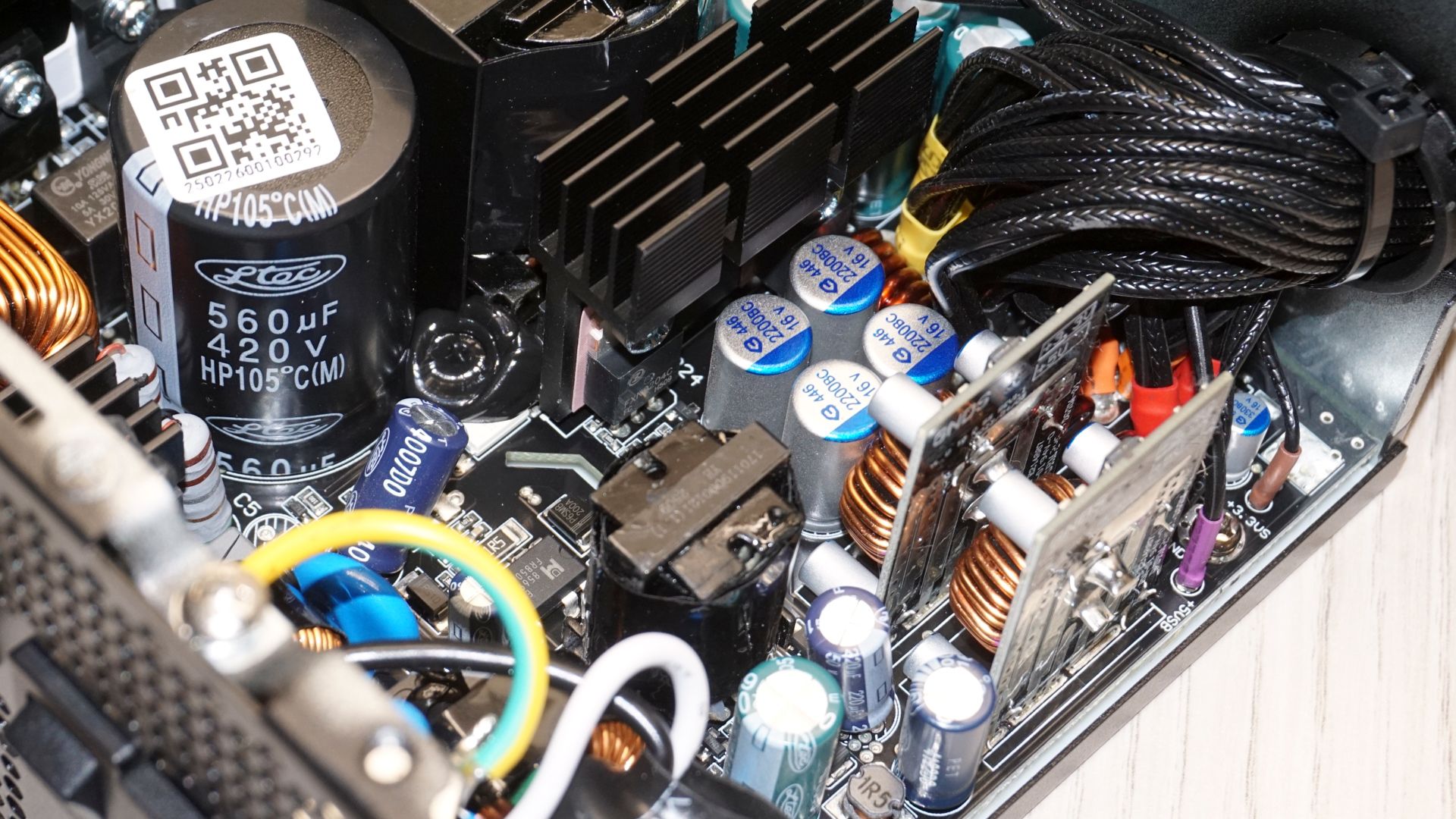
Transient filtering runs to four Y capacitors, three X capacitors and two common-mode chokes, which is a complete filter by any reasonable standard and better provisioned than several units we have looked at this year. Inrush is handled by an NTC thermistor with a relay for bypass. Two bridge rectifiers sit on their own dedicated heatsink, feeding an APFC stage built around two Oriental Semiconductor OSG55R190F MOSFETs. The bulk capacitor is a 560 µF, 420V Ltec from its HP series, rated at 105°C. That is a low-cost Taiwanese part rather than a premium one, and it is the first place the budget shows. Capacity is adequate for 750W, the temperature rating is right, but the pedigree is not. The APFC coil beside is unshielded, which is a cost decision rather than a functional problem, though it does nothing for radiated noise.
AZZA PSAZ-750G ATX 3.1

(Image credit: Tom's Hardware)

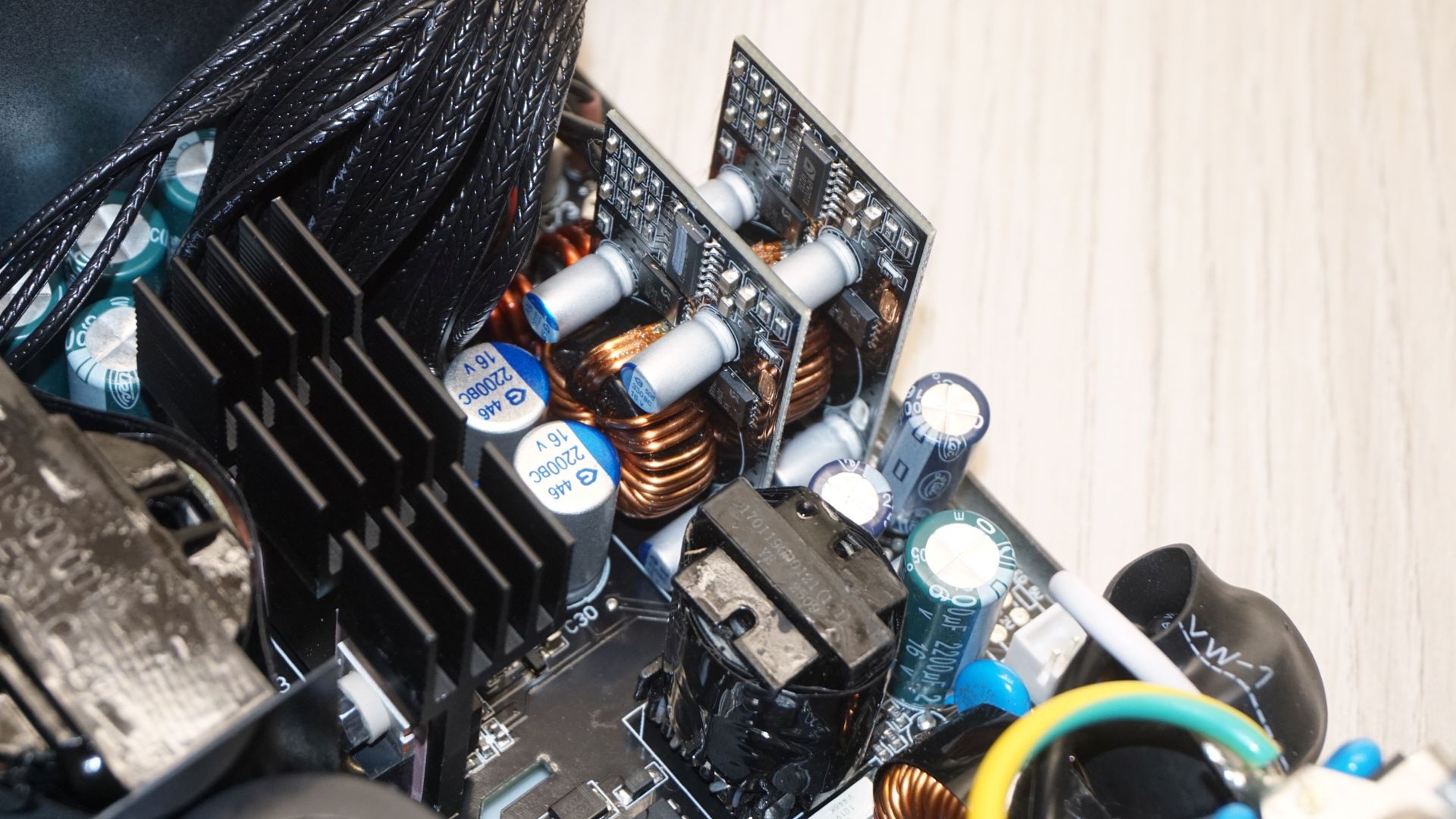
The primary inversion stage uses two PIP PTA25N50 MOSFETs in a half-bridge LLC resonant arrangement, the standard modern topology at this power level. On the secondary side, the 12V rail is rectified by four Fuxin FXN0204C MOSFETs in synchronous rectification, with the 3.3V and 5V rails generated by DC-to-DC converters on the two vertical daughterboards.
AZZA PSAZ-750G ATX 3.1
Tom's Hardware
AZZA PSAZ-750G ATX 3.1
Tom's Hardware

Secondary filtering is a mix of Ltec electrolytics and a smaller number of APAQ polymer capacitors, both Taiwanese. This is the part of the component list that will decide how the unit ages: Ltec electrolytics are not terrible parts, but they are at best ordinary ones, and they will spend their life sitting next to secondary heatsinks that may hit well over 70 °C in a normal system. A 2-year warranty against that combination is not a comfortable pairing.
AZZA PSAZ-750G ATX 3.1

(Image credit: Tom's Hardware)

Cold Test Results (25°C Ambient)

Cold Test Results (25°C Ambient)

For the testing of PSUs, we are using high-precision electronic loads with a maximum power draw of 2700 Watts, a Rigol DS5042M 40 MHz oscilloscope, an Extech 380803 power analyzer, two high-precision UNI-T UT-325 digital thermometers, an Extech HD600 SPL meter, a self-designed hotbox, and various other bits and parts.
AZZA PSAZ-750G ATX 3.1
Tom's Hardware
AZZA PSAZ-750G ATX 3.1
Tom's Hardware
AZZA PSAZ-750G ATX 3.1
Tom's Hardware
AZZA PSAZ-750G ATX 3.1
Tom's Hardware
AZZA PSAZ-750G ATX 3.1
Tom's Hardware

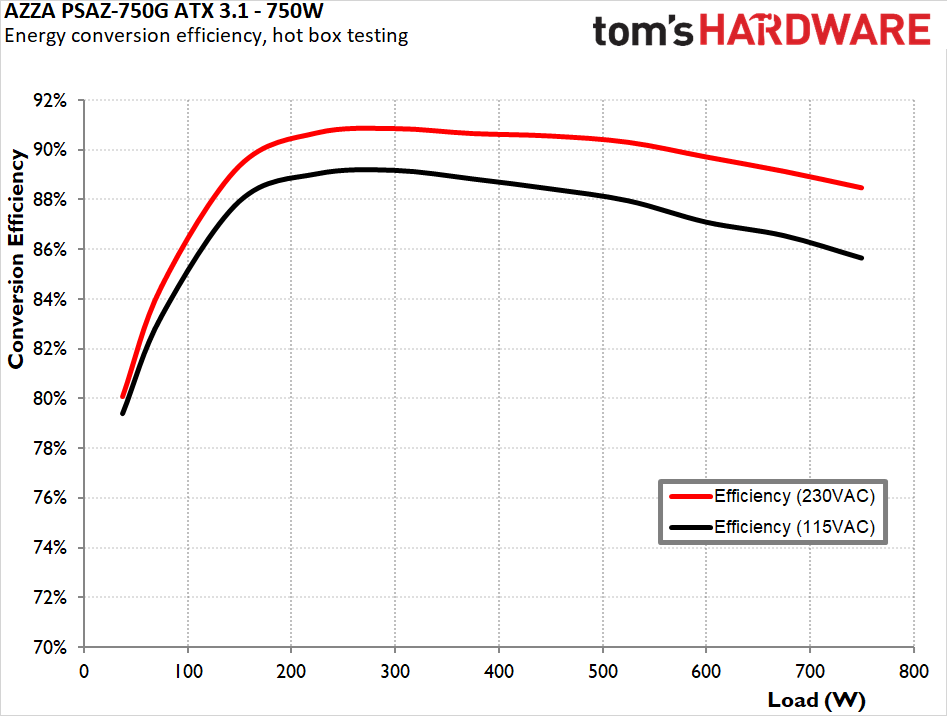
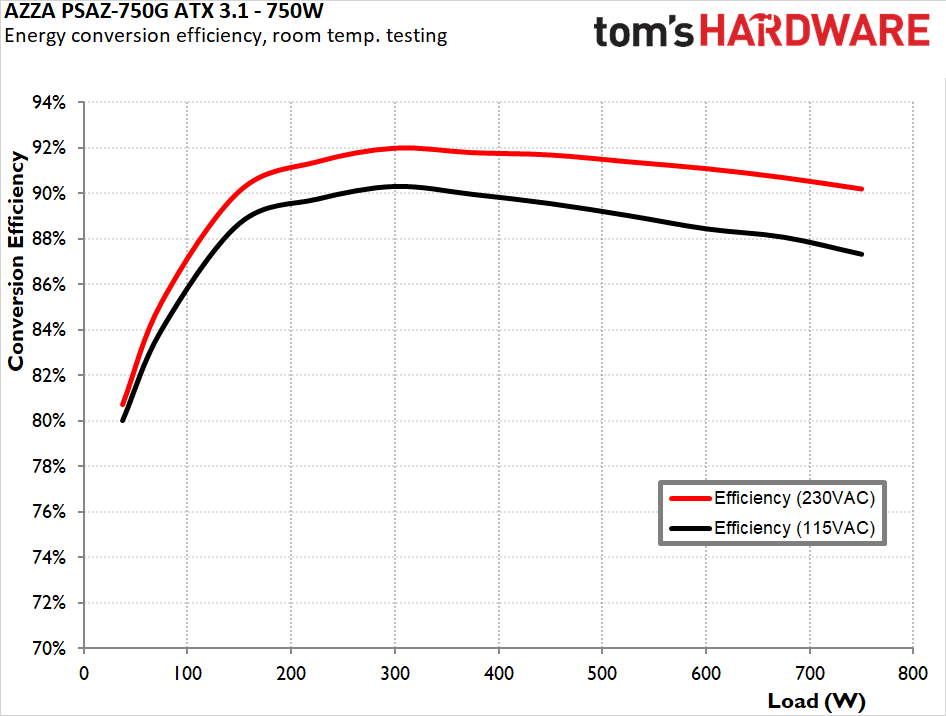
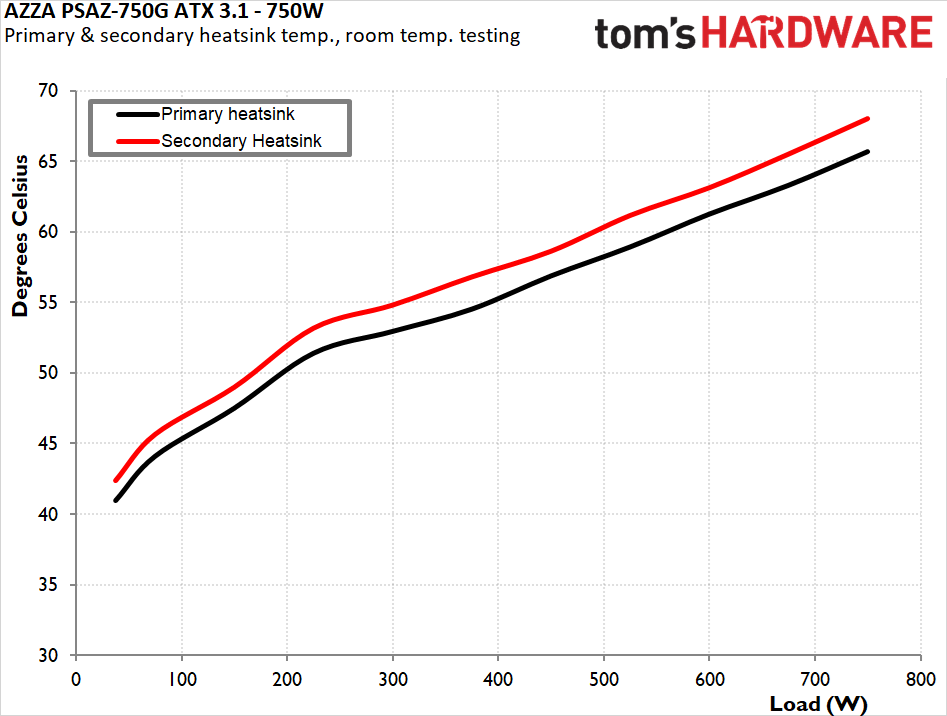
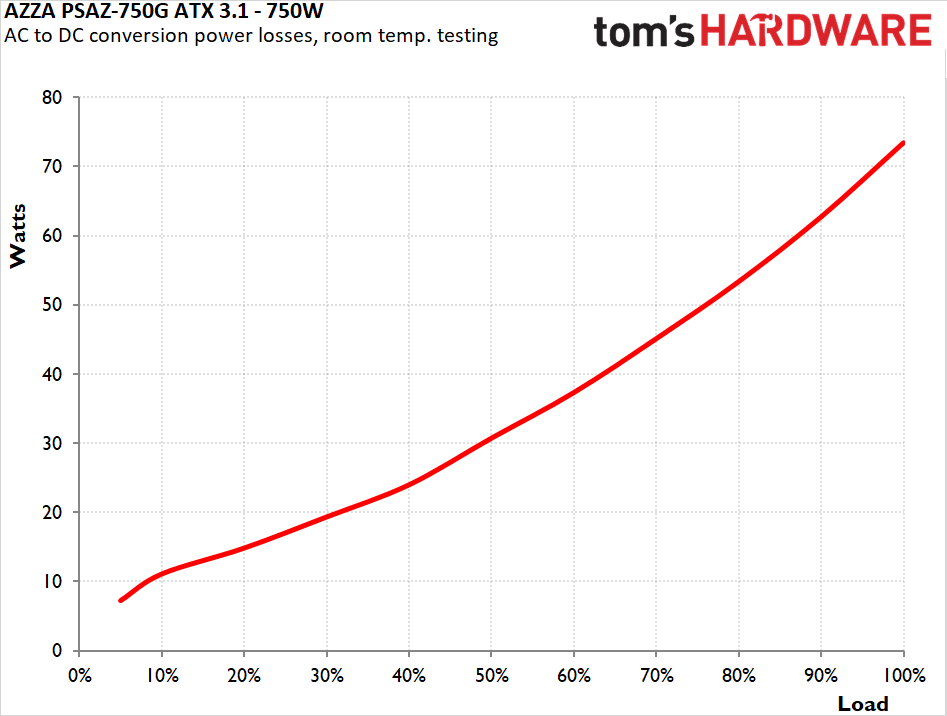
At 25°C ambient the PSAZ-750G averaged 90.6% at 230 VAC and 88.6% at 115 VAC across the nominal load range. The curve peaks at about 92% at 230 VAC around 300W and holds 90.2% at a sustained 750W, with the 115 VAC line topping out at 90.3% and finishing at 87.3%. Those are respectable numbers and the shape of the curve is healthy, with no full-load collapse. They are also, and this is the point, not Gold. 80 PLUS Gold requires 90/92/89% at 20/50/100% load on 230 VAC and 87/90/87% on 115 VAC. We measured 90.1/91.8/90.2% and 88.7/89.9/87.1% respectively. The unit clears the 20% and 100% checkpoints on both inputs and misses the 50% checkpoint on both, by 0.2 and 0.1 points. It is a near miss rather than a fraud and CLEAResult tests at 23 °C so it could possibly pass, but there is no 80 PLUS entry for the PSAZ series after 2015 to argue otherwise. There is no Cybenetics listing either.

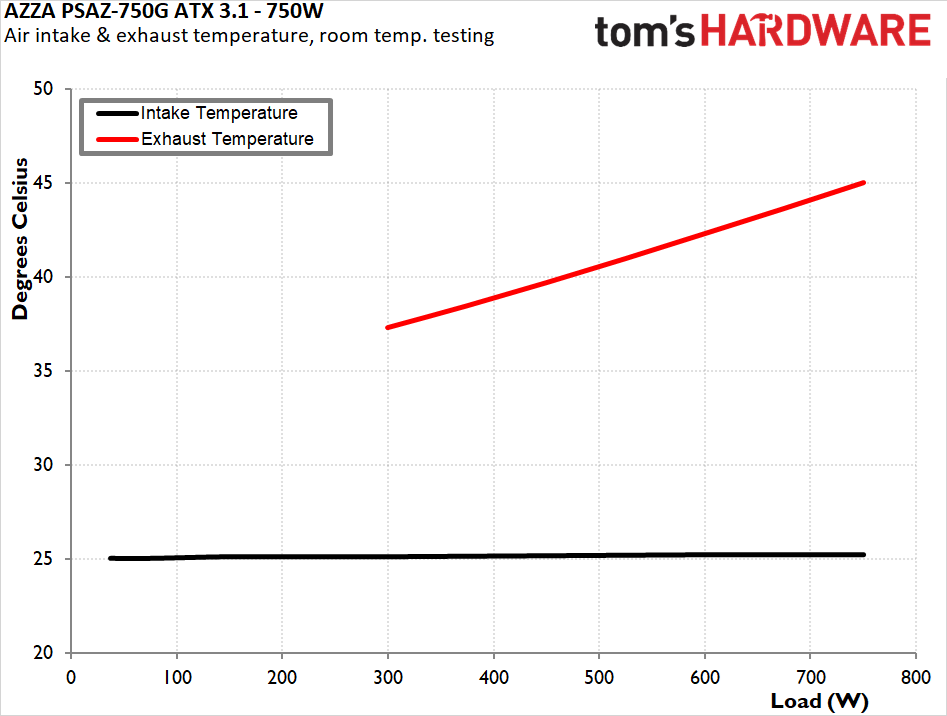
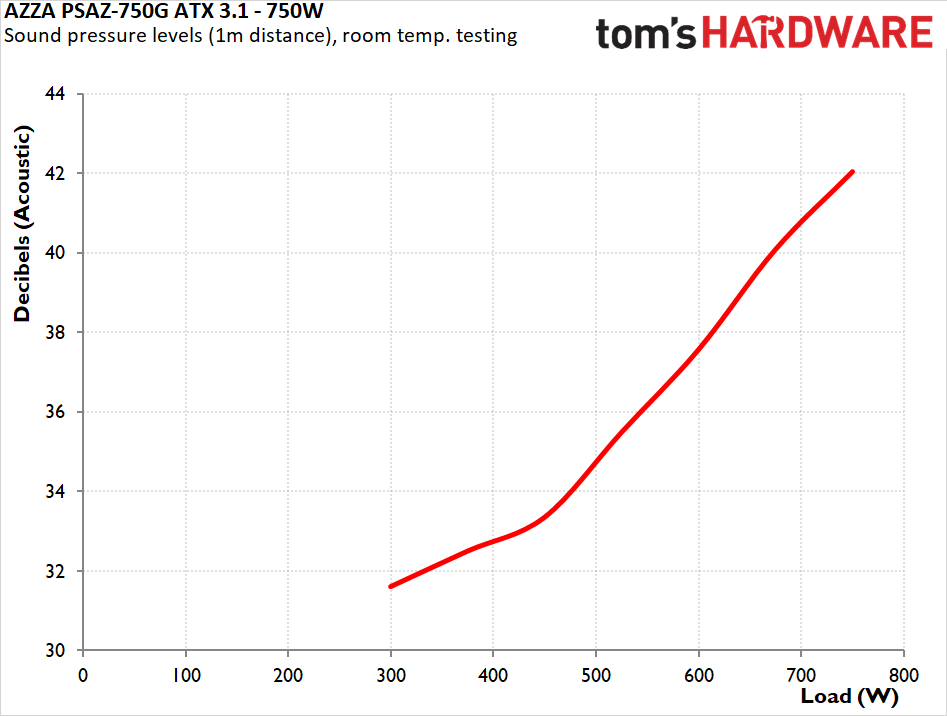
Acoustically the cold run is the best part of this review. The fan stays completely stopped up to roughly 40% load, giving a genuine 300W fanless window that covers desktop work and a good deal of gaming outright. It starts at 31.6 dB(A) and ramps gently to about 33 dB(A) at half load, at which point it becomes the quietest thing in most builds. Past 450W the curve steepens noticeably, reaching 38 dB(A) at 600W and 42 dB(A) at a sustained 750W. That is audible but not intrusive, and it is a reasonable trade for a good thermal result. The heatsinks reached 66-68°C at full load. Nothing here is under severe stress.

Hot Test Results (~45°C Ambient)

Hot Test Results (~45°C Ambient)

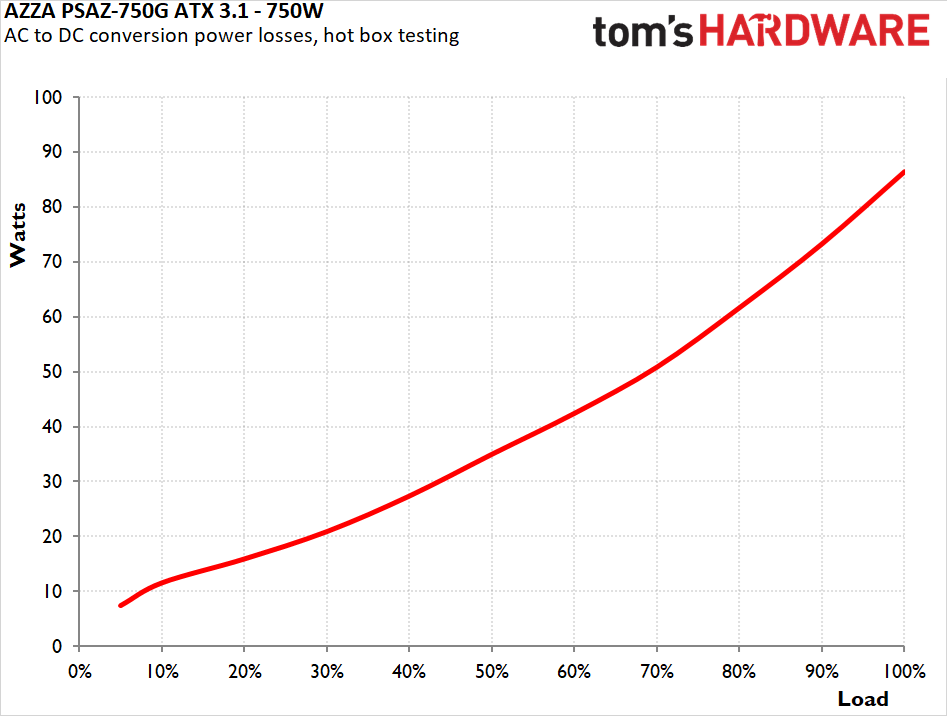
Inside the hotbox at roughly 45°C ambient, five degrees above the unit's own 40°C rating, efficiency falls by roughly a point and a half. It was not an unexpected result but it is severe for a 750W unit. The averages come to 89.4% at 230 VAC and 87.5% at 115 VAC, with the curve peaking near 90.8% and finishing at 88.5% and 85.6% respectively at full load. Nothing in the electrical behavior suggests the platform is in deep trouble but we can see the signs of thermal degradation at full load.

AZZA PSAZ-750G ATX 3.1
Tom's Hardware
AZZA PSAZ-750G ATX 3.1
Tom's Hardware
AZZA PSAZ-750G ATX 3.1
Tom's Hardware
AZZA PSAZ-750G ATX 3.1
Tom's Hardware
AZZA PSAZ-750G ATX 3.1
Tom's Hardware

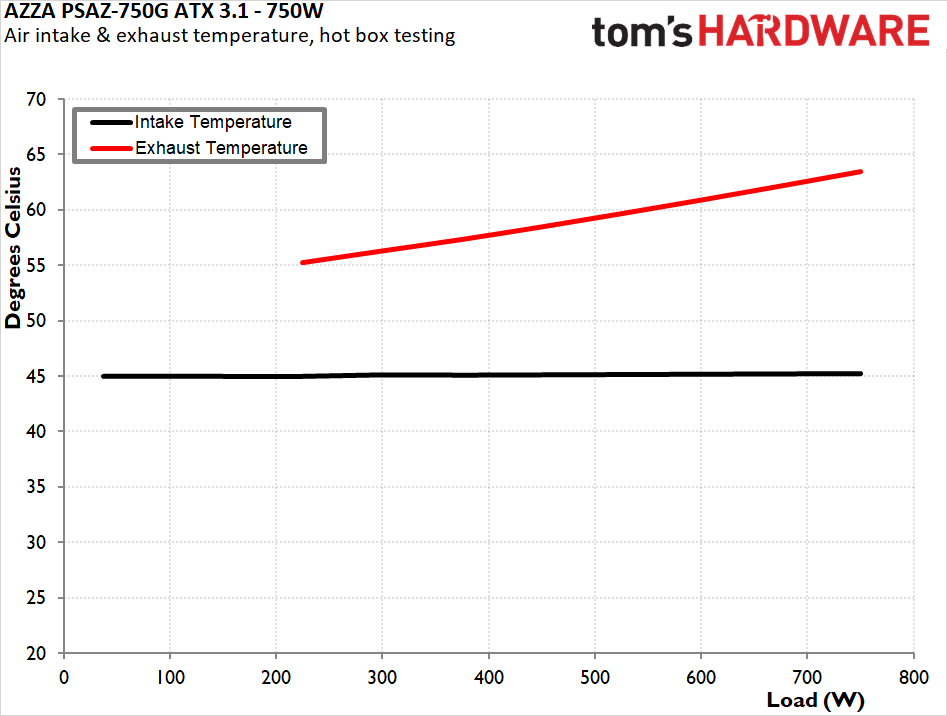
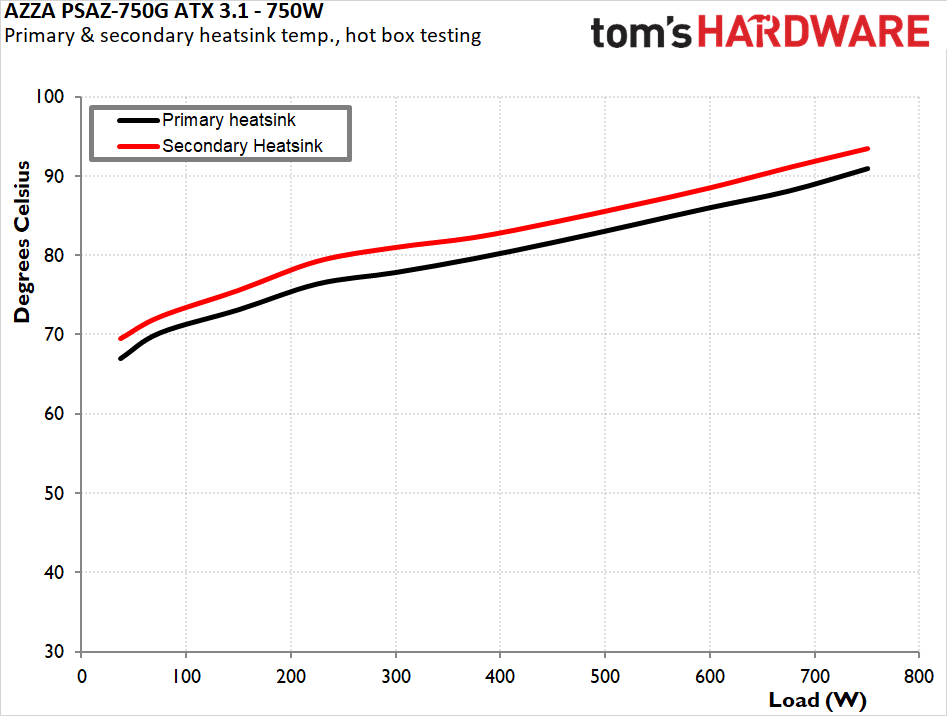
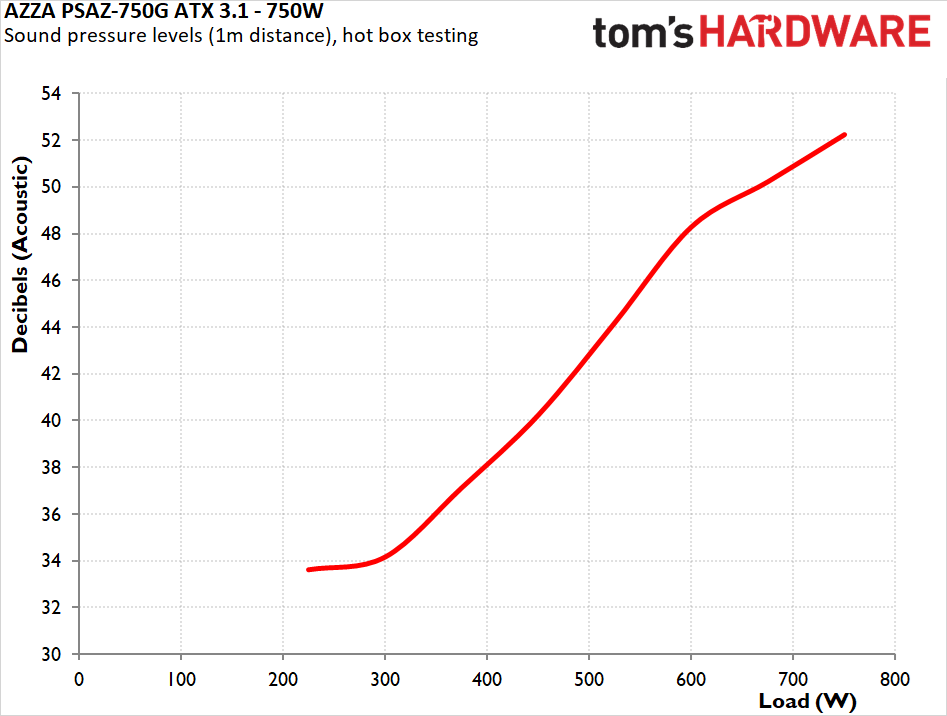
The thermal and acoustic picture is where the platform shows its limits. The fan leaves its passive mode in the hot box very quickly, starting at about 33.6 dB(A) from 200W, then climbing steeply and continuously: 43 dB(A) at 500W, 48.6 dB(A) at 600W, and 52.2 dB(A) at a sustained 750W. That last figure is loud in the plain sense of the word, well past the point where the PSU is the loudest component in a mid-tower and into the range where it likely is the loudest thing in the room. It is also the fan doing exactly what it should, because the internal temperatures need it. The heatsinks reached 94°C at full load, which is on the high side for a 750W unit. Those are not typically failure temperatures, but they are high enough to matter for the Ltec secondary electrolytics sitting beside them over a several-year ownership period.

PSU Quality and Bottom Line

Power Supply Quality

Voltage regulation is the strongest result on the sheet. Across the 20% to 100% load span the 12V rail moved by just 0.9%, with the 3.3V and 5V rails both at 1.4%. Sub-1% on 12V is genuinely good, better than several other Gold units, and it is the credit side of the DC-to-DC secondary arrangement. The minor rails are looser, but both stay comfortably inside the ±5% ATX window and neither matters much to a modern system.

Ripple suppression is adequate rather than good. The 12V rail peaked at 52 mV at full load and 50 mV in the 12V-weighted cross-load test, against a 120 mV ATX limit. The 3.3V and 5V rails topped out at 26 and 28 mV against their 50 mV limits. Those are passes with about 57% headroom on 12V and roughly 45% on the minor rails, so nothing is close to the edge. They are also roughly double what a well-filtered enthusiast platform delivers, and the 12V figure more than doubles between 50% and 100% load, which points at secondary filtering that is sized to the requirement rather than beyond it. For the hardware a 750W unit at this price will actually feed, it is sufficient.

During our thorough assessment, we evaluate the essential protection features of every power supply unit we review, including Over Current Protection (OCP), Over Voltage Protection (OVP), Over Power Protection (OPP), and Short Circuit Protection (SCP).

All protection mechanisms were present and triggered correctly. With the unit hot, OCP tripped at 146% on the 3.3V rail (29.2A), 140% on the 5V rail (28A), and 128% on the 12V rail (79.4A), with OPP shutting the unit down at about 130% of rated output, or roughly 975W. The 12V threshold is the sensible one of the three. The minor-rail thresholds are loose enough that the 100W combined budget is the real constraint there, not the protection.

Main Output

Load (Watts)

151.27 W

377.39 W

563.17 W

749.01 W

Load (Percent)

20.17%

50.32%

75.09%

99.87%

Amperes

Volts

Amperes

Volts

Amperes

Volts

Amperes

Volts

3.3 V

1.81

3.37

4.53

3.36

6.8

3.33

9.07

3.32

5 V

1.81

5.06

4.53

5.05

6.8

5.01

9.07

4.99

12 V

11.25

12.09

28.11

12.07

42.17

12.01

56.23

11.98

Line

Regulation

Voltage Ripple (mV)

(20% to 100% load)

20% Load

50% Load

75% Load

100% Load

CL1
12V

CL2
3.3V + 5V

3.3V

1.4%

20

16

22

26

22

26

5V

1.4%

20

16

20

28

22

26

12V

0.9%

30

22

36

52

50

28

Bottom Line

The PSAZ-750G is a competent budget power supply carrying a claim it cannot support. The Helly platform underneath is more modern than the price suggests and used by several manufacturers at this price point. Inside, we have a half-bridge LLC primary, DC-to-DC minor rails, a complete transient filter, generously sized heatsinks, a ball-bearing fan and a native 12V-2x6 connector. Regulation on the 12V rail is genuinely good at 0.9%, ripple is comfortably inside specification everywhere, protections all work and trip at sane thresholds, and the 300W fanless window at room temperature is real. There is nothing broken here.

AZZA PSAZ-750G ATX 3.1

(Image credit: Tom's Hardware)

The efficiency claim, however, is one that does not survive contact with the bench. Our numbers put the unit 0.2 points under the Gold requirement at 50% load on 230 VAC and 0.1 under it on 115 VAC, clearing every other checkpoint. CLEAResult tests at 23°C, so a good sample could plausibly clear the bar on the official bench. On the other hand, other units using the same platform passed our testing, even if they were fully modular (typically hardwired cables increase efficiency slightly). AZZA has not certified a PSAZ unit since 2015, there is no official 80 PLUS entry for this particular model, no Cybenetics listing and no PLPP listing, yet the Gold logo is printed on the box, on the label and in the retail listings. The unit performs like a borderline Gold supply. It is being sold as a certified one. Those are not the same thing, and the second is the vendor's choice, not a measurement artifact.

Most of the remaining compromises are ordinary for the money. Hardwired cabling at 750W in 2026 is behind the market but forgivable at $78, but the Ltec capacitors is what a $78 budget buys. One thing is harder to wave through. That is the 2-year warranty, which is half or less of what every serious competitor offers; set against heatsinks that reached 94°C at full load in the hot box, with ordinary electrolytics sitting beside them, it reads as the manufacturer telling you how long it expects the unit to be its problem.

AZZA PSAZ-750G ATX 3.1

(Image credit: Tom's Hardware)

Against named rivals, the placement is straightforward. The Phanteks AMP GH series runs a related Helly platform, which is worth keeping in mind - the design itself is not the problem here; the specification is. The MSI MAG A750GL PCIE5 is fully modular, genuinely 80 PLUS Gold certified, and backed by a 10-year warranty, and it is better than the AZZA on every axis except price. The Cooler Master MWE Gold 750 V4 at $119 MSRP is quieter under sustained load, carries verified Gold efficiency and a 10-year warranty, and gives up only a little on 12V regulation, where the AZZA's 0.9% is the better figure.

The PSAZ-750G beats them on nothing but cost, but it beats them there by a wide margin. So the recommendation is narrow but real. If you are building a mid-range machine on a tight budget, the card you are pairing it with draws under 450W, and you can live with 2 years of coverage and a fixed cable loom, the PSAZ-750G will do the job, and it will do it quietly at the loads you will actually run. If any of those three conditions do not hold, the extra money for a certified, longer-warrantied, fully modular unit is the better spend, and it is not a close call. Buy it for what it measures, not for the badge on the box.

MORE: Best Power Supplies

MORE: How We Test Power Supplies

MORE: All Power Supply Content

Thermalright TR-KG750 750W power supply review: HKC-built KG unit with a Thermalright badge for $91

2026年9月11日 19:05

Thermalright is a CPU cooling company that happens to sell power supplies. Established in Taipei in 2001, it spent its first two decades building a reputation on air coolers - the Ultra-120 eXtreme and the HR series were enthusiast reference points long before the current wave of tower coolers - then drifted out of the conversation for years before the Peerless Assassin 120 dragged it back to the top of every budget build list in 2021. Its catalog has expanded aggressively since: case fans, all-in-one liquid coolers, thermal compounds, chassis, and, since 2022, power supplies. That last category deserves a different kind of scrutiny than the rest. Much like most brand names, Thermalright does not build power supplies; it commissions them, and a heatsink company's engineering credibility transfers to a PSU exactly as far as the OEM behind it allows. Every Thermalright power supply has to be judged on its platform rather than its badge.

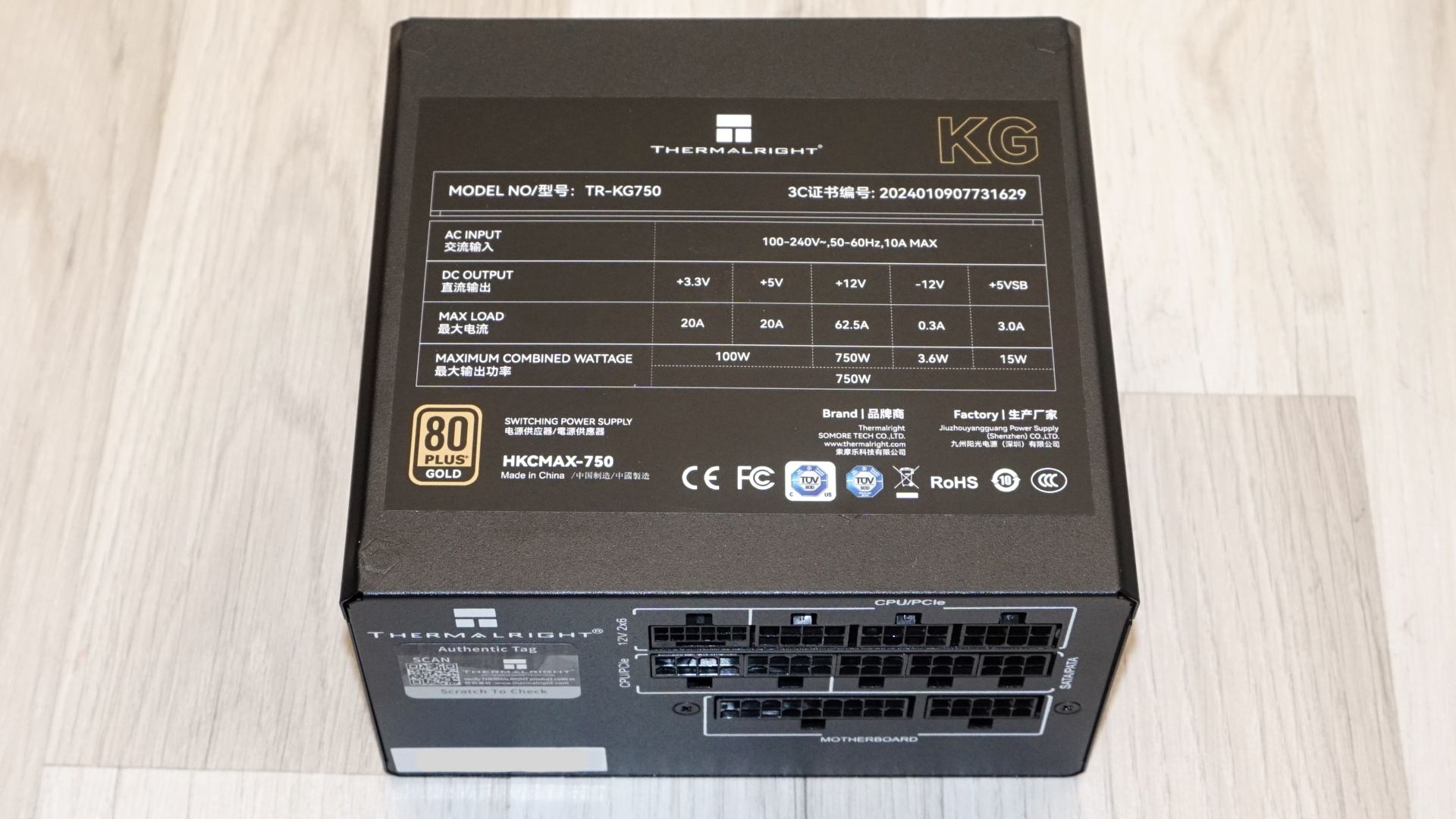
The KG series occupies the value end of Thermalright's power supply range, and the TR-KG750 reviewed here is its 750W entry. How does it hold up against the best power supplies on the market? On paper, the specification is current, with ATX 3.1 and PCIe 5.1 compliance, a native 12V-2x6 connector, full modularity, 80 PLUS Gold certification at 115 VAC, a 120 mm fan inside a 140 mm-deep chassis, and a five-year warranty. The label on the PSU itself answers the platform question without much digging. The manufacturer of record is Somore Tech Co., Ltd., the production is credited to Jiushouyangguang Power Supply (Shenzhen), and the internal designation printed beside the 80 PLUS badge is HKCMAX-750 - this is an HKC platform, and the silkscreen on the main board dates the design to April 2023. There is no Cybenetics entry for the model at the time of writing, so the 80 PLUS report is the only third-party data available on it. At a retail price of $91, it undercuts essentially every name-brand 750W Gold unit on the US market, which is the whole of its pitch.

Specifications and Design

Thermalright TR-KG750 Power specifications ( Rated @ 40 °C )

RAIL

+3.3V

+5V

+12V

+5Vsb

-12V

MAX OUTPUT

20A

20A

62.5A

3A

0.3A

100W

100W

750W

15W

3.6W

TOTAL

750W

AC INPUT

100 - 240 VAC, 50 - 60 Hz

MSRP

$91

In the Box

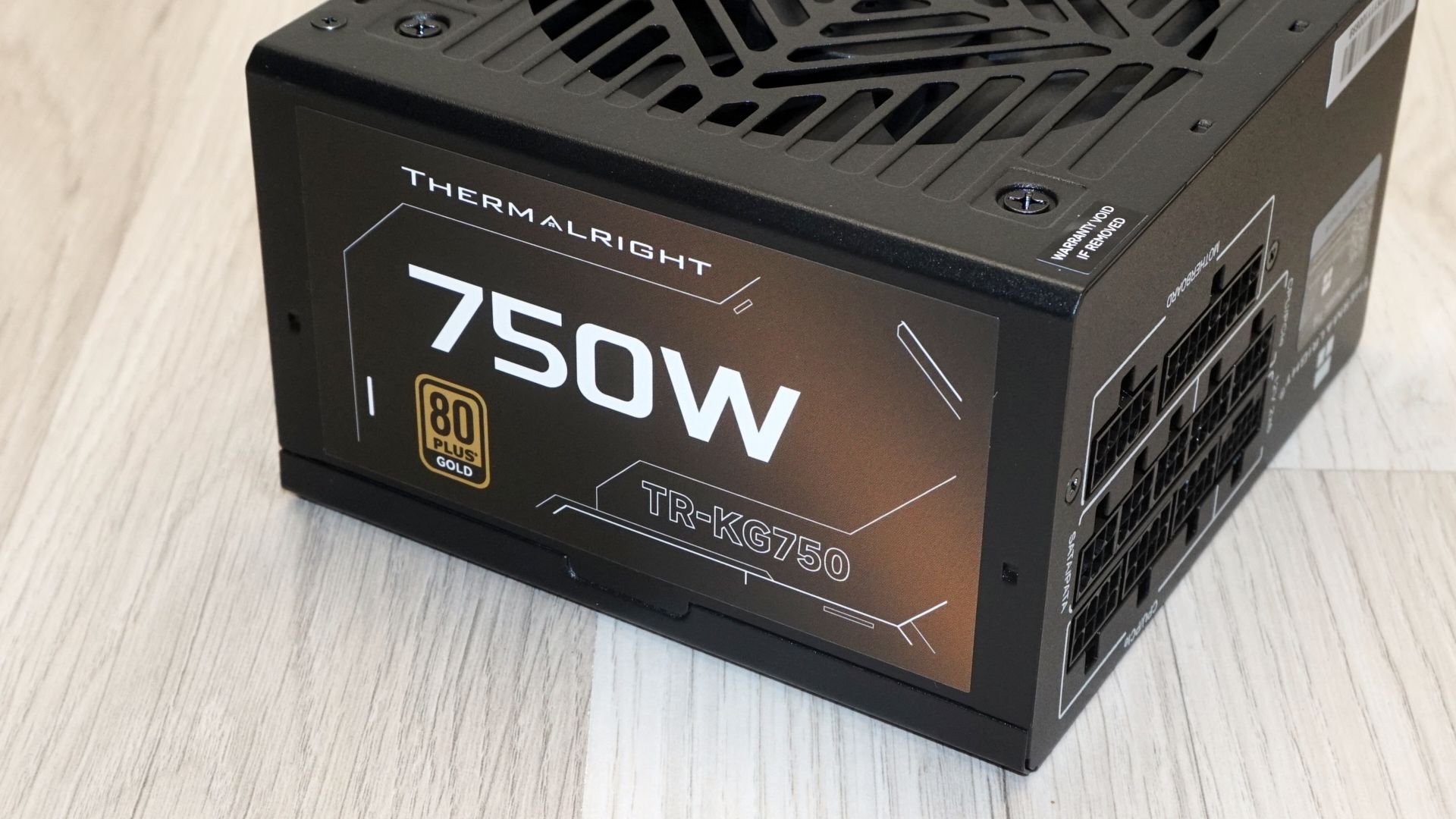
The TR-KG750 arrives in a compact cardboard box wrapped in a black-to-bronze gradient sleeve, with a three-quarter render of the unit dominating the front and the wattage set in large gold type beside it. The badge strip along the bottom edge is short: 80 PLUS Gold, ATX 3.1, PCIe 5.1, and the model number.

ThermalRight TR-KG750 750W

(Image credit: Tom's Hardware)

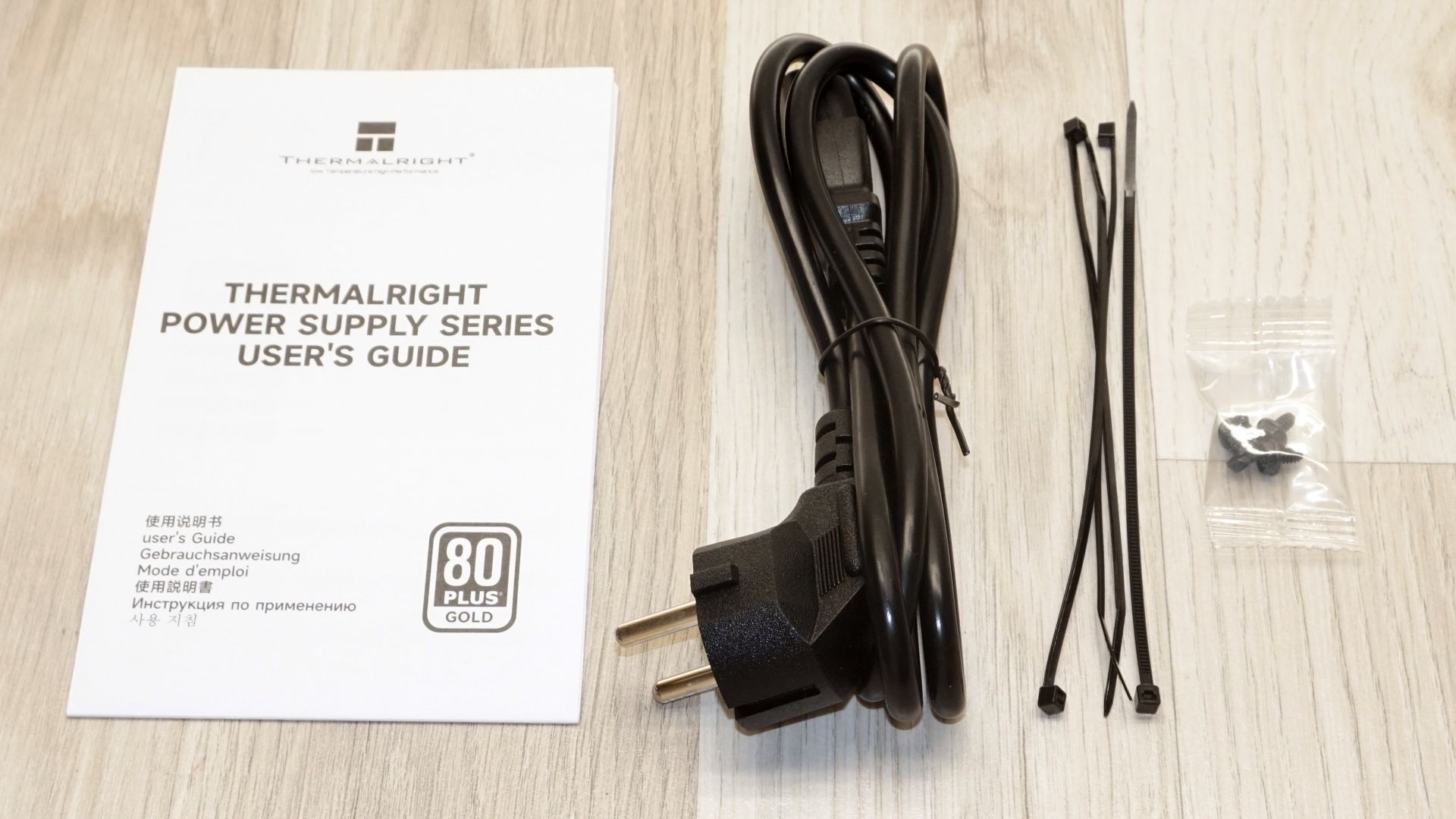
The bundle is as thin as they come. Under the protective packaging the supply is accompanied by a multilingual user’s guide, the AC power cord, a small bag of mounting screws, and four zip ties. That is the entire accessory list: no Velcro straps, no cable combs, no storage pouch. Four zip ties for an eight-cable modular supply is a token rather than a provision, and it is one of the few places where the price makes itself felt before you take the lid off.

ThermalRight TR-KG750 750W

(Image credit: Tom's Hardware)

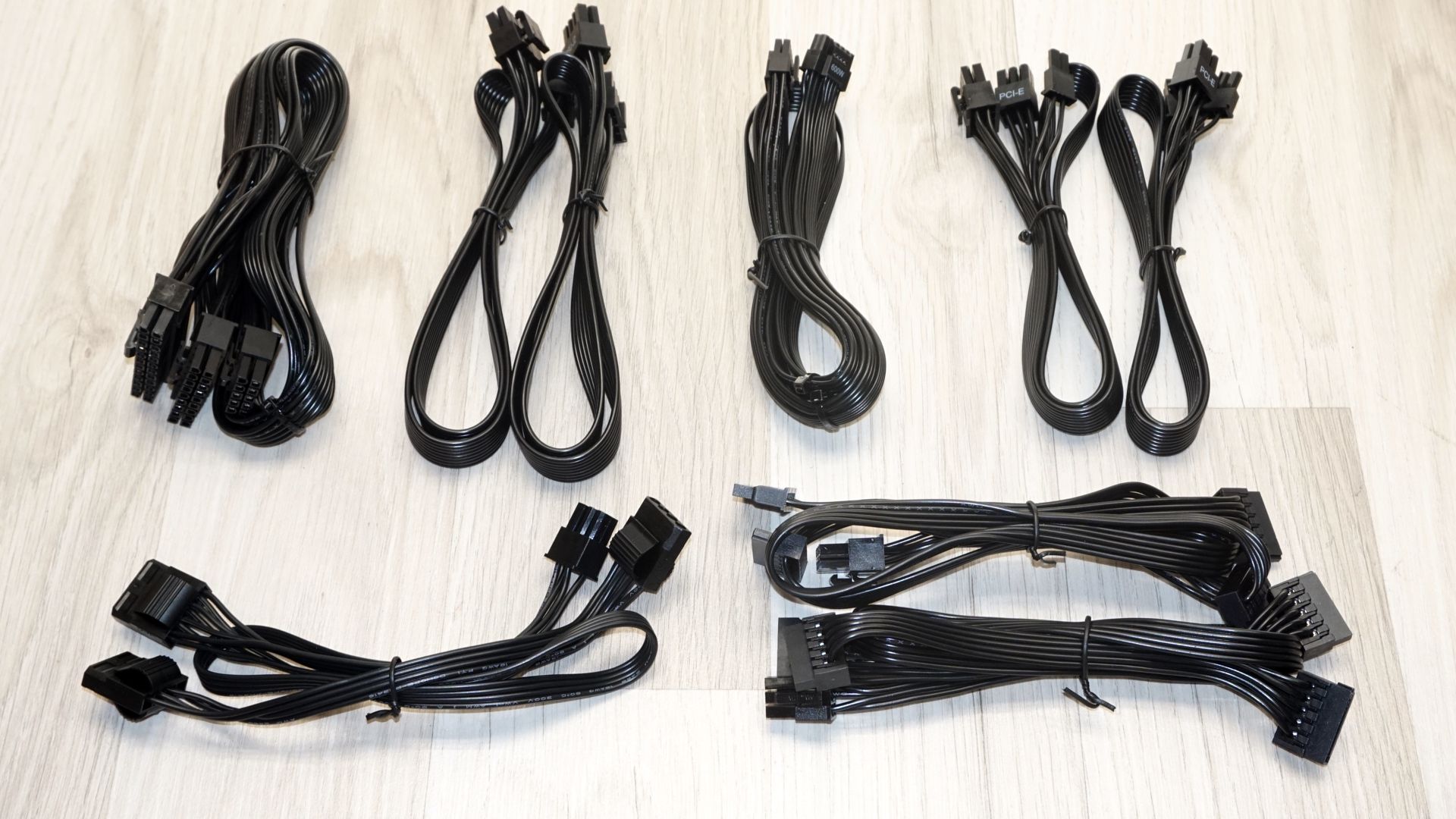
The cables are all-black flat ribbon types throughout, with no sleeving anywhere in the set. They are all uniform, adding points to the aesthetics of the unit. The 12V-2x6 cable is native - a single run from the modular panel to the graphics card, with no adapter or splitter involved - but its plug does not use the dual-color keying the ATX 3.1 specification encourages, which makes an incompletely seated connector easy to spot at a glance.

ThermalRight TR-KG750 750W

(Image credit: Tom's Hardware)
Thermalright TR-KG750

Connector type

Hardwired

Modular

ATX 24 Pin

-

1

EPS 4+4 Pin

-

2

PCI-E 5.1

-

1

PCI-E 8 Pin

-

2

SATA

-

6

Molex

-

3

Floppy

-

-

External Appearance

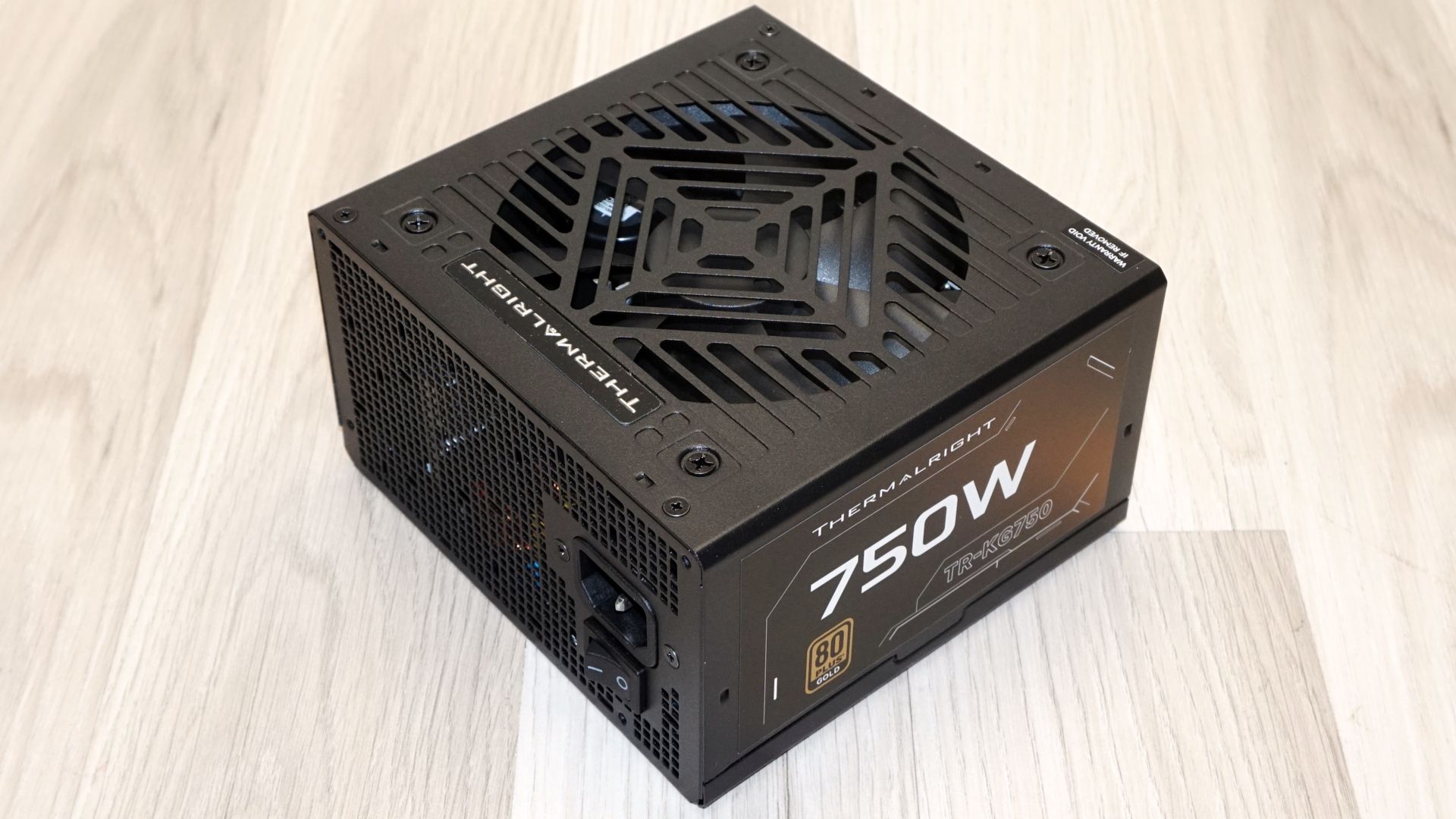
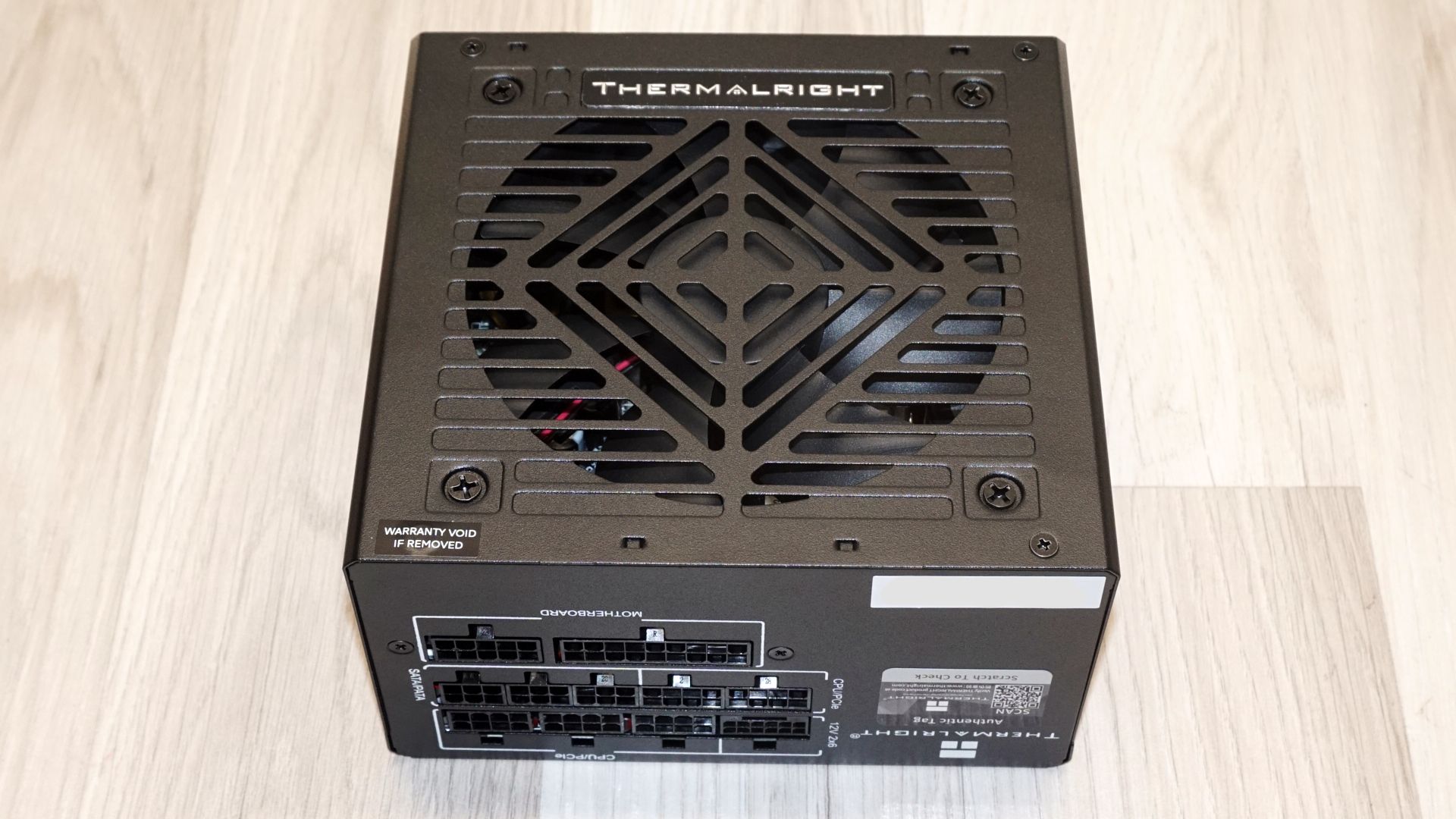
At 150 x 86 x 140 mm, the TR-KG750 is a standard-width ATX unit with a short 140 mm body, which is about as compact as a 750W supply practically gets and leaves useful slack for cable management even in a mid-tower. The chassis is finished in a matte black with a fine texture, and the top panel carries a stamped fan grille in a diamond-and-chevron pattern - four angled spokes radiating from a central square, framed by long slotted vents - with the Thermalright wordmark pressed into a raised panel at the edge. Four exposed screws sit at the corners, one of them beneath the warranty-void sticker.

ThermalRight TR-KG750 750W

(Image credit: Tom's Hardware)

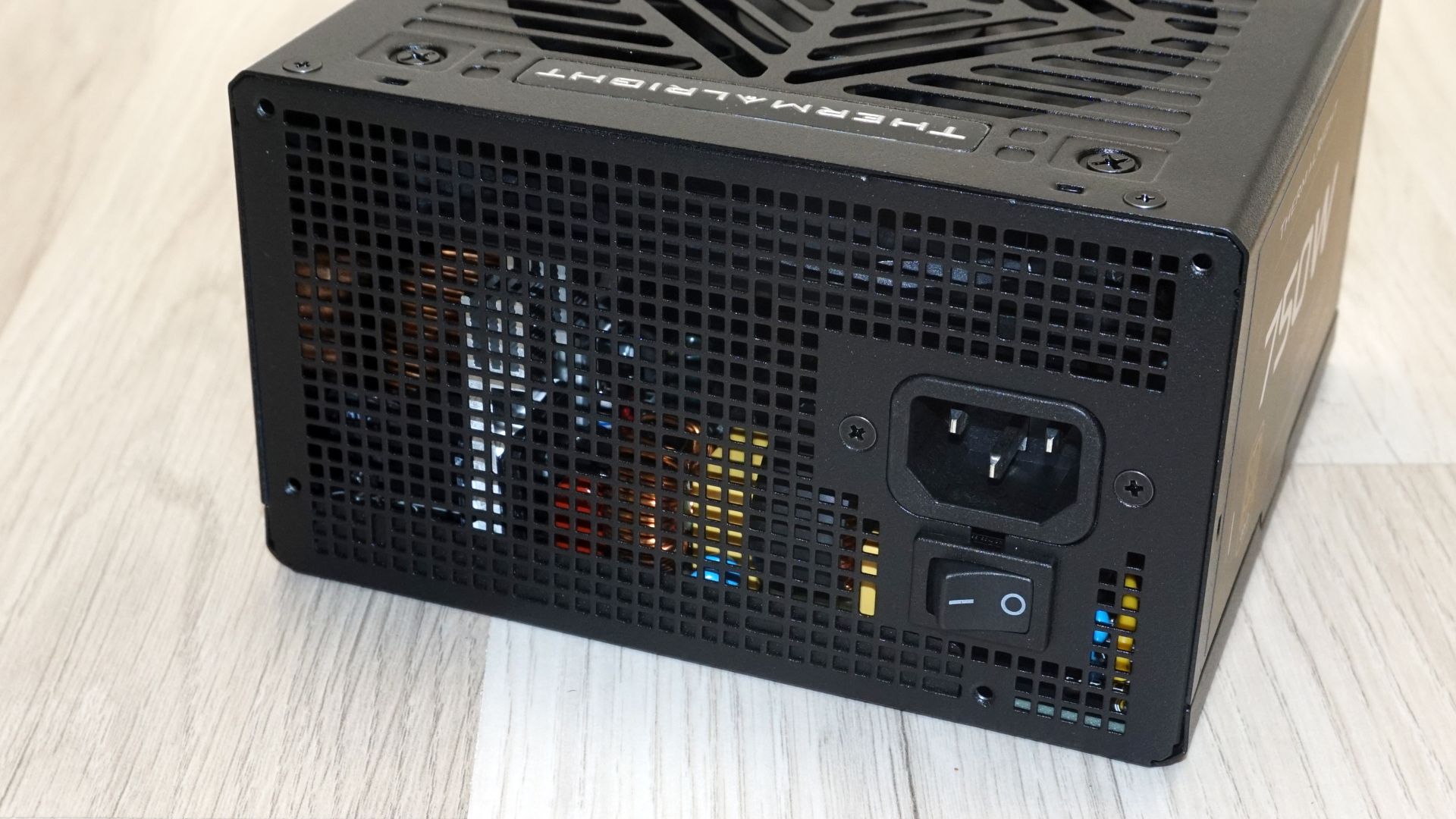
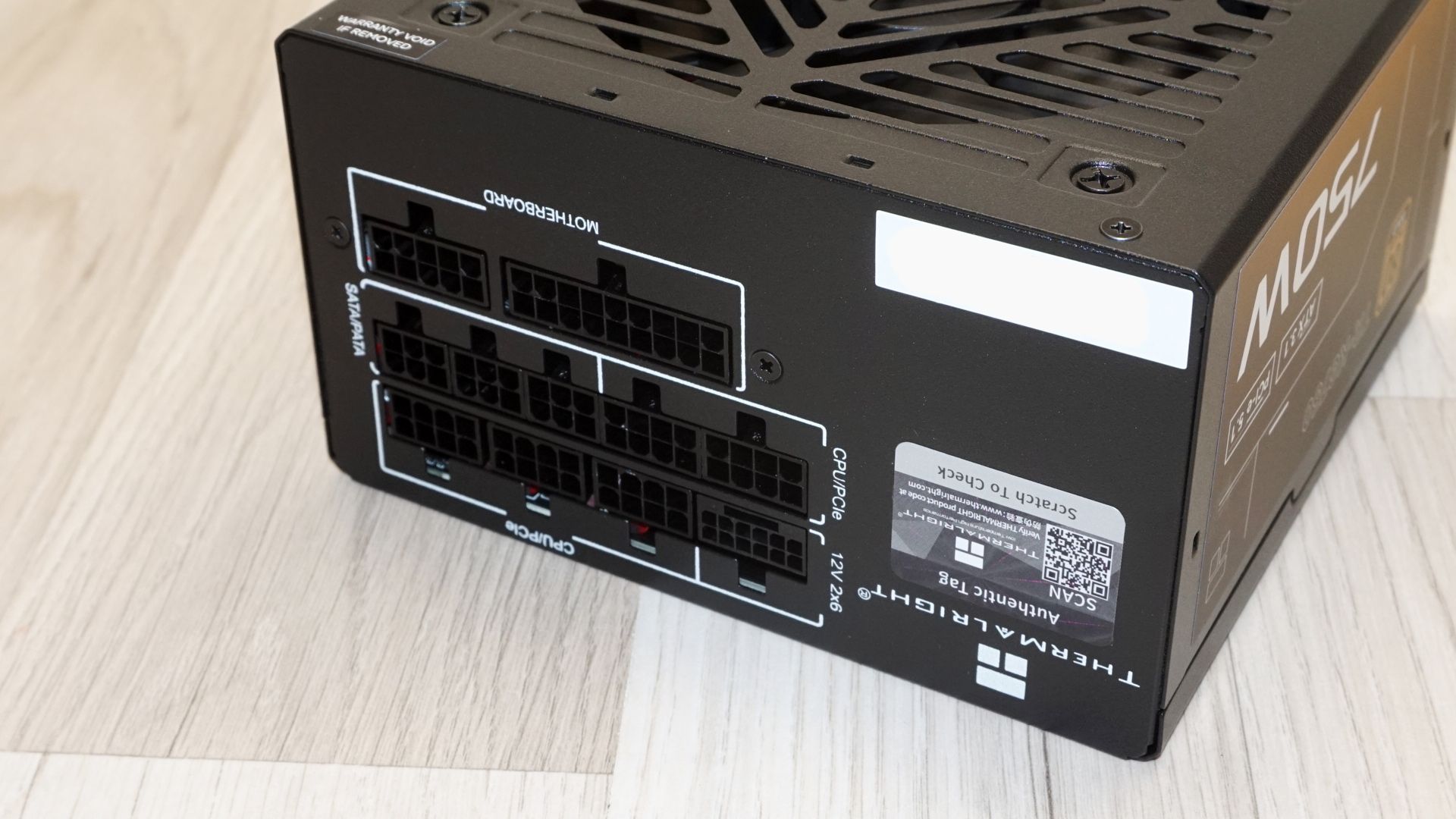
The rear face is a large square perforated exhaust panel with the AC receptacle and a rocker. The front face hosts the modular connector bay, cleanly silkscreened into four labeled groups: MOTHERBOARD for the split 24-pin, SATA/PATA for the peripheral cables, CPU/PCIe for the four eight-pin sockets, and a dedicated 12V 2x6 socket in the bottom corner. A scratch-off authenticity tag with a QR code sits alongside the panel.

ThermalRight TR-KG750 750W
Tom's Hardware
ThermalRight TR-KG750 750W
Tom's Hardware

The specification label occupies the top face rather than a side panel, which is the more useful placement for a bottom-mounted supply sitting under a windowed case, and both side panels are given over to a large bronze-gradient decal carrying the wattage, model number, and 80 PLUS Gold badge. That decal is the only decoration, and the finish underneath it is unremarkable but honest - evenly applied, no orange peel, no sharp edges. The label repeats the rail ratings, the CCC certificate number, and the internal model designation, and it is where the platform gives itself away. Build quality overall is what the price suggests: the steel gauge is adequate, the panels line up, nothing rattles, but there is none of the extra finishing that separates a $90 unit from a $150 one.

ThermalRight TR-KG750 750W
Tom's Hardware
ThermalRight TR-KG750 750W
Tom's Hardware

Internal Design

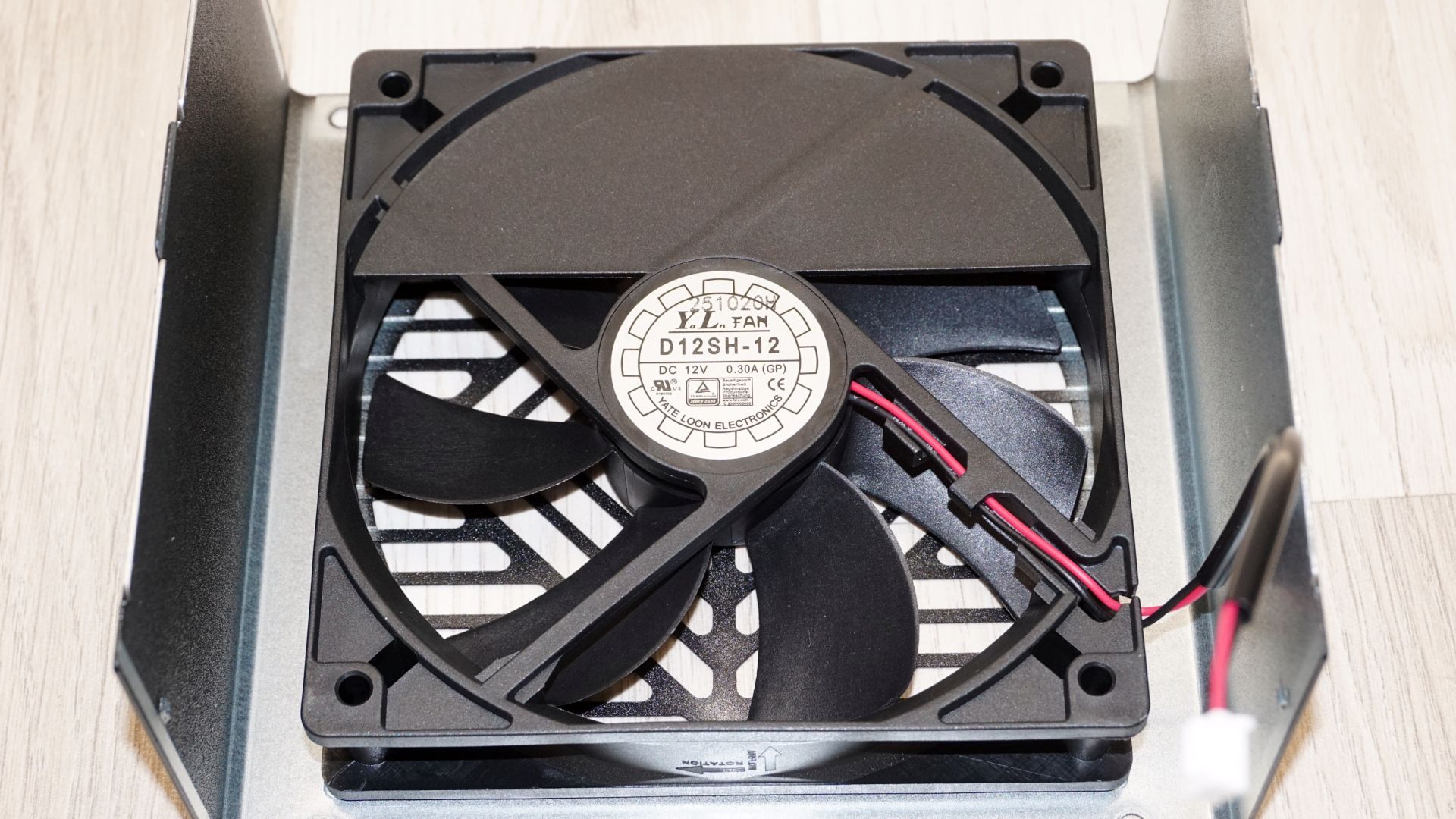
Cooling is handled by a 120 mm Yate Loon D12SH-12 rated for 12V at 0.30A. Yate Loon is a long-established Chinese fan maker, and the D-series is its bread-and-butter sleeve-bearing line, which makes this the single most consequential cost-saving in the unit. Sleeve bearings are quiet, like fluid-dynamic alternatives at equivalent speed, but wear faster and are more sensitive to heat and mounting orientation - all three of which matter in a supply that, as the test results show, runs its fan constantly and pushes it hard as soon as ambient temperature rises. The five-year warranty covers the fan, but it is not a part most owners will enjoy chasing a replacement for.

ThermalRight TR-KG750 750W

(Image credit: Tom's Hardware)

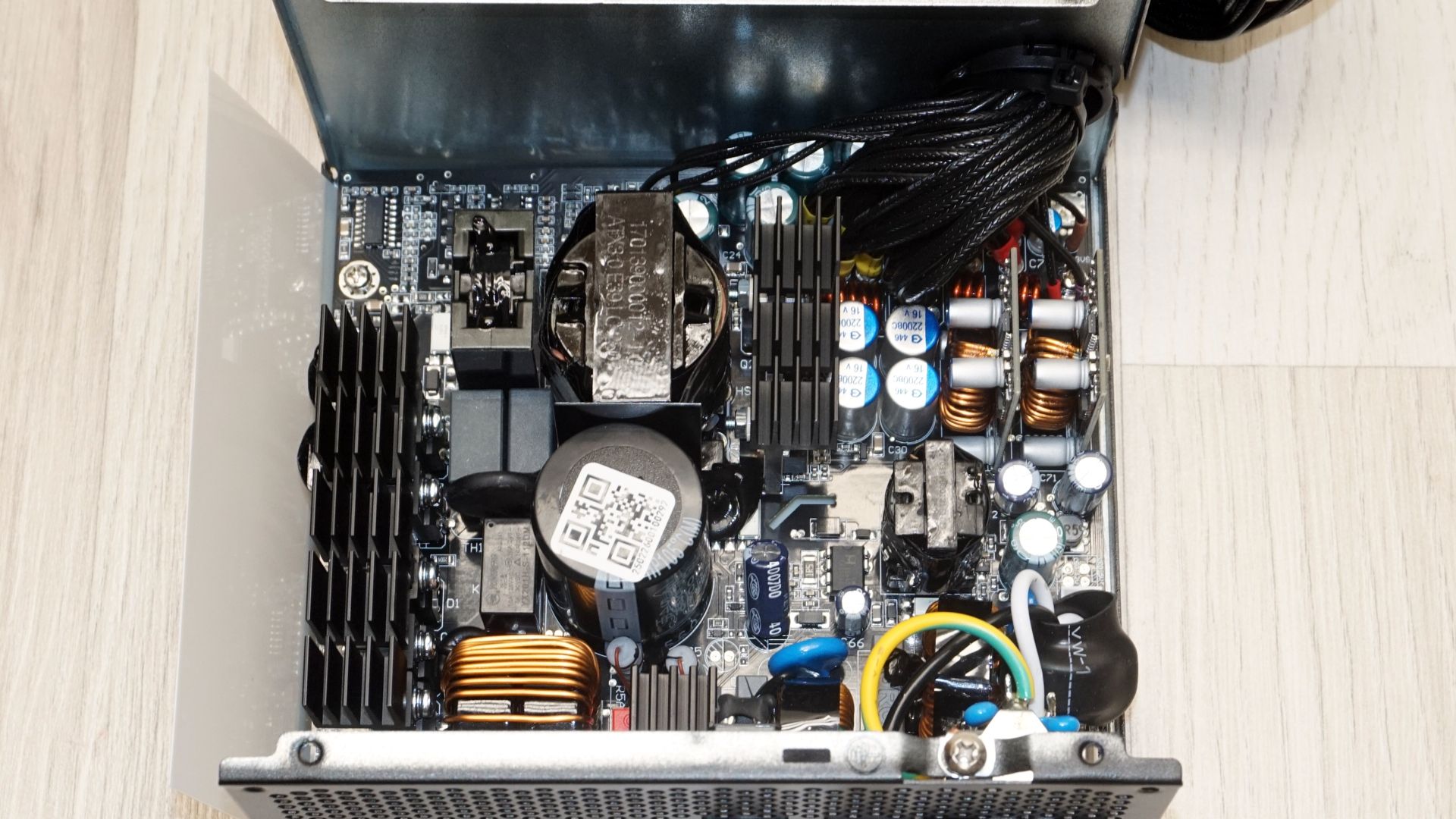
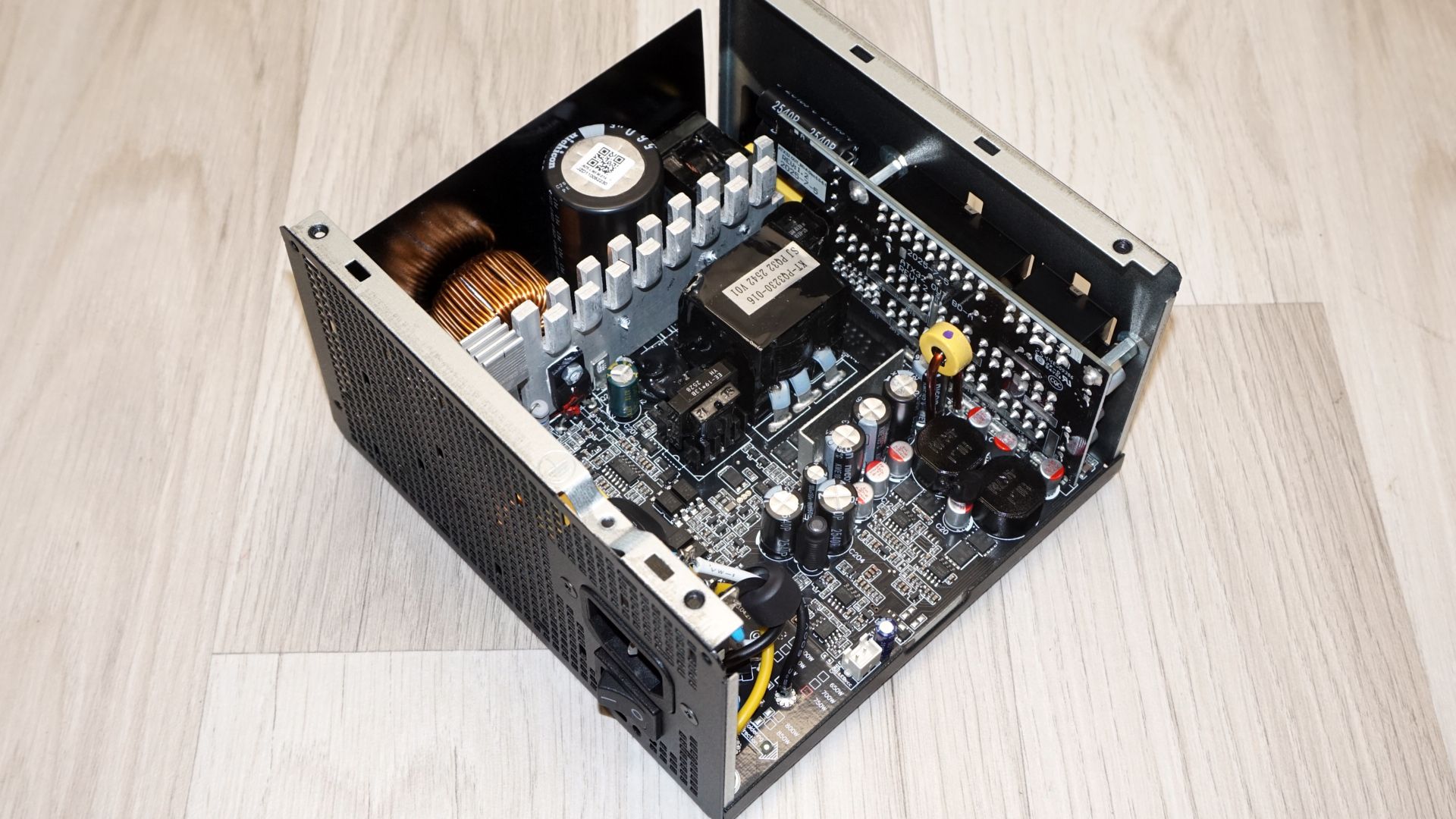
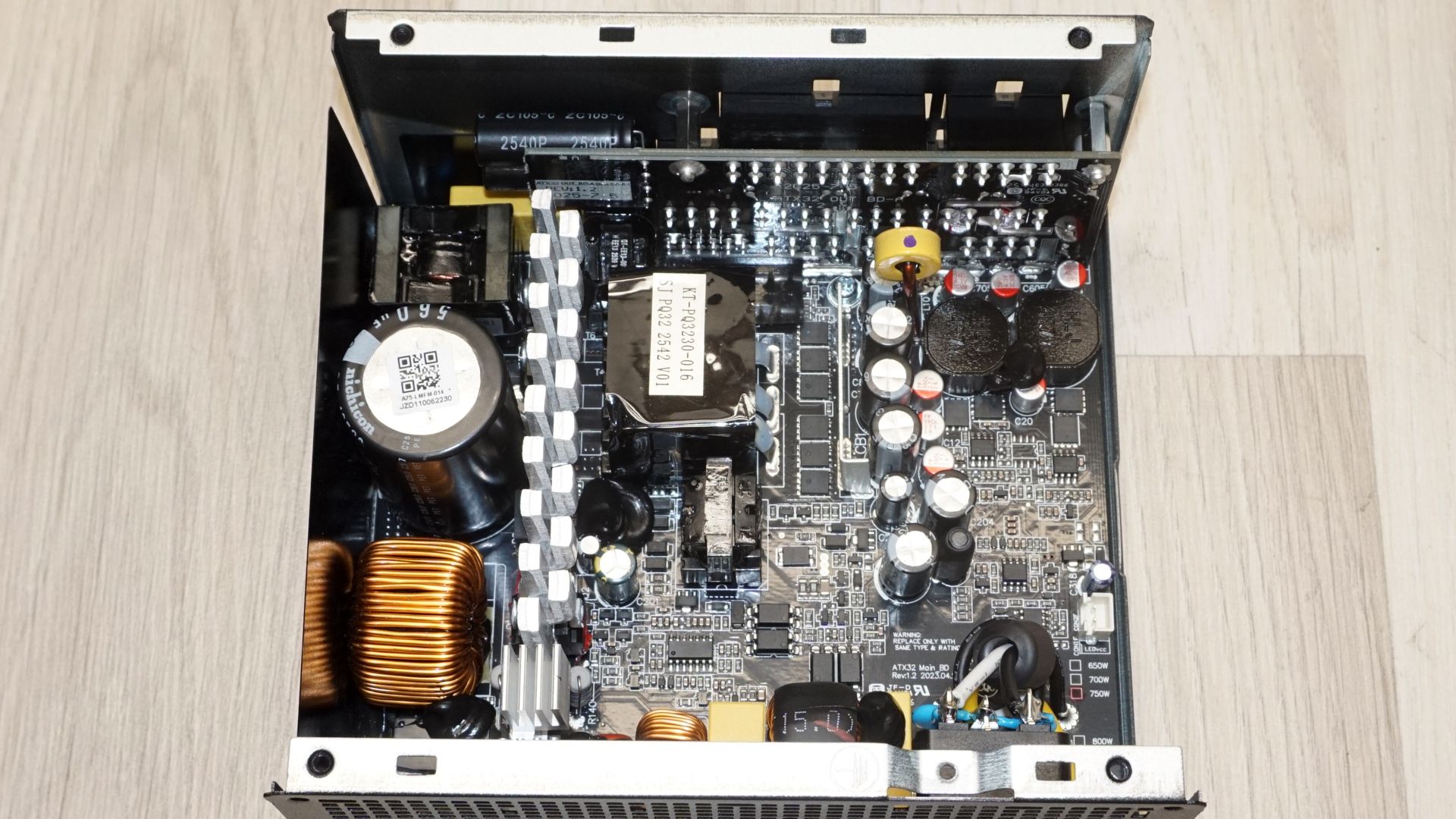
The platform is HKC’s, supplied to Thermalright under the internal designation HKCMAX-750, and the main board is silkscreened as ATX32 Main BD Rev1.2. A row of wattage selection pads along the board edge runs from 500W to 850W, with the 750W position populated, confirming this is a single design scaled across a whole product family rather than a layout drawn for 750W specifically. Component density is fair, the soldering is tidy, and some black silicone anchors the larger parts. Only two heatsinks are fitted - a small one carrying the input bridges and a taller, simple finned unit shared by the APFC and primary switching stages - and everything on the secondary side relies on the PCB and a tiny sheet heatsink soldered to it.

ThermalRight TR-KG750 750W
Tom's Hardware
ThermalRight TR-KG750 750W
Tom's Hardware

The transient filtering stage starts at the back of the AC receptacle and continues on the main PCB. In total, there are four Y capacitors, two X capacitors, and two filtering inductors, with an MOV and an NTC thermistor also present - a complete filter with nothing omitted, if not a generous one. Two input rectifying bridges follow on their own small dedicated heatsink. The APFC stage uses two MOSFETs and a boost diode sharing the tall heatsink, paired with a large open-frame filtering coil, and the bulk capacitor is a Nichicon 450V/560 uF part from the 105C-rated GN(M) series. That capacitor is comfortably the best component in the unit and practically the only one sourced from a manufacturer with a genuine reliability record. The primary inversion stage is a half-bridge arrangement built from two 65R160FR MOSFETs on the shared heatsink, feeding the main transformer.

ThermalRight TR-KG750 750W

(Image credit: Tom's Hardware)

The secondary side is where the cost engineering becomes plain. The 12V rail is rectified by six Perfertway PWC012N04ES MOSFETs mounted directly on the main PCB with no heatsink of their own, and the 3.3V and 5V rails are derived from DC-to-DC converters that also live on the main board rather than a vertical daughterboard. As a layout, this is conventional and modern. The problem is provenance: essentially every active device in the conversion path - the bridges, the APFC and primary MOSFETs, the six synchronous rectifiers - comes from manufacturers with no established track record in this application. Secondary filtering is a mix of Teapo parts and capacitors branded NICON that, despite carrying a series designation borrowed from Nippon Chemi-Con’s catalog, do not appear to be a genuine Nippon Chemi-Con nor a Nichicon product, and polymer capacitors handle high-frequency filtering on the modular board. None of this is unusual at the price. It is worth stating plainly, though, that the "all Japanese" capacitor language attached to some retail listings for this model describes the bulk capacitor and nothing else.

ThermalRight TR-KG750 750W
Tom's Hardware
ThermalRight TR-KG750 750W
Tom's Hardware

Cold Test Results (25°C Ambient)

Cold Test Results (25°C Ambient)

For the testing of PSUs, we are using high-precision electronic loads with a maximum power draw of 2700 Watts, a Rigol DS5042M 40 MHz oscilloscope, an Extech 380803 power analyzer, two high-precision UNI-T UT-325 digital thermometers, an Extech HD600 SPL meter, a self-designed hotbox, and various other bits and parts.
ThermalRight TR-KG750 750W
Tom's Hardware
ThermalRight TR-KG750 750W
Tom's Hardware
ThermalRight TR-KG750 750W
Tom's Hardware
ThermalRight TR-KG750 750W
Tom's Hardware
ThermalRight TR-KG750 750W
Tom's Hardware

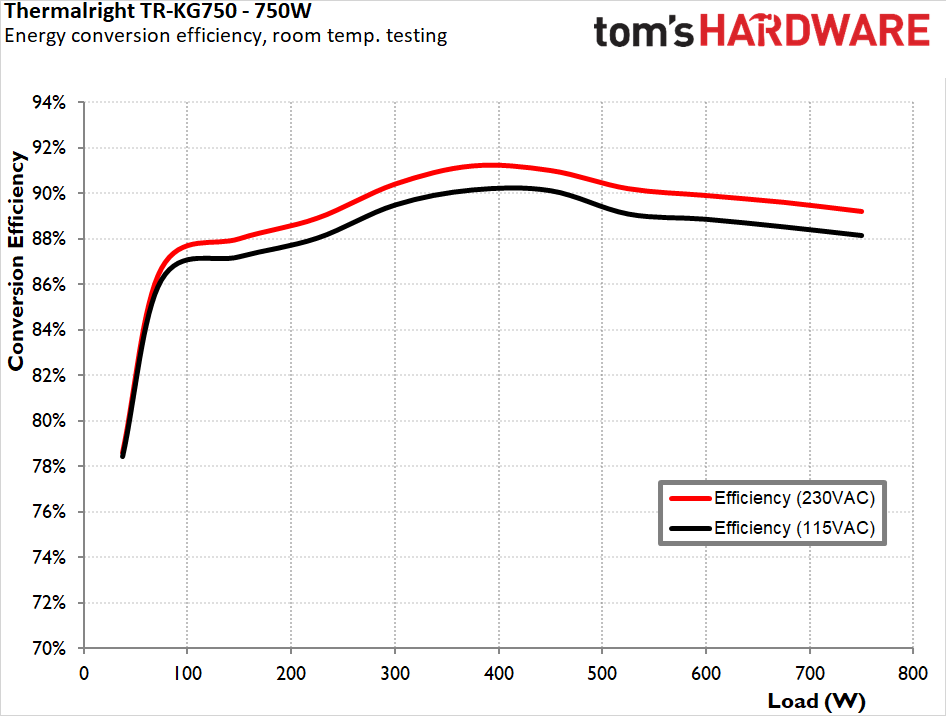
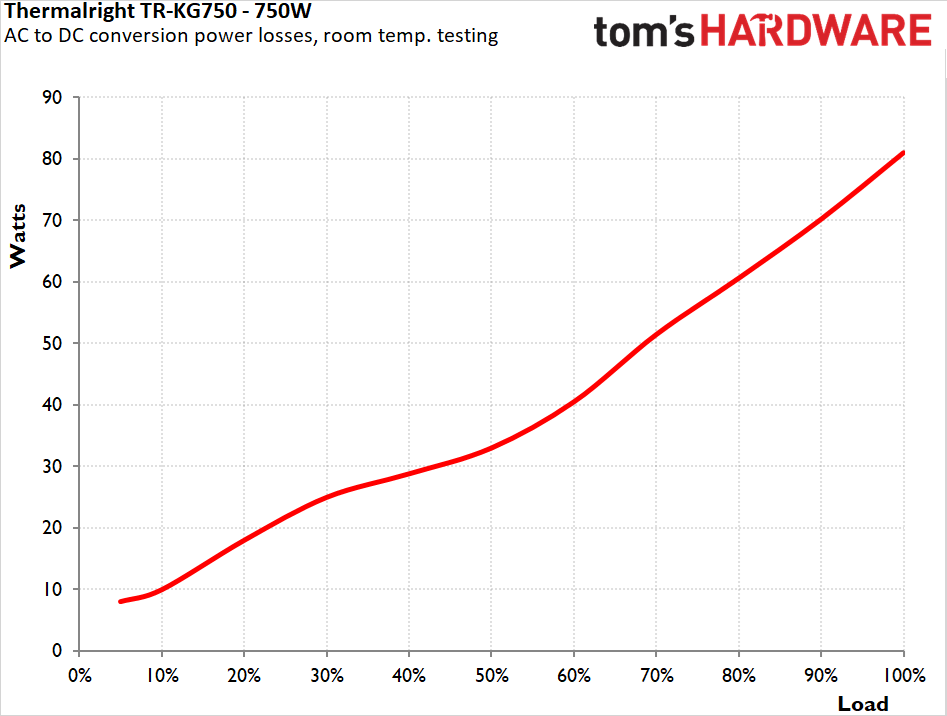
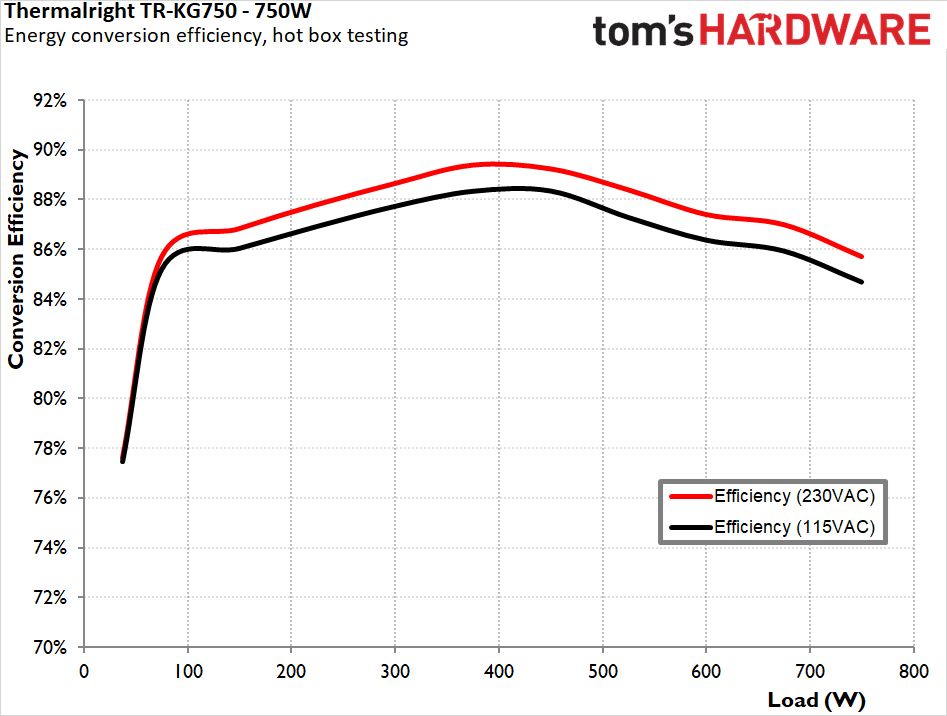
At 25°C ambient, the TR-KG750 averaged 89.5% at 230 VAC and 88.5% at 115 VAC across the nominal load range, peaking at 91.2% and 90.3%, respectively, at 50% load and settling to 89.2% and 87.9% at a sustained 750W. The curve is well shaped, with the usual broad plateau between 40% and 70% load and no collapse at the top end. What it does not have is margin. Against the 80 PLUS Gold thresholds at 115 VAC - 87% at 20% load, 90% at 50%, and 87% at 100% - our measured 87.2%, 90.3%, and 87.9% clear the bar by 0.2, 0.3, and 0.9 percentage points. The unit’s own 80 PLUS report reads slightly kinder at 90.2%, 91.4% and 88.3%, but the conclusion does not change: this is a Gold unit by a narrow margin.

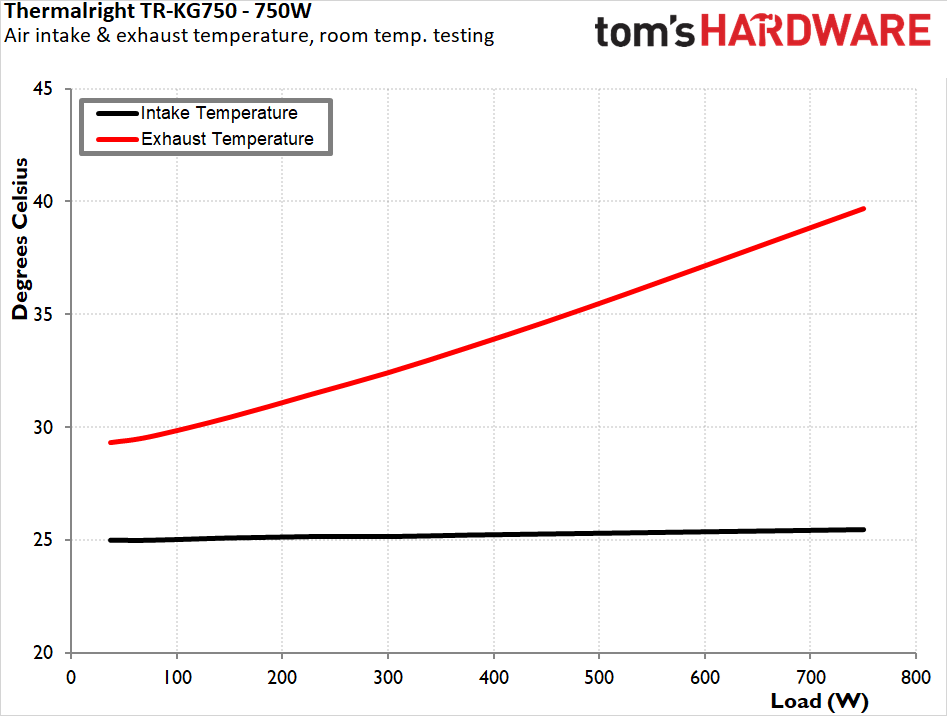
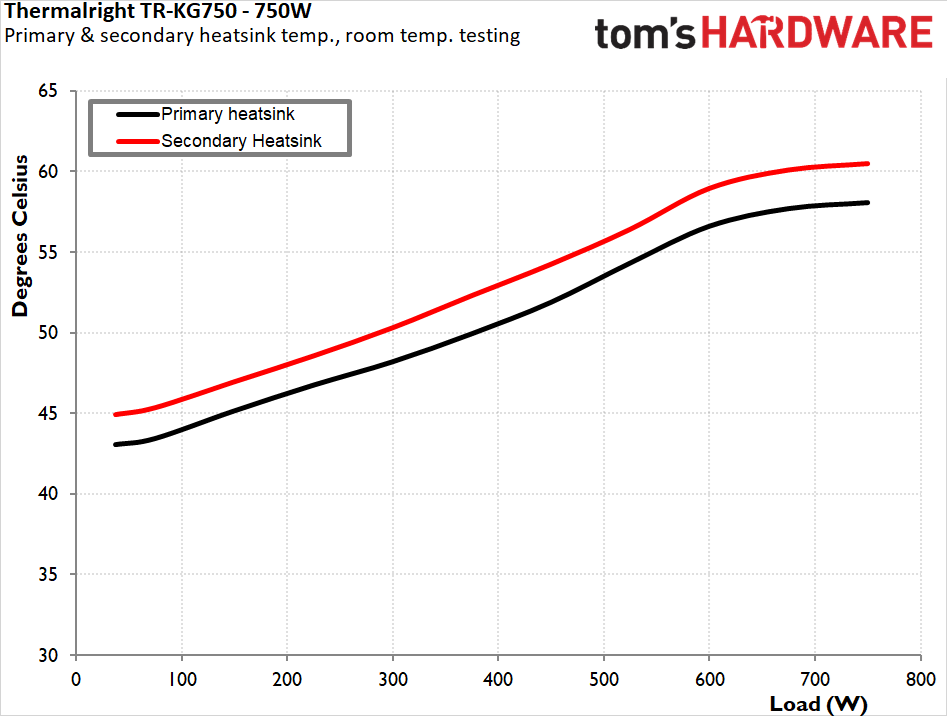
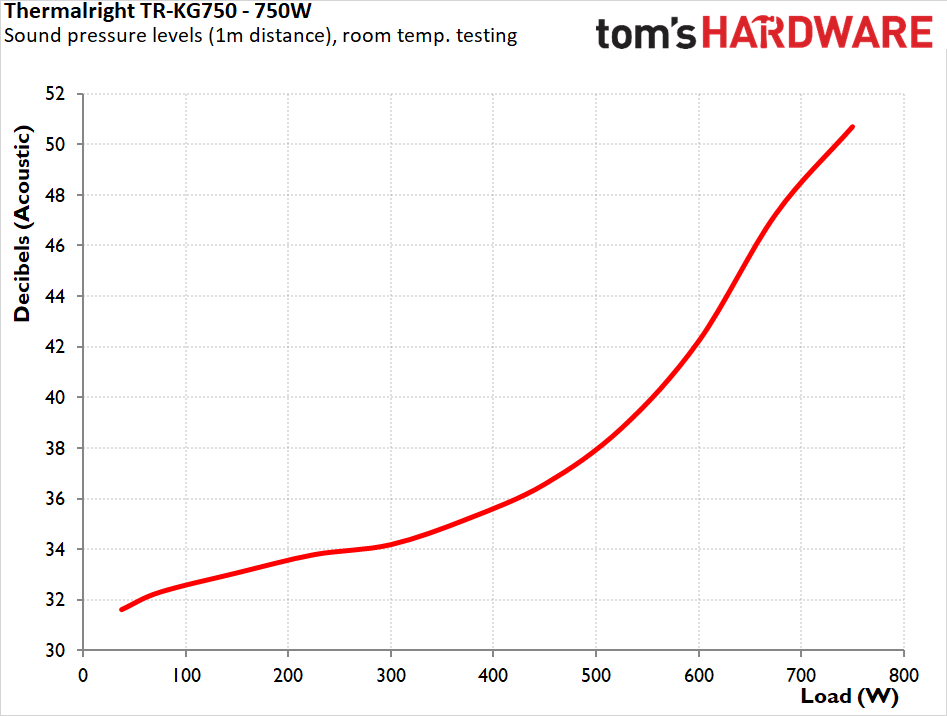
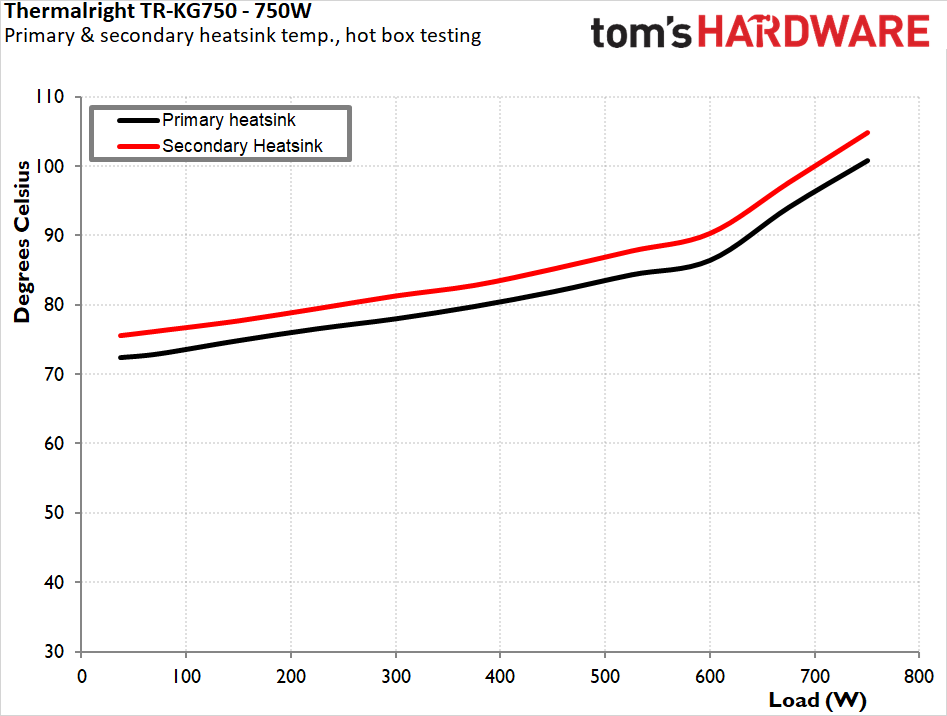
Acoustically, there is no great news. The Yate Loon spins whenever the supply is powered but remains quiet across the first half of the load range. The ramp through the middle of the range is gentle enough, but it steepens past 70% load, reaching 42 dB(A) at 600W and almost 51 dB(A) at a sustained 750W. That is loud for an efficient 750W unit at room temperature. Thermally, the platform is comfortable at 25°C. The primary and secondary heatsinks stabilized at around 60°C. Those are unremarkable numbers, with the small heatsinks and mediocre efficiency being the obvious culprits.

Hot Test Results (~45°C Ambient)

Hot Test Results (~45°C Ambient)

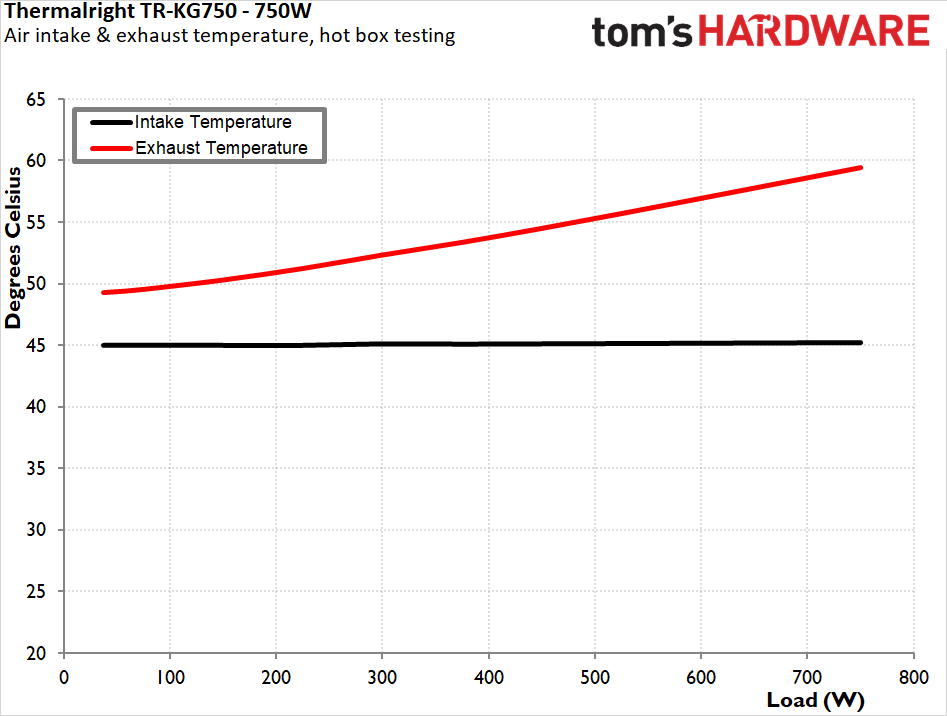
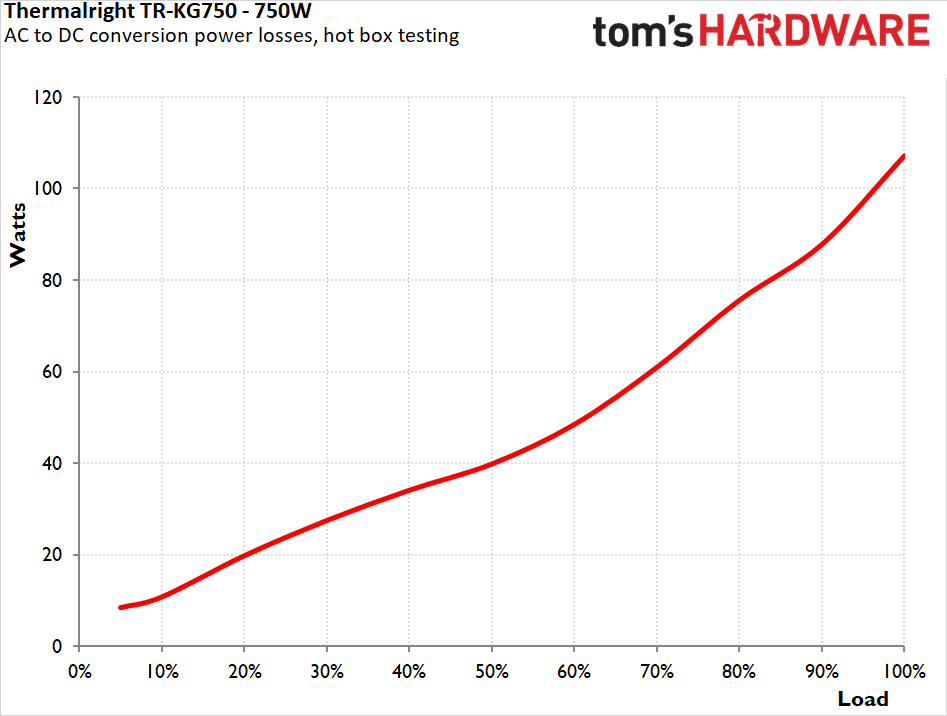
Inside the hotbox at roughly 45°C ambient - five degrees beyond the unit’s own 40°C rating - efficiency averaged 87.6% at 230 VAC and 86.6% at 115 VAC, an almost uniform 1.9-point loss against the cold run. Full load is where the degradation concentrates: 85.8% at 230 VAC and 84.5% at 115 VAC, both 3.4 points down on the 25°C figures. A drop of that size is larger than we like to see, and it puts the unit well outside Gold territory under heat, although it is being measured beyond its rated envelope and the shape of the curve essentially holds throughout. The supply completed every load step without shutting down.

ThermalRight TR-KG750 750W
Tom's Hardware
ThermalRight TR-KG750 750W
Tom's Hardware
ThermalRight TR-KG750 750W
Tom's Hardware
ThermalRight TR-KG750 750W
Tom's Hardware
ThermalRight TR-KG750 750W
Tom's Hardware

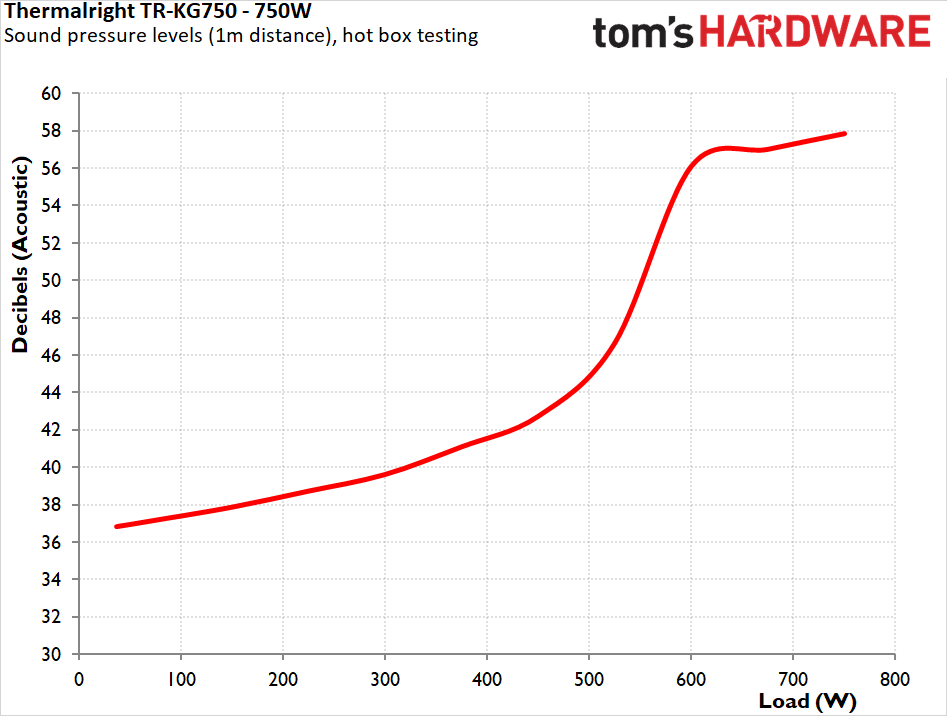
Heat turns the fan from merely constant into genuinely intrusive. The floor rises to 37 dB(A), which is audible but not dramatic. It maintains reasonable noise figures up to 525W and then the curve breaks: between 525W and 600W the fan jumps almost ten decibels to 56 dB(A), settling at 58 dB(A) at a sustained 750W. A step that abrupt points to a coarse thermal control scheme rather than a tuned curve, and at 58 dB(A) the power supply is likely to be the loudest component in almost any system. The internal readings explain the urgency: the primary heatsink reached well over 100°C at full load. Those are very high figures for parts of uncertain pedigree and for a 750W PSU, and while the unit held together for the duration, sustained full load at 45°C is not an environment we would ask this platform to live in.

PSU Quality and Bottom Line

Power Supply Quality

Voltage regulation is adequate rather than tight. Between 20% and 100% load, the 3.3V rail moved 1.2%, the 5V rail 1.4%, and the 12V rail 1.8%. The 12V figure is the one that matters, and it is the loosest of the three, sliding from 12.11V at 151.5W to 11.89V at 744.5W. That sits comfortably inside the ±5% ATX window and will not trouble any component, but it is roughly double what a well-tuned modern LLC platform delivers, and most of the drop arrives between 50% and 75% load rather than being spread evenly across the range.

Ripple suppression follows the same pattern of simple adequacy. On the 12V rail we measured 24 mV at 20% load rising to 62 mV at full load, against the 120 mV ATX limit - a comfortable pass with roughly 48% headroom, though the jump from 38 mV at 75% load to 62 mV at 100% is steeper than the rest of the curve. The minor rails run closer to their ceilings: 34 mV on 3.3V and 38 mV on 5V against a 50 mV limit, leaving 32% and 24% headroom respectively. Cross-load behavior was unremarkable, with 60 mV on 12V under the 12V-heavy test and 34 mV on 5V under the minor-rail test. None of this is a problem for the hardware a 750W supply will realistically feed, but the minor rails have less room than we would expect from a DC-to-DC design.

During our thorough assessment, we evaluate the essential protection features of every power supply unit we review, including Over Current Protection (OCP), Over Voltage Protection (OVP), Over Power Protection (OPP), and Short Circuit Protection (SCP).

All protection mechanisms were verified and triggered correctly during testing. With the unit hot, OCP tripped at 140% on the 3.3V rail (28A), 142% on the 5V rail (28.4A), and 136% on the 12V rail (85A), with OPP shutting the supply down at 134% of rated output, or approximately 1005W. Those are generous thresholds, more generous than most mainstream 750W units carry, and they mean the platform will ride out the transient excursions a modern graphics card throws at it without any complaint - which is precisely what ATX 3.1 compliance is meant to guarantee.

Main Output

Load (Watts)

151.52 W

377.76 W

558.95 W

744.47 W

Load (Percent)

20.2%

50.37%

74.53%

99.26%

Amperes

Volts

Amperes

Volts

Amperes

Volts

Amperes

Volts

3.3 V

1.8

3.38

4.5

3.37

6.75

3.36

9

3.34

5 V

1.8

5.11

4.5

5.10

6.75

5.05

9

5.04

12 V

11.25

12.11

28.14

12.07

42.2

11.90

56.27

11.89

Line

Regulation

Voltage Ripple (mV)

(20% to 100% load)

20% Load

50% Load

75% Load

100% Load

CL1
12V

CL2
3.3V + 5V

3.3V

1.2%

22

26

30

34

24

30

5V

1.4%

20

26

32

38

24

34

12V

1.8%

24

30

38

62

60

32

Bottom Line

What the TR-KG750 is, stated plainly, is an HKC platform wearing a Thermalright badge at a $91 price, and most of what follows from that is predictable. The specification sheet is current - ATX 3.1, PCIe 5.1, a native 12V-2x6 connector, full modularity, a compact 140 mm chassis - and the engineering is competent in the sense that nothing is missing or obviously wrong. The transient filter is complete, the topology is a modern half-bridge LLC with DC-to-DC minor rails, and the Nichicon bulk capacitor is a real Japanese part. Measured performance is broadly consistent with the class: regulation within 2% on every rail, ripple with meaningful headroom on 12V, and protection thresholds more generous than most.

ThermalRight TR-KG750 750W

(Image credit: Tom's Hardware)

The problems concentrate in two places. The first is efficiency, where the unit clears its 80 PLUS Gold thresholds at 115 VAC by a small margin. Certification is a floor, and this unit sits on it. Under heat, the margin vanishes entirely - 84.5% at 115 VAC and full load - and with no Cybenetics listing, there is no other independent data to weigh against ours. The second is acoustics, and the fault there is part control, part hardware. The Yate Loon is quiet enough through the first half of the load range, but the curve steepens past 70%, and the supply reaches almost 51 dB(A) at a sustained 750W at room temperature. In a warm case, it is worse: a ten-decibel step between 525W and 600W, and 58 dB(A) from there to full load. That is a coarse fan profile rather than a tuned one, and there is no fanless mode to fall back on at idle. It was little choice, as the heatsinks are too small to combat such thermal needs. Builders who care about a perfectly quiet machine can stop reading here.

Underneath those sit the component choices. The Nichicon bulk capacitor aside, the secondary filtering is Teapo and NICON, and every active device in the conversion path - bridges, APFC and primary MOSFETs, the six synchronous rectifiers - comes from manufacturers with no track record to point at. That is not automatically a defect; plenty of anonymous silicon runs happily for a decade. But it is unverifiable, and heatsink temperatures well over 100°C at 45°C ambient leave less comfort than we would like, as does a sleeve-bearing fan if asked to run continuously in that heat. The five-year warranty is doing real work in the value case here, and it is the correct length for this class rather than a generous one.

ThermalRight TR-KG750 750W

(Image credit: Tom's Hardware)

At $91, the TR-KG750 is around $30 cheaper than the Cooler Master MWE Gold 750 V4, and that comparison is the instructive one. The Cooler Master is quieter by a wide margin, holds tighter regulation, runs a cooler secondary side under heat, and carries a ten-year warranty; the Thermalright answers with a lower price, and concedes almost everything else. Set against the Thermaltake Toughpower GX3 850W or the MSI MAG A850GLS, the picture is similar - more wattage and better-documented platforms, for more money. The TR-KG750 earns its place on price alone. If the budget is fixed near $90 and the machine lives under a desk rather than on it, this is a defensible purchase with a current feature set and adequate measured performance behind it. If there is $30 of headroom, or if noise matters substantially, have a look at higher price tags.

MORE: Best Power Supplies

MORE: How We Test Power Supplies

MORE: All Power Supply Content

Phanteks AMP GH 750W power supply review: Great buy at sub-$90 street pricing, but comes with a 450W cap on its 12V-2x6 connector

2026年9月9日 19:05

Phanteks is a Dutch company, founded in 2007 and best known for enclosures, alongside air coolers, AIOs, and a steadily expanding catalog of accessories. Power supplies came later, and they have always been commissioned work. As with most such companies, Phanteks does not own a factory, and the identity of the power supply inside a Phanteks box has changed more than once. For example, the original AMP series from 2020 was a Seasonic Focus derivative, a genuinely strong platform that earned the AMP series a significant reputation. The AMP GH is the current mainstream range, and it is a different animal.

The platform of the AMP GH 750W that we are reviewing today comes from Helly Technology, the Guangzhou outfit founded in 2008 that has spent the last few years building the mid- and upper-tier units. Young by the standards of this industry, but no longer an unknown quantity. The series spans 650W to 1200W across Gold and Platinum tiers, in black or white. We take a closer look at the AMP GH 750W to see how it ranks against our best power supplies list. Everything in it is ATX 3.1 and PCIe 5.1 compliant, fully modular, and cooled by a single 120 mm fan that stops entirely at low load. The 750W model reviewed here is the volume seller of the range, aiming squarely at the mid-range gaming build.

Specifications and Design

Phanteks AMP GH 750W Power specifications ( Rated @ 40 °C )

RAIL

+3.3V

+5V

+12V

+5Vsb

-12V

MAX OUTPUT

20A

20A

62A

2.5A

0.3A

100W

100W

744W

12.5W

3.6W

TOTAL

750W

AC INPUT

100 - 240 VAC, 50 - 60 Hz

MSRP

$110

In the Box

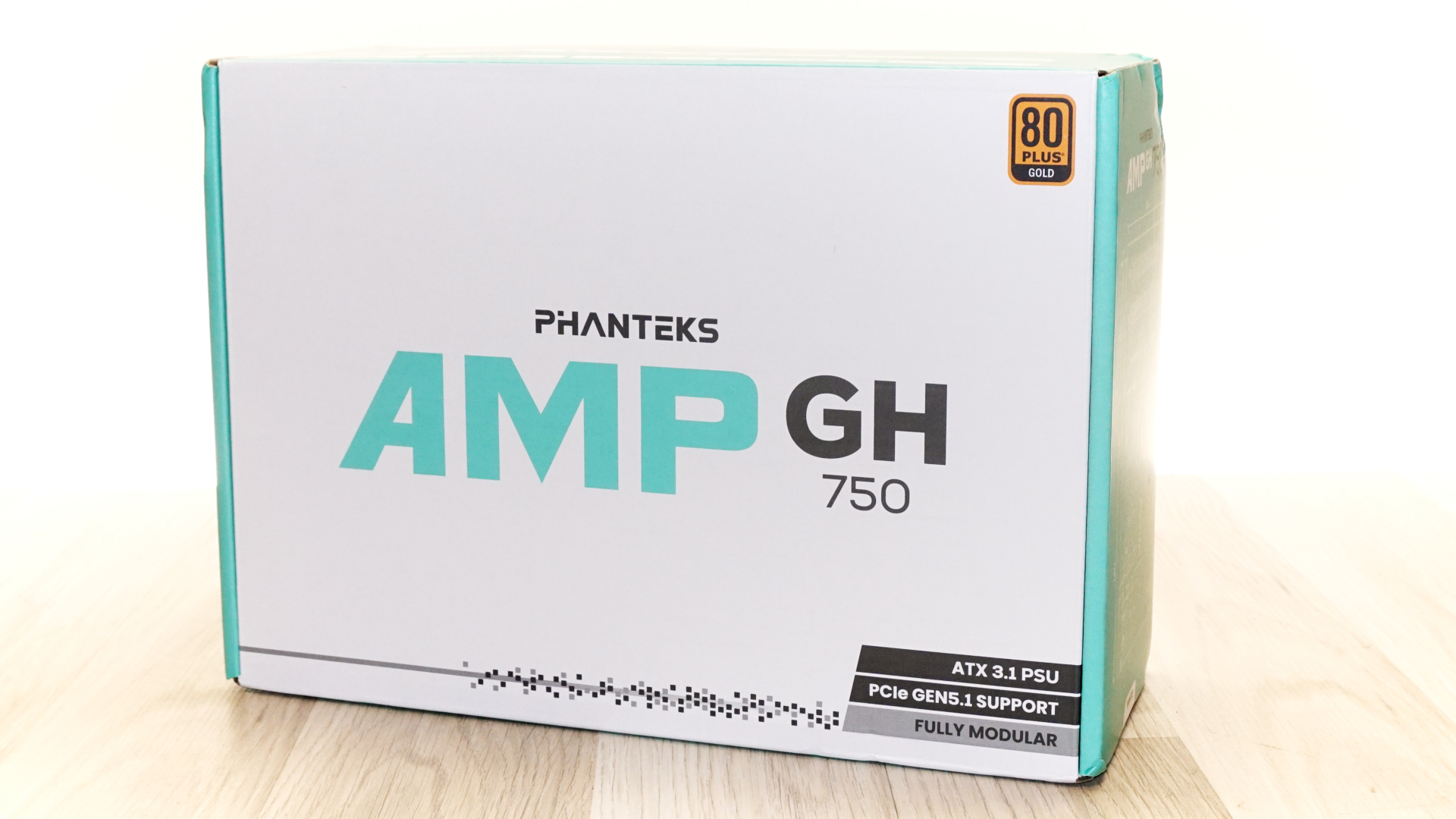
The AMP GH 750 arrives in a white cardboard box with mint-green edges and sides, the product name in large type across the front, and the 80 PLUS Gold badge in the top corner. Three black-and-grey strips along the bottom edge carry the three main headline claims: ATX 3.1 PSU, PCIe Gen5.1 support, fully modular. That is about the extent of the marketing. It is a restrained, we dare say almost clinical presentation next to what most of this segment ships in.

Phanteks  AMP GH 750W

(Image credit: Tom's Hardware)

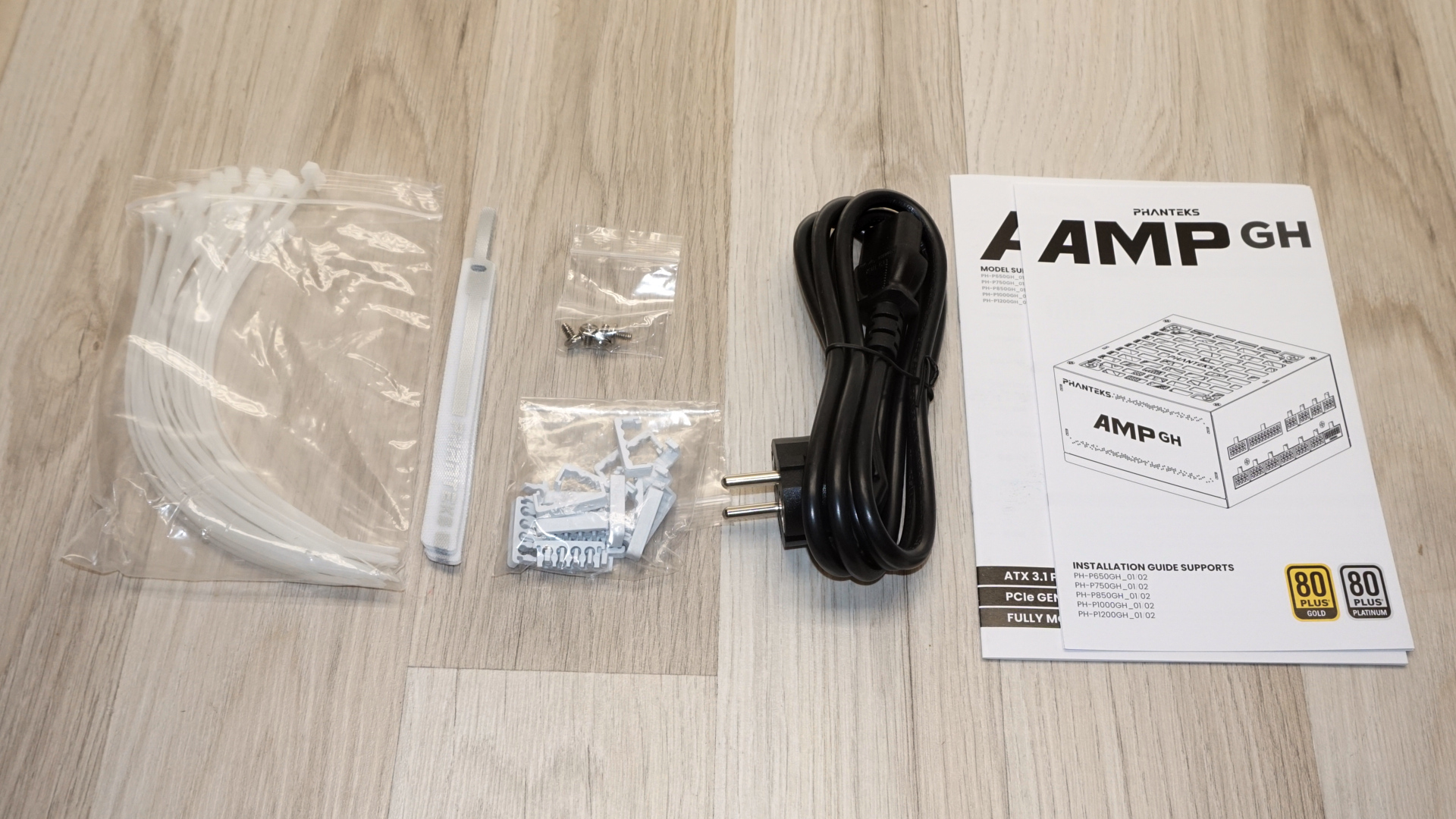
Inside, the power supply sits between molded protective inserts, with the cables bagged separately. The bundle is far better than the price suggests and one of the most complete we have seen this year. It comprises of the AC cable, four chrome mounting screws, a very generous bunch of white zip ties, a few black and white Velcro straps, and a bag of white cable combs. There is also an installation guide and manual that are shared across the whole series.

Phanteks  AMP GH 750W

(Image credit: Tom's Hardware)

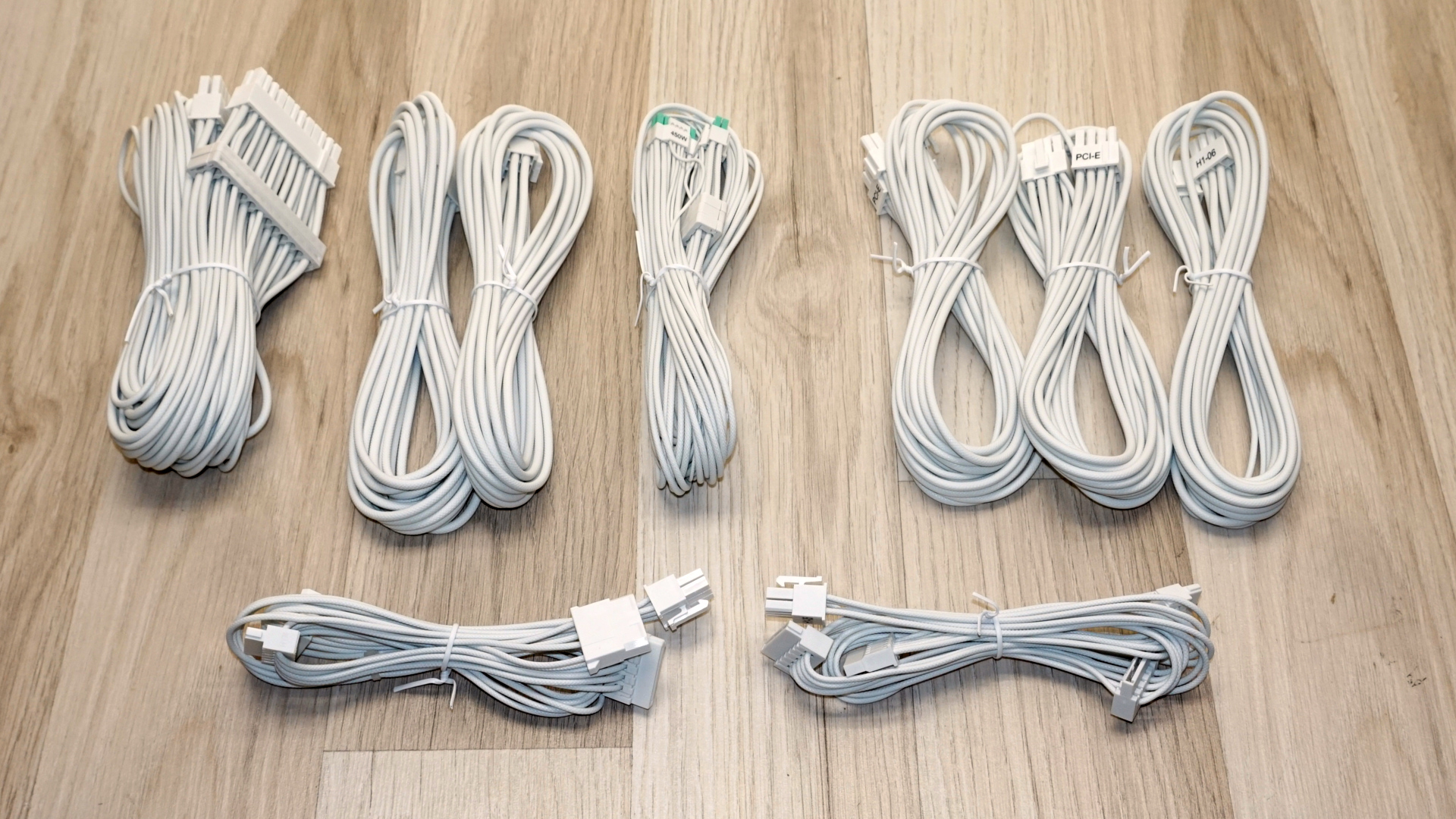
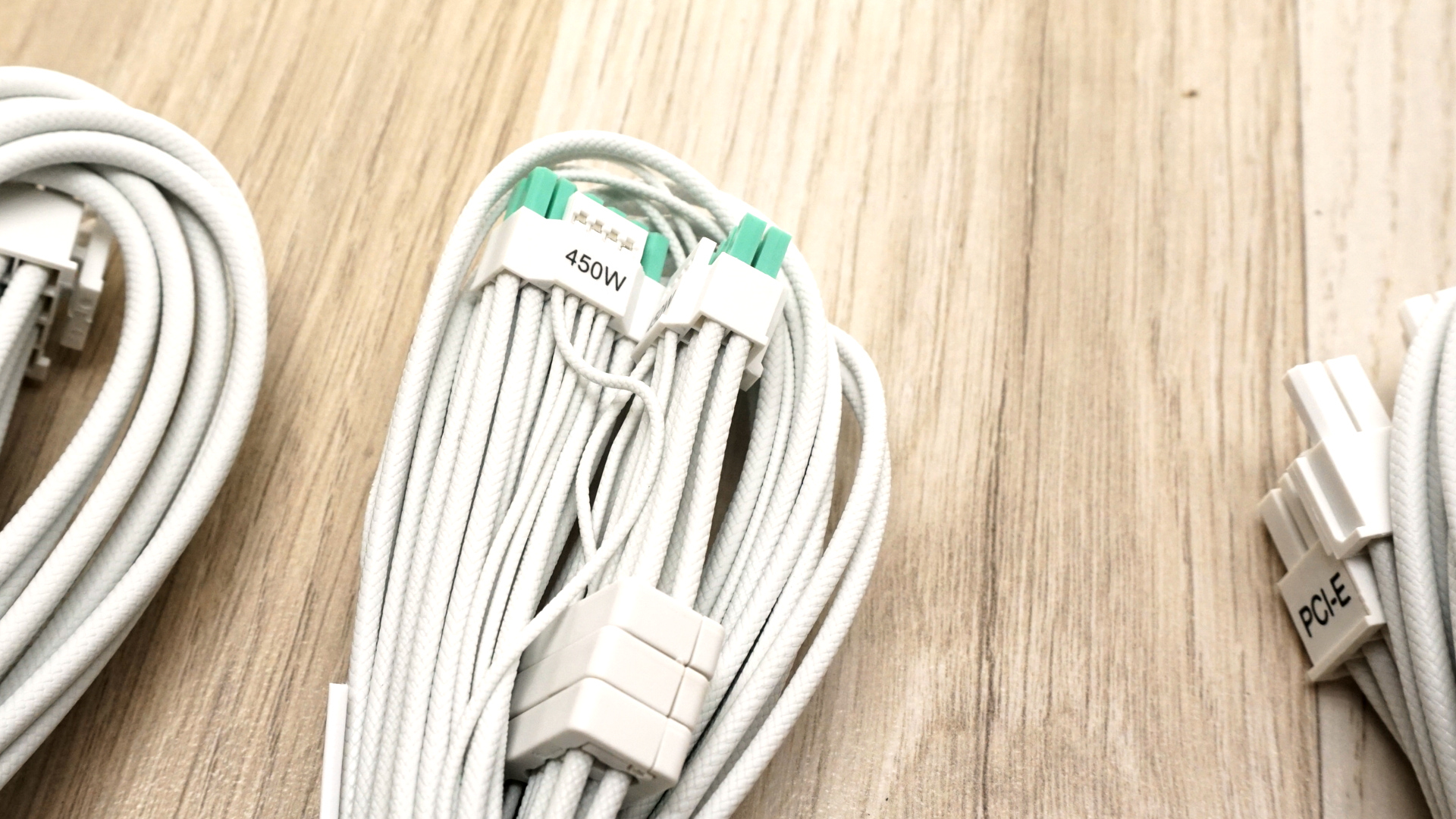
The cables themselves are the highlight. Every wire is individually sleeved in white braid rather than the flat ribbon type this class usually gets, and they stay flexible enough to be easily routed. Even the 12V-2x6 signal wires are, creating a very high-quality aesthetic result. They do take up a little bit more room behind a motherboard tray than flat cables would, but we are certain that this is a sacrifice builders are willing to make. The 12V-2x6 cable is marked 450W on the connector housing and uses mint-green latch tabs, which do double duty as a seating indicator (if you can still see green, the plug is incorrectly seated). The 12V-2x6 and ATX 24-pin cables have cable combs pre-installed.

Phanteks  AMP GH 750W
Tom's Hardware
Phanteks  AMP GH 750W
Tom's Hardware
Phanteks AMP GH 750W

Connector type

Hardwired

Modular

ATX 24 Pin

-

1

EPS 4+4 Pin

-

2

PCI-E 5.1

-

1

PCI-E 8 Pin

-

3

SATA

-

6

Molex

-

2

Floppy

-

-

External Appearance

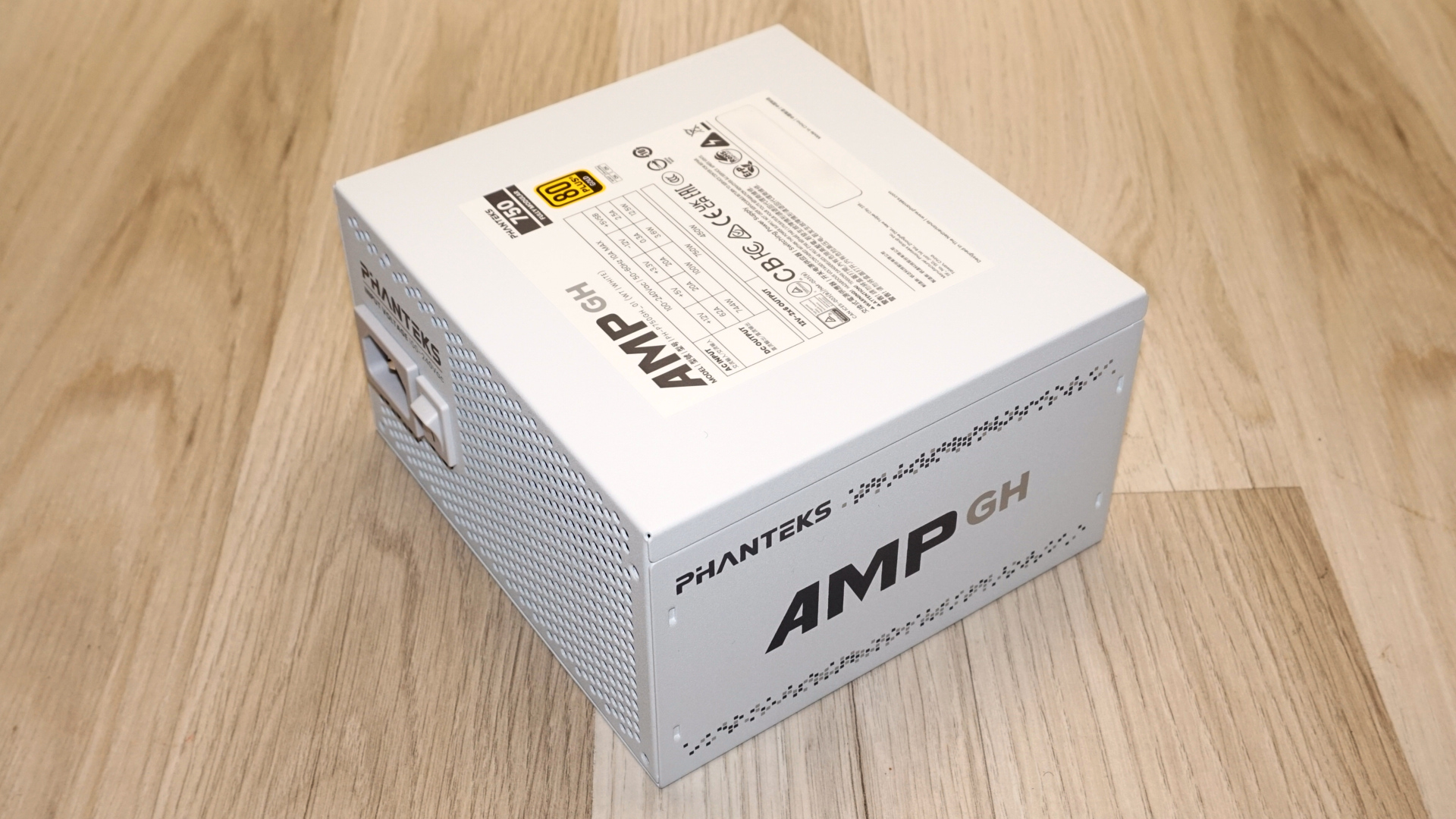
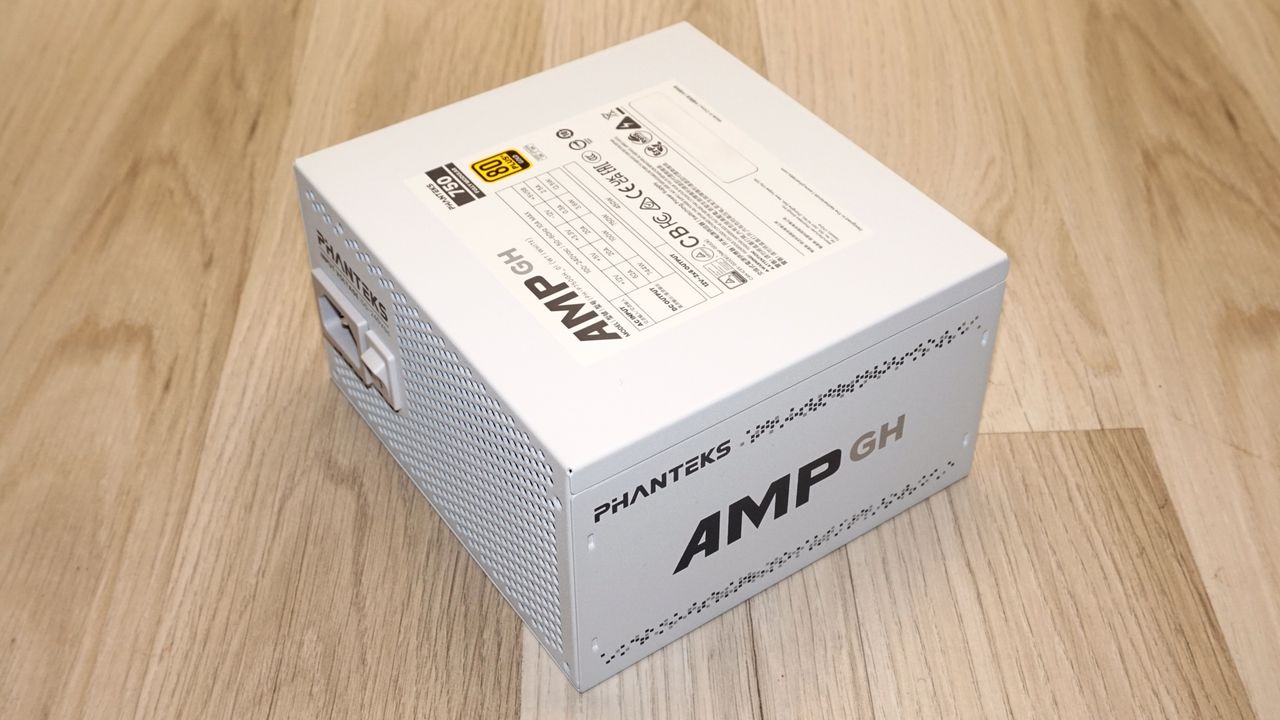
At 140 x 150 x 86 mm, the AMP GH 750 is about as short as a modern ATX unit gets, which means it will fit anything that takes a standard supply and leave room for cable slack in front of it. Our sample obviously is the white version, and the finish is the first thing worth commenting on. It is a clean, even satin snow white with an exceptional finish. This is not a given with white units, as they can easily look a little grey next to a truly white item/case. This one does not. Phanteks also sells the unit in black, and at MSRP, the black version is $10 cheaper.

Phanteks  AMP GH 750W

(Image credit: Tom's Hardware)

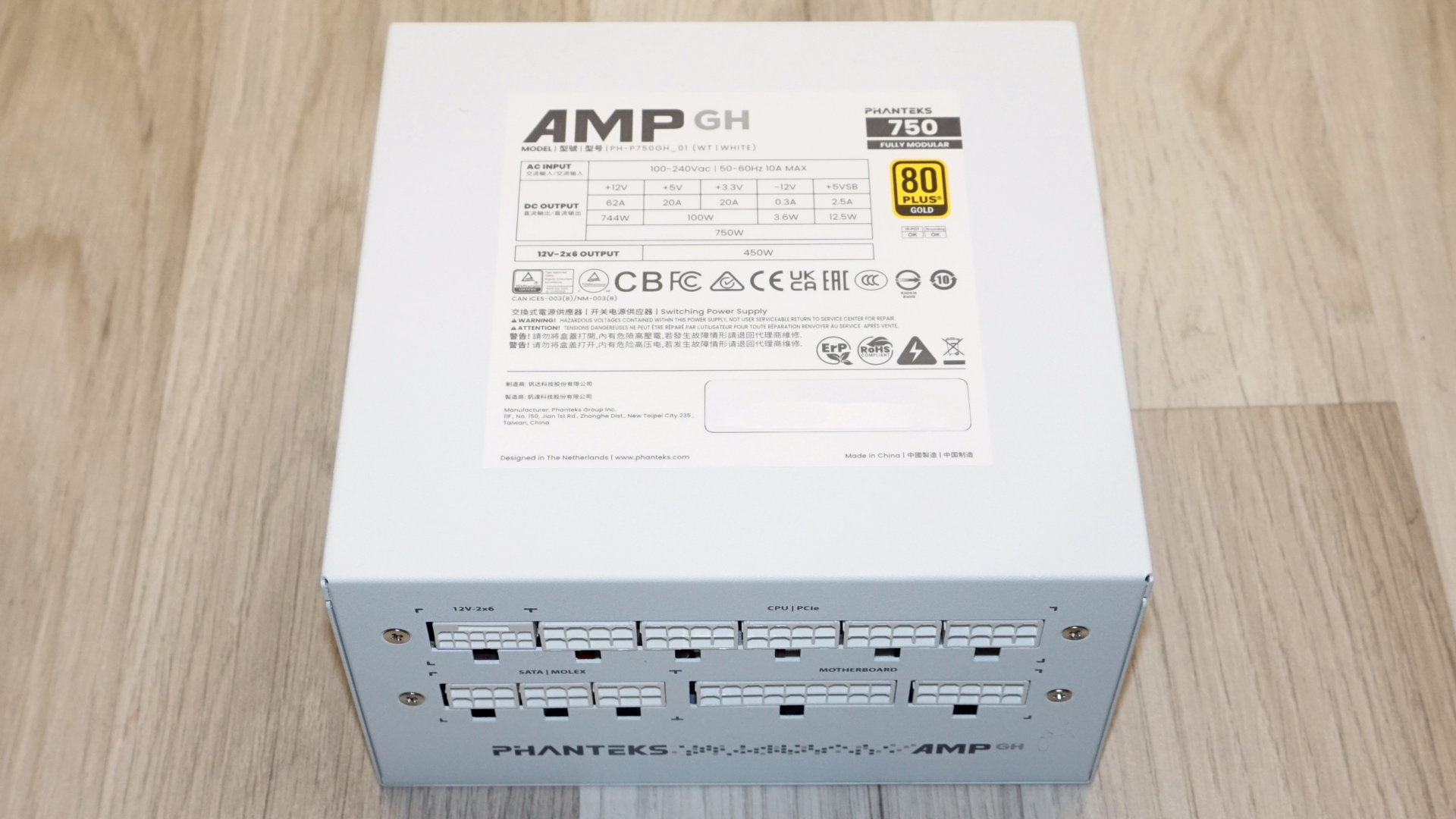
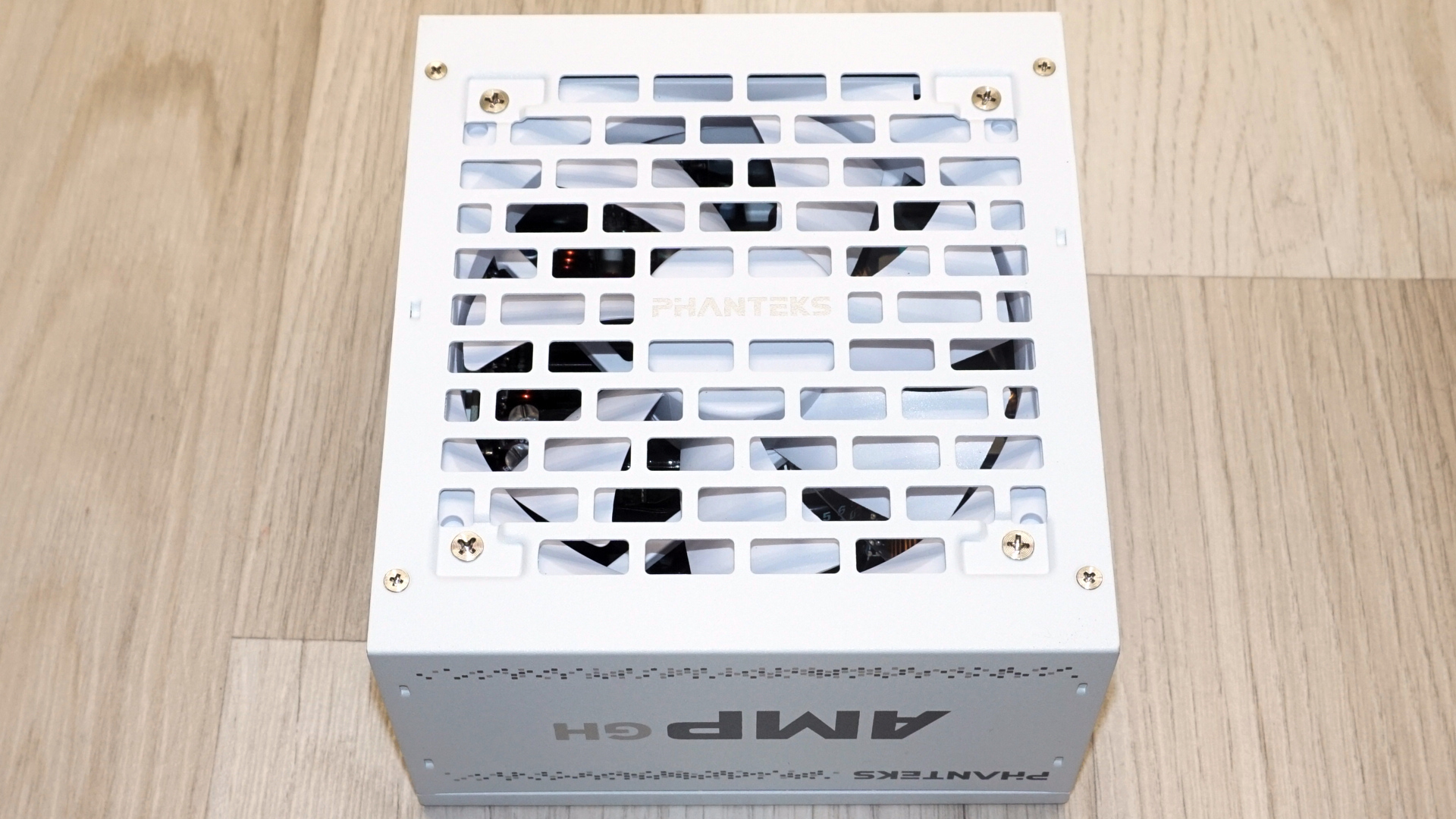
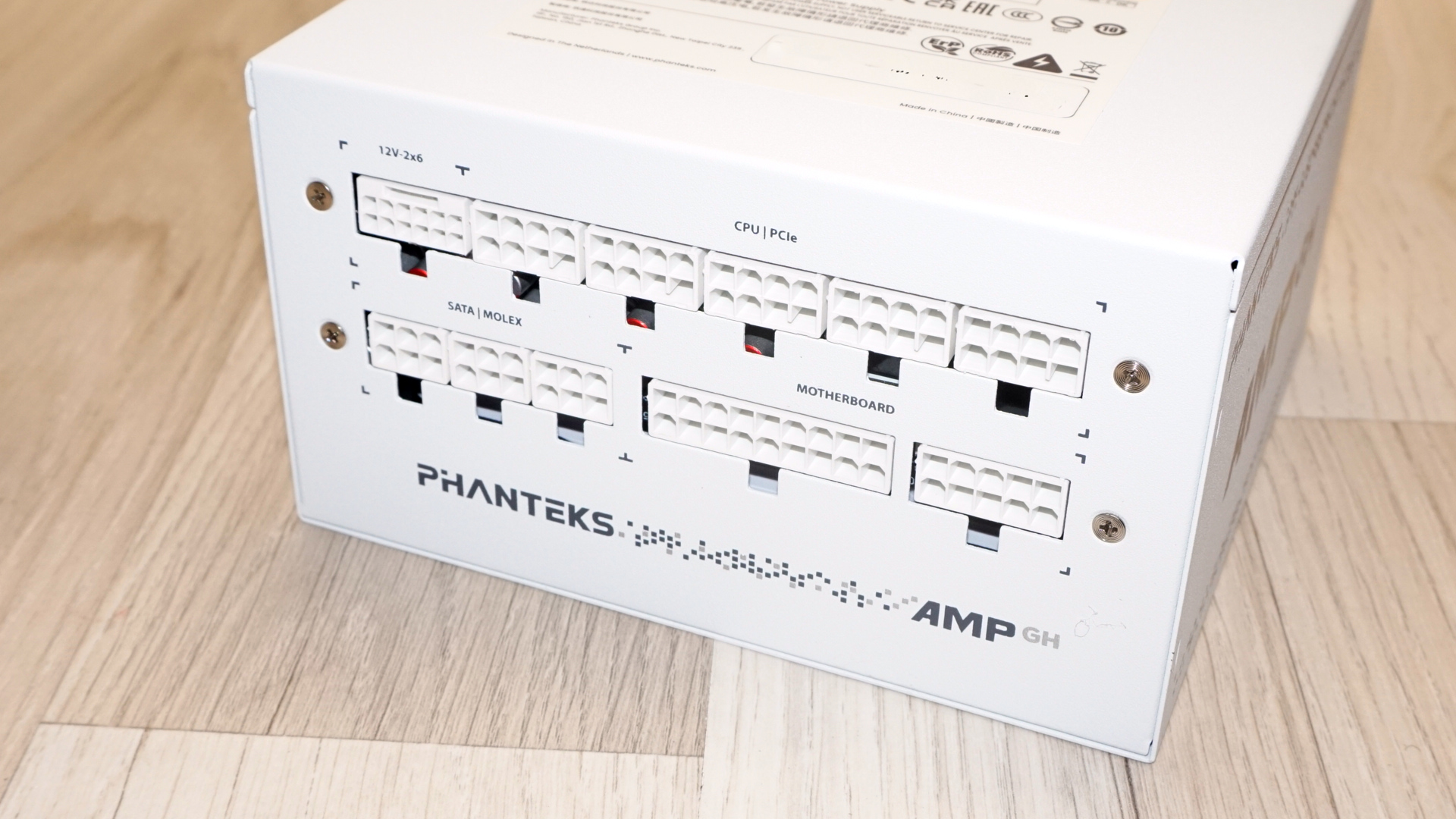
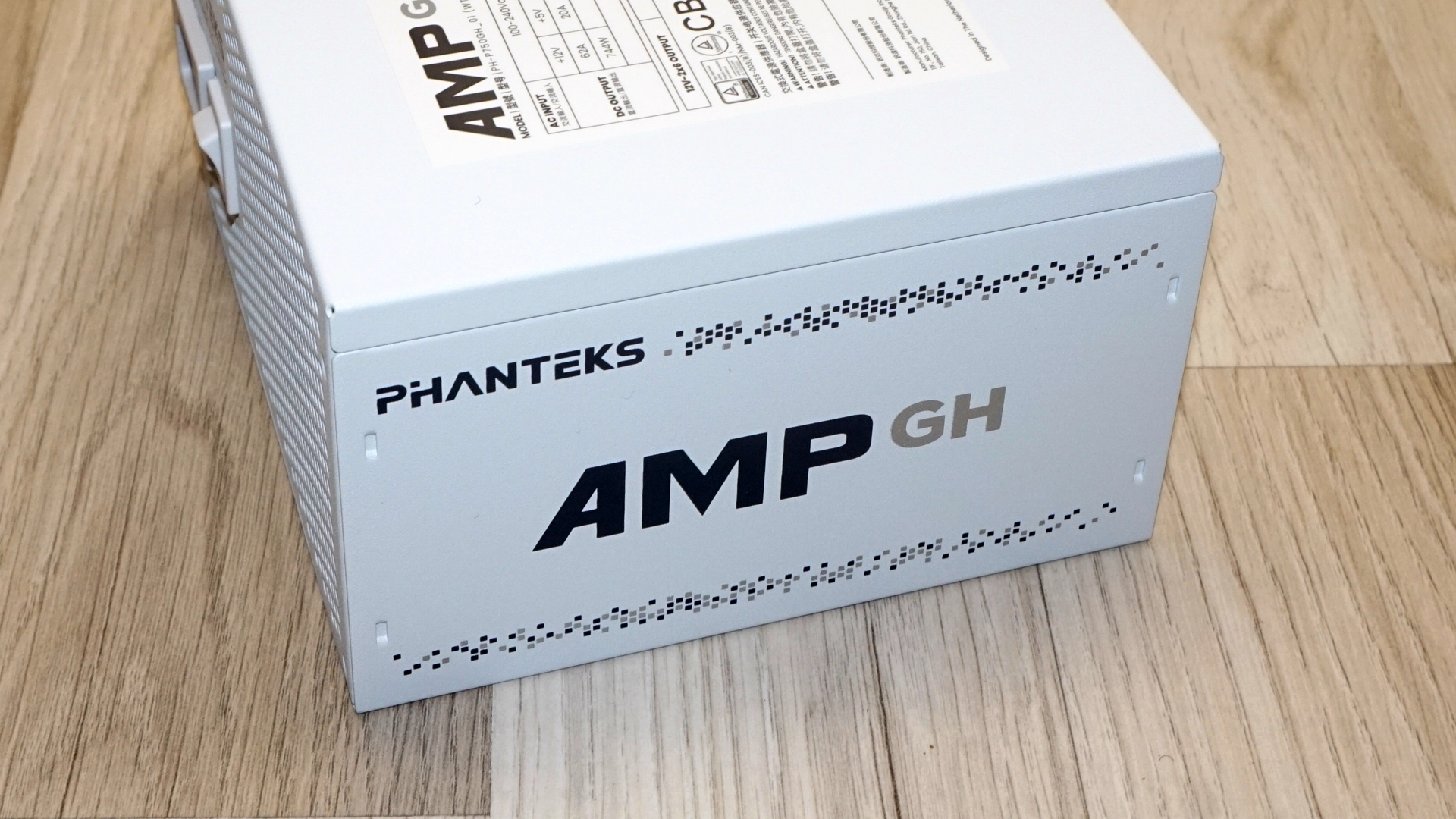
The bottom carries a fan grille cut as a field of staggered rectangles rather than the usual honeycomb, with the company logo embossed across the middle and four polished exposed screws at the corners. The side panels get the company and series logo, as well as a scattered pixel-dot pattern in grey. The specification label is found at the top. The specification label deserves a read before purchase: 62A on the 12V rail for 744W, 100W combined on the minor rails, and a separate line stating 450W for the 12V-2x6 output. That is a hard limit on what you can hang off the single native Gen5 connector, and it is printed on the unit and on the connector rather than buried in a datasheet, which is at least honest.

Phanteks  AMP GH 750W
Tom's Hardware
Phanteks  AMP GH 750W
Tom's Hardware

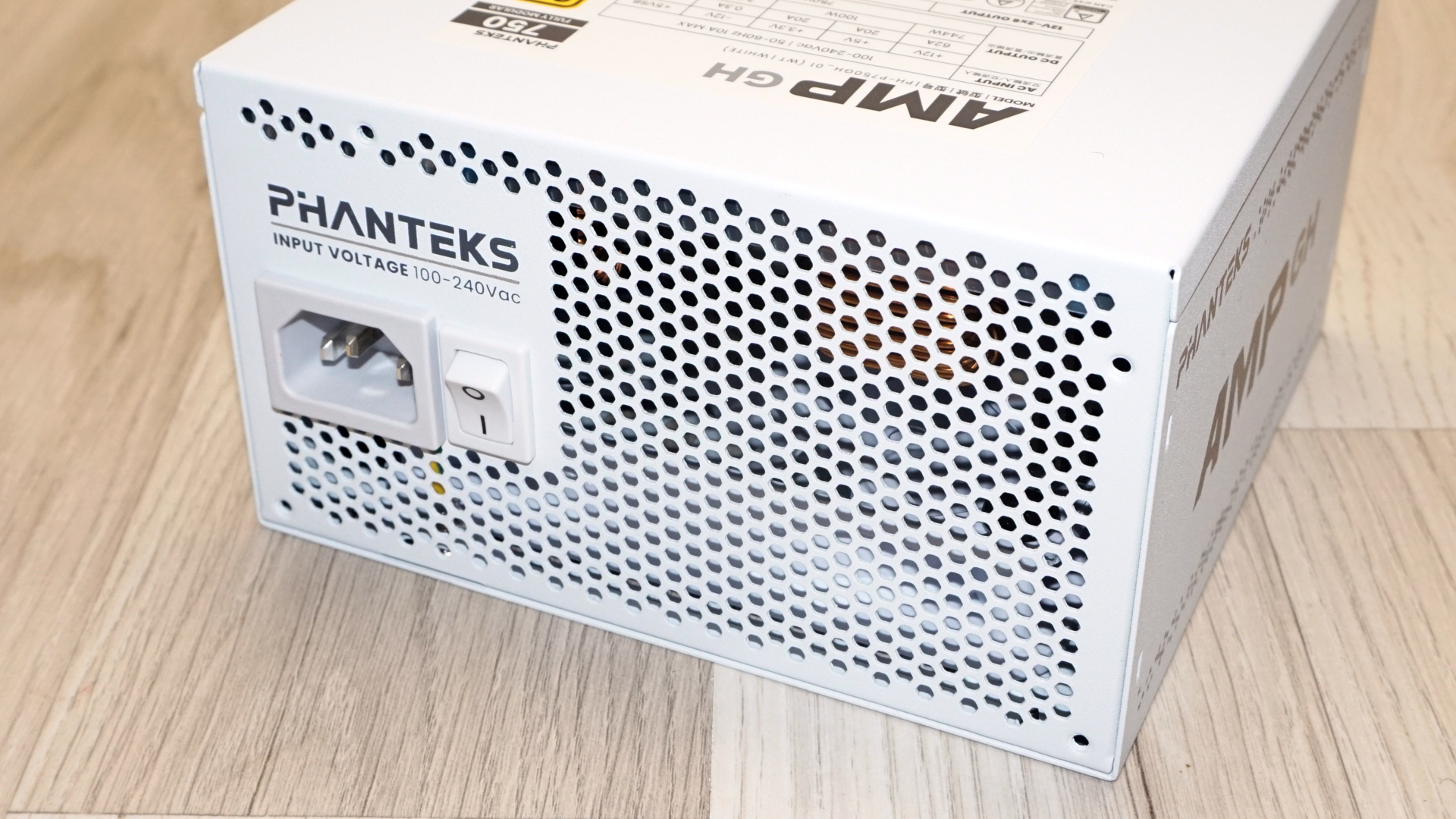
The rear face is somewhat straightforward, with an AC receptacle and a rocker switch, with the only difference being that these are all white. Even though one is pictured in the manufacturer’s website, there is no switch for the semi-passive mode, so the fanless mode is automatic and not something you can override in either direction. The front of the unit hosts the connectors for the modular cables. The top row starts with the dedicated 12V-2x6 socket and continues with five shared 8-pin sockets marked CPU and PCIe. The bottom row has three sockets for the SATA and Molex cables, then two for the motherboard cable.

Phanteks  AMP GH 750W
Tom's Hardware
Phanteks  AMP GH 750W
Tom's Hardware

Internal Design

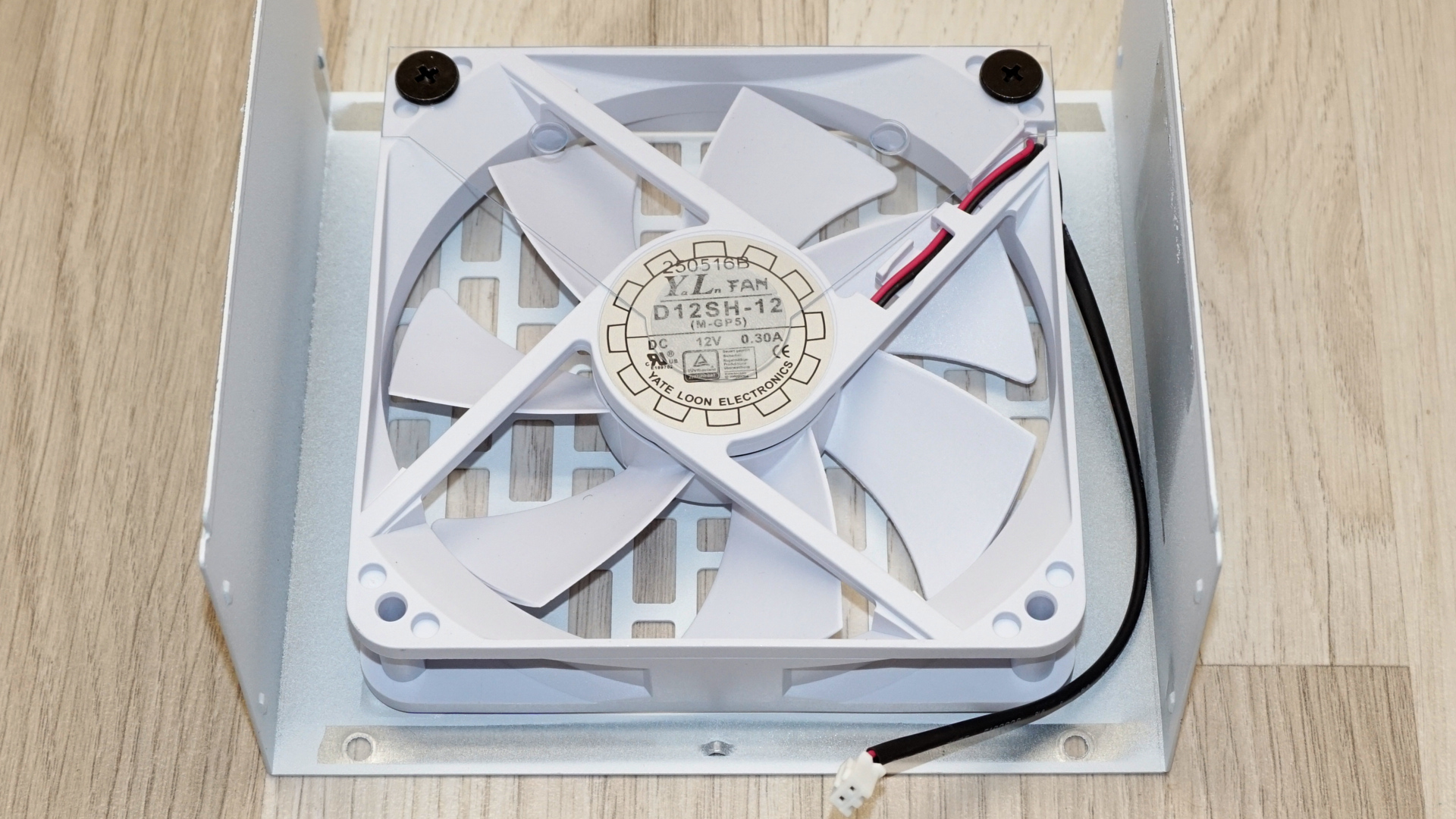
Cooling comes from a 120 mm Yate Loon D12SH-12, a 12V/0.3A sleeve-bearing fan rated for 2200 RPM in Yate Loon's catalog. Yate Loon is a long-standing name, and the D12SH has been turning up in power supplies for years, but a sleeve bearing is a sleeve bearing - it is the cheapest part of an otherwise decent bill of materials. The fan is white to match the chassis rather than the usual black part hidden behind a grille.

Phanteks  AMP GH 750W

(Image credit: Tom's Hardware)

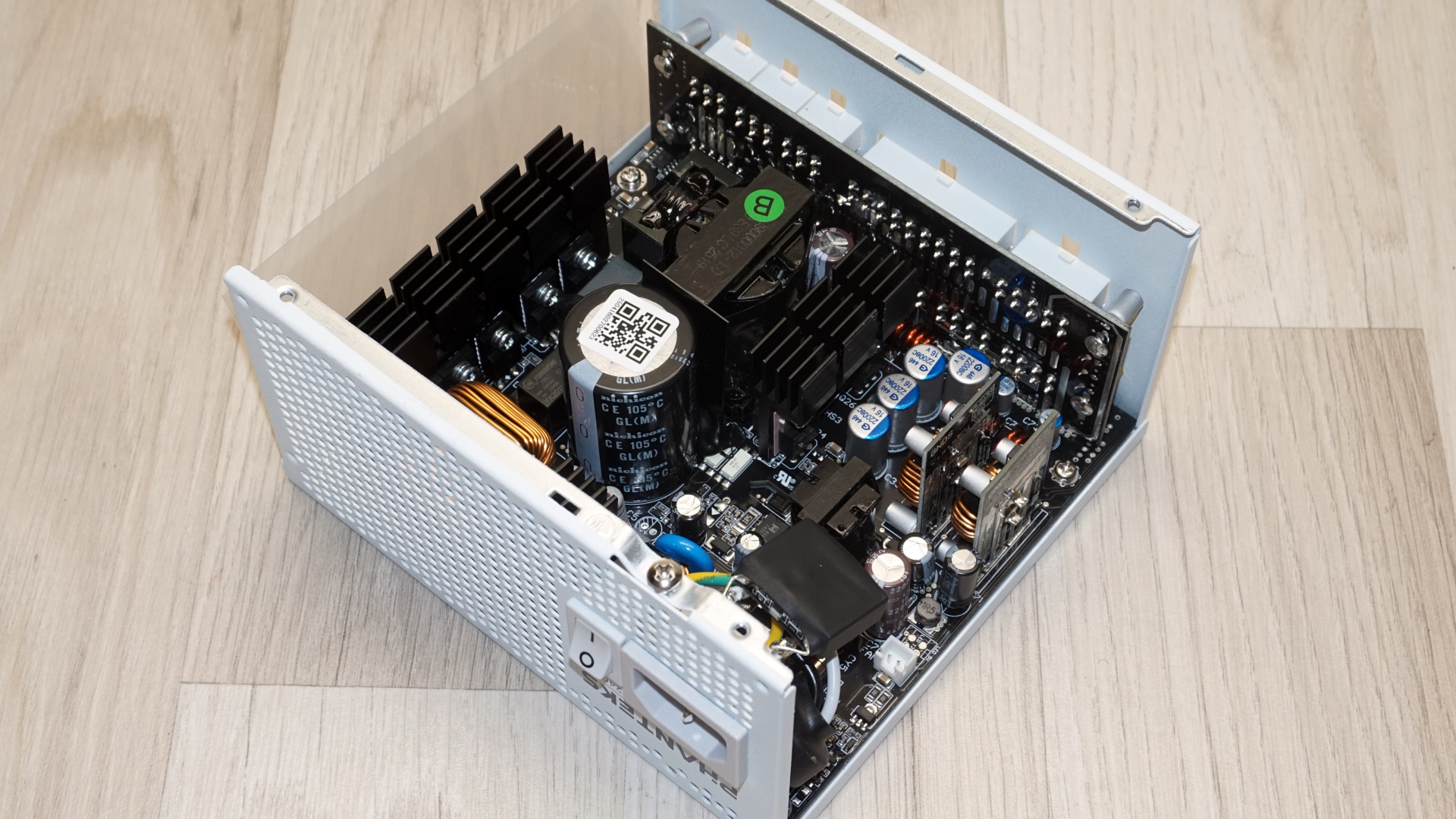
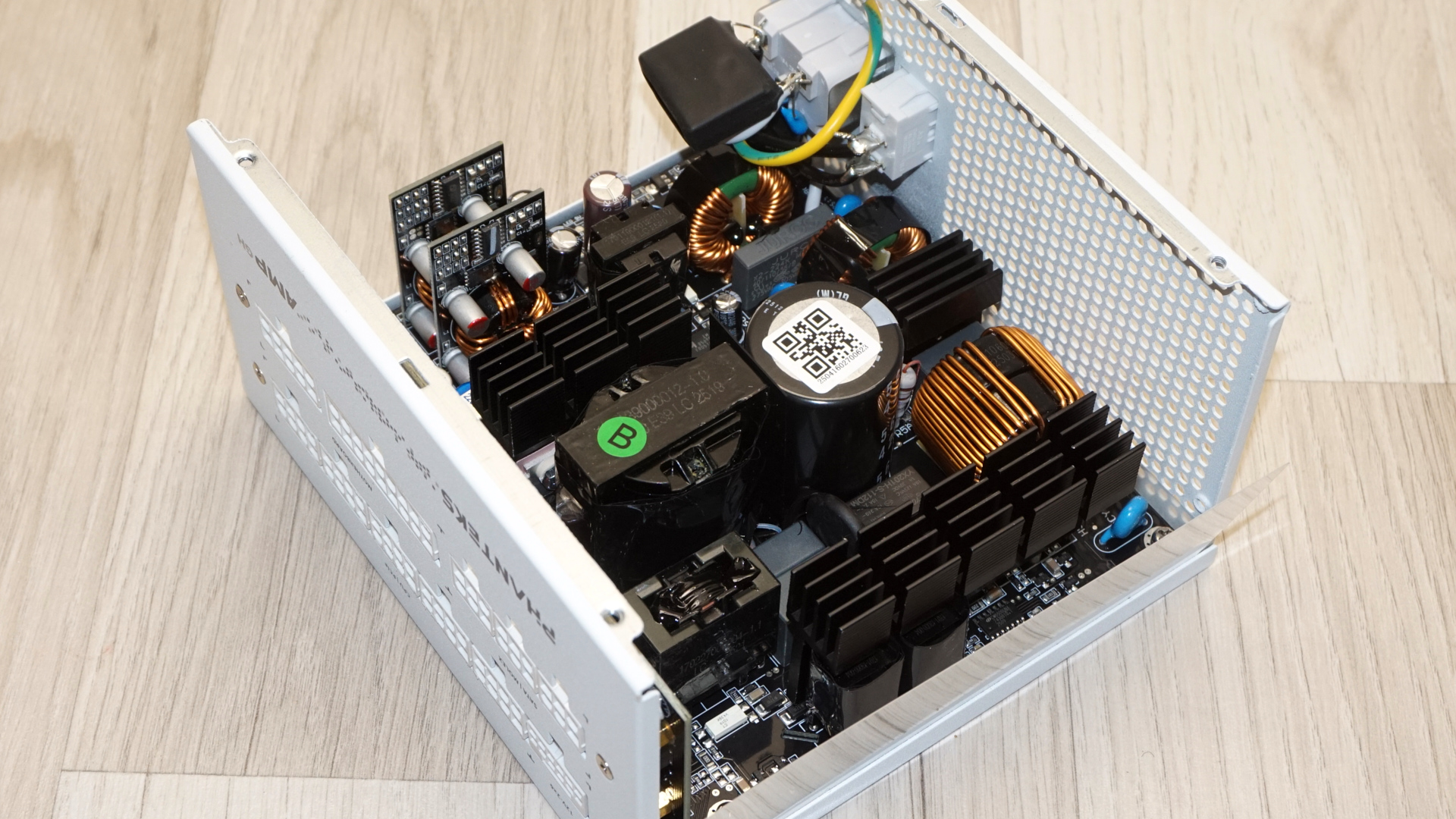
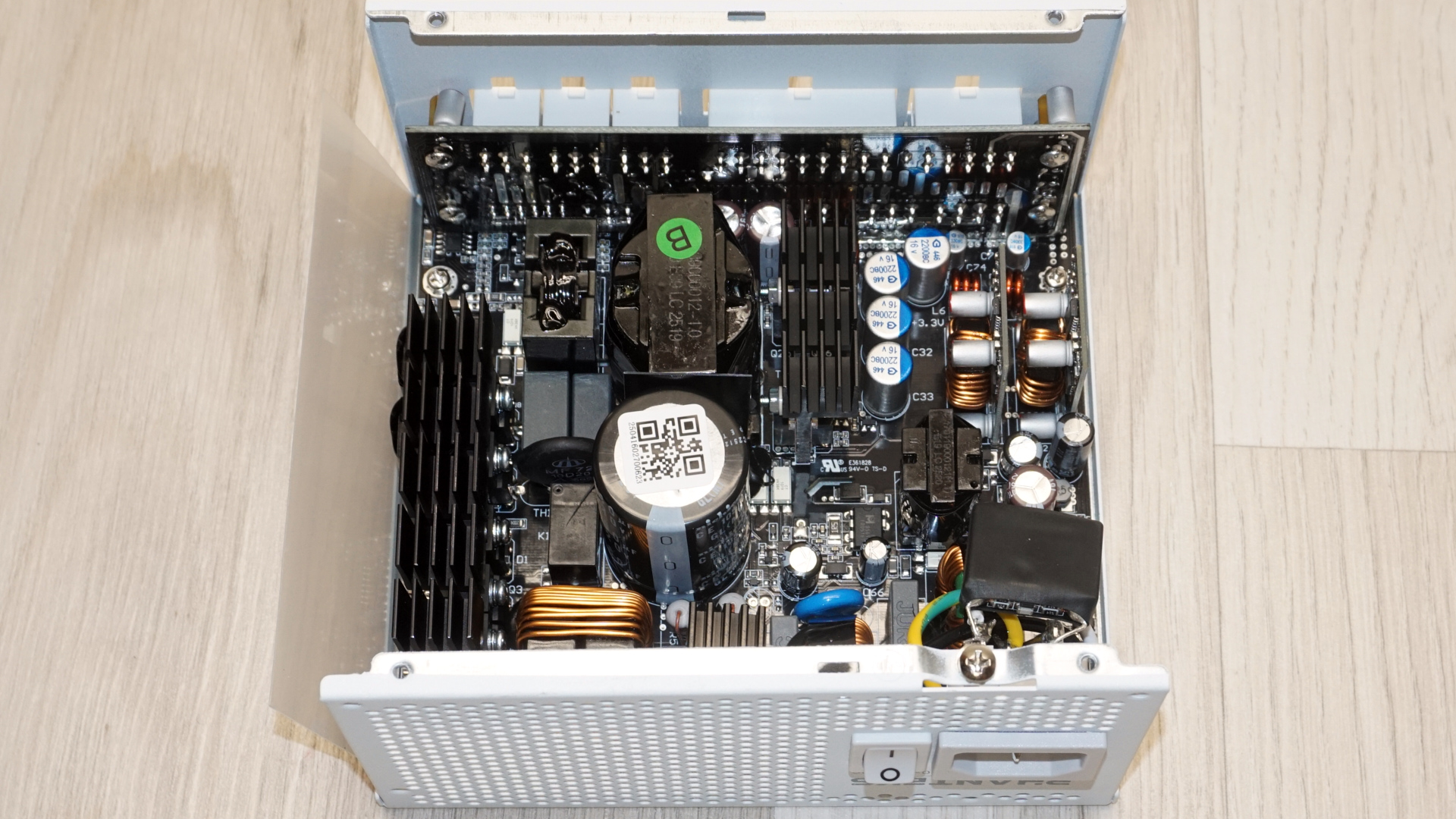
The platform is Helly's, and the layout is tidy. We have proper heatsinks rather than basic aluminum plates, sensible component spacing, and a restrained amount of glue holding the taller parts down. Transient filtering begins at the AC receptacle and continues on the main board, totaling three X capacitors, four Y capacitors, and two filtering inductors. Two bridge rectifiers sit on their own dedicated heatsink, which is more than this class usually gets.

Phanteks  AMP GH 750W
Tom's Hardware
Phanteks  AMP GH 750W
Tom's Hardware

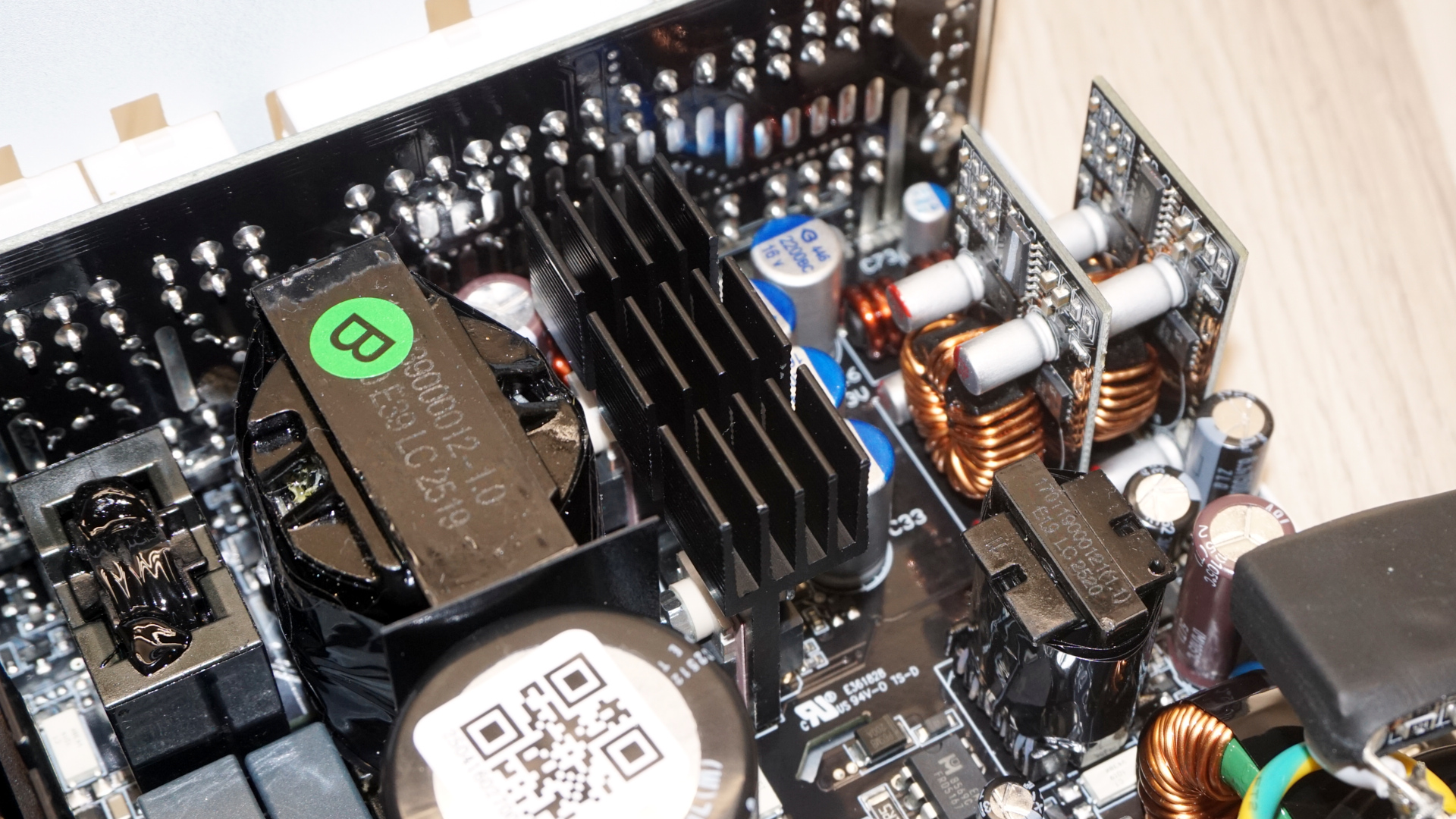
The APFC stage uses a pair of Oriental Semiconductor OSG55R190F MOSFETs, sharing the long heatsink with the primary side inversion switchers. This is a common cost-and-space-saving arrangement but hardly matters when the heatsink is large enough. The bulk capacitor is a Nichicon rated 560 μF at 420V and 105°C and the choke beside it is on the small side and unshielded. Primary inversion is a half-bridge LLC resonant arrangement driving two PIP PTA25N50 MOSFETs, which is the standard and entirely sensible topology for a 750W Gold unit.

Phanteks  AMP GH 750W
Tom's Hardware
Phanteks  AMP GH 750W
Tom's Hardware

On the secondary side, four Fuxin FXN0204C MOSFETs generate the 12V rail through synchronous rectification, and the 3.3V and 5V rails come off two vertical DC-DC daughterboards standing near the modular connector board. Capacitor sourcing is the pleasant surprise, with the secondary electrolytics coming from Rubycon and Nippon Chemi-Con and APAQ polymers filling the rest. That is a fully Japanese set of capacitors on a unit that sells for under $90, and it is the single strongest argument that the 8-year warranty is more than a marketing number.

Phanteks  AMP GH 750W
Tom's Hardware
Phanteks  AMP GH 750W
Tom's Hardware

Cold Test Results (25°C Ambient)

Cold Test Results (25°C Ambient)

For the testing of PSUs, we are using high-precision electronic loads with a maximum power draw of 2700 Watts, a Rigol DS5042M 40 MHz oscilloscope, an Extech 380803 power analyzer, two high-precision UNI-T UT-325 digital thermometers, an Extech HD600 SPL meter, a self-designed hotbox, and various other bits and parts.
Phanteks  AMP GH 750W
Tom's Hardware
Phanteks  AMP GH 750W
Tom's Hardware
Phanteks  AMP GH 750W
Tom's Hardware
Phanteks  AMP GH 750W
Tom's Hardware
Phanteks  AMP GH 750W
Tom's Hardware

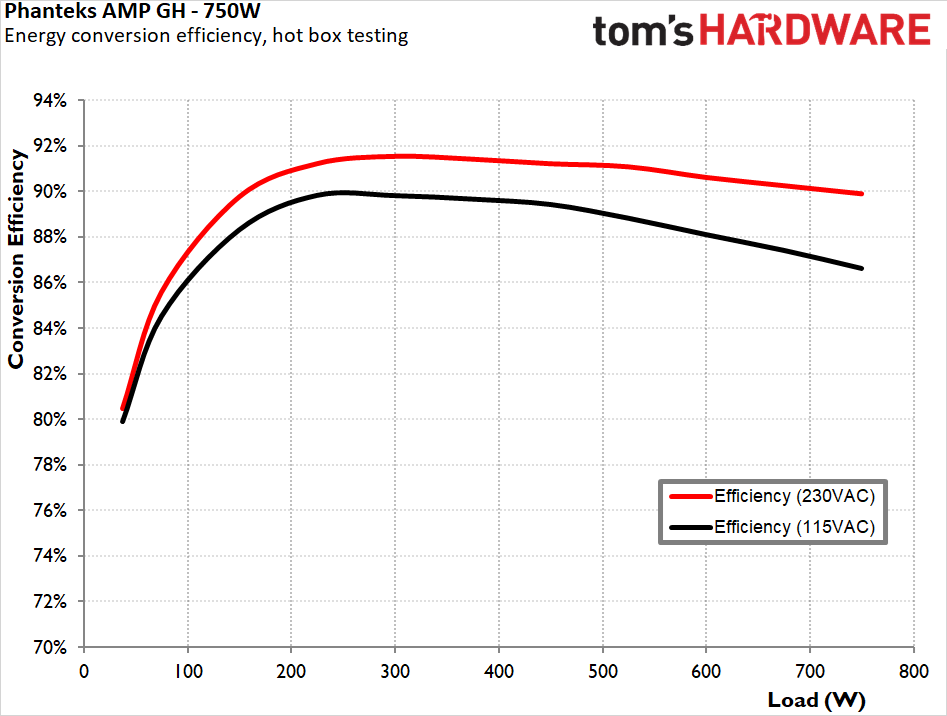
At 25°C ambient, the AMP GH 750 averaged 91.0% at 230 VAC and 89.0% at 115 VAC across the full load range, peaking at 92.3% (230 VAC) at around 300W and holding 90.8% at a sustained 750W. The curve is well shaped. It climbs fast, is stable between 250W and 450W, and loses very little ground at the top end, which is exactly the profile you want from a PSU that will spend its life between 30% and 70% load. At 115 VAC, the equivalent figures are 90.6% at peak and 87.5% at full load. The 80 PLUS Gold asks for 87% at 100% load on 115V, so the margin is half a point. It is a pass, but our numbers land roughly one point below the CLEAResult published certification report, which is dated 4/8/22 and lists the same PH-P750GH_01 model code. That certificate predates the ATX 3.1 revision of this unit by some margin, so it is describing an earlier configuration sharing the model number.

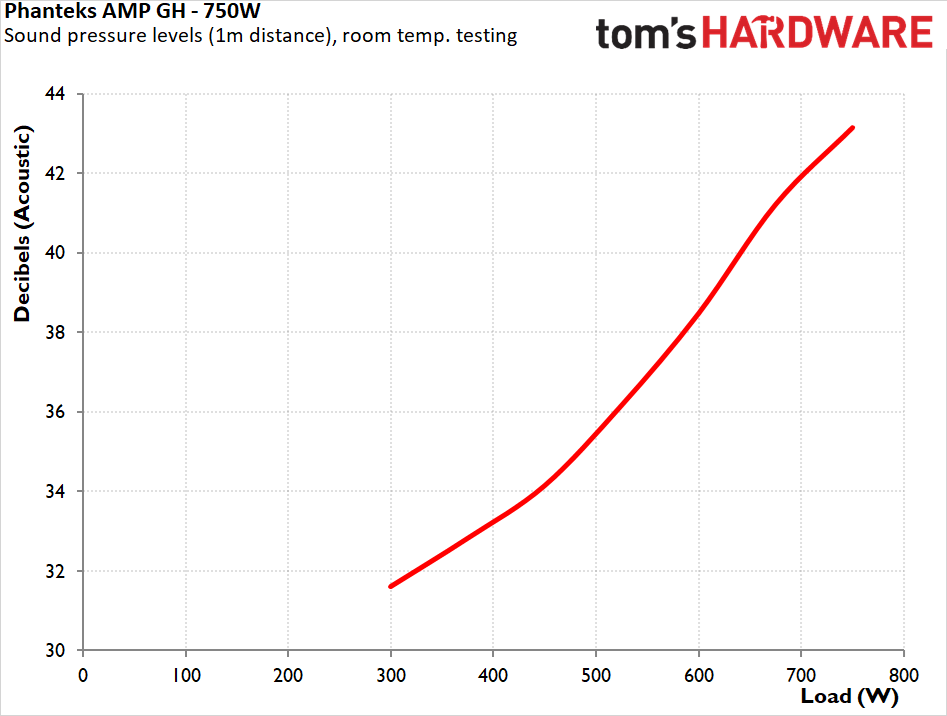
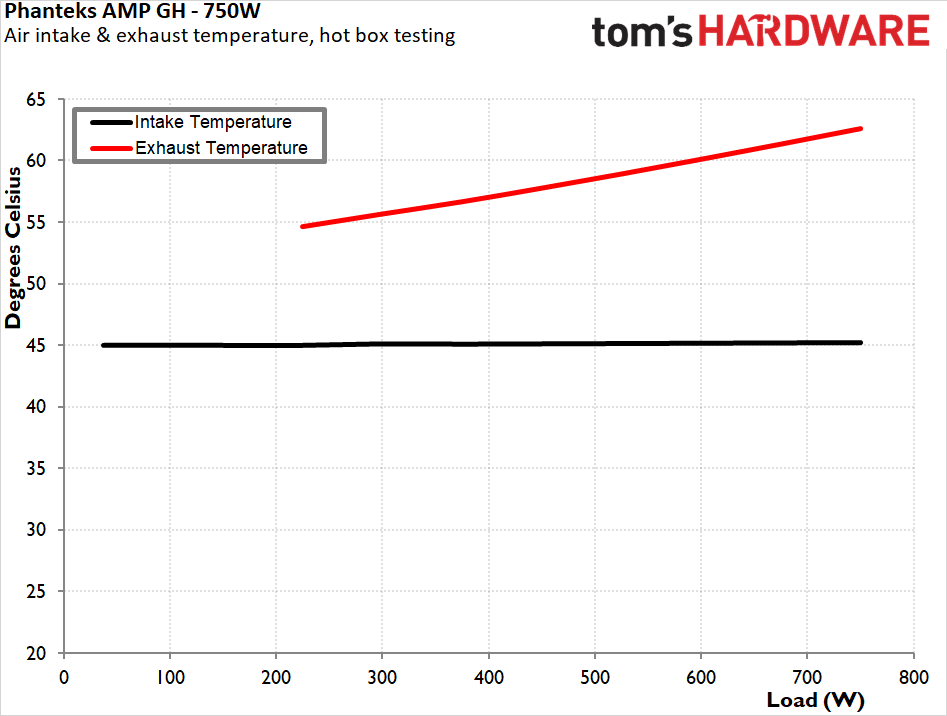
Acoustically, the cold run is the unit's best showing. The fan stays completely stopped up to nearly 300W, which is almost 40% of its maximum rating, comfortably wider than the 30% Phanteks claims. It will easily cover any system idling and even performing medium-power tasks as well. It comes on at 31.6 dB(A) and climbs gently, crossing 38 dB(A) only past 590W and topping out at 43.2 dB(A) at a sustained 750W. That is audible in a quiet room but not intrusive, and you have to be pushing a 750W load through a 750W supply to get there. Thermals are unremarkable but in a good way, with both the exhaust and internal temperatures well within the acceptable margins while the fan is largely idling. Nothing here is working hard.

Hot Test Results (~45°C Ambient)

Hot Test Results (~45°C Ambient)

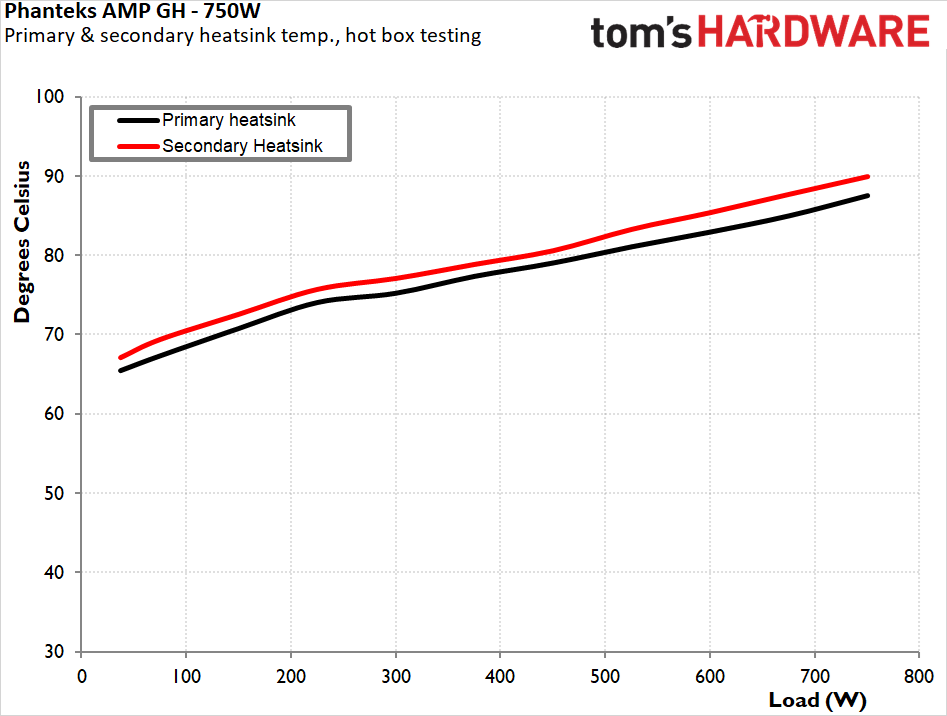
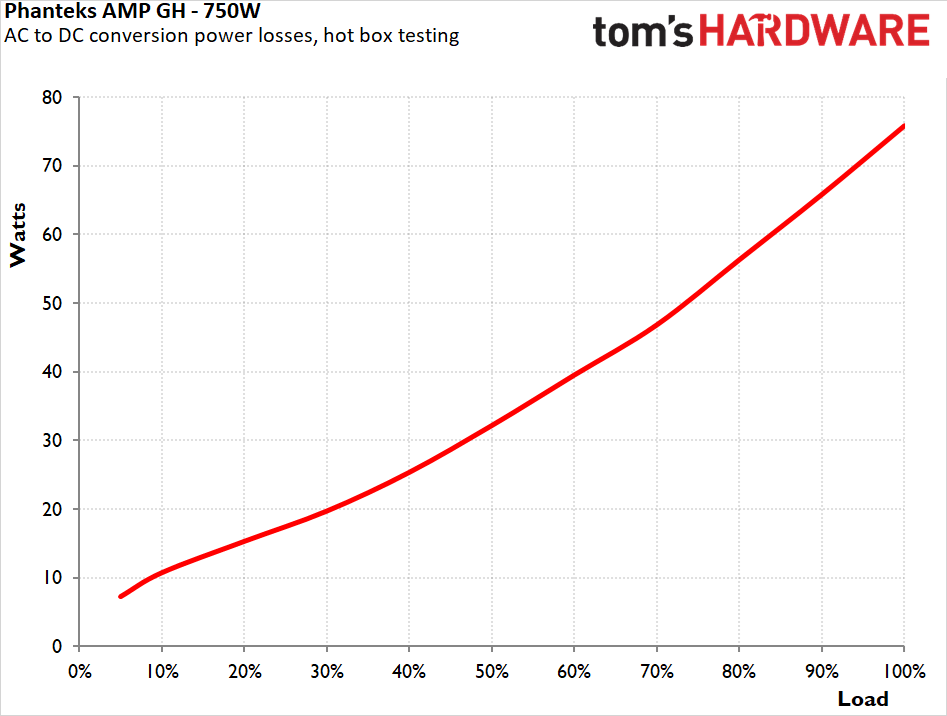
Inside the hotbox at roughly 45°C (five degrees past the unit's own 40°C rating), efficiency degraded far less than we expected. The 230 VAC average fell from 91.0% to 90.3% and the full-load figure from 90.8% to 89.8%, a single point for a twenty-degree increase in ambient. At 115 VAC, the average went from 89.0% to 88.3%, with full load dropping to 86.5%, which does slip under the 80 PLUS Gold threshold. That threshold is defined at 23°C ambient, so what we have here is a note rather than a failure. Full-load losses rose from 69W to 76W. This is a better hotbox result than most mainstream Gold units manage, and it says something reassuring about the heatsink sizing and choice of components.

Phanteks  AMP GH 750W
Tom's Hardware
Phanteks  AMP GH 750W
Tom's Hardware
Phanteks  AMP GH 750W
Tom's Hardware
Phanteks  AMP GH 750W
Tom's Hardware
Phanteks  AMP GH 750W
Tom's Hardware

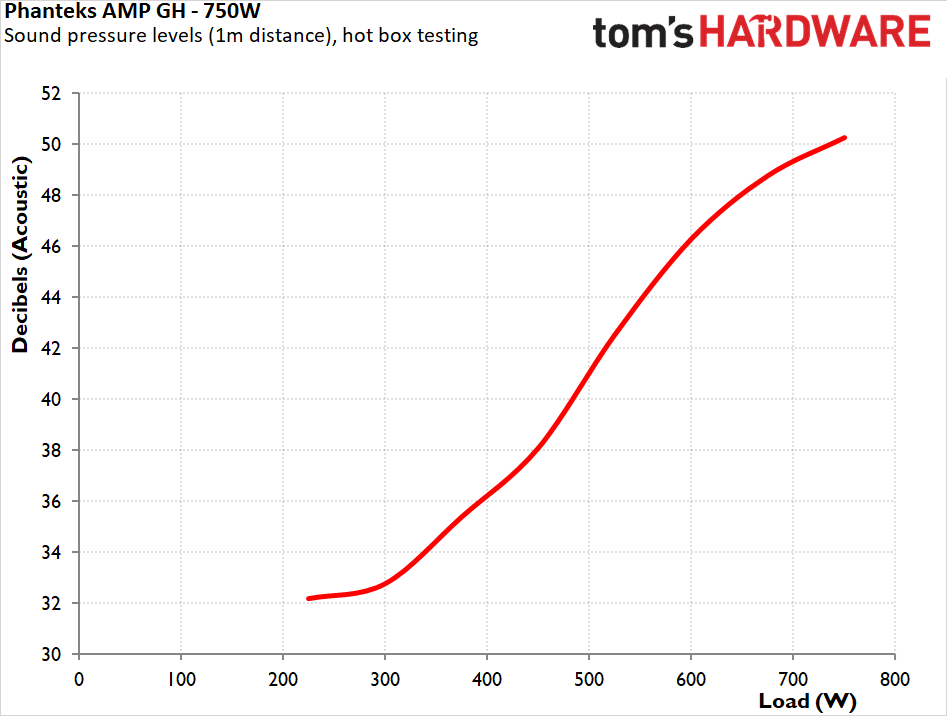
Heat makes little impact on the unit’s electrical performance, but noise is where it makes itself felt. The fanless window narrows from about 300W to roughly 220W, and from there the ramp is much steeper than it was at room temperature: 38 dB(A) at 450W, 46 dB(A) at 600W, and 50.2 dB(A) at a sustained 750W. That is loud, and the sleeve-bearing Yate Loon is working hard. The trade-off is that internal temperatures stay very well controlled, so the fan is doing real work rather than spinning for the sake of it, with the designer obviously favoring reliability over acoustics when ambient conditions are tense. Even though sustained full output in a 45°C environment is outside this unit's specifications, it handled it without complaint and without shutting down.

PSU Quality and Bottom Line

Power Supply Quality

Voltage regulation is the standout result of the whole test. Across the 20% to 100% load span, the 12V rail moved by just 0.4%, an enthusiast-tier tightness on a sub-$90 unit and better than several platforms costing twice as much. The 3.3V and 5V rails came in at 1.2% each, which is ordinary but perfectly fine given DC-DC conversion and the negligible loads modern systems put on them. There is no sign of the minor rails dragging the 12V line around under uneven loading.

Ripple suppression is equally comfortable. The 12V rail peaked at 38 mV under full load against the 120 mV ATX limit, leaving nearly 70% headroom, while the 3.3V and 5V rails topped out at 24 mV against their 50 mV limits. Nothing in this data set gets anywhere near a limit, with the Japanese capacitors on the secondary clearly backing their reputation.

During our thorough assessment, we evaluate the essential protection features of every power supply unit we review, including Over Current Protection (OCP), Over Voltage Protection (OVP), Over Power Protection (OPP), and Short Circuit Protection (SCP).

All protection mechanisms were verified and triggered correctly during testing. With the unit hot, OCP tripped at 150% on the 3.3V rail, 148% on the 5V rail, and 138% on the 12V rail. OPP shut the unit down at approximately 1050W, or 140% of rated output. Those are loose thresholds and generous enough that a genuine fault has room to develop before anything intervenes. However, these are not unusual for the ATX 3.1 class, and every protection engaged cleanly when it should have.

Main Output

Load (Watts)

150.89 W

376.35 W

563.58 W

750.68 W

Load (Percent)

20.12%

50.18%

75.14%

100.09%

Amperes

Volts

Amperes

Volts

Amperes

Volts

Amperes

Volts

3.3 V

1.81

3.40

4.53

3.38

6.80

3.37

9.07

3.36

5 V

1.81

5.07

4.53

5.05

6.80

5.03

9.07

5.01

12 V

11.25

12.05

28.11

12.03

42.17

12.01

56.23

12.00

Line

Regulation

Voltage Ripple (mV)

(20% to 100% load)

20% Load

50% Load

75% Load

100% Load

CL1
12V

CL2
3.3V + 5V

3.3V

1.2%

18

16

18

24

18

22

5V

1.2%

18

18

18

24

18

24

12V

0.4%

26

26

26

38

38

24

Bottom Line

The AMP GH 750 is a better PSU than its price implies at the time of this review, but the reasons are not the ones Phanteks leads with. Phanteks spent considerable effort and resources on the aesthetics of the unit, leading their marketing campaign with the appearance and quality of the wires. It is undeniable that the cables of this unit have been exceptionally well designed and made, with extreme attention to quality and detail. The same is true about the unit itself, the construction and appearance of which are immaculate and attractive.

Phanteks  AMP GH 750W

(Image credit: Tom's Hardware)

While unquestionably important, aesthetics can only take you so far when we are talking about any tech equipment. What makes the AMP GH 750 really worth buying is the bill of materials and the electrical results. Japanese capacitors throughout, amazing regulation on the 12V rail, and ripple that never gets within two-thirds of the ATX limit. Helly is not a famous name amongst enthusiast cycles, but this is a well-executed platform, and the 8-year warranty behind it looks like a considered commitment rather than a gamble.

Phanteks  AMP GH 750W

(Image credit: Tom's Hardware)

The measurements may look indifferent, but the results are honest. Efficiency clears 80 PLUS Gold at both input voltages and holds its curve well, but that level of performance is hardly stellar by today’s standards. Our numbers sit about one percentage point below the CLEAResult certification report on file for this model code, a report dated 2022, which predates the ATX 3.1 revision the unit ships as today. There are no Cybenetics or PLPP certifications at the time of this review. We feel that two things hold the AMP GH 750 back. The first is the 12V-2x6 connector's 450W rating. On a 750W unit, that is not fatal; anything you would sensibly pair with 750W stays under it, but anyone planning to move a heavier card into this system later will be facing a limit. The second is the fan. The Yate Loon D12SH-12 is a sleeve-bearing part that does not match the eight-year warranty's ambition.

Phanteks  AMP GH 750W

(Image credit: Tom's Hardware)

At $109.99 MSRP for the white unit and $99.99 for the black, and at the time of writing, $84.99 and $89.99 respectively at Newegg, both landing at $74.99 after Phanteks' mail-in rebate, the value case is straightforward. Under $80 buys you Japanese capacitors, near-flat 12V regulation, a 300W fanless window, and 8 years of warranty. The compromises are a connector limit you should check against your GPU plans, and a fan that will remind you it exists in a warm case. For a mid-range build that lives between 200W and 500W most of the time, which is exactly what a 750W supply is for, that is an easy recommendation.

MORE: Best Power Supplies

MORE: How We Test Power Supplies

MORE: All Power Supply Content

Montech Century II Gold 850W power supply review: Excellent budget-friendly Gold-tier ATX 3.1 unit with Cybenetics Platinum efficiency

2026年9月7日 20:05

Montech is one of those brands that, despite a relatively recent international profile, traces its lineage back through the Taiwanese components industry to engineers with three-plus decades of experience. The company formally took shape in 2016 and entered Western retail channels around 2019, initially building its name on aggressively priced PC cases. From that beachhead, Montech expanded methodically into air and liquid coolers, fans, mechanical input devices, and, most relevant for this review, power supplies.

The original Century line positioned Montech at the value-conscious end of the PSU market. At the same time, the more recent Titan series advanced to premium territory by relying on Seasonic and CWT for its underlying platforms. The Century II line, refreshed for ATX 3.1 and PCIe 5.1 with native 12V-2x6 connectivity, sits between those bookends. It is meant to deliver modern-spec compliance and Gold-level efficiency at a price point that undercuts the established premium players by a meaningful margin. The 850W model is the entry point of the family, and today we examine whether it belongs among our list of best power supplies on the market.

Specifications and Design

Montech Century II Gold 850W ATX 3.1 Power specifications (Rated @ 40 °C)

RAIL

+3.3V

+5V

+12V

+5Vsb

-12V

MAX OUTPUT

20A

20A

70.8A

3A

0.3A

100W

100W

849.6W

15W

3.6W

TOTAL

850W

AC INPUT

100 - 240 VAC, 50 - 60 Hz

MSRP

$90

In the Box

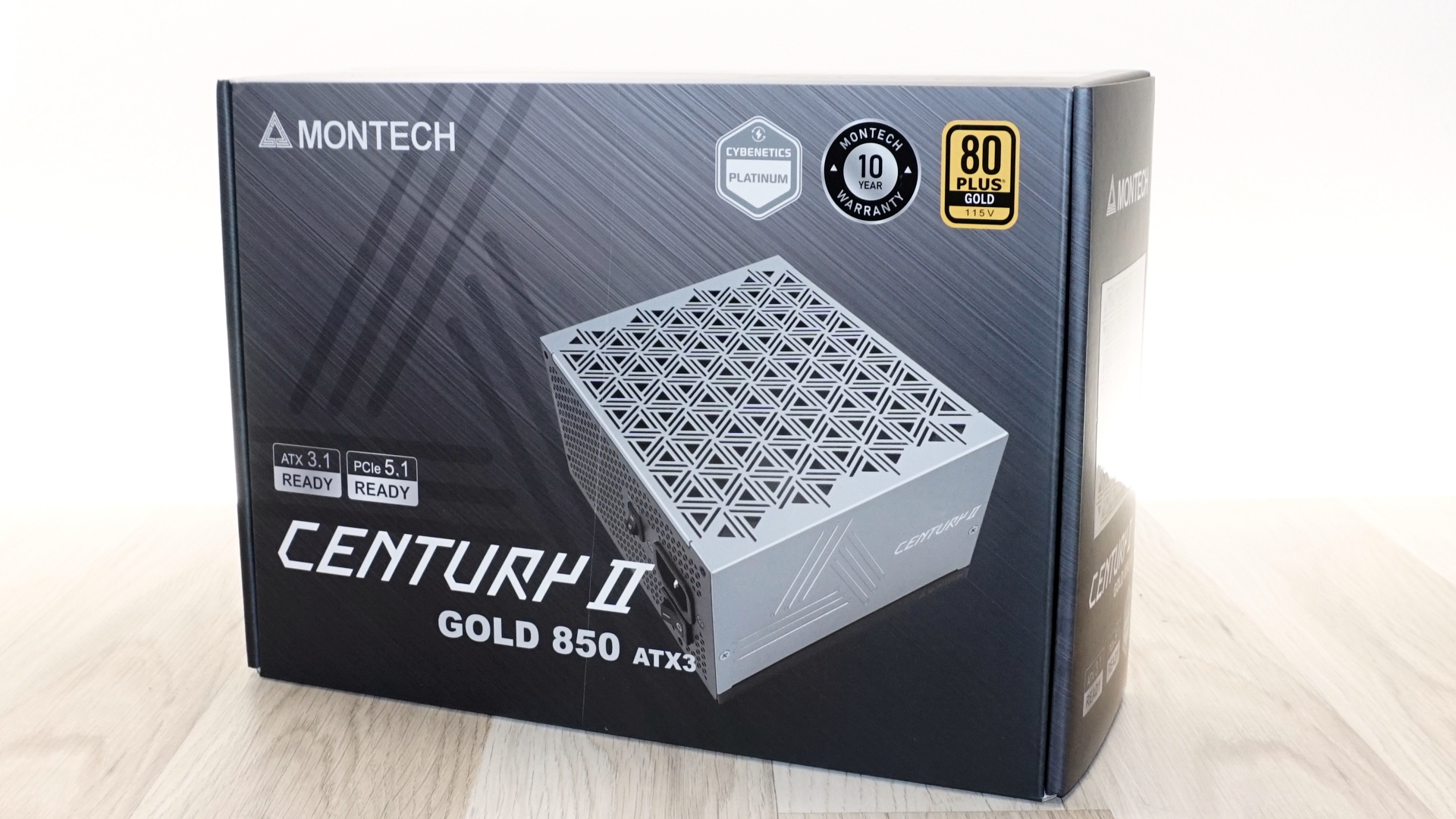
The Century II 850W ships in a tidy cardboard box dressed in a charcoal/silver color scheme that attempts to mirror the unit's own finish. Montech leans hard on the dual certification story up front, with the 80Plus Gold and Cybenetics Platinum badges both printed prominently on the box face, alongside the ten-year warranty claim and references to the ATX 3.1 and PCIe 5.1 standards. Foam inserts protect the PSU itself.

Montech Century II Gold 850W ATX 3.1

(Image credit: Tom's Hardware)

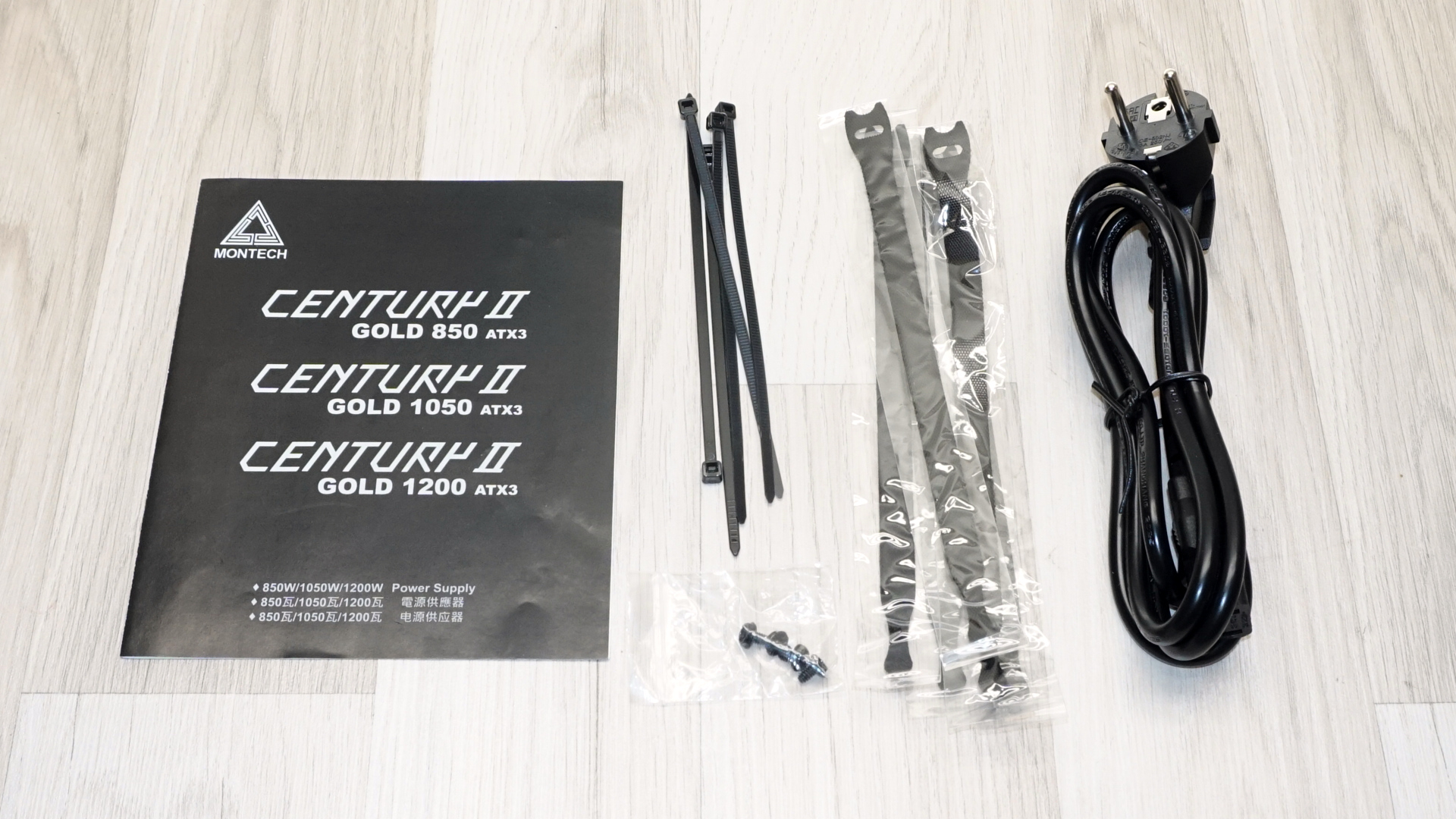
Bundled accessories are beyond modest, especially for the price range of the unit. We found the AC power cable, a sleeve of mounting screws, a few reusable Velcro-style cable straps, a few cable ties, and a small user manual. At this price point, that is an unexpectedly good unboxing experience.

Montech Century II Gold 850W ATX 3.1

(Image credit: Tom's Hardware)

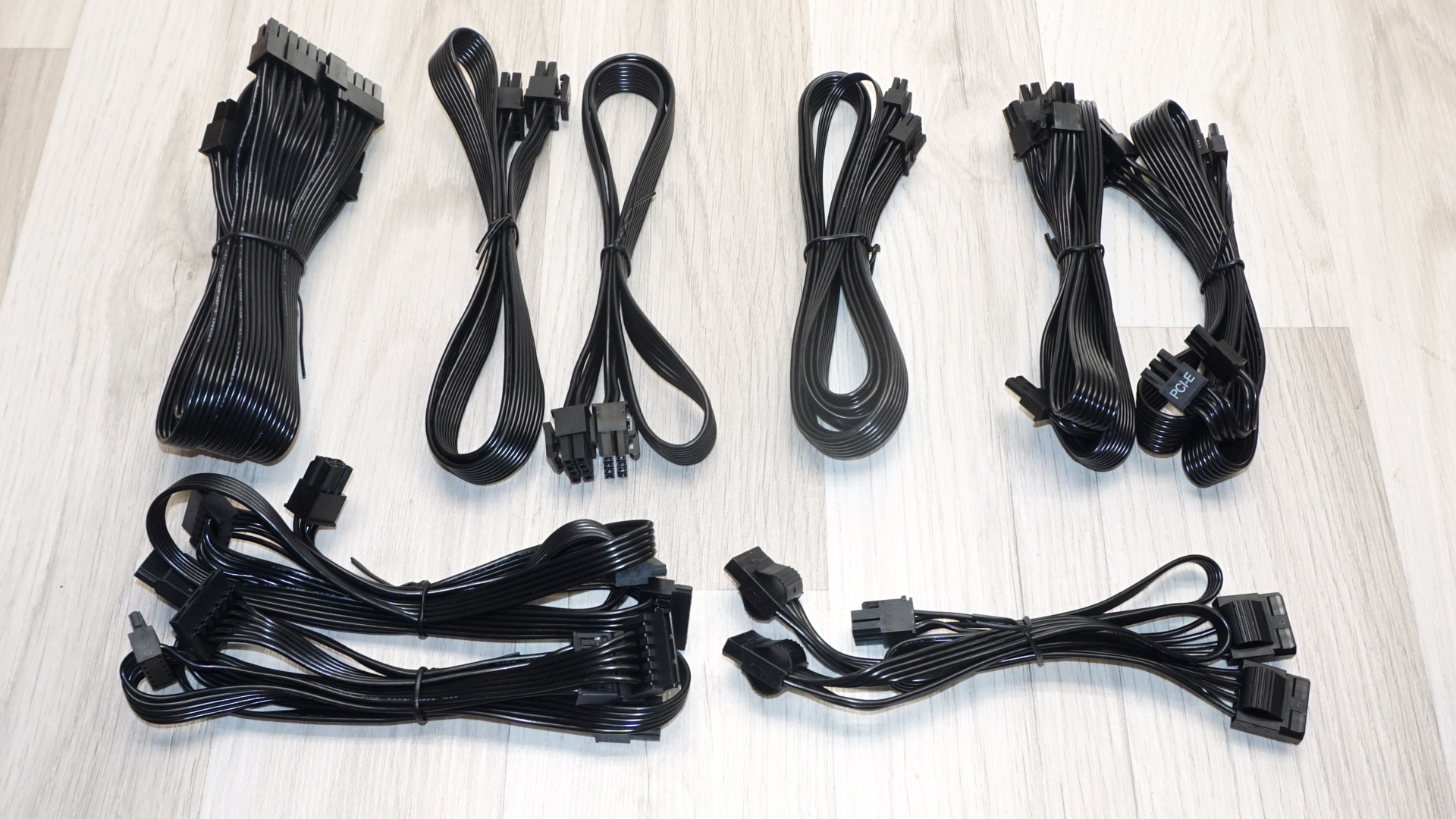
The cable bundle itself is all-black and entirely flat-ribbon in construction. The native 12V-2x6 cable is the highlight, rated at the full 600W of the connector standard. Buyers get two 6+2-pin PCIe cables carrying four connectors total, two EPS 8-pin runs for CPU power, two SATA chains with four connectors apiece, and a single Molex chain. The total connector count covers every realistic single-GPU configuration this PSU should be paired with, including current-generation cards with multiple PCIe inputs.

Montech Century II Gold 850W ATX 3.1

(Image credit: Tom's Hardware)
Montech Century II Gold 850W ATX 3.1

Connector type

Hardwired

Modular

ATX 24 Pin

-

1

EPS 4+4 Pin

-

-

EPS 8 Pin

-

2

PCI-E 5.1 (12V-2x6)

-

1

PCI-E 6+2 Pin

-

4

SATA

-

8

Molex

-

4

Floppy

-

-

External Appearance

At 160mm in length, the Century II 850W is a touch longer than the ATX guideline 140mm reference, though well within what any modern mid-tower will accept without complaint. Compact-case builders should double-check clearances before committing.

Montech Century II Gold 850W ATX 3.1

(Image credit: Tom's Hardware)

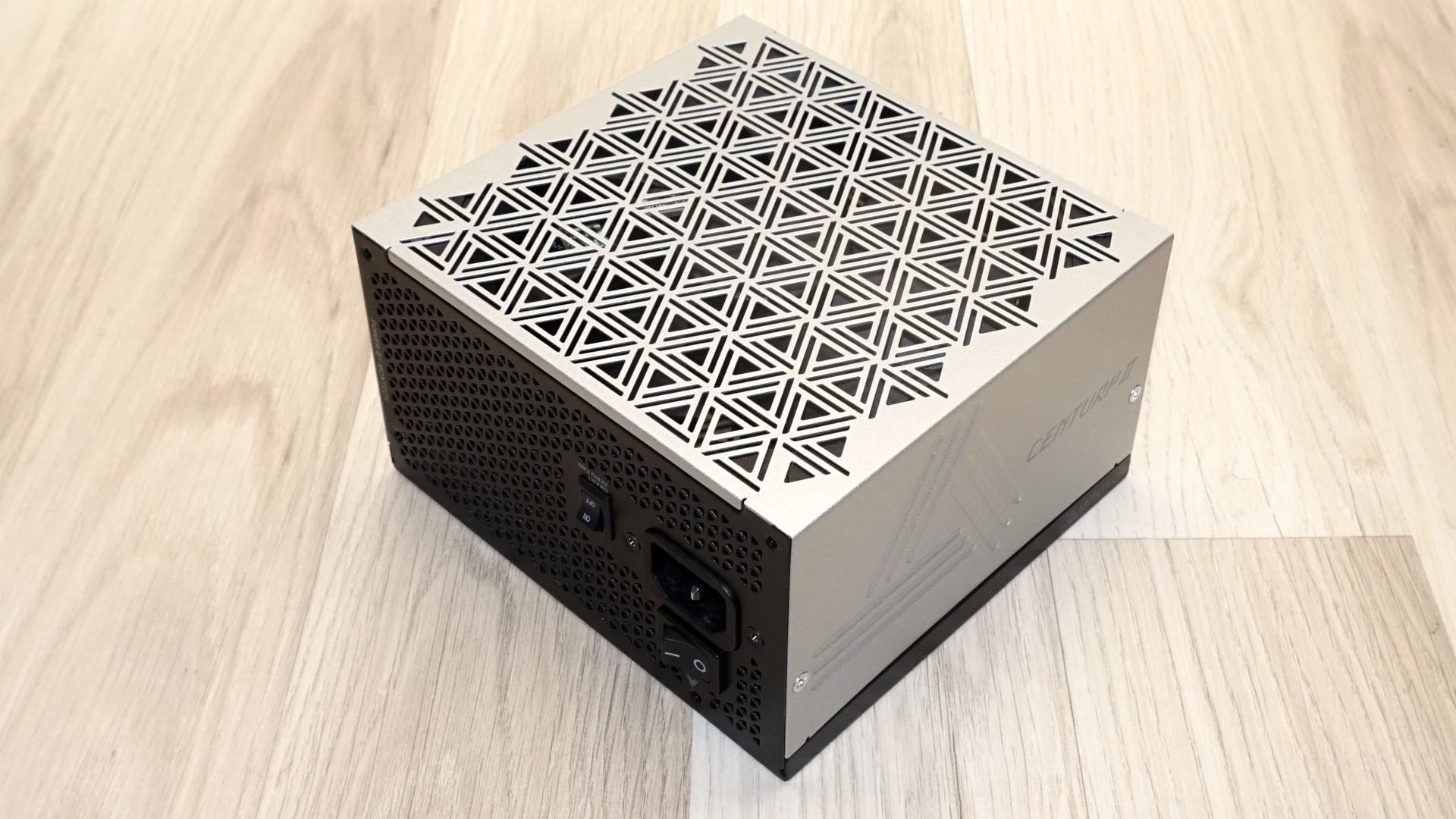
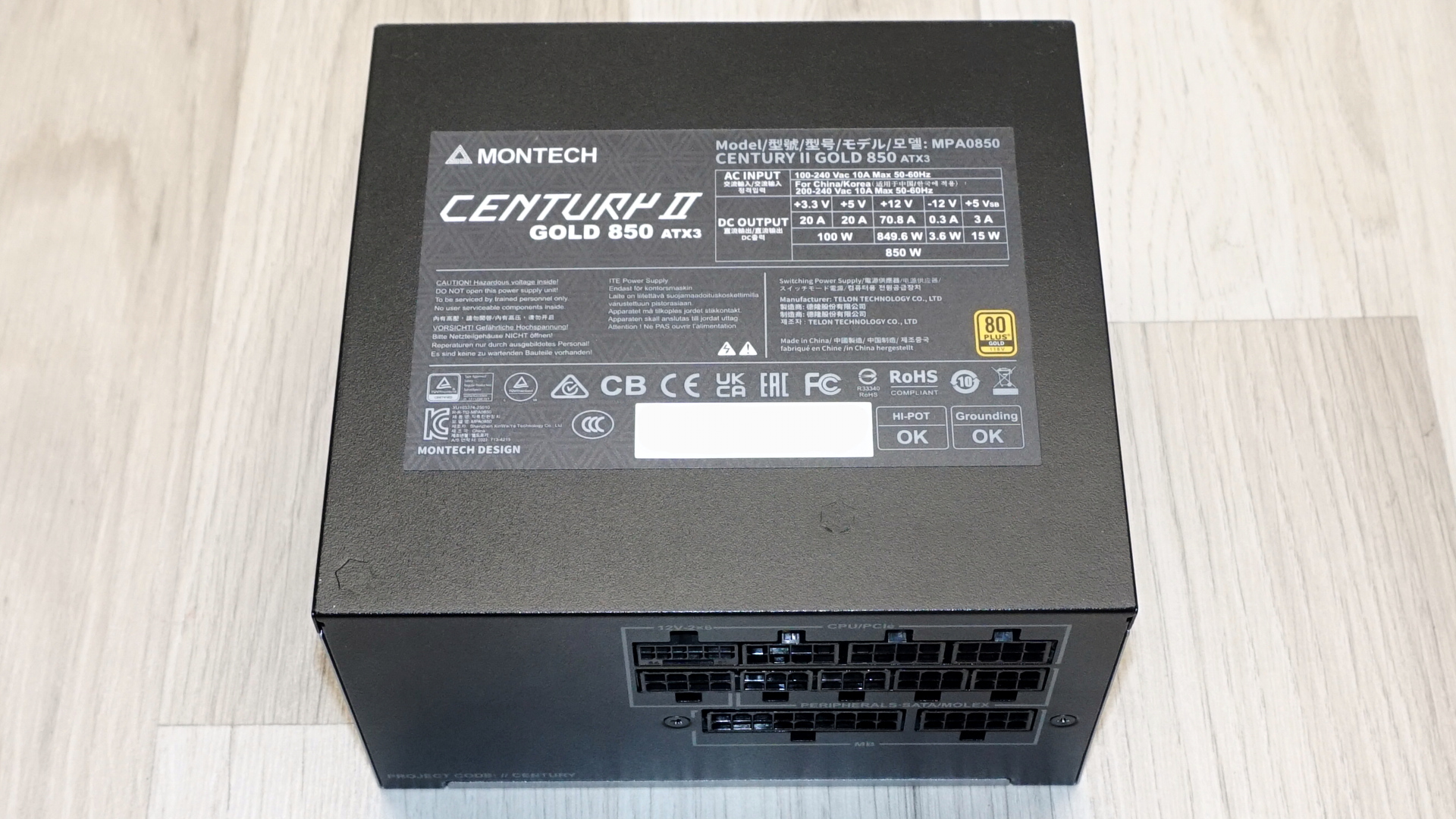
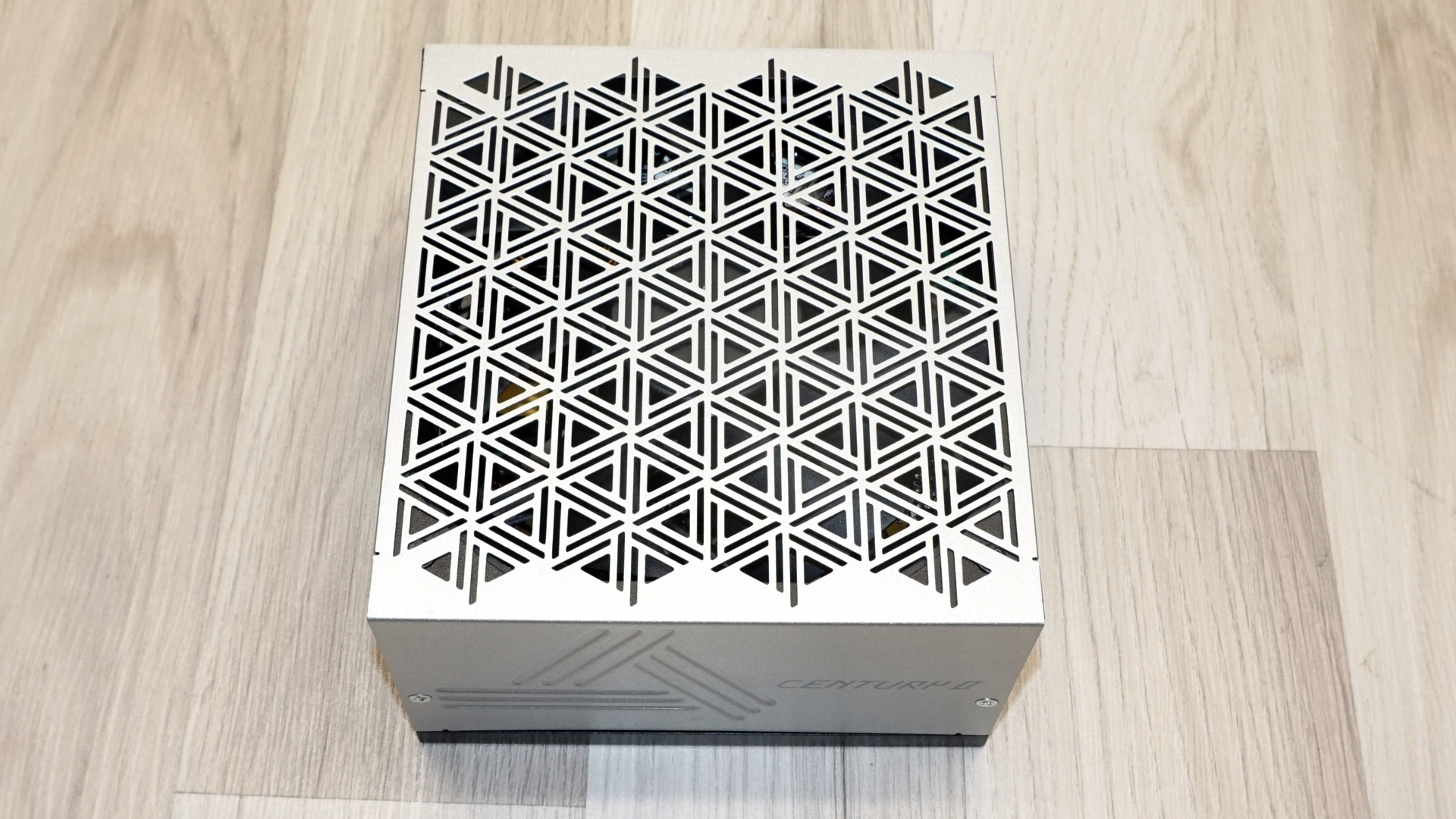
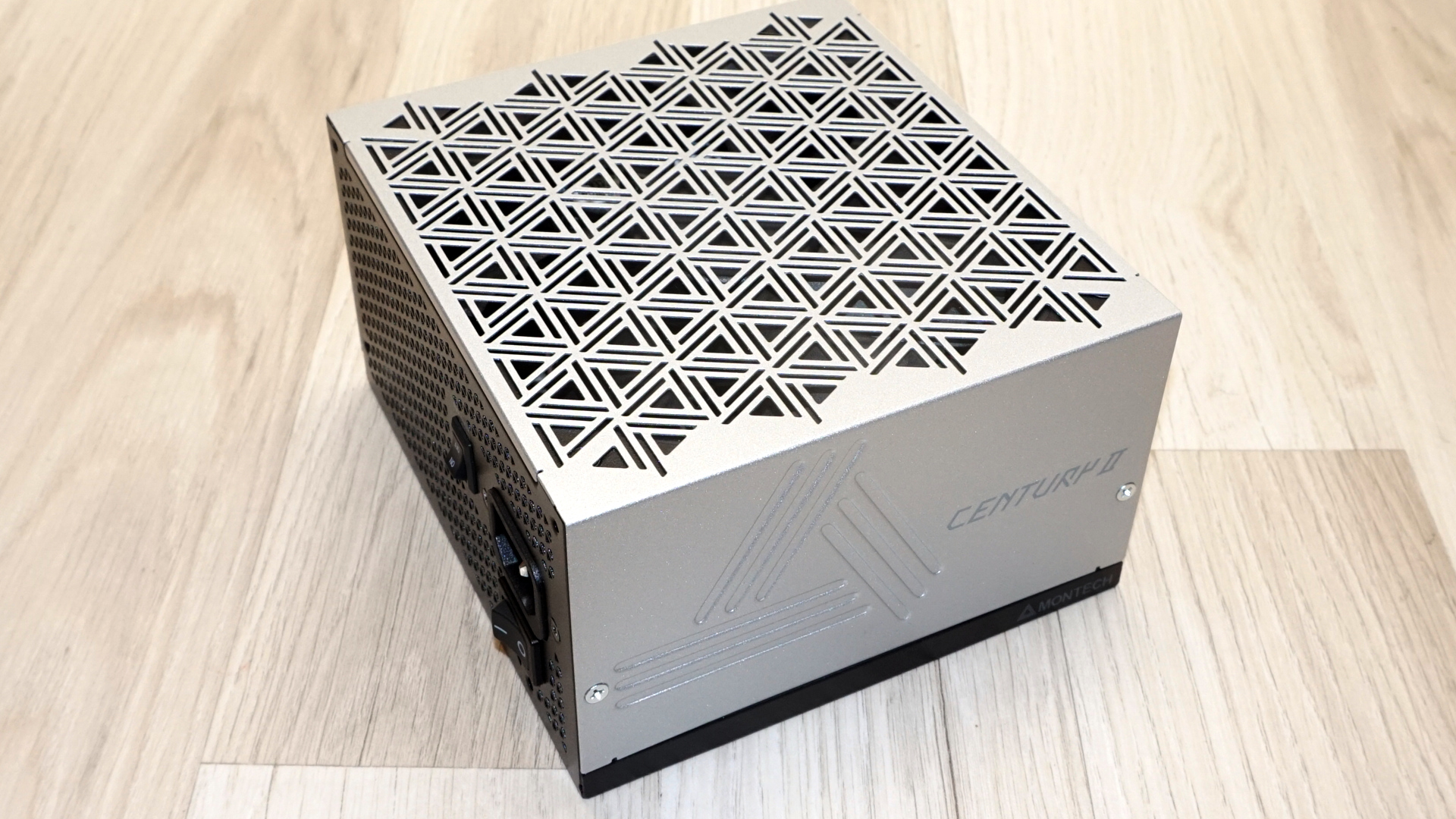
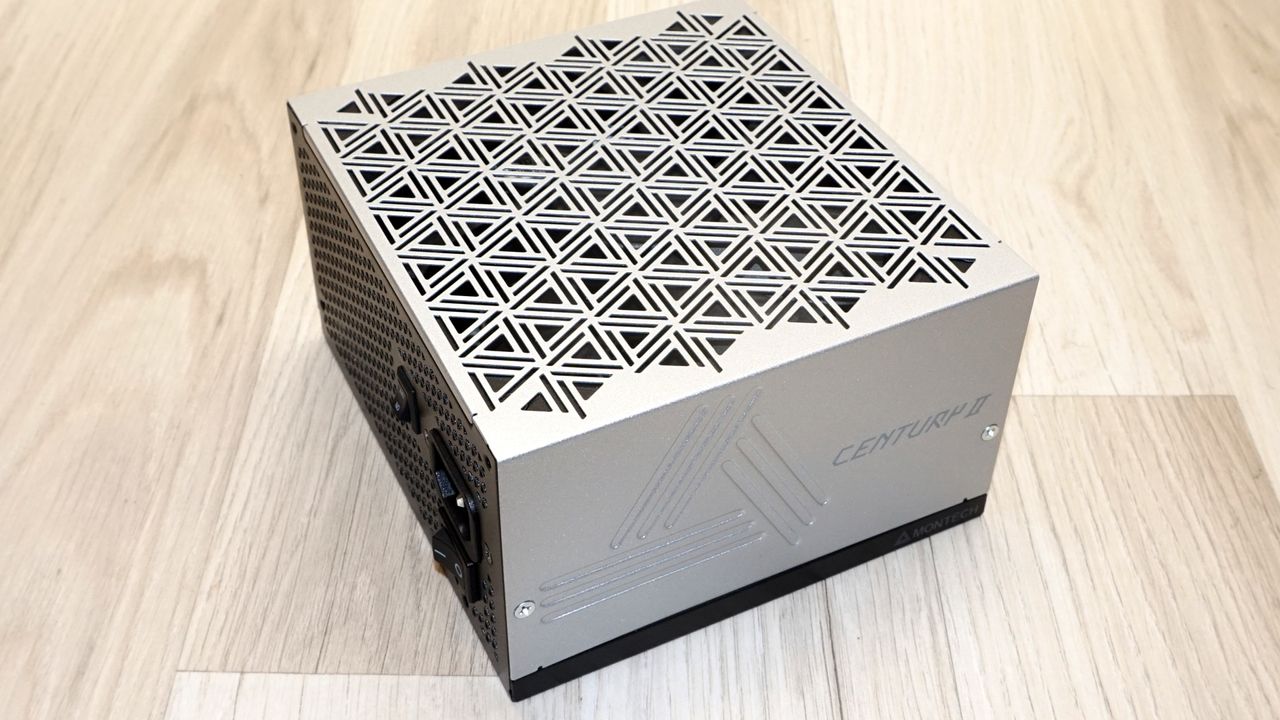
Visually, this is one of the most distinctive units in its class. Where the vast majority of competitors stick to plain black sheet metal, Montech has gone with a two-tone treatment: a matte silver top panel cut with a geometric triangular grille that looks like an architectural detail more than a fan vent, paired with a black chassis body. Both side panels carry a subtle, debossed angular pattern and the Century II wordmark, while a discrete "Montech" logo is along the bottom edge. The finish is clean, and the panel gaps are tight.

Montech Century II Gold 850W ATX 3.1
Tom's Hardware
Montech Century II Gold 850W ATX 3.1
Tom's Hardware

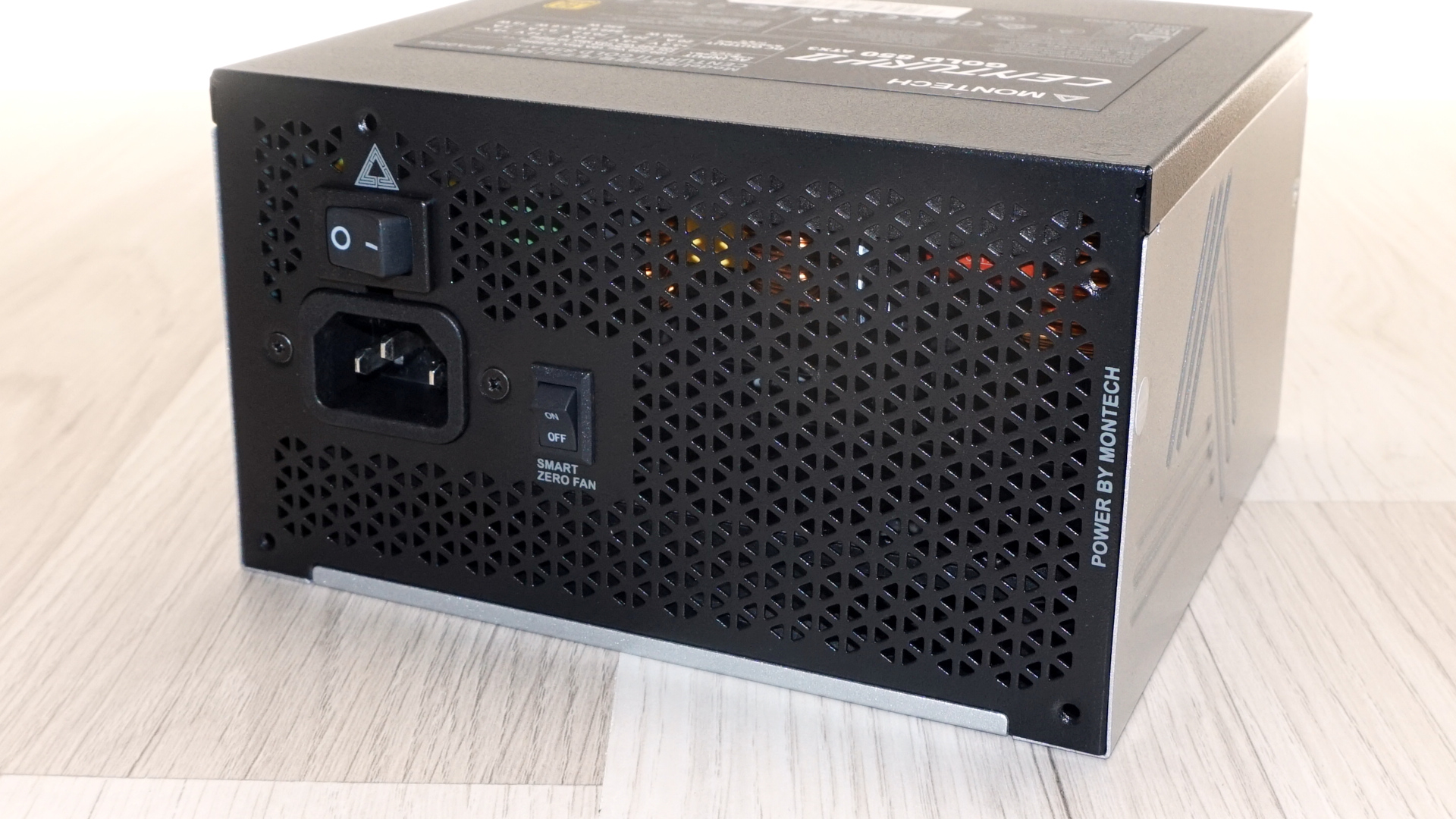
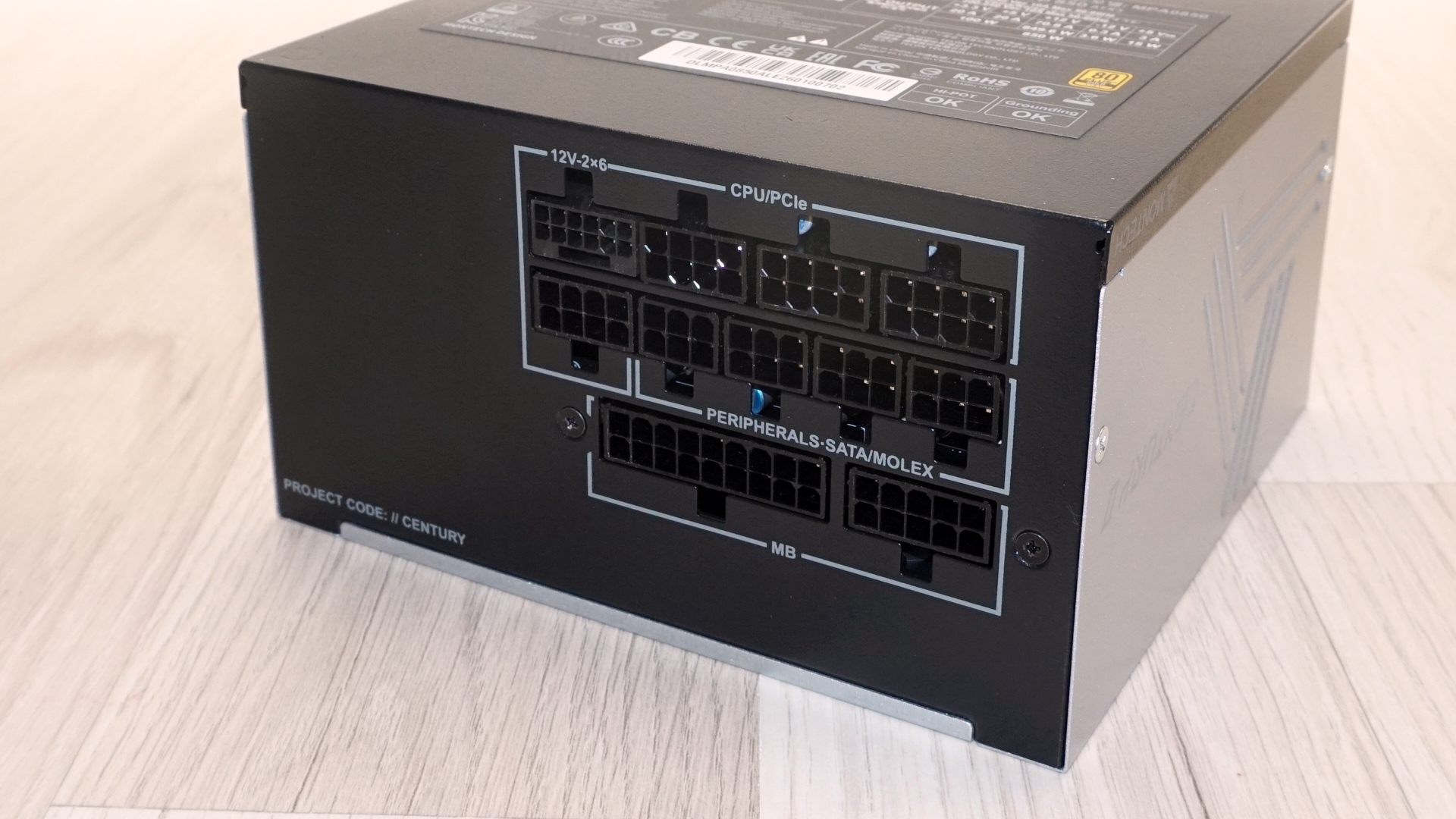
The rear face holds the AC receptacle and the primary on/off switch, plus a smaller secondary toggle that lets the user disable the hybrid mode and run the fan continuously if they prefer. That second switch is something Montech could easily have buried, and it is a small feature but one we are glad to see. At the front, we can only see the modular connectors with their silkscreened labels that clearly identify each socket. Connector keying makes mis-insertion practically impossible anyhow.

Montech Century II Gold 850W ATX 3.1
Tom's Hardware
Montech Century II Gold 850W ATX 3.1
Tom's Hardware

Internal Design

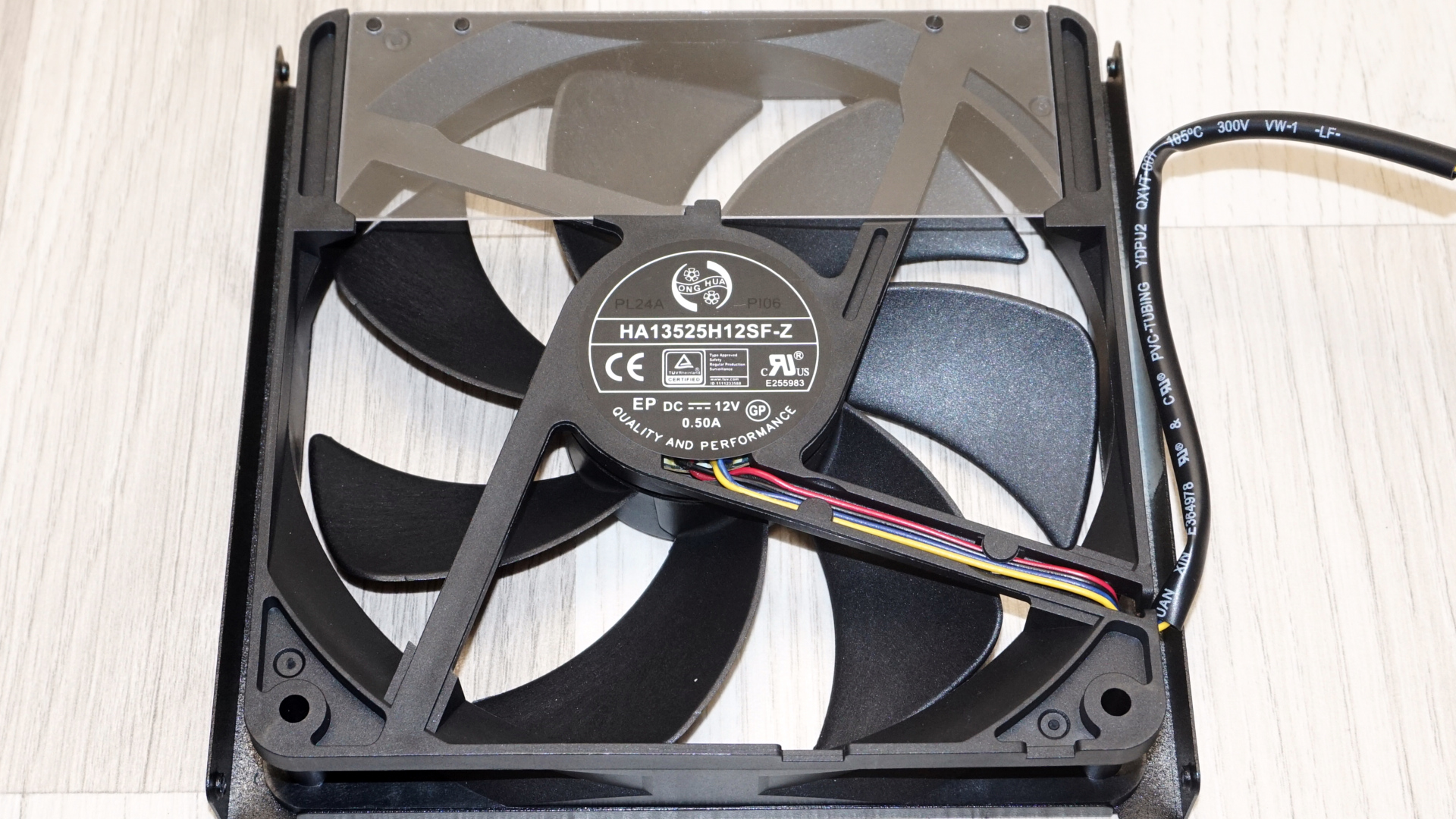
Cooling falls to a 135mm Hong Hua HA13525M12SF-Z fan, which uses a fluid-dynamic bearing engine. The model designation indicates a medium-speed variant rather than the higher-rated H-series spindle some premium Hong Hua models employ, but the maximum speed of 2000 RPM is very high. In practice, fluid-dynamic bearings are the right choice for a unit pitched for long service life, and the fan curve of this unit is calibrated conservatively enough.

Montech Century II Gold 850W ATX 3.1

(Image credit: Tom's Hardware)

The OEM is Shenzhen Xinweiye Technology Co., typically referred to as XWY. XWY is not as familiar a name as Seasonic, CWT, or Great Wall, but the company has been quietly supplying Montech's Century II family and a handful of other brands' mainstream ATX 3.x designs.

Montech Century II Gold 850W ATX 3.1
Tom's Hardware
Montech Century II Gold 850W ATX 3.1
Tom's Hardware

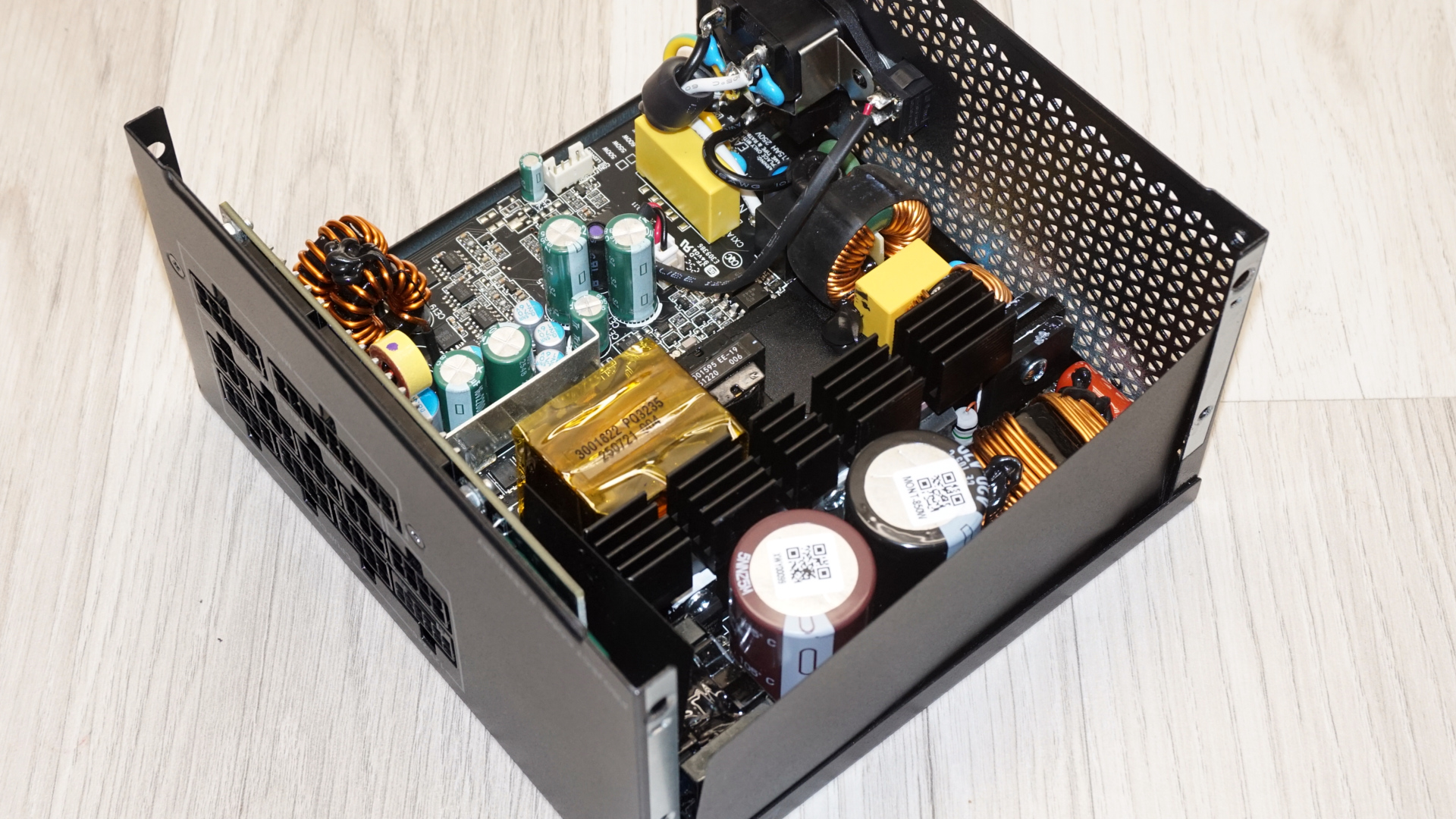
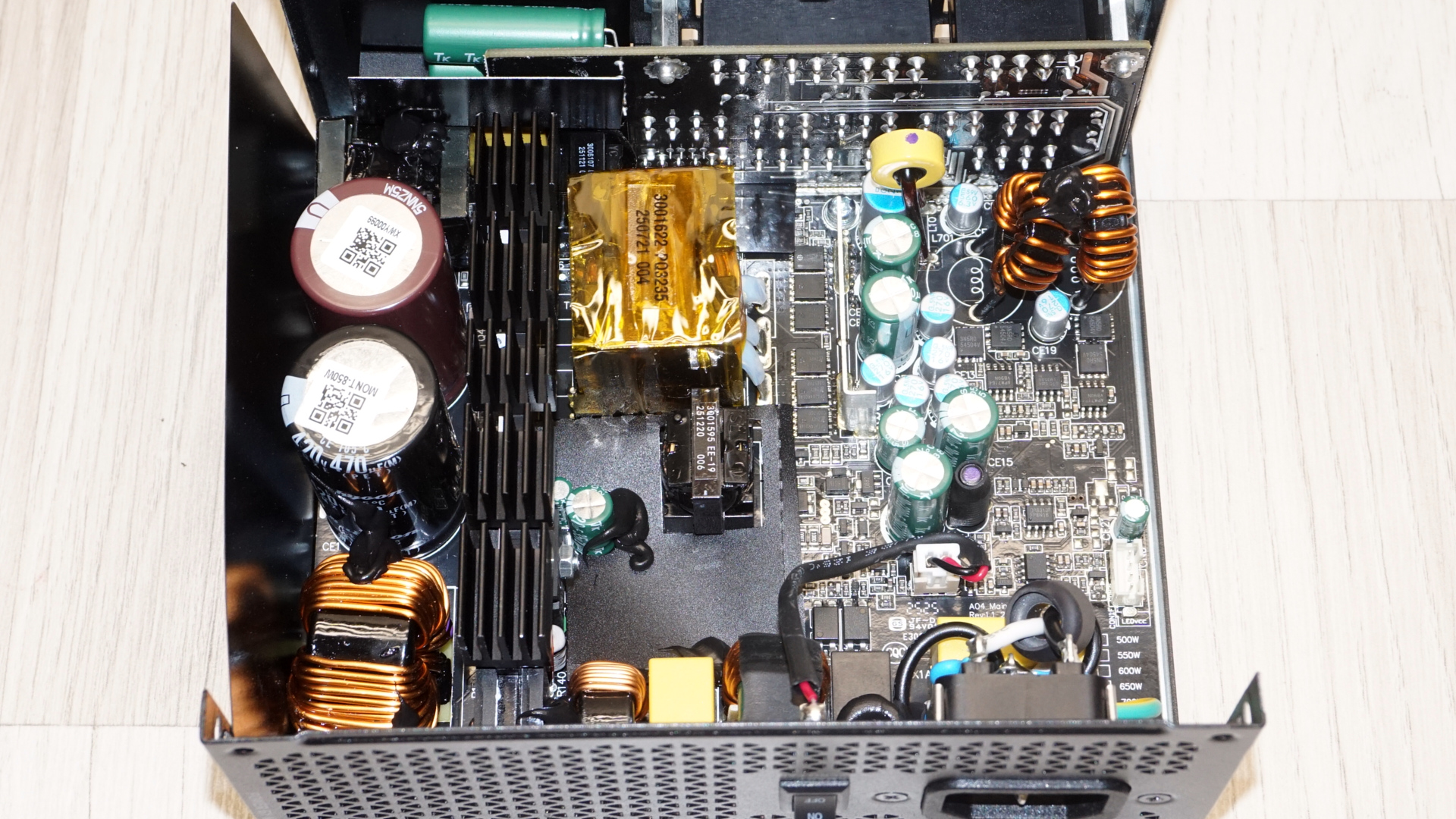
Filtering on the AC inlet PCB consists of four Y capacitors, two X capacitors, and two filtering inductors – a good, complete configuration for a unit at this wattage. The two bridge rectifiers sit on the large heatsink across the unit’s edge, sharing it with the APFC stage components. The APFC stage uses a typical inductor paired with two bulk capacitors mounted side by side, one from Rubycon and one from Nippon Chemi-Con, both branded for 105°C operation. These are two of the most reputable Japanese manufacturers, in line with Montech's marketing claim of 100% Japanese capacitors, although the products themselves are extremely unlikely to have been made in Japan nowadays.

Montech Century II Gold 850W ATX 3.1

(Image credit: Tom's Hardware)

The primary inversion stage topology is a half-bridge LLC with two PIP Semiconductor SPTA65R130FDD MOSFETs, entirely appropriate for the price point and well-proven at this output rating. The main transformer sits centrally on the board with gold tape insulation, dividing primary from secondary. The rectification stage on the secondary side is handled by six SPTJ04R014E MOSFETs operating in synchronous-rectifier mode. 3.3V and 5V is generated through typical DC-to-DC conversion, but unlike the commonly found vertical daughterboard, all components are on the main PCB.

Montech Century II Gold 850W ATX 3.1

(Image credit: Tom's Hardware)

Secondary-side electrolytics are predominantly TK-branded, which corresponds to the Japanese manufacturer Toshin Kogyo. TK is genuinely Japanese, which validates Montech's marketing copy, but enthusiasts should be aware that Toshin Kogyo is widely regarded as a second-tier domestic capacitor brand rather than a peer of Nippon Chemi-Con, Rubycon, or Nichicon. Then again, TK’s reputation is solidly higher than that of the manufacturers supplying the silicon of this unit. In practical terms, the unit should age perfectly well, but it is a tier below what the higher-end competition uses (and that is reflected in the price).

Montech Century II Gold 850W ATX 3.1

(Image credit: Tom's Hardware)

Cold Test Results (25°C Ambient)

Cold Test Results (25°C Ambient)

For the testing of PSUs, we are using high-precision electronic loads with a maximum power draw of 2700 Watts, a Rigol DS5042M 40 MHz oscilloscope, an Extech 380803 power analyzer, two high-precision UNI-T UT-325 digital thermometers, an Extech HD600 SPL meter, a self-designed hotbox, and various other bits and parts.
Montech Century II Gold 850W ATX 3.1
Tom's Hardware
Montech Century II Gold 850W ATX 3.1
Tom's Hardware
Montech Century II Gold 850W ATX 3.1
Tom's Hardware
Montech Century II Gold 850W ATX 3.1
Tom's Hardware
Montech Century II Gold 850W ATX 3.1
Tom's Hardware

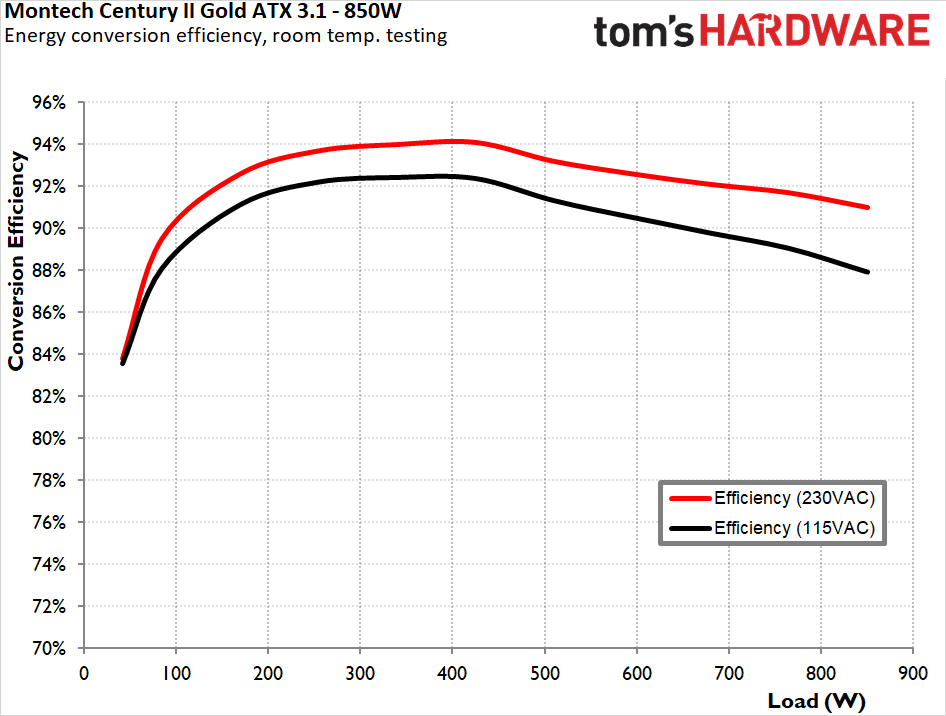
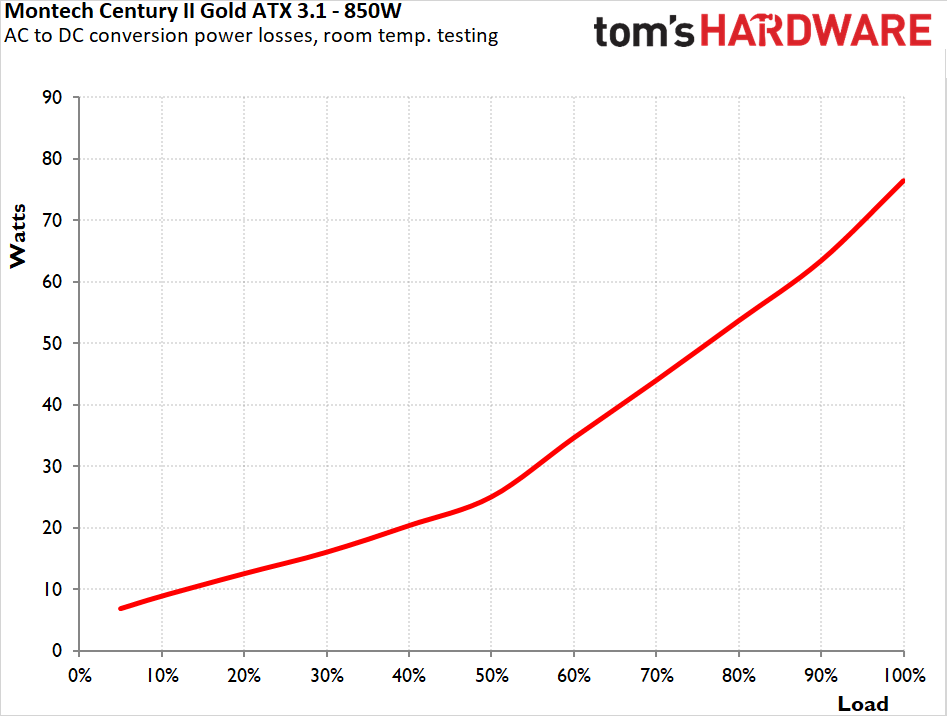
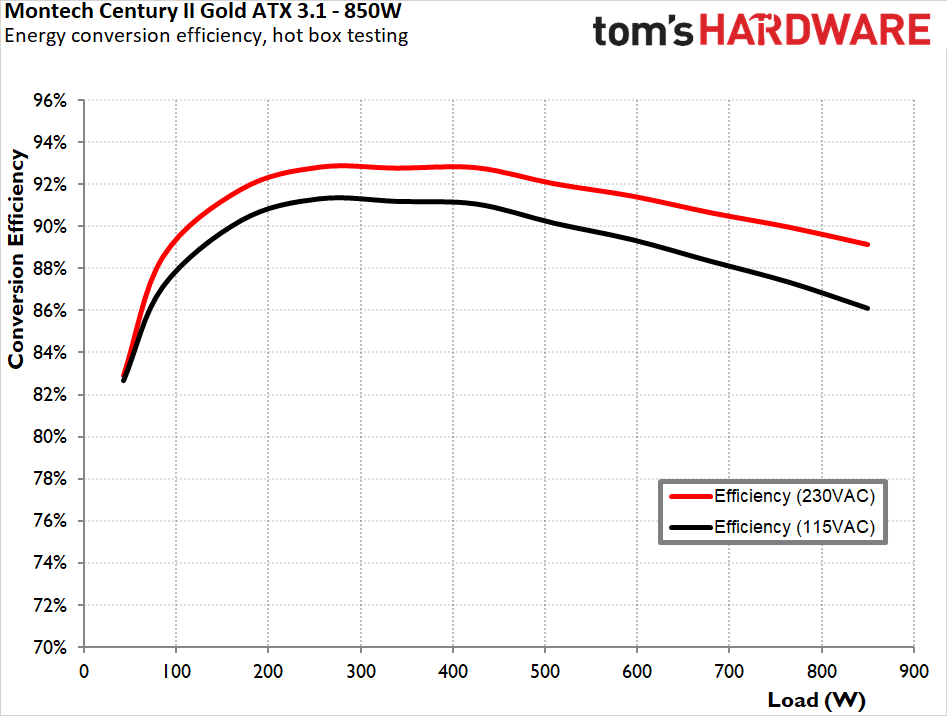
At 115 VAC, the Century II 850W averaged 90.5% efficiency across the 10-100% load range during cold testing. At 230 VAC, the figure rose to 92.5%. Both numbers comfortably exceed the Cybenetics Gold threshold, with Cybenetics independently certifying the unit as Platinum across both input voltages. The unit holds 80Plus Gold certification under the 115V input voltage because it does not meet the 100% load efficiency requirement for the 80Plus Platinum badge, which is why Montech labels it Gold rather than Platinum on that scheme. The Cybenetics methodology, which considers the average efficiency rather than the four-point 80Plus protocol, reflects the platform's strengths more accurately. The efficiency curve peaks just below the 50% load mark and stays largely flat from there through the upper end of the range.

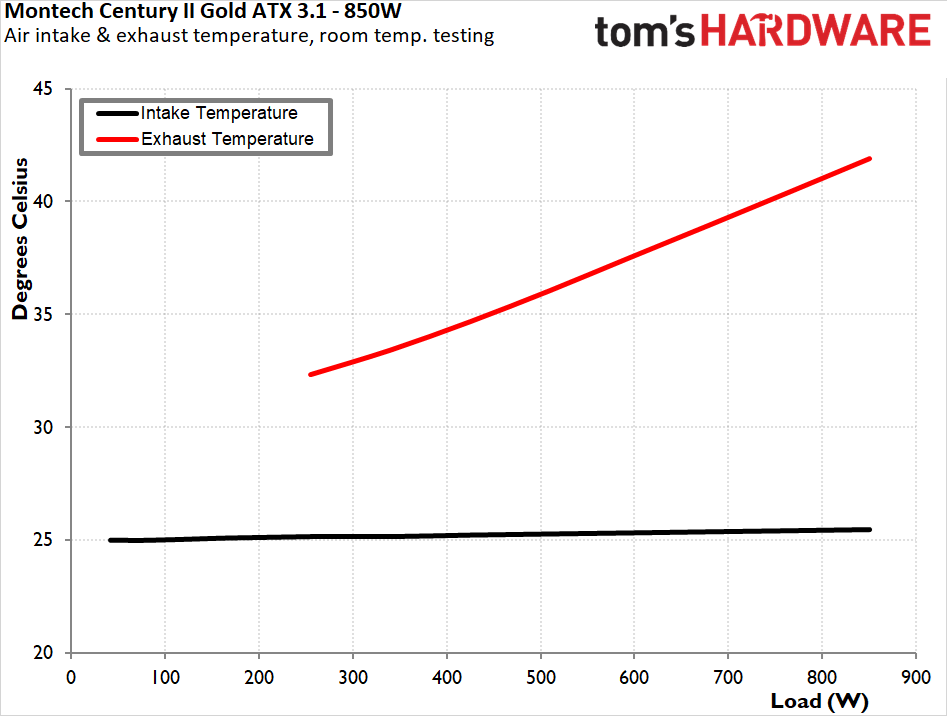
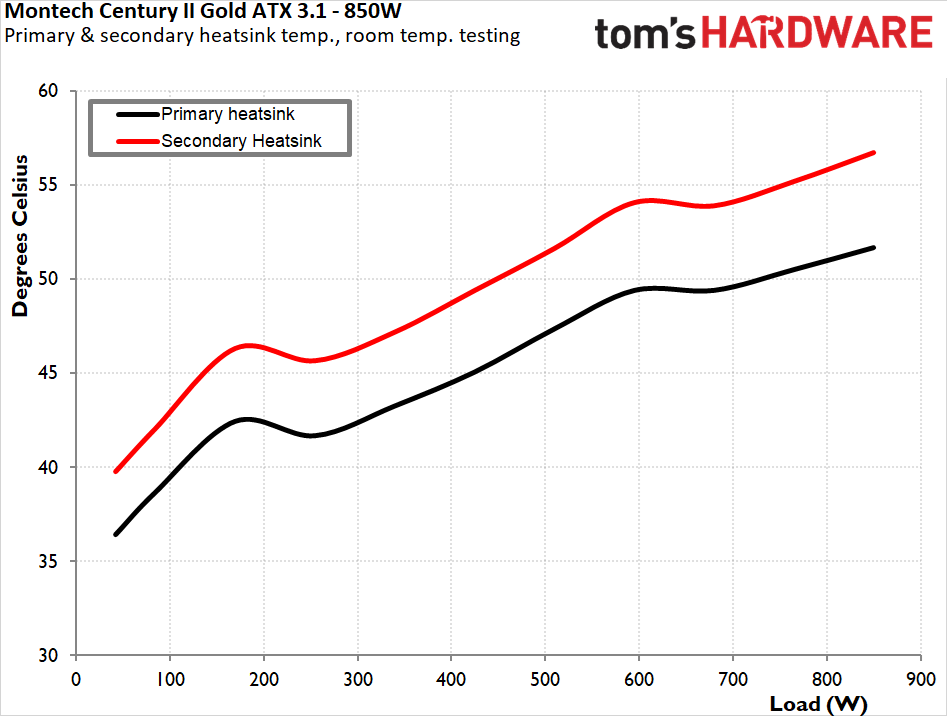
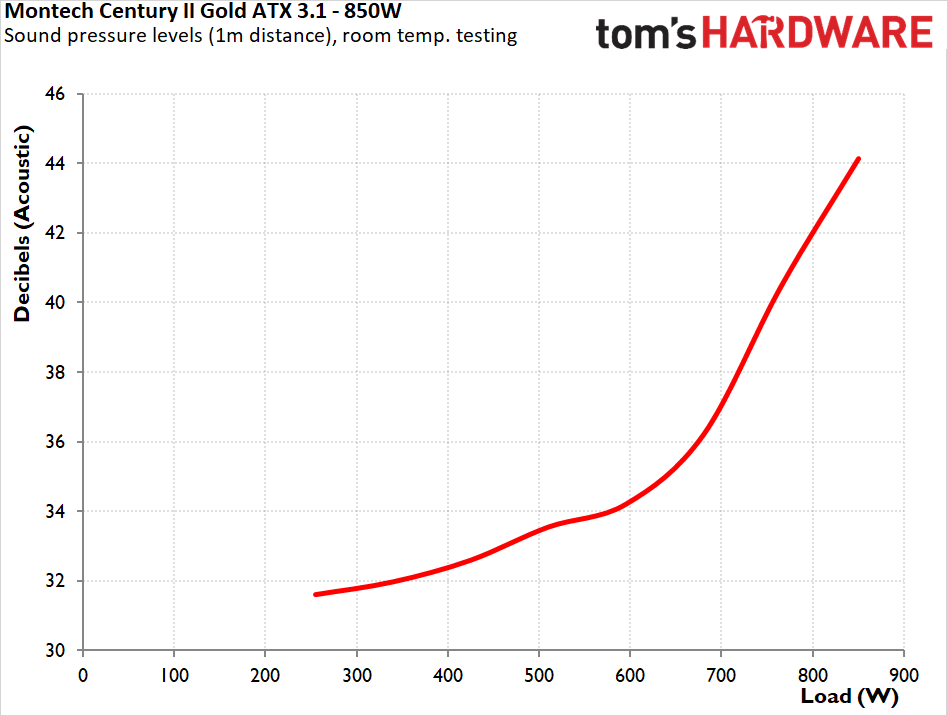
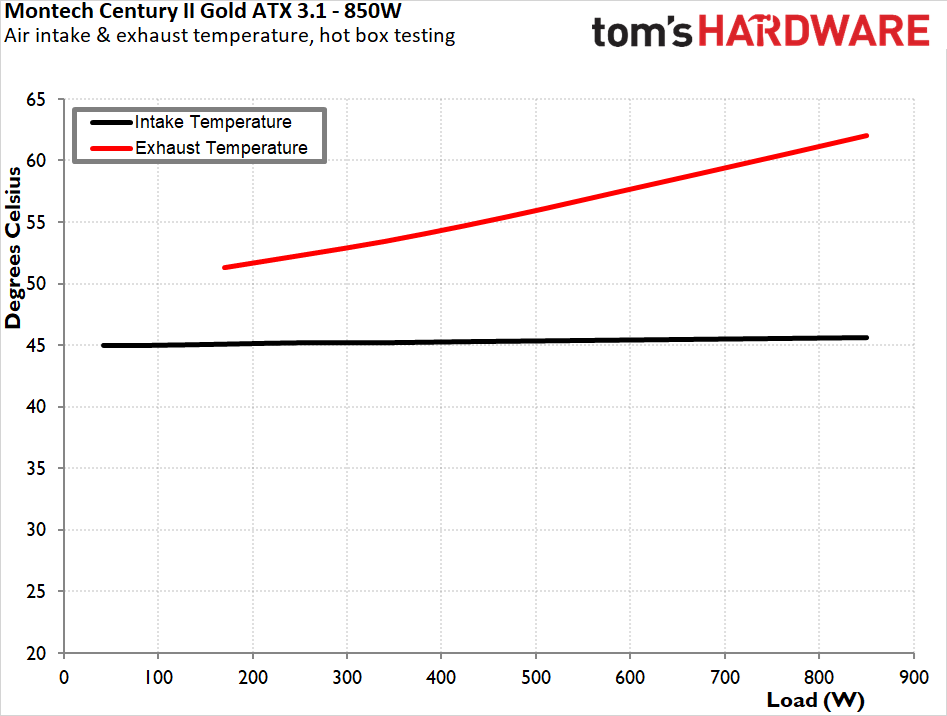
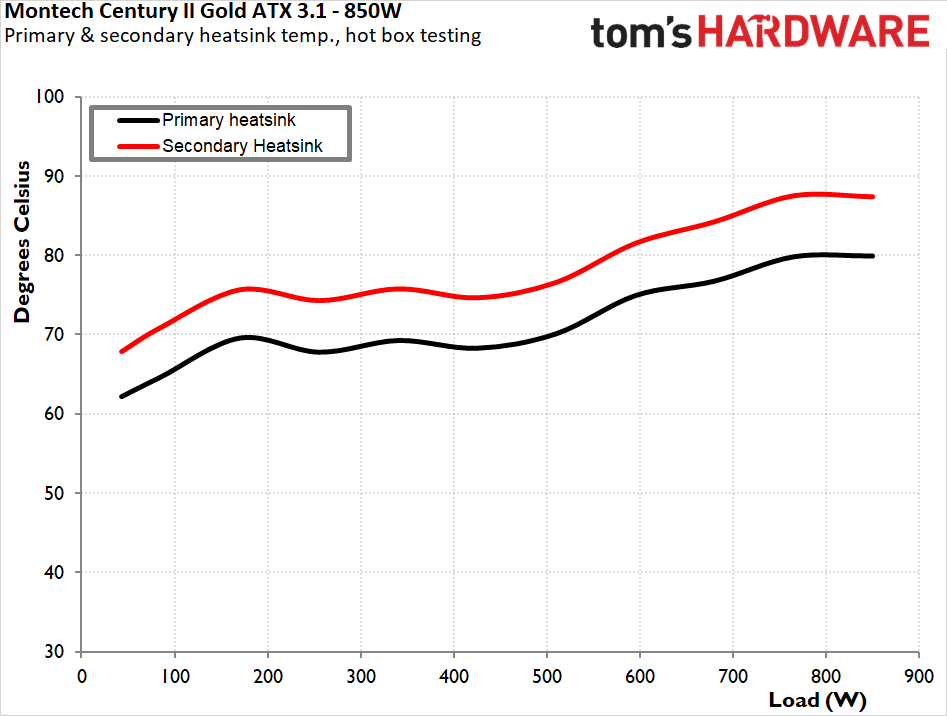
Fan behavior under cold conditions is adequately good. The smart fan mode keeps the rotor stationary at the lowest load points, and even after the fan begins spinning, the noise floor stays well under the threshold of audibility in a typical desktop environment. There is a ramp toward maximum output, but the fan does not approach anything resembling a high RPM during room-temperature testing. Internal temperatures climb predictably with load but remain well within the comfort zone of the components throughout.

Hot Test Results (~45°C Ambient)

Hot Test Results (~45°C Ambient)

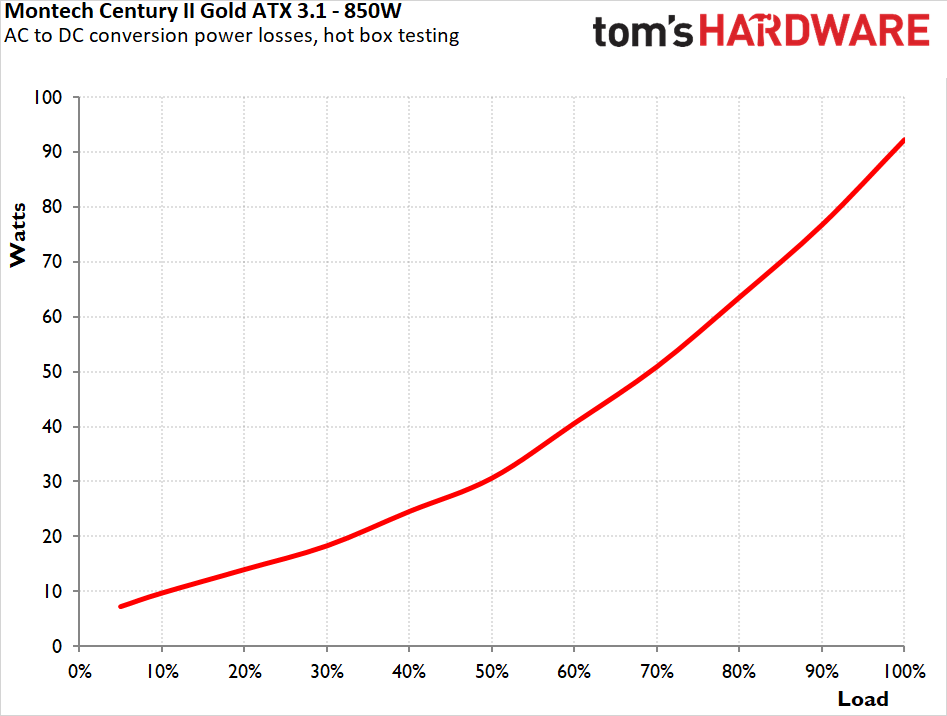
Inside the hot box, the average efficiency at 115 VAC fell to 89.2%, while 230 VAC operation averaged 91.1%. The roughly 1.3-1.4 percentage-point degradation is not small but is in the expected range for a Gold-tier 850W design under sustained elevated ambient conditions. The unit shrugged off the thermal stress impressively, better than we thought it would after checking its parts.

Montech Century II Gold 850W ATX 3.1
Tom's Hardware
Montech Century II Gold 850W ATX 3.1
Tom's Hardware
Montech Century II Gold 850W ATX 3.1
Tom's Hardware
Montech Century II Gold 850W ATX 3.1
Tom's Hardware
Montech Century II Gold 850W ATX 3.1
Tom's Hardware

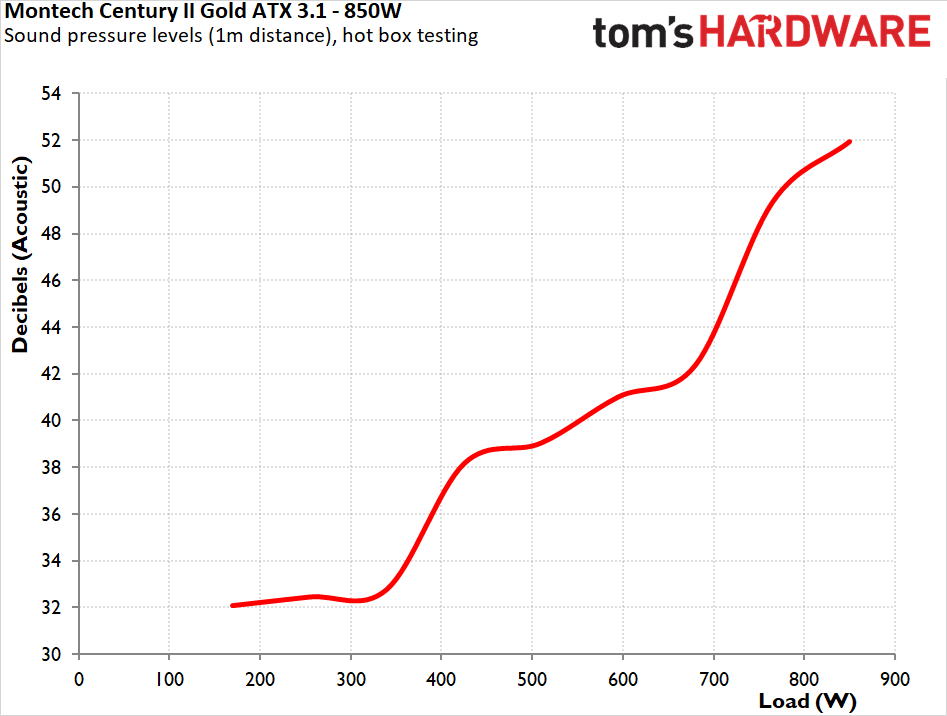
The fan ramp under hot conditions is, as expected, much steeper than under cold testing. The fanless operation threshold moves down, and the speed curve becomes more aggressive. The fan reached its maximum rated speed at maximum load. The heatsink temperatures we measured are fair, suggesting that the platform has a cooling margin but largely depends on its massive fan for cooling.

PSU Quality and Bottom Line

Power Supply Quality

Electrical performance is solid across the board. Voltage regulation sat at 0.4% on the 12V rail, 0.5% on the 5V rail, and 0.4% on the 3.3V rail across the 20-100% load range. Those numbers are well below the ATX specification recommendations and demonstrate that the unit is extremely well-tuned. They do not match the absolute best units we have tested, but they are firmly in exceptional territory for a Gold-class design.

Ripple suppression follows a similar pattern. At 100% load, the 12V rail peaked at 30 mV, the 5V at 24 mV, and the 3.3V at 22 mV. All of these figures sit well inside ATX limits (120 mV on 12V, 50 mV on the minor rails). They are not the cleanest numbers we have ever seen, but they are clean enough that system components will see a stable, quality power supply.

During our thorough assessment, we evaluate the essential protection features of every power supply unit we review, including Over Current Protection (OCP), Over Voltage Protection (OVP), Over Power Protection (OPP), and Short Circuit Protection (SCP).

All four protection mechanisms triggered correctly during our hot-box stress runs. OCP on the 3.3V and 5V rails sat at 154% and 150%, respectively, with the 12V triggering around 126% of its nominal rating. OPP triggered at approximately 124% of the 850W output during hot testing, which translates to roughly 1,050W of sustained delivery before the unit pulled the plug. That is a substantial cushion. The minor rails in particular carry far more headroom than the nameplate implies, and even the 12V rail tolerates well over its rated current before tripping.

Main Output

Load (Watts)

171.92 W

429.38 W

643.02 W

855.86 W

Load (Percent)

20.23%

50.52%

75.65%

100.69%

Amperes

Volts

Amperes

Volts

Amperes

Volts

Amperes

Volts

3.3 V

1.82

3.40

4.56

3.40

6.84

3.39

9.11

3.39

5 V

1.82

5.09

4.56

5.09

6.84

5.07

9.11

5.06

12 V

12.91

12.12

32.26

12.11

48.40

12.09

64.53

12.07

Line

Regulation

Voltage Ripple (mV)

(20% to 100% load)

20% Load

50% Load

75% Load

100% Load

CL1
12V

CL2
3.3V + 5V

3.3V

0.4%

14

16

20

22

16

22

5V

0.5%

16

16

22

24

16

22

12V

0.4%

12

20

26

30

28

20

Bottom Line

At its $90 pricing at the time of this review, the Century II 850W is one of the most aggressively priced ATX 3.1 units with a native 12V-2x6 connector and Cybenetics Platinum-equivalent efficiency on the market. Competition at that price point exists but is genuinely thin once you start filtering for fully modular, all-Japanese capacitor designs with a decade of warranty coverage. Especially at the $80 sale price that it reaches periodically, it becomes a borderline default recommendation for mid-range 5070-tier and 9070-tier builds.

Montech Century II Gold 850W ATX 3.1

(Image credit: Tom's Hardware)

The performance picture is a study in restraint. Voltage regulation and ripple suppression are not class-leading, but they surely are exceptional. Efficiency comfortably exceeds the Gold thresholds across almost all of the load range, easily granting the platform a Platinum certification badge when the average efficiency is the primary factor. Fan management is quiet, and the Smart Zero mode behaves the way the marketing claims.

Where the unit shows its budget positioning most clearly is in the platform and silicon. XWY is a less established OEM than Seasonic or CWT, much of the silicon comes from relatively unknown Chinese manufacturers, and TK secondary capacitors - while genuinely Japanese - are not Nippon Chemi-Con. None of these are problems per se but simply the cost-engineering decisions that make the $90 price possible. The 10-year warranty is the strongest signal that Montech itself expects the platform to age gracefully, and that warranty length is a meaningful feature, not marketing decoration.

Montech Century II Gold 850W ATX 3.1

(Image credit: Tom's Hardware)

Taken on its own terms, the Century II 850W ATX 3.1 unit is exactly the unit Montech intended to build: a no-nonsense, modern-spec, Gold-tier 850W power supply that does not try to compete with the premium tier on engineering pedigree, but does compete, and very effectively so, on overall value. It is the sort of PSU we expect to see in a lot of mainstream builds over the next few years, and there are worse fates than that for any product.

MORE: Best Power Supplies

MORE: How We Test Power Supplies

MORE: All Power Supply Content
FSP Mega GM 1200W power supply review: An in-house FSP platform that quietly overshoots its own Gold label

2026年9月6日 21:57

FSP is not a brand that needs an introduction so much as a reminder of scale. Founded in Taiwan in April 1993 as a joint venture between Fortron/Source of the United States, Sparkle Power International, and Powertech Systems — the three names that give the company its initials — FSP grew into one of the largest power-supply manufacturers in the world. It became one of Intel’s early seed partners during the formative years of the ATX standard, was listed on the Taiwan Stock Exchange in 2002, and has spent three decades quietly building units for a long list of system integrators and consumer brands. When most companies want a power supply, they call an OEM. FSP is the company that frequently gets the call.

That distinction matters here. The Mega GM is not a contracted design wearing someone else’s sticker but FSP’s own platform, engineered and assembled under its roof. We evaluate the Mega GM 1200W to see whether it belongs on our best power supplies list. The series spans 850W, 1000W, and the 1200W flagship reviewed here, all built around the same ATX 3.1 and PCIe 5.1 brief: native 12V-2x6 delivery, support for the 200% transient power excursions modern GPUs demand, and FSP’s proprietary MTLC (Micro Tolerance Load Control) regulation scheme. On paper, it is positioned as a Gold-class product. In practice, as the testing will show, it behaves like something a tier above.

Specifications and Design

FSP Mega GM 1200W ATX 3.1 — Power Specifications (Rated @ 50 °C)

RAIL

+3.3V

+5V

+12V

+5Vsb

-12V

MAX OUTPUT

20A

20A

100A

3A

0.3A

100W

100W

1200W

15W

3.6W

TOTAL

1200W

AC INPUT

100 – 240 VAC, 50 – 60 Hz

MSRP

$229

WARRANTY

10 Years

In the Box

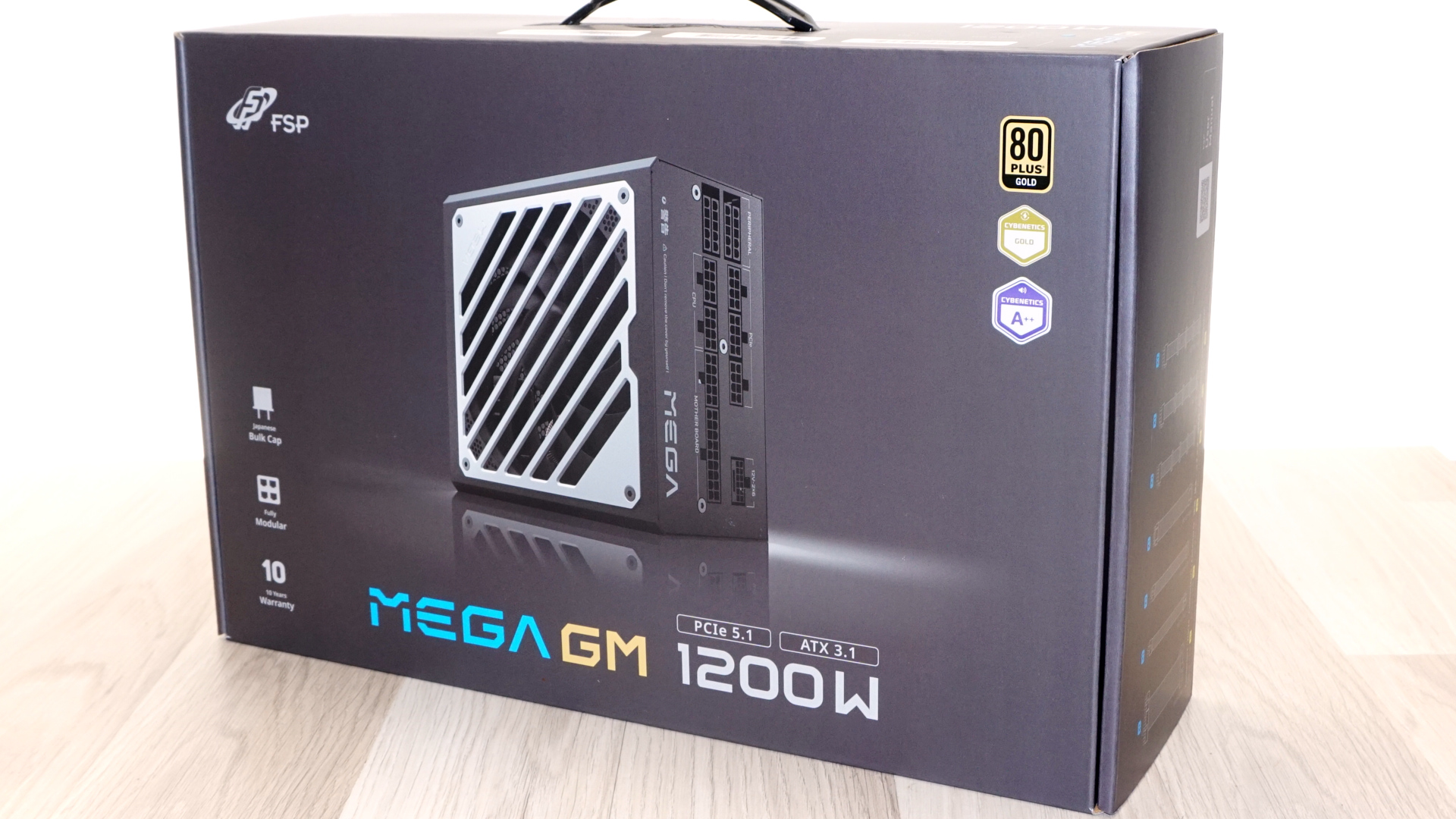
The Mega GM 1200W arrives in a cleanly designed box, black with a high-resolution render of the unit and the certifications laid out plainly on the front: 80 PLUS Gold, Cybenetics Gold, and the Cybenetics A++ acoustic award, alongside the PCIe 5.1 and ATX 3.1 badges – which is kind of weird considering the unit’s actual certifications are not aligned with those on the box!

FSP Mega GM ATX 3.1 1200W

(Image credit: Tom's Hardware)

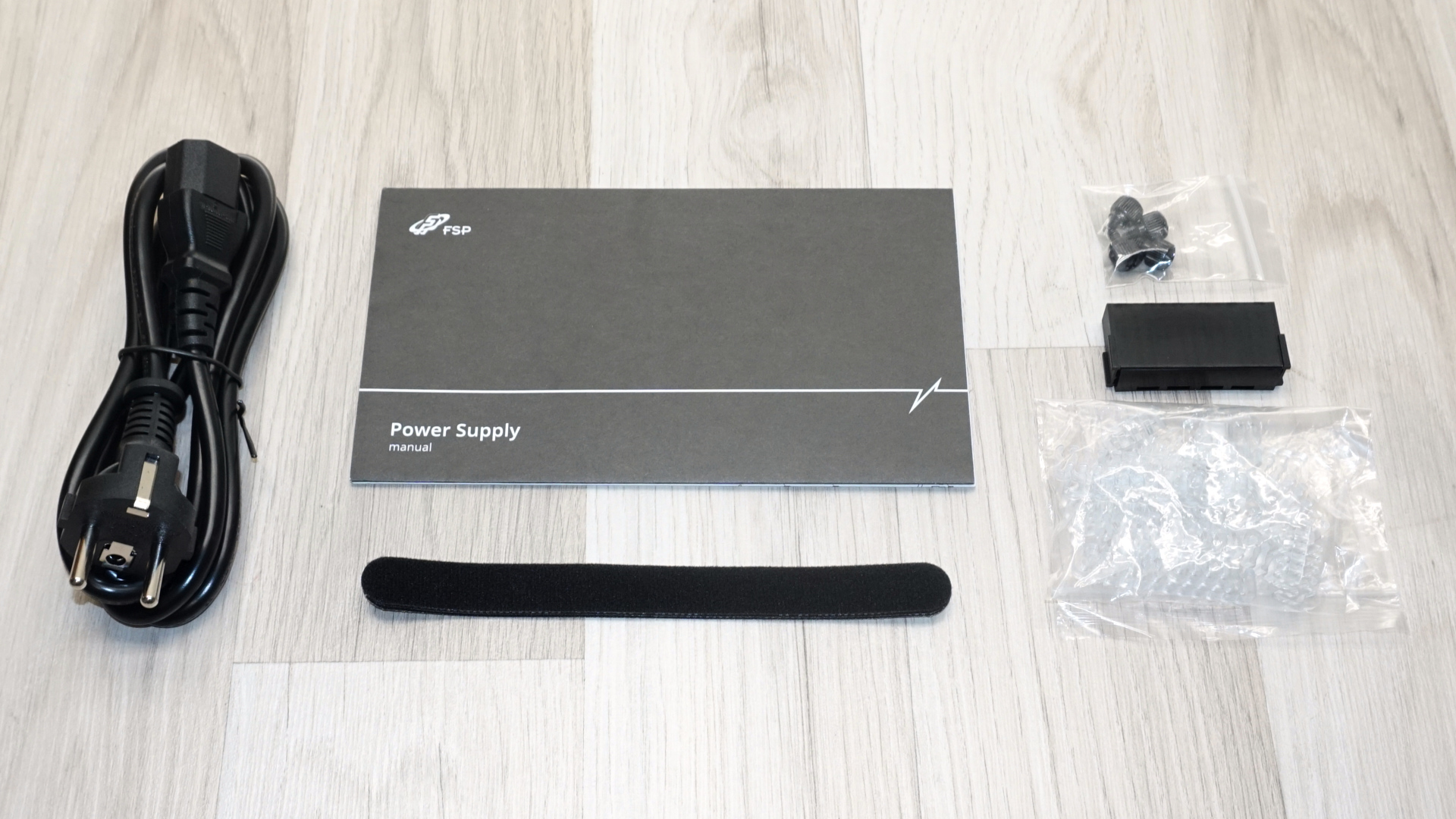
Inside, the supply is well protected within a molded cardboard housing, with the accessories boxed separately. The bundle is sensible, if not lavish: mounting screws, the AC power cable, cable ties, a set of cable combs, an ATX jump-start tester, the usual paperwork, and a storage pouch for whatever cables a given build leaves unused.

FSP Mega GM ATX 3.1 1200W

(Image credit: Tom's Hardware)

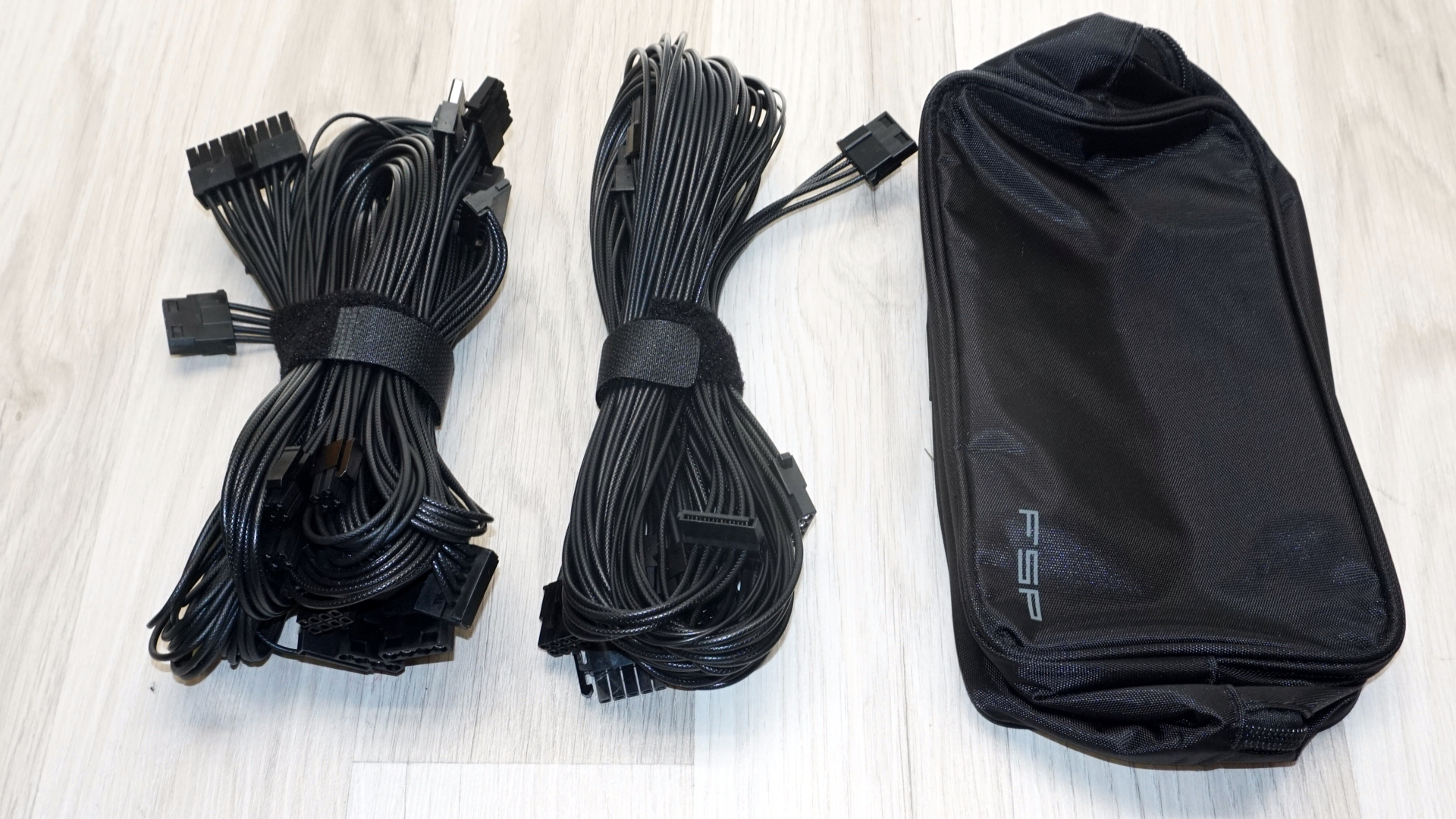
The cables themselves are individually sleeved with FSP’s embossed weave and shipped in two tidy bundles held together by another two reusable cable straps. Gauges are appropriate to the tier. That native 12V-2x6 lead is the headline inclusion - a full 600W with no adapters, which is exactly what an RTX 50-series build wants to see. Sadly, there is only one, which is a shame for a 1200W unit.

FSP Mega GM ATX 3.1 1200W

(Image credit: Tom's Hardware)
FSP Mega GM 1200W ATX 3.1 — Connectors

Connector type

Hardwired

Modular

ATX 24 Pin

-

1

EPS 4+4 Pin (CPU)

-

2

PCI-E 5.1 (12V-2x6)

-

1

PCI-E 8 Pin (6+2)

-

3

SATA

-

10

Molex

-

6

Floppy

-

-

External Appearance

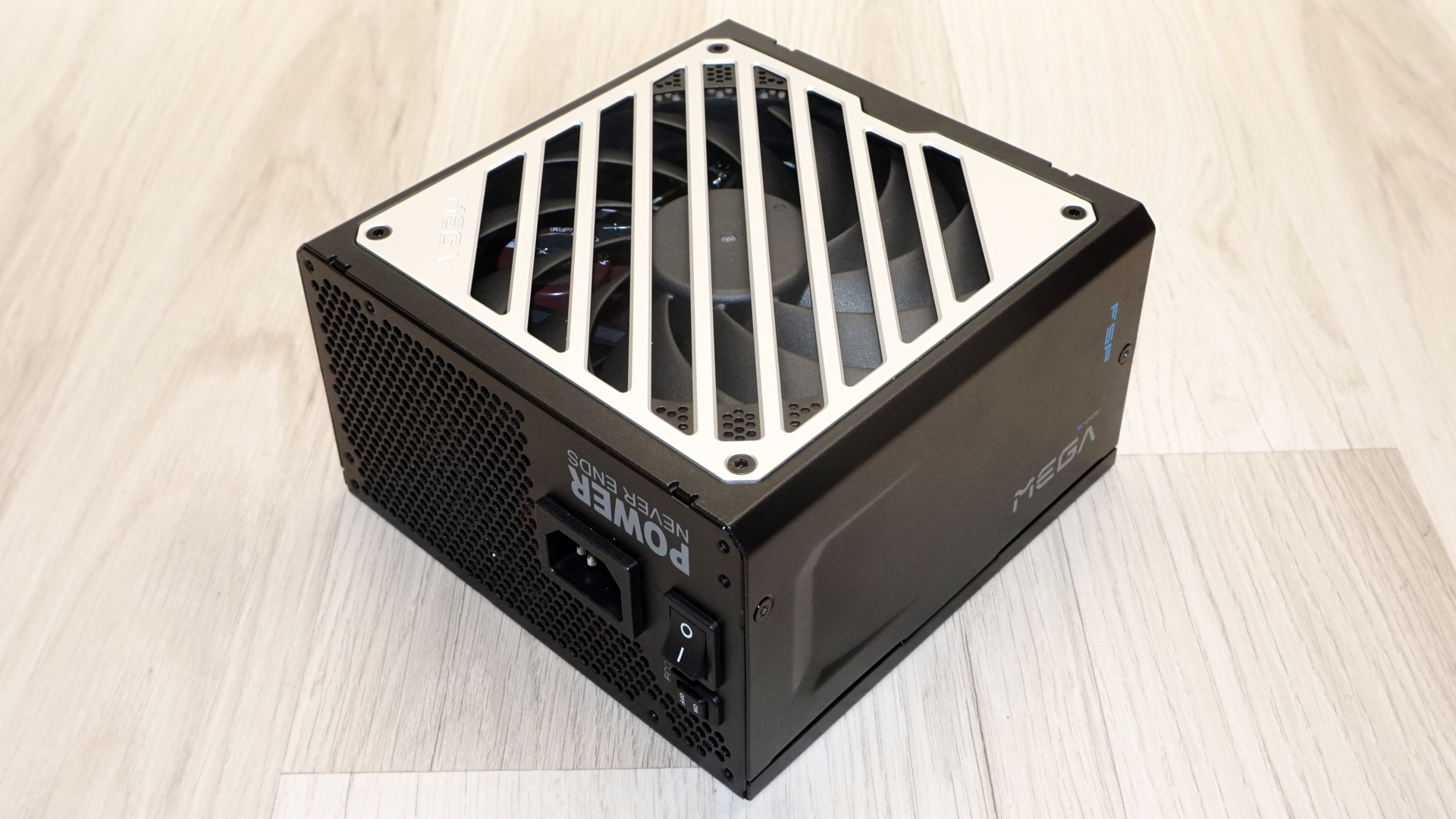
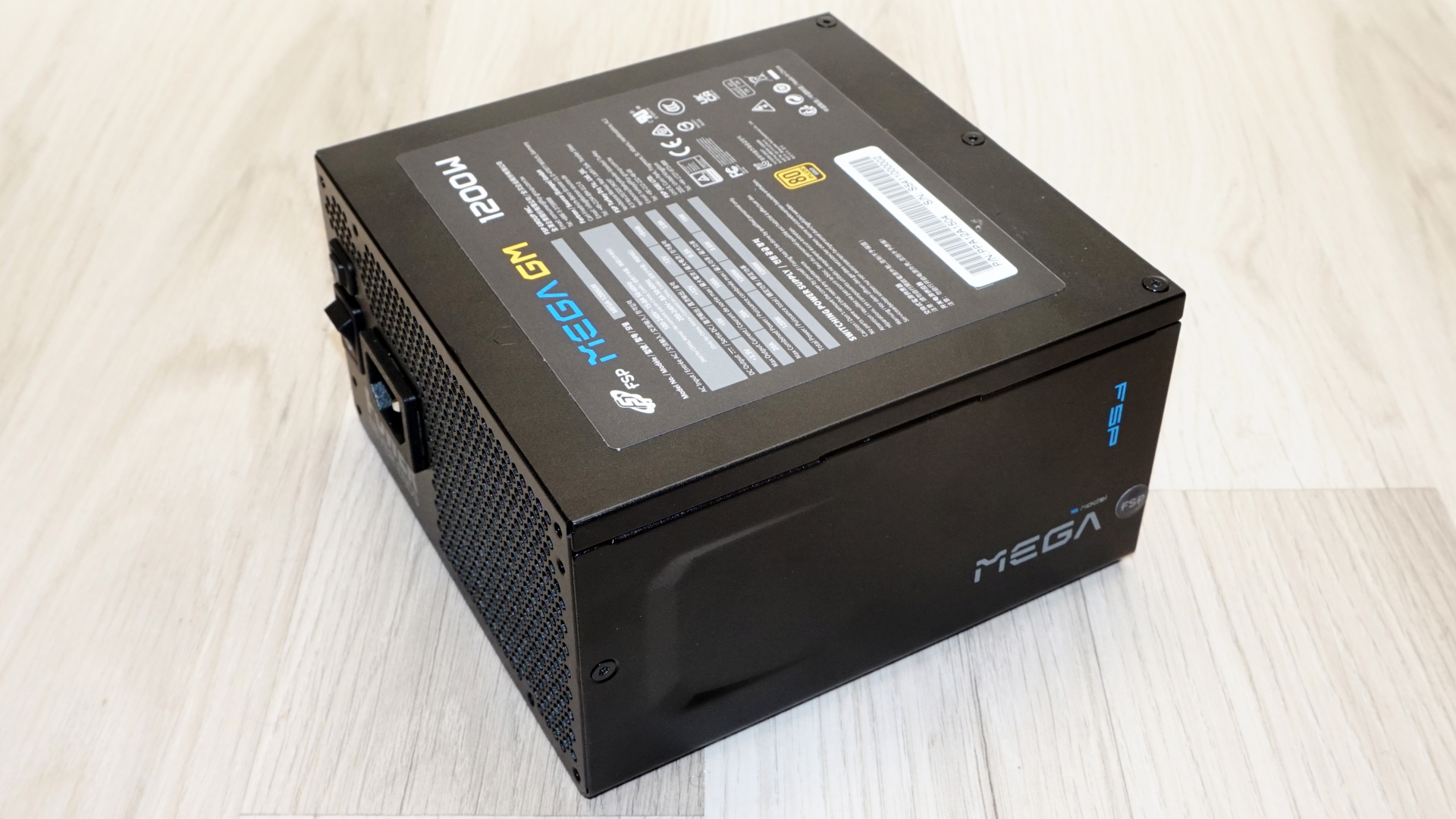
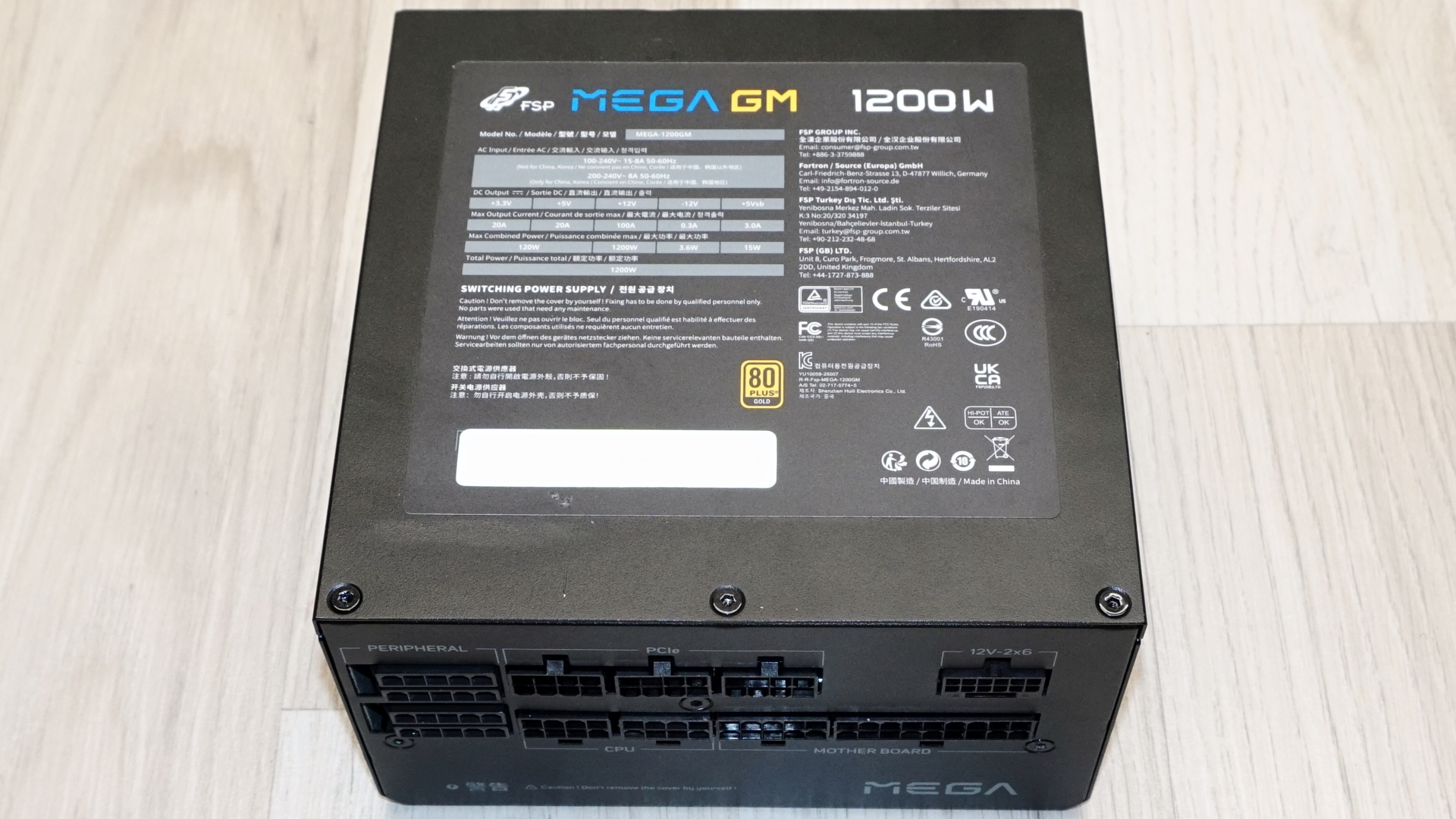
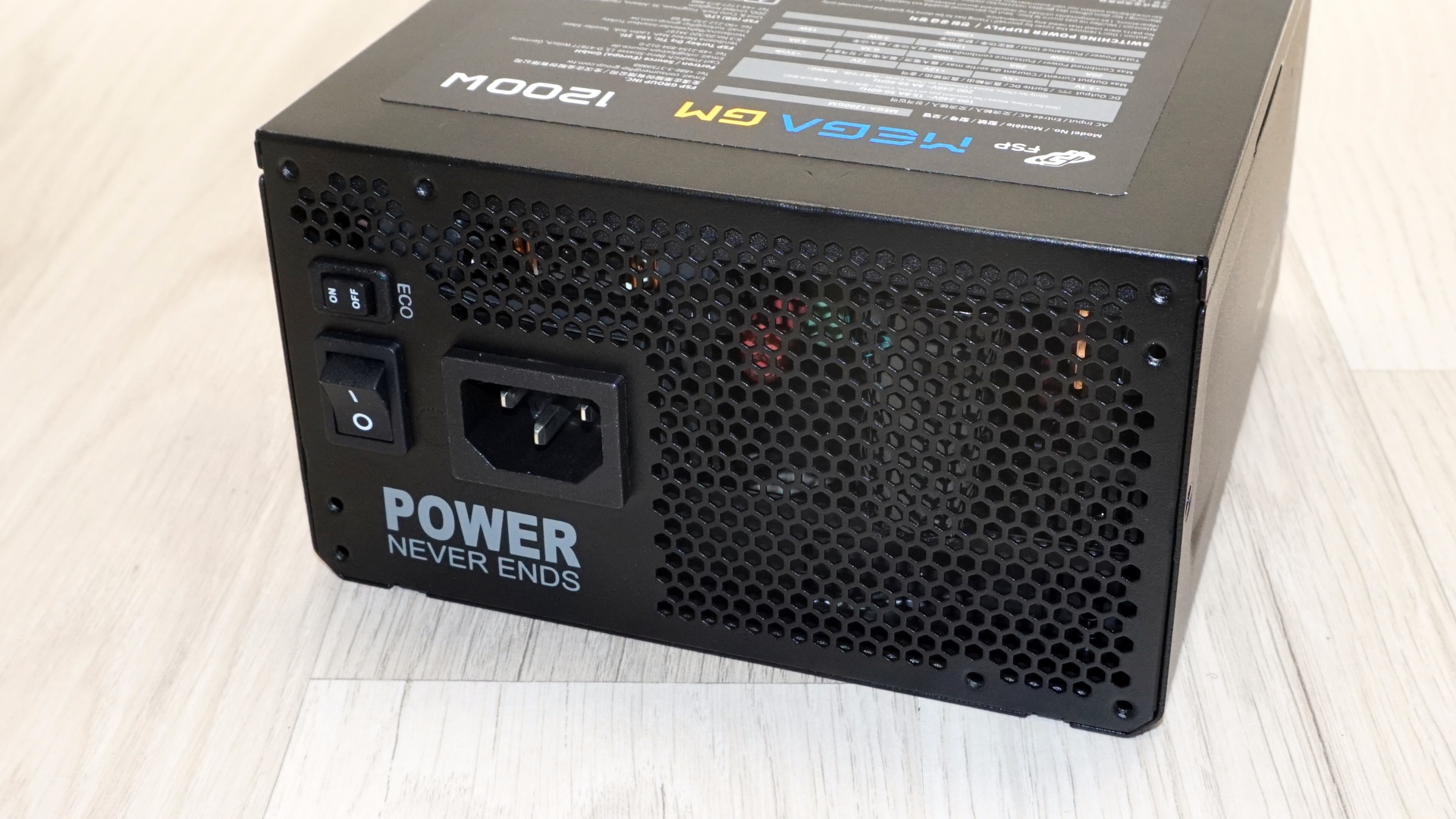
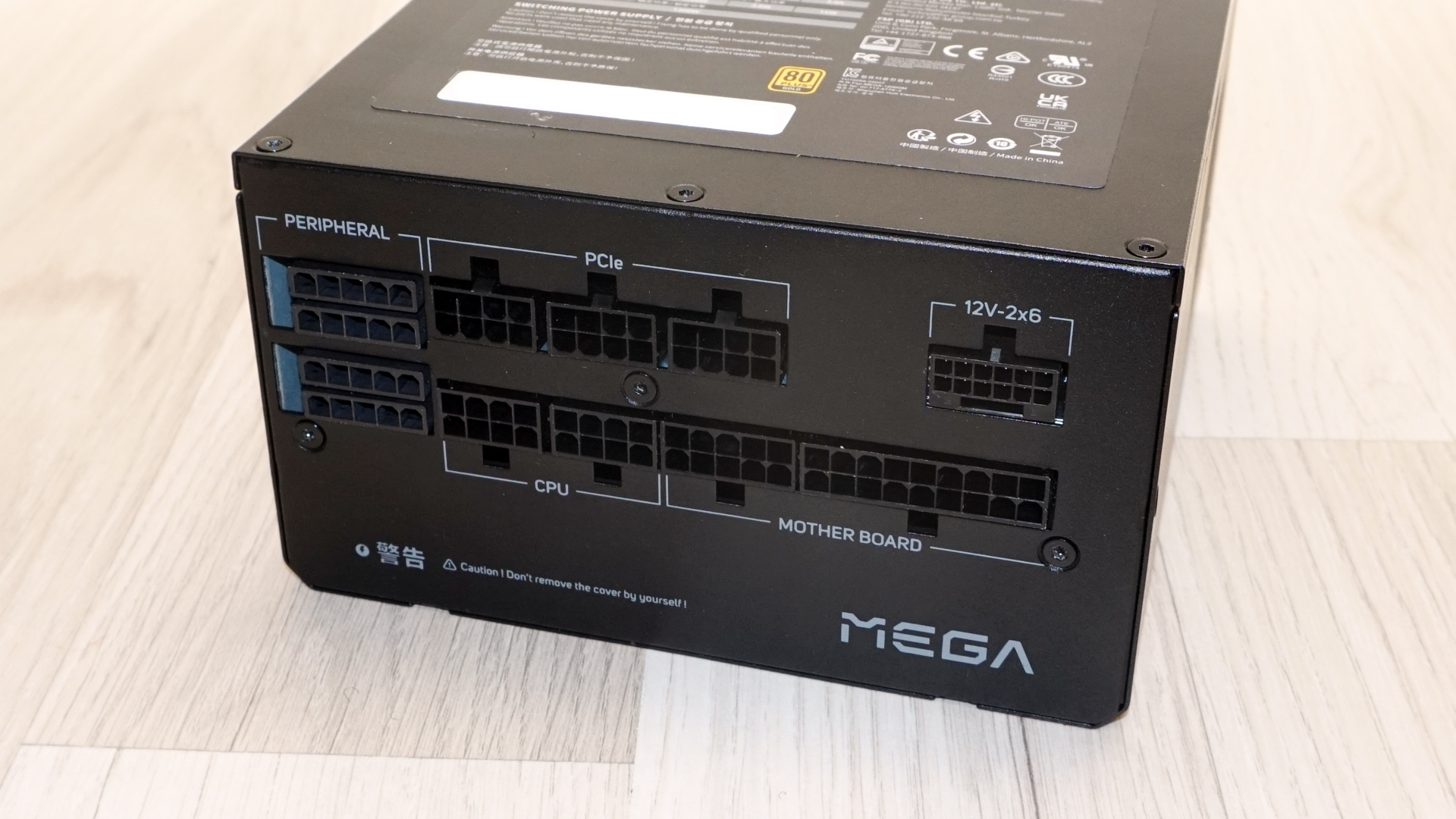
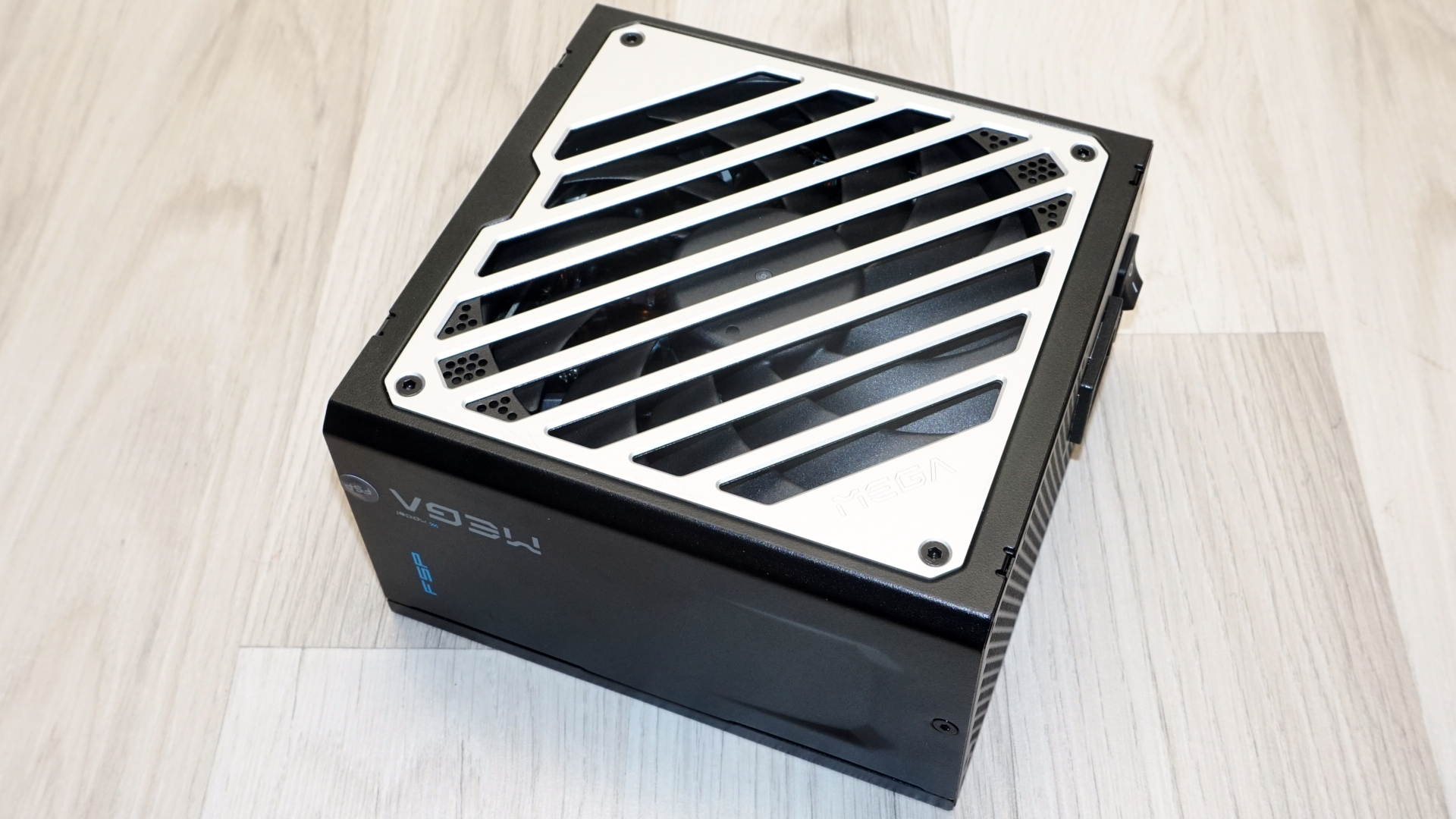
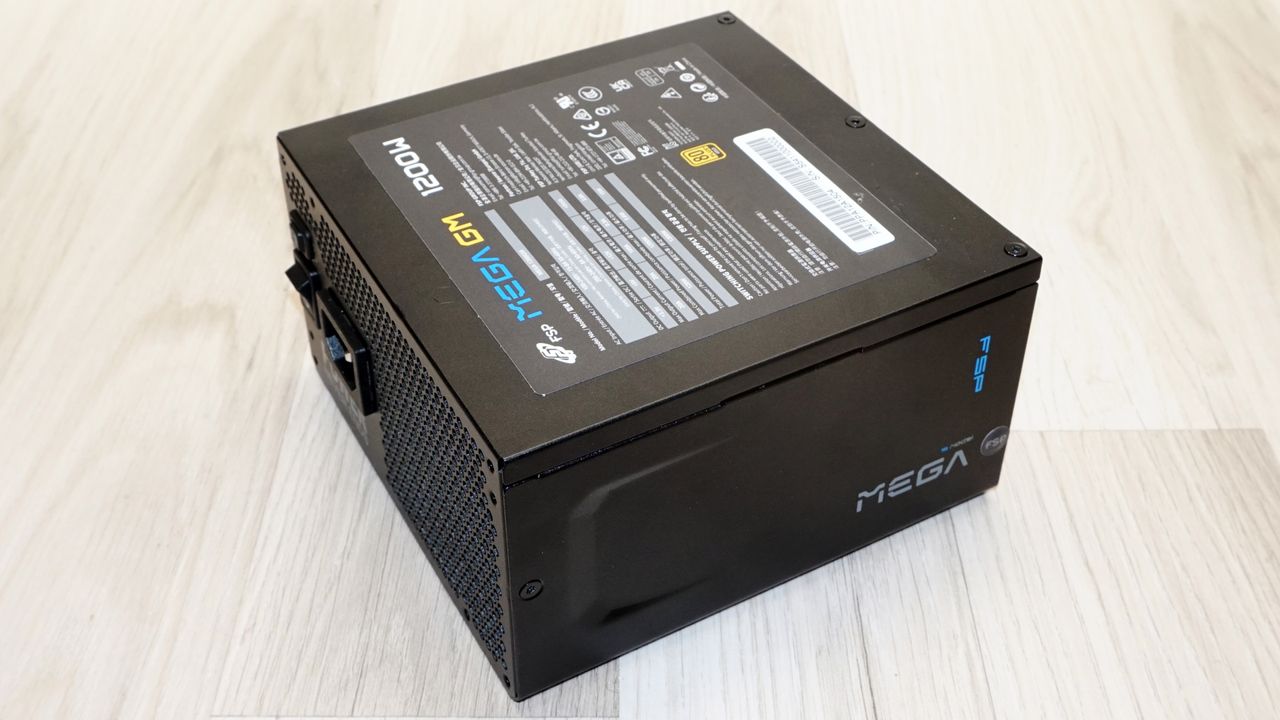
At 150 x 150 x 86 mm, the Mega GM 1200W is genuinely compact for its output. A great many 1200W units stretch to 160 mm or beyond, so the standard 150 mm depth here is a real practical advantage — it drops into mid-tower cases without the clearance anxiety that so often accompanies this wattage. The chassis is finished in a matte, lightly textured black that hides fingerprints well, and build quality is reassuring.

FSP Mega GM ATX 3.1 1200W

(Image credit: Tom's Hardware)

The top panel is given over to the intake fan, sitting behind a diagonally slatted finger guard finished in champagne-silver that lifts the otherwise monochrome look. At the sides of the unit, the “Mega” wordmark is picked out in one corner and the FSP logo resting above it. The full-length specification and certification label occupies the top side of the unit, the face that points upward in most installations. For the record, this sample is assembled in China, which is normal for FSP’s consumer lines despite the company’s Taiwanese roots.

FSP Mega GM ATX 3.1 1200W
Tom's Hardware
FSP Mega GM ATX 3.1 1200W
Tom's Hardware

The mains side carries the AC receptacle and the primary rocker switch, joined by a separate ECO switch that enables or disables the semi-fanless mode — a welcome piece of user control rather than a fixed, non-negotiable profile for users that prefer the fan running at all times even if at a minimum speed. That same face is a large honeycomb exhaust grille, perforated edge to edge so the fan can push warm air straight out of the chassis. The opposite end houses the fully modular connector bay, with the sockets keyed so that plugging a cable into the wrong port during installation is effectively impossible.

FSP Mega GM ATX 3.1 1200W
Tom's Hardware
FSP Mega GM ATX 3.1 1200W
Tom's Hardware

Internal Design

Cooling is handled by a 135 mm Power Logic PLA13525S12M, a fluid (hydro) dynamic bearing (FBD) fan drawing 0.40A at 12V. It is a known, well-regarded part. Τhe same model has turned up inside several other premium PSUs. An FBD is the right call at this tier, trading a little extra cost for low noise and a long service life.

FSP Mega GM ATX 3.1 1200W

(Image credit: Tom's Hardware)

FSP both designs and builds the platform, so there is no hidden OEM behind it. The internals are tidy and logically laid out on a double-sided PCB. The transient filtering stage is good, with two Y capacitors, three X capacitors, two common-mode filtering inductors, and a single MOV. Mains rectification is handled by a pair of 600V bridges mounted on their own heatsink immediately after the filter.

FSP Mega GM ATX 3.1 1200W
Tom's Hardware
FSP Mega GM ATX 3.1 1200W
Tom's Hardware

The active PFC stage pairs two Infineon 60R080P7 MOSFETs with two STMicroelectronics diodes found on their dedicated heatsink. Bulk energy storage is, pleasingly, entirely Japanese: two Nippon Chemi-Con 680 µF and 330 µF capacitors, both rated to 420V and 105 °C. The primary inversion stage uses two Greatpower GP47S60 MOSFETs arranged in a half-bridge LLC resonant topology, also found on their dedicated heatsink. This is a mature, reliability/cost-focused topology rather than the full-bridge arrangement reserved for top tier units. On the secondary side, the +12V rail is produced by synchronous rectification, with six Infineon 07N04LS6 MOSFETs doing the work. The minor 3.3V and 5V rails are derived from DC-to-DC converters.

FSP Mega GM ATX 3.1 1200W
Tom's Hardware
FSP Mega GM ATX 3.1 1200W
Tom's Hardware

FSP has stayed disciplined with the secondary capacitors, which is the clearest single signal that the company is being serious regarding the marketing claims of this unit. The electrolytics are entirely Japanese, with all of the electrolytics supplied by Nippon Chemi-Con and Rubycon. The same goes for the solid-state capacitors, with Nippon Chemi-Con and Nichicon products handling high-frequency filtering. The one notable omission is dedicated fan-failure protection, which the unit does without.

FSP Mega GM ATX 3.1 1200W
Tom's Hardware
FSP Mega GM ATX 3.1 1200W
Tom's Hardware

Cold Test Results (25°C Ambient)

Cold Test Results (25°C Ambient)

For the testing of PSUs, we are using high-precision electronic loads with a maximum power draw of 2700 Watts, a Rigol DS5042M 40 MHz oscilloscope, an Extech 380803 power analyzer, two high-precision UNI-T UT-325 digital thermometers, an Extech HD600 SPL meter, a self-designed hotbox, and various other bits and parts.

FSP Mega GM ATX 3.1 1200W
Tom's Hardware
FSP Mega GM ATX 3.1 1200W
Tom's Hardware
FSP Mega GM ATX 3.1 1200W
Tom's Hardware
FSP Mega GM ATX 3.1 1200W
Tom's Hardware
FSP Mega GM ATX 3.1 1200W
Tom's Hardware

At 25 °C ambient, the Mega GM 1200W posts strong efficiency through the low and middle of its range. It averaged 93.0% at 230 VAC and 90.7% at 115 VAC across the nominal load band, peaking at roughly 94.6% near 30% load and holding above 92% across most of the curve. The weakness is at the top: efficiency sags as the unit approaches full output, dropping to 91.0% at 230 VAC and just 87.3% at 115 VAC at a sustained 1200W. That full-load dip has consequences for how the unit is rated. Despite the 80 PLUS Gold logo printed on the box, the Mega GM’s only independently verified efficiency credential is its Cybenetics certification — there is no corresponding entry in CLEAResult’s 80 PLUS database. The distinction is not academic: Cybenetics averages efficiency across the whole operating range, which is generous enough here to reach Platinum, whereas 80 PLUS tests fixed 20/50/100% load points with a strict full-load threshold. Under that methodology, the efficiency drop at maximum load is exactly what would cap the unit at Gold rather than Platinum. The headline efficiency is real, but it is flattered by the rating system it was measured under.

Acoustically, the cold run is where the rating earns its keep. With the ECO mode engaged, the fan simply stays off below roughly 50% load. Once it does spin up, it registers a barely-there 31.6 dB(A) at 600W, climbing gently to about 41 dB(A) only at the very top of the load range. For most real-world workloads, this supply is effectively inaudible. Internal temperatures stay well in hand throughout: the primary heatsink tops out near 65 °C and the secondary near 69 °C at full load.

Hot Test Results (~45°C Ambient)

Hot Test Results (~45°C Ambient)

Raising the ambient to roughly 45 °C predictably trims efficiency, but not alarmingly. Average efficiency settles to 91.4% at 230 VAC and 89.2% at 115 VAC, with full-load figures of 88.9% and 85.3%, respectively. The drop of around 1.6 points at 230 VAC is measurable but normal for the temperature delta, and at no load point did the unit show any hint of thermal instability or output stress during sustained running.

FSP Mega GM ATX 3.1 1200W
Tom's Hardware
FSP Mega GM ATX 3.1 1200W
Tom's Hardware
FSP Mega GM ATX 3.1 1200W
Tom's Hardware
FSP Mega GM ATX 3.1 1200W
Tom's Hardware
FSP Mega GM ATX 3.1 1200W
Tom's Hardware

Noise is the one area where the heat clearly changes the character of the unit. The fan engages earlier and ramps harder, rising from the low-30s dB(A) through the mid-load range to about 55.0 dB(A) at a sustained 1200W. That is a substantial step up from the cold run and the loudest this supply gets — though it is worth keeping in perspective that it only happens at the intersection of maximum load and elevated ambient, a corner most systems should never visit. Internal temperatures rise accordingly, with the secondary heatsink reaching roughly 109 °C and exhaust air near 70 °C at full load, figures that are flirting with the OTP protection, but the platform held composure for the duration of testing.

PSU Quality and Bottom Line

Power Supply Quality

Voltage regulation is solid without being a strong point. Across the 20% to 100% load span, the 12V rail moved by 1.2%, the 5V rail by 1.5%, and the 3.3V rail by 1.3%. FSP markets its MTLC scheme as delivering ±1% regulation, but only the 12V rail comes close to that figure. The minor rails clearly miss it, with the 5V line in particular drifting half a point beyond the claim. It is a perfectly acceptable result for a 1200W unit, just not the precision the marketing implies.

Ripple suppression is another weak point. The unit stays very well inside the ATX limits, but it is some way off class-leading. The 12V rail peaked at 44 mV under full load and 46 mV under the harsher cross-load condition, with the 5V rail at 28 mV and the 3.3V rail at 26 mV. Against the 120 mV (12V) and 50 mV (3.3V/5V) ATX ceilings, that is a comfortable pass, yet the best units in this price bracket hold the filtering tighter. For a supply that does so well on efficiency and noise, the ripple figures are a conspicuous step down.

During our thorough assessment, we evaluate the essential protection features of every power supply unit we review, including Over Current Protection (OCP), Over Voltage Protection (OVP), Over Power Protection (OPP), and Short Circuit Protection (SCP).

All protection mechanisms, including OCP, OVP, OPP, and SCP, were verified and triggered correctly during testing. The OCP tripped at 126% on the 3.3V rail, 128% on the 5V rail, and 120% on the 12V rail, with OPP engaging only at roughly 120% of rated output before shutdown. The protection circuitry is on the conservative side, favoring equipment reliability.

Main Output

Load (Watts)

242.42 W

603.12 W

901.88 W

1197.63 W

Load (Percent)

20.20%

50.26%

75.16%

99.80%

Amperes

Volts

Amperes

Volts

Amperes

Volts

Amperes

Volts

3.3 V

1.87

3.37

4.68

3.36

7.01

3.34

9.35

3.33

5 V

1.87

5.10

4.68

5.09

7.01

5.03

9.35

5.02

12 V

18.71

12.11

46.77

12.05

70.15

12.02

93.53

11.97

Line

Regulation

Voltage Ripple (mV)

(20% to 100% load)

20% Load

50% Load

75% Load

100% Load

CL1
12V

CL2
3.3V + 5V

3.3V

1.3%

20

16

18

26

20

26

5V

1.5%

22

18

24

28

18

26

12V

1.2%

22

28

32

44

46

24

Bottom Line

Specifications aside, the Mega GM 1200W is a very capable power supply that falls just short of the top tier on a handful of specific, identifiable points. FSP designs and builds the platform itself, which is worth more than it sounds, as this is not a rebadged contract design but an in-house effort from one of the largest and oldest power-supply manufacturers in the world, and the engineering discipline shows in the layout, the soldering quality, and the parts selection. The bones of this unit are excellent.

FSP Mega GM ATX 3.1 1200W

(Image credit: Tom's Hardware)

The build is where it is least open to criticism. The capacitor complement is 100% Japanese on both the primary and secondary sides, while the active components also are top-tier, a choice that speaks to longevity rather than to a cost target. The 150 mm chassis is genuinely compact for 1200W and drops into mid-tower cases that many rivals of this output simply will not fit. The ten-year warranty is the kind of commitment that, in this segment, tracks platform quality more reliably than almost any single number on the box.

Efficiency is where the marketing and the measurements part ways, and it deserves to be spelled out for prospective buyers, even if the marketing actually undersells the unit. The low and middle of the load range the unit is excellent but it sags at full load, and that has a concrete consequence. The Mega GM officially carries only a Cybenetics certification — there is no 80 PLUS listing from CLEAResult behind the Gold logo on the box. Cybenetics’ whole-range averaging is forgiving enough to award Platinum, but under 80 PLUS’s fixed-load-point testing that full-load dip would probably pull the unit down to Gold. Anyone shopping on the strength of a Platinum efficiency figure should understand that the number depends entirely on which methodology you trust, or the kind of use you are going to put the Mega GM to.

FSP Mega GM ATX 3.1 1200W

(Image credit: Tom's Hardware)

The electrical results reinforce the impression of a unit that is good rather than outstanding. Ripple suppression is always within spec, but the figures are noticeably higher than what the best units in this bracket achieve. Load regulation is acceptable yet misses FSP’s own ±1% MTLC claim on the minor rails, with the 5V line the clear laggard. The protections all work, though their thresholds prioritize conservative shutdown. None of these is a deal-breaker on its own; collectively, they are the difference between a strong unit and a class-leading one, and they are why this review stops short of a higher score.

Availability is the last thing to weigh, and it is sharply regional. Across Europe and Asia, the Mega GM 1200W is available but, even then, not readily. At an MSRP of $229 and significantly lower retail pricing, the unit is sensibly priced for what it delivers, which makes it an easy unit to recommend to readers in those markets. In the United States, by contrast, stock is currently very hard to come by, even though the manufacturer assures us that the unit will eventually become available. Taken as a whole, this is an FSP-built, all-Japanese, compact 1200W supply with excellent acoustics and strong everyday efficiency. It earns a solid recommendation in the regions where you can actually buy it - just not an unqualified one.

MORE: Best Power Supplies

MORE: How We Test Power Supplies

MORE: All Power Supply Content
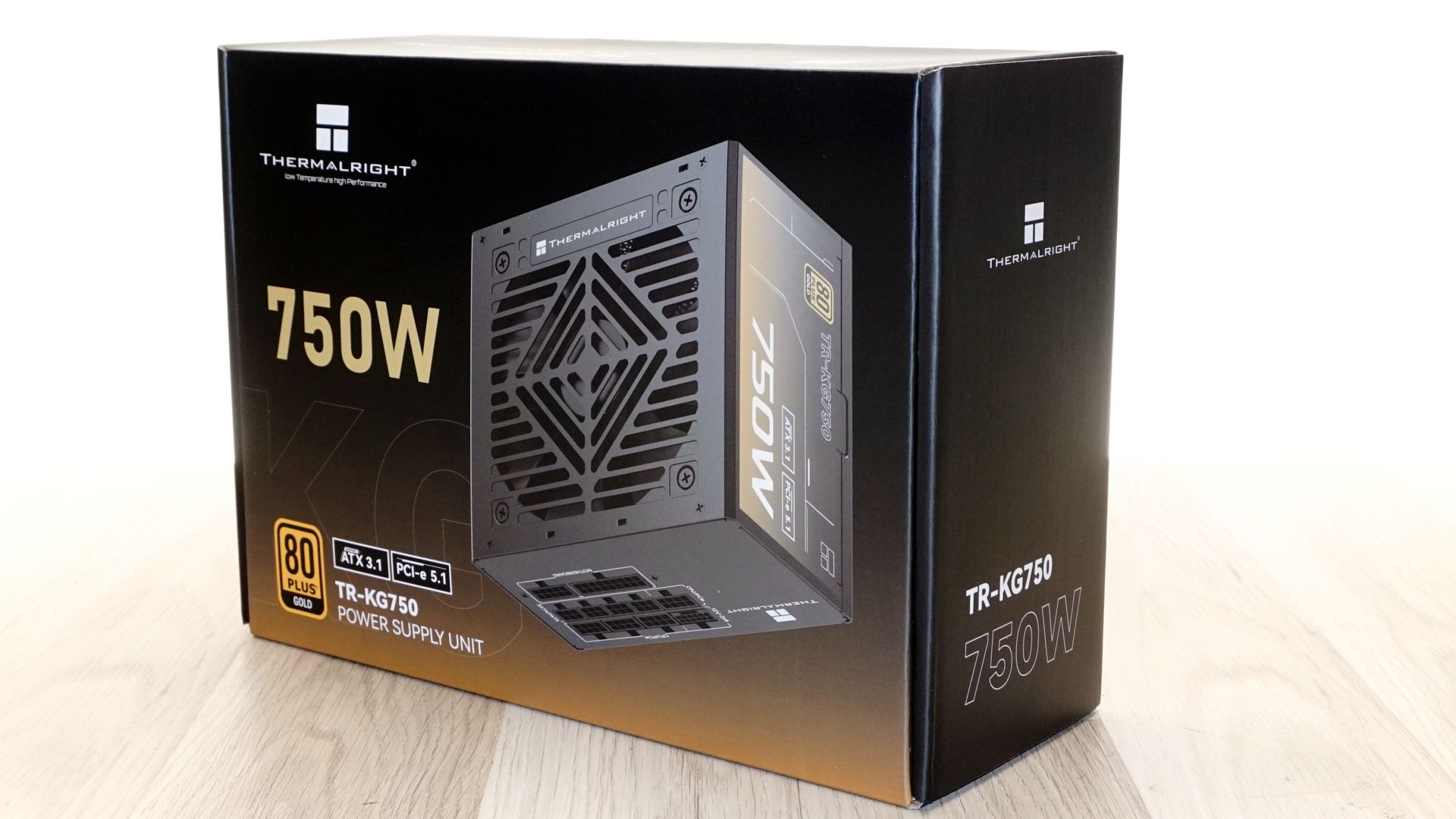
❌
❌