The estimated natural gas consumption of data centers in the U.S. is expected to massively increase as these facilities increasingly rely on gas turbine generators for their power. According to Bloomberg, data centers are projected to use up to 15 billion cubic feet per day by 2035, a 117% increase from the previous forecast of 6.9 billion cubic feet. This number tracks with other data center forecasts, which suggest that data centers will use 20% of U.S. power by 2035, amounting to about 194 gigawatts.
New technologies like small modular reactors are currently being developed as an answer to AI data centers’ insatiable demand for power, like Ampera’s 3D-printed modular thorium nuclear reactor or Valar Atomics’ Ward 250 nuclear microreactor. Many AI hyperscalers, including Amazon, Google, Microsoft, Nvidia, and Oracle, have even invested in projects like these in a bid to generate massive amounts of clean energy for AI. However, they’re expected to take a few more years before they could become commercially viable — time that tech giants do not have. Because of this, Musk said that “natural gas will still be needed to supplement and bootstrap solar for several years.”
The deployment of natural gas turbines in data centers isn’t good news for the communities living around them, though. The NAACP said in its lawsuit against SpaceXAI that the use of these turbines at Colossus 2 increased nitrogen oxide exhaust by 111%, PM2.5 particles by 83%, and formaldehyde emissions by 88%. While the company has already pledged to remove all its unpermitted generators, the process will take at least a year as the portable turbines are slowly being replaced by a 1.2-gigawatt on-site power plant.
Aside from this, the massive demand for natural gas could potentially put a strain on the supply, causing prices to rise and hit the average consumer. Domestic natural gas producers are projected to raise their output by 35 billion cubic feet per day in the next decade, but this still falls short of the forecasted demand by around 11 billion cubic feet per day. So, unless output manages to catch up with the demand, prices are expected to shoot up and cause a scramble for available supply. Still, some experts suggest that there are still more than enough undeveloped gas fields within the U.S. to allow the industry to increase natural gas supplies and reduce costs.
Residents of Frederick County, Maryland, could be the beneficiaries of what is purported to be the biggest residential benefits package yet to be offered by data center developers, in a move a new report claims is a sign of a growing trend that Big Tech is trying to get ahead of fears and community pushback surrounding AI infrastructure. The $110 million deal includes new schools, water reclamation, and more, The Informationreports.
According to the report, the Frederick Digital Campus offering could be a sign that data center developers like Amazon, Microsoft, and Oracle are wising up to growing residential pushback and concerns around the building of large AI data centers in their communities, with developers "sweetening financial offers to municipalities and regulators to gain approval for new facilities" while "getting smarter" about ensuring they shoulder the cost of utilities like electricity. The report says AI builders are turning towards tangible benefits, rather than rhetoric, to get their projects approved.
The Maryland site, if approved, would see residents of Frederick County benefit from a $110 million investment in total, including a $30 million elementary school, $40 million of recreational facilities, a $14.5 million workforce training center, and a further $10.5 million for "agricultural preservation." That comes on top of a purported $215 million in annual property taxes the campus would pay upon completion, a 40% uptick in tax revenue.
It appears the developers have also offered concessions regarding construction, reducing the square footage by almost 20%, and reducing potable water (water safe for human consumption and use) usage by 80%, with up to $100 million also proposed for a water reclamation system.
The proposal is yet to be approved, but if passed, the campus would boast Amazon and Aligned Data centers amongst its tenants. The report reiterates the deal "reflects a rapidly emerging consensus by both tech companies and host governments to eliminate giveaways to developers and to accelerate benefits to towns in the vicinity of the facilities."
A further cited example from Pennsylvania claims AWS announced it would not seek any economic incentives to reduce the tax burden on its 4.5GW, 36-building data center campus in Homer City.
The report further cites occasions where big tech companies are taking the side of consumers and residents over power rate debates, with Microsoft recently said to have challenged an American Transmission Co. and We Energies’ proposal for its Wisconsin data center, claiming the plan wasn't robust enough to protect retail customers from footing the bill if demand was lower than expected. In another case, Google and Amazon are said to have lobbied Virginia regulators to ensure they would fund transmission upgrades required for their infrastructure, rather than let an energy company cover the cost by marking up customer bills.
With concerns around data center buildouts impacting local water supplies, energy rates, and even contributing to noise pollution, it's clear that Big Tech companies appear to be trying to grease the wheels on a local level by investing more directly in some local communities. Big Tech has reportedly now spent more than $1 trillion on AI infrastructure, so even local investments to the tune of hundreds of millions of dollars are a drop in the ocean for companies.
Regulators are trying to pump the brakes on data center buildouts, with some 500 data centers on hold in the US because of various moratoriums and legal pauses.
Patagonia, a region of Argentina with 17,300 glaciers, has the potential to turn into a data center hotspot. The cool climate and abundant energy resources there are drawing interest from the likes of Amazon, Google, and OpenAI, according to Reuters. However, there needs to be more work on tapping into the resources and equipping high-speed networking, like fiber, to make the place irresistible. There’s also the question of political stability with a presidential election next year.
Argentina, and Patagonia in particular, has some juicy lures for potential hyperscale data center operators, and the cold climate is a bonus. That environment helps keep data centers cool and use less power while maintaining agreeable thermals. Patagonia has tens of thousands of glaciers across the Northern Patagonian Ice Field and the Southern Patagonian Ice Field combined.
Another bonus to would-be Patagonian data center operators are the range of energy sources there. Reuters mentions hydroelectric power, wind, and shale gas, but some operators who are already established are also adding solar.
Then, the social and political climate looks good for data centers in Argentina. According to the source, the populace doesn't hate data centers yet. At least there seems to be no campaign groups or public backlash. It is also reported that President Javier Milei has been making changes to court Big Tech. That’s a positive, and may be a negative. Positive in that the Argentines are now being accommodating to the needs of huge AI data centers. Negative, as there’s a presidential election next year, where things could take a dramatic turn, or not. There are also some regions in Patagonia where data center expansions may be complicated by the wishes and needs of indigenous communities. Businesses offering sizable, long-term investments aren’t keen on uncertainty.
With the pretty good environment for hyperscale buildouts established, it isn’t that surprising to see Reuters say OpenAI has confirmed a $25B and 500MW clean energy data center in the country. Lesser-known (to us) companies like Poland's Green Capital also plan a $3B and 300MW data center in Patagonia. It is also reported that FlexDomes, a U.S.-based green data center company, is planning the first stage of a 120MW facility.
Meanwhile, in neighboring South American countries, there are large developments from the likes of Amazon, Google, and others. Argentina must have these data center whales in its sights, as they are known to be scouting for expansion into new locations.
As well as political / business risk, Argentina has some structural weaknesses that need to be addressed by those developing in the country. It is said to have connectivity and power grid infrastructure deficiencies, for example. In other locations, we have seen these addressed on almost a per-project basis, with some state intervention, but it adds some high costs to setting up.
Data center builds are one of the hotly contested items worldwide. Many states and cities have upheld moratoriums on new buildouts due to power usage, water consumption, and noise concerns. Thailand is the latest nation to pump the proverbial brakes, with the government requesting that existing buildouts hit the pause button while coming up with a more precise regulatory framework.
Government heads requested that agencies compile information about current and future data centers during this week, in a bid to create unified legislation. The country currently has few laws specific to data centers, leading to legal voids like zoning a data center as a "warehouse" right next to a hospital. Much like everywhere else, the country has seen growing complaints about data centers' water and power usage.
After the week is out on September 11, the government expects to take about a month to come up with a regulatory draft, making the pause technically an indeterminate timeframe — though further delays wouldn't benefit either party, as Thailand considers the industry critical to the country’s competitiveness. The catch is that pausing construction isn't enforceable, so companies can elect to plow ahead regardless while the legislation is discussed.
NESDC (National Economic and Social Development Council) secretary-general Danucha Pichayanan is very specific: "we don't have the power to suspend the construction of the 49 data centers" currently under construction. However, when the legislation arrives, it will apply retroactively to ongoing projects, though with an adjustment period for in-progress builds. New builds will naturally need to comply with the legislation from the get-go.
Some companies may elect to soldier on with the belief their buildouts will be in compliance with the reasonably predictable content of the new laws, or betting that they could win future legal challenges — a dynamic that's already in play elsewhere with Project Jupiter. The incoming legislation is expected to cover power consumption (and possibly generation), closed-loop cooling, and water-surplus guarantees, meaning builders already have a fairly good idea of what they'll need to do.
Not complying with the request for a pause might be a game of political chicken, though, as the government may retaliate with regulatory delays and additional costs to power connections. Just last Thursday, Thailand's energy ministry raised concerns over a Bangkok data center that may be planning to hold diesel stockpiles far in excess of the 200,000 liters it has permission to.
On that topic, Thailand revised laws on industrial power delivery last July, and among other requirements, demands a bank guarantee of ฿4.5 million ($134,000) per megawatt. Half the money will be refunded when the actual usage reaches 50% of proposed utilization, and the rest when usage hits 70%. This mechanism is meant to stop preemptive allocation of power delivery capacity that might remain unused for months, years, or not at all — once again, mirroring datacenter playbooks elsewhere around the world.
At face value, the amount of $134k per megawatt sounds like a small price to pay for a builder to get ahead of the pack, but its per-megawatt nature means that a hyperscale facility pulling 200 MW or more needs to place around $27 million in escrow.
With the power laws recently revised, water consumption is seemingly the largest concern, as the current legal framework allows companies to make deals directly with utilities without additional safeguards. For example, in Chonburi, an operator signed a decade-long deal with Eastwater Stecon Utilities for 3.3 million cubic meters annually, or about 36,900 residents. It's expected that the new laws will add much stricter requirements to avoid localized deserts.
A Bitcoin mining data center in El Reno, Oklahoma, has been condemned after it leaked 3 million gallons of water, reports Koco TV News. Schools, businesses, and city and county offices were all closed last week due to the leak.
According to the source report, the Athlon Blockchain LLC-owned data center shouldn’t even have been operating, as the city issued it a Stop Work Order in 2023 due to “multiple fire and life safety code violations as well as the expiration of the building and electrical permits that had previously been issued.” The city asserts that none of the costs related to the water leak at the property will be passed on to citizens, according to the source.
We don’t know whether the Bitcoin mining data center development went ahead despite the Stop Work Order in 2023 due to ignorance or a devil-may-care attitude toward regulation. Koco reports that the owner of the property was given until the end of 2023 to comply with safety codes and obtain new permits, while construction should have been put on hold. Now it is believed that the firm building the facility set up the data center and began operations without any further consultation with the city. Perhaps the owners thought they could sidestep the Stop Work Order by housing the data center in an array of shipping containers.
Clearly, regulators should check that codes, directives, and ordinances are obeyed. This incident shows a disastrous leak from an insufficiently policed operator with serious repercussions for local citizens. Thus, the city has now committed to routinely reviewing compliance. As for the waste and costs involved in this case, a statement on behalf of the city says it is “preparing to take the necessary legal actions to recoup all costs and expenses related to the water leak from the property owner, including city resources expended in locating and addressing the leak.”
There has been a lot of controversy recently regarding data center usage of water. Concerns have been heightened due to widespread drought conditions in the Northern Hemisphere this summer.
Denver Water, which supplies the city and its surrounding areas, has imposed Stage 1 drought restrictions in its service area starting August 2026 as water supplies continue to drop. According to Gadget Review, commercial properties like data centers can only water grass twice a week — on Tuesdays and Fridays — until September 30. Starting October 1, lawn sprinklers will be banned for use until the Board of Water Commissioners declares otherwise. However, one resident who was out walking their dog saw that the new AI data center built close to their home was watering its lawn and using so much water that some areas have started to puddle.
This is OUTRAGEOUS 🚨 Denver, Colorado resident shows a brand new data center was built next to her neighborhood. Democrats put residents on a water restriction, they can’t water their yards until next summerMeanwhile the Data Center’s sprinklers are on watering their lawn… pic.twitter.com/SDTbSn5eIFSeptember 2, 2026
“We can’t water our lawns until next summer, at the earliest, but you better believe that they are watering their entire green with so many sprinklers that it’s already making a giant pond, but I can’t water my f****ng tomatoes. I hate it here,” one resident claimed in the video.
This has understandably raised a lot of outrage, especially with all the widespread, bipartisan resistance that these data centers have been facing. However, there are still a lot of unknowns when it comes to the video. Firstly, we do not know when the video was shot; there’s a possibility that it was recorded on either a Tuesday or a Friday, meaning the site was well within its rights to water its lawns, at least until September 30.
The publication also noted several other possibilities: it could be using recycled, non-potable water, which Denver Water explicitly states, “are approved to irrigate any day of the week”; it could hold a variance from the utility provider, granting them permission to water their grass under “special circumstances,” or it was just plainly violating the law. Without further information, there’s just no way we can determine what is going on based on a single video. Nevertheless, this compounds the negative perception that data centers are already facing. Although closed-loop cooling technologies like those from Microsoft and Nvidia have essentially cut data center water consumption for cooling to zero, we still cannot get around the fact that several sites have already caused water issues for their neighbors.
Independence City Council member John Perkins lost his position after 68.05% of voters opted to oust him in a special election because he supported data centers. According to NBC News, Perkins was one of the five councilors who said yes to the tax breaks amounting to more than $6 billion for the Nebius data center being built in the area.
Many members of the community have been campaigning against this development ahead of the March City Council meeting when these tax breaks were approved, but the council ended up voting 5-2 anyway in favor of the data center. Perkins is the third to have lost their seat after this vote, with Jared Fears, who was running for re-election in the city council, and Bridget McCandless, who was running for mayor, losing their respective bids.
“Politicians aren’t entitled to elected positions. They’re elected by the people to serve those people. When they stop serving the people they were elected to represent, they’re voted out of office,” a member of the Stop the AI Data Center in Independence Facebook group said. “This is democracy in action.” While Perkins hasn’t released a statement yet after the release of the unofficial results of the Special Recall Election, he previously said in an Op-Ed on The Kansas City Star that he stands by his decision to support the Nebius tax breaks and that recalling him would be a setback for the city.
“You can disagree with that call, and I respect that. However, disagreement isn’t a crime, and I don’t believe it is grounds to attempt to overturn an election that happened two years ago,” Perkins wrote. “One vote is not a reason to erase the previous hard work I’ve done for my district.”
Despite the massive support for ousting Perkins, we should also note that the voter turnout for this issue has been abysmally small. Out of the 14,250 registered voters in Jackson County, only 1,643, or 11.5%, went to the polls to vote for or against the councilor.
Another Missouri town has voted out half of its city council, which approved a data center project within its jurisdiction. The people of Festus, Missouri, ousted four of the eight members of its council in a regular election in April 2026 after they approved a 360-acre data center project in the area. Another petition was raised to have the remaining four members recalled, but the measure was shot down by the council.
OpenAI CEO Sam Altman has downplayed the water consumption issue that AI data centers are facing, saying that it has been blown out of proportion over time and does not keep up with the latest developments in data center cooling technology. Altman said this in an episode of the Sources Podcast with Alex Heath, where the two talk about the backlash against AI development. He claimed that producing a single almond in California is equivalent to 38,000 ChatGPT queries.
“You know, I saw this thing going around about the water usage of ChatGPT. And it was like every time you run a single ChatGPT query, it’s like, you know, you run your shower for like six hours. And the water never comes back, and it’s just done. I don’t have the exact calculation in front of me, but I think the real number is something like — doing this from memory, it might be wrong, but it’s close — for every 38,000 ChatGPT queries, that is the same amount of water that is used in the production of a single almond in California… This is like the full-on, you know, total true water accounting, not just what’s running in one data center,” Altman told the host.
SAM ALTMAN: “For every 38,000 ChatGPT queries, that is the same amount of water that is used in the production of a single almond in California.” pic.twitter.com/vRCCPneJSmSeptember 2, 2026
“There’s a question of like where this came from because the people that are scarfing down 12 almonds at a time don’t feel like they’re doing something horrible from a water perspective, for the most part. It is true that data centers at one point used evaporative cooling, but they have not done that in a long time. Like if you look at a modern very large data center, it uses the equivalent amount of water as an office building in terms of, you know, people like running the sinks and the toilets and whatever. So, that has been a robust meme and difficult to disprove, but I don’t think it holds up to any scrutiny.”
It’s true that almonds are some of the most water-intensive crops being grown in the U.S. Researchers say that it takes about 1.1 gallons of water to grow a single almond. By comparison, Altman's own statements in the past indicate that one ChatGPT response uses somewhere between 1 to 50mL of water, ostensibly using older evaporative cooling techniques, or about 0.0002 to 0.013 gallons per query. While this is nowhere near Altman’s 38,000 estimate, it’s still about 85 to 5,500 ChatGPT queries per almond using an unspecified cooling method. Nevertheless, training AI models in older facilities can use far more water, with estimates suggesting that GPT-3 used up almost 185,000 gallons of water with older systems, while the increasing popularity of AI, especially AI agents which use up a lot more tokens than just chatbots, means that data centers could still use more water compared to almond farming.
GoPro just announced a merger with Starman Optical, Inc., an optical-photonics company, saying that the deal would allow the combined entity to produce U.S.-made optical transceivers for use in AI data centers. According to the press release, Starman will pay shareholders $285 million in cash for the action camera company, amounting to $1.14 per share, and will also pay off its outstanding debt of $92 million. Despite that, current GoPro investors will retain 10% ownership of the post-merger company.
Starman said that the move will give it access to GoPro’s intellectual property, which amounts to more than 2,500 patents, as well as its imaging solutions, advanced optics, and other technologies that it has developed. This deal is crucial in keeping the camera company afloat, especially as it has recently faced declining sales and increasing costs, leading the camera maker to warn investors that there is “substantial doubt about the company’s ability to continue.”
On the other hand, the merger would expand GoPro’s portfolio to include optical transceivers, which are getting increased demand as AI data centers transition to fiber optics for their networking needs. Aside from data centers, the deal would also allow GoPro to expand into defense, government, robotics, and the aerospace industries, where it “intends to leverage its IP, optics, and imaging capabilities” to supply the increasing demand for solutions made within the U.S.
While GoPro has successfully moved its manufacturing out of China to protect its supply chain from U.S. tariffs, it still has no local manufacturing. So, this merger would allow it to have production within American borders and help isolate it from further economic instability brought about by surprise tariff announcements.
This could help it secure its future, especially as the FCC has recently been making moves to keep foreign-made tech like routers, LiDAR-equipped drones, and robots. It also makes sense for the two companies to partner — even though consumer action cameras and optical transceivers for data centers sound like they have nothing in common, they share a lot of technologies between them, like imaging sensors and advanced lenses or optics.
This isn’t the first company with seemingly no relation to data centers to expand or pivot towards it. Struggling shoemaker and apparel brand Allbirds pivoted towards it earlier this year, resulting in a 580% jump in its stock price after the announcement, although it has since settled back down to its pre-announcement prices. AI data centers are indeed a tempting investment, with consultancy firm PricewaterhouseCoopers saying that investment on the technology could hit $32 trillion by 2050.
PricewaterhouseCoopers LLP (PwC) estimates that spending on AI data centers could reach as much as $31.6 trillion in the next decade and a half, with optimistic outlooks suggesting that capital expenditure could potentially hit $50 trillion. Bloomberg reports that this amount exceeds the spending that railways, electrification, or the internet required when they were being set up for the first time. It also pointed out that investments in AI data center infrastructure aren’t a one-time expense that would last decades, unlike railroad networks, the power grid, or fiber optic cables — instead, data center operators are expected to purchase new GPUs and related infrastructure every four to six years.
GPU development is happening at breakneck pace, with Nvidia, AMD, and other manufacturers releasing new generations every two to three years. In fact, one Google architect said that a data center GPU service life is only about one to three years, which has got some experts concerned that GPU depreciation could be the next big crisis for hyperscalers. “Railways. Electrification. The internet. Each required enormous amounts of capital and defined an era,” the publication reiterated from the report. “The AI infrastructure cycle underway dwarfs all three. This one resets every four to six years — and shows no signs of ending.”
Nvidia and other chip manufacturers would be some of the biggest winners in this spending spree, but other hardware industries would also benefit, like networking equipment and even the copper material needed for running power inside data centers. PwC is confident in its forecast, especially as it claimed that both capital and demand for the AI build-out exist. It also broke down the investment in each region — spending in the U.S. is projected to hit $15.1 trillion, followed by the Asia-Pacific region, including China and India, at $8.2 trillion. Europe will likely spend $5.6 trillion, and it’s trailed by the Middle East at $1.1 trillion and Africa, with $255 billion.
There are still some concerns that the current AI boom is a bubble that will pop sooner or later. This is especially true as some AI tech companies currently have “hidden debt” worth around $1.65 trillion, while costs have started spiking as AI companies like OpenAI look for a path towards profitability. Despite that, Nvidia is still going full steam ahead, partnering with several firms to build a $500 billion AI infrastructure fund for further AI investments.
The Oklahoma Office of the Attorney General commanded the City of Claremore to release body cam footage requested by farmer Darren Blanchard and his legal team without charging them $17,125.44. According to 404 Media, the city is asking for that amount so that it will release information on Blanchard’s arrest in April 2026 for speaking 30 seconds longer than the allowed time during a public consultation for a proposed data center in the area, as well as city records of previous disturbances in other public meetings. This led Kate Griffin, one of the farmer’s lawyers, to complain to the Oklahoma Attorney General, which looked at the situation.
Claremore justified the fees by saying that it would need to spend $16,540.44 for a legal review of requested records “to ensure that all information which must be withheld relating to members of the public and the City’s personnel is redacted in order to protect their privacy.” It’s also asking for $585 — equal to the 15-hour pay of a city clerk — to conduct the search of the documents.
“The City knows and is aware that any documents released to Mr. Blanchard and to those associated with him, regardless of the privacy implications of individuals named in such documents, are subject to wide distribution, including on social media,” Claremore said in its response to the Oklahoma AG. It also added, “Her persistence in maintaining an overly onerous request demonstrates that this dispute has nothing to do with transparency and likely has everything to do with causing excessive time/money expense to the City in order to generate public sympathy for her client and negative publicity for the City.”
However, Assistant Attorney General for Oklahoma Anthony Sykes said that this isn’t a valid reason to charge Blanchard thousands of dollars for this request. He said that the state’s law says that public bodies can only charge for the direct costs of searching and copying data when it comes to information requests. More than that, all the fees being charged must be disclosed publicly beforehand.
“The City has not posted a schedule of fees as required by the Open Records Act. Having failed to give the requisite notice of the fees charged for public access to City records, the City is foreclosed from charging search fees,” Sykes said. “If I were to conclude otherwise, there would be no incentive for public bodies to comply with the statute. They could simply ignore what the ORA requires and charge what they deem reasonable on a case-by-case basis.”
Another justification the city used for the egregious fees is the need to redact the body cam footage “to protect the privacy of the public and City personnel.” However, the assistant attorney general said that the incident happened at a public meeting with no reasonable expectation of privacy. Because of this, the city should hand over the requested data as soon as possible.
Blanchard is being charged with trespassing, a municipal crime with a penalty of just $200, making these charges very steep by comparison. Even though it might’ve been easier to plead guilty and pay the fine, the farmer is fighting the city on the grounds that it’s violating his right to free speech.
Donald Trump doesn't appear to be a fan of the data center backlash that has swept the nation. Posting on his Truth Social platform, the President said that communities that reject data centers only do so because "they want to end up being backwards and poor," and posited that China "could not be happier with this anti Data Center movement." The comment comes amid a wide, albeit unorganized, pushback to data center buildouts in the United States that's left local communities and municipalities reckoning with an unanticipated and rapid infrastructure buildout.
The President says to "let Data Reign" if communities "want to be successful and rich, with far lower taxes and jobs all over the place." Presumably, the President missed a comma after "taxes" and does not mean that data centers will lower the number of jobs available. The economic argument surrounding data centers is a tough issue to quantify, though it's not completely detached from reality.
A July study from Georgia Tech found that data center developments increase local employment by 3.5%, total wages by 5%, business establishments by 4.7%, and median household income by 1.9%. Further, the developments reduce unemployment rates. Critically, however, the study found that these benefits mainly show up in metropolitan areas, calling the benefits in rural areas "negligible." The study also highlights that data centers often employ fewer than 100 permanent workers, with specialized services "imported from outside the country."
The research also looked into trade-offs with electricity prices, finding that prices rise an average of 5% after a data center is built in a community.
In another analysis, Brookings found that, although new data center construction creates jobs, the number is somewhere between 100 and 200 permanent positions. Additionally, it found that areas with data centers see average home prices rising between 2% and 5% without any impact on wages.
Early attempts at studying the effects of data centers on local communities have, on one hand, substantiated the claims that data centers bring economic activity. On the other, they suggest that economic activity is smaller than expected, localized to the area in question, and comes with unintended side effects like higher electricity prices. There's also an environmental concern, one that is difficult to study in the midst of buildouts.
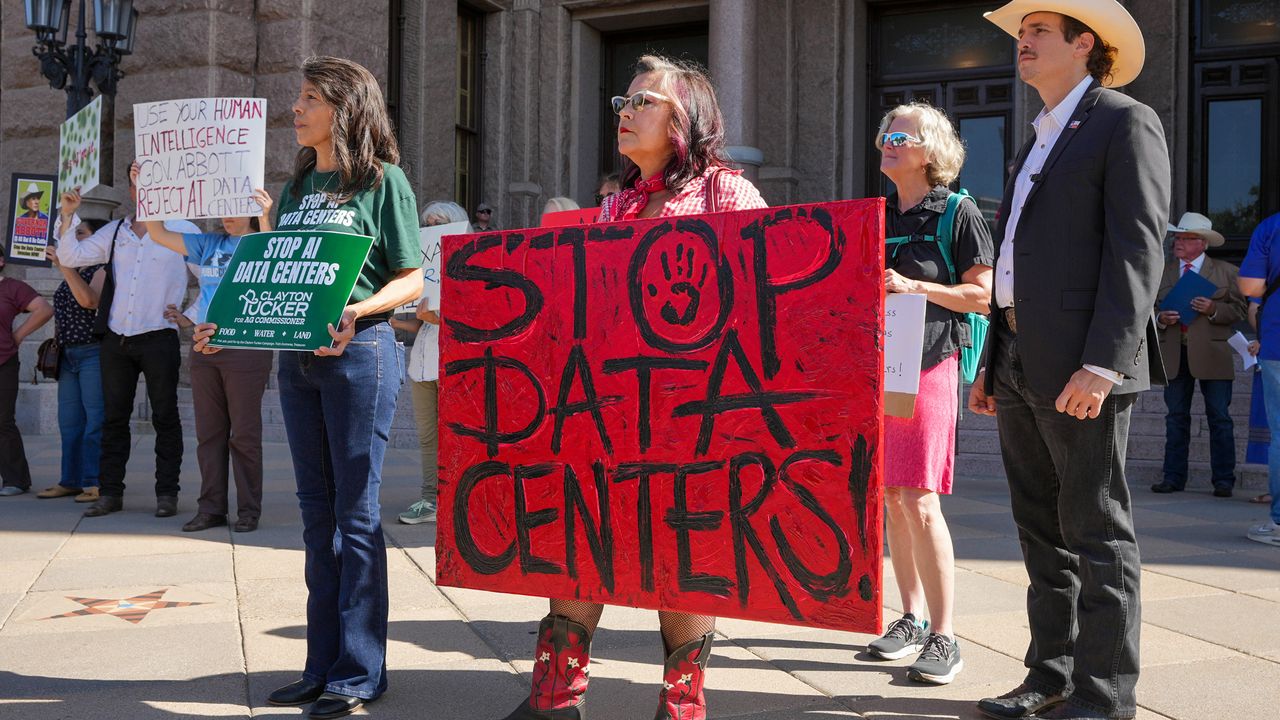
Instead of outright banning data centers, local governments and increasingly state governments have paused development to study the impact. In July, New York Governor Cathy Hochul signed a one-year moratorium on data center construction to study the economic and environmental impacts. In early August, Texas Governor Greg Abbott directed state agencies to cut data centers off from connecting to the Texas power grid until an audit of the facility's power and water usage is completed. Republican Governor Mike DeWine of Ohio has made similar directives.
At a national level, the Artificial Intelligence Data Center Moratorium Act, sponsored by Representative Alexandria Ocasio-Cortez, proposes a pause on data center construction and new AI products until the government can review both the environmental impacts of new data center construction, as well as the impacts on jobs for new AI products. The bill has been introduced, though it has yet to be debated in committee or voted on in the House.
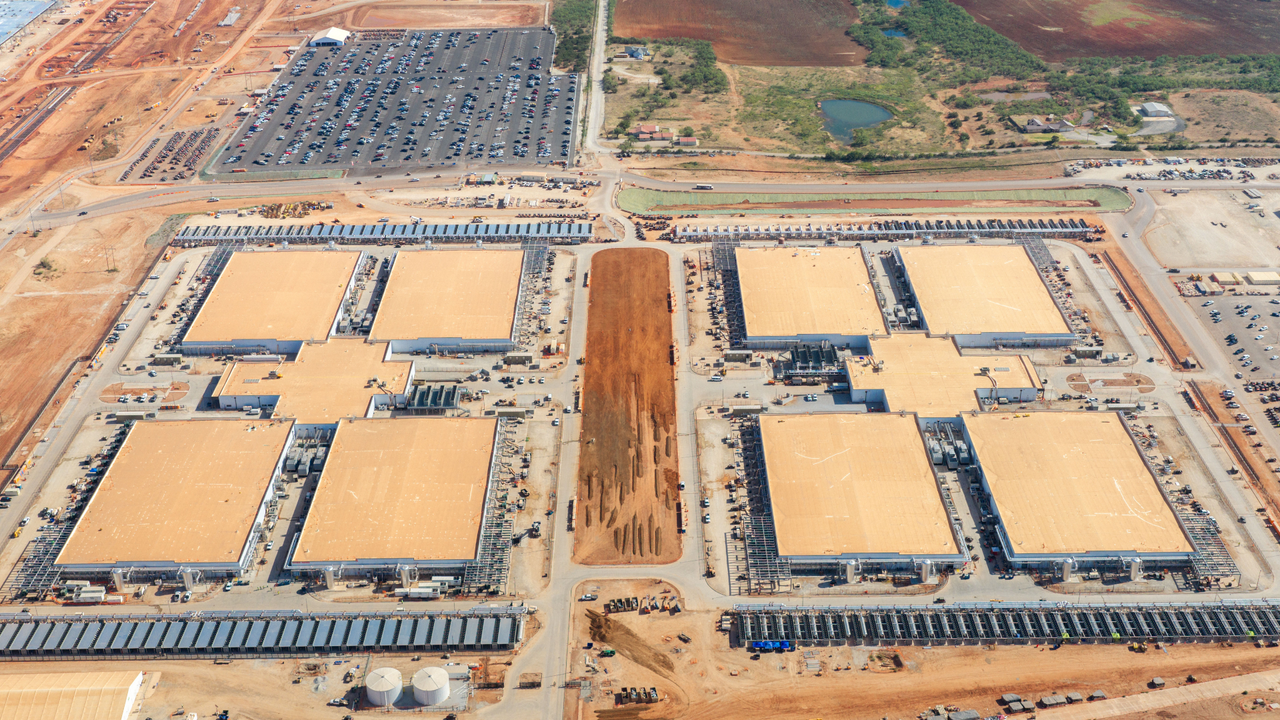
Electricity supply in the U.S. is a limiting factor preventing AI data centers from coming online as quickly as possible. Because of this, many projects are turning to portable natural gas turbine generators to get the electricity they need and bypass long wait times to connect to the grid. This has driven demand for turbines, so Elon Musk said on X that SpaceX will bring turbine blade and vane casting in-house.
This sudden influx of demand has led to jet engine shortages for data center operators. Beyond the fact that engine manufacturers weren’t prepared for the AI boom, commercial aviation has already been suffering from its own shortages due to supply chain and engine design issues even before data center developers started buying up turbines.
SpaceX and Tesla are each building 100GW/year of solar production capacity as fast as possible, but natural gas will still be needed to supplement and bootstrap solar for several years. The limiting factor for nat gas turbine production is casting the blades & vanes. By doing…August 29, 2026
Turbine blade and vane manufacturing is one of the biggest bottlenecks in jet engine production right now. The blades used in these engines are difficult to build, with one batch often requiring 60 to 90 weeks to produce from start to finish. That’s because these are specialized parts that are subjected to extreme forces and temperatures, especially in the core of the engine. Even if the engines that these blades will end up on are bolted to the ground or strapped to a trailer instead of hanging under the wing of an airliner, manufacturing them still requires the same level of care and precision.
Because of this, it seems that Musk wants to take things into his own hands by making SpaceX manufacture its own turbine blades. He says this move could cut deliveries by 18 months, allowing xAI to get brand-new turbine generators much faster instead of waiting behind a long queue expected to stretch into 2030.
SpaceX and Tesla aren’t abandoning solar power, but Musk says that “natural gas will still be needed to supplement and bootstrap solar for several years.” Because of this, it seems that he’s willing to invest in parts of turbine manufacturing as demand for turbine generators for data centers increases in the coming years. He has even reportedly quietly bought a portable gas and diesel turbine fleet for around a billion dollars, possibly to take advantage of this boom.
It’s unclear how Elon Musk intends to make turbine blades and vanes, especially given how complicated the process is. Nevertheless, he’s no stranger to tackling “impossible” problems, especially given his track record with Tesla and SpaceX.
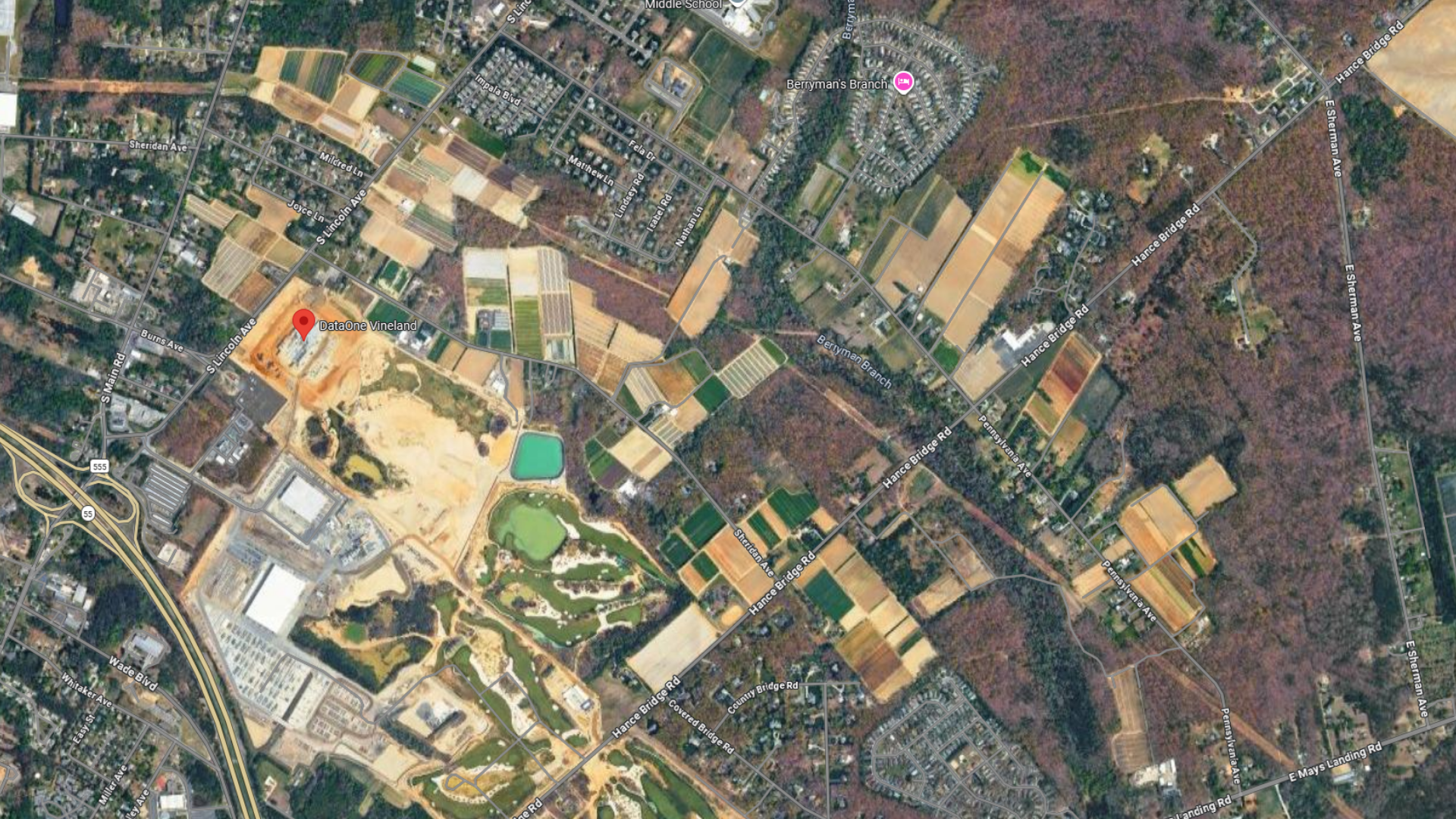
The DataOne data center in Vineland, New Jersey, has faced a slew of complaints from the community since construction began in 2025. According to Stand.earth, the project has reportedly been operating several unpermitted gas turbines on site, spewing air pollution in the area near two local schools. Aside from that, the site has also faced allegations of constructing an unpermitted 1.5-million-gallon liquefied natural gas storage tank and of unacceptable noise levels at night, which affected residents within a half-mile radius of the data center.
Vineland residents began seeing references to the data center in various government documents, prompting several questions to the city government. Because of this, the city called a town hall meeting last January 2026 — several months after construction on the data center had already begun, with DataOne CEO Charles-Antoine Beyney admitting that the meeting should have been initiated several months before.
A few weeks before the town hall, some people living within a half-mile radius of the site started complaining about noise from the development. While they couldn’t confirm the source of the noise, it was often described as a low hum, similar to that of a generator. A later investigation revealed that the site had 62 gas turbines deployed in the area, with at least 45 running at any given time. This is similar to what SpaceXAI has done in Memphis, Tennessee, where it deployed 69 unpermitted natural gas turbines to power its data centers. While the company has since promised to remove these polluting generators, it will do so only over a span of one year, as they’re being slowly replaced by a 1.2-GW on-site power plant.
There have also been concerns that the site’s stormwater management system does not comply with the state’s regulations. A third-party engineering review stated that if these issues are not fixed, they could result in on-site and off-site flooding, especially given the site’s massive 55-acre size. The experts also noted that the data center has “underestimated the annual groundwater recharge by at least 20 million gallons per year,” which could result in lower aquifer levels and reduce the amount of water available or the water quality for the people living in the area.
“The incident should shatter the illusion that Microsoft is a ‘good neighbor’ or in any way more responsible than the other Big Tech companies,” Stand.earth Senior Campaigner Nathan Taft said in the statement. “This investigation has revealed that far from ‘doing this work differently than other’ as it promised, Microsoft is drawing directly from Elon Musk’s xAI playbook of doing the damage first and asking for permission later.”
(Image credit: Sustain South Jersey and Stand.earth)
In an interview with Tom’s Hardware,Nathan said that even though Microsoft does not directly own or operate the Vineland data center, it stands to reason that the tech giant should do something about all these complaints, as it’s the one that has contracted Nebius for the computing power, which resulted in DataOne’s construction project. He compared this to a contractor making a mess on their client’s neighbor’s property. Even though a third-party provider — DataOne — was at fault for the issue, the fact that the people have already been complaining should give Nebius pause and compel Microsoft to do something.
DataOne’s actions in New Jersey directly contradict the promise Microsoft made back in January 2026, and residents are asking the tech giant to stand by its word. Although the concerns about air and noise pollution are technically not mentioned in the company’s “community-friendly” commitments, these issues still impact the quality of life of the people living around the DataOne data center. Aside from that, the unpermitted construction shows it does not adhere to the rules of Vineland. “The developers have been ‘act first, pay the fine, and ask for forgiveness later,’” says Mr. Williams.
Indiana Michigan Power, or I&M, which serves over half a million residential customers across the two states, said that it’s planning to cut rates for residential customers in Indiana. According to the company, it’s planning “one of the nation’s largest base rate reduction plans,” with the total bill reduction saving Hoosiers approximately $59 million in electric bills by 2027. This translates to about $100 per year for each home that uses around 1,000 kWh monthly. Aside from that, I&M wants to freeze rates for the next three years, offering its customers a measure of stability as data centers are forecasted to use 20% of U.S. power by 2035.
The plan is still under consideration by the Indiana Utility Regulatory Commission (IURC), with a decision expected by June 2027, with residents seeing savings by the summer of that year. This also isn’t the first time the state has seen electricity rate cuts in recent months. I&M has already reduced its rates twice in the first half of 2026, offering some users much-needed relief from rising electricity costs brought about by the massive demand from AI data centers.
PJM Interconnection, which operates the grid that I&M uses, has implemented “irreversible” price hikes of up to 76%, but it seems that I&M was able to isolate ratepayers from increased prices. It achieved this through load growth, allowing it to recoup its capital investments on grid upgrades more quickly, and the increased revenue brought by the massive consumption of large customers like data centers.
“As Indiana continues to experience unprecedented growth, we are taking action to help our customers benefit from that growth through lower costs, enhanced value and continued investments to strengthen our system,” said I&M president and chief operating officer Maryam S. Brown. “We are proud to join forces with state leaders to advance economic development and make energy more affordable – while continuing to provide system reliability upgrades.”
Indiana isn’t the first state to see reduced rates driven by increased rates or usage by larger customers. Oregon approved a 1.3% reduction in residential electricity prices in early July, as customers that used up 20 MW or more saw a 30% increase in their utility bills. Virginia, which plays host to a ton of data centers, is now following suit, with its regulators requiring firms to pay for dedicated upstream electrical infrastructure being built to serve their needs.
Moves like this should allow some Americans to see their bills go down a little bit and address one of the major concerns that they raise whenever a data center project is proposed in their neighborhood. However, several other issues like water supply impact and noise pollution must also be resolved to reduce the community’s resistance to these developments.
Researchers from the University of Mary Washington in Virginia found that of the 31 localities with an existing, approved, or proposed data center, 25 of them have non-disclosure agreements (NDAs) that make it difficult, if not impossible, for their citizens to find information about these projects. According to NPR, these NDAs have left the questions of many residents unanswered, making them feel left out of the decision process and increasing their distrust of their leaders.
Many officials defended signing these secrecy agreements, saying that this is standard practice among tech companies, and that they could lose the potential business and revenue that data center projects could bring to their jurisdiction if they fail to sign the NDA. Louisiana Economic Development Secretary Susan Bourgeois even told the publications that NDAs are “fundamental for economic development” as they allow the state to compete with other states and territories for the data centers’ business. “The last thing that they want to have happened in the beginning of the discussion, or in any part of the discussion, is for their information that they’re sharing to be disclosed publicly. So, without NDAs, our work, frankly, just doesn’t happen,” the agency secretary said to NPR. She also added, “The irony is that we, we use NDAs not to be more cloaked, we use NDAs to be more forthcoming.”
NDAs aren’t only limited to Louisiana, as other towns across the U.S. have signed these secrecy agreements even before they started talks with potential data center projects in their regions. Some Wisconsin citizens raised a similar issue in early 2026, when at least four municipalities reportedly signed NDAs with Microsoft and Meta as they negotiated with the two companies. These confidentiality agreements are some of the things that drive the heated debate between elected officials and ordinary citizens, with the latter often feeling betrayed and sold out by the former when they belatedly find out that a data center will be put up in their community.
However, West Feliciana Parish proved that it could get a data center deal without keeping its details top secret. Parish President Kenny Havard said that economic development does not require NDAs. “I don’t think NDAs are necessary unless they’re going to bring you in a room and share some proprietary information. When you’re talking about land sales, tax incentives, those sorts of things that affect the citizens, it should be out in the open. It should be transparent,” Havard told the outlet. He also said, “We’re proud that we did it without having to sign NDAs. And I think it just shows that you can do these projects without keeping the people in the dark.”
Data centers are unpopular among U.S. citizens right now, with projects facing resistance and moratoriums across the nation. While we’ve seen over a hundred protests against the developments happen simultaneously, researcher Andy Masley wanted to answer one question: what is driving the pushback against these projects? Is it big tech? AI skepticism? Or maybe even China? But after reviewing data from multiple polls, his answer seems quite simple: the “object-level local environmental and economic harms” that have been widely reported in the media.
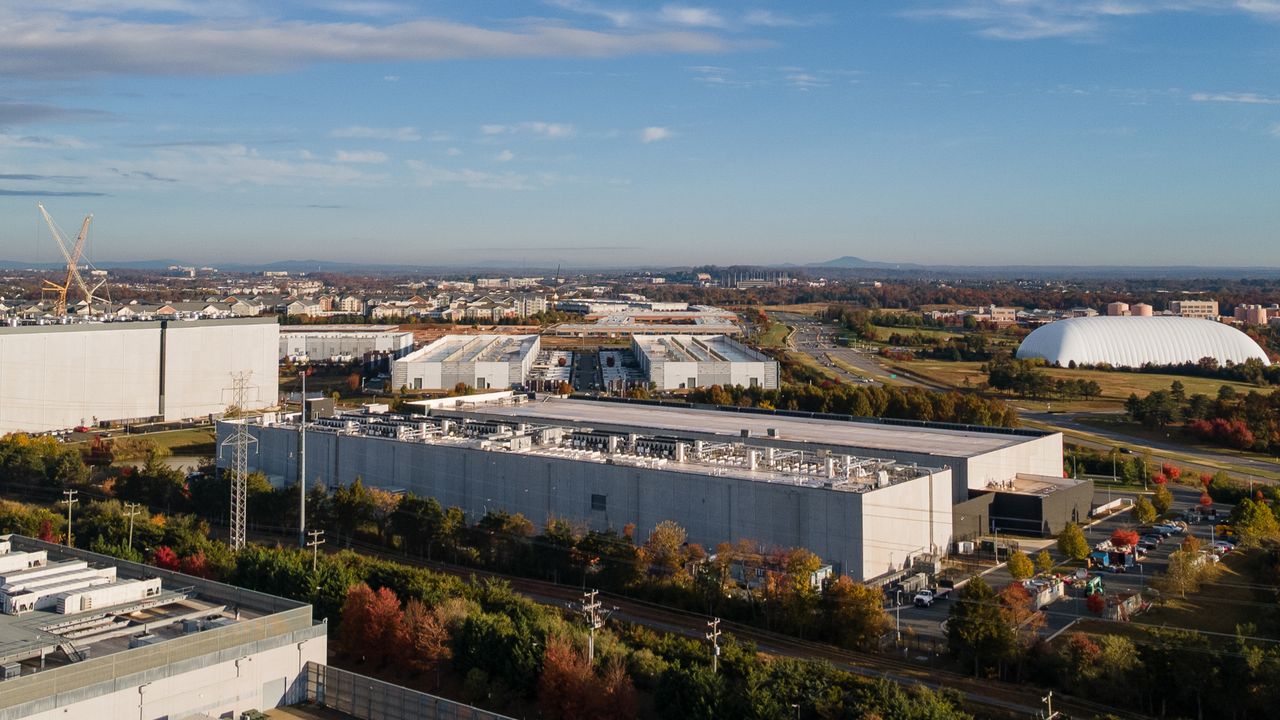
Multiple data center sites owned and operated by different hyperscalers have found themselves in hot water with the people surrounding them. The biggest issue that caught the attention of the public is the massive amounts of electricity that these developments use, requiring grid operators like PJM Interconnection to expand their infrastructure to service AI data center needs, which costs billions of dollars. Unfortunately, the capital expenditure for these upgrades has typically been passed on equally to all users, with ratepayers seeing price hikes of up to 76% on their utility bills.
It has gotten to the point that President Donald Trump had to make tech giants, AI hyperscalers, utility operators, and state governors sign a “ratepayer protection pledge” so that AI companies “pay their own way” when it comes to their electricity needs. But this move was too little, too late to halt increased electricity costs to the huge swathe of the American population that PJM Interconnection serves. Oregon is the only state, so far, to have passed a law that requires sites using 20MW or more to pay for their own share, with PGE, the state’s largest power provider, hiking data center bills by 30% while also cutting residential costs by 1.3%.
All of these are “object-level” concerns, meaning these are specific issues that exist, have happened on other sites, and are directly observable by other people. However, Masley also points out that some of the coverage of these issues was either overblown or only showed the concerns of the residents, without putting them into the context of the actual project and comparing them with other existing data centers in other areas. Because of this, many people have become fearful that the issues found in other developments will automatically apply to the data center being proposed in their community.
Some data center developers also aren't helping to assuage fears. Some are pushing back against moratoriums and bans, and have begun suing local jurisdictions. One town in Pennsylvania listed 43 specific demands that the developer called “too difficult” and pulled out of negotiations before applying again, with the council calling the move an attempt at “approval by tantrum.”
Lux Claridge, the teacher who was arrested in Emporia, Kansas, during an AI data center meeting for clapping, said that the city has dropped the charges against them. According to 404 Media, the Emporia assistant city attorney told Claridge’s lawyer that the case has been dismissed without prejudice in municipal court because of conflicts on the matter. Unfortunately, that doesn’t mean that they’re in the clear yet, as the case has been bumped to the County Attorney’s office for further review.
“Today, I was informed by my attorney that the city has dropped my charges and has passed my information along to the county,” Claridge told the publication. “As far as I know, I’m in the clear unless the county is feeling froggy.” This series of unfortunate events started when the teacher politely clapped five times after a speaker gave their comments against the proposed data center in the city. It seems that the city’s commissioners had warned against clapping and other reactions beforehand, saying that it was disruptive. So, when they clapped, someone from the crowd, presumably someone with authority, asked a police officer to take the next person who claps outside of the venue.
This was when several cops approached Claridge, who asked them to leave, but they stood firm, saying, “I have a right to speak.” When the authorities insisted that they go, they just said, “Drag me out,” after which the four officers cuffed the individual, physically lifted them, and hauled them off to the Lyon County Jail. They were finally let out after eight hours, after which they were charged with disorderly conduct and interfering with a law enforcement officer.
After this incident, the city canceled the public meetings set for August 5 and August 19, 2026, and moved them online. The city said that commissioners were receiving death threats from external sources and that it’s taking the measure to protect the safety of its officials and the public. However, it also didn’t allow public comments, which some are questioning, although it did tell citizens that they can phone in their concerns instead. Nevertheless, the city will return to in-person meetings soon, and it will also open public comments once more, with Claridge quoting Emporia mayor Becky Smith saying that she’s “willing to give us another shot to act like grown-ups.” Emporia is expected to put the data center ban to a vote in November via public ballot. However, it also said that even if the people approve the proposed ordinance, it can only take effect after it has been ruled that the petition is deemed legal in the first place.
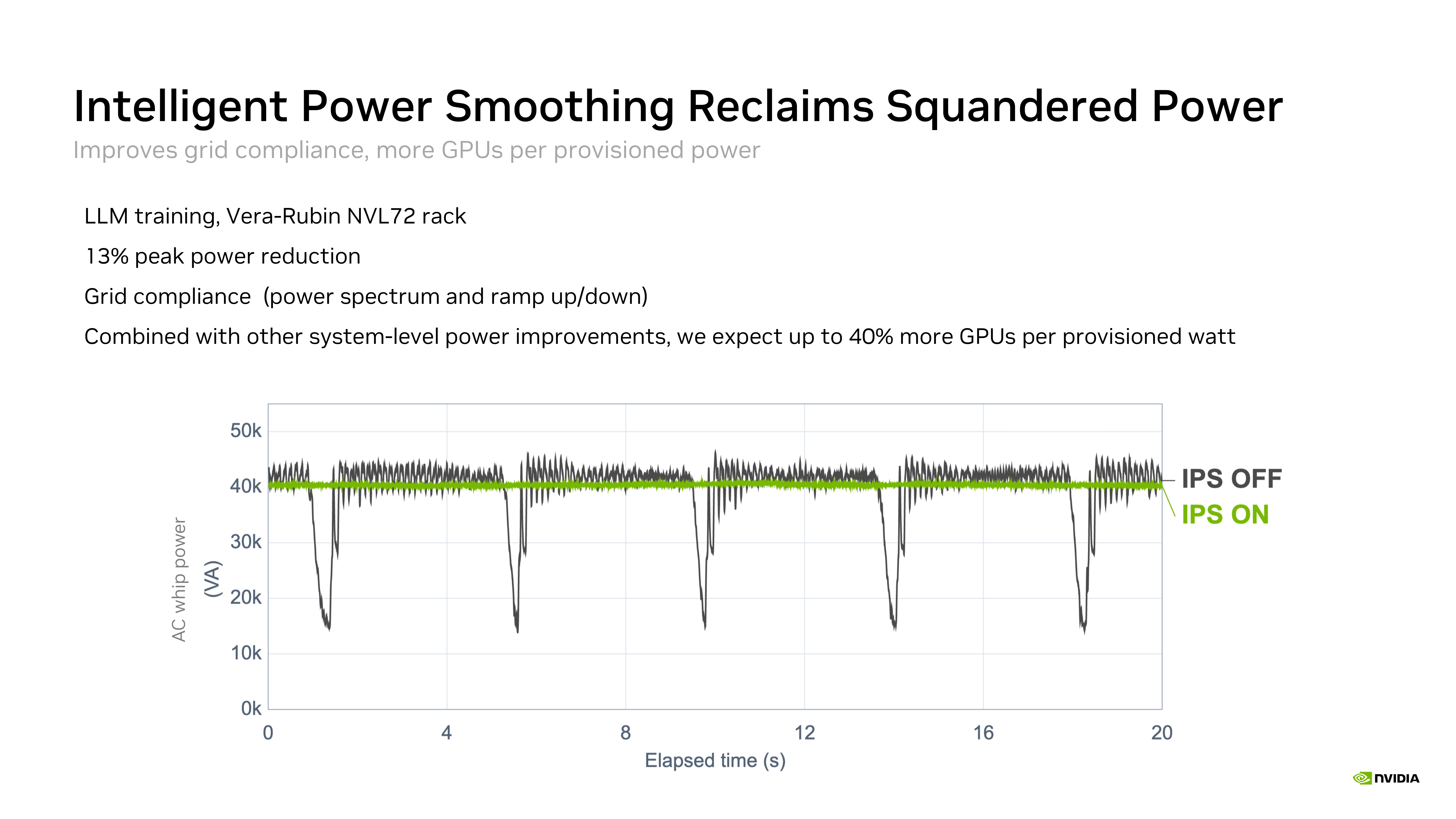
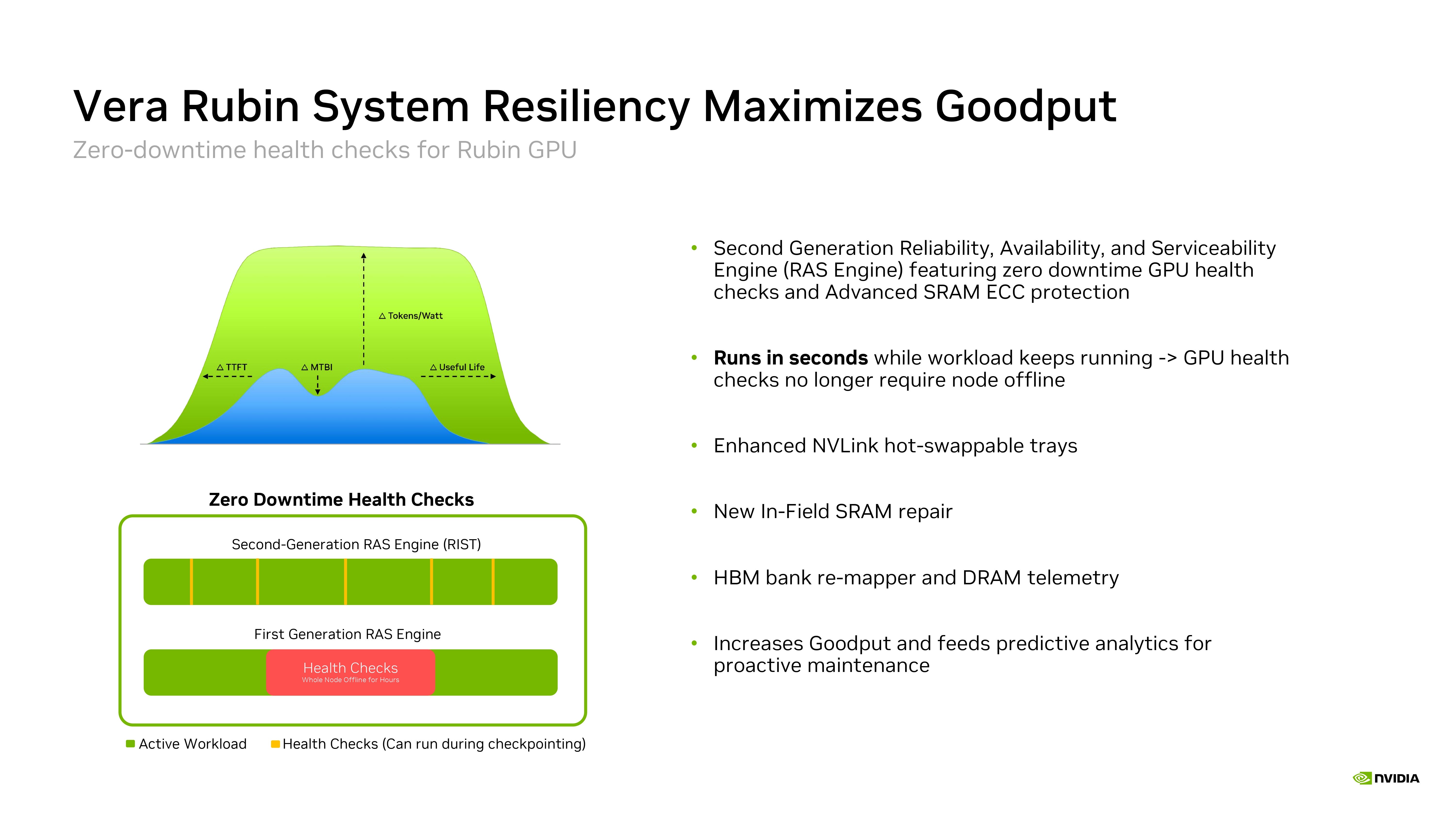
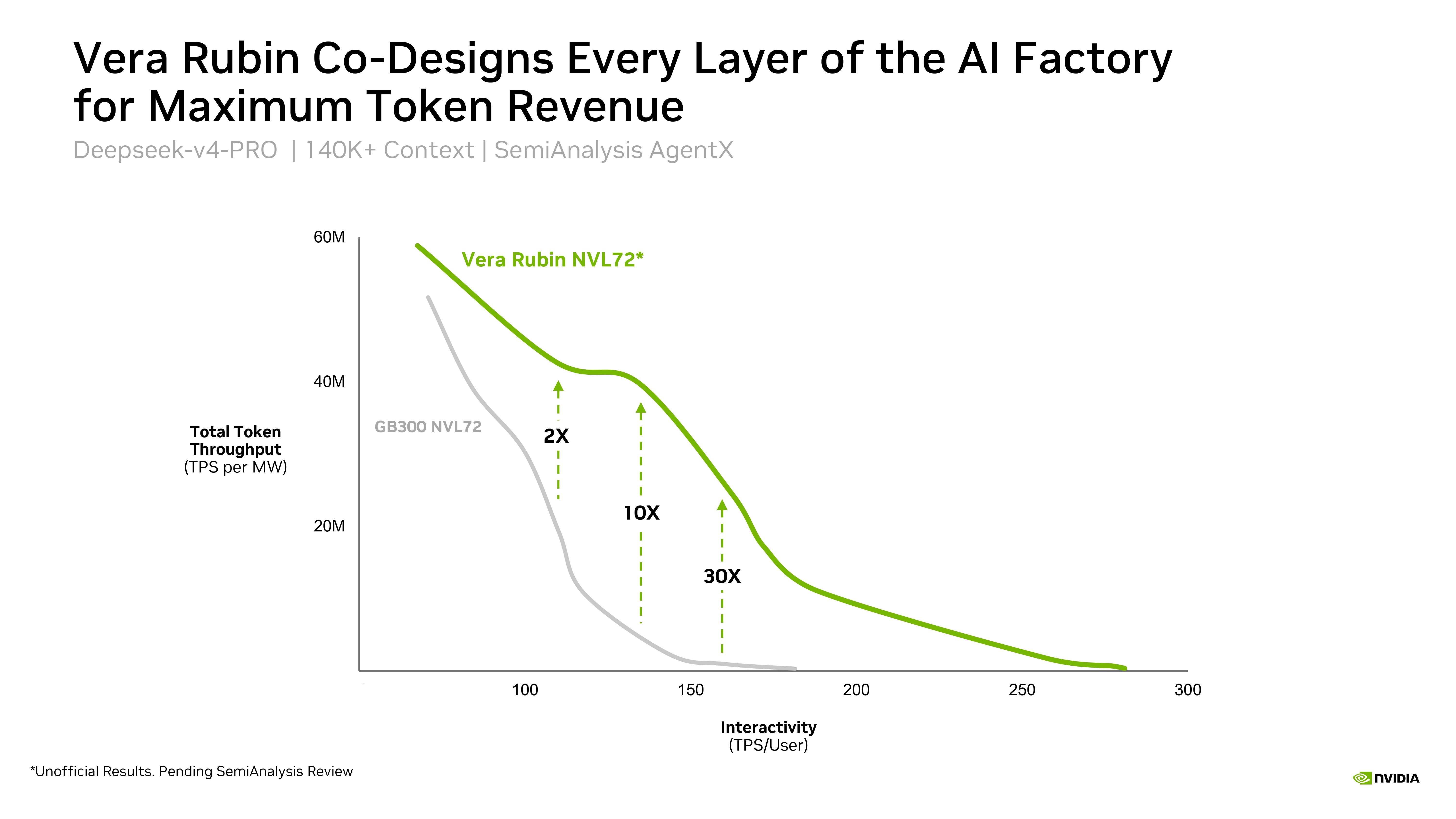
For as much as we might discuss the performance of an individual CPU, GPU, or other chip in a rack-scale AI system, the ultimate constraint on the performance of those chips is the amount of power one can get to the building and into each of the racks that contain them. The management and allocation of that power is a major concern for maximum productivity from a data center installation going forward.
During Nvidia's Hot Chips presentation on the Rubin GPU, the company emphasized this hard limit on data center capacity and touted the amount of compute that Vera Rubin NVL72 systems can deliver within an example fixed facility power budget of 100MW.
Nvidia says that the use of all of Vera Rubin’s power management technologies, in tandem with its DSX MaxLPS (Land, Power, Shell) suite of design and site-level dynamic power management resources, will allow operators to provision installations of 40,000 of those next-gen chips GPUs (or about 40 Rubin DGX SuperPODs) within that 100MW budget, and expects that hardware to deliver up to 2 zettaFLOPS (ZFLOPS) for NVFP4 inference and up to 1.4 ZFLOPS for NVFP4 training.
(Image credit: Nvidia)
Doing some back-of-the-napkin math for ourselves from publicly available Rubin specs, we feel safe in assuming that those performance figures are estimated, not measured. The maximum number of achievable FLOPS from real-life workloads is likely to be significantly lower for a host of reasons.
But the overall point still stands: getting the most compute out of precious power budgets when planning the AI data centers of the future is going to require more refined planning, monitoring, and facility management than simply applying the coarse measure of estimated peak power draw for every electrical component in the facility. And Nvidia has those building blocks ready for data center constructors in the form of its DSX toolkit.
According to a companion blog post that Nvidia shared, as data center operators provisioned their facilities in the past, many of the assumptions they made around power usage focused on those fixed, worst-case power peaks per rack, potentially leading to inflated power budgets that end up stranding power allocation in racks that will rarely, if ever, use all of it.
In just one example, if there was an application load differential between racks in a cluster such that one system would benefit from having more power sent its way in that moment, it couldn’t be re-routed under a static provisioning scheme. The less-utilized rack would use less of its allocated power budget, and the more heavily loaded one might still run into the limits of an overly conservative guard band.
(Image credit: Nvidia)
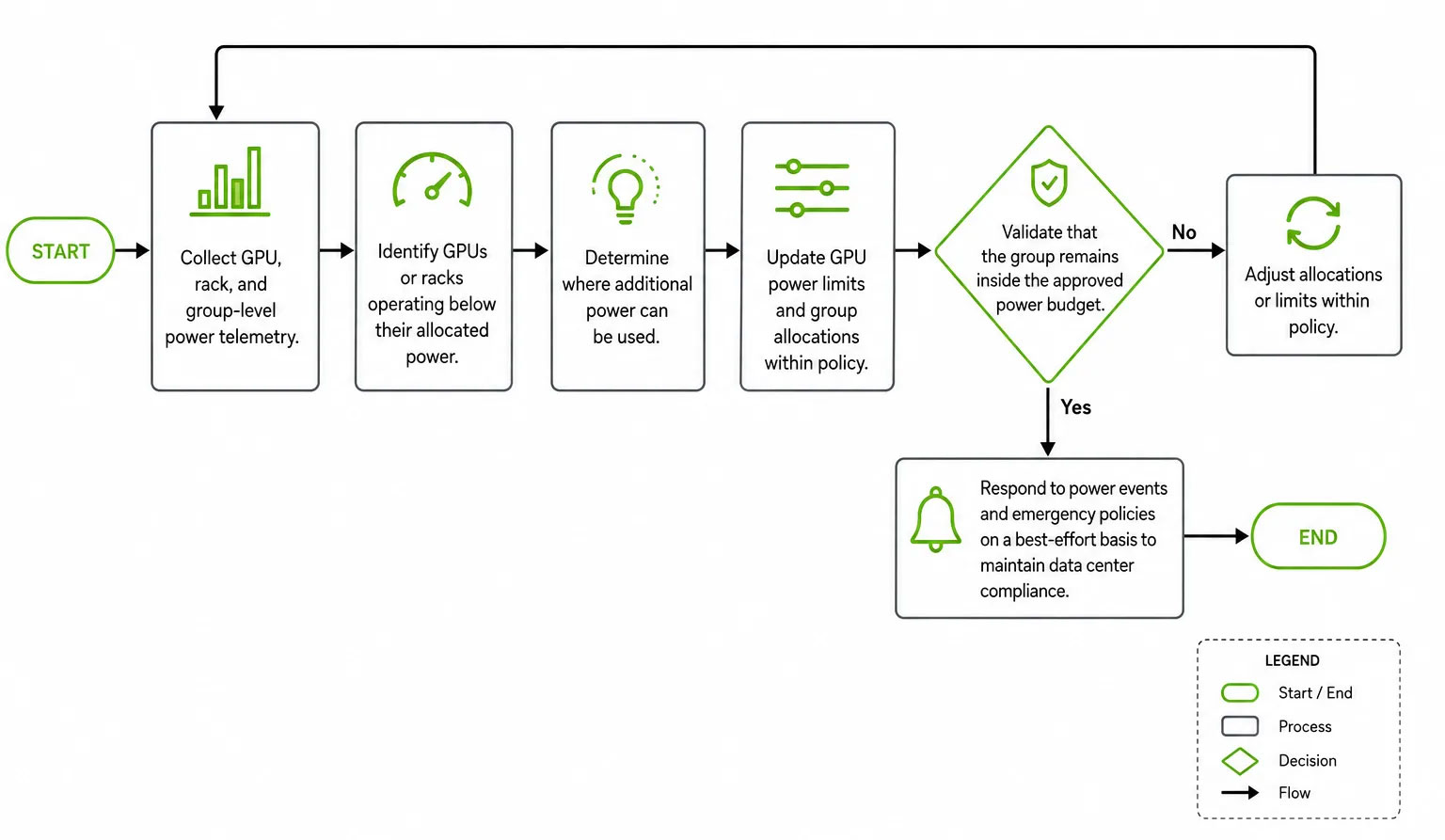
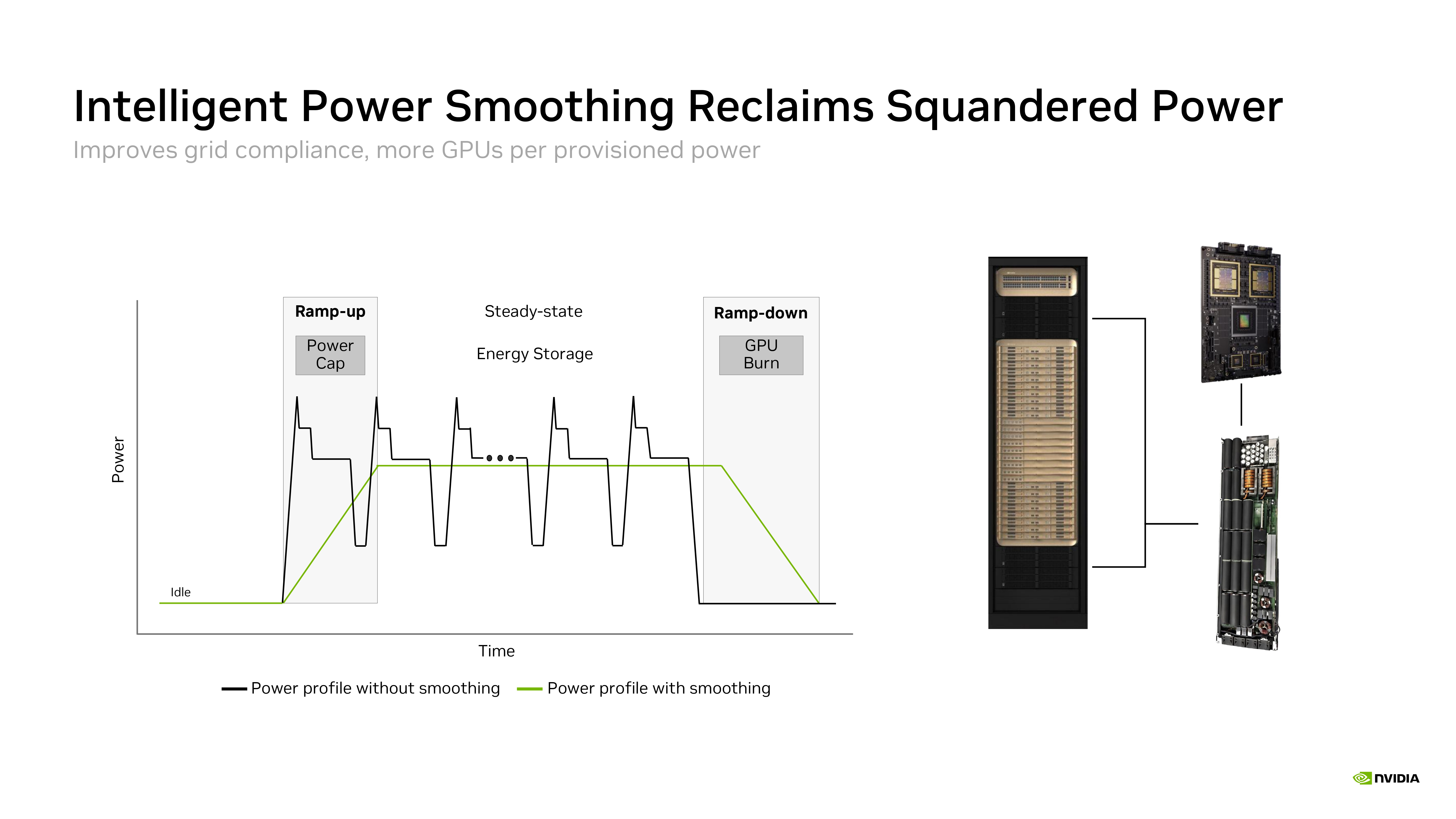
The DSX MaxLPS approach is meant to overcome the limitations of static power provisioning by instead applying an intelligent, dynamic scheme that is continuously aware of power usage at the chip level, rack level, and groups-of-racks level. Where unused power is available due to workload characteristics or idle capacity, Nvidia's Dynamic Power Software control loop can find and redistribute that energy to systems where it's most needed in the moment, maximizing the number of systems that can be installed and performance per watt from the facility over time.
(Image credit: Nvidia)
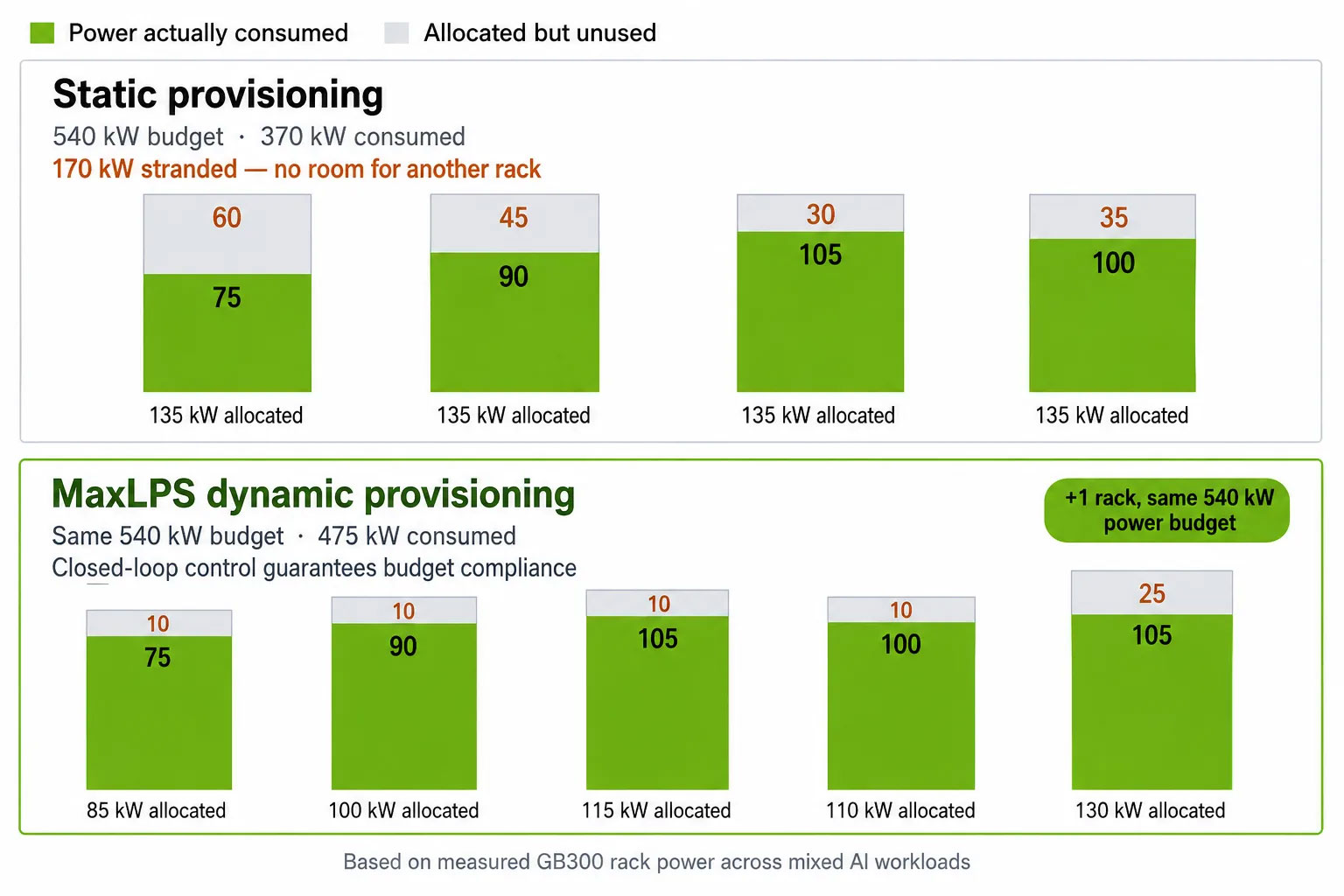
In Nvidia's measured example of current GB300 racks, within a 540kW power budget and with static provisioning, an operator might be able to install four 135kW systems by statically provisioning for peaks rather than measured values from workloads. But in practice, as much as 170kW of that power budget might sit unused due to differences in rack utilization.
For modern rack-scale systems like Nvidia’s NVL72s, that’s an entire rack and change that could safely be installed within the same power budget, and indeed, that’s just what the company’s example shows. And across those five systems, the amount of reserve power allocated for peaks can be much lower.
At the rack level, DSX MaxLPS offers further flexibility through workload-specific power profiles. Much like the quiet, balanced, and high-performance power modes that client PC users are familiar with, Nvidia has produced rack-level power profiles that can be assigned to systems performing example workloads like inference, training, and more general memory-bound or compute-bound tasks.
As we noted, Nvidia didn’t share measured Rubin power or performance-per-watt results, but it has characterized the benefits of MaxLPS for prior-generation systems running inference workloads to prove the concept.
(Image credit: Nvidia)
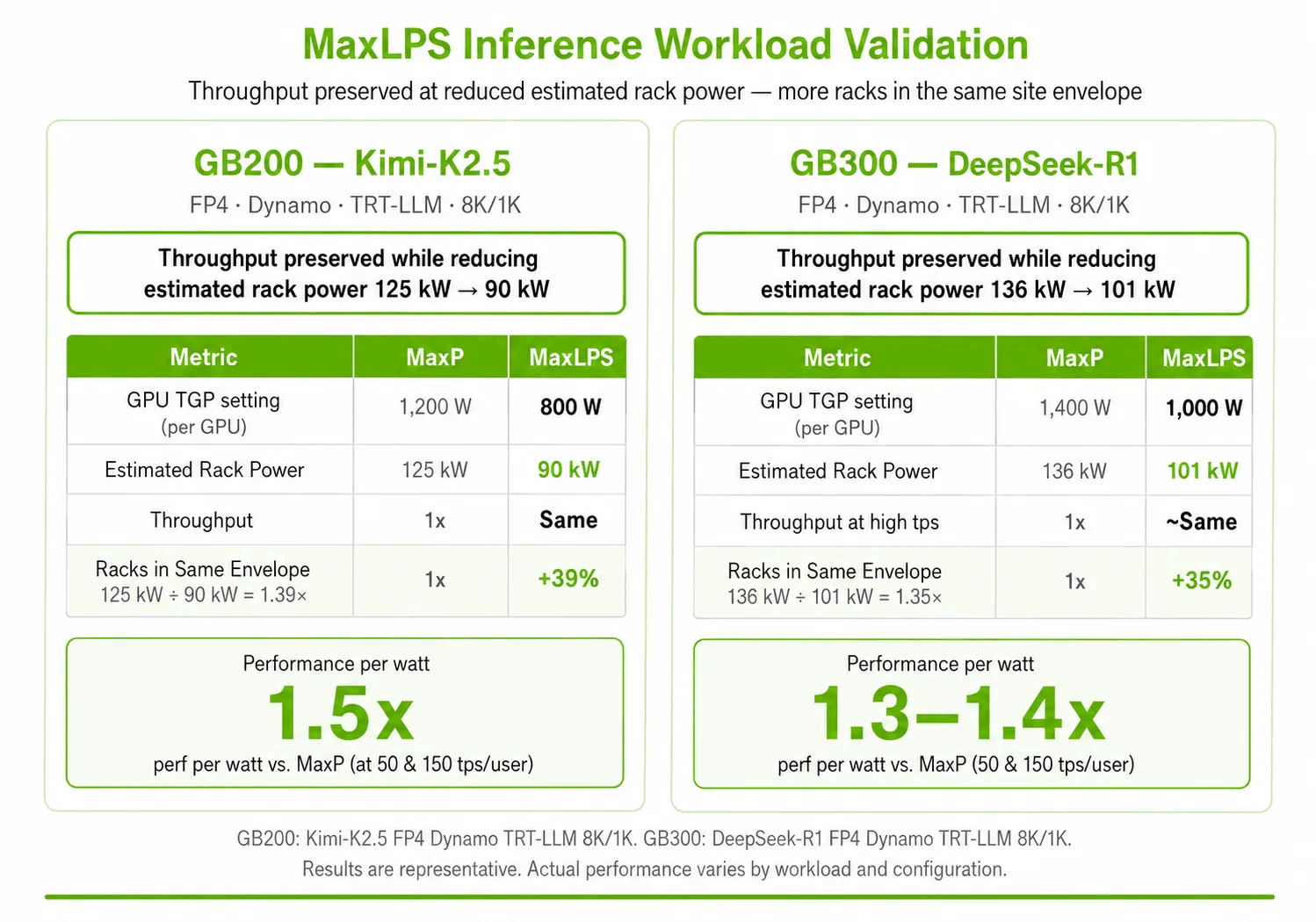
For a Grace Blackwell GB300 system running DeepSeek-R1, Nvidia says the past fixed-peak regime would have assumed a 1400W GPU TGP and an estimated rack power of 136kW. Applying MaxLPS, however, the typical GPU TGP under this workload falls to 1000W, and the total rack power falls to 101kW, all without affecting delivered performance.
That less conservative envelope translates directly into higher performance per watt, larger numbers of racks that can be installed within the same facility, and ultimately more tokens that can produce revenue for the data center operator or its tenants.
Nvidia further notes that designing a data center with MaxLPS from the start grants an operator greater flexibility over the life of the installation. For example, if a site starts as a training-focused facility outfitted with cutting-edge hardware, each installed system is likely to need a greater share of the available site power for that more intense workload, and so an operator might not want to populate every available floor space for those racks from the get-go.
But later in the life cycle, as training shifts to new generations of hardware and older systems transition into inference roles, the power demands of each GPU and rack will fall, and so a facility with dynamic power provisioning would be able to free up capacity that can then be used to install more hardware within the same facility and to generate more profitable tokens.
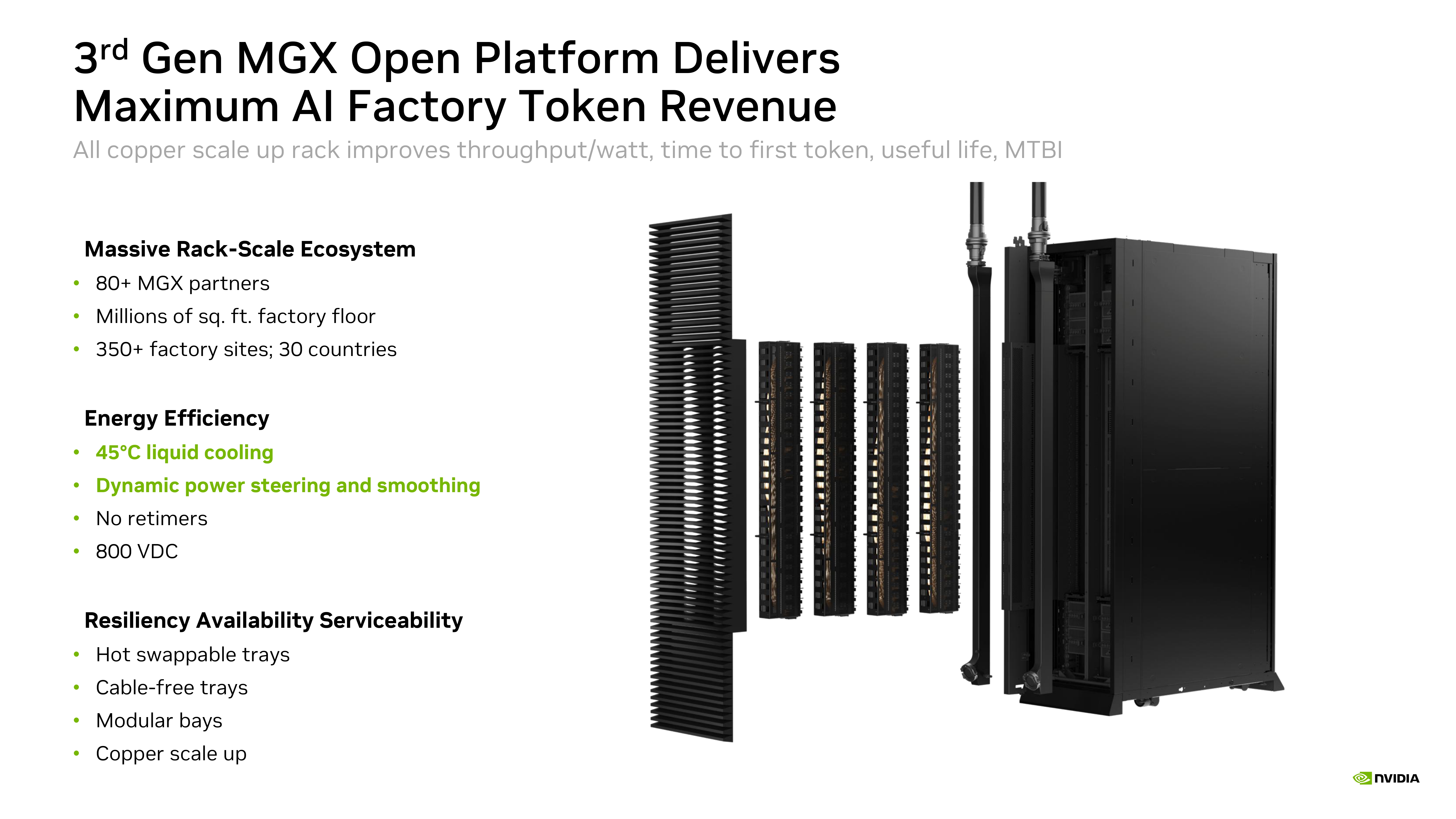
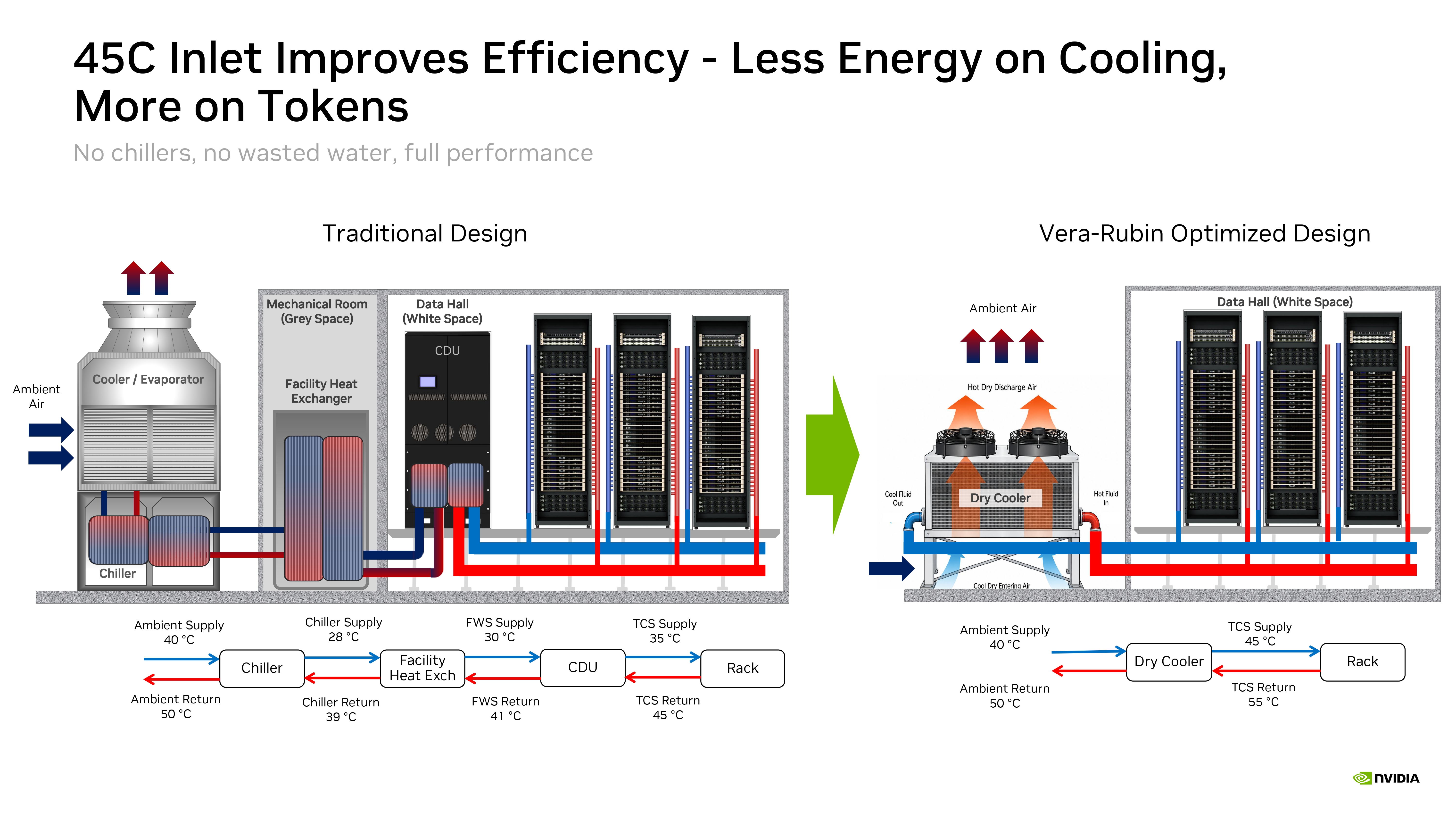
Another major component of MaxLPS in data centers deploying Vera Rubin hardware is the use of higher liquid coolant temperatures for the exclusively liquid-cooled Rubin NVL72 racks. Those systems are designed to work with 45 °C inlet coolant temperatures, much higher than for past liquid-cooled systems. We learned more about this “dry cooling” approach during our visit to Nvidia’s Vera Rubin proving grounds earlier this year.
The use of this higher coolant temperature for Rubin installations is important because the mechanical chillers used to shed waste heat in non-evaporative systems also consume a large portion of the site power budget – as much as 40% for past installations, Nvidia says. As with static provisioning for servers, the company notes that those chillers have traditionally been sized for the worst-case scenario that a facility might face, even if they’re operating well below that capacity for much of the year.
Again, this approach strands power that could be dynamically reallocated to compute given the proper operating conditions and site-level monitoring and management. Those chillers might still need to run during the hottest parts of the year, but outside of those conditions, the higher coolant temperature generally enables more power to be put to productive use, improving a site’s power usage effectiveness (PUE) figure, all else equal.
Power for AI data centers, whether generated by public utilities or behind the meter using alternative power sources, is expected to remain one of the most critical constraints for those facilities for the foreseeable future, and we heard that concern from multiple presenters during Hot Chips.
Nvidia’s DSX MaxLPS approach looks ready to provide the building blocks needed for dynamic allocation of that resource to extract the maximum possible performance per watt from Rubin facilities, and it reflects a comprehensive concern for the interplay of power and achievable performance that only seems likely to grow in importance going forward.
The U.S. government is looking to move a critical transparency step in the approval of data centers behind closed doors. The Environmental Protection Agency (EPA) has plans to remove a requirement that forces states to seek public feedback on applications for air pollution permits, as reported by The New York Times. The change, if it goes into effect, would apply to a subset of air pollution permits. However, the primary concern is around data centers, as local communities seek to delay, or outright ban, AI data center construction.
The latest proposal applies to permits for a "minor source" of air pollution, which includes landfills, laundromats, steel mills, and, of course, data centers. However, recent analysis of the expansion of AI data centers suggests that environmental impact is growing. The Harvard School of Public Health estimated that the Vantage data center in Loudoun County, Virginia, contributed between $53 million and $99 million in annual health damages, the largest estimate for any single facility ever.
In another example, the analysis conducted by researcher Michael Cork directly influenced a proposal in Fluvanna County, Virginia, to expand a fossil fuel plant. The expansion was ultimately denied based on the findings from the analysis that "shaped the public discussion leading up to the... vote."
The proposal from the EPA would remove, or at least create the opportunity for states to remove, the public discussion that shapes these decisions. The EPA's stance has been that these minor sources don't require federal oversight. However, there's a clear gap when a federal agency decides to stop enforcing federal rules and asks states to step in to make their own decisions.
The Attorneys General from 14 states and three cities signed an open letter opposing the change, writing, "despite the name, even 'minor' sources can pose significant health and environmental impacts." The letter suggests that removing the required publicization of permit applications and 30-day comment period "sidelines these fundamental transparency and democratic safeguards in the name of administrative expediency and relieving regulatory burdens, particularly for accelerating the buildout of data centers and other artificial intelligence (AI) infrastructure."
Although the EPA requires a public comment period after an air pollution permit application, the process has been circumvented in some cases.
In Gilroy, California, an Amazon data center began construction last month without the knowledge of many residents. A years-long approval process between the city and Amazon meant the public comment period had lapsed two years before construction began, leaving the public little time to react. In another case, residents of Festus, Missouri sued the city, arguing that it didn't give the public enough time to review a data center proposal before moving forward with it.
With the EPA's proposed change, responsibility for regulating data centers is placed on the states. Current environmental law allows states to impose stricter environmental standards than the federal minimum, provided the state does not fall below it. The EPA change would allow a state to eliminate the public comment period, since it's not required by federal law.
Currently, a public comment period is still required. The proposed change would go into effect within the next year.
 登录
登录