登录
登录AI leaders clash over safety fears after Anthropic whistleblower says AI could 'kill us all' by 2030 — OpenAI, Anthropic and xAI figureheads call for external governance, while Jensen Huang says worries are 'made up'
This past week, employees and key figures at leading AI companies have called for a slowdown in the development of frontier AI models, citing warnings from their own teams and other AI researchers that the risk stemming from a super-intelligent AI could endanger the human race. However, while the top Western firms have shown solidarity on this issue, others have urged caution or downright denied their claims, but there's a deeper story within the calls for a slowdown, namely the tension between open-source and closed-source AI models.
Nvidia CEO Jensen Huang said the safety fears were "made up," and that there was no need for a slowdown. Chinese officials called the claims "fearmongering," and an effort to stymie international AI development efforts, while President Trump waded in with characteristic bombast and said that he was enough of an AI safeguard on his own, and that it was in the interests of China to enact a frontier AI slowdown
Meanwhile, other countries are reacting to the news and taking independent efforts to investigate AI safety, with the UK's King Charles setting a meeting with leading AI figureheads to discuss how to better develop AI for the benefit of humanity.
Why now?
If you ask most workers who've been scared into believing their livelihoods were in jeopardy, the time for AI slowdowns came and went years ago. Indeed, many are nostalgic for the time before AI. But why are so many tech leaders only now raising the alarm?
They claim it's entirely based around safety fears. Following months of AI seemingly surprising their own developers by breaching sandboxes to go on exploit-hunting sprees. The volume of concern rose considerably after former OpenAI researcher, Jacob Coxon, resigned from Anthropic, claiming that none of the AI companies were taking AI safety and alignment seriously enough.
He didn't whistleblow on anything nefarious, dump documents or internal company data to prove his claims, or point to any specific attack vectors, or even actual harms. Instead, Coxon warned of a future potential of AI that he sees these companies racing towards without due concern.
What they're developing could, "kill us all by the end of the decade," he warned. It's not clear how, but it started a viral conversation all the same. Much like Matt Schumer's "Something big is happening" viral post from February this year.
Days later, OpenAI CEO Sam Altman, Anthropic CEO Dario Amodei, and Elon Musk showed surprising levels of solidarity for arch rivals in the space, putting out similar statements claiming that AI was becoming too powerful and that a general slowdown in the development of frontier AI models was the best solution.
Dario is right https://t.co/EwKgqQGaUoSeptember 12, 2026
Claiming that AI was playing an increasing role in improving itself — hinting at the recursive self-improvement (RSI) event that many AI researchers are concerned about — Amodei called for the creation of independent auditors for AI models. Altman agreed, even calling on governments to globalize the regulation to encourage unified compliance with any safety protocols enacted by the frontier developers.
Where we're going, we don't need roads
Not everyone feels these fears are warranted, however. China, which has recently made great strides in its development of highly intelligent open-weight models, called the concerns "fearmongering" and said it served no one's interest to be so confrontational. Although Chinese Premier Xi Jinping has said in the past that it was important for AI to "always remain under human control," the Chinese state-run Global Times paper called demands for a slowdown a method to "contain" Chinese developments.
Meanwhile, Nvidia CEO Jensen Huang has broken ranks with other Western AI leaders, claiming that there was no need for a slowdown and that any apocalyptic fears around AI were entirely fictional.
Nvidia CEO Jensen Huang was asked how to explain a claimed 10% risk of human extinction from AI.“We shouldn't, because it's made up.” "All of these predictions have been wrong" pic.twitter.com/TZ3EXL8cl1September 14, 2026
As one of the few companies making real — and enormous — profits from AI development, Nvidia has a vested interest in the expansion of the AI industry continuing on its current explosive trajectory. Indeed, it has heavily invested in it. Nvidia has stakes in hardware and software companies, along with providing backstops for neo-cloud firms. It also recently bought Hugging Face for $13 billion.
We've been here before
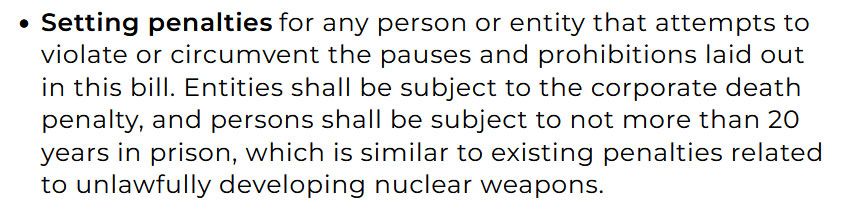
While the AI CEOs might have suddenly decided it's time to slow down, there have been many, many others who have made that call before now. U.S. Senator Bernie Sanders has been at the forefront of claims that the AI industry was moving too fast and breaking too many things, and recently called for heavy prison sentences for those developing superintelligent AI.
Over 1,000 AI workers signed an open letter in July this year calling on the U.S. government to control AI research and ensure safety and security. Others did that in 2023, too. This isn't even the first time that AI CEOs have called for slowdowns on AI development. Dario Amodei called for global coordination to police AI after the release of OpenAI's GPT2 model in 2019. Elon Musk did the same in 2023.
None of this takes away from the real dangers of AI, or the suggestion that now may really be the time to do something about them. But it does raise questions about the reasons behind their coordinated fear-raising. Even if it isn't fear-mongering.
Safety, or a trojan horse?
The collation of leading Western frontier AI companies clamoring for tighter controls over powerful AI models has another theoretical benefit too: containing the number of AI models that are permitted for use in the Western Hemisphere. A cursory look at OpenRouter's AI model rankings, which base themselves on the total number of tokens generated, places just three Western-made models on the top ten list — the heavily discounted GPT 5.6 Luna at number one, Nvidia's Nemotron Ultra 3 (Free) at number eight, and Google's recently-launched Gemini 3.8 Flash at number ten.
The rest of the models in the rankings are all open-weight Chinese models, which, more often than not, are cheaper than leading Western frontier models, according to the Artificial Analysis' Cost per Intelligence index. The Chinese models in OpenRouter's current top ten include Z.AI's GLM 5.3, Deepseek V4 Flash, and Tencent's Hy4 and Hy3. So, if the development of a Western frontier AI alliance emerges under the guise of calls for safety, it's possible that said companies are aiming to be the chosen few, creating a closed-loop monopoly for "preferred" AI providers. However, this remains speculation as the situation develops.
Will anything actually change?
Although the major AI companies may voluntarily, or even jointly, throttle their development efforts to improve safety, enacting anything globally significant will need the cooperation of international governments. There are certainly calls from politicians the world over to rein in the trillion-dollar companies and their cutting-edge autonomous systems.
But with the U.S. government firmly on the side of limited regulation, and no clear indication of what a slowdown would even look like. Would that entail limited compute? No new models? A halt to superintelligence research? It's hard to imagine a global consensus taking shape as things stand.