普通视图

发现新文章,点击刷新页面。
昨天以前首页

Humanoid robots shatter Usain Bolt's 100m record, hits 23.8 mph before crashing into foam pads — video shows Tiangong Ultra logging 9.39-second sprint before colliding with padded wall

2026年8月23日 19:45

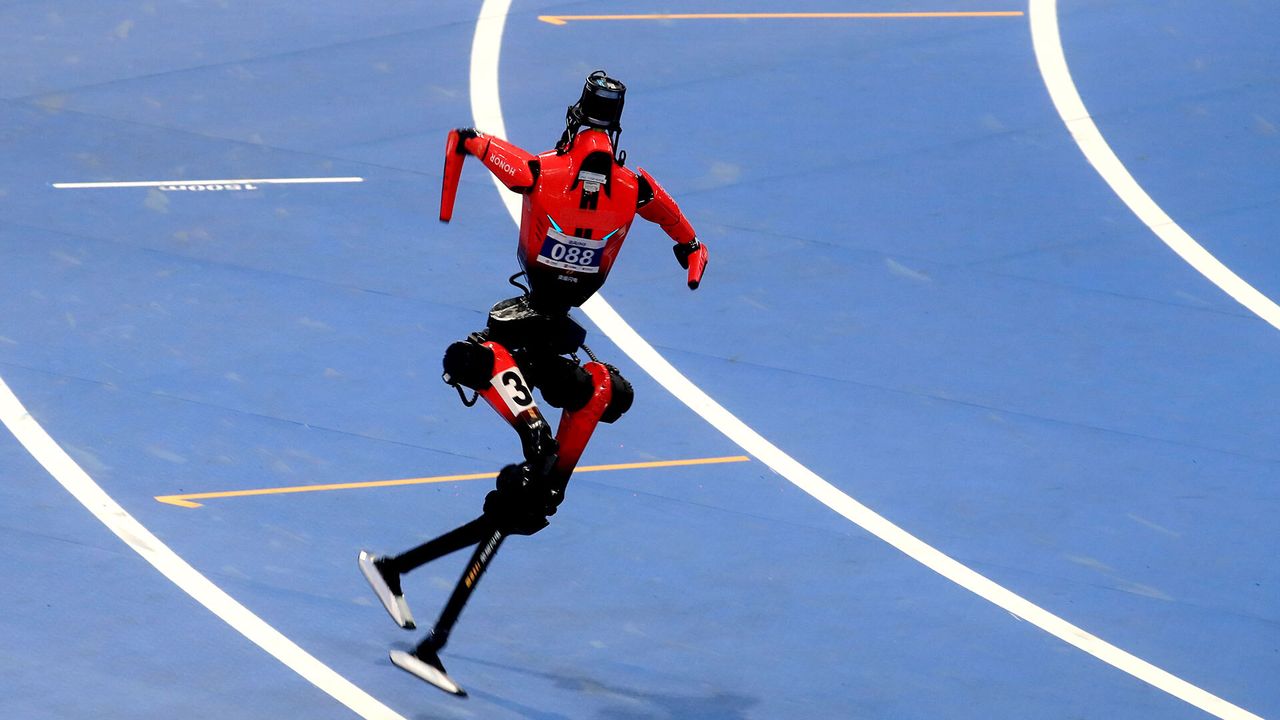
Two Chinese humanoid robots just beat the record of the world’s fastest human in the 100-meter dash. According to Reuters, Tiangong Ultra achieved a record time of 9.39 seconds in the race, while Honor’s Lightning came in at a close second, with a time of 9.47 seconds. These are 0.19 and 0.11 seconds faster than Usain Bolt’s 9.58-second record, which he set in 2009 at the World Athletics Championships in Berlin, Germany. This gives the Tiangong Ultra an average speed of 23.83 mph or 38.34 kph, which is just marginally faster than Bolt’s 23.35 mph or 37.58 kph. The robots set the records at the World Humanoid Robot Games in Beijing, which has been held annually starting last year.

It may seem odd that we’re celebrating a robot speed record when the world’s fastest quarter mile is just 3.22 seconds, but we must remember that these are autonomously running bipedal robots. This “form factor” is certainly more challenging to build compared to machines running on four wheels or legs. Despite that, the teams behind these machines greatly improved their projects in such a limited time. To put things into context, the Tiangong Ultra also won the 100-meter race last year, but at a relative snail’s pace of 21.50 seconds. By comparison, Donald Lippincott set the first 100-meter world record in 1912 with a time of 10.6 seconds at the Stockholm Olympics. That means that it only took the machines one year to cut their time by more than 12 seconds, but it took humans nearly 100 years to shave the world record by a little over a second.

While these machines are certainly fast, with the Lightning reportedly achieving a 9.32-second unofficial time during practice runs, they still lack the finesse of human runners like Bolt. A few meters after these robots crossed the finish line, they slammed directly onto a foam pad, with the winning Ultra redirecting itself towards the right off the camera frame while the Lightning seemingly lost control and eventually fell helplessly towards the left. A third robot, which was a couple of seconds behind the faster two units, attempted to slow down by sliding forward before it crumpled itself on the massive cushion. They probably need to teach themselves how to end a race gracefully, much like how Nvidia’s AI robots taught themselves how to install GPUs on mobos.

Aside from this 100-meter dash, there are 51 other competitions during this five-day event, including boxing, football, dancing, and industrial-task contests. Reuters reports that 2,056 robots across 666 teams have registered for the games, with representatives from 16 countries from every corner of the world. These robots might not yet be ready for at-scale deployments in industrial, commercial, or residential uses, but events like this show that they’re beginning to become more than capable of doing many different things. But as for the two fastest robots, it’s unlikely that they’ll become available in the U.S. because of the FCC’s ban on foreign-made robots.

Qualcomm-powered robot collapses spectacularly on stage during company's keynote — prepared stagehands rush to cloak and then carry off stricken humanoid (updated)

2026年7月31日 18:40

A Qualcomm exec suffered from one of the most disastrous tech demos we’ve ever seen live on stage at Computex 2026 this summer. In what should have been a wow moment during a press event in Taipei, Qualcomm hardware partner NEURA Robotics’ 4NE-1 humanoid robot quickly shifted gears from being a technical tour de force to a crashing mechanical shambles.

Robot powered by Qualcomm’s new AI chip dies mid-presentation from r/singularity

We see that the 4NE-1 humanoid robot is powered by Qualcomm’s Dragonwing IQ10 robotics reference design (RRD), claimed to be capable of 700 TOPS. But even before the robot’s spectacular malfunction, it didn’t look particularly healthy or nimble. 4NE-1’s slow shambling walking style radiated strong Two Soups vibes.

As the robot eventually hobbled close enough to the smart-suited presenter, the on-stage human picked up a Qualcomm Dragonwing IQ10 RRD from the robotically delivered platter and proudly showed it off to the attending crowd. As the applause and whoops subsided, the robot turned to face the crowd, and the presenter rolled on with his spiel.

Seconds into his script, the exec spun away to the side as the 4NE-1 humanoid robot very suddenly and noisily collapsed into a mechanoid mess. After resting in its terminal backbend for a second, one robot hand raised momentarily to make a futile gesture. Thankfully, the glass tray that had carried the Dragonwing IQ10 box onto the stage didn’t shatter.

Qualcomm’s Dragonwing IQ10 robotics reference design

We can think of another 'D' word for the strapline (Image credit: Qualcomm)

Stage hands seemed well-prepared

While the overall feeling from watching the video is one of shock from the ambling robot’s sudden noisy collapse, many on social media have commented on how unruffled and well-prepared the stagehands seemed to be. The silent and swift action of the black-clothed helpers, first cloaking the dead robot with purple silks, then the trio carrying it away, exits stage left, making it look like this catastrophe wasn’t such a surprise to some.

As the robotic remains were eventually removed through the side doors, we hear the brave speaker who carried on regardless come to the end of his polished presentation. The crowd politely and quite loudly claps - but is most of the applause for the speech, or for the unflappable stagehands who have efficiently extracted the heap that was the 4NE-1?

This late-emerging clip from Computex 2026 rivals the Windows 98 USB plug-and-play scanner crash during Bill Gates’ presentation at Comdex. That infamous software crash event may well have prompted the creation of the USB Cart of Death.

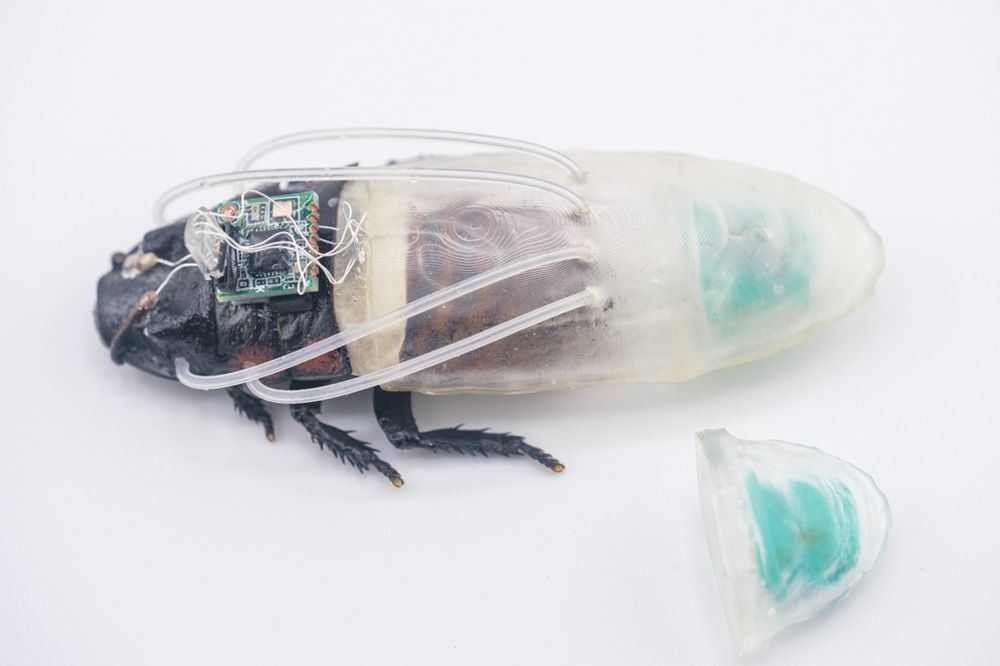
Scientists have created a 3D-printed remote-controlled cyborg cockroach equipped with IR cameras — living insects fitted with flexible 'diving suit' can survive and move underwater for three hours

2026年7月3日 17:22

Two decades after DARPA first started playing around with cyborg insects in its HI-MEMS program, a team of Singaporean researchers is showing off the latest accomplishment in the area. The productive researchers are proudly presenting their potent new 3D-printed variant: a remote-controlled, cyborg cockroach equipped with IR cameras that can breathe underwater for hours on end.

Although that description sounds like the start of a sci-fi or horror movie, the team led by Hirotaka Sato at Nanyang Technological University has been working with the much-hated pest for a good while, outfitting them with infrared cameras in a bid to help rescue operations by steering the roaches in disaster areas to find survivors. To be clear, as the release notes, Cyborg insects are living insects that have been retrofitted with technology. Sato's team had already demonstrated an orchestrated swarm of the little beasties in 2024, but reportedly wasn't happy with the fact that they couldn't send them through water, and went back to the drawing board to fix that.

The result is an upgraded form that went underwater for three hours in stages, at a depth of 20" (50 cm); enough for most puddles and lightly flooded areas. Quite interestingly, the roaches' speed was only lightly affected, going from 3.5" (8.75 cm) per second on land to 3.1" (7.84 cm) a second while submerged in water. Cockroaches don't swim per se, but they can paddle-float, and are fine navigating water bodies in general, and it's possible they can go deeper than in the test.

To achieve this, the animals wear a spiffy-looking bespoke 3D-printed scuba suit, complete with tubes that attach from the tank to their "nostrils," called spiracles. The tank has a sponge with both hydrogen peroxide and manganese dioxide, in a slow, carefully tuned reaction that outputs oxygen at a controlled rate. This choice was made to avoid the tricky task of providing a heavy, pressurized oxygen tank — though imagining a cockroach with a tiny tank backflipping into water from a tiny boat is amusing.

The cockroach is pretty much the ideal platform for this type of endeavor, as their legs are easy to control with electrical impulses, and their locomotion characteristics let them navigate almost every type of terrain, oftentimes better than many miniature robots. Their biological batteries theoretically last for weeks on end, too. One roach needs food only every few weeks, a mission-critical feature given that scientists working with miniaturization of any sort keep butting their heads against energy limitations. The IR cameras and wireless do use an actual mini battery pack, but the insects themselves can find sustenance on their own.

Sato's team aims to use swarms of submarine roaches in rescue ops, but is also looking farther on the horizon for the next challenge, namely harsher environments and extraterrestrial exploration, like the surface of Mars. After this latest result, such an endeavor seems plausible enough, considering that the cockroaches' build maxes out every survival skill, as attested by crestfallen homeowners who've had to deal with the insultingly invulnerable miniature tanks.

For starters, cockroaches can go without food or water for multiple weeks, and they function just fine in respiratory environments that would put a human to a slow death, like those with low O2 or high-CO2 concentrations. They can withstand enough radiation to microwave a human, and closing their spiracles lets them hold their breath for up to 40 minutes.

A roach's diet puts even seagulls to shame, as the list of items they can consume for nourishment is essentially "yes," including human waste. Any wound, including loss of head, doesn't bleed and just clots closed, while their immune systems let them metabolize many pollutants and pesticides. Adding insult to injury, they evolve adaptations rather quickly, and their breeding rate puts that of rabbits to shame.

If you want your own remote-controlled cockroach, there's a ready-made ride-a-roach kit you can buy, complete with a phone app. The kit is pricey but readily available, and we're fairly certain you won't have issues procuring the animal for free. Cockroaches on Mars does sound exactly like a prologue to the Terra Formars manga/anime, and that's quite the scary prospect.

Apple shifts robotics team to hardware as leadership shuffle continues

作者 David Snow
2025年4月25日 05:27
Apple robotics team gets new leadership

Apple robotics team gets new leadership as management reorg continues -- this time AI chief John Giannandrea loses team to John Ternus.

(via Cult of Mac - Apple news, rumors, reviews and how-tos)

Apple’s amazing desktop robot looks straight out of Pixar

作者 David Snow
2025年2月7日 03:40
Apple desktop robot

Apple's amazing new lamp-like robot prototype, developed for both functionality and social interaction, looks a lot like Pixar's mascot.

(via Cult of Mac - Apple news, rumors, reviews and how-tos)

❌
❌