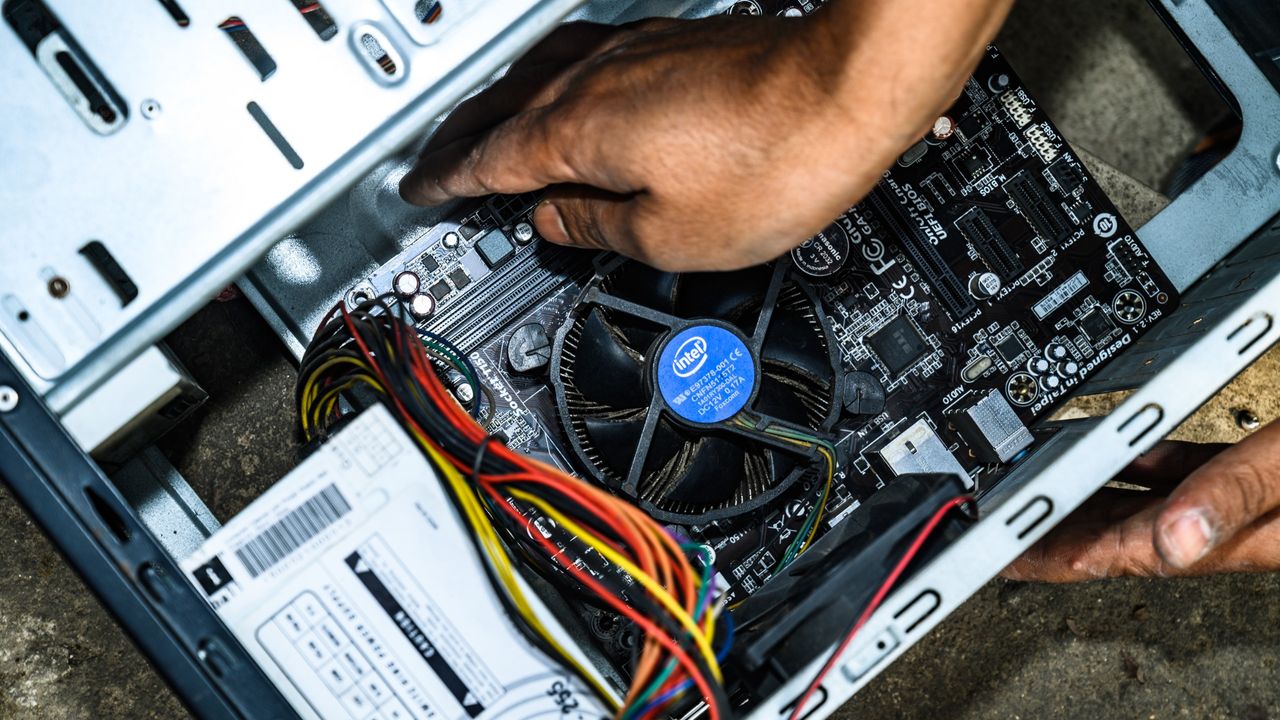
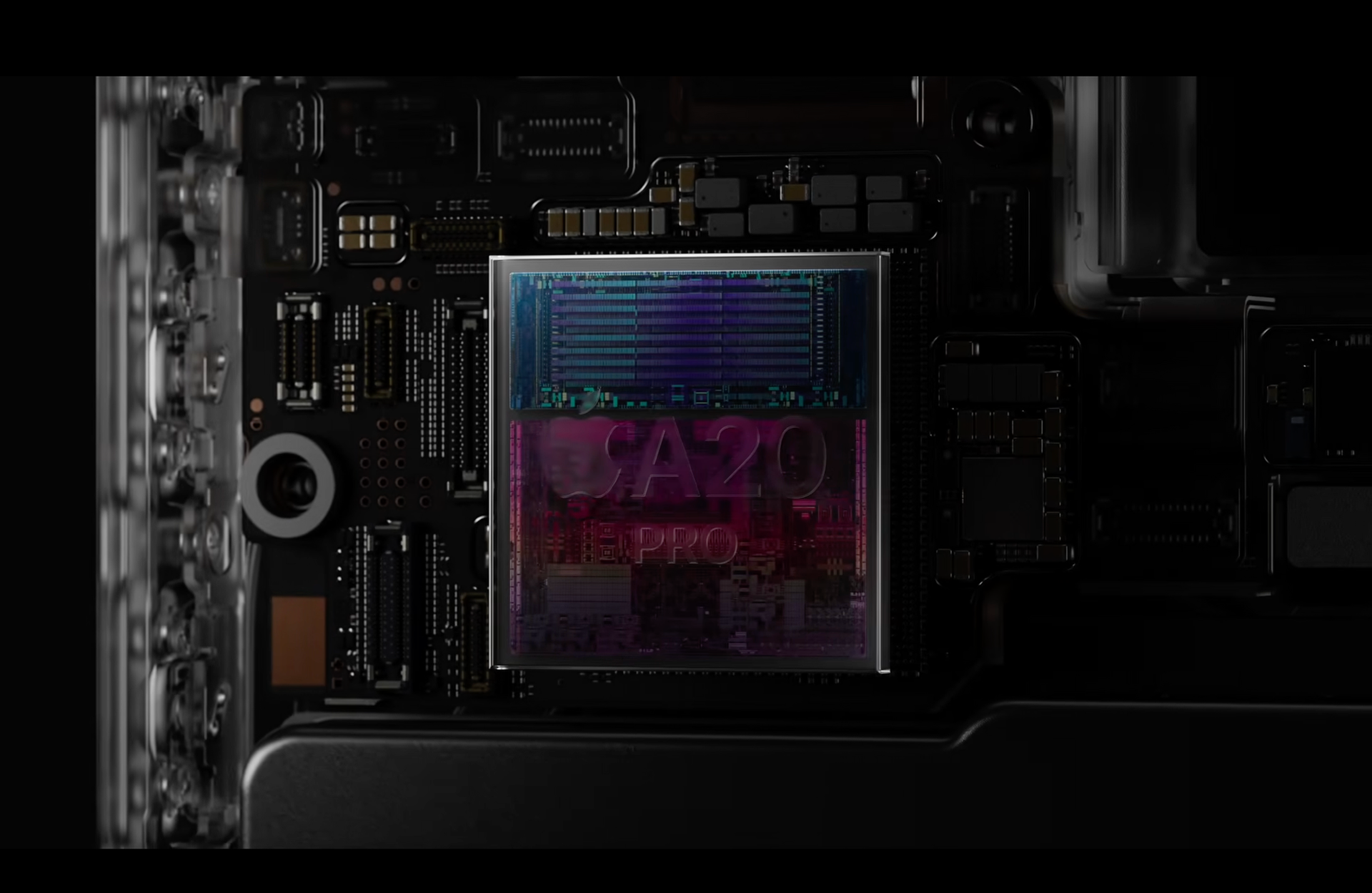
Intel won't launch a Nova Lake-S SKU with 12 Xe3P graphics cores, according to tipster Jaykihn, who originally flagged a beefed-up APU design with the Nova Lake architecture. The original SKU was said to come with 4 P-cores, 8 E-cores, and 4 LPE-cores, along with the 12 Xe3P cores, presumably offering an inexpensive onramp to a gaming desktop without a discrete GPU. Now, the leaker says that design is cancelled, and Intel intends to pick it back up with Razor Lake, the generation that will follow Nova Lake.
Nova Lake -S 12Xe has been changed to Razor Lake -S 12XeSeptember 14, 2026
Originally, Intel's 12 Xe3P Nova Lake SKU was said to require 65W of dedicated power to drive the iGPU, necessitating the use of two VCCGT phases on the motherboard for integrated graphics. Intel's Arc B390 GPU, which is the 12 Xe3-core model available in Panther Lake and Arc G-series processors, has a thermal design that can sustain up to 80W. However, it's currently being used in Panther Lake machines and handhelds like MSI Claw 8 EX AI+ that have lower power targets.
The Xe3P architecture is slotted for use in Intel's Crescent Island AI accelerator, but it hasn't been announced for any other products yet. Xe3P supports a wide deployment of Xe cores (up to 32), a deeper XMX engine with support for low-precision data types like FP8 and FP4, an increased 512KB L1 cache per Xe core, and a new unified L2 cache (32MB on Crescent Island).
Even by desktop APU standards, an 80W iGPU is a beefy accelerator to have on the same package. In addition, Intel's Nova Lake stack is said to extend up to a 175W TDP with the rumored top-end 52-core SKU, meaning the full 12 Xe3P iGPU would likely only be possible lower down the stack (and maybe only in the 4 + 8 + 4 + 12 Xe design originally suggested).
Earlier in the year, rumors suggested Intel was working on a mobile APU to counter AMD's Strix/Gorgon Halo products, featuring a large pool of unified memory and a large iGPU, dubbed Nova Lake AX. Now, the rumor mill suggests Intel will recycle the Nova Lake CPU cores for Razor Lake AX on mobile while pushing a larger iGPU.
Nova Lake-S rumored specifications
SKU*
Core Config (P+E+LPE)*
bLLC*
TDP (Unlocked/Locked)*
52 Cores (dual-tile)
(8+16)+(8+16)+4
288MB
175W
44 Cores (dual-tile)
(8+12)+(8+12)+4
264MB
175W
28 Cores
8+16+4
144MB
125W
28 Cores
8+16+4
-
125W / 65W
24 Cores
8+12+4
132MB
125W
24 Cores
8+12+4
-
125W / 65W
22 Cores
6+12+4
108MB
125W / 65W
22 Cores
6+12+4
-
125W / 65W
16 Cores
4+8+4
-
65W / 35W
12 Cores
4+4+4
-
65W / 35W
8 Cores
4+0+4
-
65W / 35W
6 Cores
2+0+4
-
65W / 35W
*Specs rumored, unconfirmed by Intel
Intel has told us that Nova Lake is one of the most important desktop CPU launches for the company ever, following on the heels of the mediocre Arrow Lake rollout. Perhaps the biggest addition to the lineup is rumored to be bLLC, or big last-level cache, which is said to show up on select SKUs to counter AMD's X3D assault among the best CPUs for gaming. The company has yet to confirm that bLLC is even possible with its current packaging capabilities, though enthusiast channel VP Robert Hallock hinted to Tom's Hardware that Intel has plans to address X3D in the next generation.
The main stack is rumored to climb up to 28 cores, with two additional dual-tile SKUs that can go as high as 52 cores. The dual-tile models look like a bid for HEDT, perhaps competing with AMD's Threadripper CPUs, though it's not clear how Intel will position its dual-tile models yet.
Alongside Nova Lake, Intel will introduce the new LGA1954 socket, along with the flagship Z990 chipset. We've already seen multiple Z990 motherboards in the flesh, suggesting Intel is preparing for a Nova Lake release in short order.
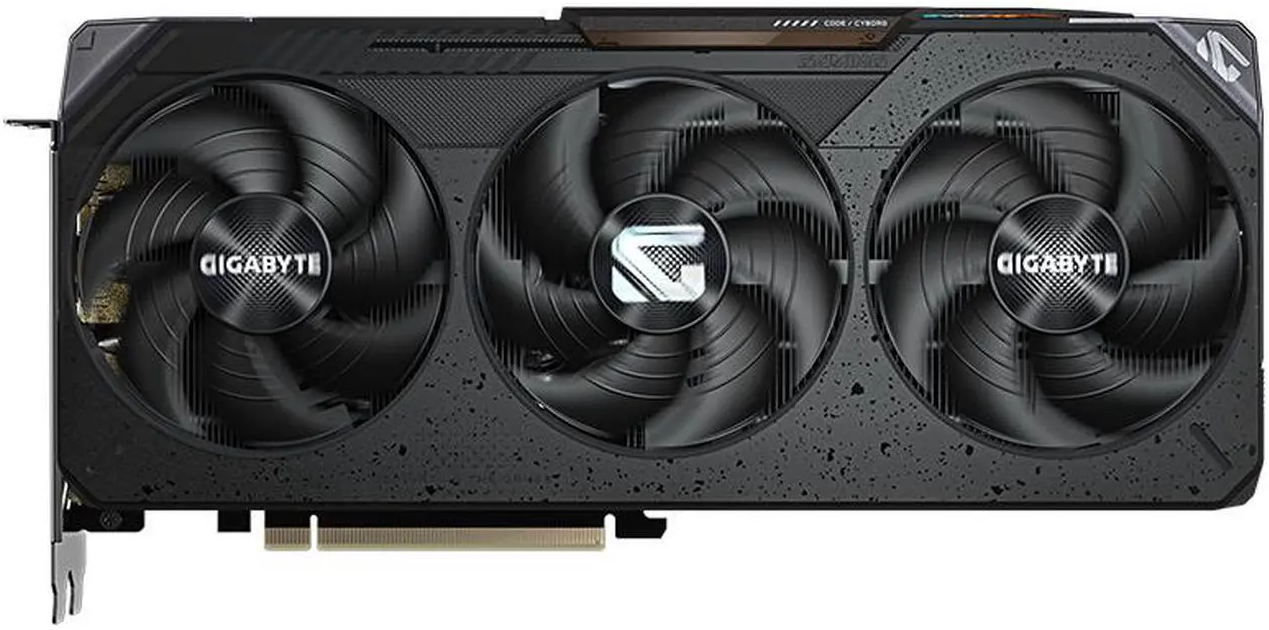
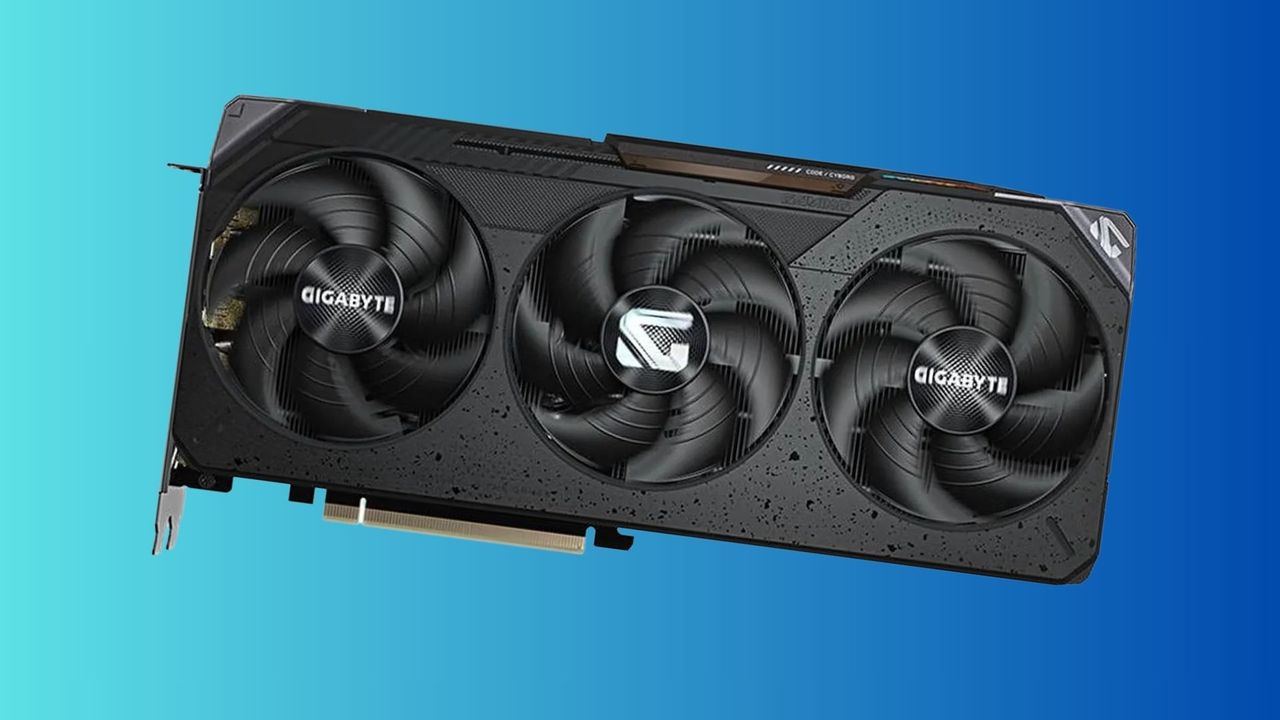
It's back: one of the best deals on a brand-new, current-generation, mid-range graphics card that packs 12GB of VRAM. There is a little hoop to jump through via Newegg to receive the discount, but it's more than worth it to slash $70 off the card and bring the price back down to its all-time low. AMD's Gigabyte Gaming Radeon RX 9070 GRE GPU is available at Newegg for $499. All you need to do is click on the "Extra Discount Available" link and enter your email address to receive the promotional code. Once you do that, you bring the price of this graphics card all the way down from its $569.99 list price. It's a very grim time for shopping for PC component upgrades, so to see an actual deal on a GPU that takes it below its MSRP in today's inflated market is a rare sight indeed.
The RX 9070 GRE was initially made available to the Chinese GPU market and received a few changes from the original RX 9070 XT. The available VRAM was cut from 16GB to just 12GB of GDDR6, but it still sports bandwidth speeds of 18 Gbps on a 192-bit bus, producing 432 GB/s of memory bandwidth in gaming and applications. The Radeon RX 9070 GRE is still built on AMD’s RDNA 4 graphics architecture and uses the same Navi 48 GPU as the Radeon RX 9070 and RX 9070 XT. The RX 9070 GRE features a cut-down version of the Navi 48 chip with 48 compute units compared to the RX 9070's 56. Using just 220W total power draw, the RX 9070 GRE has an Identical power footprint to the standard Radeon RX 9070 GPU, making it quite power efficient and not needing a huge power supply to run.
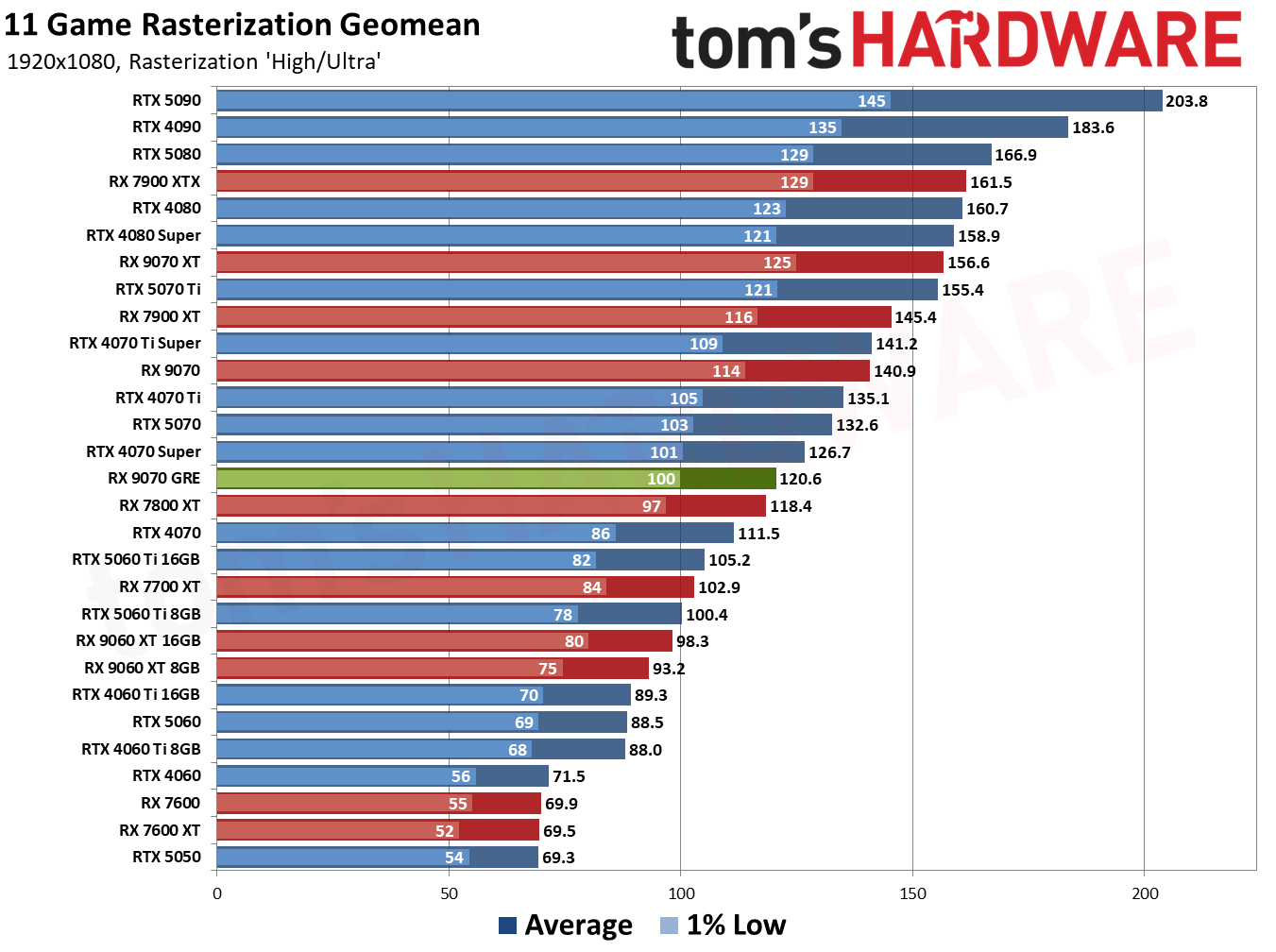
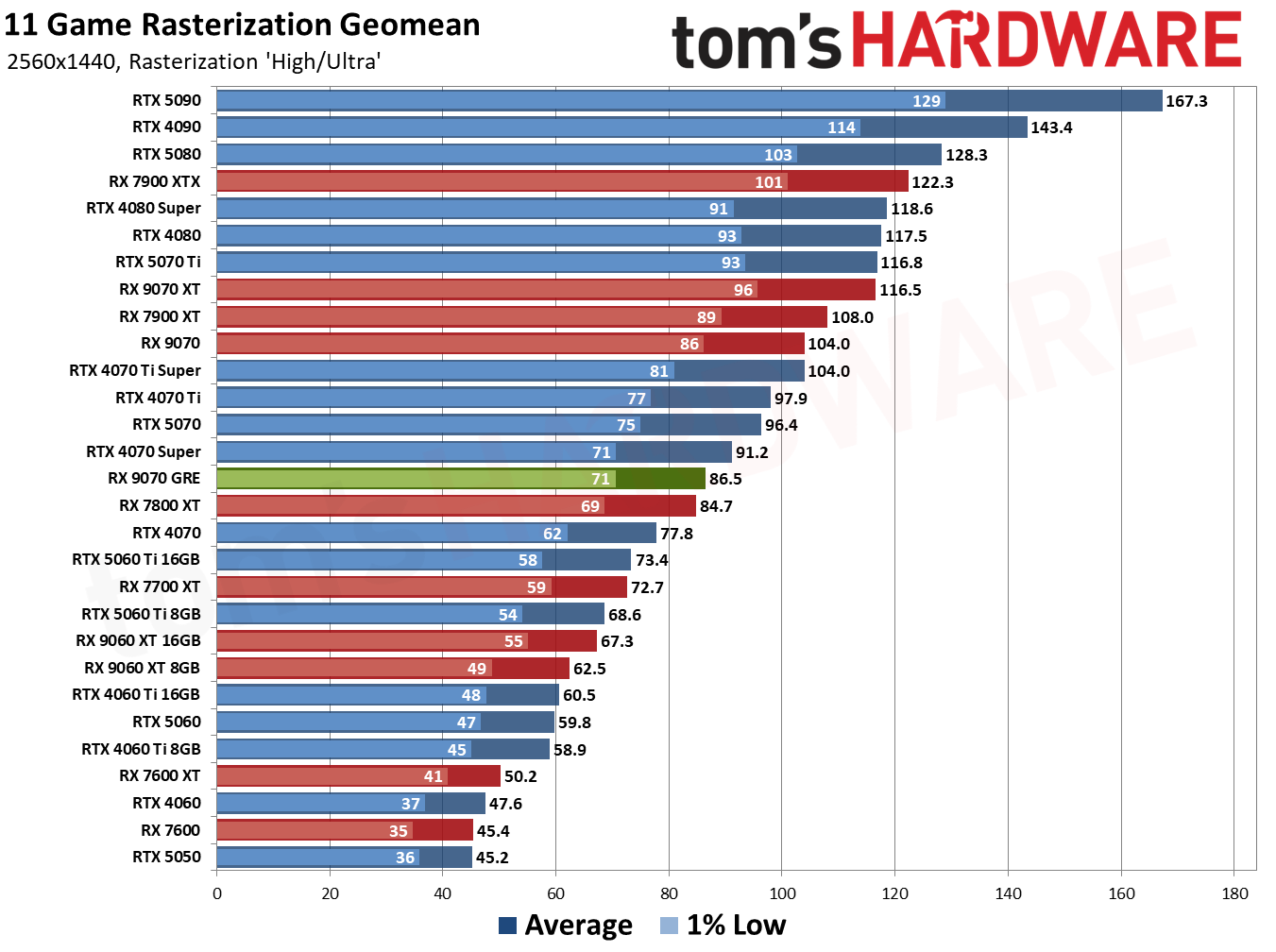
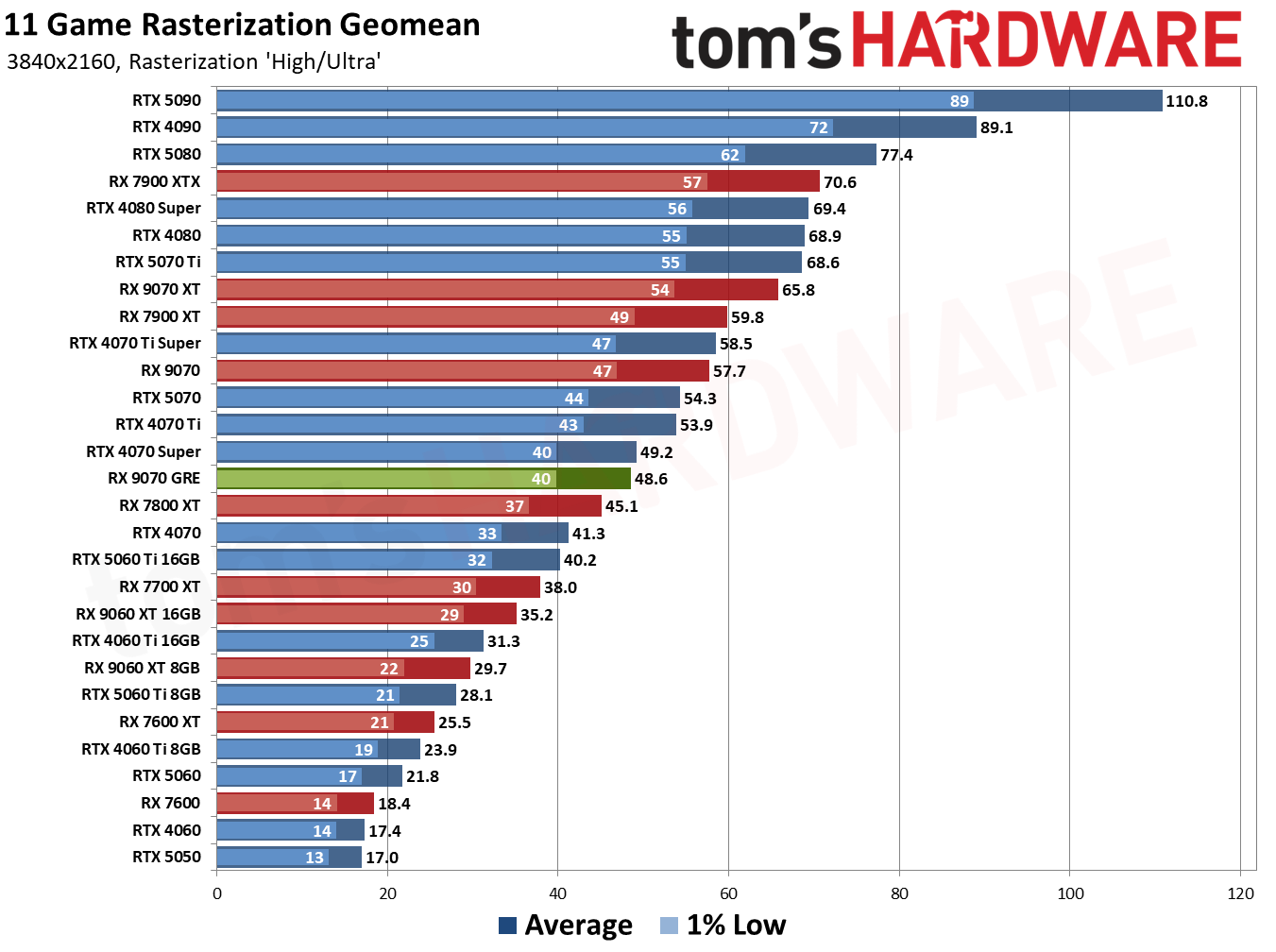
We benchmarked the Radeon RX 9070 GRE in our extensive review, putting it through its paces in our suite of games. We found the card averages a cool 120 FPS at 1080p settings and 86.6 FPS at 1440p across our 11-game raster-only test suite. This is a good GPU choice for 1080p and 1440p gaming, with the RX 9070 GRE packing ample VRAM for high settings at 1080p, but pushing ultra settings at 1440p may use up the 12GB of VRAM. AMD's Radeon RX 9070 GRE sits just behind Nvidia's RTX 5070 in our results chart that you can view below.
FutureFutureFuture
If you're actively looking for a new GPU in the current PC component market, you're more than aware of the considerable price hikes across the GPU lineups from both AMD and Nvidia. To see a graphics card on sale for under its launch MSRP is a very rare sight, and I personally did not expect to see this kind of deal again outside of a large sale event like Prime Day or Black Friday. So if you're looking for a competent card for 1080p and 1440p gaming, then jump on the Gigabyte Gaming RX 9070 GRE for just $499.99.
Nvidia's fastest gaming graphics card, the RTX 5090, has been on a tear of price increases over the past several weeks. However, over the past week, the available inventory has dwindled. Now, you can only find the RTX 5090 from third-party sellers at online retailers like Newegg and Amazon, commanding anywhere from $6,500 to $9,500 (or even higher) for Team Green's best GPU.
At Newegg, the cheapest RTX 5090 is the MSI Ventus 3X that's available from Slava Computers (a relatively new seller with 239 ratings and a 2.8 out of 5 rating at the time of writing) for $6,449. On Amazon, you can get the Asus TUF Gaming OC for $6,395 from Joes Tech Shop, a seller with an 81% positive rating. However, among the most recent reviews are a string of one-star reviews about orders never being fulfilled. The cost goes much higher, as well. The first result for "RTX 5090" on Newegg, for example, surfaces the MSI Ventus 3X OC for $8,699.
In June, the median price for an RTX 5090 was $4,299. At the beginning of September, we logged the lowest online price at $5,199 in our GPU price tracker. Now, in less than two weeks, the available stock has completely disappeared online, and the options available from third-party sellers have ballooned in price once again.
Naturally, we don't recommend buying from one of these third-party sellers. The RTX 5090 is selling at a vastly inflated price, but more importantly, we've seen no shortage of scams around high-ticket items like the RTX 5090. In January, 42 Amazon customers were duped into a scam involving a $999 RTX 5090, instead receiving a fanny pack in place of the GPU. Earlier this month, an online seller scammed two buyers with the RTX 5090, selling phantom graphics cards with the core and memory removed on the secondhand market for prices near MSRP.
The one exception to RTX 5090 inventory is Micro Center, which still has cards available around the average selling price. At a local Micro Center we checked, the cheapest in-stock option was $4,299. Micro Center has exclusively sold graphics cards in-person for several years, insulating it from online buyouts like what appears to be going on right now.
As usual, the reason why there's so much demand for the RTX 5090 is fairly obvious: AI. The RTX 5090 holds the GB202 GPU and 32GB of GDDR7 memory. For context, Nvidia's RTX Pro 5000 48GB comes with the same GPU with a third fewer shader units enabled, and lower memory bandwidth compared to the RTX 5090, and sells for between $7,000 and $9,000. In that context, the RTX 5090 starts to look attractive for building an AI server, even at $5,000 (or more) apiece.
At the same time, the RTX 5090 remains the fastest gaming graphics card on the market according to the testing in our GPU benchmark hierarchy. That's even more true now with Nvidia's launch of DLSS 5 Neural Rendering, which the RTX 5090 can fully capitalize on (though, thankfully, we've found playable performance on lower-end cards in our extensive DLSS 5 testing).
We've reached out to Nvidia for comment on whether it has any plans to stabilize inventory. We'll update this story when we hear back.
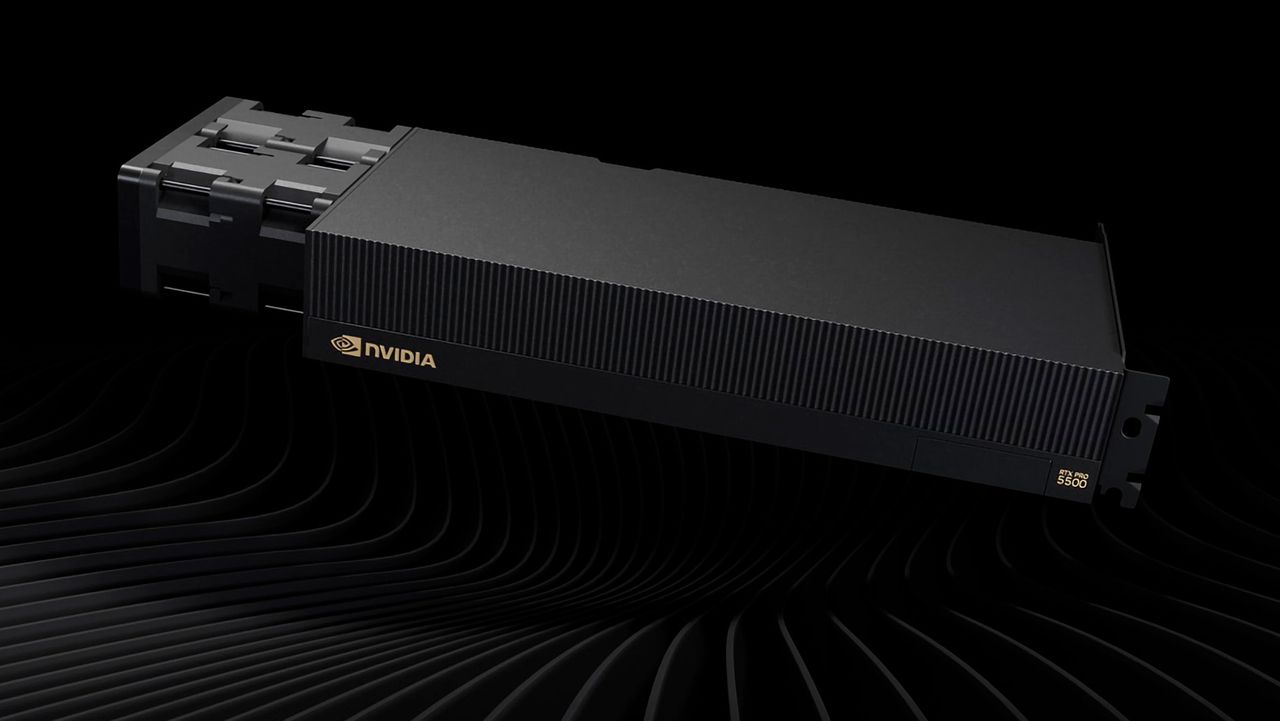
The GeForce RTX 5090 is undeniably one of the best graphics cards money can buy. Banking on the fact that many already use it for AI, Nvidia has bolstered it with even more memory and launched it as the new RTX 5500 Pro Blackwell Workstation Edition. It offers comparable specifications to the GeForce RTX 5090 but distinguishes itself with 84GB of GDDR7 memory, 2.6X more than the Blackwell gaming flagship.
The RTX Pro 5500 features the GB202 silicon, the powerhouse die that powers other high-end mainstream and professional Blackwell graphics cards, including the GeForce RTX 5090, RTX Pro 6000, and RTX Pro 5000. In fact, the RTX Pro 5500 uses the same die as the GeForce RTX 5090, which means 170 Streaming Multiprocessors (SMs) are enabled out of a possible 192. As a result, the RTX Pro 5500 has 21,760 CUDA cores and offers performance comparable to the GeForce RTX 5090. The differentiator is the memory subsystem, where the RTX Pro 5500 excels.
Nvidia equipped the RTX Pro 5500 with 84GB of GDDR7 memory. This is the second time Nvidia has launched a graphics card with 84GB of memory, with the first being the China-exclusive RTX Pro 6000D. The RTX Pro 5500's memory capacity lets the Blackwell graphics card sit comfortably between the RTX Pro 5000 and the upgraded RTX Pro 6000, with 72GB and 96GB of GDDR7 memory, respectively.
Nvidia RTX Pro 5500 Workstation Edition Specifications
Graphics Card
RTX Pro 6000
RTX Pro 6000D
RTX Pro 5500
RTX 5090
RTX Pro 5000
Architecture
GB202
GB202
GB202
GB202
GB202
Process Technology
TSMC 4N
TSMC 4N
TSMC 4N
TSMC 4N
TSMC 4N
Transistors (Billion)
92.2
92.2
92.2
92.2
92.2
Die size (mm^2)
750
750
750
750
750
SMs
188
156
170
170
110
CUDA Cores
24,064
19,968
21,760
21,760
14,080
Tensor Cores
752
624
680
680
440
Ray Tracing Cores
188
156
176
176
110
Boost Clock (MHz)
2,617
2,430
?
2,407
2,617
VRAM Speed (Gbps)
28
25
25
28
28
VRAM (GB)
96
84
84
32
48 / 72
VRAM Bus Width
512
448
448
512
384
L2 Cache
128
128
96
96
96
Render Output Units
192
192
192
176
176
Texture Mapping Units
752
624
680
680
440
TFLOPS FP32 (Boost)
126.0
97.04
?
104.8
73.69
Bandwidth (GB/s)
1,792
1,400
1,398
1,790
1,344
TBP (watts)
600
600
600
575
300
Nvidia achieved the 84GB memory capacity by outfitting the RTX Pro 5500 with 28 GDDR7 memory chips in a clamshell configuration. Each side of the PCB houses 14 24Gb (3GB) GDDR7 memory modules. They run at 25 Gb/s across a 448-bit memory interface, delivering up to 1,400 GB/s of bandwidth, which aligns with Nvidia’s official specification of 1,398 GB/s. In other words, the RTX Pro 5500 shares the same memory subsystem as the RTX Pro 6000D.
Samsung, Micron, and SK hynix only produce standard 28 Gb/s memory packages. Therefore, Nvidia downclocks the RTX Pro 5500's GDDR7 chips for its own reasons, whether to meet thermal and power targets or avoid cannibalizing higher-tier SKUs. From a memory-bandwidth perspective, the RTX Pro 5500 is not particularly impressive. Its bandwidth is only 4% ahead of the RTX Pro 5000, and it lags 22% behind both the flagship RTX Pro 6000 and the GeForce RTX 5090, which fully leverage 28 Gb/s GDDR7 memory chips.
To sum it all up, if RTX Pro 6000D and GeForce RTX 5090 had a child, it would be the RTX Pro 5500. Nvidia's main motivation was to launch the RTX Pro 5500 to fill the large performance and pricing gap between the RTX Pro 6000 and RTX Pro 5000. Also, the chipmaker makes substantially more profit by putting recycled GB202 into an RTX Pro 5500 than into a GeForce RTX 5090. By giving the former more memory with similar core specifications as the latter, Nvidia seemingly hopes to win more customers over to the RTX Pro 5500.
We reached out to both Nvidia and PNY for official pricing on the RTX Pro 5500, but neither company has responded. For reference, the flagship RTX Pro 6000 retails for $15,599, while an RTX Pro 5000 72GB starts at $9,209. Given the RTX Pro 5500's role as a bridge between the two models, it is reasonable to expect its launch price to fall somewhere within this range.
With the latest ROCm updates, AMD finally brought robust, official PyTorch and HIP SDK support to Windows for consumer GPUs, fully supporting the Radeon RX 7000 and the RX 9000 series. For native, supported frameworks, AMD on Windows is finally a viable reality, but what happens when you want to run a proprietary application, an older repository, or a specialized AI tool that absolutely refuses to support anything but NVIDIA's CUDA? That's where a new project, Speedstu's "CUDA-for-AMD-Windows," could save the day. It proves that running rigidly CUDA-exclusive workloads on AMD hardware in Windows is possible without virtualization or dual-booting.
To be clear, this project is not a brand-new runtime. Instead, it is a highly automated and reproducible PowerShell setup that bridges the gap between ZLUDA, the well-known, formerly AMD-funded translation layer, and AMD's native HIP/ROCm SDK for Windows. Through a series of clever scripts, the toolkit automatically detects the user's GPU architecture, grabs a specifically pinned version of ZLUDA (v6-preview.69), and, at least in theory, seamlessly maps it to the ROCm math libraries already present in Windows.
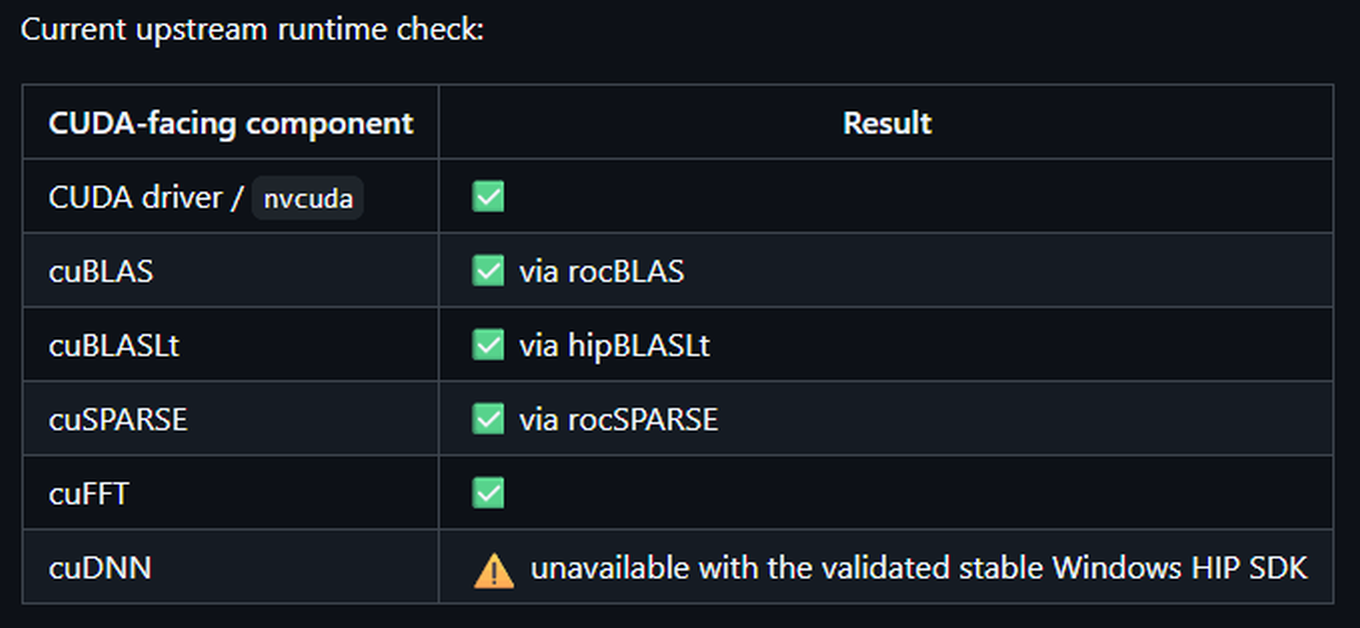
Several important CUDA libraries link up, but the important cuDNN doesn't work yet. (Image credit: Speedstu/GitHub)
The result is that the developer successfully intercepted and mapped the CUDA driver API as well as the cuBLAS, cuSPARSE, and cuFFT libraries directly over to their AMD equivalents. As a proof-of-concept, the author even trained a 2.2-million-parameter PPO reinforcement-learning network end-to-end using unmodified CUDA libraries on an AMD Radeon RX 9060 XT, which happens to be the only officially supported GPU at this time.
Even with AMD's official ROCm support on Windows, the local developer community frequently runs into dependency hell when trying out experimental GitHub repos or specialized AI tools that hardcode CUDA as a requirement. For developers who want to experiment with these CUDA-only tools natively on their Windows daily driver machines without dealing with WSL2 passthrough issues or waiting for the original author to write a HIP port, this project offers a highly desirable translation pipeline. It acts as a sort of hacky adapter for software that stubbornly demands an NVIDIA card.
Benchmark testing included in the project's documentation offers some interesting findings. In a controlled A/B test running a 2.2M-parameter reinforcement learning workload on a Radeon RX 9060 XT, the "public upstream path," which relies purely on official ZLUDA releases and AMD's stock HIP SDK 6.4, achieved a median throughput of 13,278 steps per second (SPS). By contrast, an optional "recovered custom overlay" apparently built from salvaged legacy ZLUDA binaries ran slightly worse at 12,876 SPS, making it roughly 3% slower. While the clean official setup is faster, the author notes that "a later rewrite removed LibTorch/ZLUDA from PPO and achieved substantially higher throughput," indicating that there is still a performance hit for this stack of translators.
CUDA for AMD Windows Official benchmarks (BENCHMARKS.md)
Metric
Public upstream
Recovered custom
Custom delta
Overall SPS, median
13,278.46
12,875.80
-3.03%
Overall SPS, mean
13,172.49
12,649.83
-3.97%
Collection SPS, median
63,306.00
59,360.67
-6.23%
Consumption SPS, median
16,806.36
16,445.66
-2.15%
Inference time, median
0.5863 s
0.6293 s
+7.33%
PPO learn time, median
3.2076 s
3.2958 s
+2.75%
Now, before anyone declares the CUDA moat officially drained, it is crucial to set realistic expectations. First, this is a solo open-source project, not an enterprise-grade solution. The author is extremely transparent about its narrow scope, as crucial machine learning libraries like cuDNN, TensorRT, and NCCL do not resolve yet. This means compatibility is strictly workload-dependent; if your specific AI tool relies heavily on cuDNN, this setup will fail. Furthermore, it's worth pointing out that ZLUDA itself is currently being maintained as a "weekend hobby project" after losing its commercial backing a second time. Relying on this pipeline for production-level work remains a massive risk. This repository is a tinkerer's tool, not a corporate IT deployment strategy.
Despite these limitations, "CUDA-for-AMD-Windows" is pretty exciting, as it proves that the barrier to entry for running CUDA-exclusive software on AMD GPUs isn't an insurmountable hardware flaw, but a relatively tractable translation tooling problem. Because the project is entirely open-source, its potential extends far beyond this initial proof-of-concept. With community contributions, we could see expanded hardware detection and clever patches to get more stubborn CUDA libraries resolving properly.
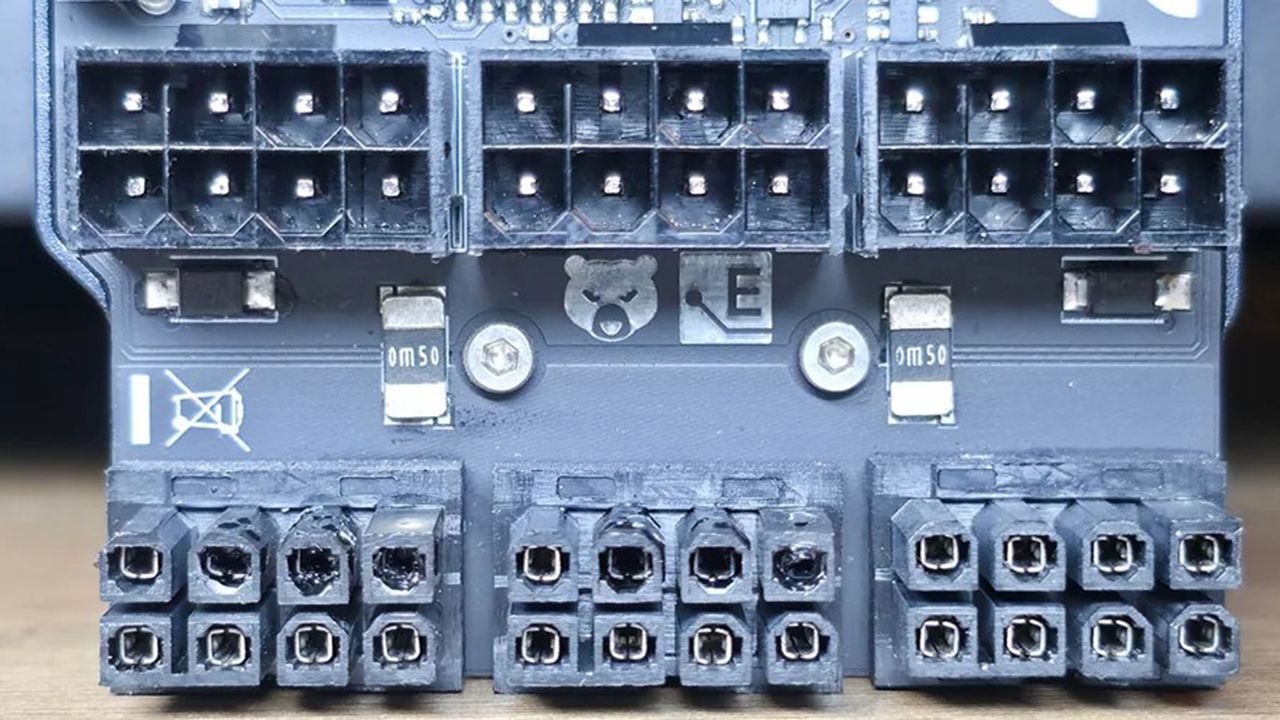
If you believe that the 8-pin PCIe power connector is entirely immune to the problems that have plagued the newer 16-pin connector, think again. A recent incident suggests that even the humble 8-pin is not entirely immune to failure. According to a Radeon RX 7900 XTX owner on Reddit, the 8-pin connectors on a Thermal Grizzly WireView monitoring device suffered overheating damage while connected to the graphics card.
The user said that they experienced frequent freezes and black screens before discovering the damage. The affected connectors were the 8-pin connectors on the GPU side of the monitoring device, with visible signs of burning and melted plastic. The user also confirmed that the connectors were fully inserted, although the exact cause of the failure is still unknown.
WireView is essentially an adapter that sits between a graphics card and the power cables, allowing users to monitor various values like power consumption, voltages, current in amperes, minimum and maximum power consumption, and more. Rather than connecting the PSU cables directly to the GPU, the power passes through the monitoring device, thus adding another set of connectors and electrical contacts to the power delivery path. A poor electrical connection, increased contact resistance, a damaged connector, or an issue with the adapter itself could have caused the overheating damage.
Thermal Grizzly previously pointed to improper seating, backplate interference, or incorrectly aligned or soldered contacts as possible causes of connector damage, although the company is yet to identify the cause of this particular incident. The company has reportedly contacted the affected user and asked them to get in touch with its support team so the company can investigate the damaged WireView adapter. The investigation could potentially help determine whether the failure originated from the adapter, the connectors, the GPU, or a combination of factors.
While we are on the subject of 8-pin power connectors, just days ago we saw a heavily modified RTX 5090 successfully running on traditional 8-pin connectors. The modders replaced the card's original 16-pin connectors with three 8-pin connectors soldered directly to the PCB, using heavy-gauge cables and modified sense pins. The card reportedly pulled as much as 900W and reached 3,400 MHz, demonstrating how capable 8-pin connectors can be when properly implemented. However, this was an extreme hardware modification, not a stock configuration.
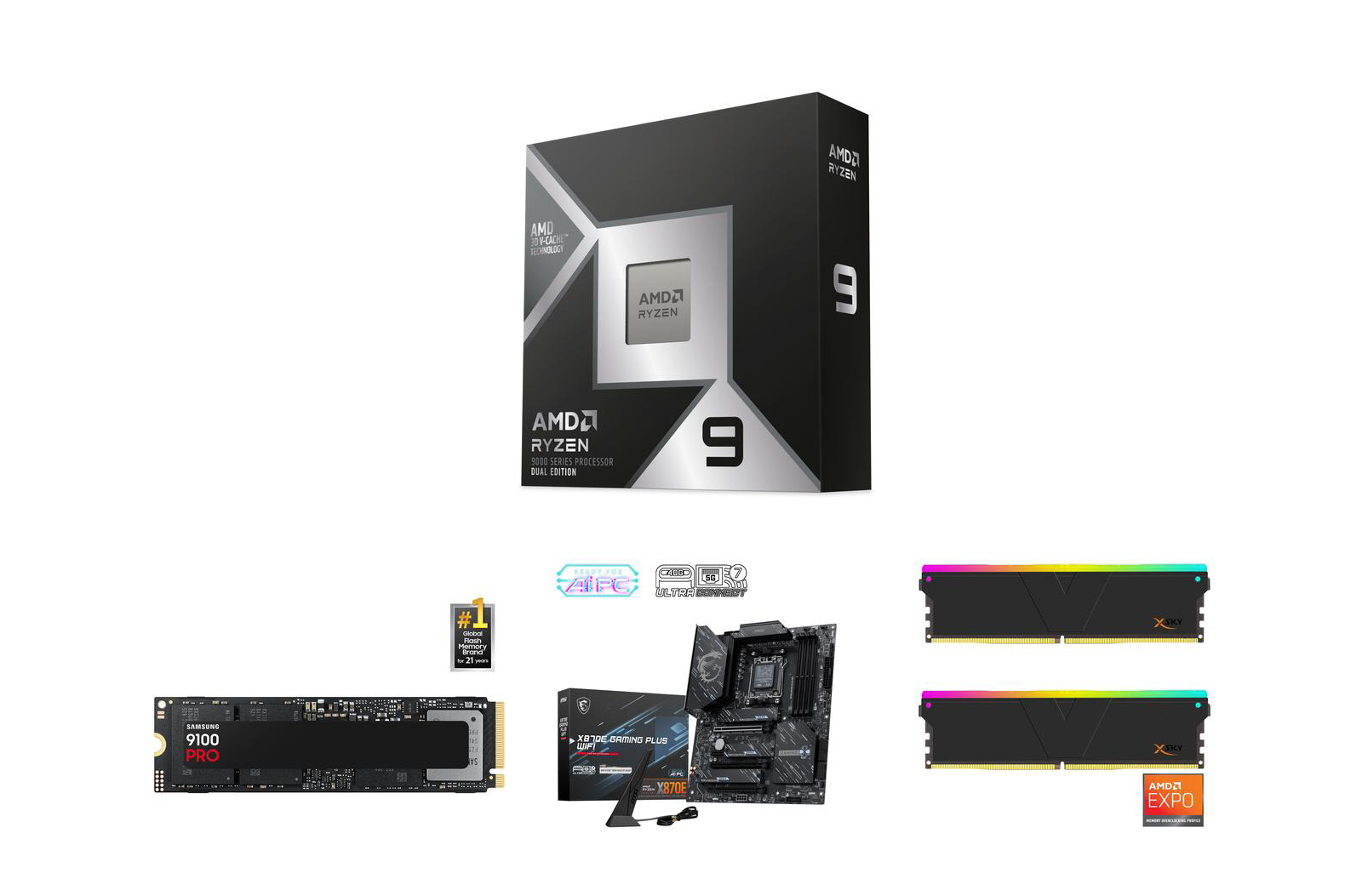
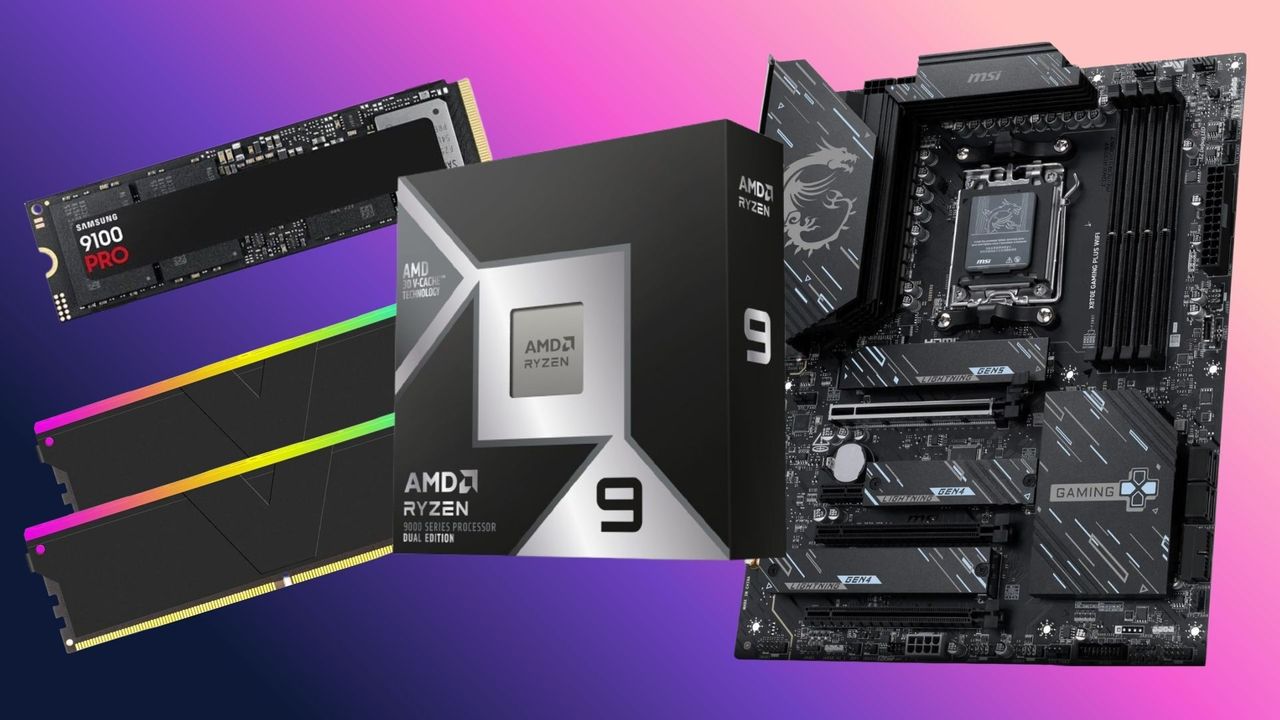
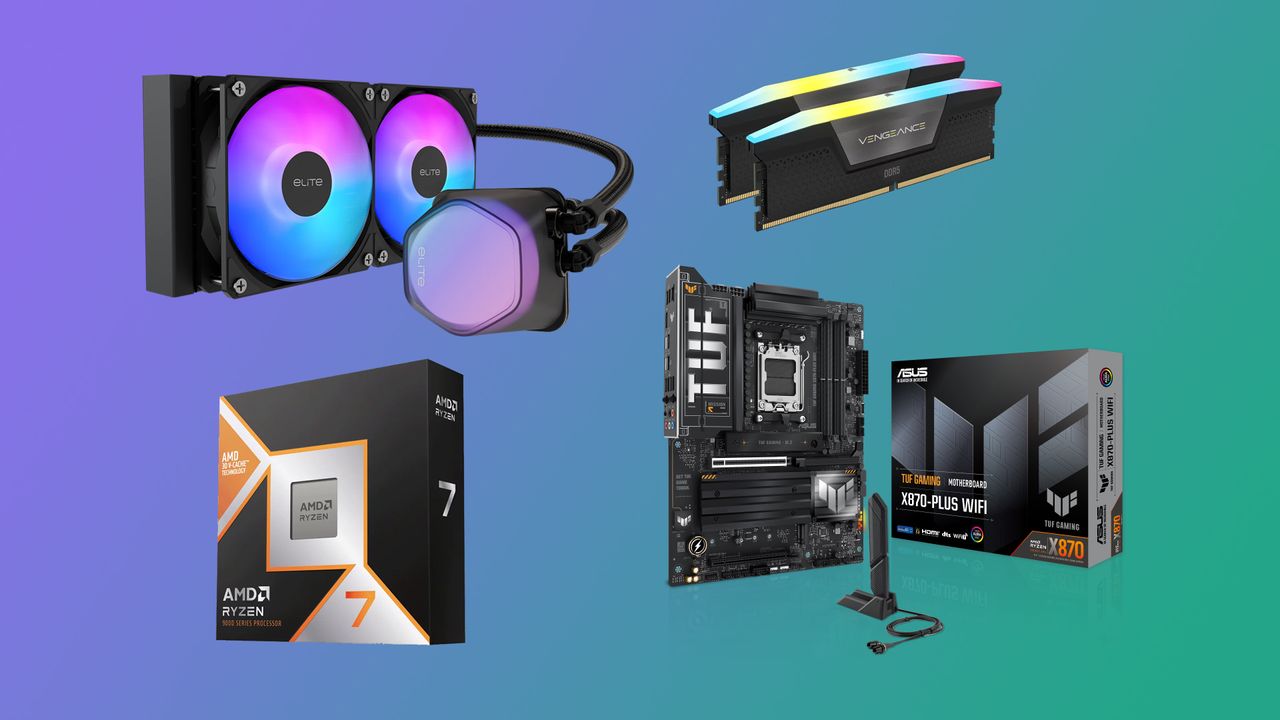
When money is no object, but you still want to be slightly frugal, combo bundles like today's Newegg offering might pique your interest. Featuring some of the most powerful and extreme consumer PC components on the market, this selection of parts will make for a very powerful gaming machine and an even more powerful productivity workhorse. Right now, you can save $1,289 when you spend $2,999 on an AMD Ryzen 9 9950X3D2 processor along with an 8TB Samsung 9100 Pro SSD, MSI X870E Gaming Plus WiFi motherboard, and 32GB of V-Color Manta XSkyDDR5-6000 memory at Newegg. The normal price for all of these components reaches $4,288, plus Newegg also throws in a free Cooler Master Elite Liquid 240mm AIO CPU cooler, and you get a copy of Capcom's latest Onimusha hitgame with the purchase of select AMD products (Ryzen 9 9950X3D2).
This bundle includes most of the components you'll need to build a mightily impressive gaming and productivity PC. You'll still need to source a PC case, power supply, and graphics card to complete the build, though. This Newegg bundle includes AMD's halo processor - the Ryzen 9 9950X3D2 - stacking 3D V-cache on both the CCDs of the processor for some extreme cache memory performance.
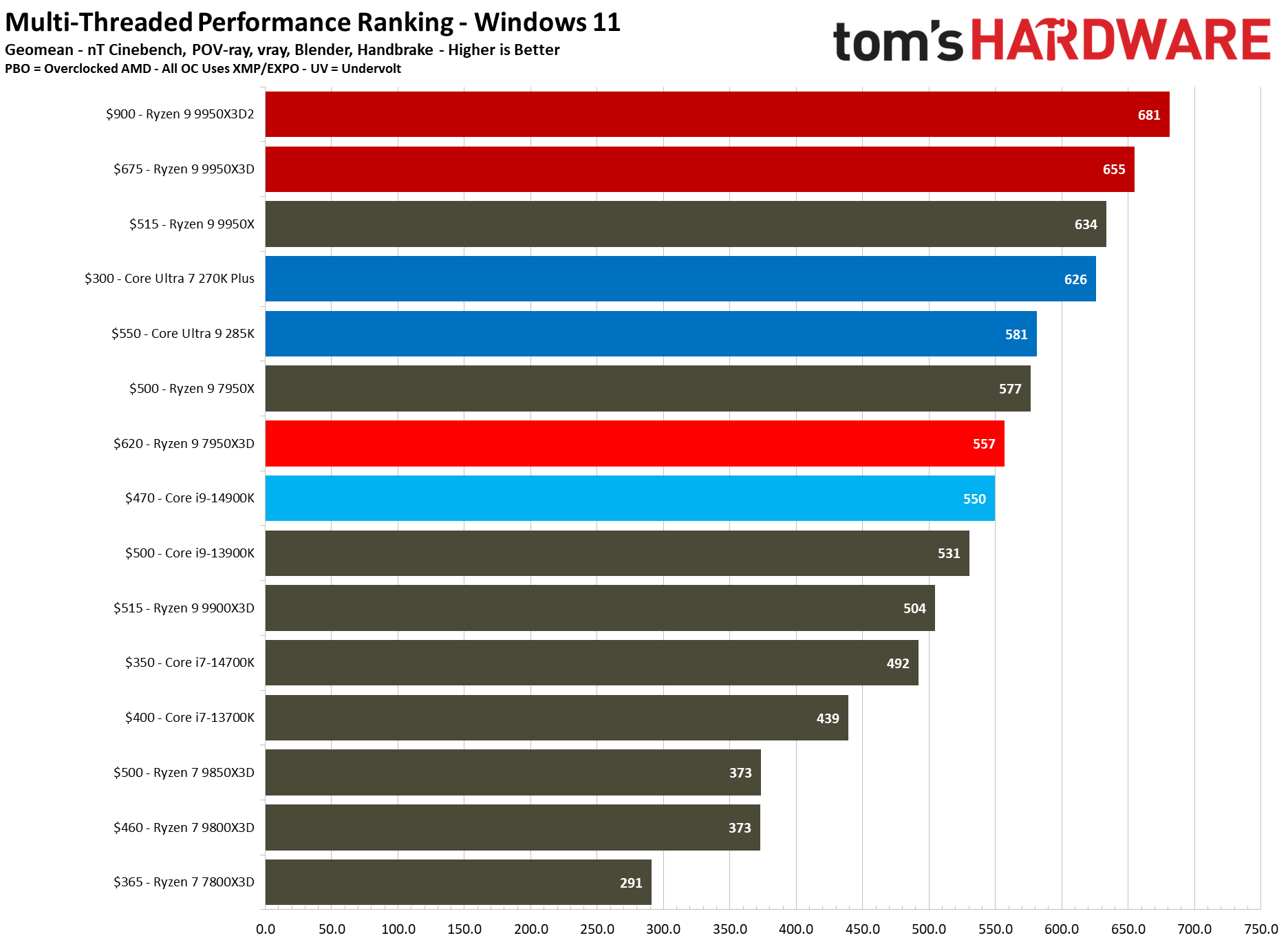
In our testing of the Ryzen 9 9950X3D2 processor, we found the 16-core and 32-thread monster to match the 9800X3D in gaming performance, but excel in multi-threaded application performance. You can see below from our multi-threaded performance chart that the 9950X3D2 tops the table, but at a price. The 9950X3D2 is also very power-hungry and costs more than the other CPUs on the list.
(Image credit: Tom's Hardware)
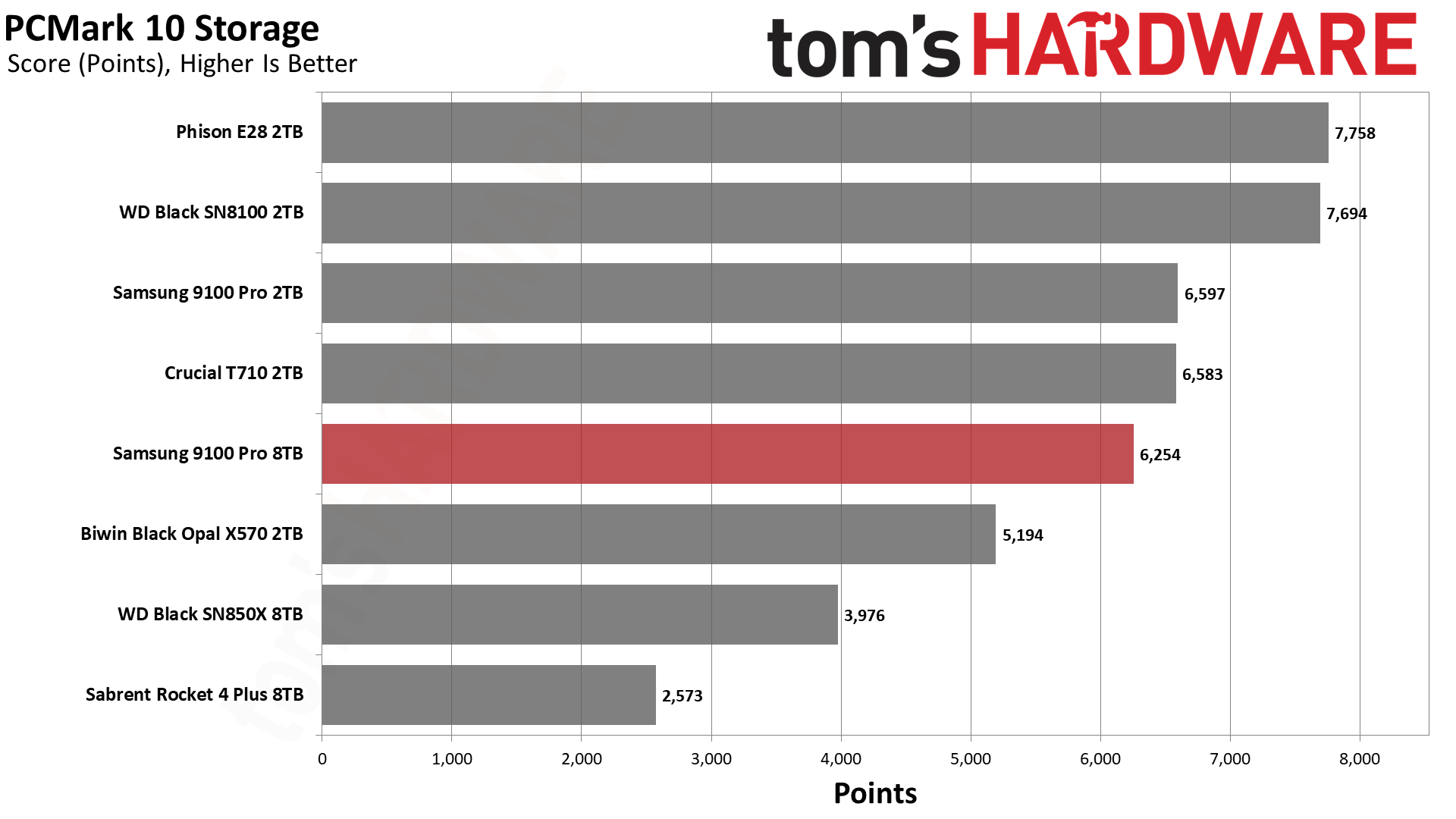
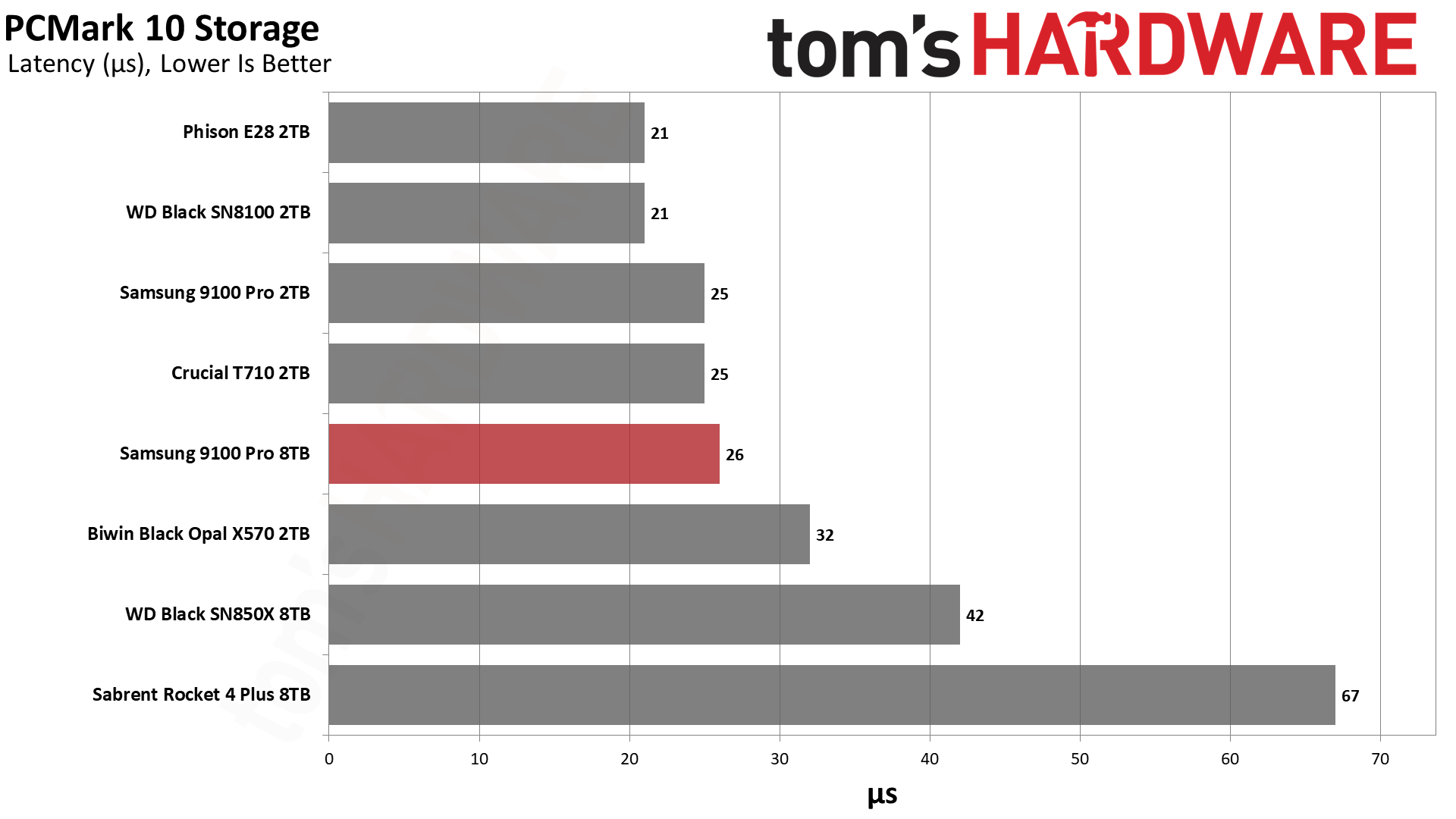
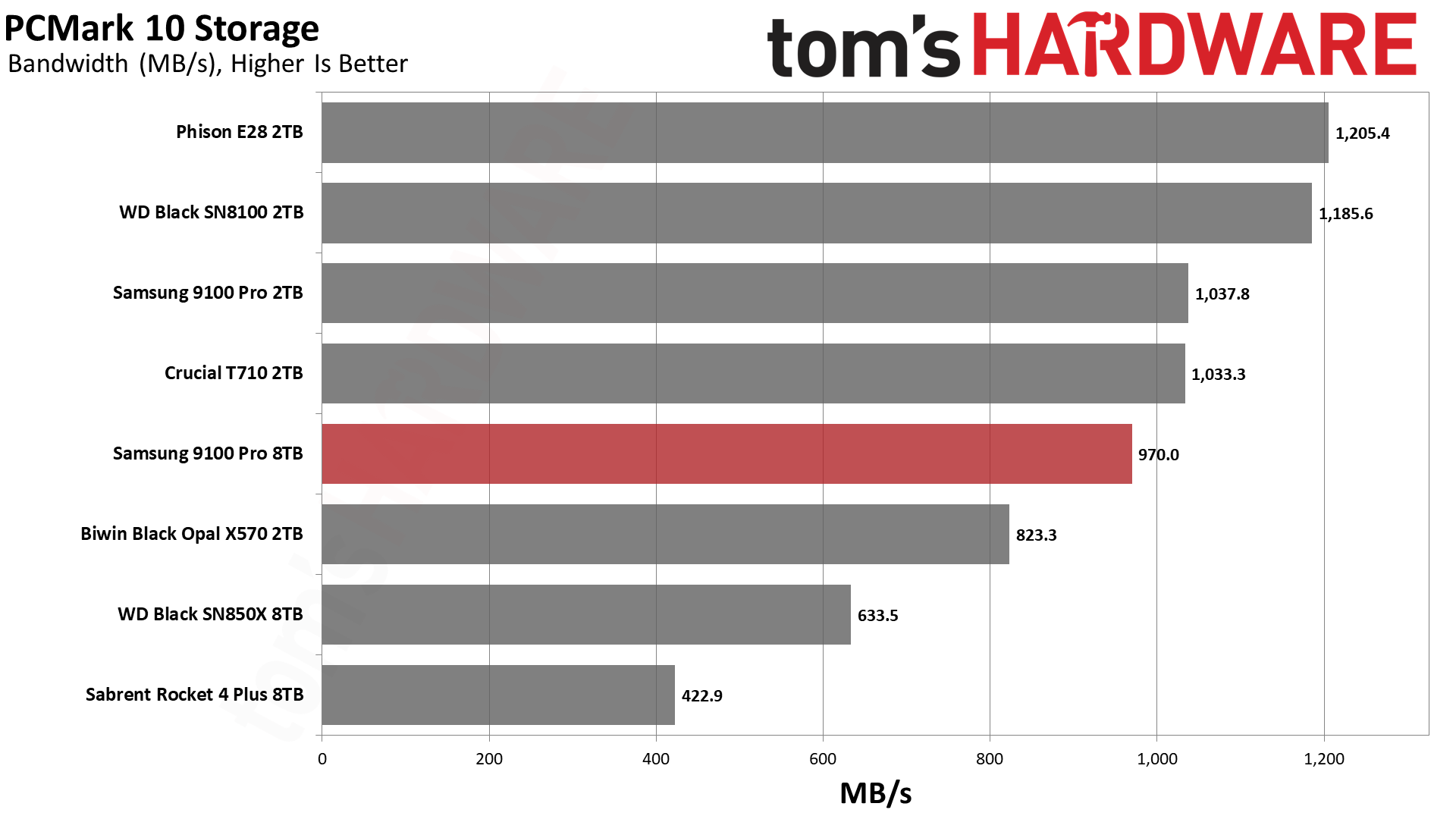
The component bundle also features a massive 8TB Samsung 9100 Pro PCIe Gen 5.0 SSD. This is the most extreme size for a superfast SSD in both capacity and price. In our testing, the 8TB 9100 Pro beats the other 8TB competition in our PC Mark 10 storage tests, but isn't as fast as smaller 2TB capacity drives, as its controller is designed to operate optimally with up to thirty-two dies at 4TB. See our review for more details.
Tom's HardwareTom's HardwareTom's Hardware
On its own, the 8TB 9100 Pro retails for a jaw-dropping $2,719.99, almost the cost of this entire bundle. So if you want superfast transfer speeds with 8TB of space, then this is the best way of getting one at a reduced price, especially in the current climate of storage pricing.
Modders have slashed the cost of running FSR 4 on AMD’s RDNA 2-powered BC-250 by nearly half, with a new implementation cutting the upscaler’s processing time from 11.51 ms to 5.92 ms at 1440p. Detailed in a VideoCardz post, the latest work builds on the community’s ongoing effort to turn AMD’s unusual PlayStation 5-derived crypto-mining board into a capable Linux gaming machine, while moving the FSR 4 optimizations from a custom Mesa modification into a portable FidelityFX DLL.
According to testing shared by the developer, FSR 4.1.1 running at 2560 x 1440 with a 1706 x 960 Quality input required 11.51 ms using the original shaders, compared with 5.92 ms using the latest v4.0.0-rc9 release. At 4K, processing time reportedly dropped from 25.72 ms to 12.08 ms, while 1080p fell from 7.13 ms to 3.93 ms. The developer also reports that the optimized implementation produced byte-identical images to the original shaders in controlled testing, suggesting that the performance improvement comes from executing the same workload more efficiently, and not reducing image quality.
The BC-250 is particularly interesting in this context because it is based on much older RDNA 2 graphics hardware. FSR 4 relies heavily on machine-learning workloads and accelerated low-precision integer operations that are far better suited to newer AMD architectures. On the BC-250, those operations have to be handled through alternative instruction paths.
Earlier community work tackled the problem in Mesa, optimizing the INT8 dot-product operations used by FSR 4. Instead of relying on a much more expensive fallback sequence, the modified implementation used a more efficient mathematical path based around signed 24-bit integer operations. One representative shader reportedly fell from 64,269 instructions to 37,613.
The latest fork takes that work a step further by shifting the optimizations into a FidelityFX DLL. This removes the requirement to run a specially modified Mesa build, potentially making the optimized path easier to use with an existing OptiScaler installation or games with compatible native FidelityFX implementations.
Native Windows support, other GPUs, and frame generation have not yet been qualified, as the developer tested the BC-250 on Linux using standard Mesa and GE-Proton. The practical upper target for the board is roughly 1440p, as FSR 4 still consumes 12.08 ms at 4K even after the optimization.
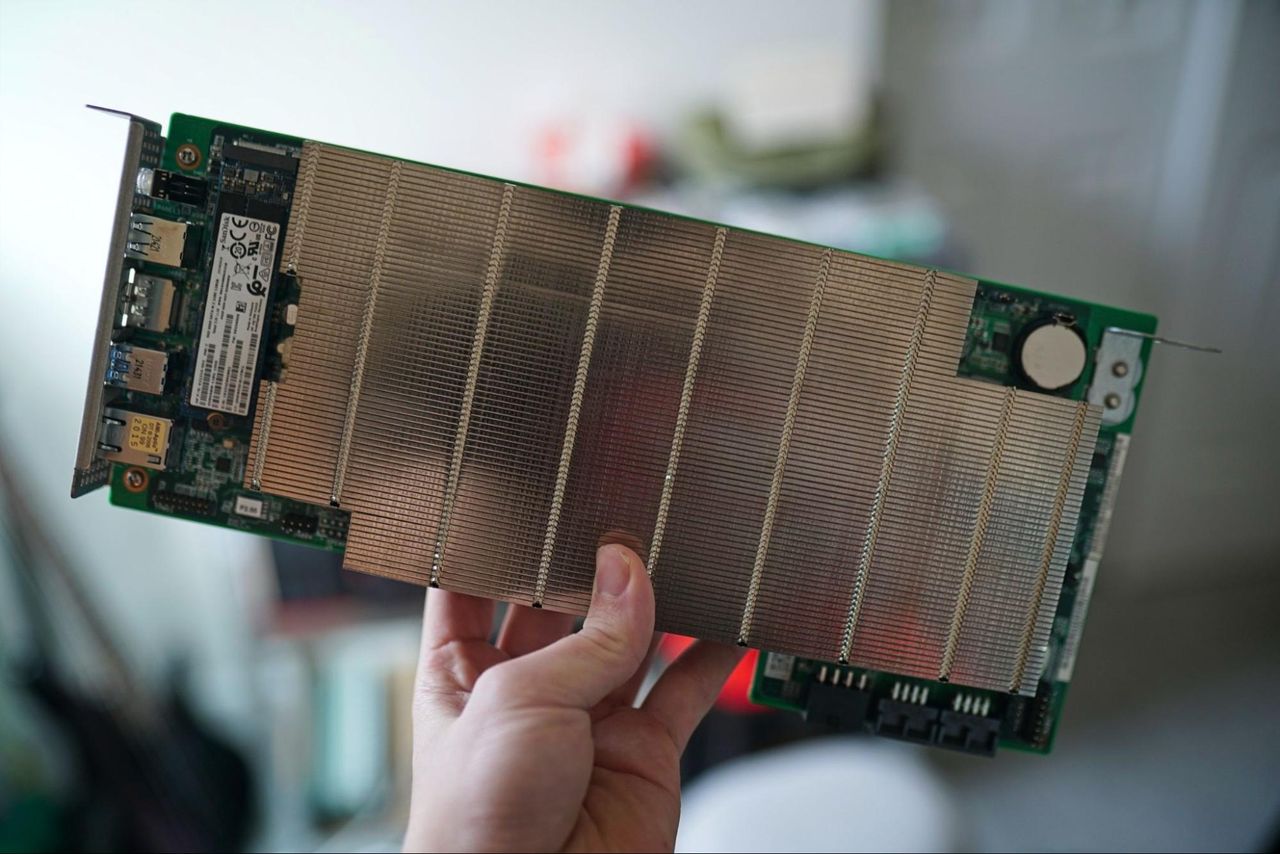
The achievement is the latest chapter in the BC-250's unusual story. ASRock built the board for cryptocurrency mining systems around PlayStation 5-class AMD silicon, with six Zen 2 CPU cores and 24 RDNA 2 compute units enabled by default. With the mining market's collapse, individual boards began filtering onto the second-hand market for well under $150, and enthusiasts have since assembled a mature Linux gaming ecosystem around them, complete with custom firmware, GPU governors, CU unlock tools, cases, cooling solutions, and distro-specific fixes.
The ecosystem still comes with limitations. In our testing, the BC-250’s aging Zen 2 CPU became a substantial bottleneck at 1080p and 1440p in some games, even with the GPU fully unlocked. The board also has only 16GB of shared GDDR6 memory, which caused some titles to crash due to memory issues at 4K and made frame generation harder at higher resolutions. While FSR 4 will not erase those limitations, halving the upscaler's per-frame cost gives a once-discarded mining board significantly more headroom to spend elsewhere.
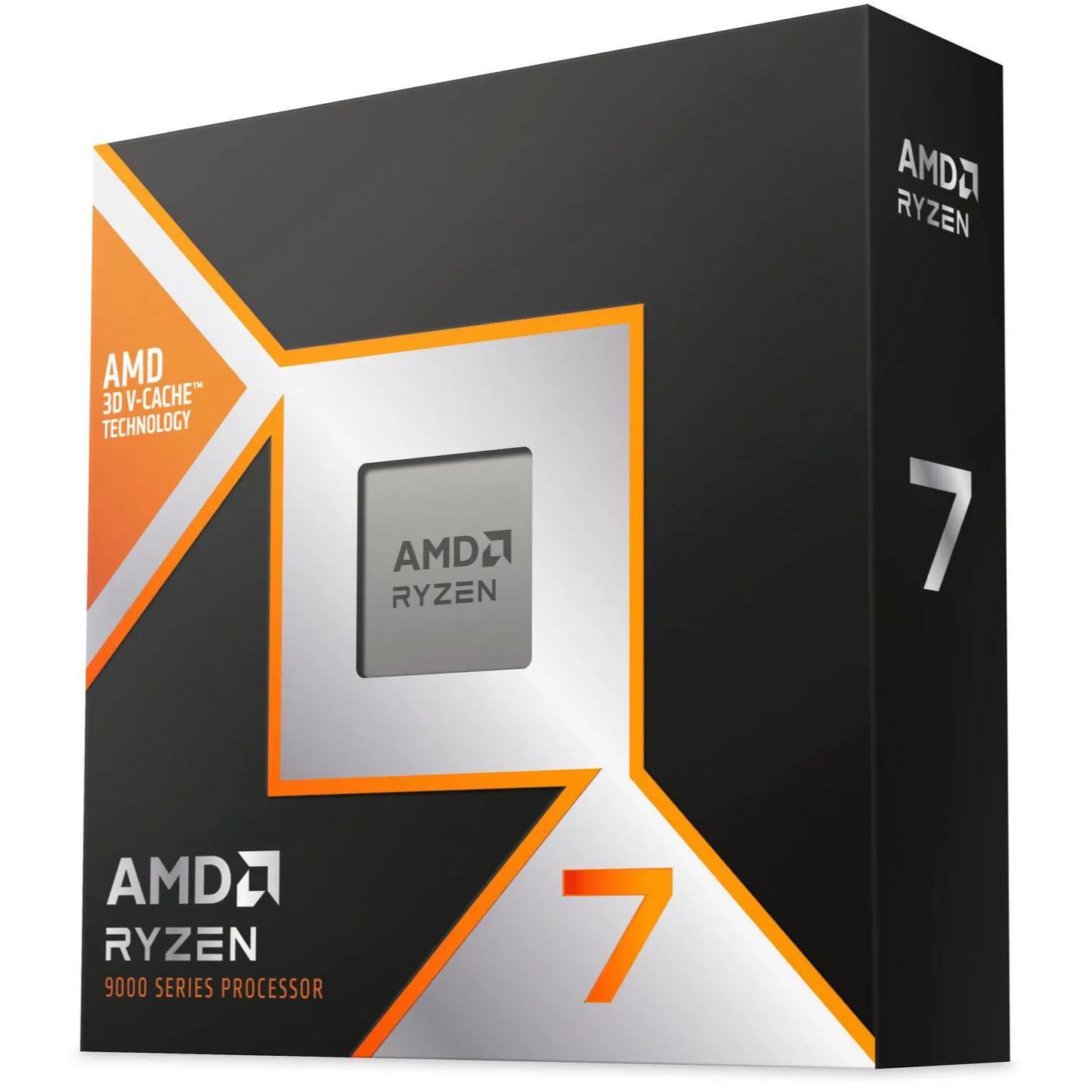
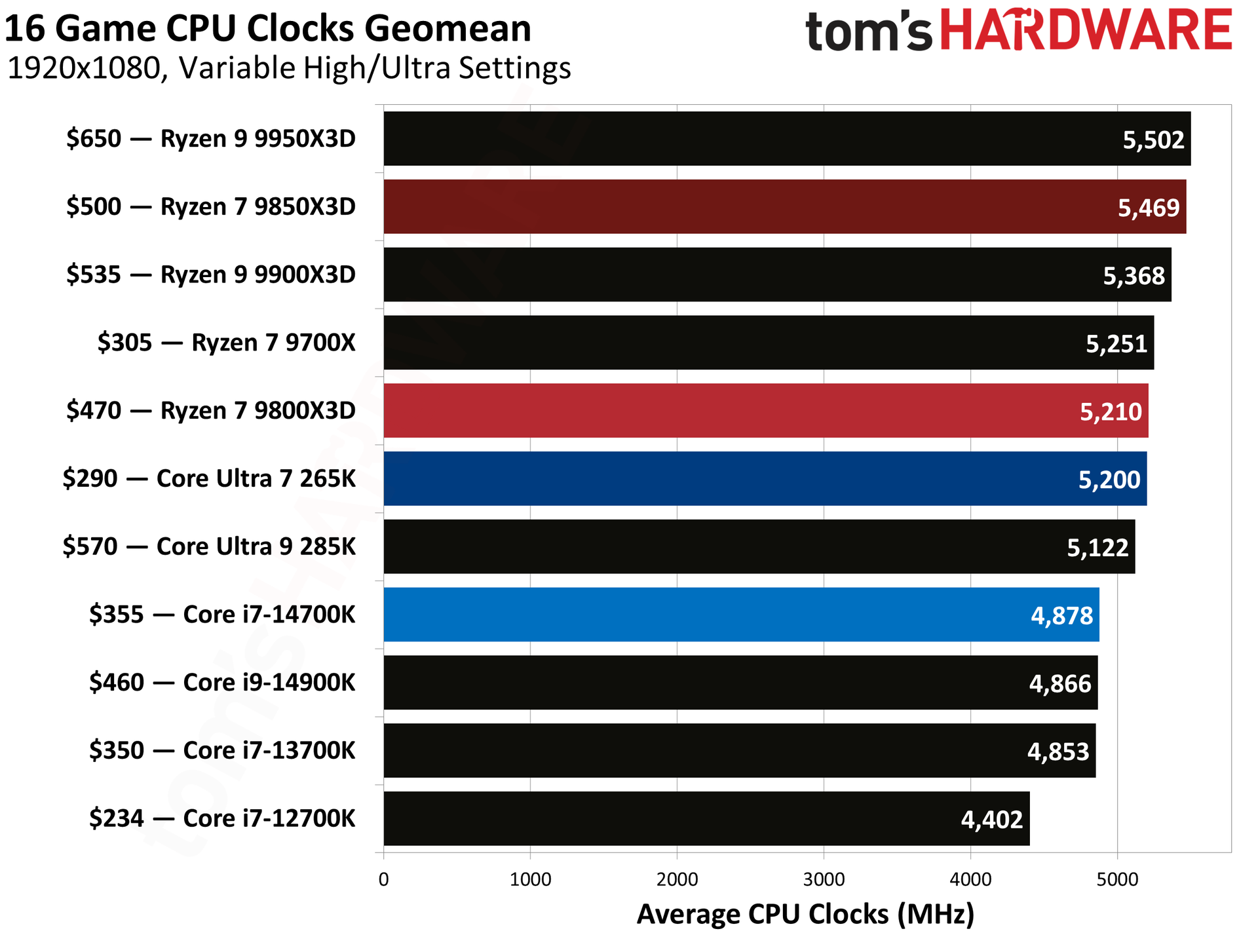
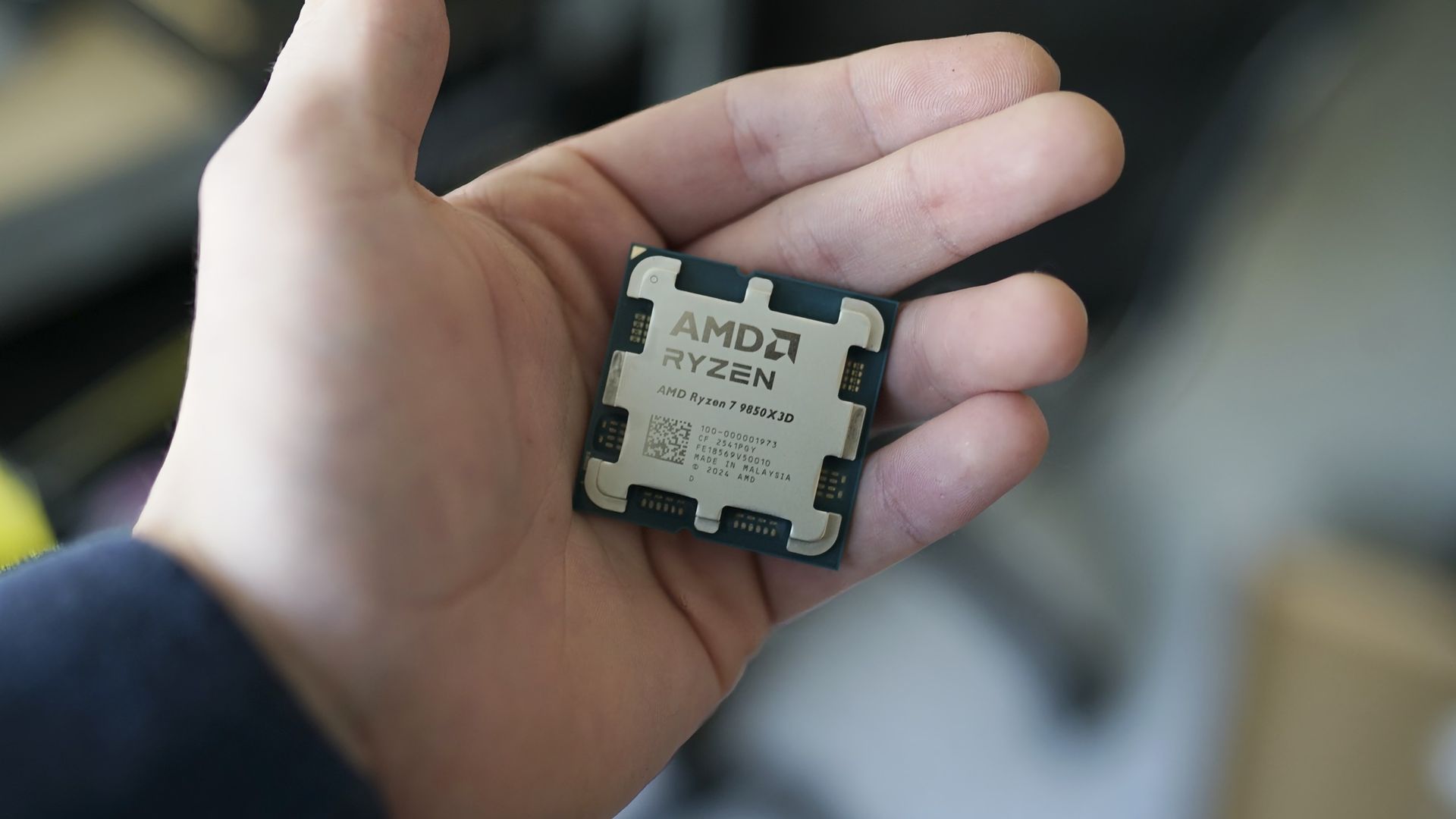
For those seeking the highest performance for gaming, AMD’s Ryzen 7 9850X3D is currently the best CPU money can buy. If you’re planning to upgrade or build a new PC, now might be a good time to pick one up, as Newegg is selling the 9850X3D for $484, around $15 less than its launch price. The deal also includes a 240mm Cooler Master AIO liquid cooler, valued at $79.99, along with a copy of Onimusha: Way of the Sword worth $69.99, both included as free gifts.
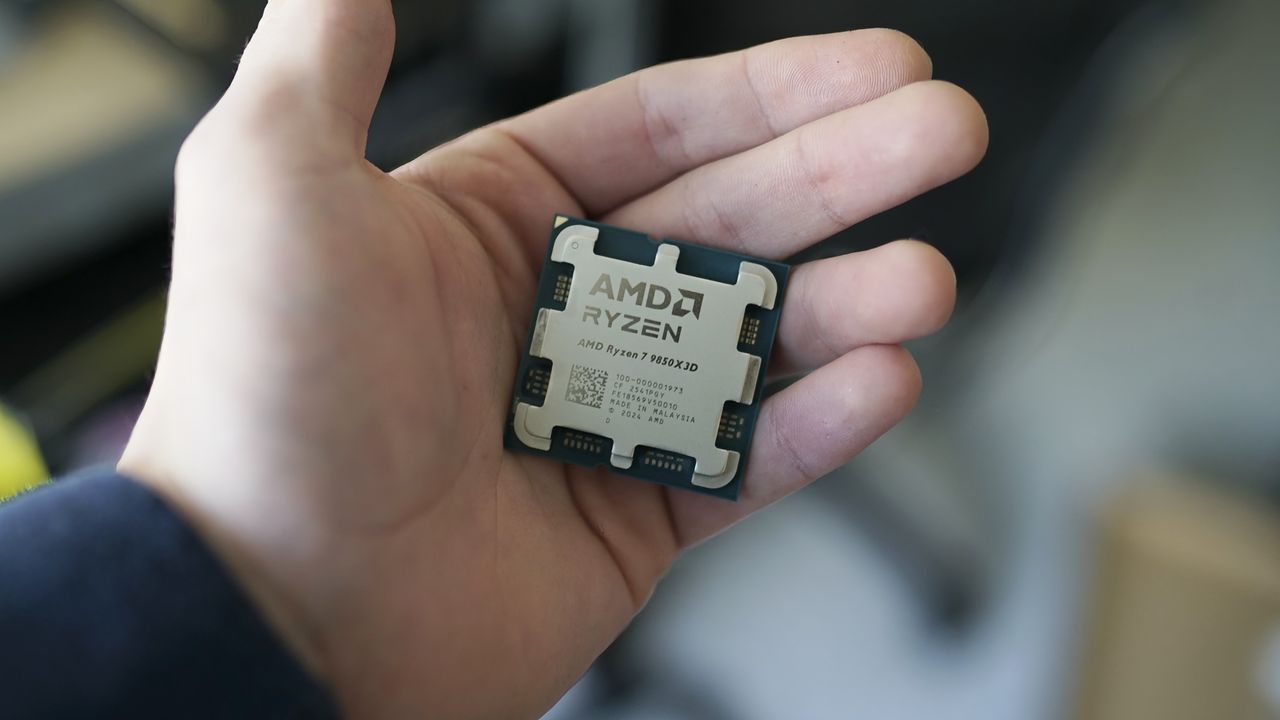
Announced at CES 2026, the Ryzen 7 9850X3D is essentially a higher-binned version of the Ryzen 7 9800X3D. It retains the same 8-core, 16-thread configuration and 4.2 GHz base clock as its predecessor, but gets a higher 5.6 GHz boost clock. The chip comes with the same 104MB of total cache, including 96MB of 3D V-Cache, which is the key ingredient behind its strong gaming performance. It also shares the same 120W default TDP and uses the AM5 platform with DDR5 memory support, making it compatible with a wide range of existing 800- and 600-series AMD motherboards.
Built on AMD’s Zen 5 architecture, the Ryzen 7 9850X3D combines 8 cores and 16 threads with a 5.6GHz boost clock and 96MB of 3D V-Cache.View Deal
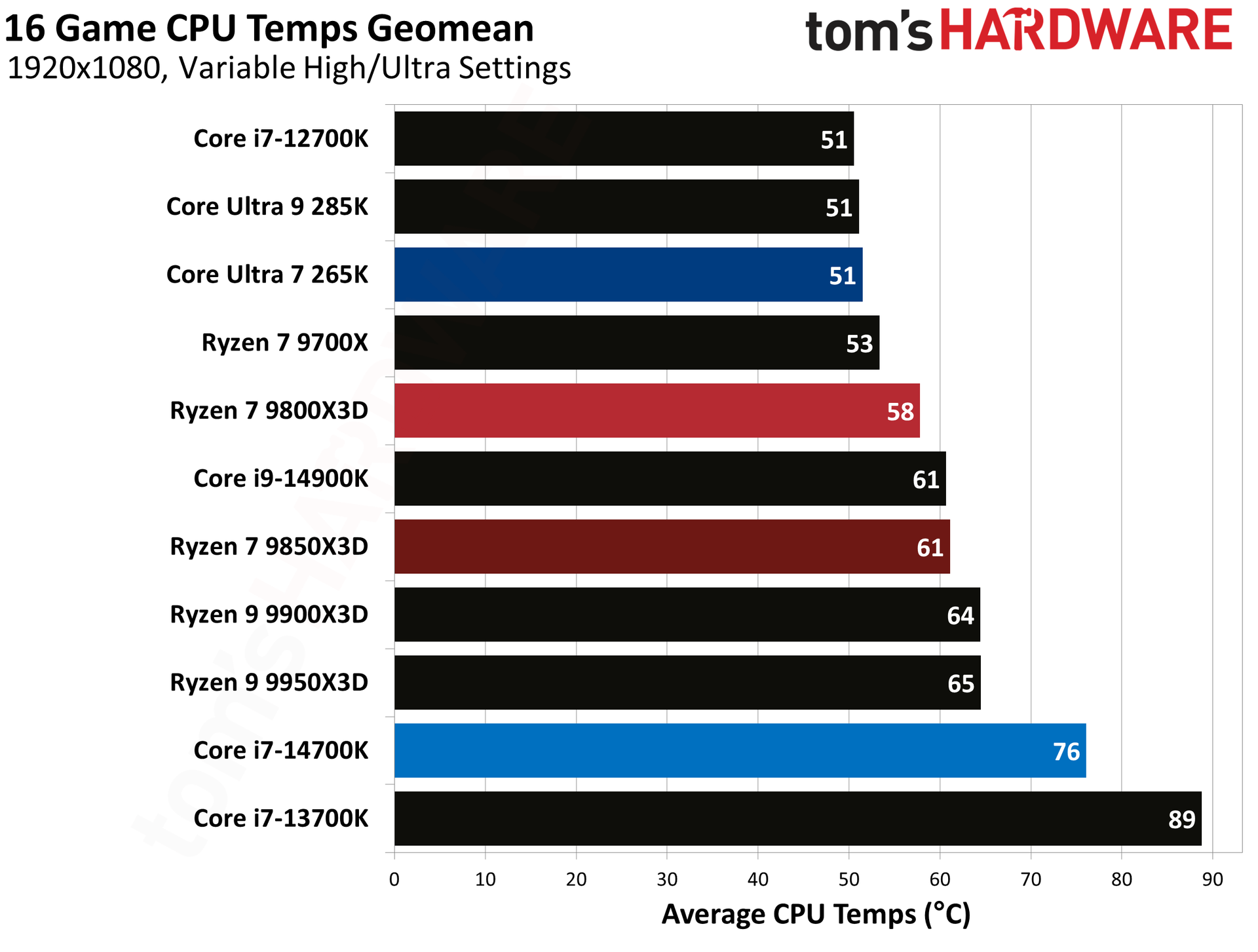
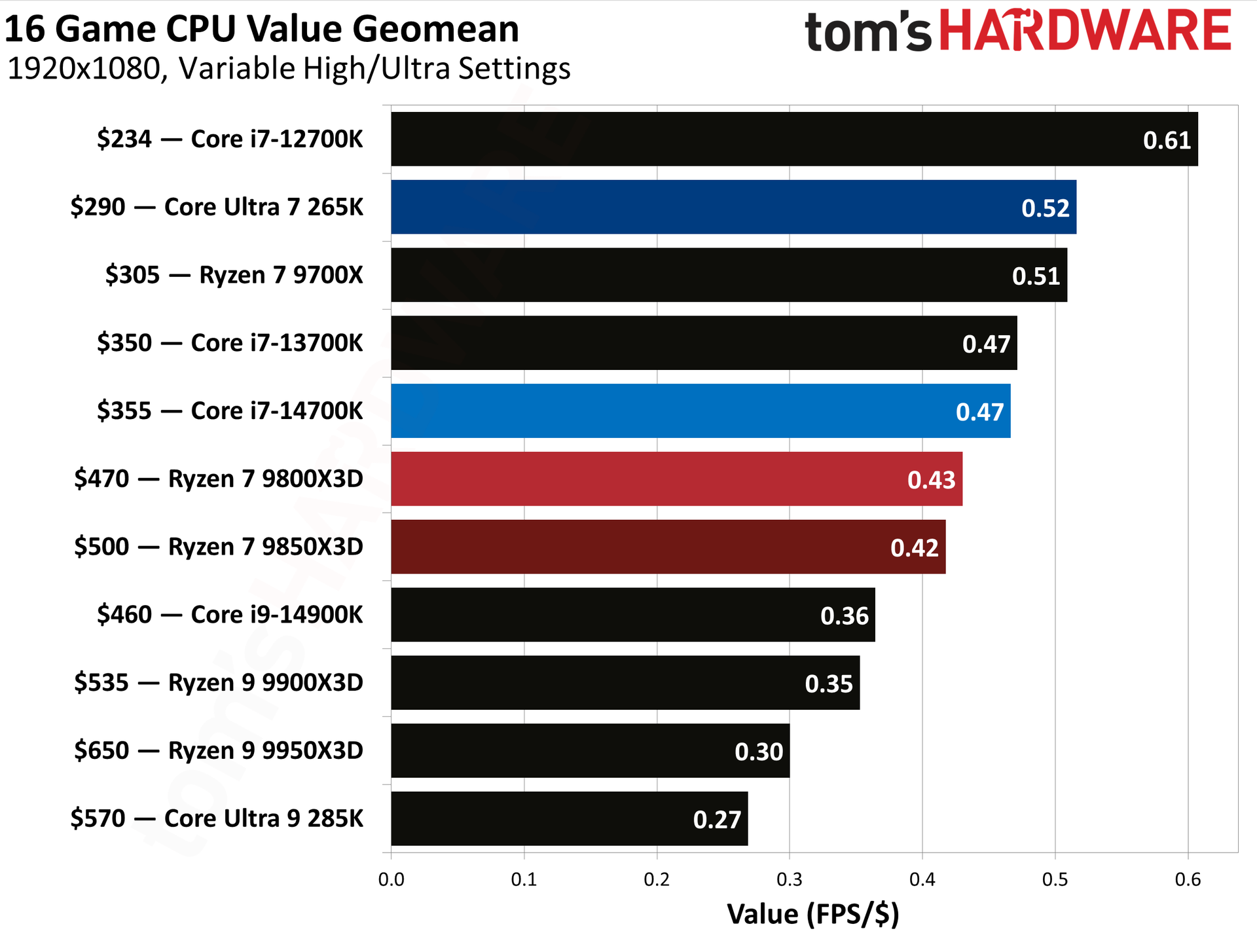
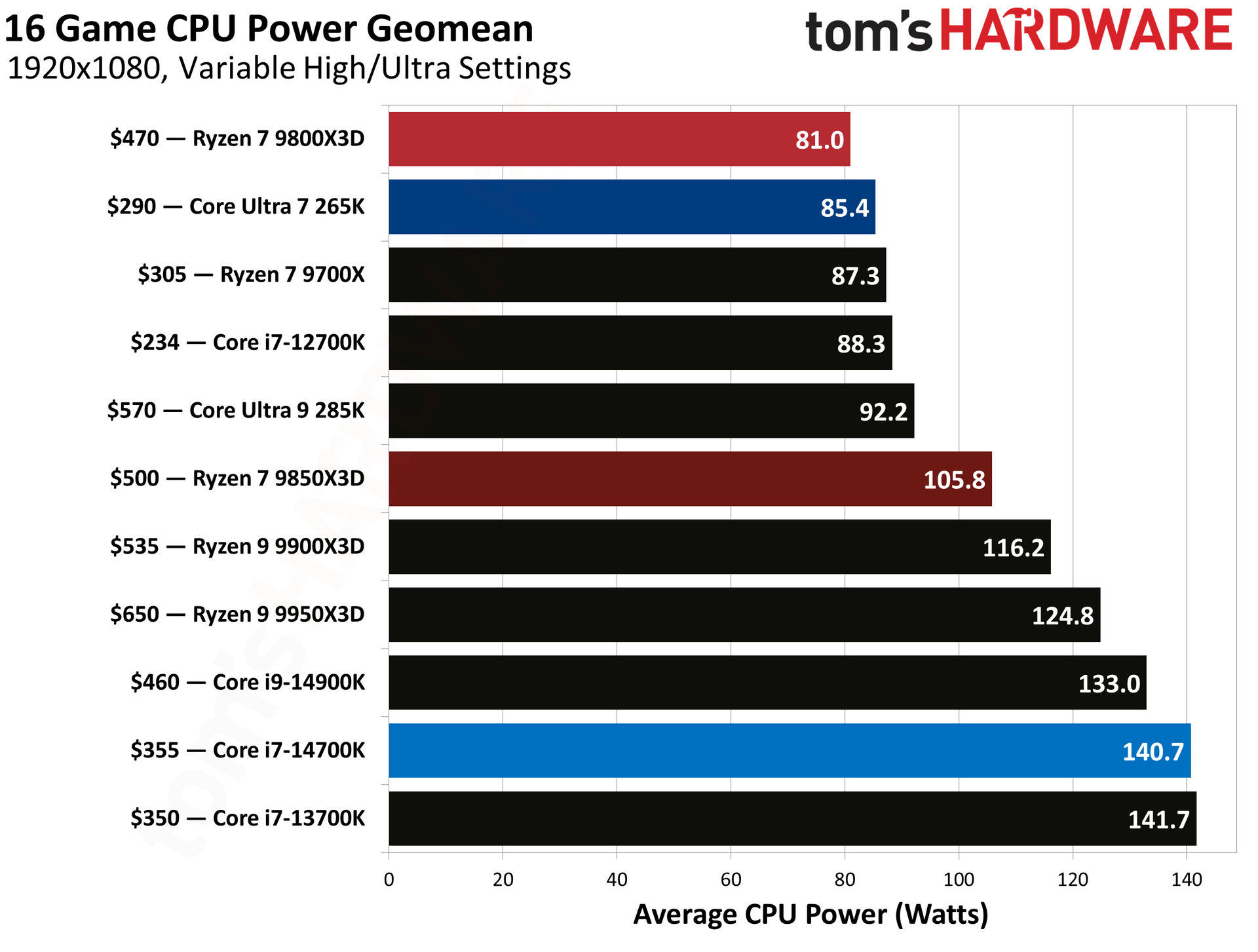
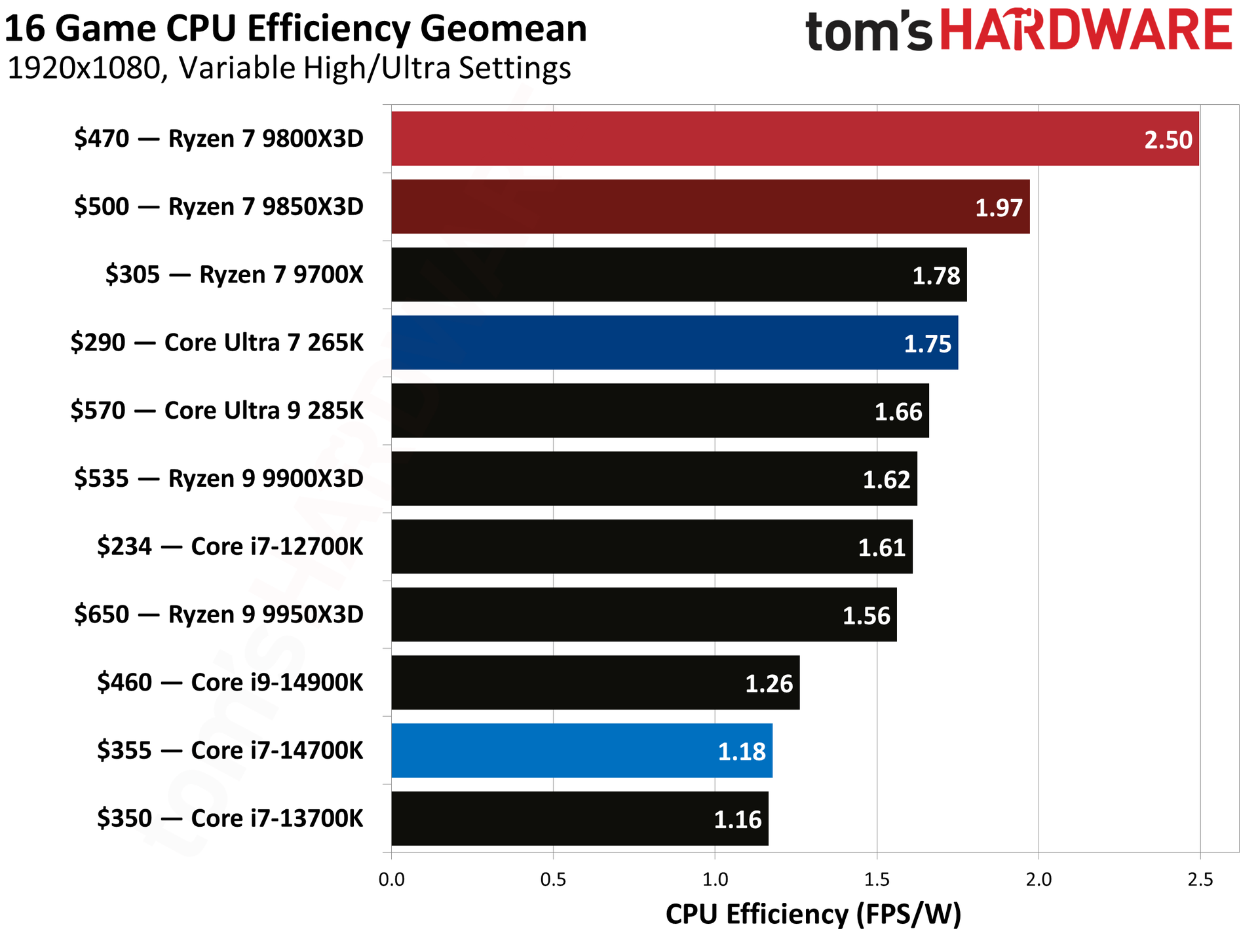
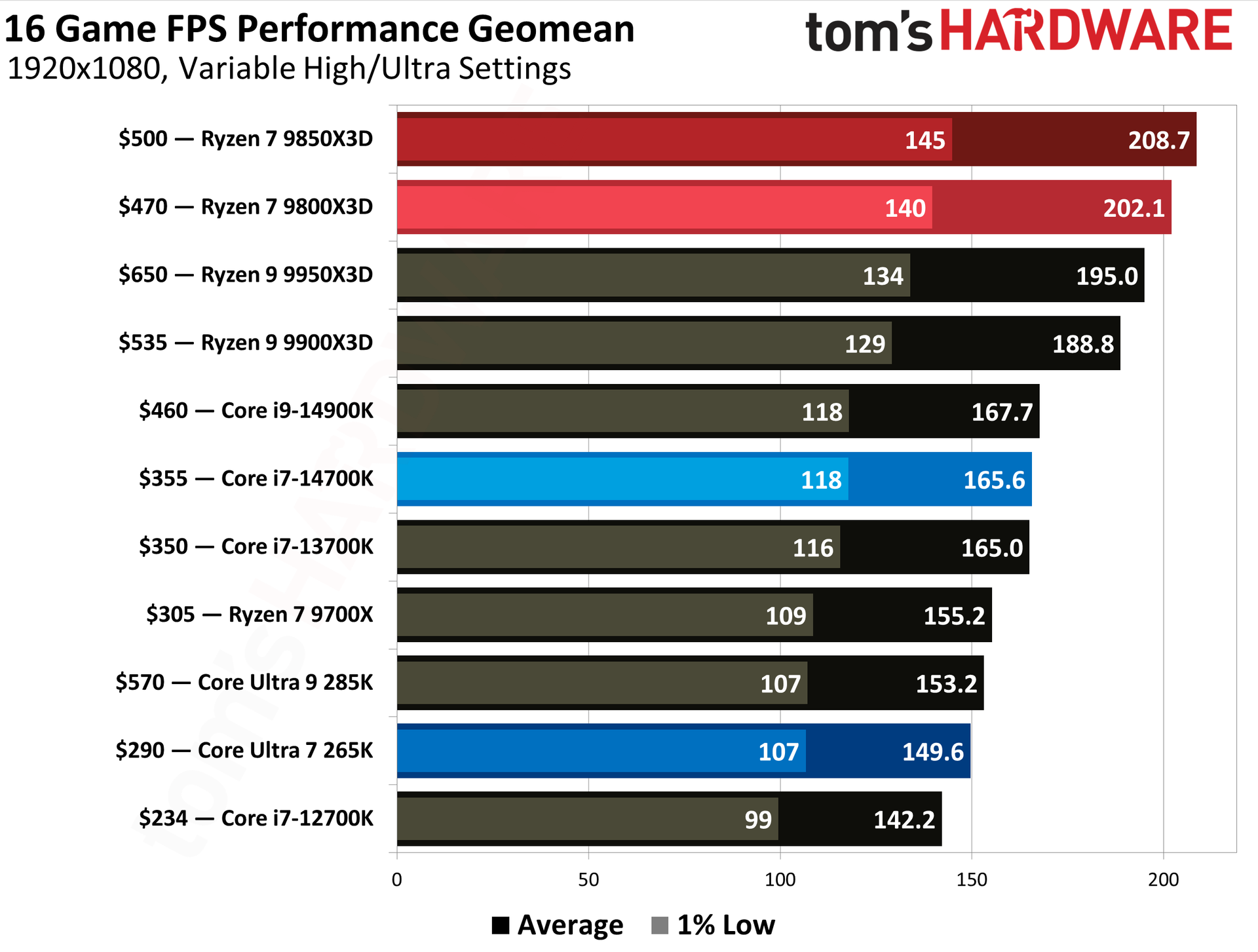
In our in-depth testing of the Ryzen 7 9850X3D, we found that it was only 3.3% faster than the Ryzen 7 9800X3D. But a win is a win, and that performance edge puts the CPU at the top of our 16-game 1080p FPS performance geomean, beating the more expensive Ryzen 9 9900X3D and 9950X3D. Although it loses out to Intel in some productivity workloads, the less complex 8-core configuration packed into a single CCD results in lower power draw. As you can see from our results, the peak power consumption is around 170W, making it much easier to cool.
With the included 240mm AIO liquid cooler, you should be able to keep the Ryzen 7 9850X3D well under control during gaming and moderate workloads, although it may run warmer under heavy multi-core workloads. At its sale price of $484, you’re paying less than its actual launch price while getting two useful extras at no additional cost. That makes this a worthwhile deal for anyone looking to build a high-end gaming PC around AMD’s gaming-focused platform.
AZZA is one of those brands that has been around far longer than its shelf presence suggests. The company is the PC-components arm of Linkworld Electronic, and it has spent the better part of two decades selling cases, coolers, chassis fans and power supplies into the value end of the market, mostly through regional distribution rather than the big review-sample circuit. That low profile cuts both ways. AZZA has never had the marketing budget to overpromise the way larger brands do, but it also has never had to answer for its power supplies in public the way brands like Corsair or Cooler Master routinely do. Like almost every brand in this segment, AZZA designs none of their units themselves but buys platforms from (usually Chinese) OEMs and puts its own sticker on the side.
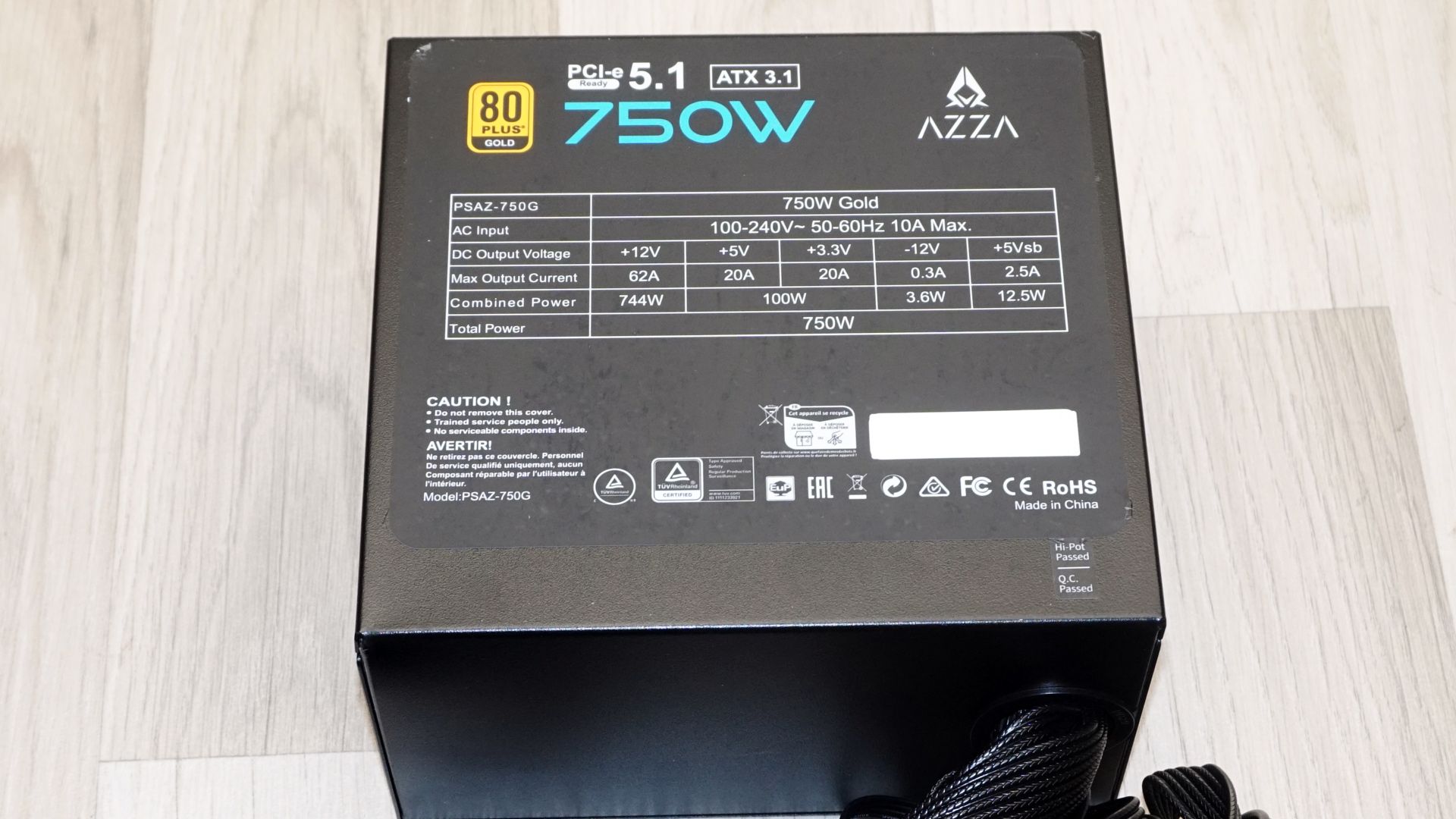
The PSAZ series is AZZA's mainstream ATX line, and the PSAZ-750G is the 750W Gold-badged member of it. The unit we have is marked ATX 3.1 and PCIe 5.1 Ready on the box, carries a native 12V-2x6 connector, and is rated for its full 750W at 40°C ambient. It ships with a 2-year warranty, which is a statement all by itself. The platform comes from Helly, a manufacturer that supplies a number of platforms and we meet their products frequently in mainstream units. What makes the PSAZ-750G interesting is not the specification sheet but the badge on it: the box, the label and the retail listings all carry the 80 PLUS Gold logo, and AZZA has not put a PSAZ unit through 80 PLUS certification since 2015. That claim, more than anything else, is what this review has to settle and determine whether it deserves a spot in our list of best power supplies.
Specifications and Design
AZZA PSAZ-750G ATX 3.1 Power specifications ( Rated @ 40 °C )
RAIL
+3.3V
+5V
+12V
+5Vsb
-12V
MAX OUTPUT
20A
20A
62A
2.5A
0.3A
100W
100W
744W
12.5W
3.6W
TOTAL
750W
AC INPUT
100 - 240 VAC, 50 - 60 Hz
MSRP
$78
In the Box
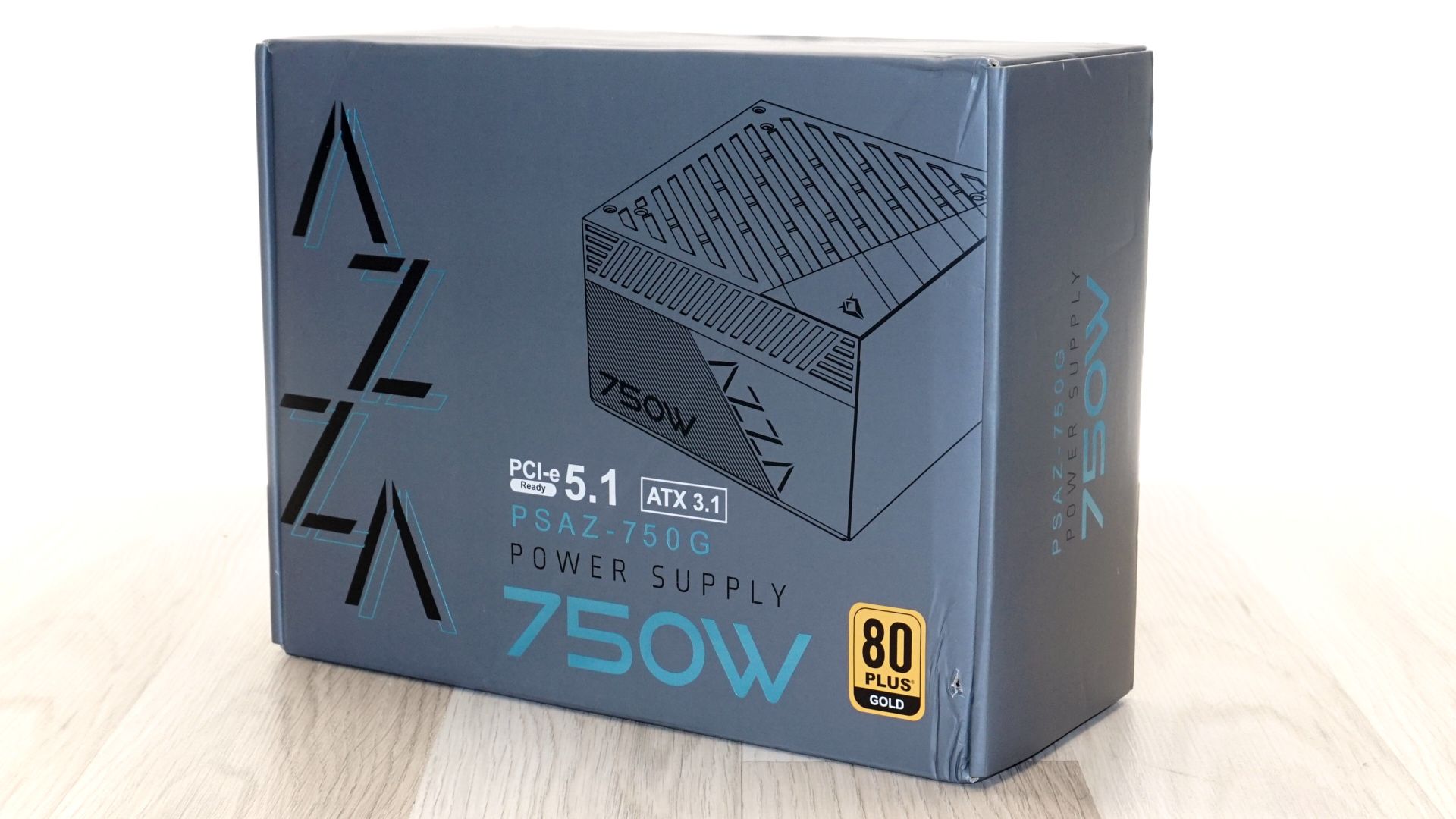
Packaging is plain and inexpensive, and honest about it. The sleeve is a flat slate-blue with the AZZA wordmark rendered as three large outlined chevrons on the left, a line drawing of the unit on the right, and the model and wattage stacked underneath. The badges run along the lower half - PCI-e 5.1 Ready, ATX 3.1, and the 80 PLUS Gold logo in its usual gold square. The unit sits inside between two moulded protective inserts, with the cables bundled beside it.
(Image credit: Tom's Hardware)
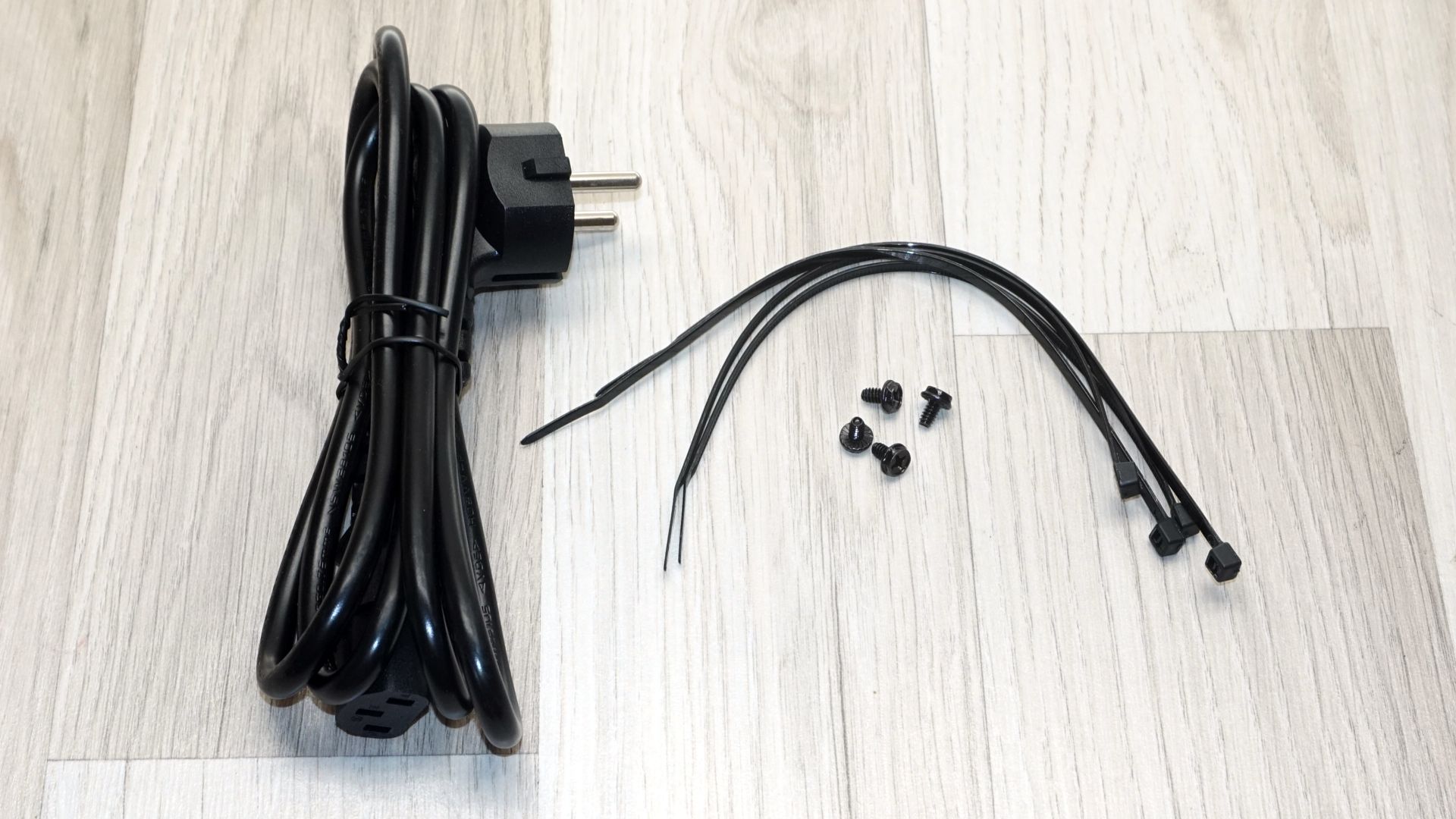
The bundle is as thin as it gets. There is the AC power cord, four mounting screws and four black zip ties. No Velcro straps, no cable combs, no pouch, no tester, and nothing in the way of printed documentation beyond what is on the box itself. At $78 for a 750W unit, none of that is unreasonable, but it is worth noting that the four zip ties are doing real work here. With a hardwired cable set there is no way to leave unused cables out of the case, so whatever routing tidiness you get, you will be building yourself.
(Image credit: Tom's Hardware)
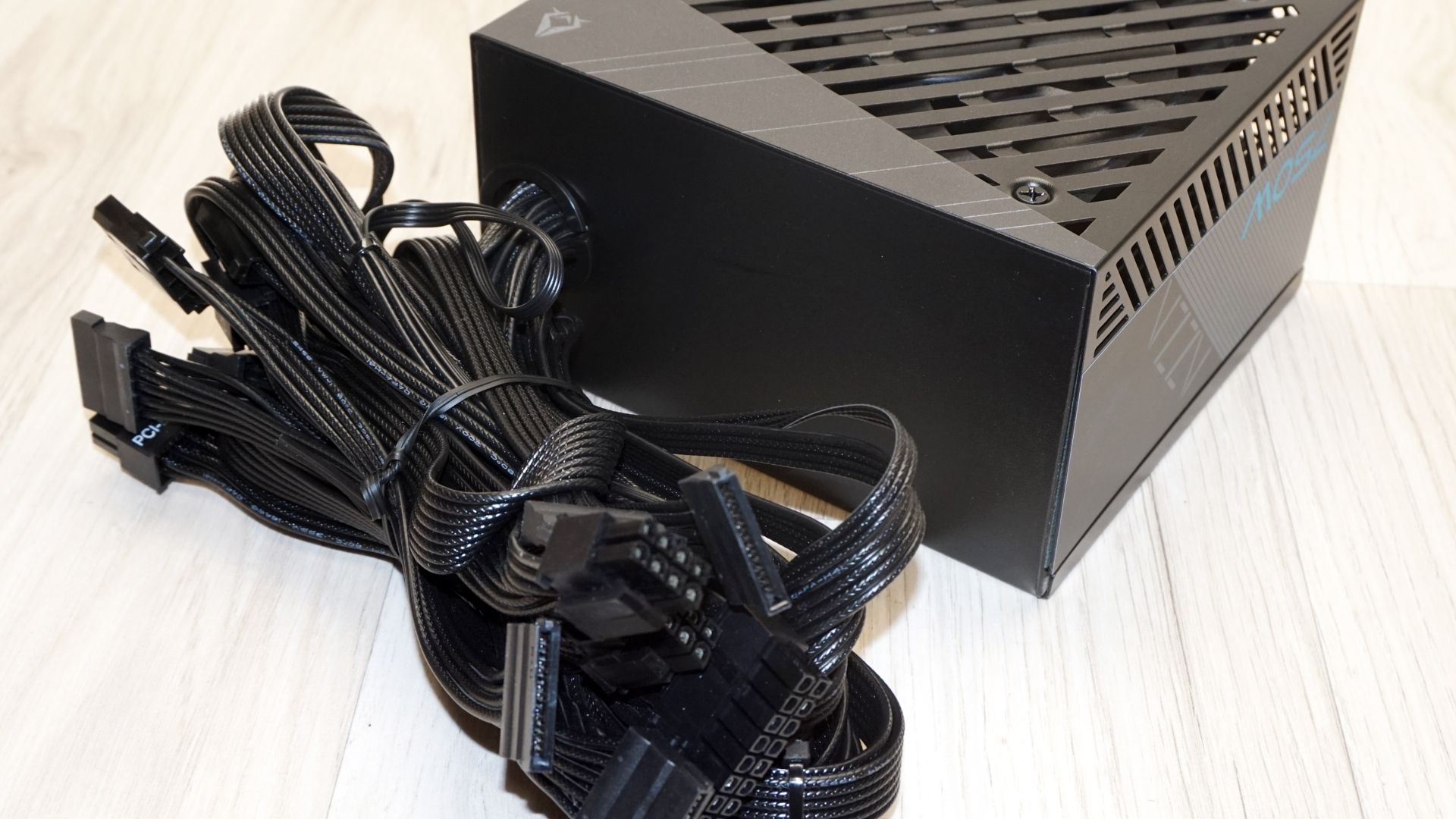
The cables themselves are better than the accessory list implies. All of them are black nylon-sleeved rather than the flat ribbon type common at this price, sleeved right up to the connector housings, and the wire gauges look appropriate throughout. The 12V-2x6 cable is a native run from the PCB rather than an adapter, and it is printed with a 450W rating along its length, which is the single most important thing to know about this power supply before you buy it. That is enough for a mid-range card, and not enough for a 500W+ flagship, regardless of what the 750W on the box suggests. There is no dual-color keying on the connector, so seating it correctly is on you.
AZZA PSAZ-750G ATX 3.1
Connector type
Hardwired
Modular
ATX 24 Pin
1
-
EPS 4+4 Pin
2
-
EPS 8 Pin
-
-
PCI-E 5.1
1
-
PCI-E 8 Pin
3
-
SATA
6
-
Molex
2
-
Floppy
-
-
External Appearance
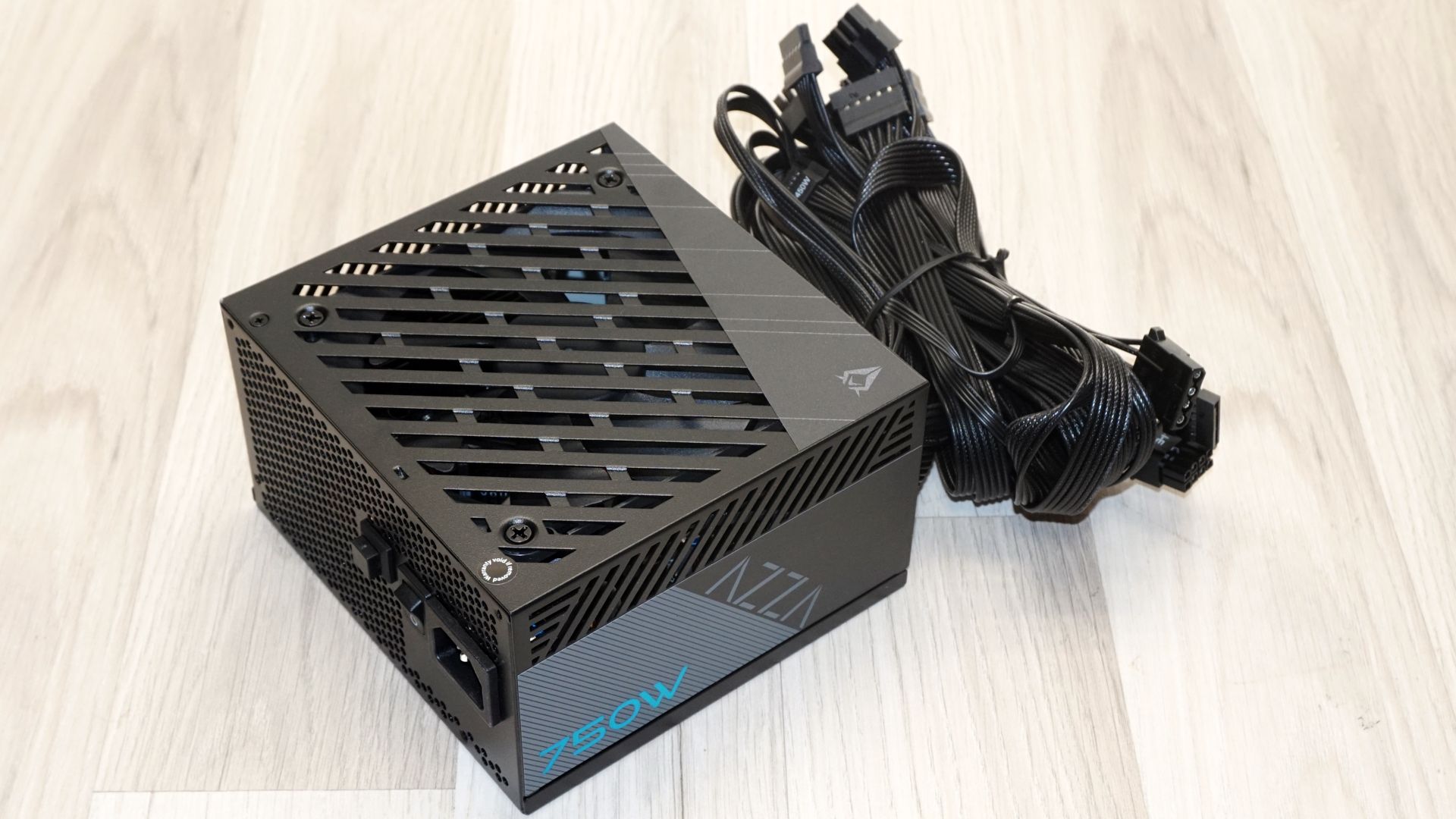
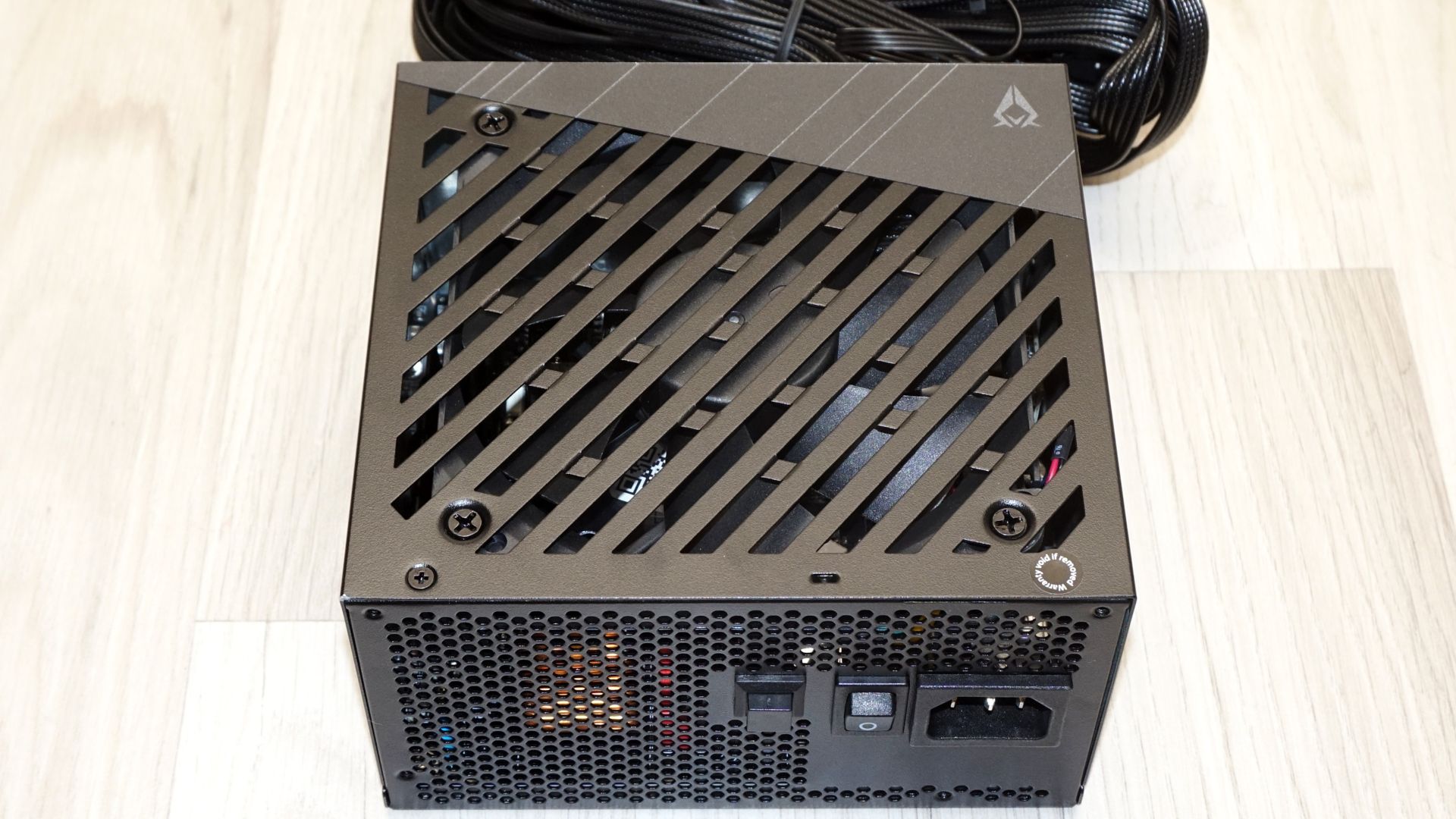
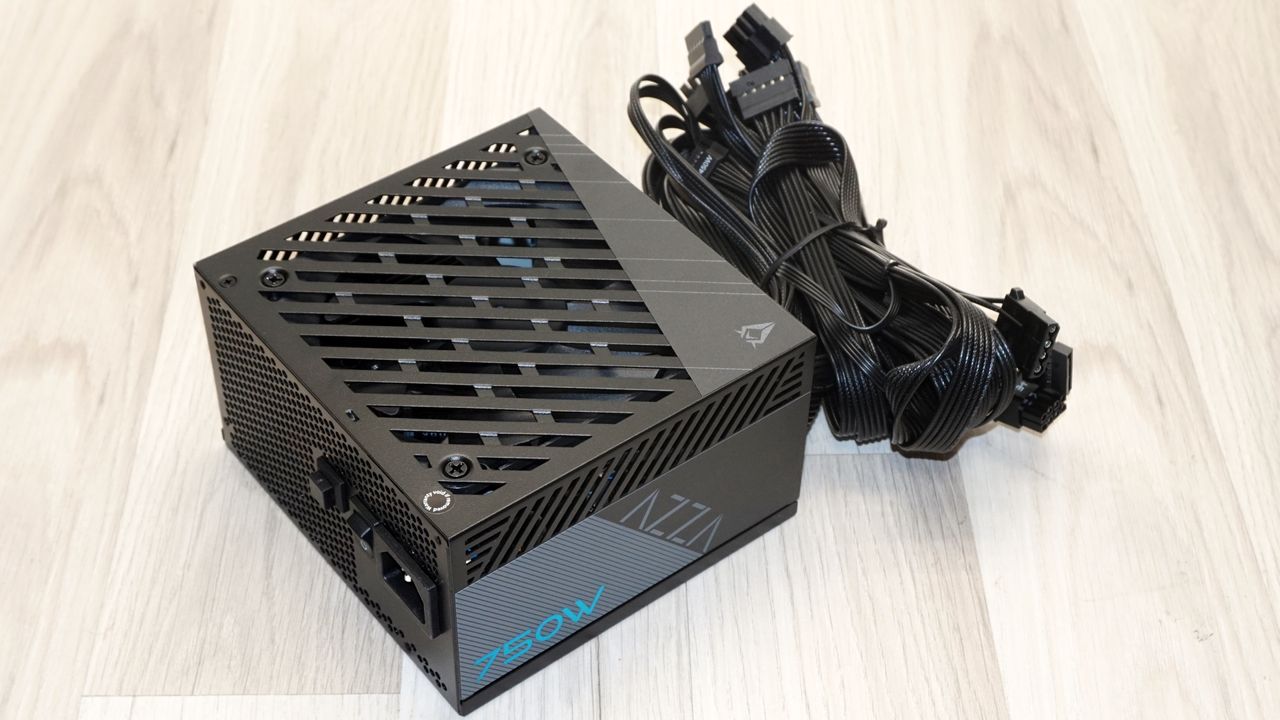
At 150 x 86 x 140 mm the PSAZ-750G is a standard-depth ATX unit, and 140 mm means it drops into essentially any case that takes an ATX supply, with enough clearance left over to deal with the fixed cable loom. The chassis is finished in a dark grey-brown matte paint and it is a better finish than the price would predict. The top face carries a slotted grille with wide diagonal bars over the fan, cut off at one corner by a plain triangular panel bearing the AZZA logo and a few thin pinstripes. It is a restrained, slightly industrial look, and the diagonal grille bars do restrict airflow area more than a wire or honeycomb grille would, which increases noise.
(Image credit: Tom's Hardware)
The side panel carries the only color on the unit: a grey hatched rectangle with the AZZA wordmark in outline and 750W set in a bright cyan that matches the box. The top side holds the specifications label, and it is worth reading. It lists the ATX 3.1 and PCIe 5.1 Ready marks and, again, the 80 PLUS Gold logo.
(Image credit: Tom's Hardware)
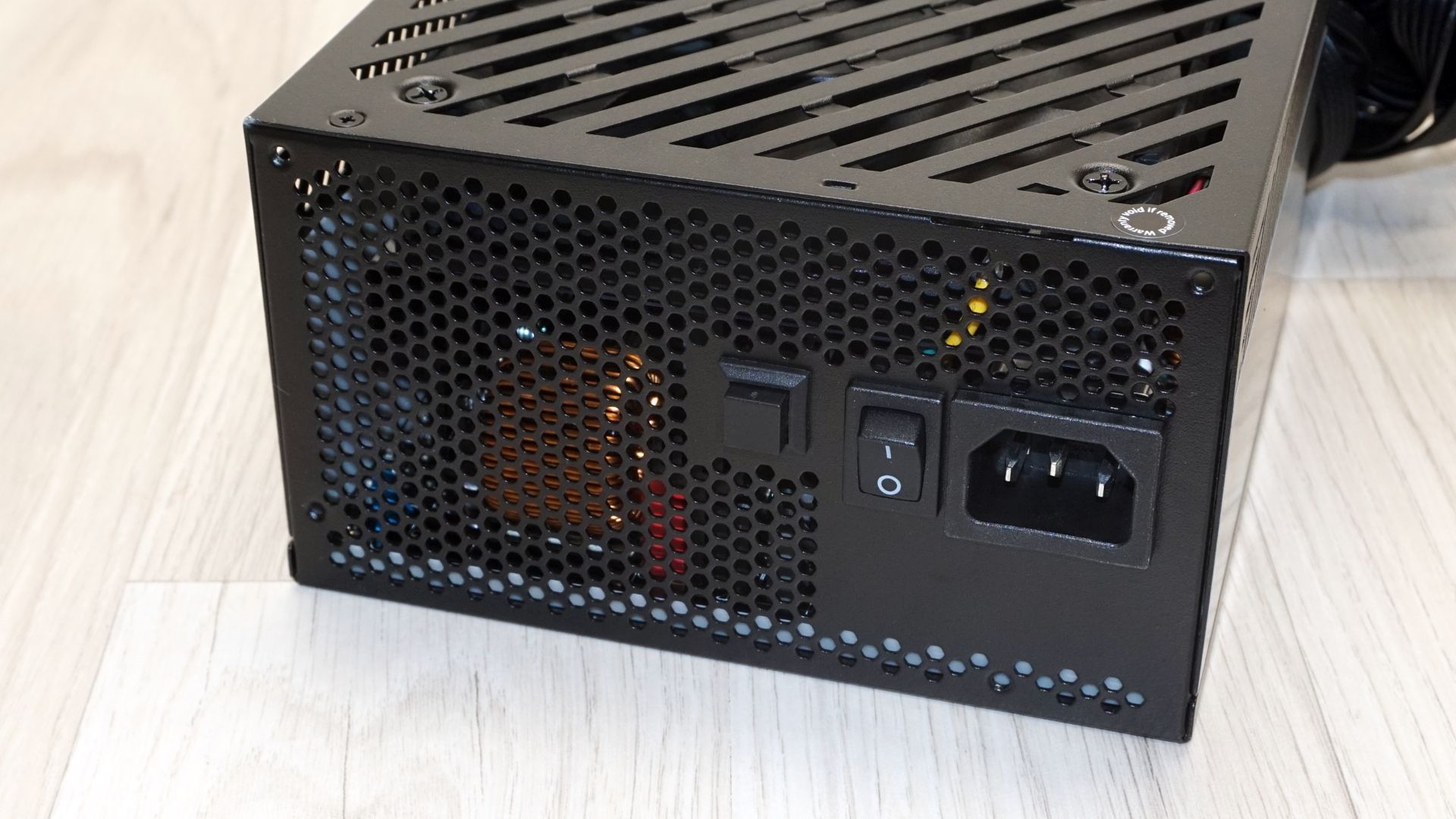
The rear face is a hexagonal honeycomb exhaust panel with the AC receptacle, the main I/O rocker, and a second, smaller square button beside it. That button is the hybrid fan mode switch: press it and the semi-passive behavior is disabled, so the fan runs continuously from idle rather than waiting for load. It is a feature several units at three times this price still omit, and it is faintly odd to find it here. The front face is solid, with the fixed cable loom leaving through a single rubber-grommeted opening. There is no modular bay, no LED, and no other features.
Tom's HardwareTom's Hardware
Internal Design
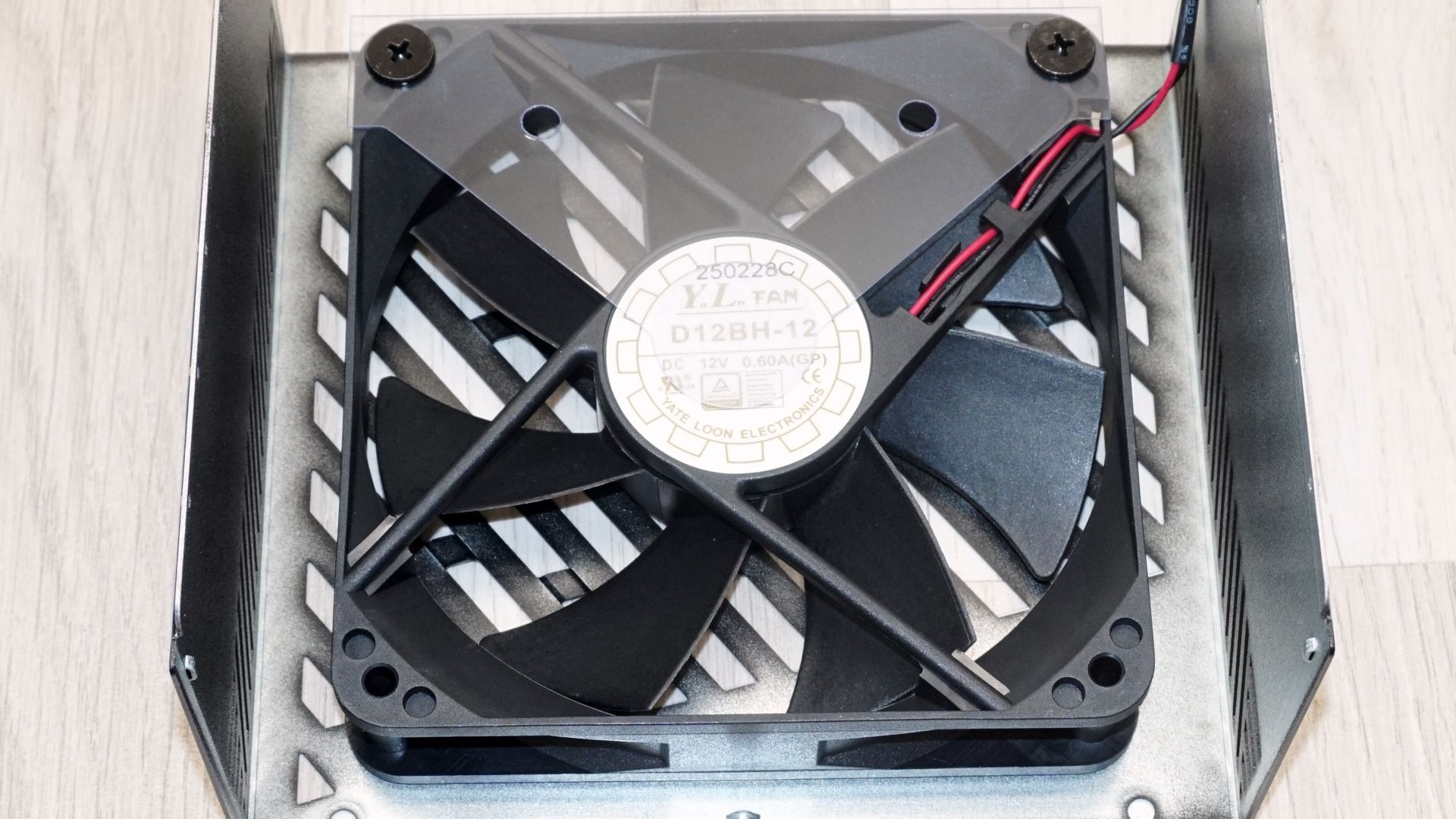
Cooling comes from a 120 mm Yate Loon D12BH-12, a ball-bearing fan rated at 12V and 0.60A. Yate Loon publishes this model at 2300 RPM, 89 CFM and 41 dB(A) at full speed, which puts it firmly in the high-airflow, high-noise half of the catalogue. Ball bearings are a durability advantage over the sleeve-bearing fans that usually appear at this price, and given the 2-year warranty that matters - a fan that outlasts the coverage period is the minimum bar. What it is not is a quiet fan, and the platform leans on it hard, as the hot-box results below make clear.
(Image credit: Tom's Hardware)
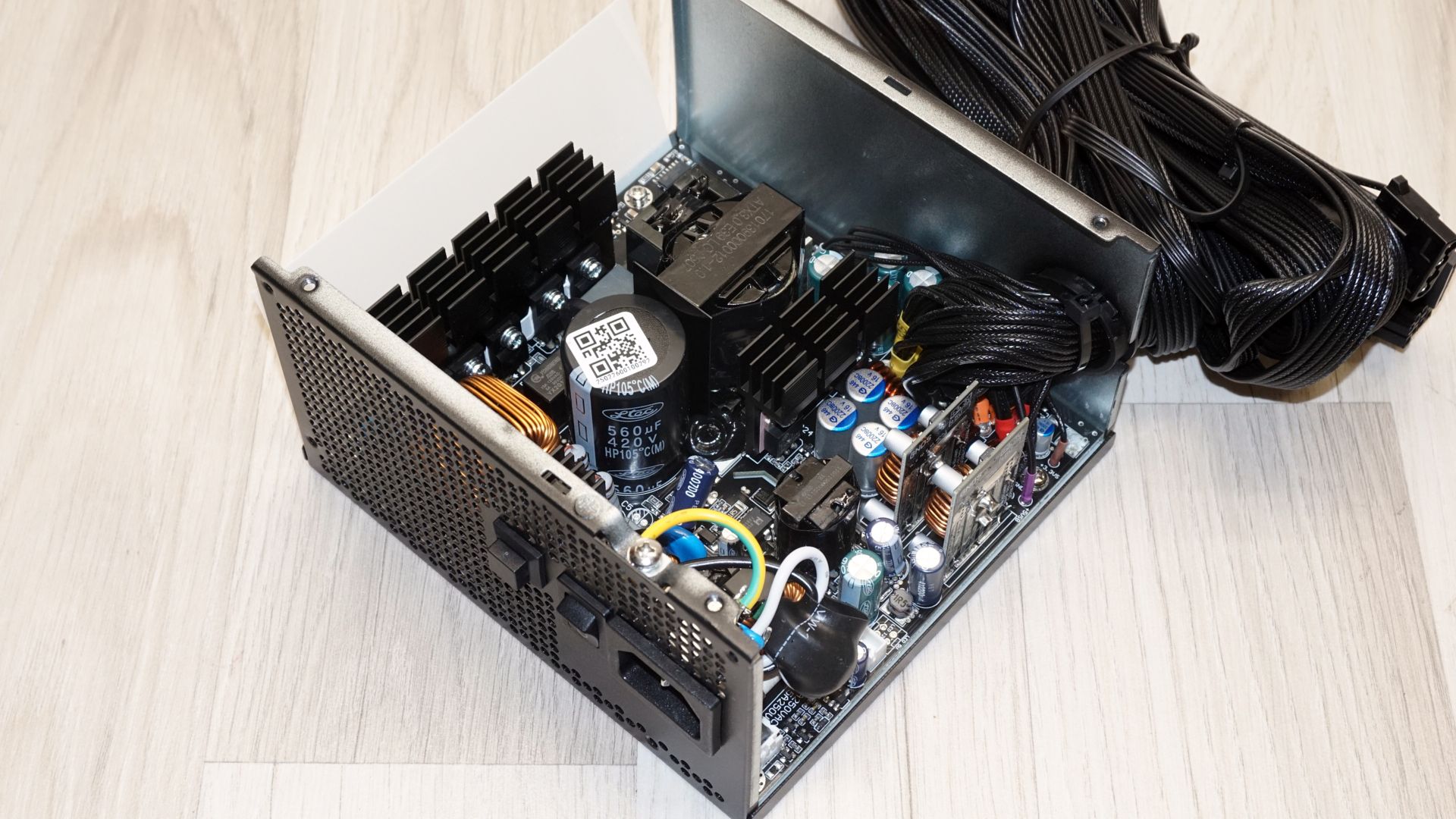
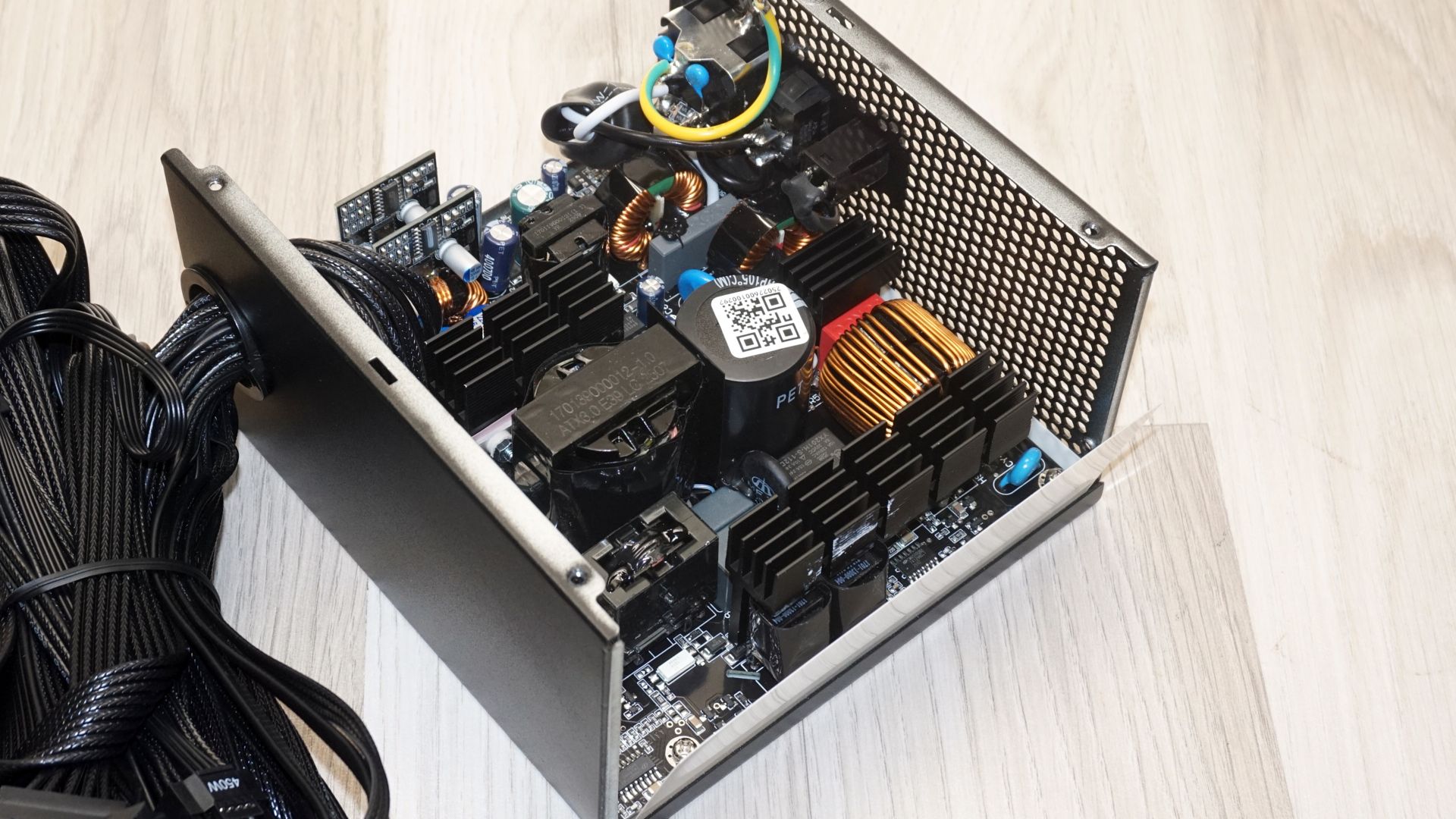
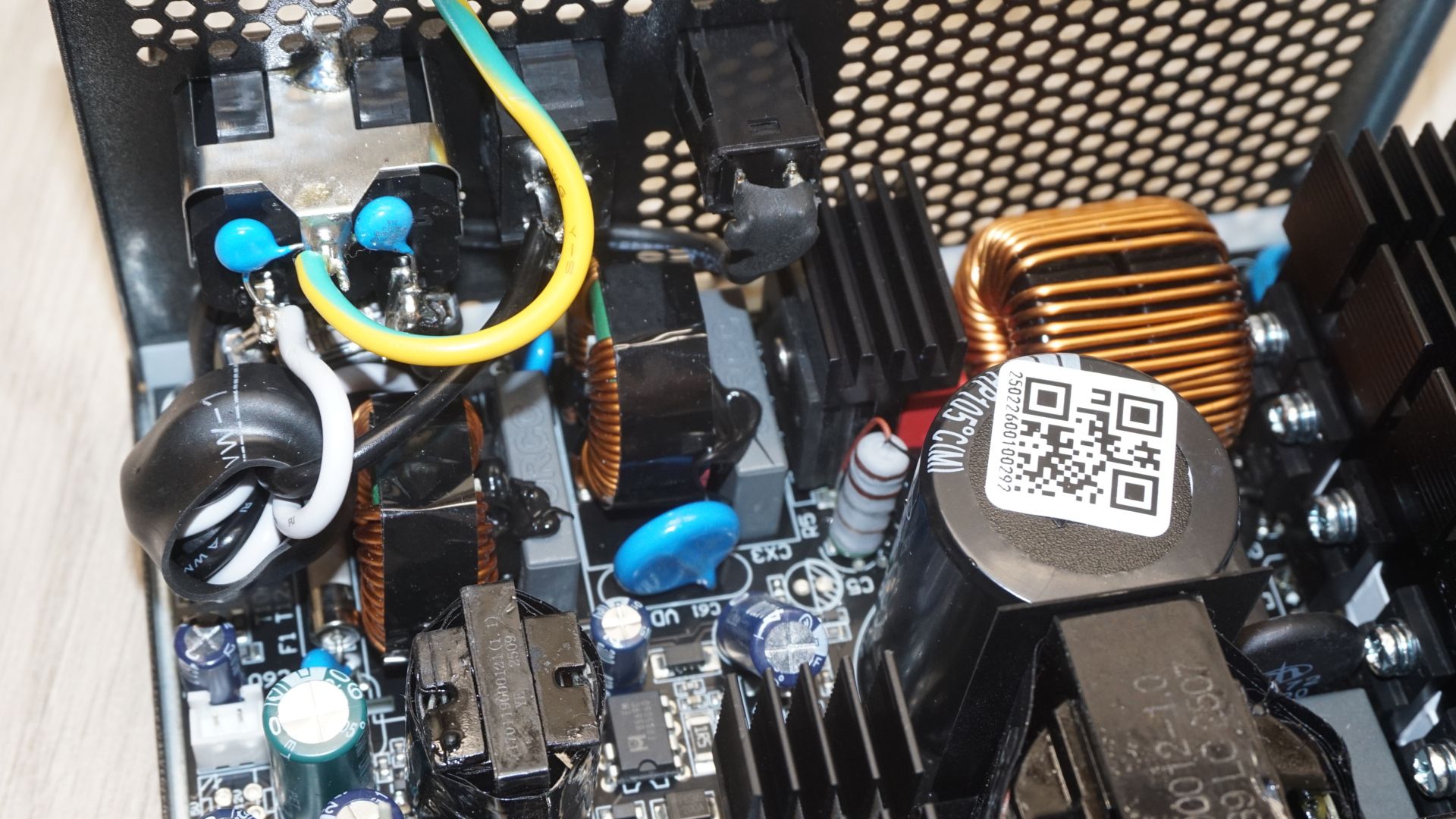
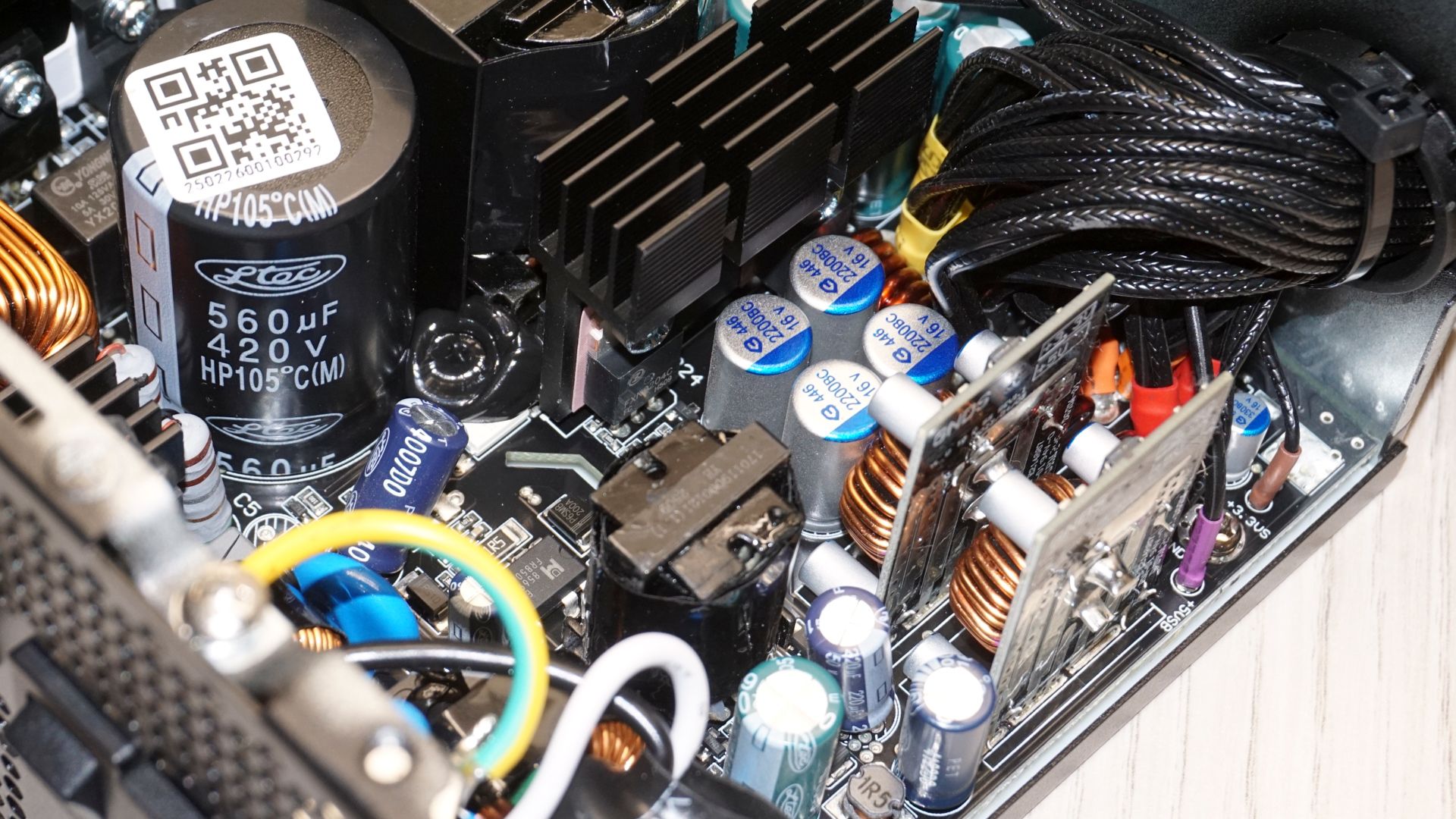
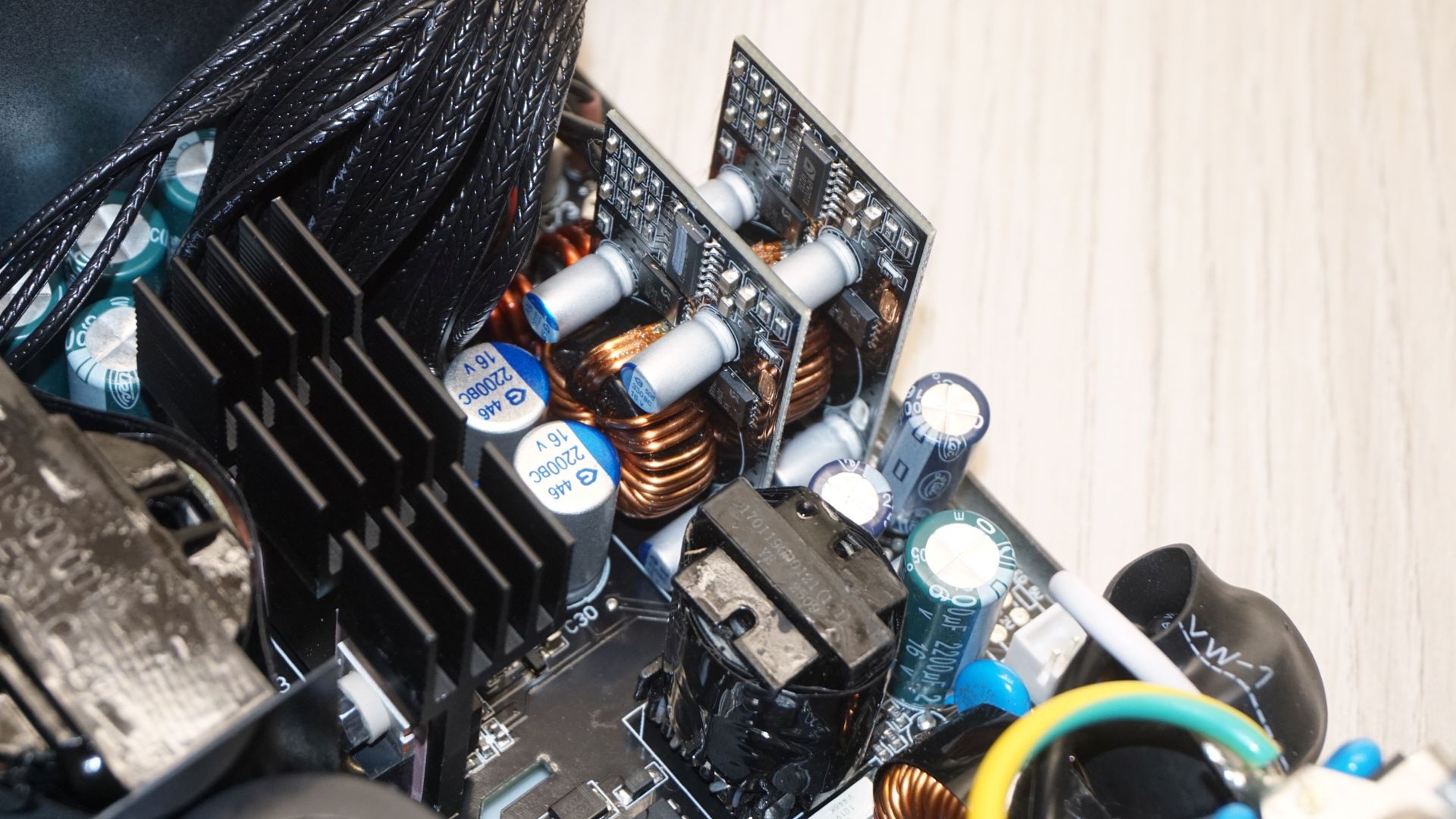
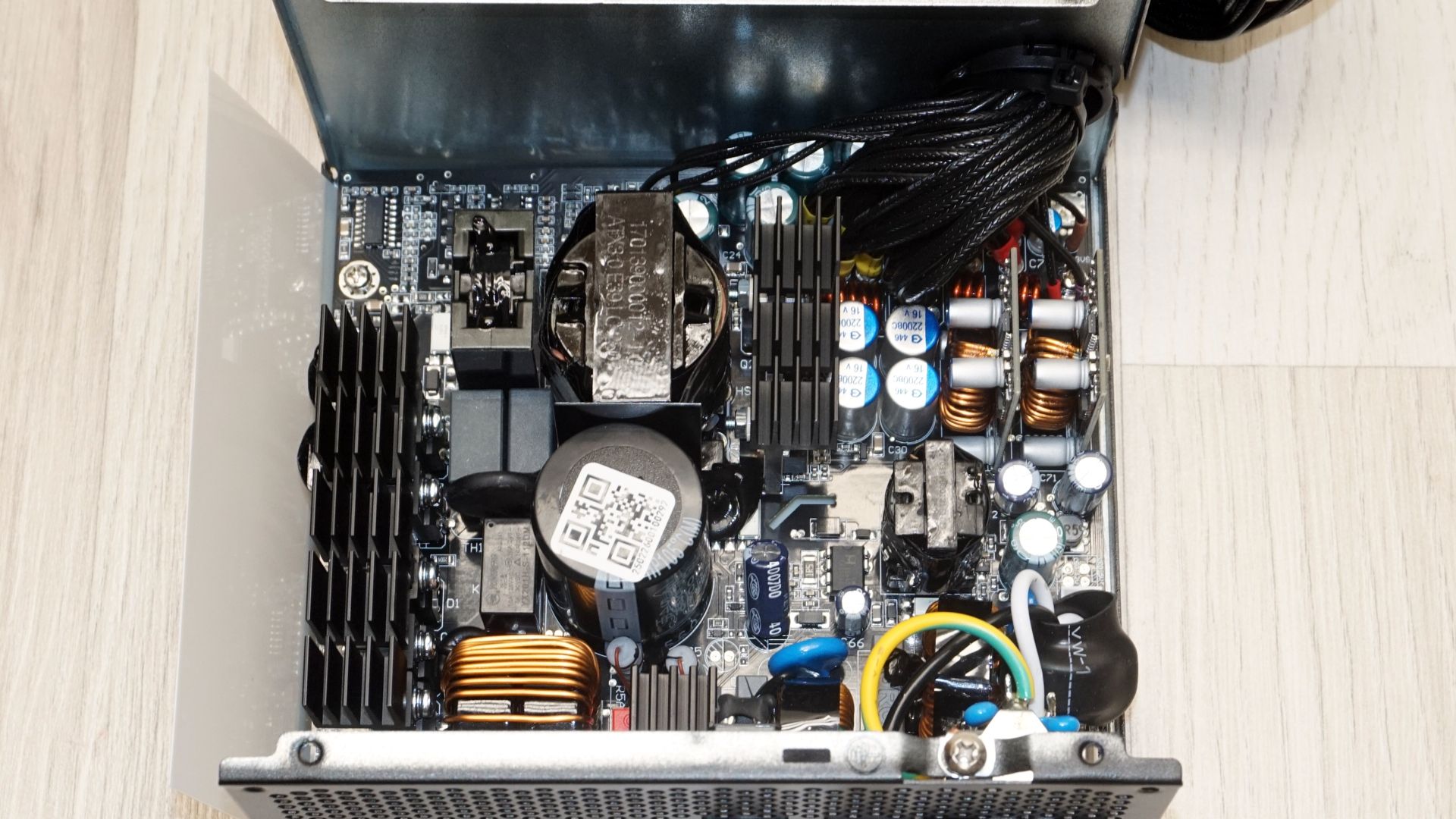
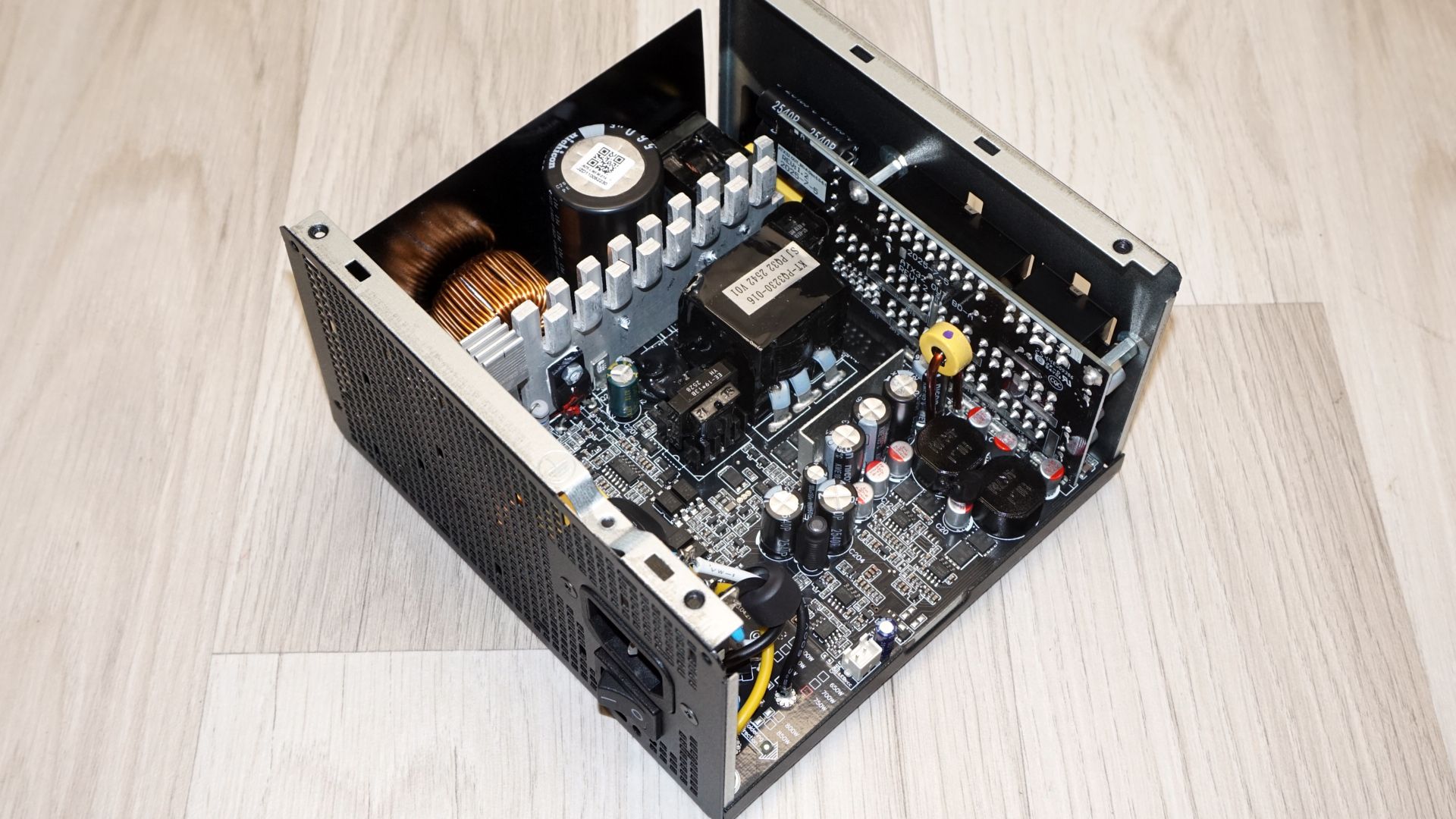
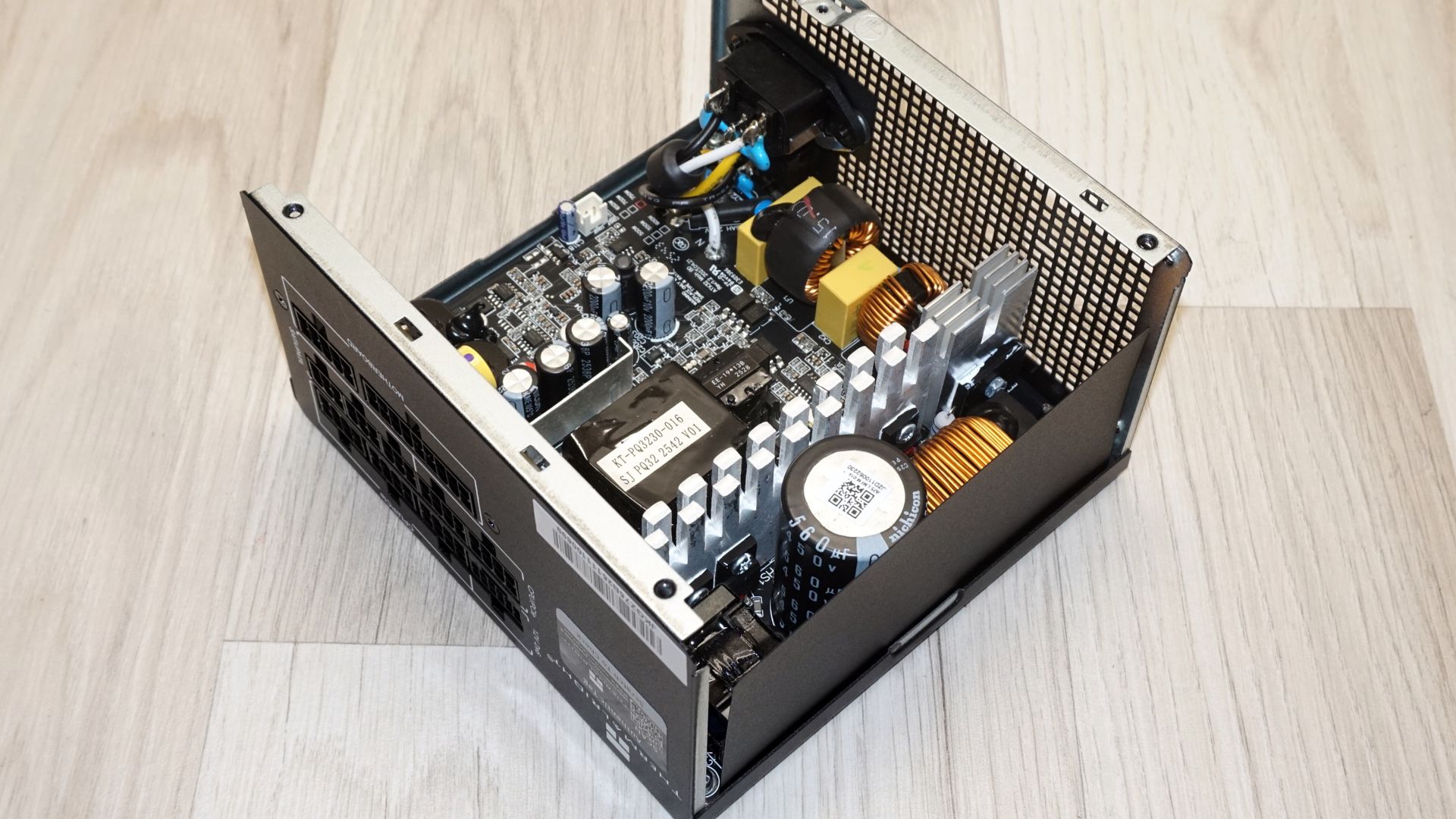
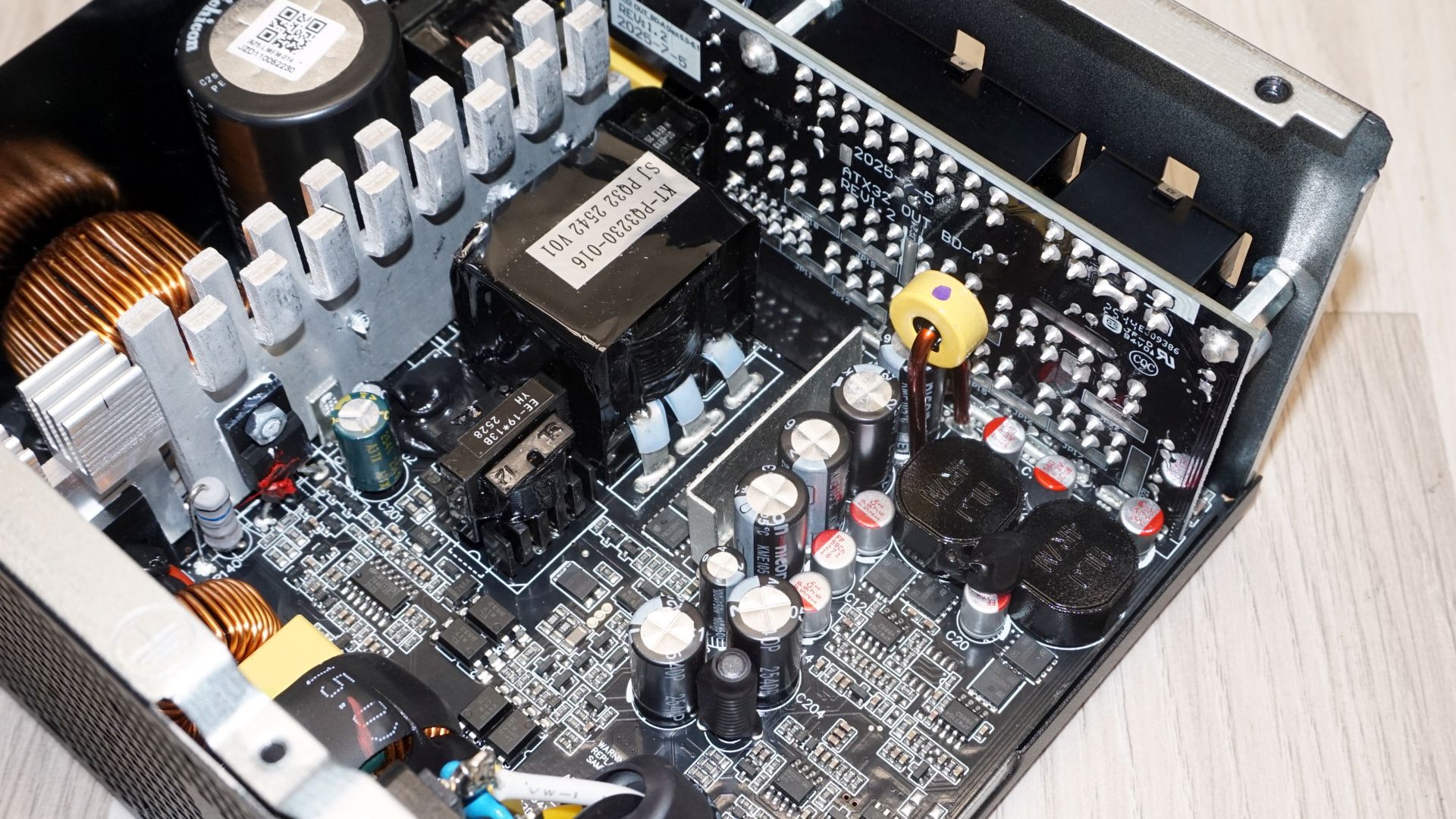
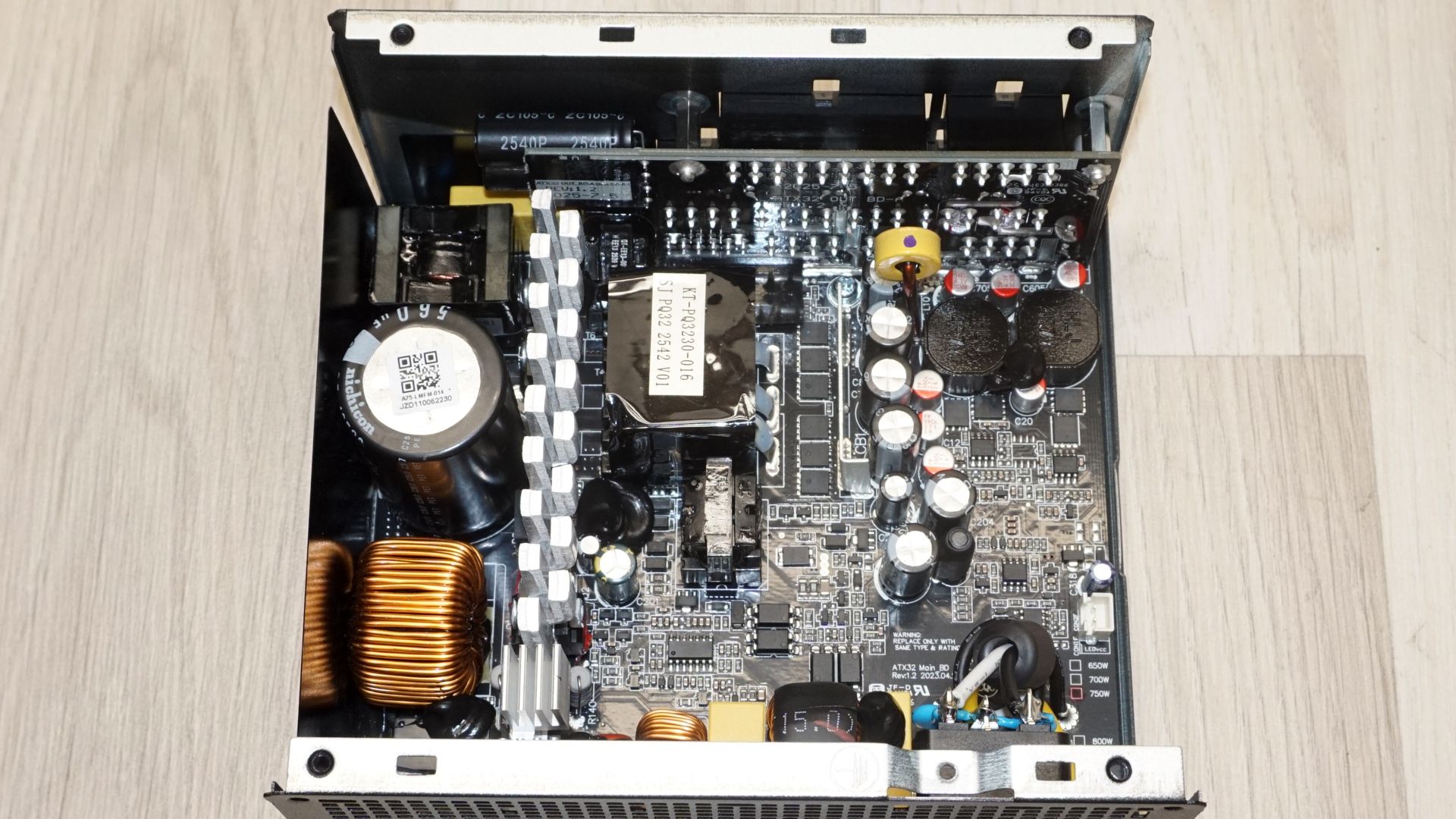
The platform is a Helly design and is similar to the platform Phanteks AMP GH series is using - but that is where the similarities end. The layout is clean and reasonably modern, with the main PCB carrying the primary and secondary stages and a pair of small vertical daughterboards near the front handling the minor rails. Heatsinks are generously sized for the class, dark-anodised finned extrusions rather than the bent aluminium strips that budget platforms often make do with, and the board is well populated with silicone glue on the taller components. The main transformer is marked ATX3.0 on the bobbin, which is a small reminder of how recent the 3.1 revision on the box actually is.
Tom's HardwareTom's Hardware
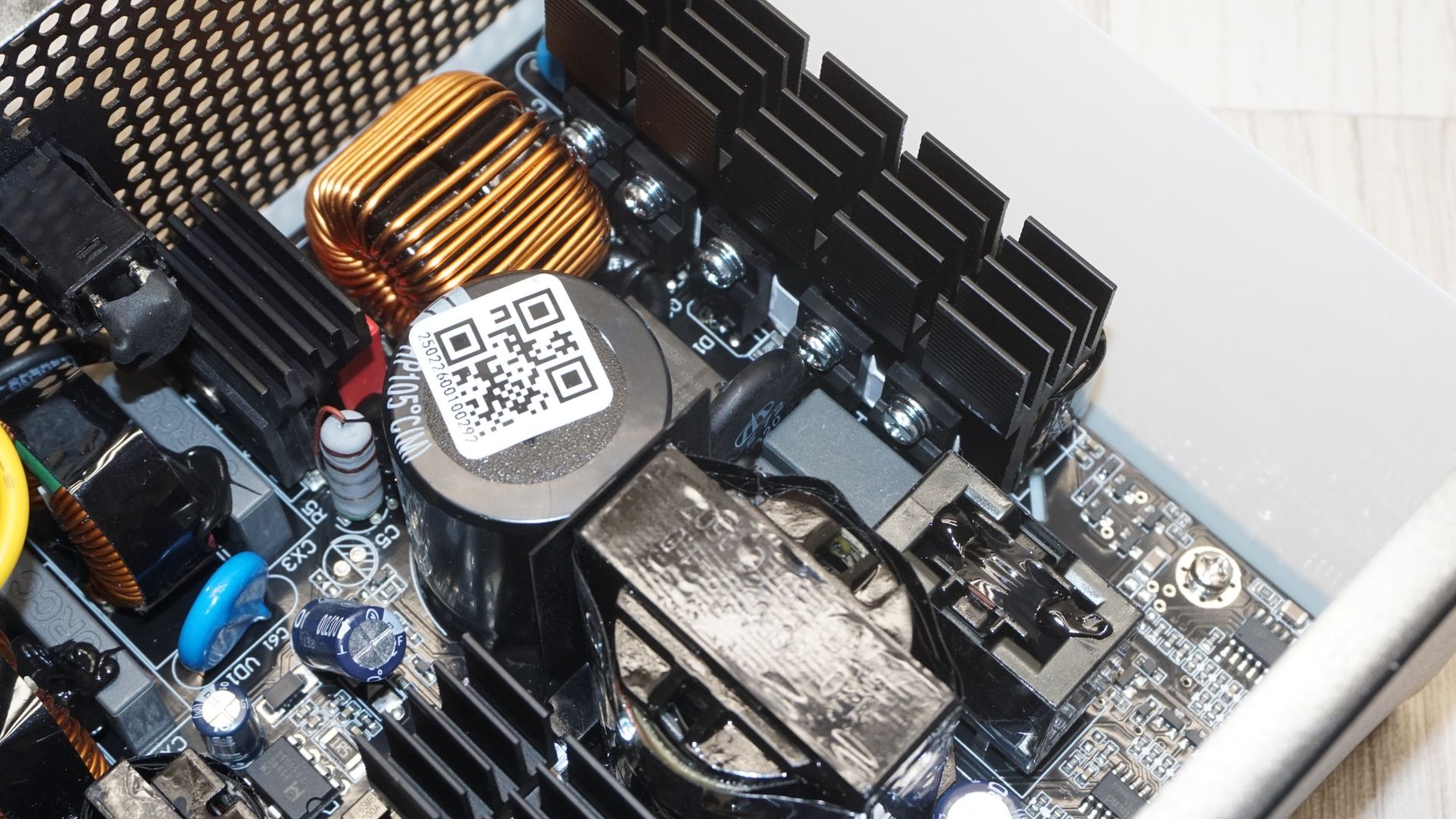
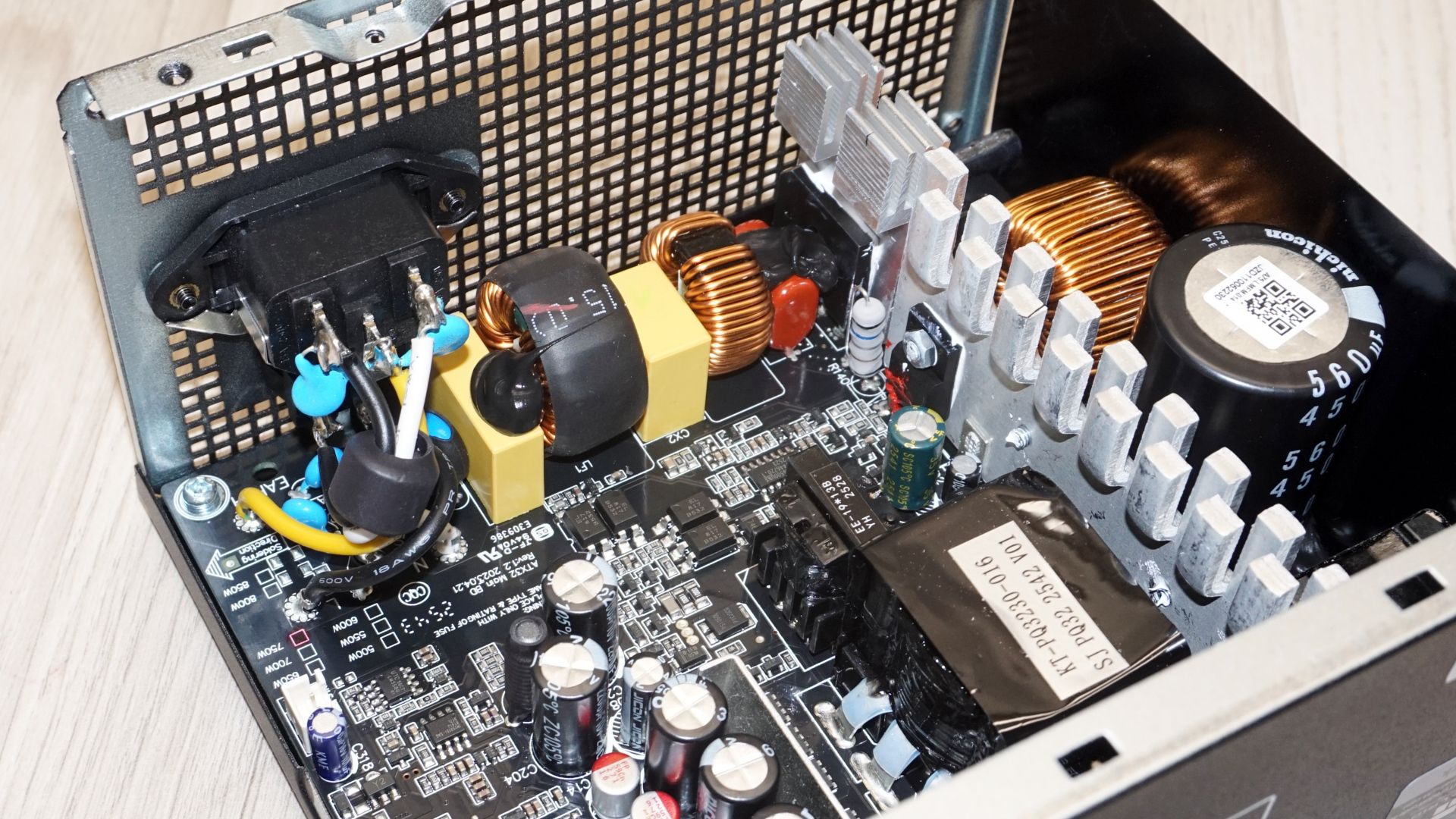
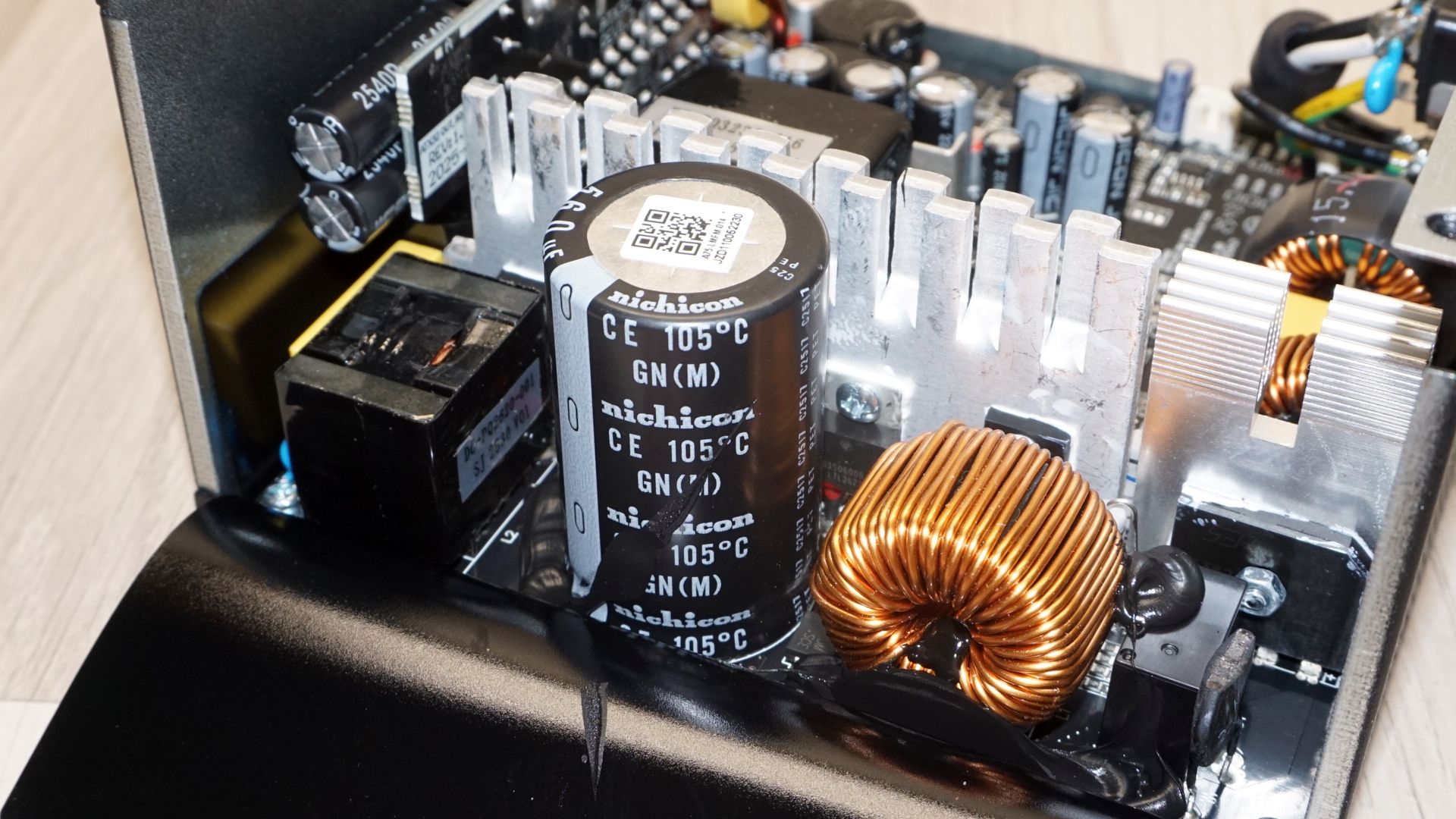
Transient filtering runs to four Y capacitors, three X capacitors and two common-mode chokes, which is a complete filter by any reasonable standard and better provisioned than several units we have looked at this year. Inrush is handled by an NTC thermistor with a relay for bypass. Two bridge rectifiers sit on their own dedicated heatsink, feeding an APFC stage built around two Oriental Semiconductor OSG55R190F MOSFETs. The bulk capacitor is a 560 µF, 420V Ltec from its HP series, rated at 105°C. That is a low-cost Taiwanese part rather than a premium one, and it is the first place the budget shows. Capacity is adequate for 750W, the temperature rating is right, but the pedigree is not. The APFC coil beside is unshielded, which is a cost decision rather than a functional problem, though it does nothing for radiated noise.
(Image credit: Tom's Hardware)
The primary inversion stage uses two PIP PTA25N50 MOSFETs in a half-bridge LLC resonant arrangement, the standard modern topology at this power level. On the secondary side, the 12V rail is rectified by four Fuxin FXN0204C MOSFETs in synchronous rectification, with the 3.3V and 5V rails generated by DC-to-DC converters on the two vertical daughterboards.
Tom's HardwareTom's Hardware
Secondary filtering is a mix of Ltec electrolytics and a smaller number of APAQ polymer capacitors, both Taiwanese. This is the part of the component list that will decide how the unit ages: Ltec electrolytics are not terrible parts, but they are at best ordinary ones, and they will spend their life sitting next to secondary heatsinks that may hit well over 70 °C in a normal system. A 2-year warranty against that combination is not a comfortable pairing.
(Image credit: Tom's Hardware)
Cold Test Results (25°C Ambient)
Cold Test Results (25°C Ambient)
For the testing of PSUs, we are using high-precision electronic loads with a maximum power draw of 2700 Watts, a Rigol DS5042M 40 MHz oscilloscope, an Extech 380803 power analyzer, two high-precision UNI-T UT-325 digital thermometers, an Extech HD600 SPL meter, a self-designed hotbox, and various other bits and parts.
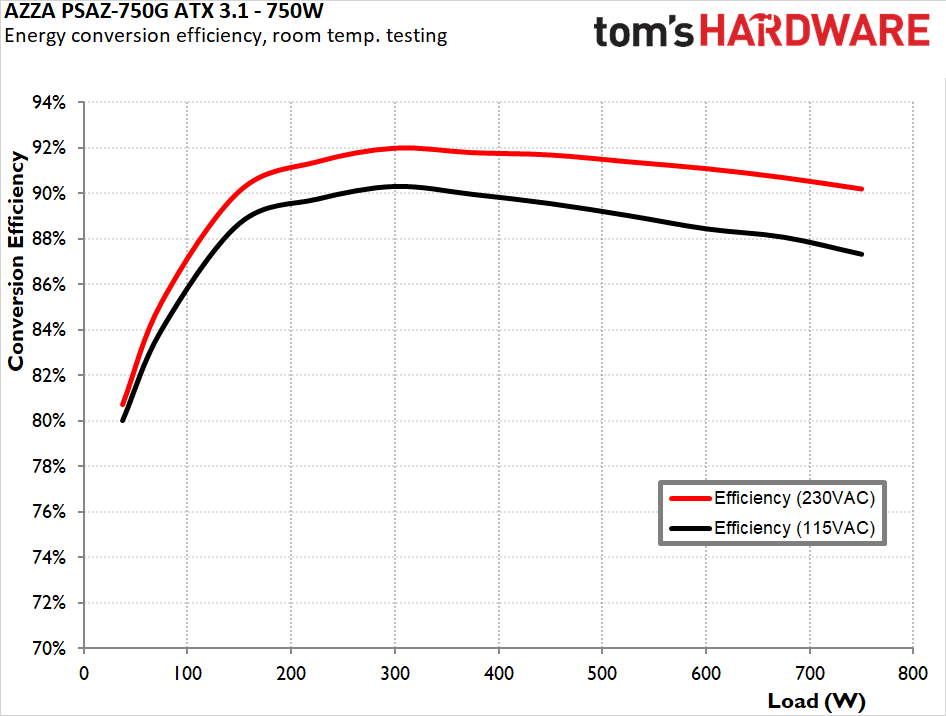
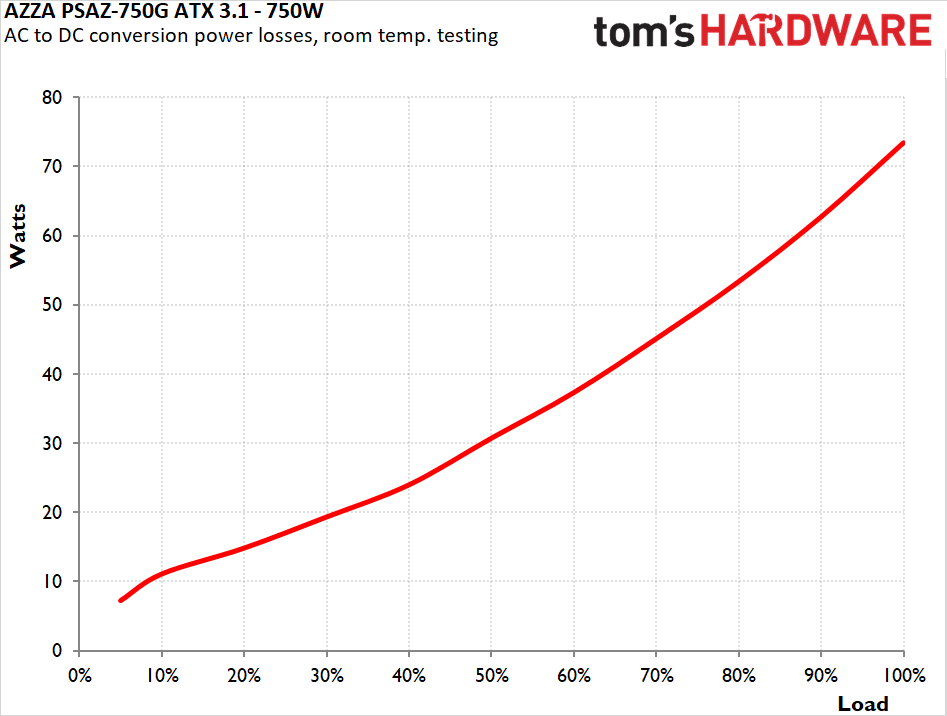
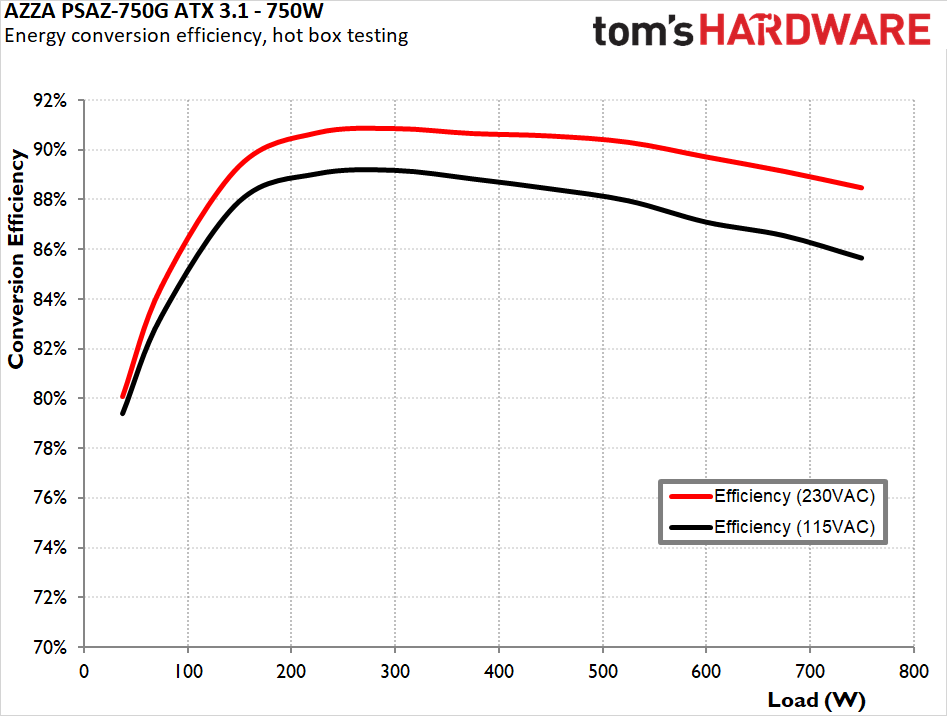
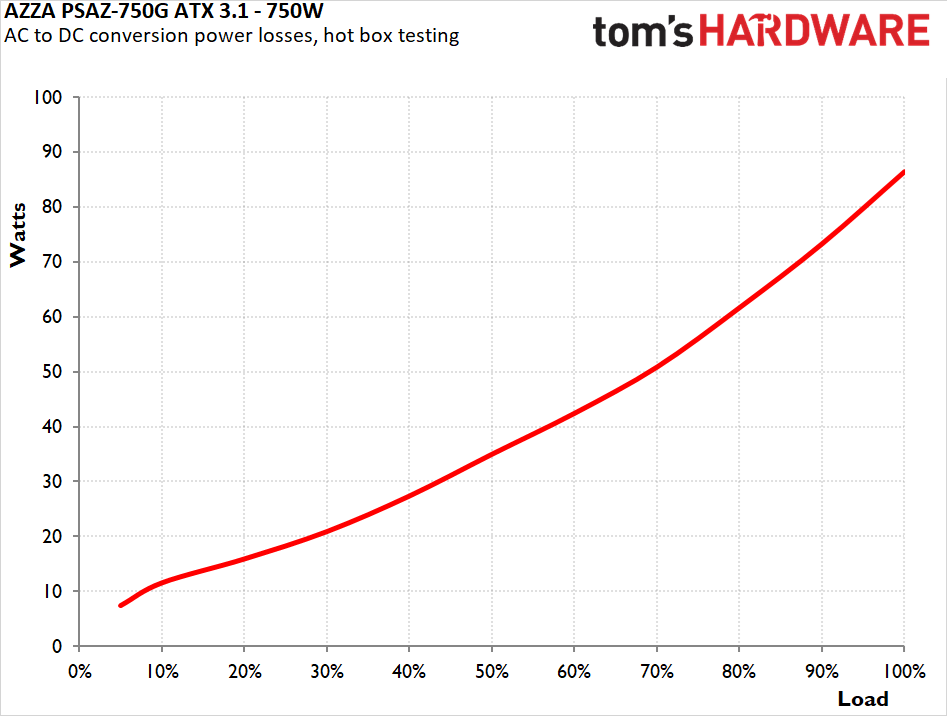
At 25°C ambient the PSAZ-750G averaged 90.6% at 230 VAC and 88.6% at 115 VAC across the nominal load range. The curve peaks at about 92% at 230 VAC around 300W and holds 90.2% at a sustained 750W, with the 115 VAC line topping out at 90.3% and finishing at 87.3%. Those are respectable numbers and the shape of the curve is healthy, with no full-load collapse. They are also, and this is the point, not Gold. 80 PLUS Gold requires 90/92/89% at 20/50/100% load on 230 VAC and 87/90/87% on 115 VAC. We measured 90.1/91.8/90.2% and 88.7/89.9/87.1% respectively. The unit clears the 20% and 100% checkpoints on both inputs and misses the 50% checkpoint on both, by 0.2 and 0.1 points. It is a near miss rather than a fraud and CLEAResult tests at 23 °C so it could possibly pass, but there is no 80 PLUS entry for the PSAZ series after 2015 to argue otherwise. There is no Cybenetics listing either.
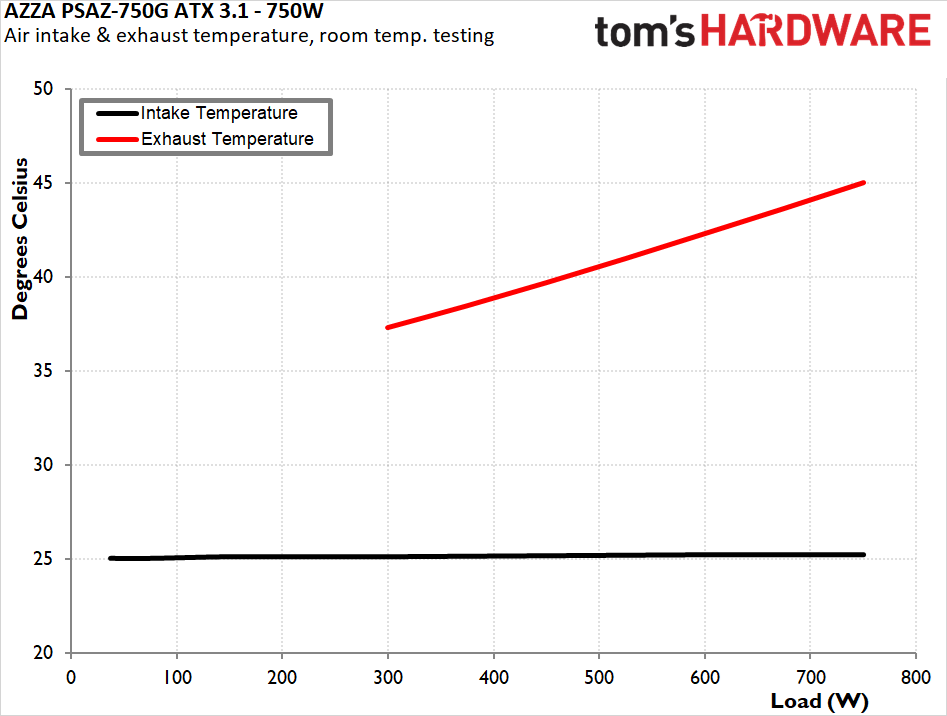
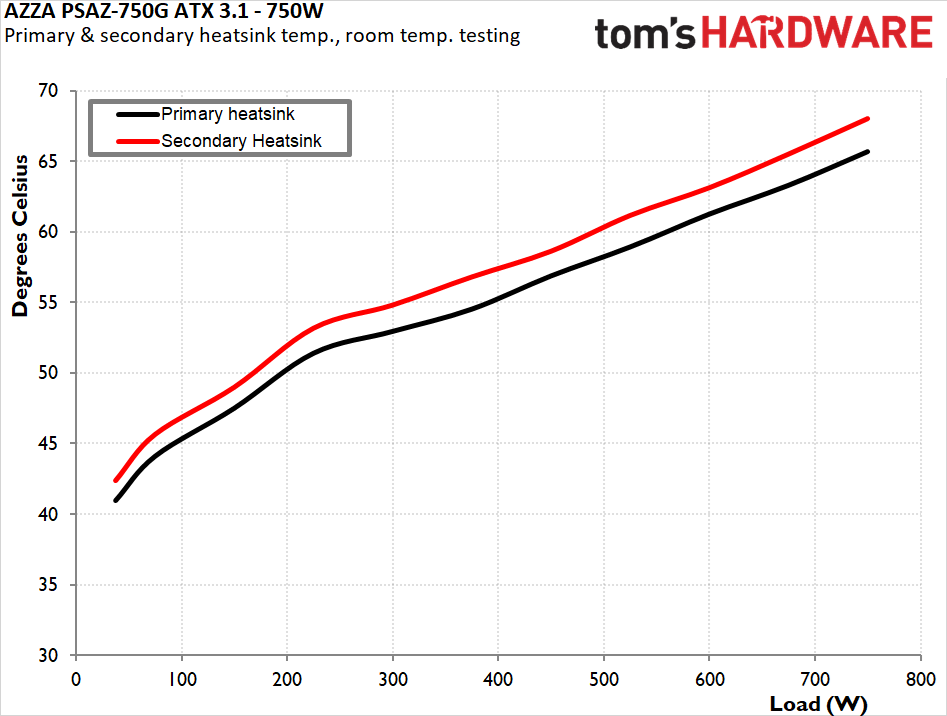
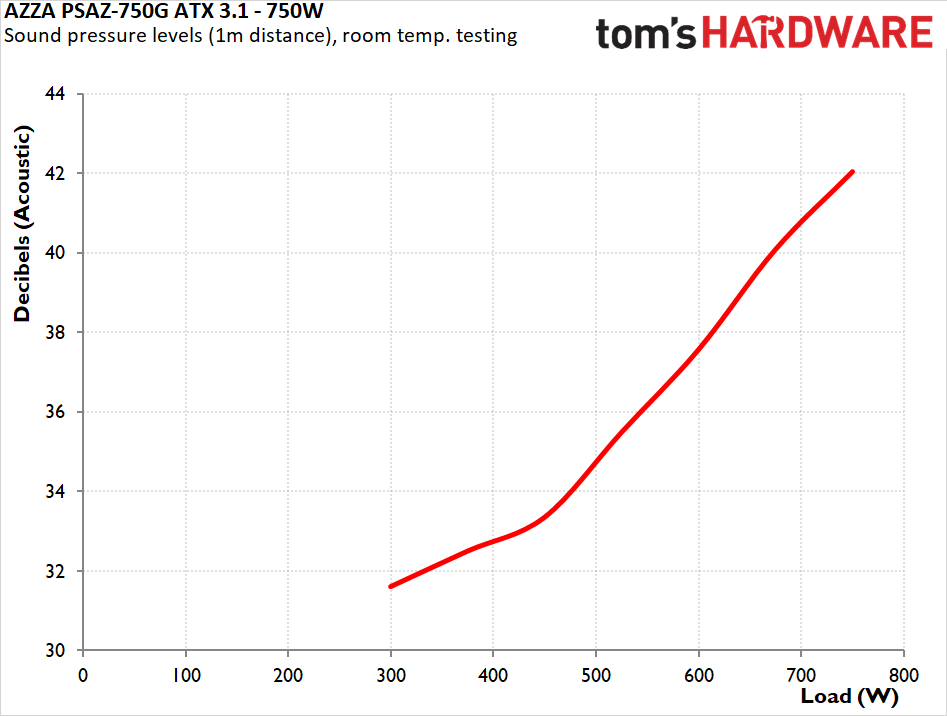
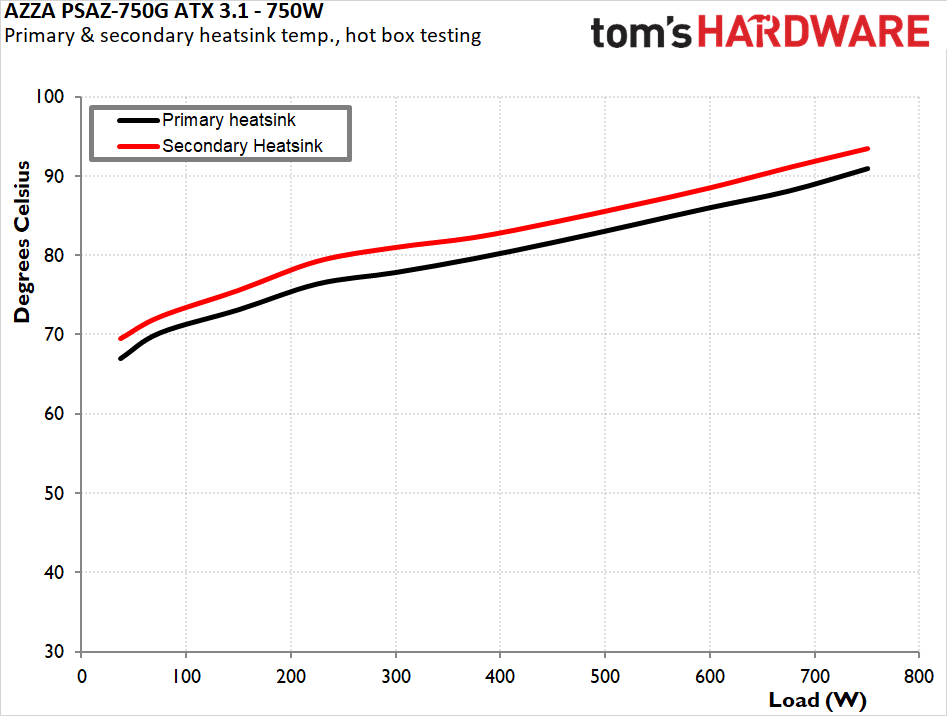
Acoustically the cold run is the best part of this review. The fan stays completely stopped up to roughly 40% load, giving a genuine 300W fanless window that covers desktop work and a good deal of gaming outright. It starts at 31.6 dB(A) and ramps gently to about 33 dB(A) at half load, at which point it becomes the quietest thing in most builds. Past 450W the curve steepens noticeably, reaching 38 dB(A) at 600W and 42 dB(A) at a sustained 750W. That is audible but not intrusive, and it is a reasonable trade for a good thermal result. The heatsinks reached 66-68°C at full load. Nothing here is under severe stress.
Hot Test Results (~45°C Ambient)
Hot Test Results (~45°C Ambient)
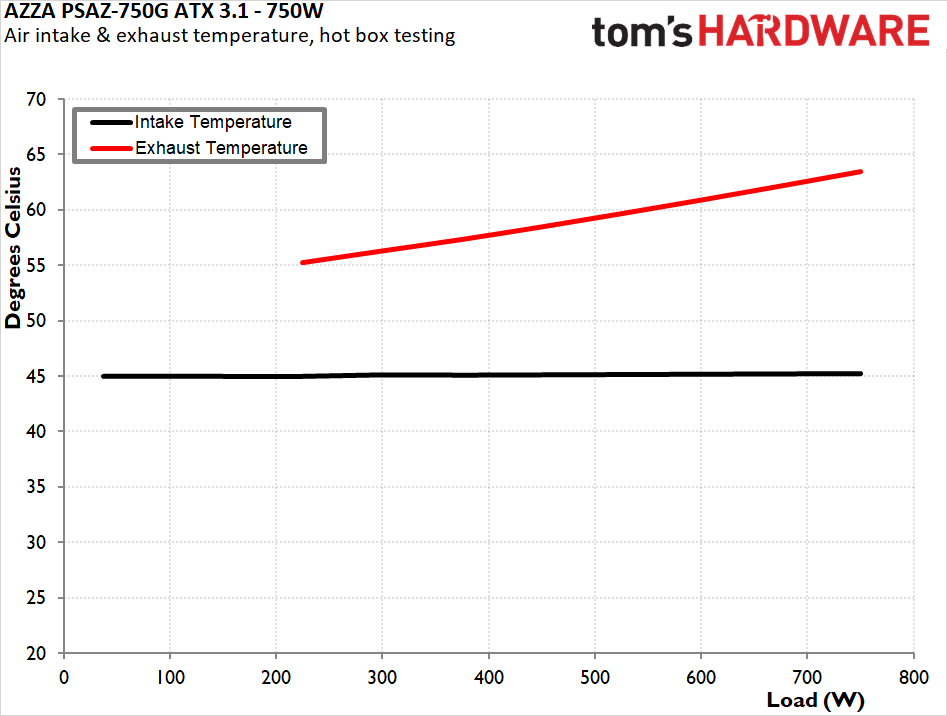
Inside the hotbox at roughly 45°C ambient, five degrees above the unit's own 40°C rating, efficiency falls by roughly a point and a half. It was not an unexpected result but it is severe for a 750W unit. The averages come to 89.4% at 230 VAC and 87.5% at 115 VAC, with the curve peaking near 90.8% and finishing at 88.5% and 85.6% respectively at full load. Nothing in the electrical behavior suggests the platform is in deep trouble but we can see the signs of thermal degradation at full load.
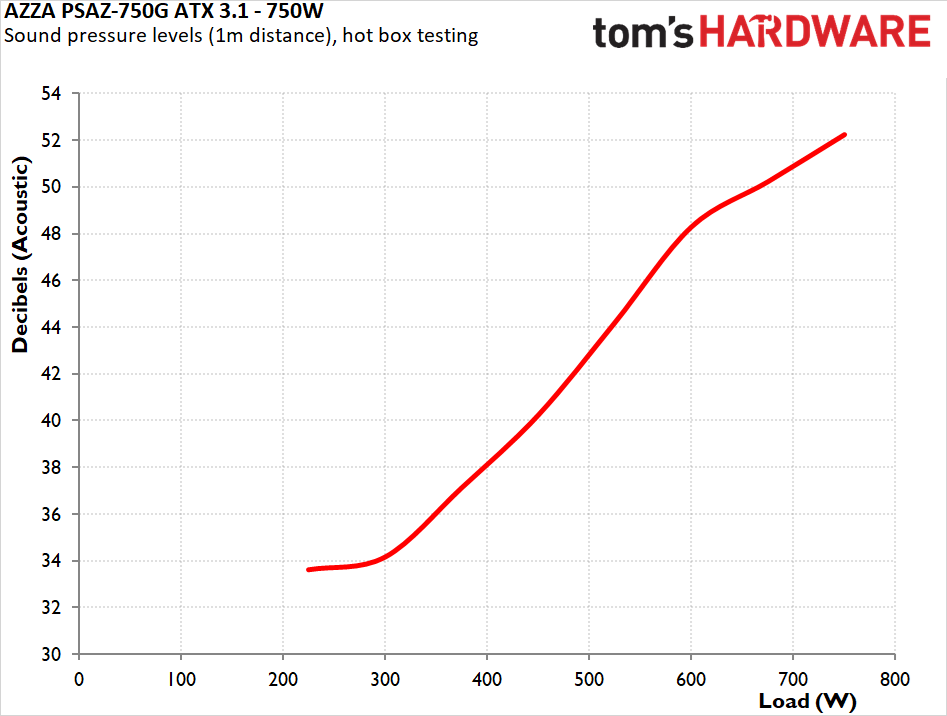
The thermal and acoustic picture is where the platform shows its limits. The fan leaves its passive mode in the hot box very quickly, starting at about 33.6 dB(A) from 200W, then climbing steeply and continuously: 43 dB(A) at 500W, 48.6 dB(A) at 600W, and 52.2 dB(A) at a sustained 750W. That last figure is loud in the plain sense of the word, well past the point where the PSU is the loudest component in a mid-tower and into the range where it likely is the loudest thing in the room. It is also the fan doing exactly what it should, because the internal temperatures need it. The heatsinks reached 94°C at full load, which is on the high side for a 750W unit. Those are not typically failure temperatures, but they are high enough to matter for the Ltec secondary electrolytics sitting beside them over a several-year ownership period.
PSU Quality and Bottom Line
Power Supply Quality
Voltage regulation is the strongest result on the sheet. Across the 20% to 100% load span the 12V rail moved by just 0.9%, with the 3.3V and 5V rails both at 1.4%. Sub-1% on 12V is genuinely good, better than several other Gold units, and it is the credit side of the DC-to-DC secondary arrangement. The minor rails are looser, but both stay comfortably inside the ±5% ATX window and neither matters much to a modern system.
Ripple suppression is adequate rather than good. The 12V rail peaked at 52 mV at full load and 50 mV in the 12V-weighted cross-load test, against a 120 mV ATX limit. The 3.3V and 5V rails topped out at 26 and 28 mV against their 50 mV limits. Those are passes with about 57% headroom on 12V and roughly 45% on the minor rails, so nothing is close to the edge. They are also roughly double what a well-filtered enthusiast platform delivers, and the 12V figure more than doubles between 50% and 100% load, which points at secondary filtering that is sized to the requirement rather than beyond it. For the hardware a 750W unit at this price will actually feed, it is sufficient.
During our thorough assessment, we evaluate the essential protection features of every power supply unit we review, including Over Current Protection (OCP), Over Voltage Protection (OVP), Over Power Protection (OPP), and Short Circuit Protection (SCP).
All protection mechanisms were present and triggered correctly. With the unit hot, OCP tripped at 146% on the 3.3V rail (29.2A), 140% on the 5V rail (28A), and 128% on the 12V rail (79.4A), with OPP shutting the unit down at about 130% of rated output, or roughly 975W. The 12V threshold is the sensible one of the three. The minor-rail thresholds are loose enough that the 100W combined budget is the real constraint there, not the protection.
Main Output
Load (Watts)
151.27 W
377.39 W
563.17 W
749.01 W
Load (Percent)
20.17%
50.32%
75.09%
99.87%
Amperes
Volts
Amperes
Volts
Amperes
Volts
Amperes
Volts
3.3 V
1.81
3.37
4.53
3.36
6.8
3.33
9.07
3.32
5 V
1.81
5.06
4.53
5.05
6.8
5.01
9.07
4.99
12 V
11.25
12.09
28.11
12.07
42.17
12.01
56.23
11.98
Line
Regulation
Voltage Ripple (mV)
(20% to 100% load)
20% Load
50% Load
75% Load
100% Load
CL1 12V
CL2 3.3V + 5V
3.3V
1.4%
20
16
22
26
22
26
5V
1.4%
20
16
20
28
22
26
12V
0.9%
30
22
36
52
50
28
Bottom Line
The PSAZ-750G is a competent budget power supply carrying a claim it cannot support. The Helly platform underneath is more modern than the price suggests and used by several manufacturers at this price point. Inside, we have a half-bridge LLC primary, DC-to-DC minor rails, a complete transient filter, generously sized heatsinks, a ball-bearing fan and a native 12V-2x6 connector. Regulation on the 12V rail is genuinely good at 0.9%, ripple is comfortably inside specification everywhere, protections all work and trip at sane thresholds, and the 300W fanless window at room temperature is real. There is nothing broken here.
(Image credit: Tom's Hardware)
The efficiency claim, however, is one that does not survive contact with the bench. Our numbers put the unit 0.2 points under the Gold requirement at 50% load on 230 VAC and 0.1 under it on 115 VAC, clearing every other checkpoint. CLEAResult tests at 23°C, so a good sample could plausibly clear the bar on the official bench. On the other hand, other units using the same platform passed our testing, even if they were fully modular (typically hardwired cables increase efficiency slightly). AZZA has not certified a PSAZ unit since 2015, there is no official 80 PLUS entry for this particular model, no Cybenetics listing and no PLPP listing, yet the Gold logo is printed on the box, on the label and in the retail listings. The unit performs like a borderline Gold supply. It is being sold as a certified one. Those are not the same thing, and the second is the vendor's choice, not a measurement artifact.
Most of the remaining compromises are ordinary for the money. Hardwired cabling at 750W in 2026 is behind the market but forgivable at $78, but the Ltec capacitors is what a $78 budget buys. One thing is harder to wave through. That is the 2-year warranty, which is half or less of what every serious competitor offers; set against heatsinks that reached 94°C at full load in the hot box, with ordinary electrolytics sitting beside them, it reads as the manufacturer telling you how long it expects the unit to be its problem.
(Image credit: Tom's Hardware)
Against named rivals, the placement is straightforward. The Phanteks AMP GH series runs a related Helly platform, which is worth keeping in mind - the design itself is not the problem here; the specification is. The MSI MAG A750GL PCIE5 is fully modular, genuinely 80 PLUS Gold certified, and backed by a 10-year warranty, and it is better than the AZZA on every axis except price. The Cooler Master MWE Gold 750 V4 at $119 MSRP is quieter under sustained load, carries verified Gold efficiency and a 10-year warranty, and gives up only a little on 12V regulation, where the AZZA's 0.9% is the better figure.
The PSAZ-750G beats them on nothing but cost, but it beats them there by a wide margin. So the recommendation is narrow but real. If you are building a mid-range machine on a tight budget, the card you are pairing it with draws under 450W, and you can live with 2 years of coverage and a fixed cable loom, the PSAZ-750G will do the job, and it will do it quietly at the loads you will actually run. If any of those three conditions do not hold, the extra money for a certified, longer-warrantied, fully modular unit is the better spend, and it is not a close call. Buy it for what it measures, not for the badge on the box.
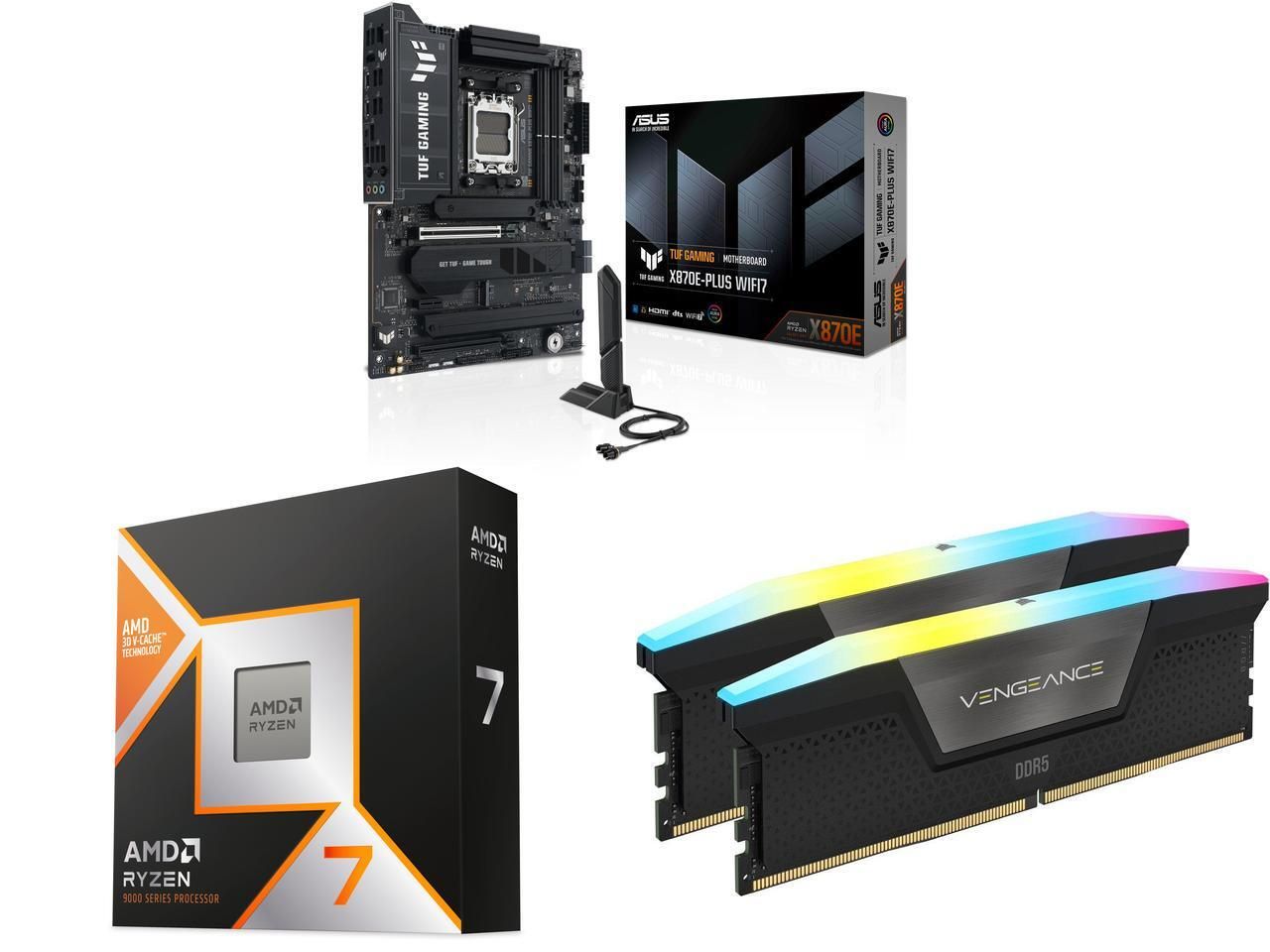
With the ongoing memory crisis driving up the price of RAM and other components, it is arguably one of the worst times to build a new gaming PC. However, bundle deals can be a good way to offset some of those inflated prices. Speaking of which, we’ve spotted an incredible AMD bundle over at Newegg that includes the AMD Ryzen 7 9800X3D, an Asus TUF X870E motherboard, and 32GB of Corsair Vengeance RGB DDR5-6000 RAM for $1,109.99, offering savings of around $150. The bundle also includes a 240mm Cooler Master AIO liquid cooler and a copy of Onimusha: Way of the Sword as free gifts.
The Ryzen 7 9800X3D is an 8-core, 16-thread processor based on AMD’s Zen 5 architecture. With a 4.7 GHz base clock and up to 5.2 GHz boost clock, the highlight feature of the chip is its 3D V-Cache technology that helps in lowering latency and giving a boost in overall gaming performance. If you’re looking for the best gaming CPU for a high-end build, the Ryzen 7 9800X3D should be at the top of your list.
The Asus TUF Gaming X870E-Plus motherboard should be a suitable pairing for the 9800X3D as it offers premium features including a robust power delivery system, dual PCIe 5.0 M.2 SSD storage slots, and solid connectivity. The motherboard supports Wi-Fi 7, 2.5Gb Ethernet, dual USB4 (40Gbps) Type-C ports, and front USB 20Gbps Type-C connector with up to 30W PD Fast-charge. It also offers enlarged heatsinks for the VRM, M.2 storage and PCH, as well as tools to overclock and fine tune various features.
Last but not least, the bundle includes a Corsair Vengeance RGB kit with two 16GB DDR5 modules running at 6000 MT/s, with a CAS latency of CL36 and timings of 44-44-96. The memory features black aluminum heat spreaders with a patterned finish, along with RGB lighting across the top of each module. It also supports both Intel XMP and AMD EXPO profiles, making it easy to apply pre-configured memory overclocking settings.
If we look at individual pricing, Ryzen 7 9800X3D is currently $469, while the Corsair RAM kit and Asus motherboard are listed at $499.99 and $289.99, respectively. You also get a CPU liquid cooler worth $79.99 and a copy of Onimusha: Way of the Sword worth $69.99. That puts the combined value at around $1,408.96, making the $1,109.99 bundle price a saving of nearly $300. If you're planning a high-end AMD gaming PC, this bundle is definitely worth exploring.
According to a report from The Maine Wire, the FBI has arrested and charged Terry “Jiajia” Liu, a Customs and Border Protection supervisor based in Calais, Maine, for theft and damage to government property. Liu allegedly stole computer hardware, including Intel 14th Generation Raptor Lake Refresh processors, memory modules, and hard drives, from at least 46 Department of Homeland Security computers across three Maine border facilities. They replaced the stolen parts with inferior hardware and exchanged the stolen equipment through Newegg’s trade-in program for store credit.
Liu’s official responsibilities were limited to information-technology support, so they did not have access to modify any government computer. Port Director Theodore Cummings made the restriction abundantly clear to Liu in a written order: “Please do not move any computers or computer parts.” However, criminals rarely listen.
Hidden surveillance cameras captured Liu opening government computers and swapping hardware during the midnight shift. The perpetrator would take the systems to a training room to commit the crime. One camera recording showed Liu using a screwdriver to scrape thermal paste off a processor and installing a replacement chip in one system. Meanwhile, another recording caught Liu removing a memory module from a system and storing it in their desk drawer.
According to the affidavit, investigators found that thirty-nine computers had their processors replaced, six machines with memory modules swapped, and eight had hard drive changes. The original systems used Raptor Lake Refresh chips but were later discovered to have older hardware, sometimes downgraded to Pentium chips. Beyond the processor swap, other computers had less memory and storage capacity than their original configurations.
Instead of trying to sell the stolen hardware on the open second-hand market, Liu used a less conspicuous approach: Newegg’s Trade-In program. According to investigators, Liu sent 13 emails between a personal account and an official CBP email address containing shipping labels and trade-in receipts for processor models matching the missing components from the government computers.
The Newegg trade-in offers varied between $200 and $210 per processor. According to the transaction records from the U.S. retailer, Liu traded in Core i7 Raptor Lake Refresh chips 16 times over 14 months, from May 2025 to July 2026. Investigators also found three $200 credits from Newegg in Liu's American Express records.
During an interview, Liu confessed to replacing hardware in the government computers with lower-performing parts bought on Amazon and Newegg. They also acknowledged submitting the government-owned parts to Newegg's Trade-In program. At first, Liu claimed their actions were motivated by a desire to improve the computers' performance and how long computer repairs took. However, they later admitted that the changes resulted in degraded performance.
Restoring the stolen hardware could cost about $20,460, while fully replacing all 46 compromised computers with equivalent hardware would cost an estimated $105,800. However, additional labor to configure each system for government use will drive the bill even higher.
It’s been a heck of a time lately for PC gamers willing to get their hands dirty with mods. Hot on the heels of the discovery of the DLSS 5 DLL in a prerelease version of NBA 2K27, modder dashdogy found a way to bring Multi Frame Generation, one of the crown jewels of GeForce RTX 50-series graphics cards, to RTX 40-series (and earlier) products.
As already elevated graphics card prices seem set to continue rising, and hardware upgrades get further and further out of reach of the average PC gamer, more and more folks are going to want to hold on to the RTX 40-series hardware they have for as long as they can, especially if smoothness-boosting features like MFG are just a few clicks away on those older cards.
So we had to see MFG working on Ada for ourselves—assuming it works at all. We grabbed the mod files and got to playing with them in Cyberpunk 2077, since it’s likely in many TH readers’ Steam libraries already and has a healthy modding community. You can find the latest instructions for enabling MFG on Ada through dashdogy’s GitHub page.
Before spending a ton of time testing, we verified that the mod works at all. While spinning the camera at a high, constant speed, we could indeed see that increasing MFG multipliers beyond the officially supported 2X factor on Ada cards does greatly increase perceived smoothness or fluidity of motion in Cyberpunk 2077, as you would expect.
Another tell is that the same visual artifacts are visible in certain regions of the screen on both RTX 40-series and RTX 50-series graphics cards as you add more generated frames. MFG 4X and above, especially, tend to add some visual “junk” at the bottom of the frame that appears regardless of the game, and we could see that artifacting on Ada.
At least in Cyberpunk 2077, then, we’re confident that MFG is really doing its thing on RTX 40-series cards with this mod.
We also didn’t see any perceptible issues with frame pacing or frame delivery, although playing on a high-refresh-rate, G-Sync-Compatible monitor like our test bench’s ROG Strix XG27UCS smooths out all but the worst such issues. If you don’t have a high-resolution or high-refresh-rate monitor to begin with, the utility of MFG will be seriously limited for you anyway.
The latency question
So is this a free lunch? Is Nvidia soft-locking MFG to Blackwell purely for marketing reasons? That’s where performance testing comes in, since it has the potential to reveal whether there’s a catch in running MFG on Ada. The question is not so much whether MFG juices output frame rates, but whether it runs on Ada within acceptable latency thresholds.
As we’ve long emphasized, when you have essentially arbitrary control over output frame rates like MFG allows, input lag becomes the final barrier to a playable experience. So in the performance results that follow, we’ll certainly present output frame rates as you would expect. But you should view those in the context of your own monitor’s refresh rate. As long as the delivered frame rates we recorded exceed your display’s peak refresh rate, you have headroom to play with to keep your monitor at or near that number during gameplay.
The real issue, then, is whether both RTX 40-series and 50-series cards deliver an acceptable input latency under our test conditions. In our past testing, we’ve determined that a roughly 60ms average latency threshold, as indicated by Nvidia’s FrameView app, is the point at which player inputs and displayed frames start to become noticeably decoupled in AAA single-player experiences like Cyberpunk.
If you’re only slightly on the wrong side of this threshold, a game might still be playable, but if you totally blow past it, you’re likely to notice laggy inputs and increasingly distracting visual artifacts as the MFG model struggles to fill in the gaps between sparser and sparser input data.
Testing methods and notes
As one of the biggest technical showcases of the current PC gaming era, Cyberpunk 2077 lets us enable all the modern rendering features we’d want for Nvidia cards. It implements not only ray tracing and path tracing, but DLSS Super Resolution, Ray Reconstruction, and Multi Frame Generation. The number of AI-generated pixels per frame can be quite high in this title.
We enabled all those features to expose the full potential complexity of running all of their associated AI models in a modern rendering pipeline. If RTX 40-series cards are going to stumble for some reason with modded MFG enabled, we want to put as many obstacles in their way as possible.
And because benchmarking the performance of an unofficial mod is venturing into the Wild West anyway, we also added a DLSS 5 mod to the mix to see whether Blackwell GPUs have a distinct edge in the neural rendering future that the arrival of that feature promises to usher in. DLSS 5 is supposed to come to RTX 40-series cards later this year, so we think it’s good to understand where performance sits today, even if it’s subject to the same disclaimers as this MFG mod.
For reference, then, we tested Cyberpunk with maxed-out raster settings, path tracing, and MFG 4X at three resolutions: 1080p with DLSS Balanced, 2560x1440 with DLSS Performance, and 4K with DLSS Ultra Performance upscaling enabled.
We only tested cards ranging from the RTX 4090 down to the RTX 4070 for these experiments, both because of time and Cyberpunk’s VRAM requirements. We didn’t want to deal with potential performance pitfalls due to running out of VRAM, so the 12GB RTX 4070 is where we’re drawing the line for now.
Modded Cyberpunk 2077 1080p performance
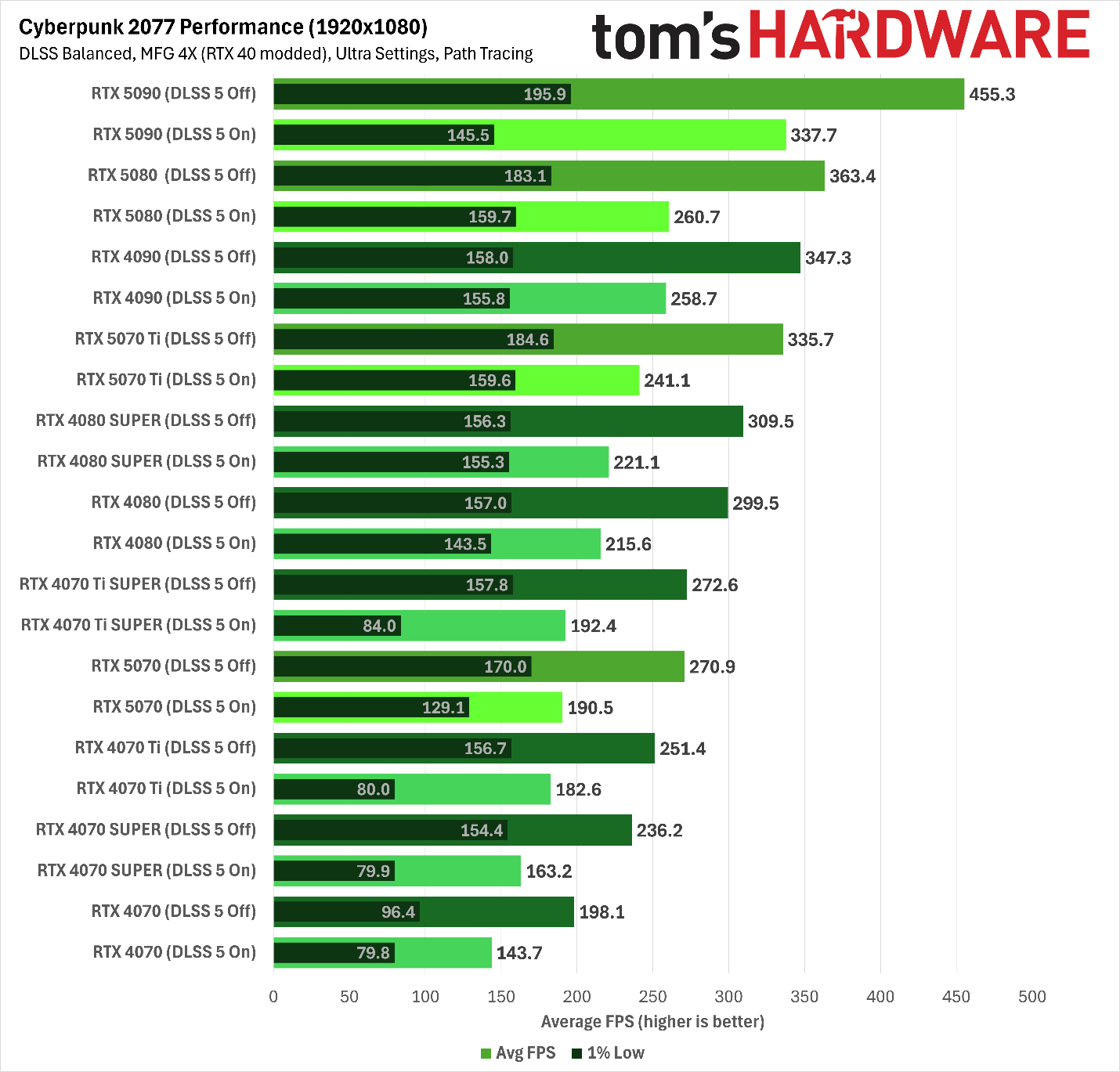
(Image credit: Tom's Hardware)
At 1080p, Cyberpunk 2077 with MFG 4X scales fine on Ada, but it’s clearly scaling better on Blackwell. The RTX 4090 lands between the RTX 5070 Ti and RTX 5080. Introducing DLSS 5 to the mix doesn’t change any relative standings, although it does create some larger gaps between average frame rates and 1% lows than we might like on the RTX 4070 Ti Super, RTX 4070 Ti, RTX 4070 Super, and RTX 4070. The RTX 5070 has no such trouble.
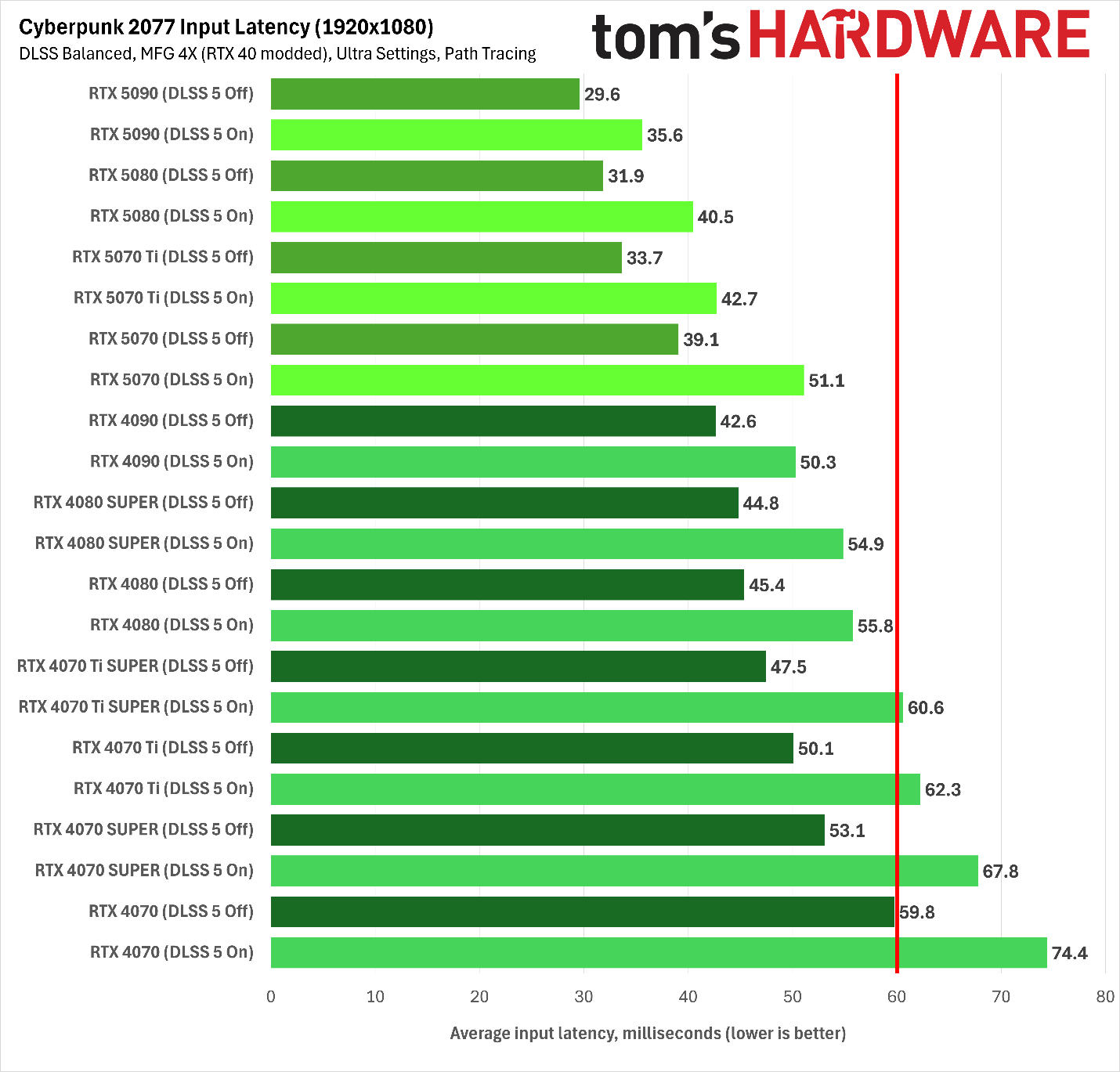
(Image credit: Tom's Hardware)
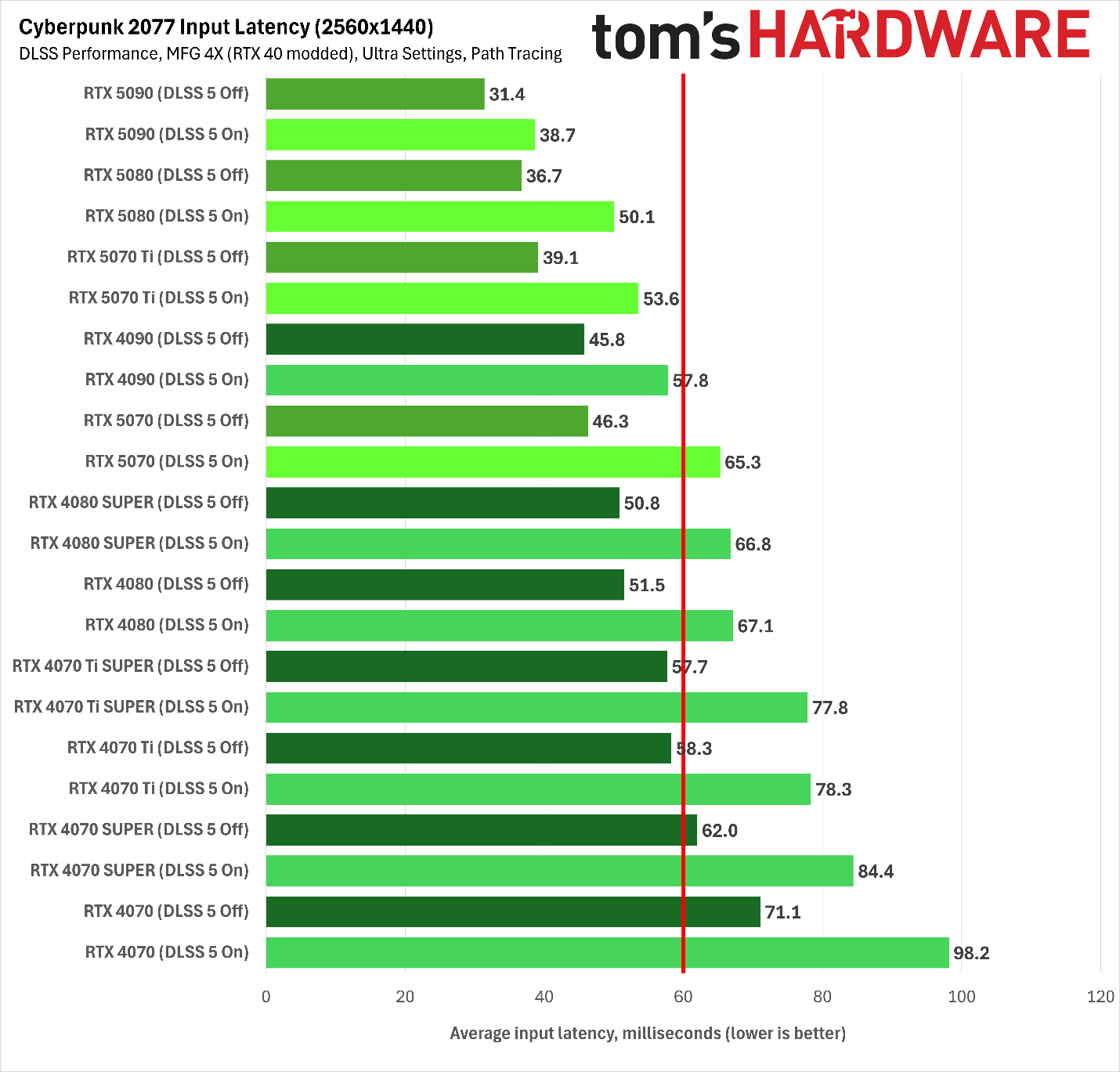
But again, the real story is in our latency results. Here, we can see that every card we tested falls under our 60ms threshold with MFG 4X alone. But Blackwell hardware has a clear advantage in the standings, as even the RTX 5070 delivers a lower input latency than the RTX 4090 with our DLSS 5 mod off and a comparable input latency with it enabled. All the other Ada cards shake out as you would expect from there. But in absolute terms, even with DLSS 5 enabled, only the RTX 4070 Super and RTX 4070 are far beyond our acceptable latency thresholds.
Blackwell might have a latency edge with MFG enabled and a smoothness edge with a modded version of DLSS 5 on top, but at least with the RTX 4070 on up, there’s certainly enough headroom to use the feature on Ada.
And as we went to press, a version of the RTX 40-series MFG mod came out that removes the need for ReShade. That more streamlined approach might cut down latency, but we couldn’t test it because it currently crashes Cyberpunk 2077. Again, this is the Wild West, not a validated, bulletproof solution from Nvidia like you get with RTX 50-series products.
Modded Cyberpunk 2077 2560x1440 performance
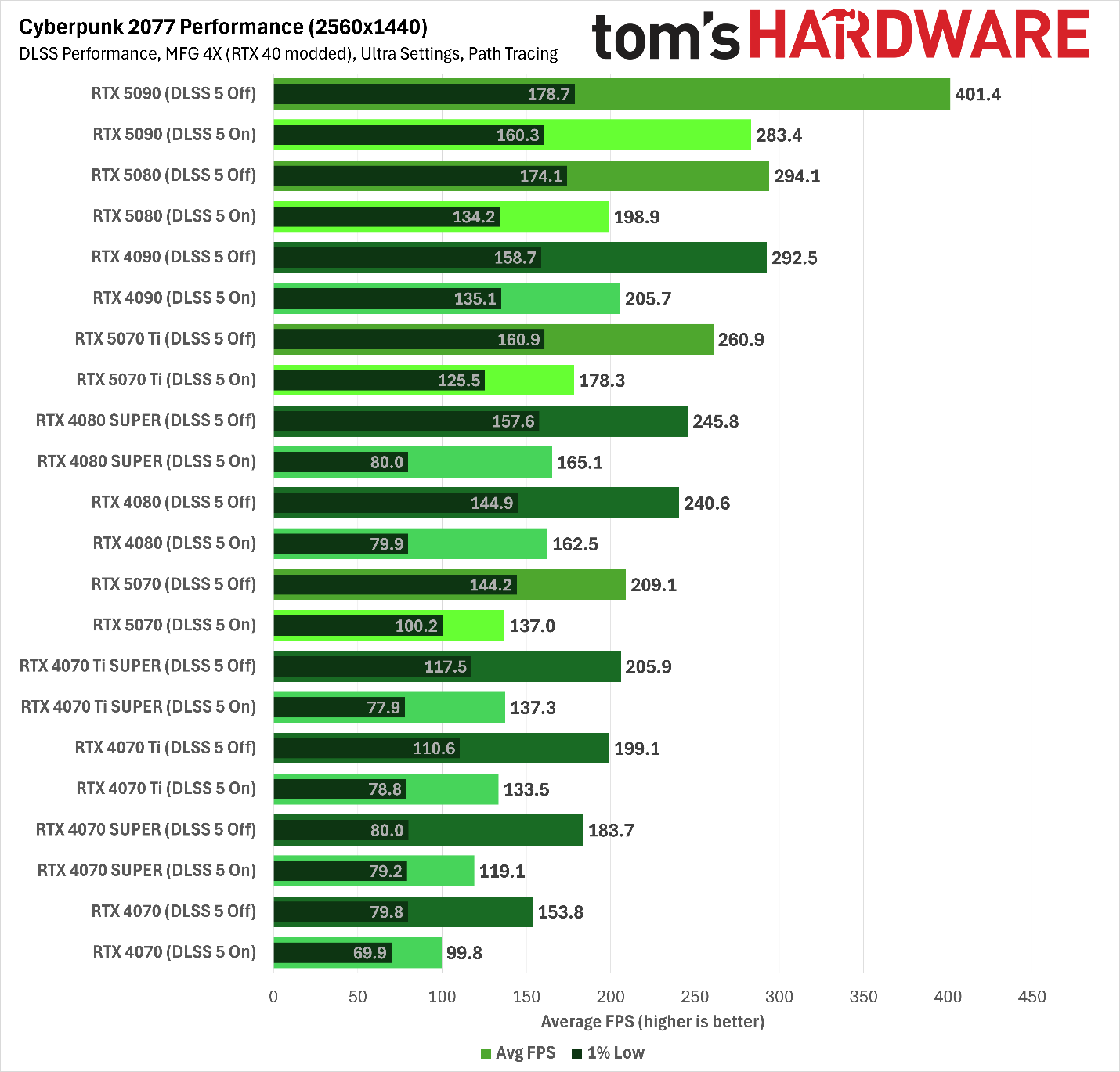
(Image credit: Tom's Hardware)
At 2560x1440, generational performance standings and scaling between cards remains much the same as we saw at 1080p. The RTX 4090 still falls short of the RTX 5080, and the RTX 4080 duo falls behind the RTX 5070 Ti.
We also still see the wide gap between average frame rates and 1% lows rear its head on more Ada cards with our DLSS 5 mod enabled, though to be fair, these lows are still being smoothed over by MFG to the point that you’re unlikely to notice them with a high-refresh-rate, variable-refresh-rate monitor like we’re using.
(Image credit: Tom's Hardware)
On the latency side, all of the Ada cards except the RTX 4070 still run our modded MFG 4X with acceptable input latency. But enable the DLSS 5 mod we’re using, and input latency climbs past 60ms for all Ada cards except the RTX 4090. The RTX 4080 Super and RTX 4080 still provide acceptable performance under this full load, as they’re only slightly over our latency threshold. But for any less powerful RTX 40-series cards, you’d need to start choosing between DLSS 5 and other eye candy, like lighter RT settings instead of path tracing or no RT or PT at all.
Modded Cyberpunk 2077 4K performance
(Image credit: Tom's Hardware)
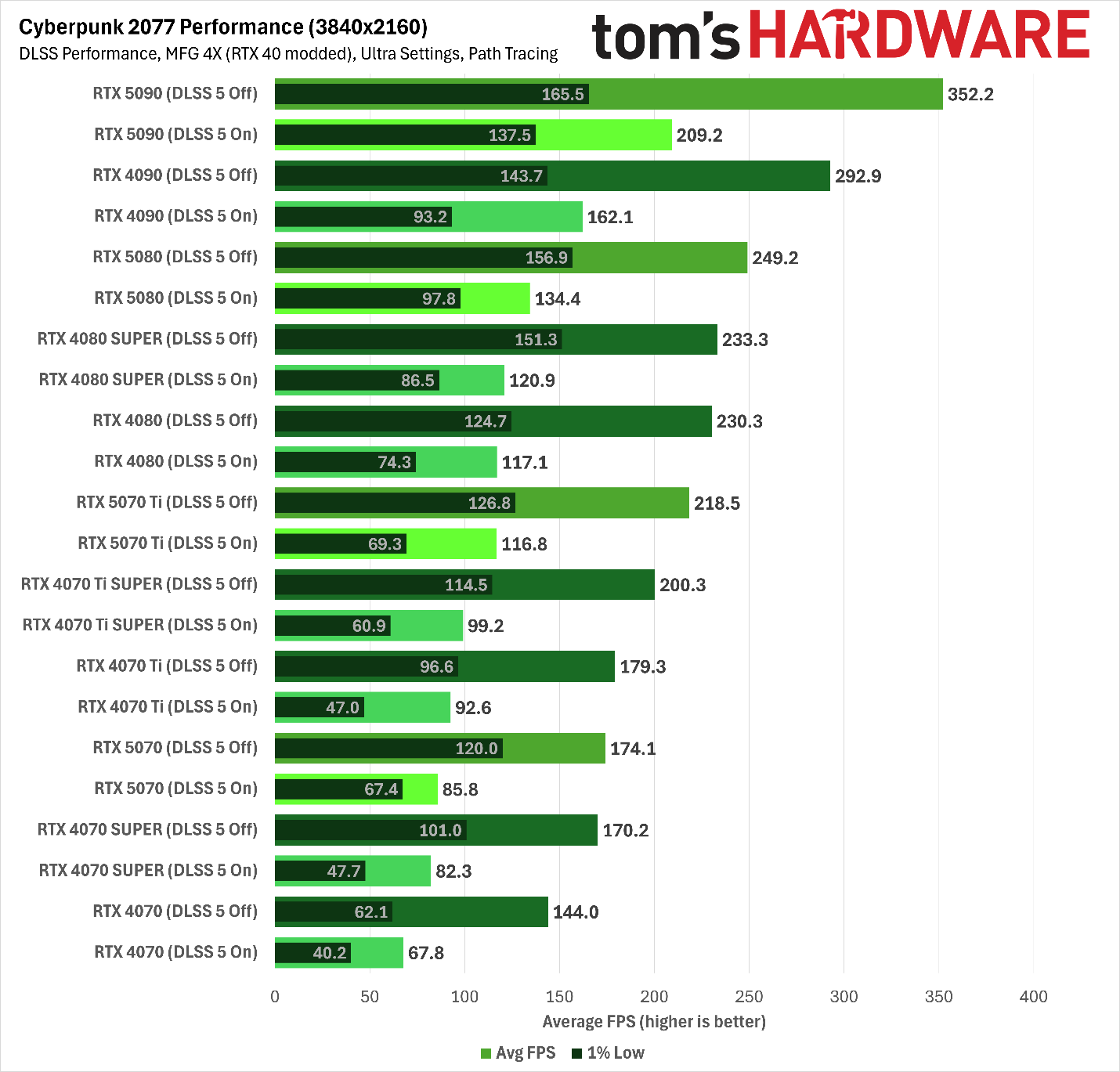
Our modded performance results at 4K with DLSS Ultra Performance demonstrate why it’s so important to discuss MFG-boosted frame rates in the context of input latency. If you’re not mentally dividing by four, everything on our output frame rate might look playable.
At this high output resolution, the RTX 4090 finally takes the lead over the RTX 5080, both with plain MFG 4X and with our DLSS 5 mod on top. The 16GB of VRAM of the RTX 4070 Ti Super would seem to be giving it an edge over the RTX 4070 Ti and RTX 5070, and the RTX 4080 duo would seem to beat out the RTX 5070 Ti.
(Image credit: Tom's Hardware)
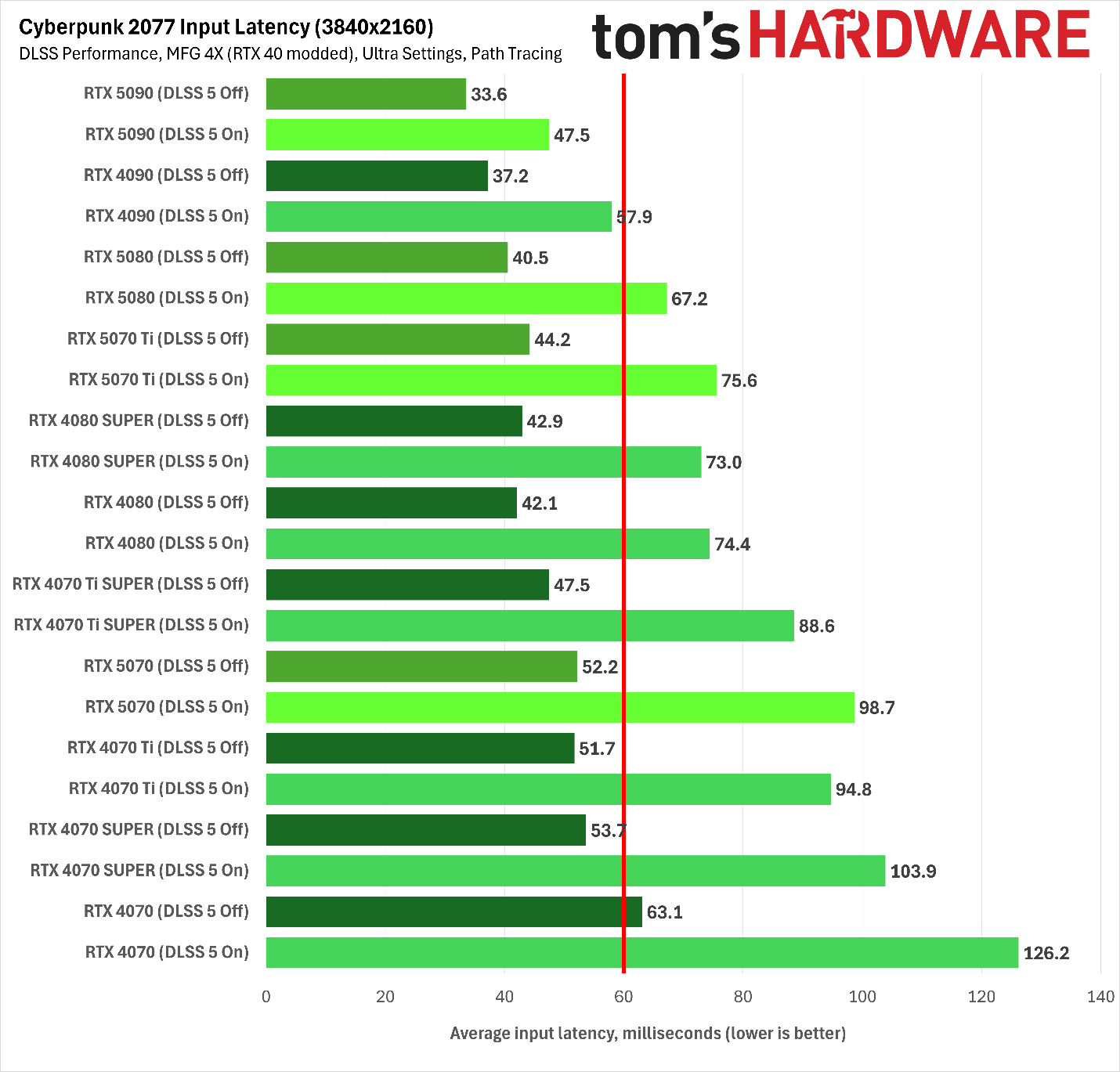
Our latency chart for MFG 4X shows a weird, but entirely reproducible result: input latencies at 4K with DLSS Ultra Performance are actually much lower than they are at 2560x1440 for most Ada cards, despite the fact that both of these output resolution targets share the same input resolution.
We’re not sure why Ada cards run into such a latency hump with this MFG mod at 2560x1440 with DLSS Performance, but we double-checked our results, and this behavior is reproducible. Blackwell cards experience the more linear rise in input latency as output resolutions rise that you would expect.
Again, this is the Wild West of modded performance, and we have nobody to blame but ourselves here, but it’s an unfortunate result given the prevalence of 2560x1440 monitors. Perhaps the maintainers of this mod can track down the root cause and fix it, but nothing is guaranteed.
In any event, input latency with MFG 4X alone at 4K with DLSS Ultra Performance isn’t an issue for any card here. You might be pushing your luck with the RTX 4070, but both Blackwell and Ada cards are delivering on the promise of MFG here: smoother output with responsive input.
Add DLSS 5 to the latency picture, though, and as we’ve come to expect, you really want an RTX 5090, RTX 4090, or RTX 5080 for acceptable responsiveness. And you’re pushing it with the RTX 5080. No other cards in this bunch need apply.
Bottom line
Our experience with the purportedly Blackwell-exclusive Multi Frame Generation on RTX 40-series cards through modding suggests that there isn’t any glaring reason why Nvidia couldn’t enable the feature for Ada Lovelace cards, and that’s kind of wild given how heavily it was touted as a Blackwell-exclusive feature back when those cards launched.
At least as long as Nvidia doesn’t find a persistent way to lock it out, our experience is that MFG generally just works on Ada. Even if input latencies aren’t quite as low on those older cards as they are on comparable Blackwell hardware, all else equal, they’re still perfectly acceptable, even under the combined load of path tracing, DLSS Super Resolution, DLSS Ray Reconstruction, and MFG 4X in Cyberpunk 2077.
We only had time to test cards ranging down to the RTX 4070 for this quick look, but for folks looking to extend the useful life of their Ada hardware, the availability of MFG could certainly stretch those cards’ lifespans.
But our experience also shows that MFG on Ada isn’t perfect. It’s still a mod in active development, and the unusual and reproducible input latency behavior we charted at 1440p on RTX 40-series cards is the sort of unexpected pitfall you might expect from an unofficial implementation of the feature. Cross your fingers that it’s an issue that can be fixed by the community.
The fact that MFG works as well as it does on Ada, even in this modded form, also makes us wonder whether Nvidia might just enable official support for it at some point, given the apparently bleak prospects for gaming graphics card pricing and future hardware generations as the AI boom shows no signs of abating. And such a move would provide much broader and more immediate performance relief for gamers than re-introducing ancient silicon like the RTX 3060.
Given that Nvidia is already working on bringing DLSS 5 to RTX 40-series GPUs, maybe this mod will convince it to throw in official MFG support, too. Fingers crossed.
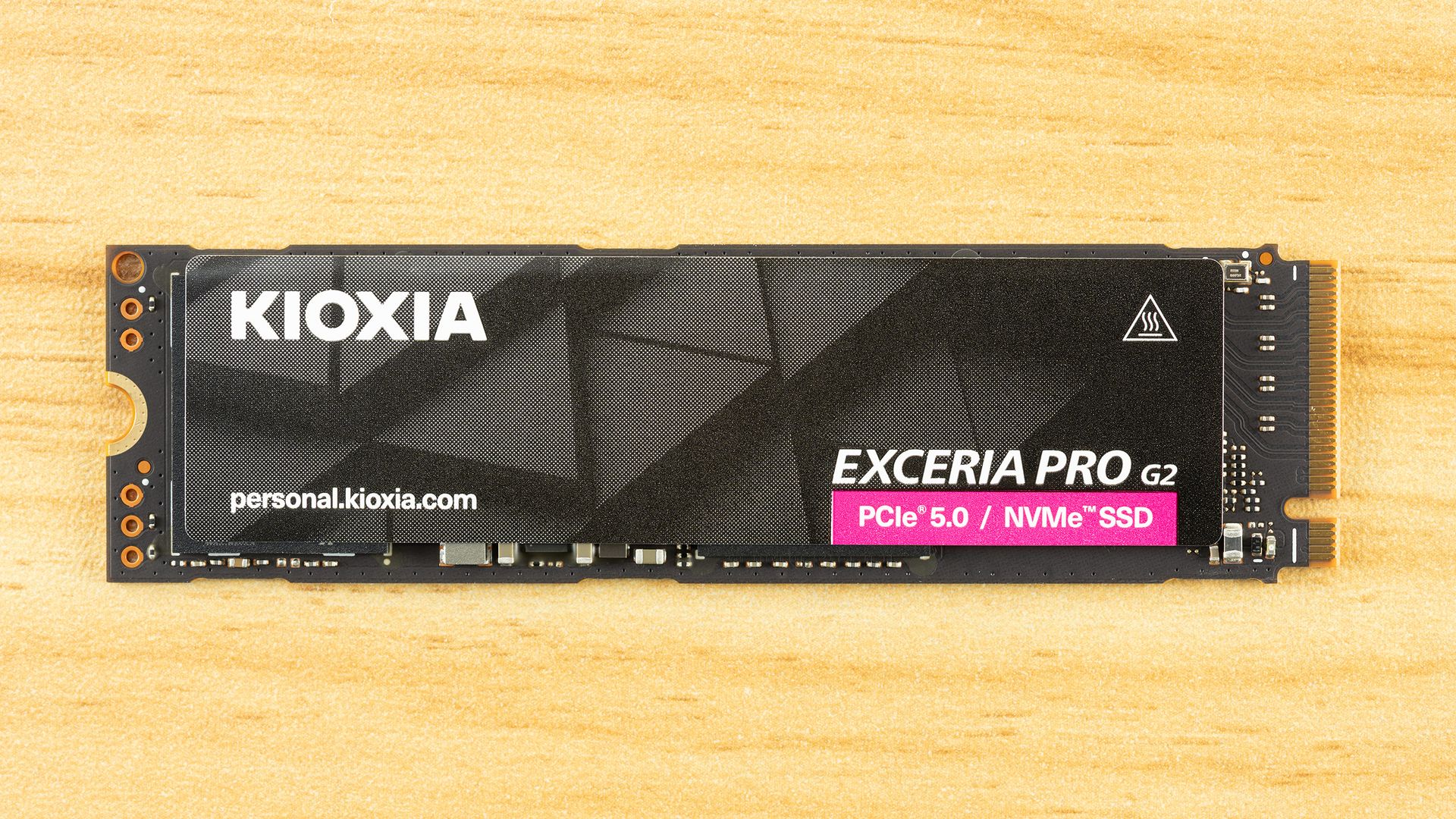
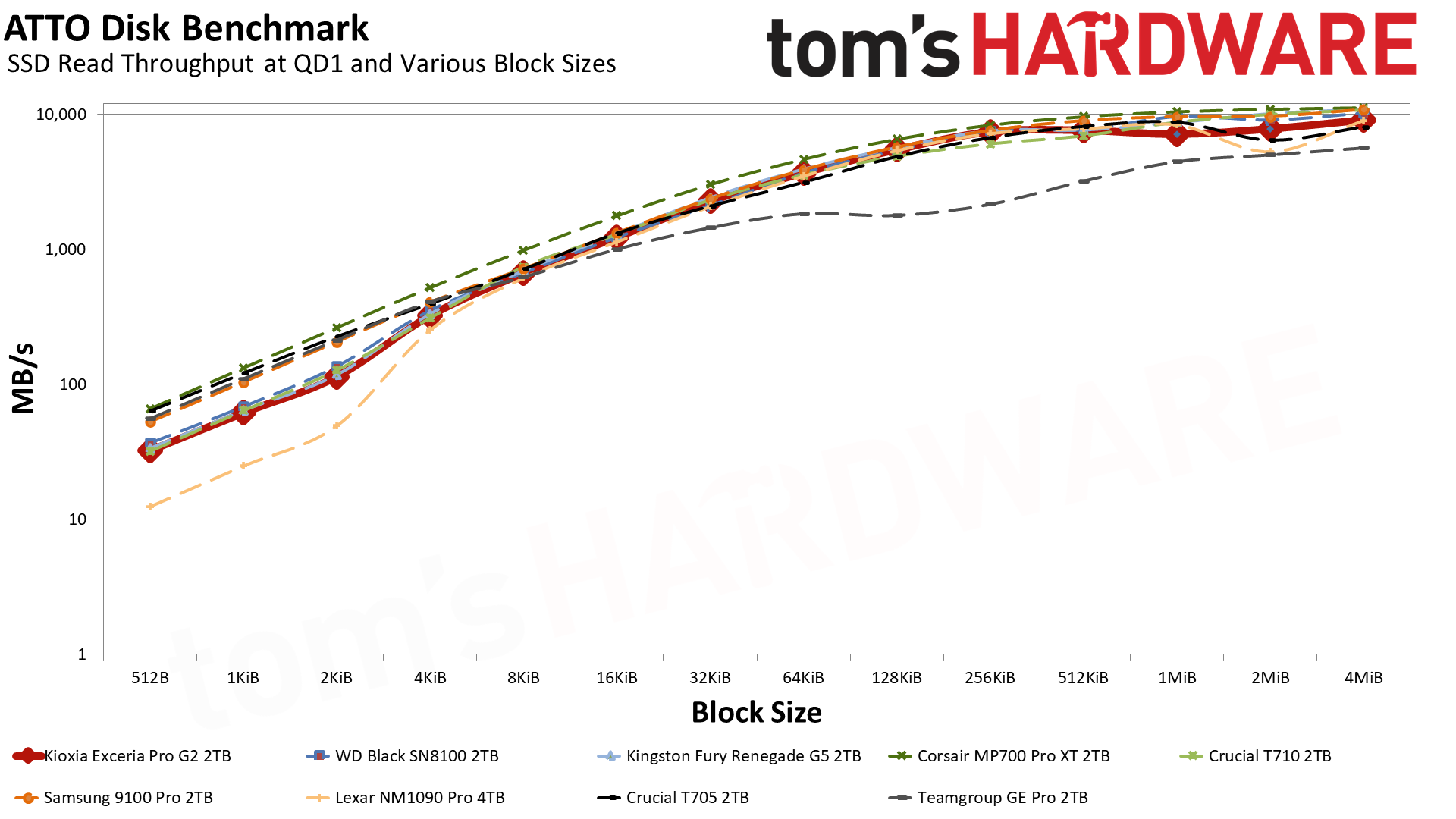
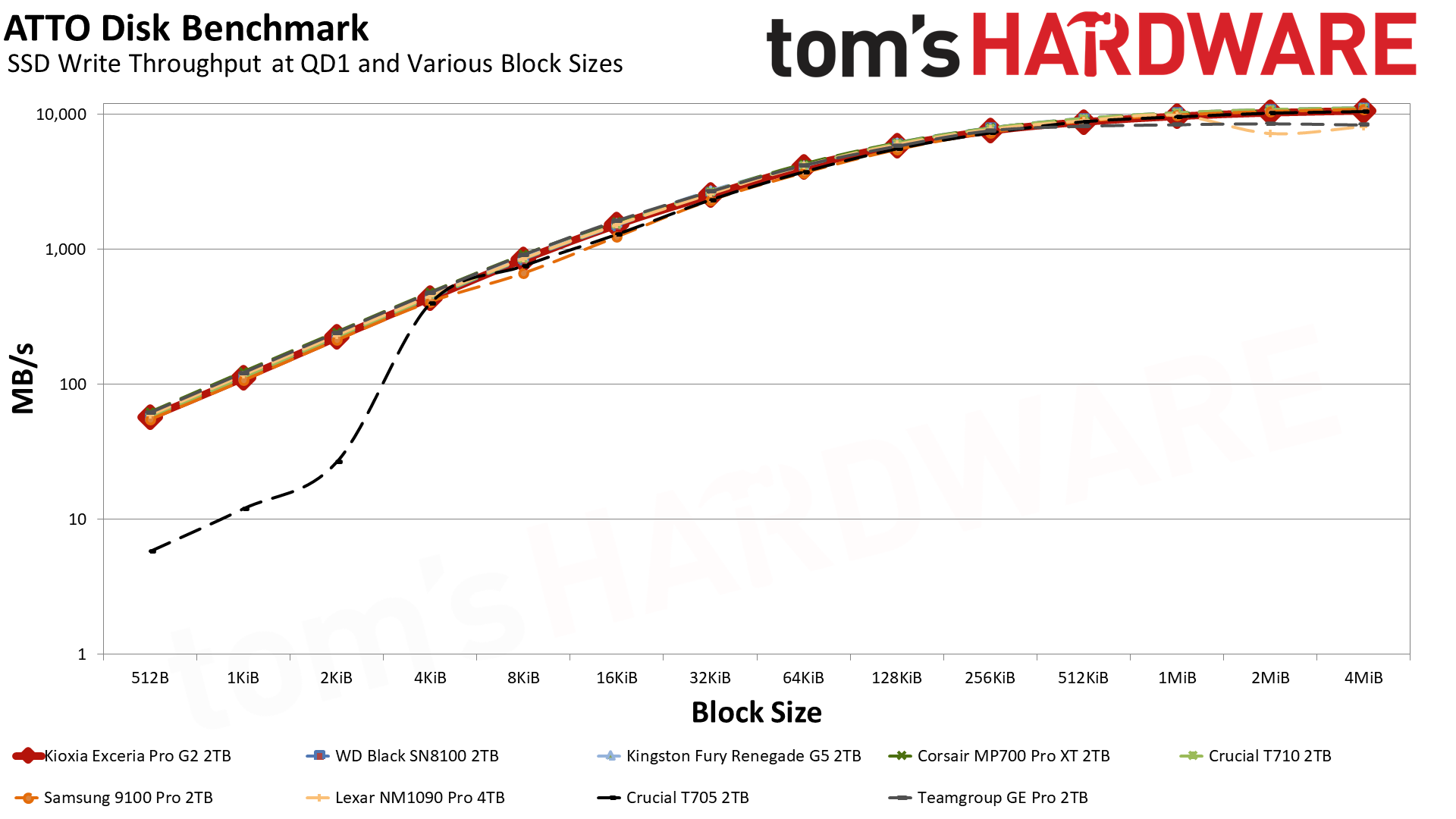
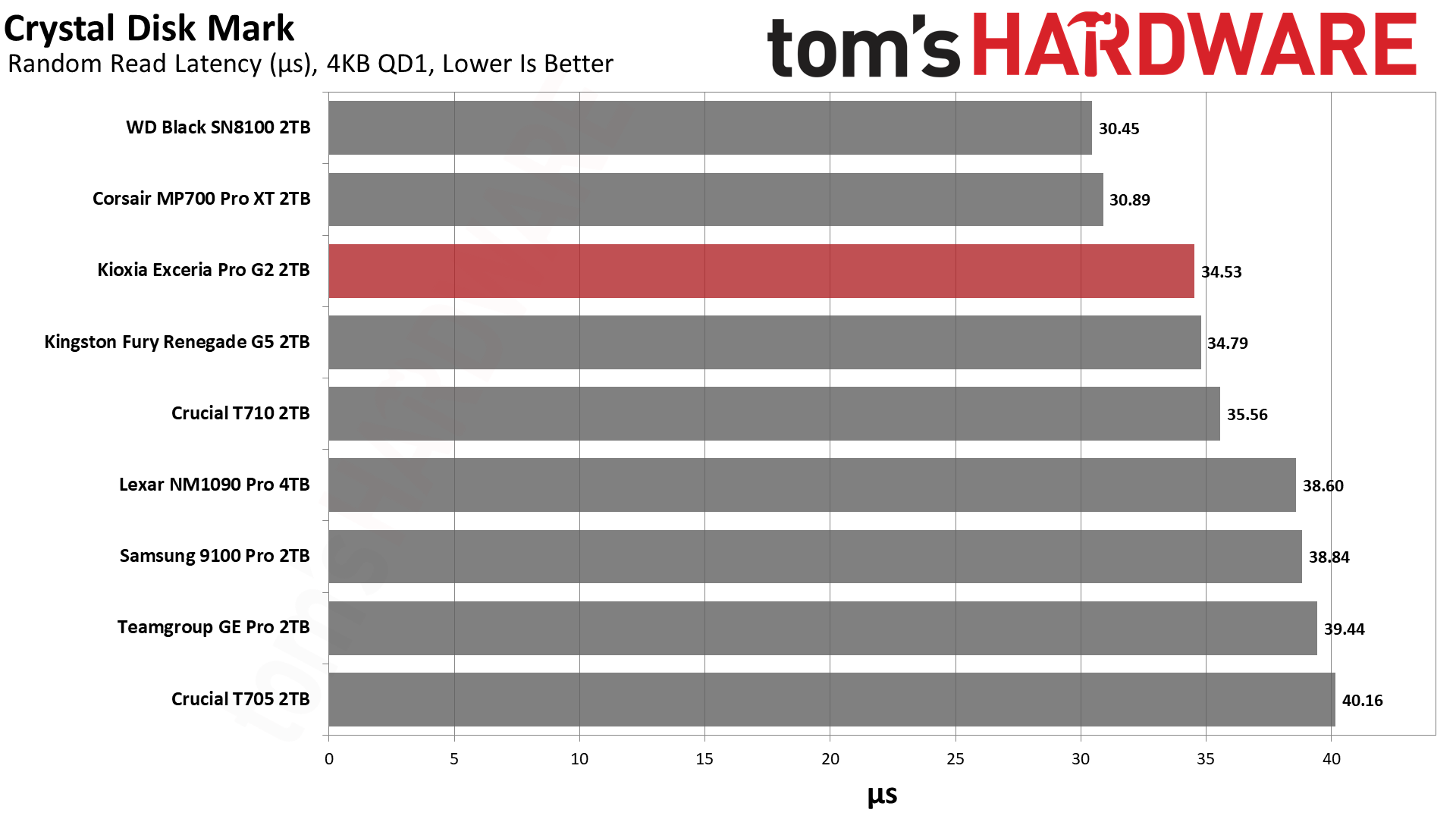
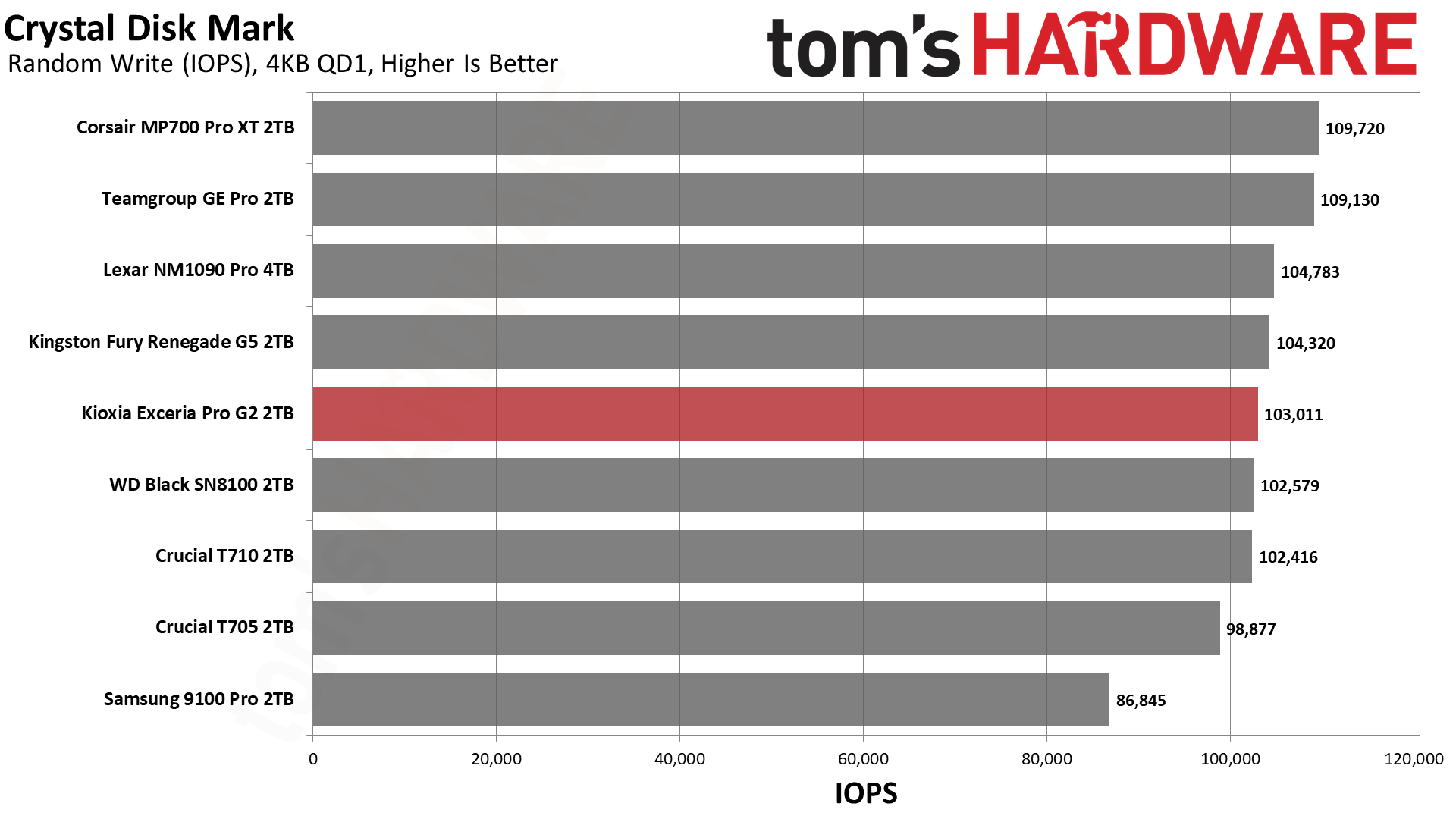
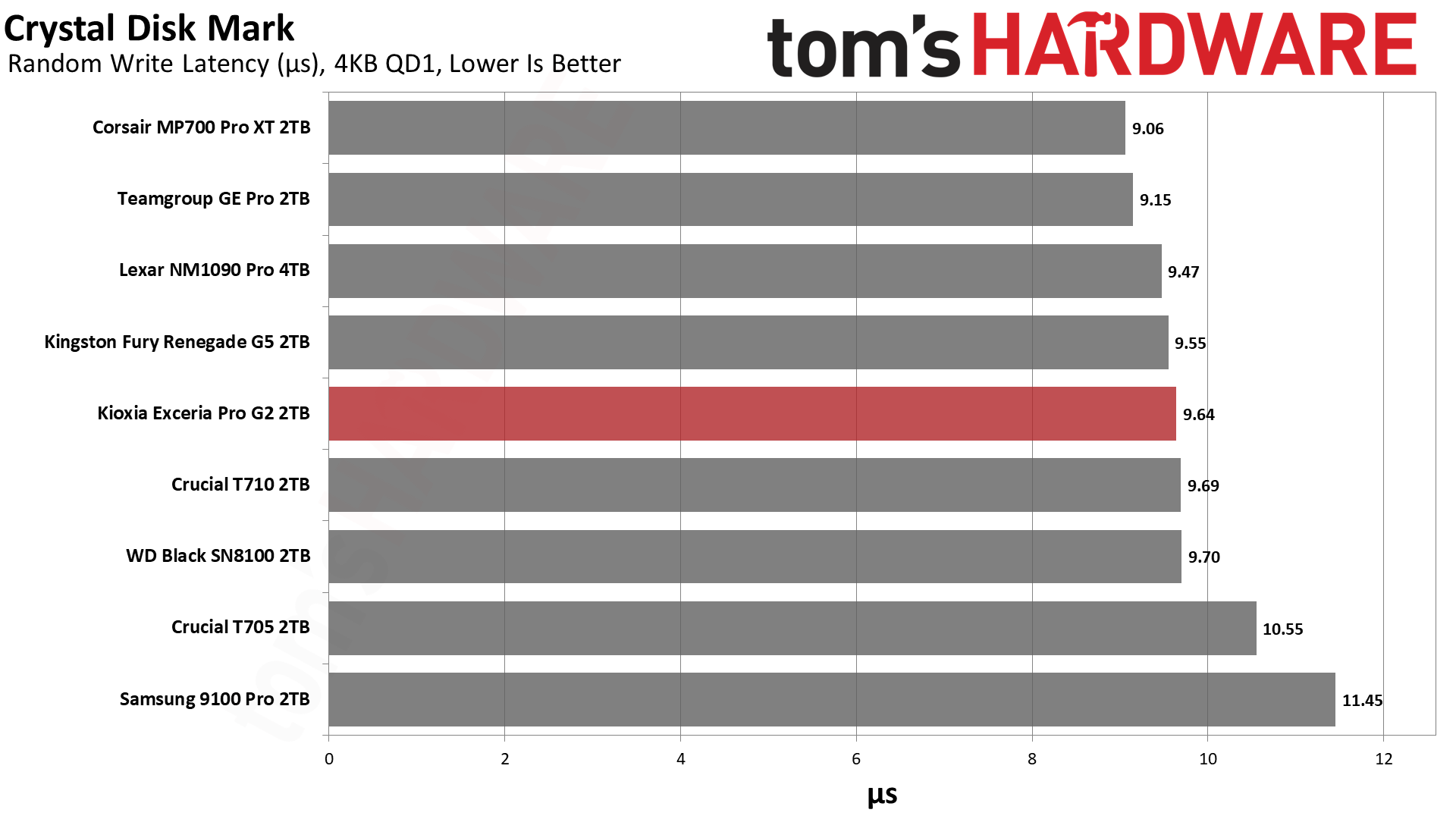
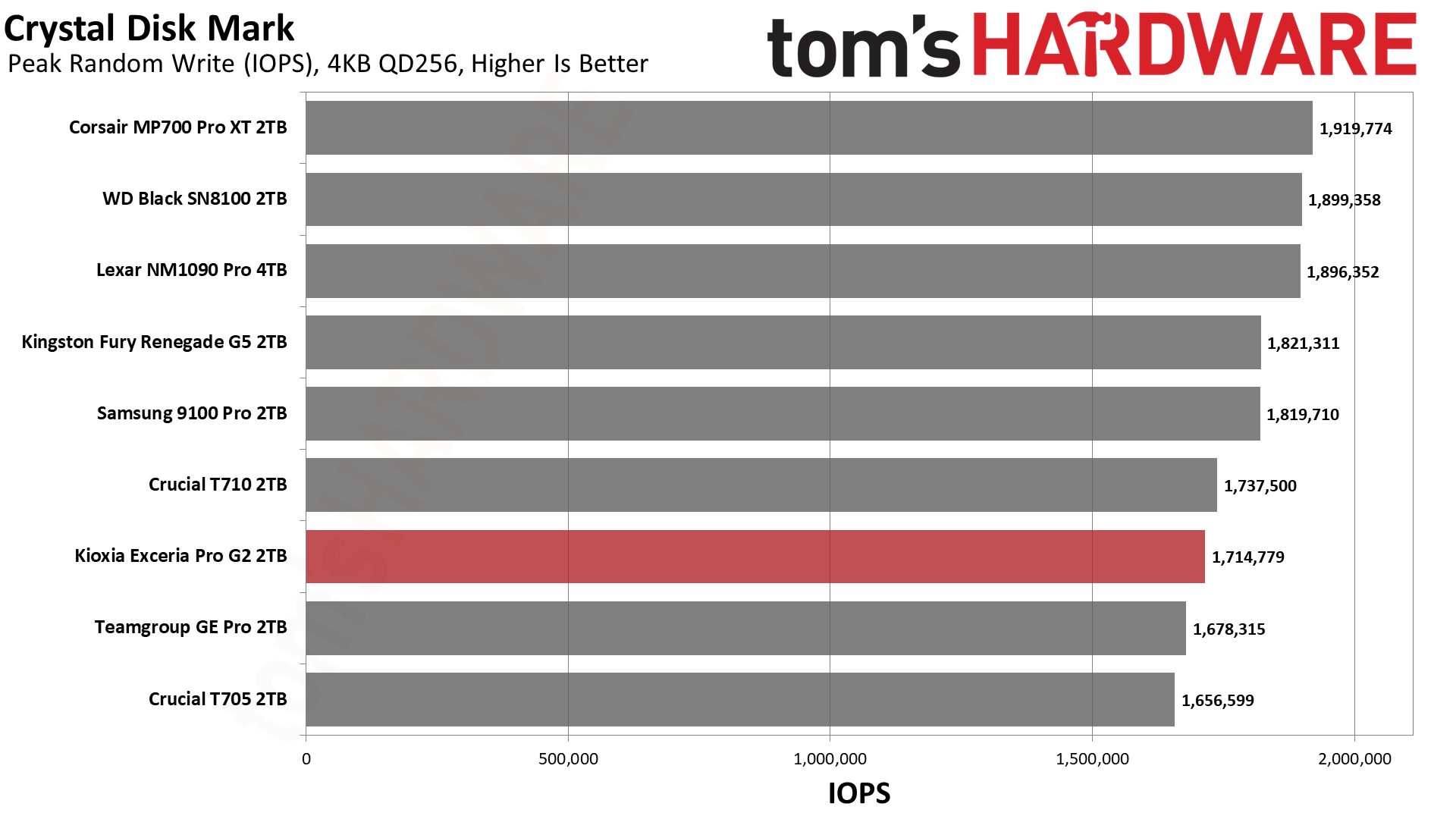
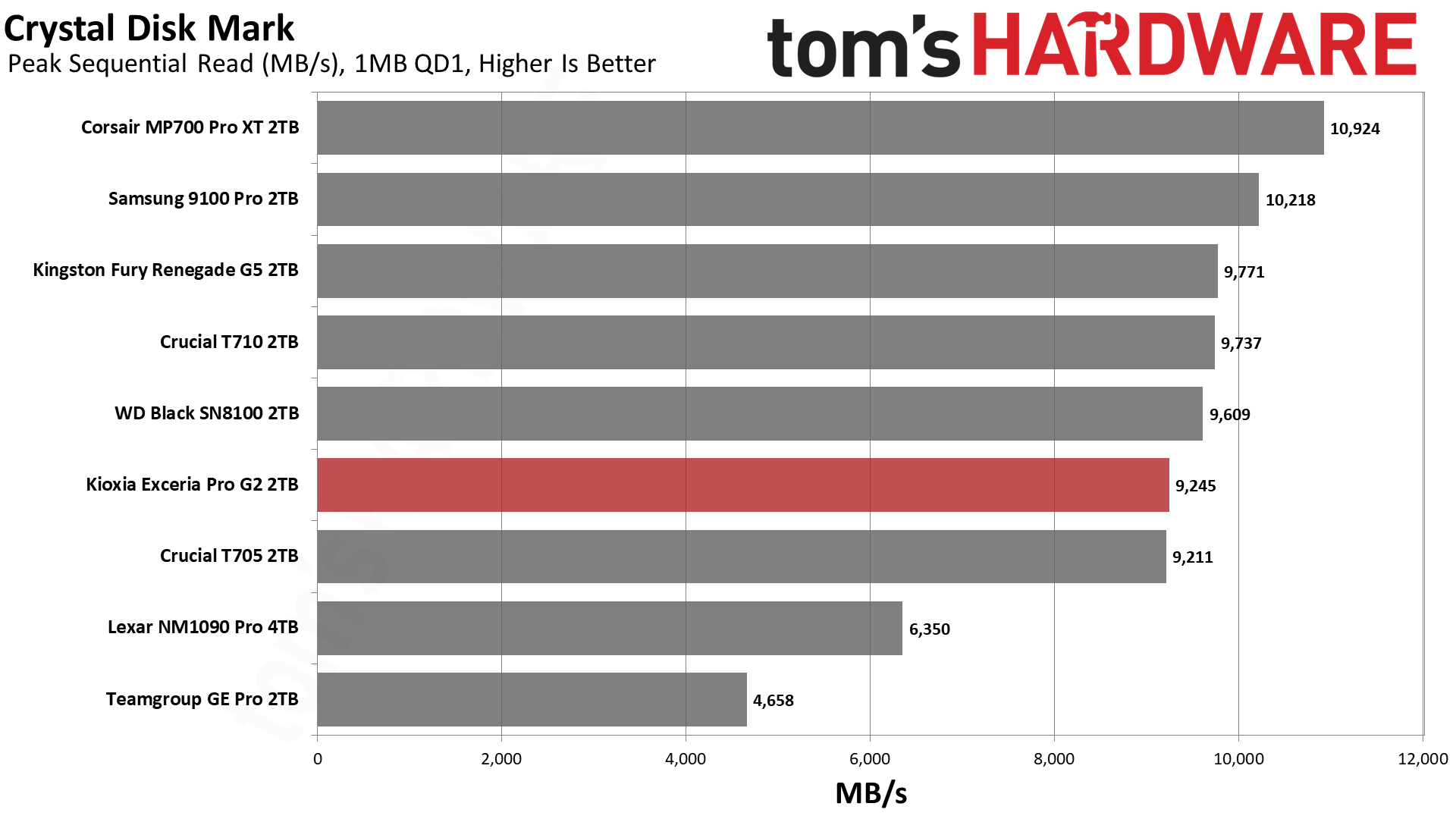
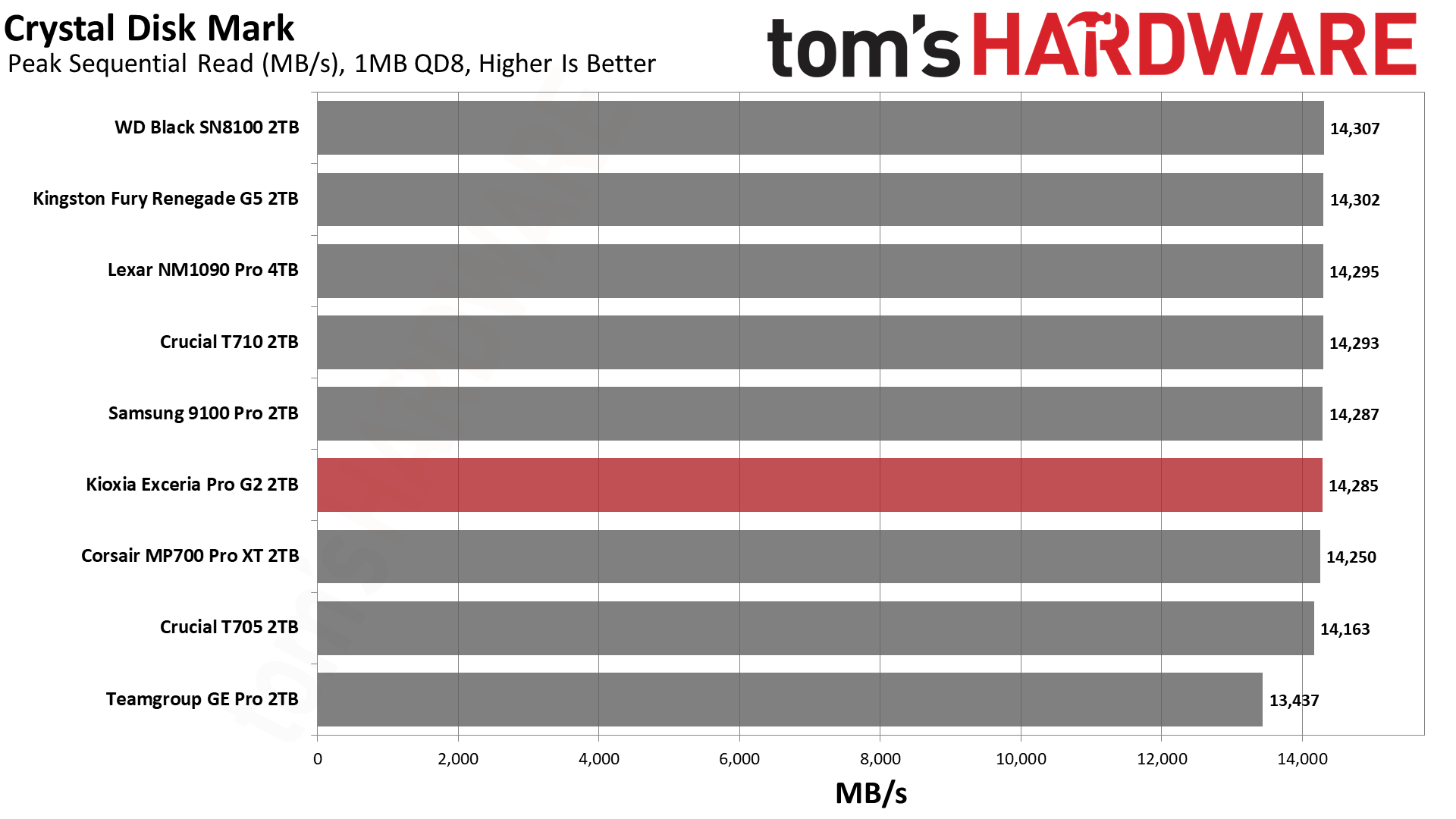
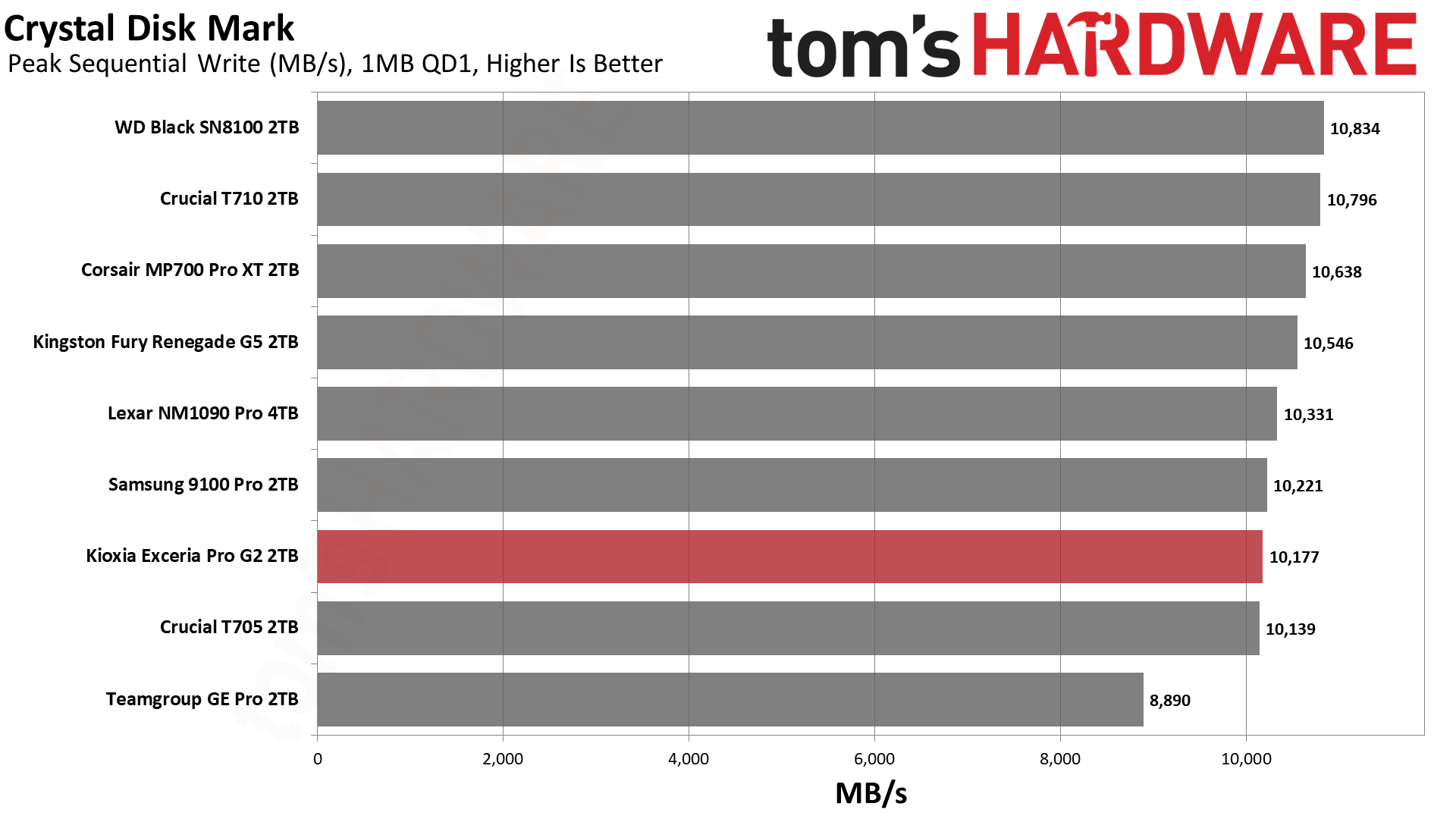
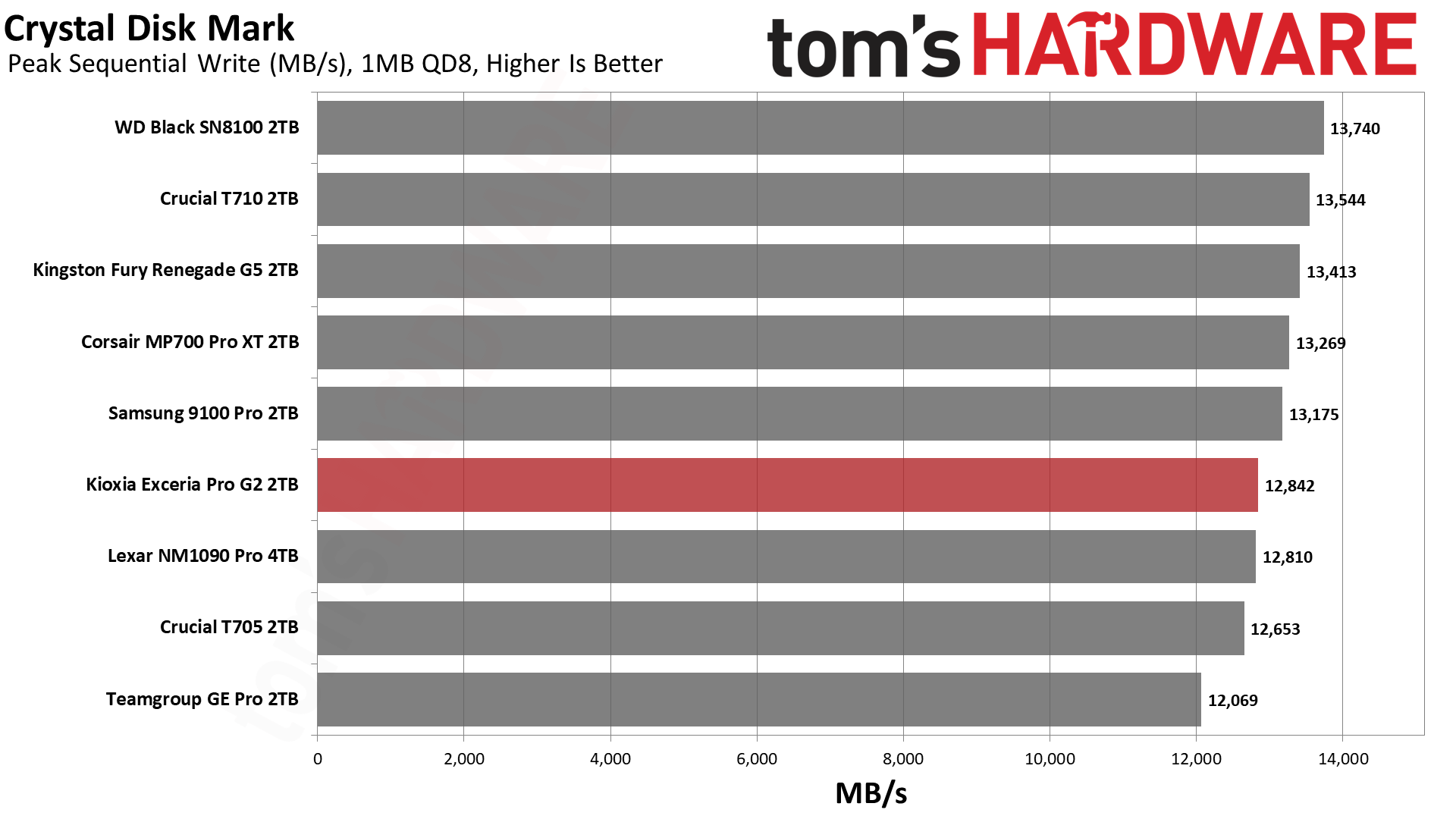
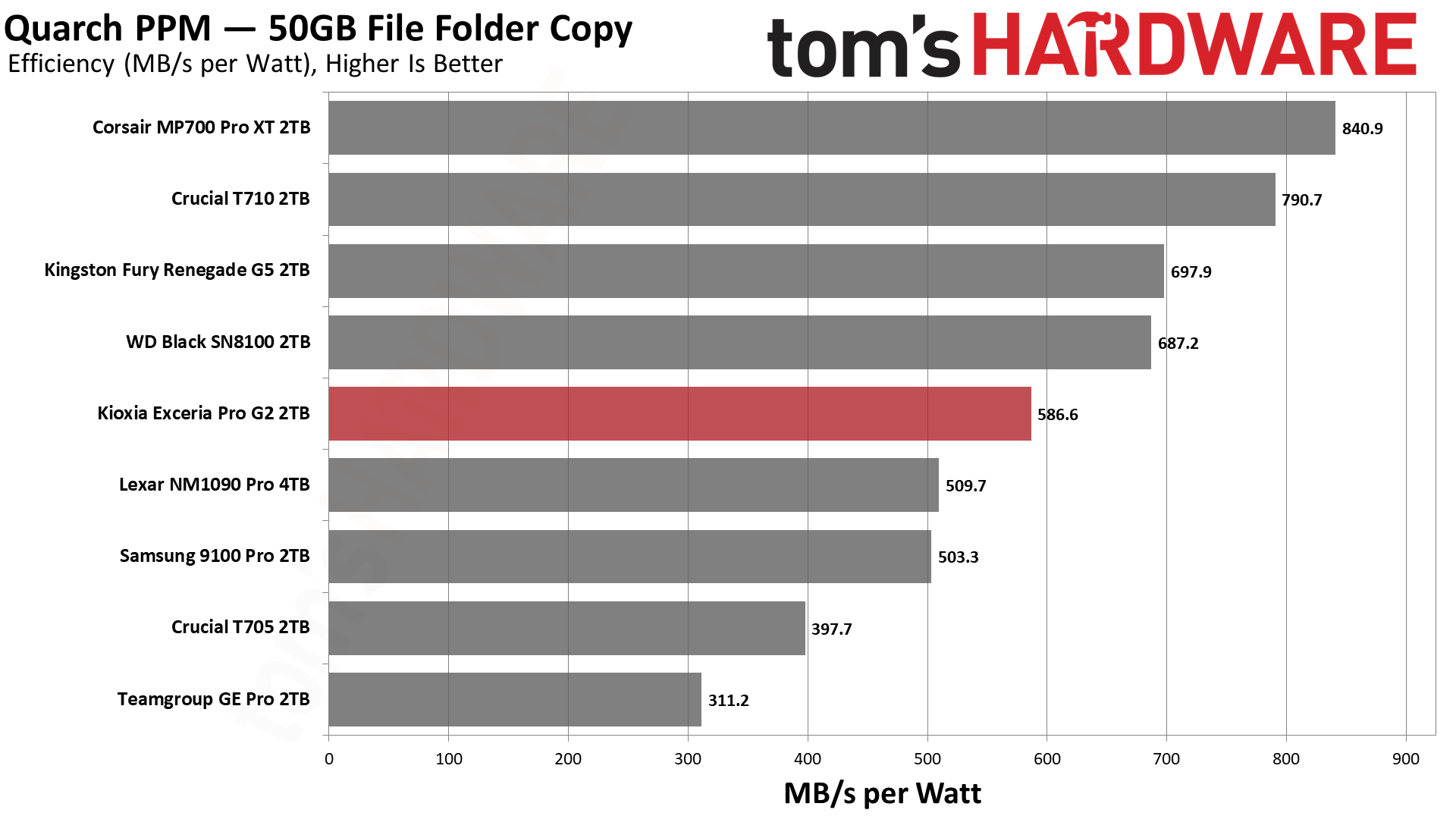
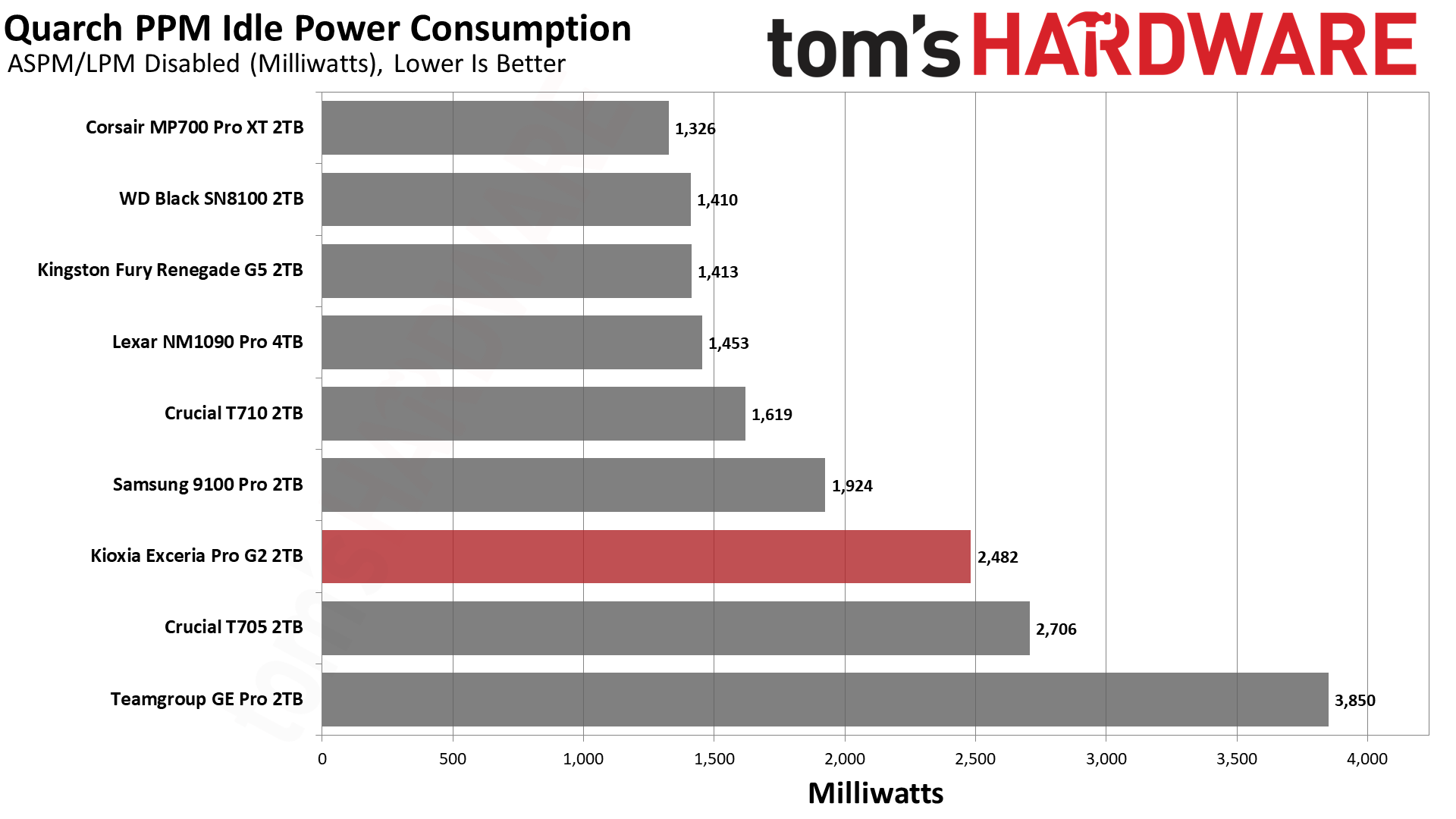
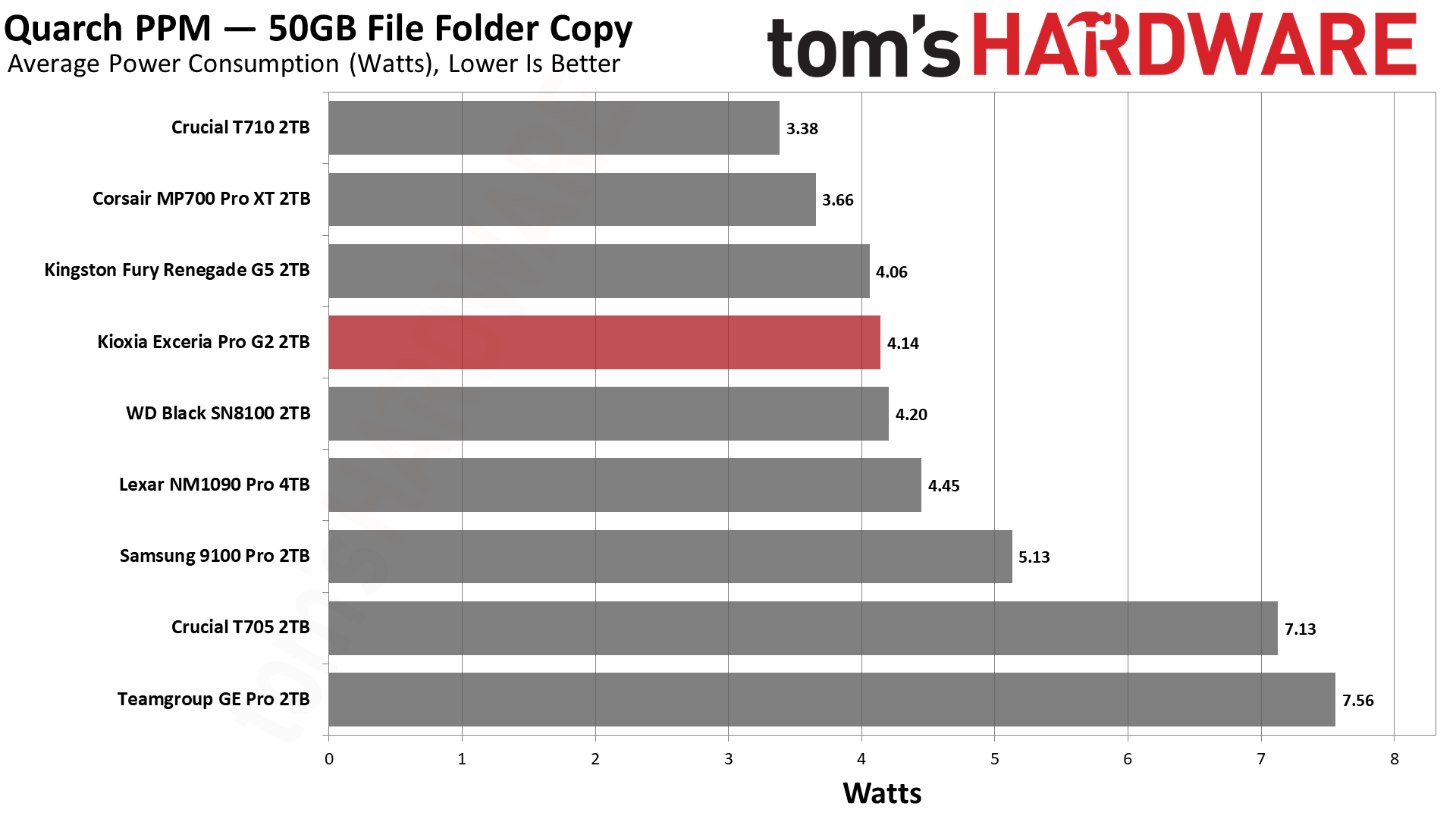
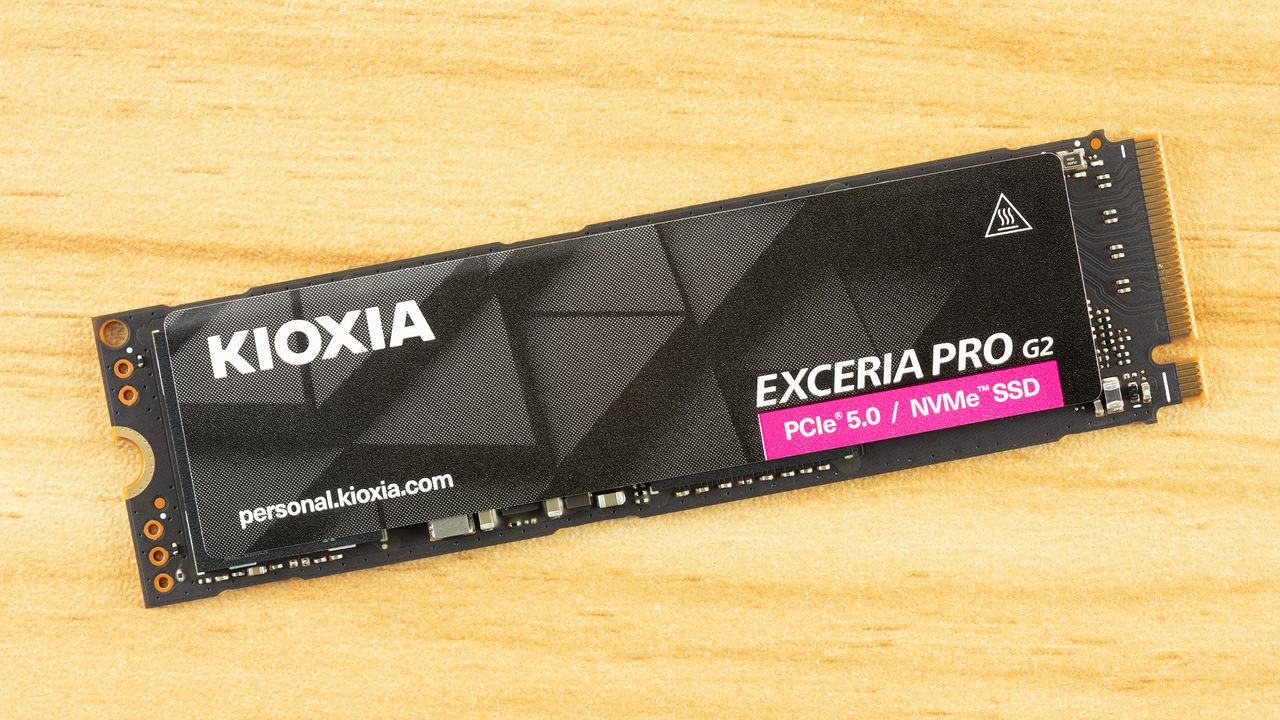
We always like to review Kioxia drives because they usually provide the perfect marriage of performance and reliability. We certainly wish they were more readily available in retail in the U.S., but we can still appreciate a good design when we see it. The Exceria Pro G2 continues in that lineage with all-new levels of performance you can only get with the newest hardware and a PCIe 5.0 interface. It’s like a Kingston Fury Renegade G5 made for OEMs, providing most of the performance you expect from this class of drive with reliability-minded firmware built in.
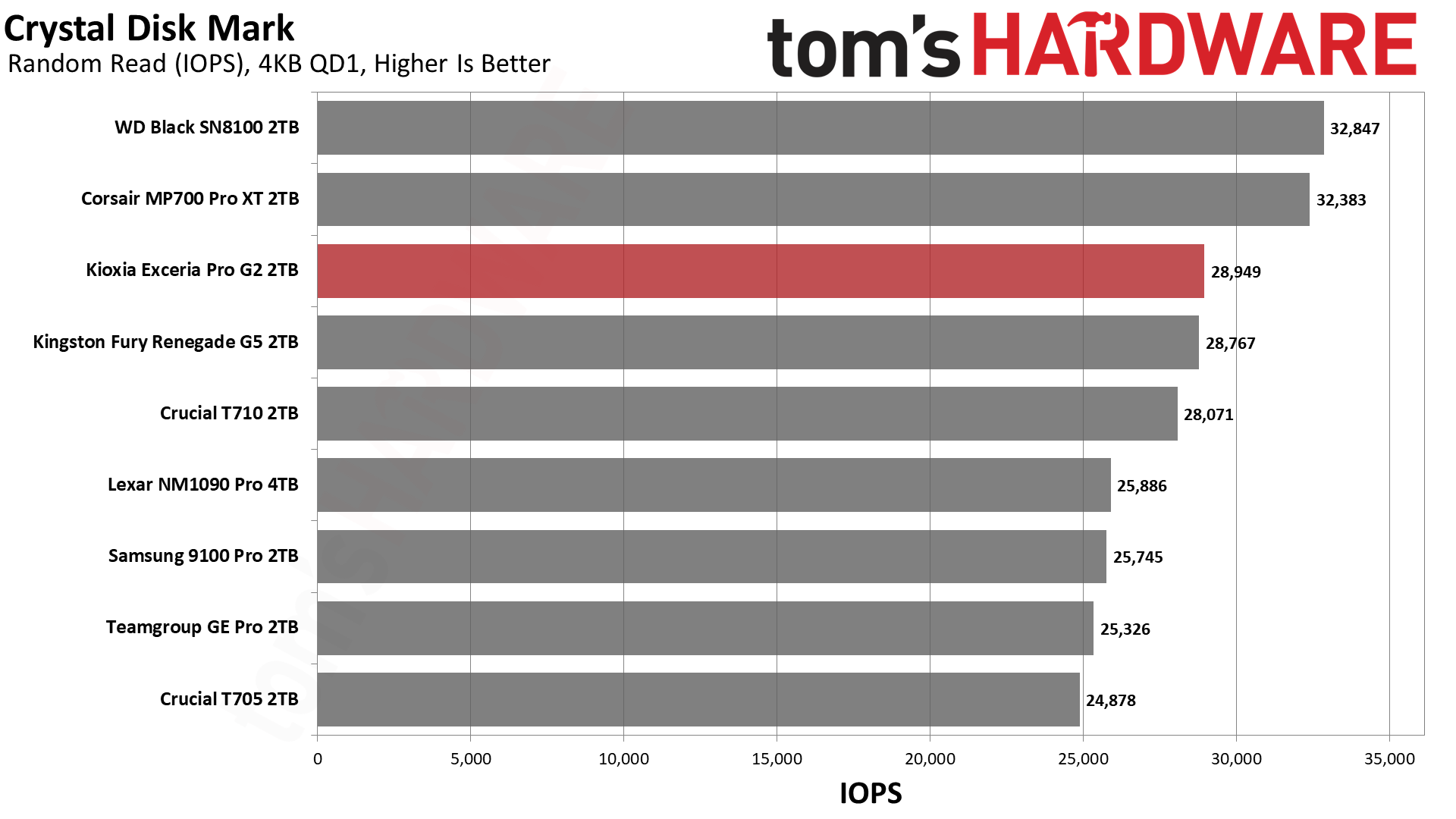
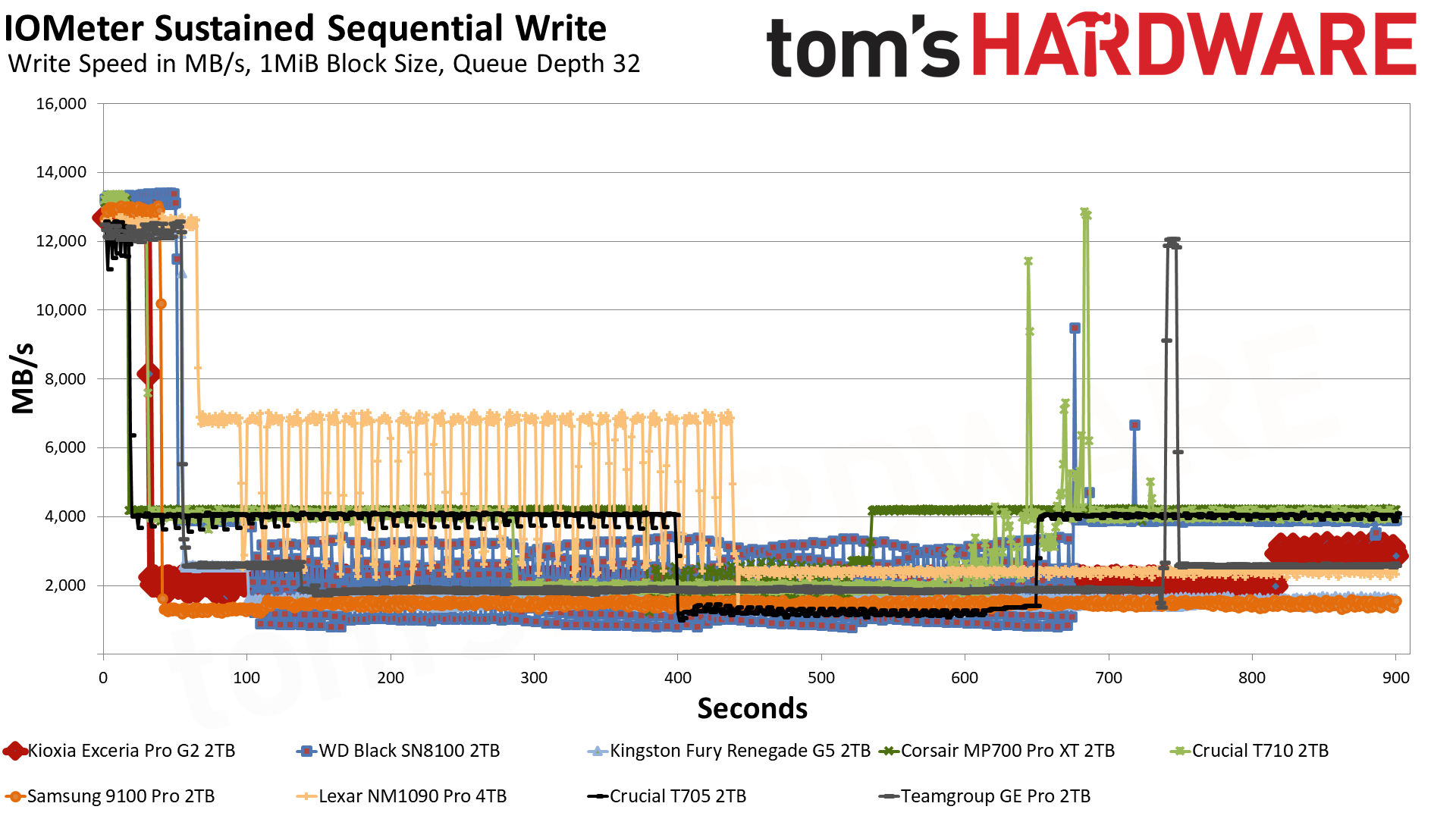
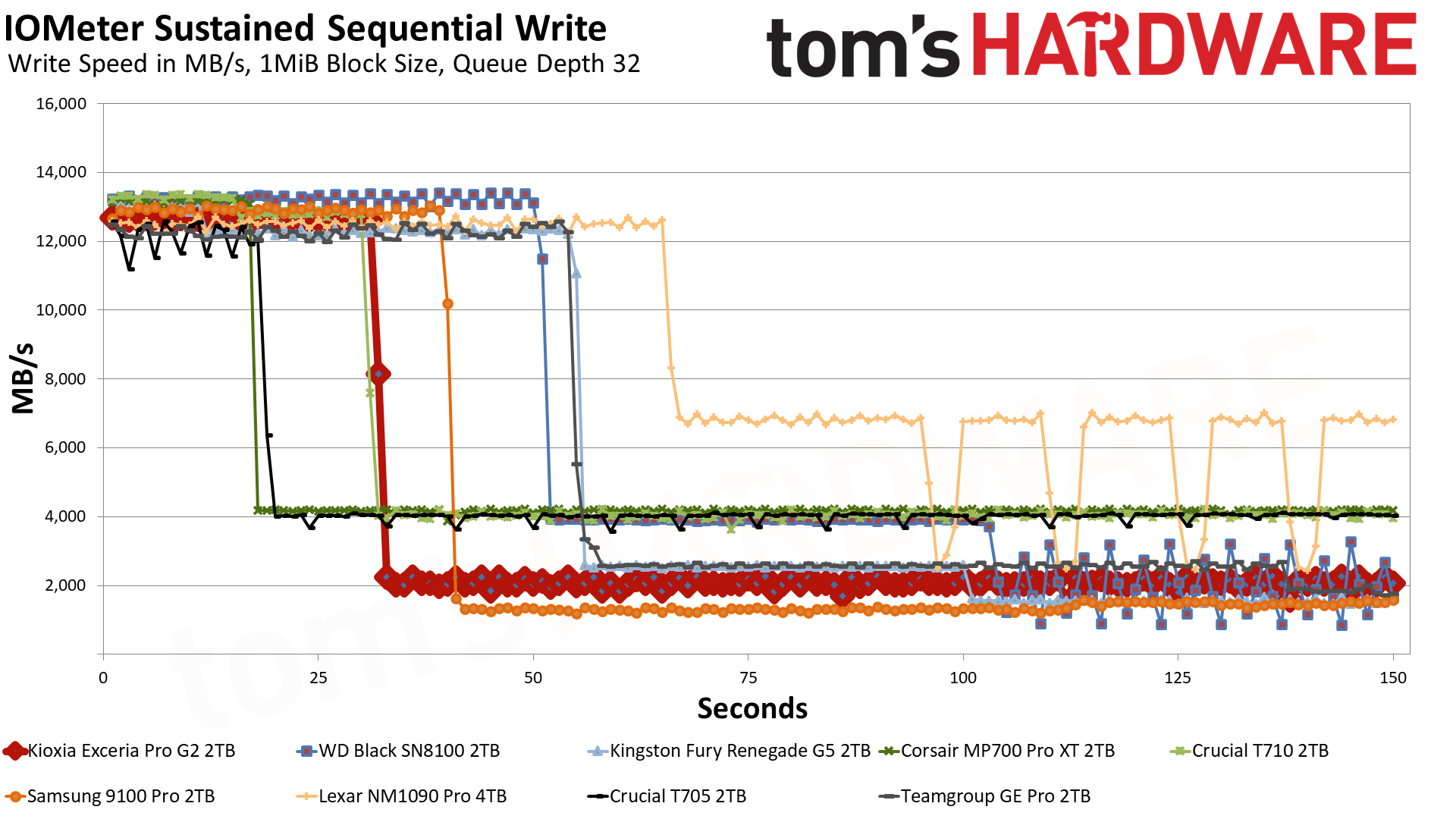
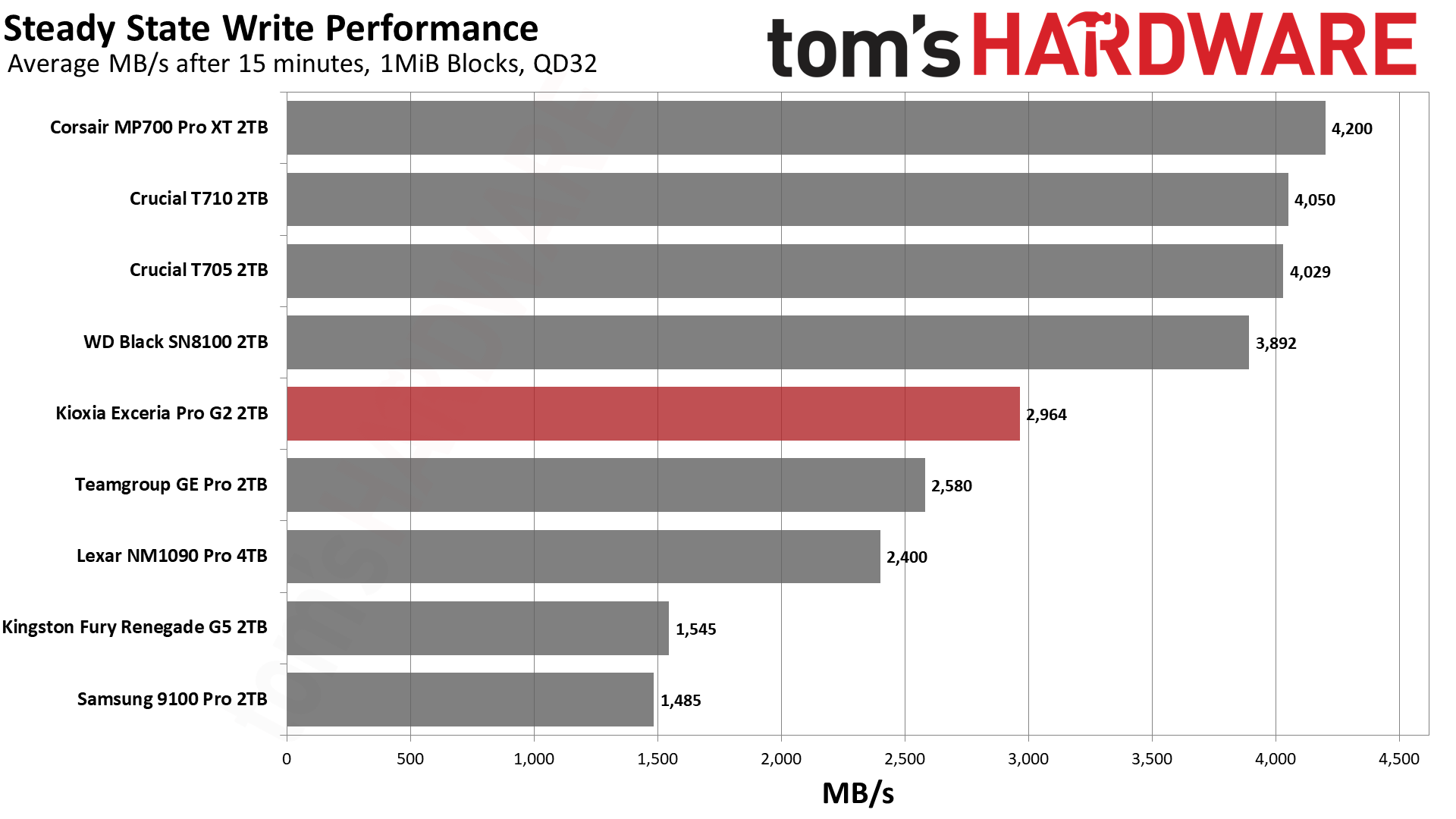
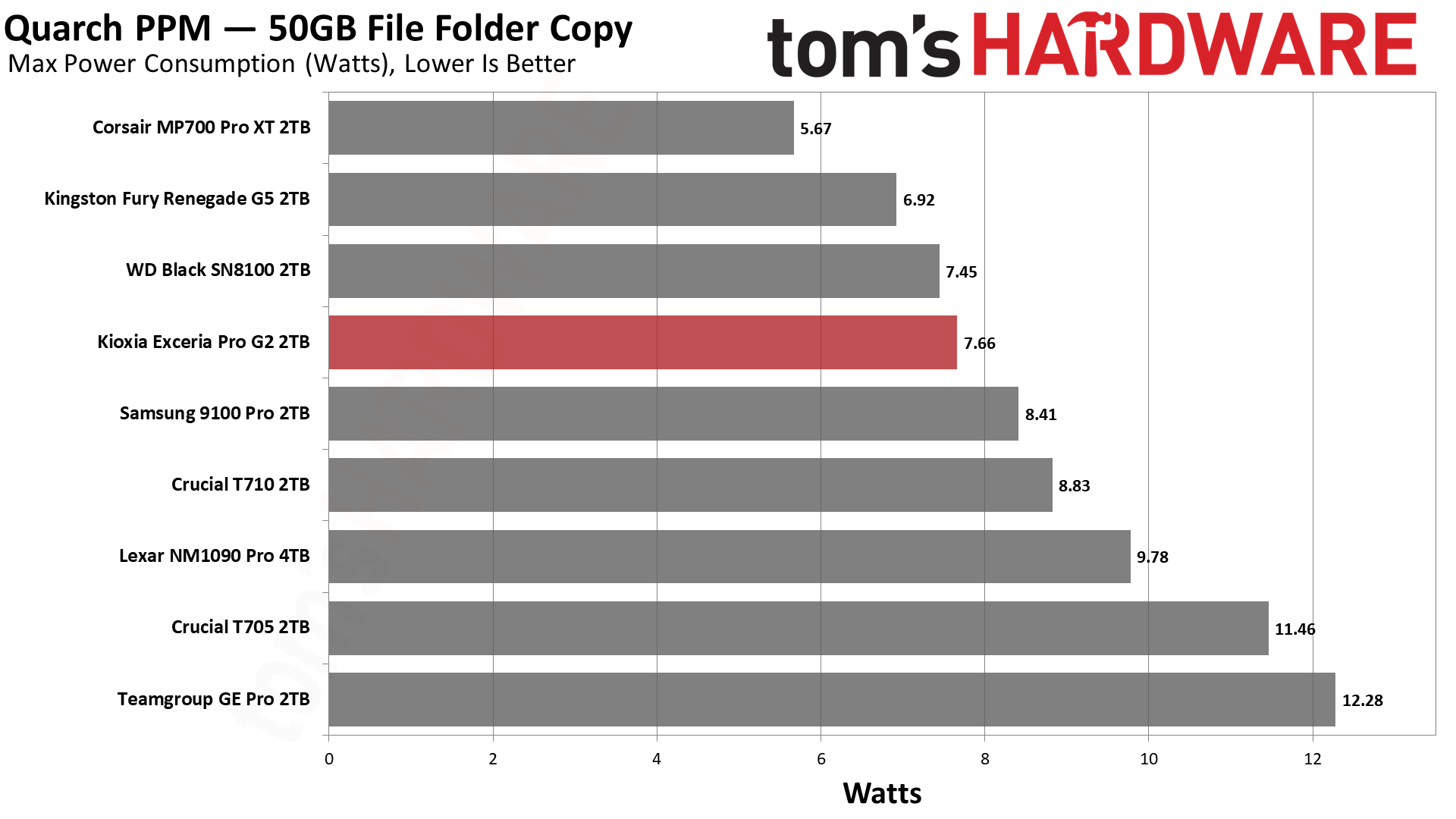
The important bit is that this drive still delivers what you’d expect. That means high performance, including sustained write performance, good power efficiency, and very low random read latency. These are the hallmarks of a drive that offers an excellent user experience. This is a very fast drive, just not the very fastest, but we make the argument that this is a deliberate trade-off for a drive with roots in an area where reliability is a bigger priority. For some, that might otherwise tip things in its favor. Regardless of your stance, though, its price in areas where it is available is competitive, and we can judge it by that.
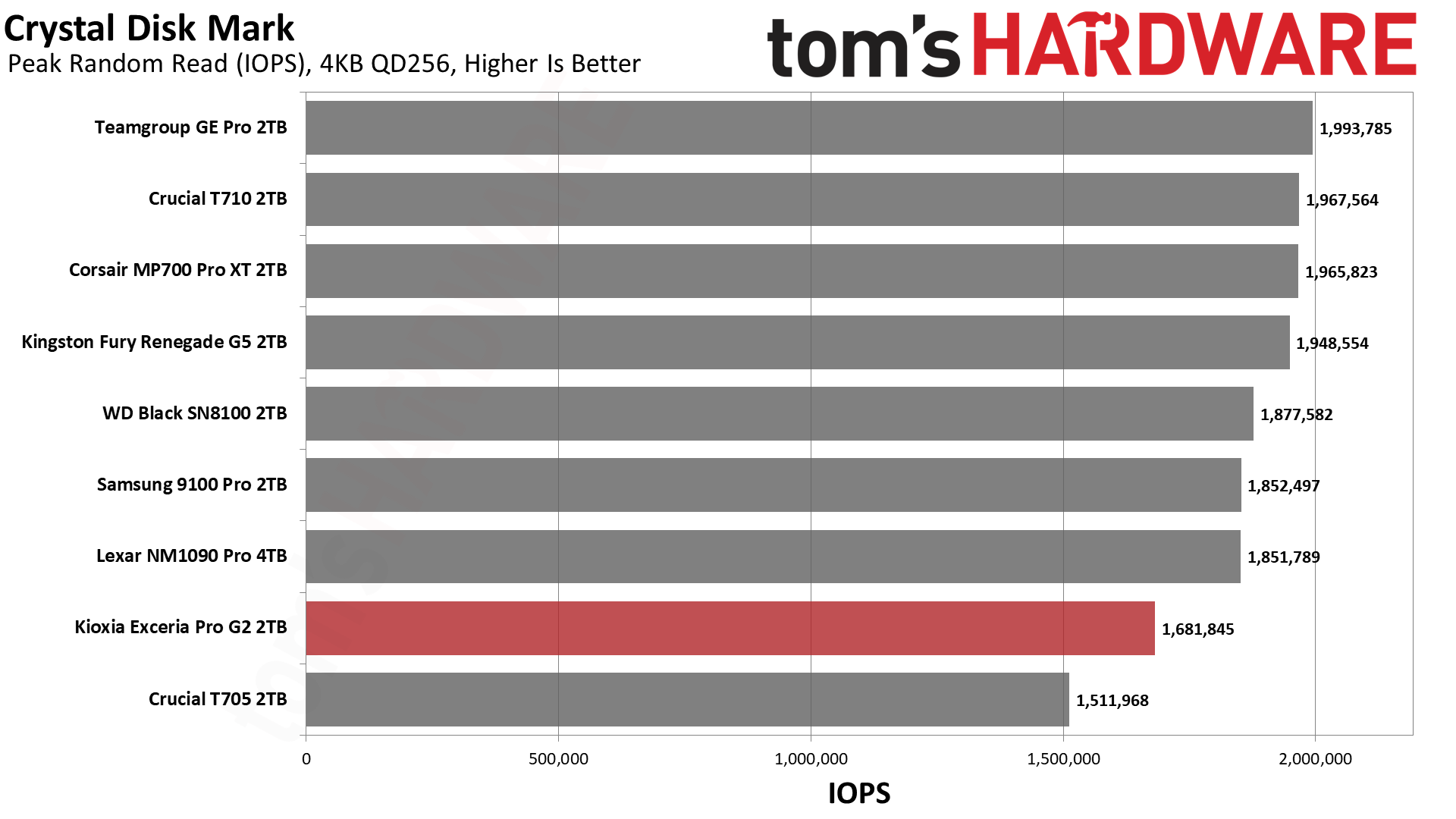
The Kioxia Exceria Pro G2 is available in 1TB, 2TB, and 4TB capacities. These are the most popular capacities, with 8TB yet again out of reach due to rising prices. The drive can reach up to 14,900 / 13,700 MB/s and 2,300K / 1,950K random read and write IOPS at the highest capacity. Most of this performance is achievable at 2TB, which is likely the sweet spot.
The drive has the usual five-year warranty with up to 600TB written per terabyte. Encryption support is not explicitly mentioned, and for a model in this line, we would expect TCG Pyrite and software encryption support only.
For pricing, we are making estimates based on pre-tax listings in the EU. Kioxia does not officially distribute the drive at U.S. retail, and the Amazon.com listings you find may be imports. These come in at ~$190, ~$340, and ~$650. These estimates make it look downright affordable, with the 1TB and 2TB models well under the WD Black SN8100, and the 4TB is roughly at parity at the time of review. It would be more expensive to import the drive, of course. One reason Kioxia can keep the price of the drive down is that it manufactures the flash it’s using, and its competition there – Crucial dropped out of the market, for one – is reduced.
Kioxia Exceria Pro G2 Software and Accessories
Kioxia supports its SSDs with SSD Utility Management Software, or SSD Utility for short. This SSD toolbox includes a summary of the drive and system, a firmware update feature, drive health monitoring, a secure erase function, password protection, and a section for troubleshooting. For data backup, we recommend MultiDrive for Windows – there is a portable version available, as well as a bootable WinPE image – or Clonezilla for other operating systems.
Kioxia Exceria Pro G2: A Closer Look
Tom's HardwareTom's Hardware
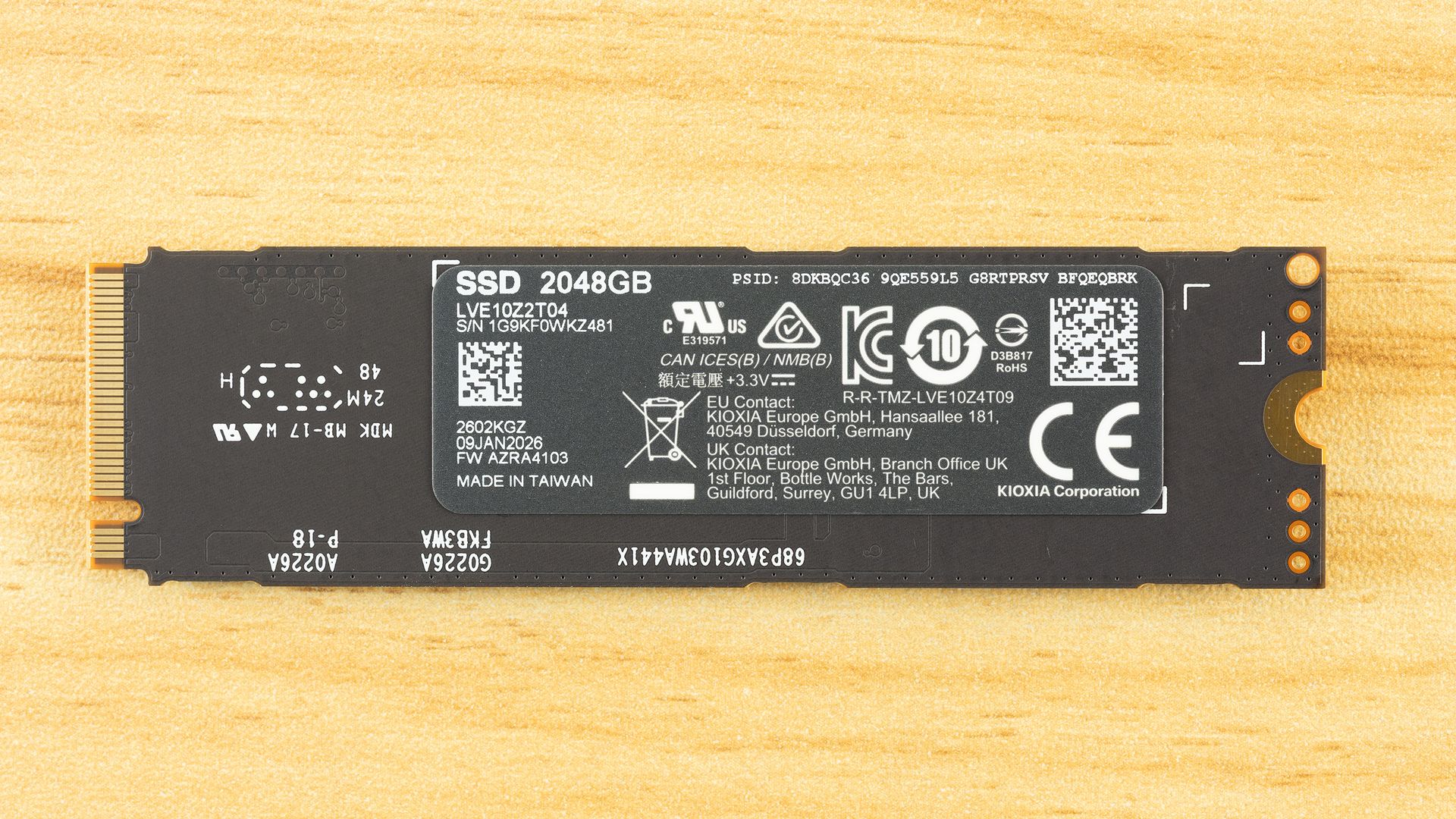
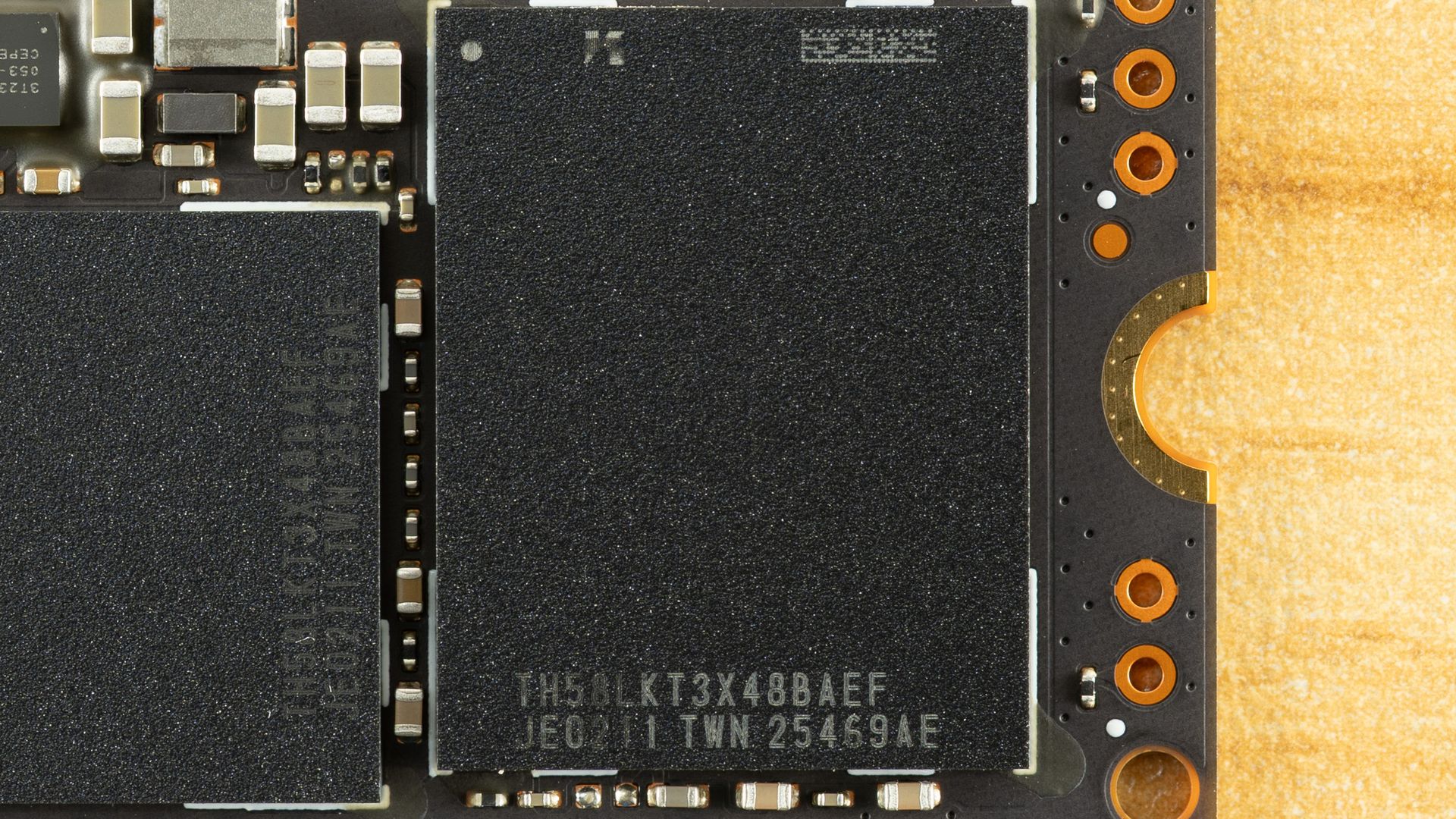
This is a single-sided drive in the M.2 2280 form factor. Specifically, the 1TB and 2TB conform to 2280-S3-M, while the 4TB is 2280-S4-M. These are all single-sided, but the 4TB is slightly thicker at 2.63mm versus 2.38mm. This is because it needs 16-die, rather than 8-die, NAND flash packages to achieve 2TB per package. The resulting extra height should not be an issue in most cases but is worth noting for devices with specific limitations.
The rear label has the Physical Presence Security ID (PSID), which allows a security reset to the factory state with an unlocked drive. This fits in with our expectation above that this drive is TCG Pyrite 2.01 compliant. The drive reports support for commands that TCG relies on, but Kioxia does not explicitly advertise hardware encryption.
Tom's HardwareTom's HardwareTom's Hardware
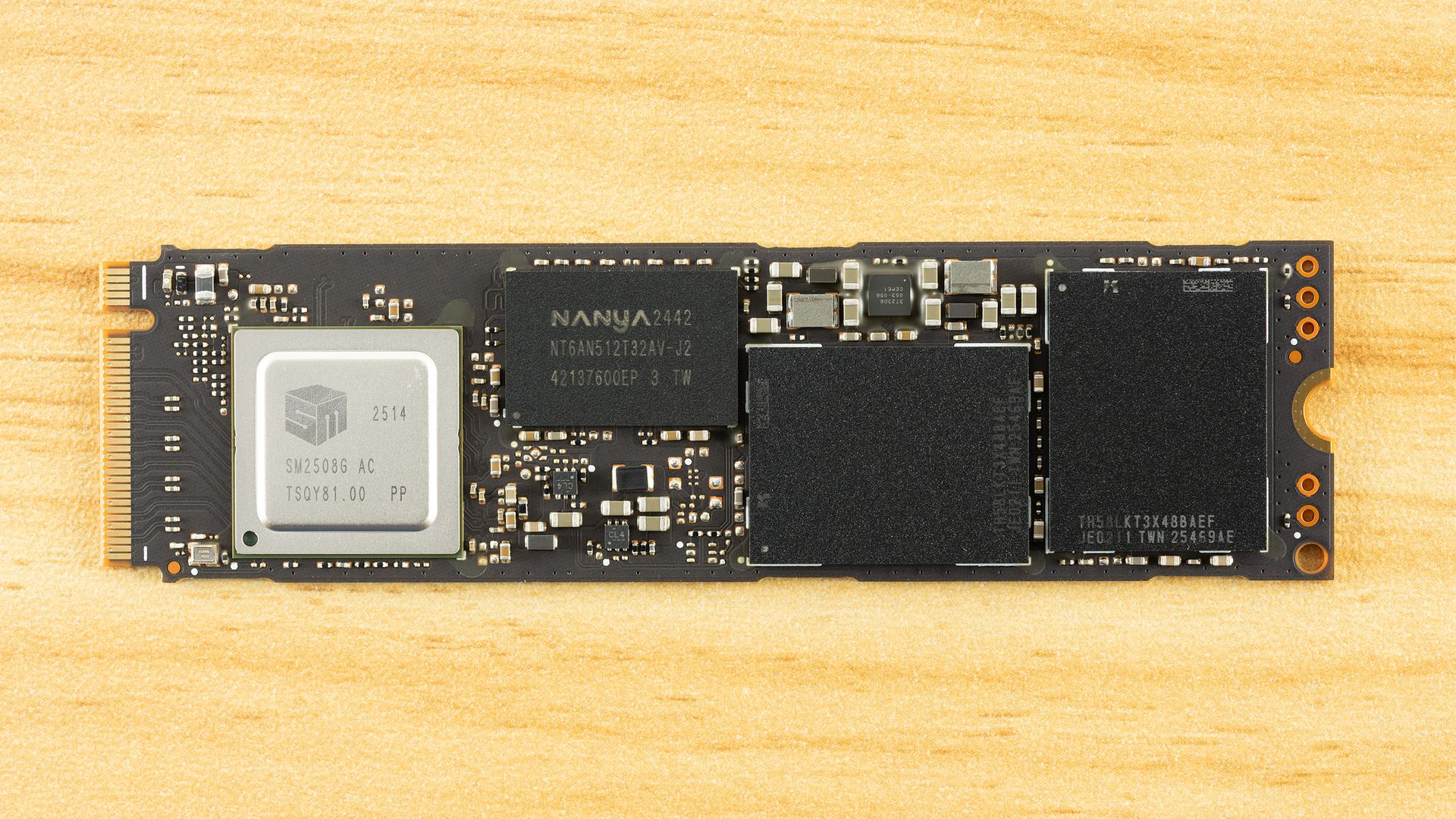
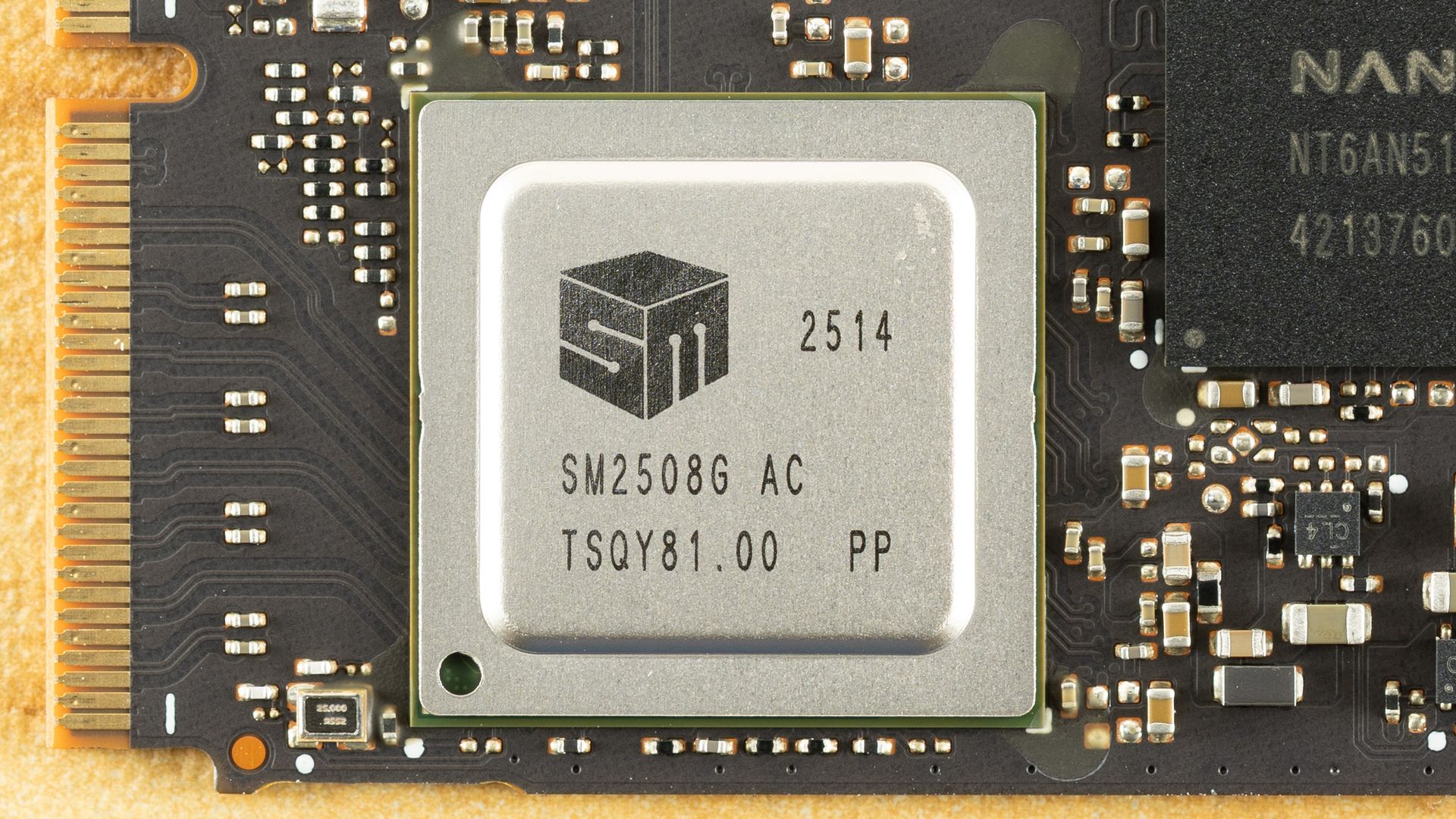
On the top of the drive, we see the Silicon Motion SM2508 SSD controller, a single DRAM package, and two NAND flash packages. We have covered the controller multiple times, and it has been paired with a range of flash, although the best-known model to use it is probably the WD Black SN8100. Both the Black SN8100 and Exceria Pro G2 are using 218-Layer BiCS8 TLC flash, but the former uses Sandisk BiCS while the latter uses Kioxia’s instead.
When we reviewed the Corsair MP700 Pro XT with Phison’s E28 controller, we noted that the E28 was supplied at one time or another with both types of BiCS. Our understanding is that there is at least one subtle difference between the two – in packaging, or so we’ve heard – and Sandisk has made it a point to emphasize its own flash on its drives. The launch E28 was faster than the prototype we previewed, but we expect firmware maturation was the most significant element. We would rather more carefully say that while Sandisk and Kioxia co-develop and share wafer output, downstream elements – die sorting, binning, package design, and possibly also how I/O speed is maintained – can differ. We wouldn’t lean towards one drive or another based on something like this, but must also point out that WD, Sandisk, and Kioxia all have their own firmware optimizations at play, which are generally more influential.
As for the DRAM, our sample has 2GB of LPDDR4X, but the exact memory will vary from drive to drive. This is not a huge consideration, but we do prefer LPDDR4/4X over DDR4 for even small power savings. The drive does have the correct 1GB-per-TB ratio of DRAM to NAND.
The Kioxia Exceria Pro G2, as a high-end drive, faces the stiffest competition we have on hand. This includes the fastest drives we’ve ever tested, the Corsair MP700 Pro XT and WD Black SN8100. We also have drives with the same hardware as the Exceria Pro G2, namely the Kingston Fury Renegade G5. The Crucial T710 uses the same controller but with Micron-made flash rather than BiCS. The T705 slots in as an example of an older high-end Gen 5 design. We also have the proprietary Samsung 9100 Pro, the more budget-oriented Lexar NM1090 Pro with older flash, and an InnoGrit-based offering from TeamGroup in the GE Pro. We are not comparing any DRAM-less drives like the Biwin Black Opal X570, as they are not in this class of drive.
Trace Testing — 3DMark Storage Benchmark
Built for gamers, 3DMark’s Storage Benchmark focuses on real-world gaming performance. Each round in this benchmark stresses storage based on gaming activities including loading games, saving progress, installing game files, and recording gameplay video streams. Future gaming benchmarks will be DirectStorage-inclusive and an evaluation for future-proofing is included where applicable.
Tom's HardwareTom's HardwareTom's Hardware
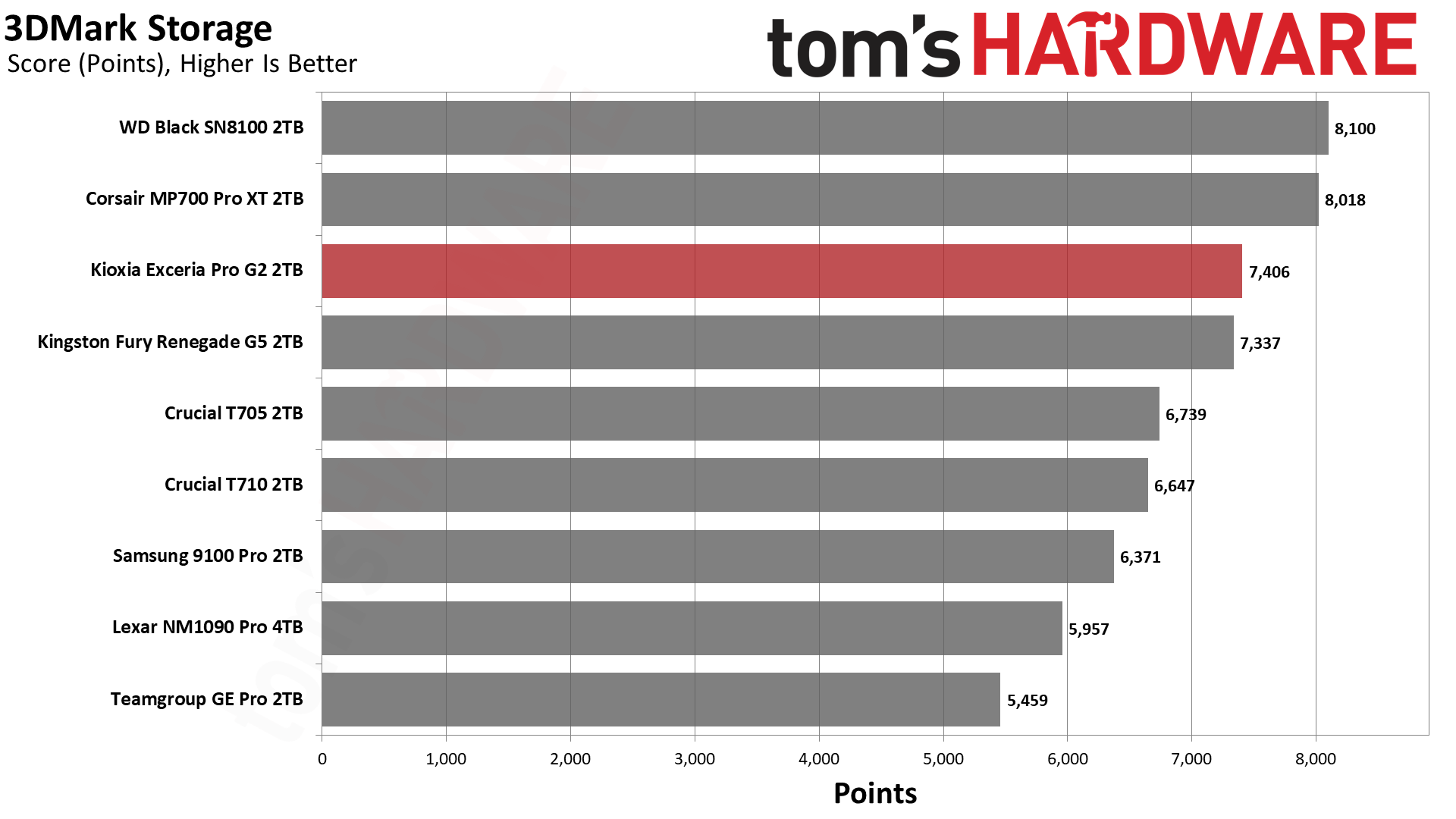
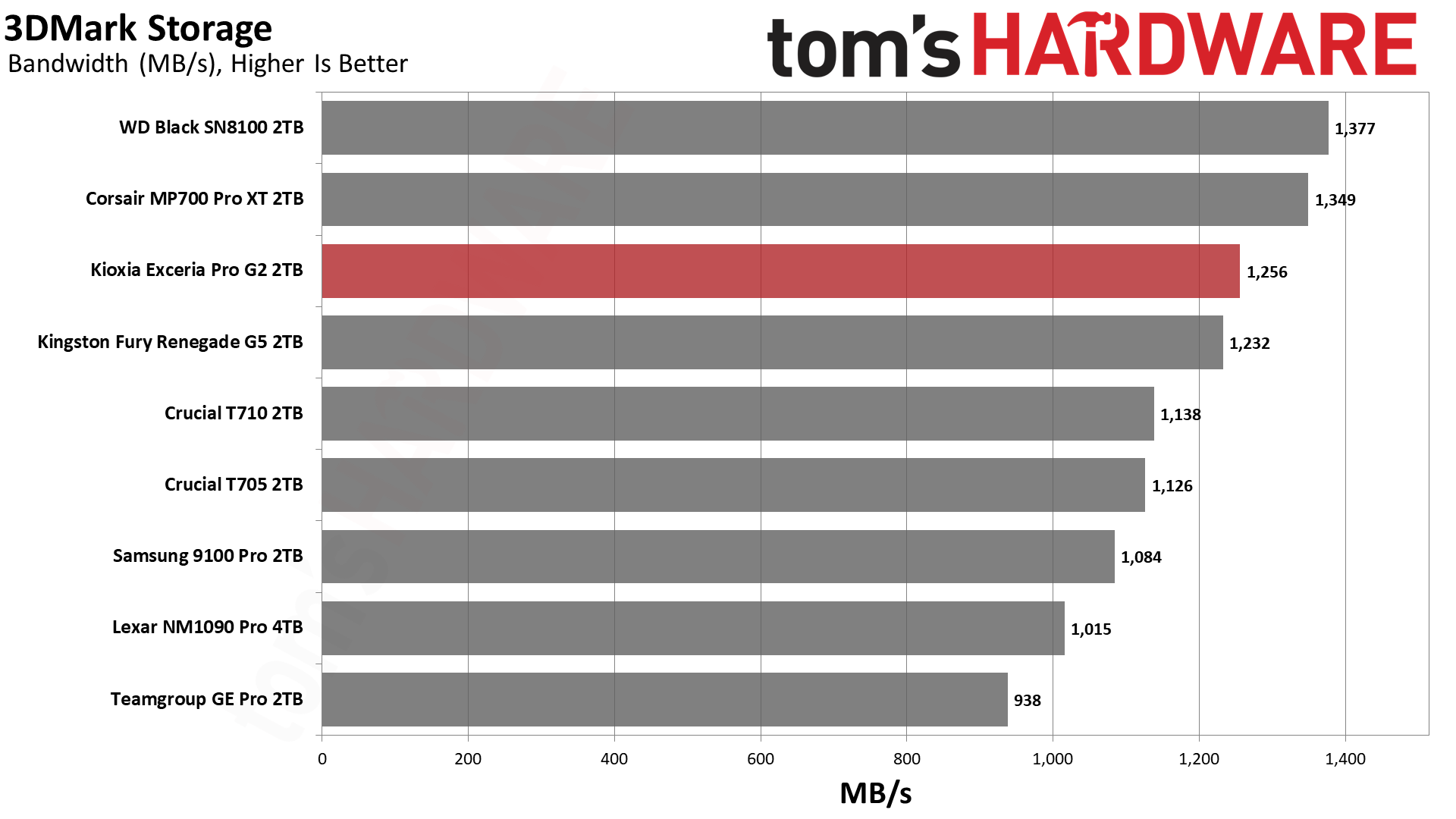
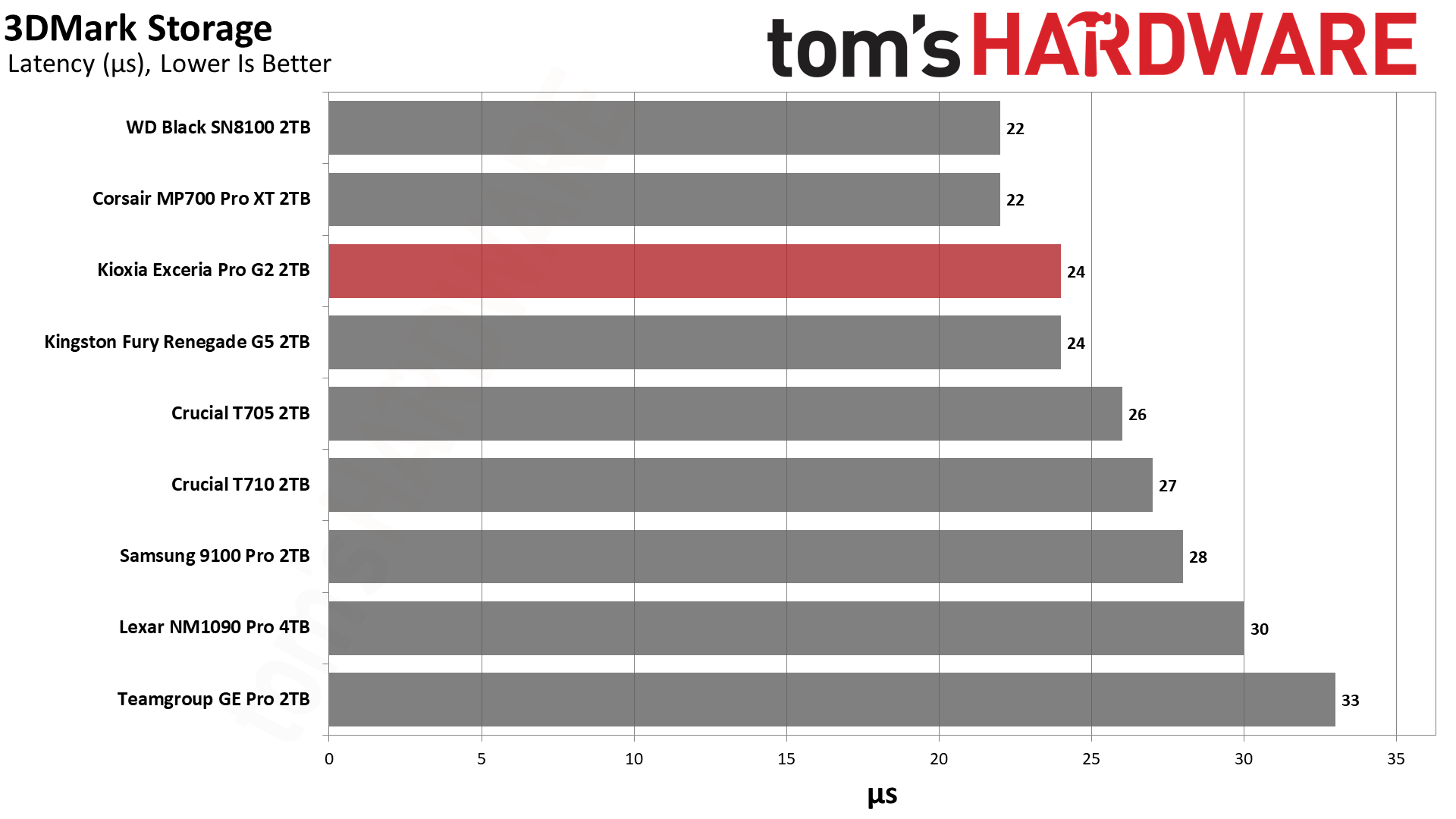
The Exceria Pro G2, being a high-end PCIe 5.0 SSD, is bound to be an excellent gaming drive. High bandwidth paired with the newest hardware is a win-win. Still, we like to qualify this with a 3DMark pass. Our finding is that the Exceria Pro G2 scores exactly where we would expect it to – right next to the Fury Renegade G5. These two drives have the same hardware, so no surprise there. The WD Black SN8100, which also has the same hardware, remains tied at the top with the Phison-controlled MP700 Pro XT. As we explained in the Black SN8100 review, this is because WD/Sandisk put some special magic in the firmware. Phison no doubt wanted to match that performance level, and actually did, but we have more than one SM2508-controlled drive to compare, which makes the SMI side of things more interesting.
Let’s look at the T710, for example. Same SM2508 controller but with Micron rather than Sandisk or Kioxia BiCS TLC flash. It’s a good performer, but clearly not as fast in 3DMark. The BiCS8 flash used on all of the fastest drives here has very low latency, which brings excellent results in many of our tests. Latency is, in fact, probably the number one thing enthusiasts look at with SSDs, with dreams of Optane-like performance. Consumer NAND flash, however, is simply not designed with that kind of ultra-low latency in mind. You are also usually bottlenecked elsewhere, to the point that improvements here lead to very little real-world value. Games load faster, sure, but there will be no improvement in FPS. That said, the Exceria Pro G2 will deliver a very good experience even in suboptimal circumstances, such as when the drive is very full.
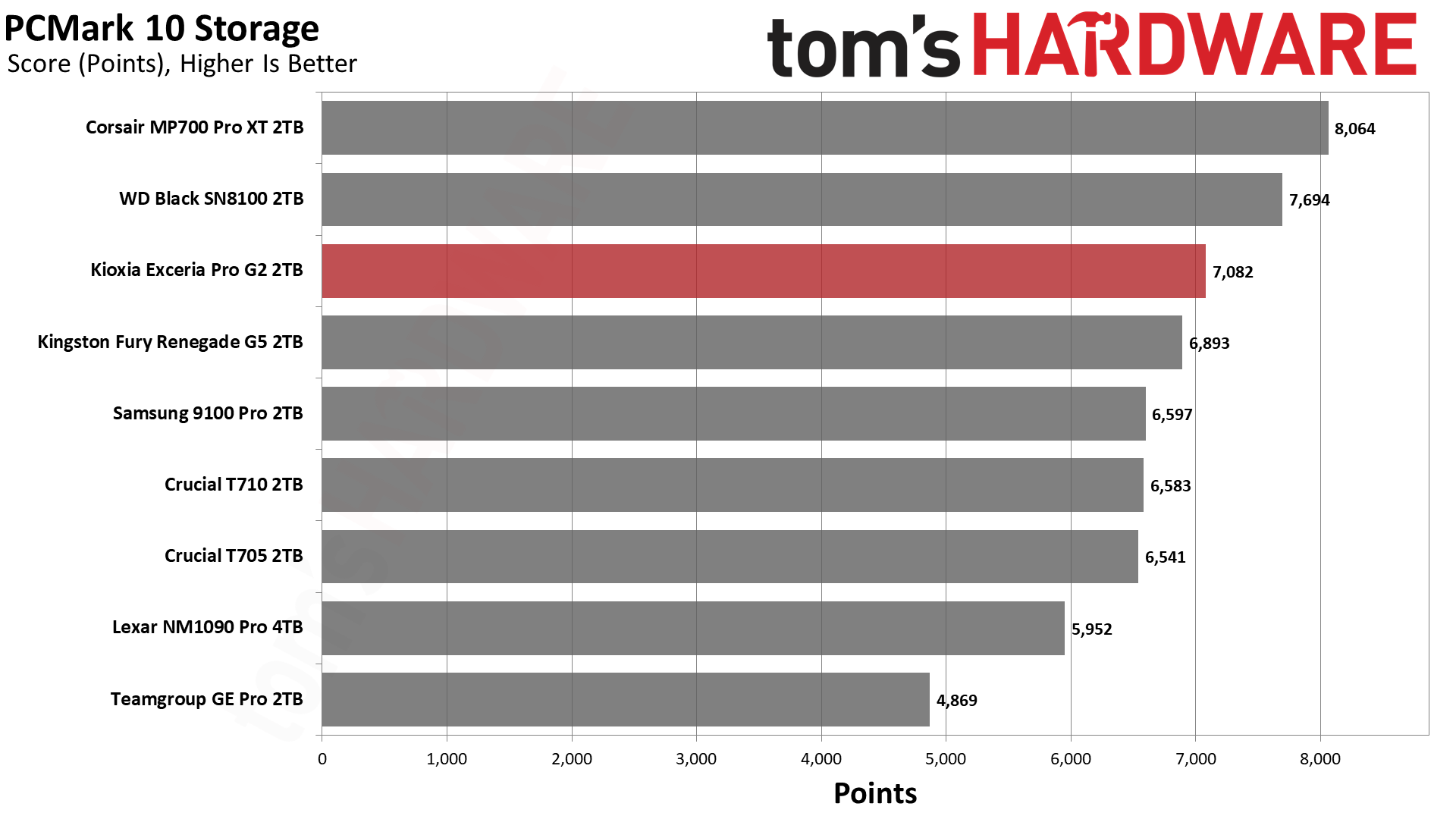
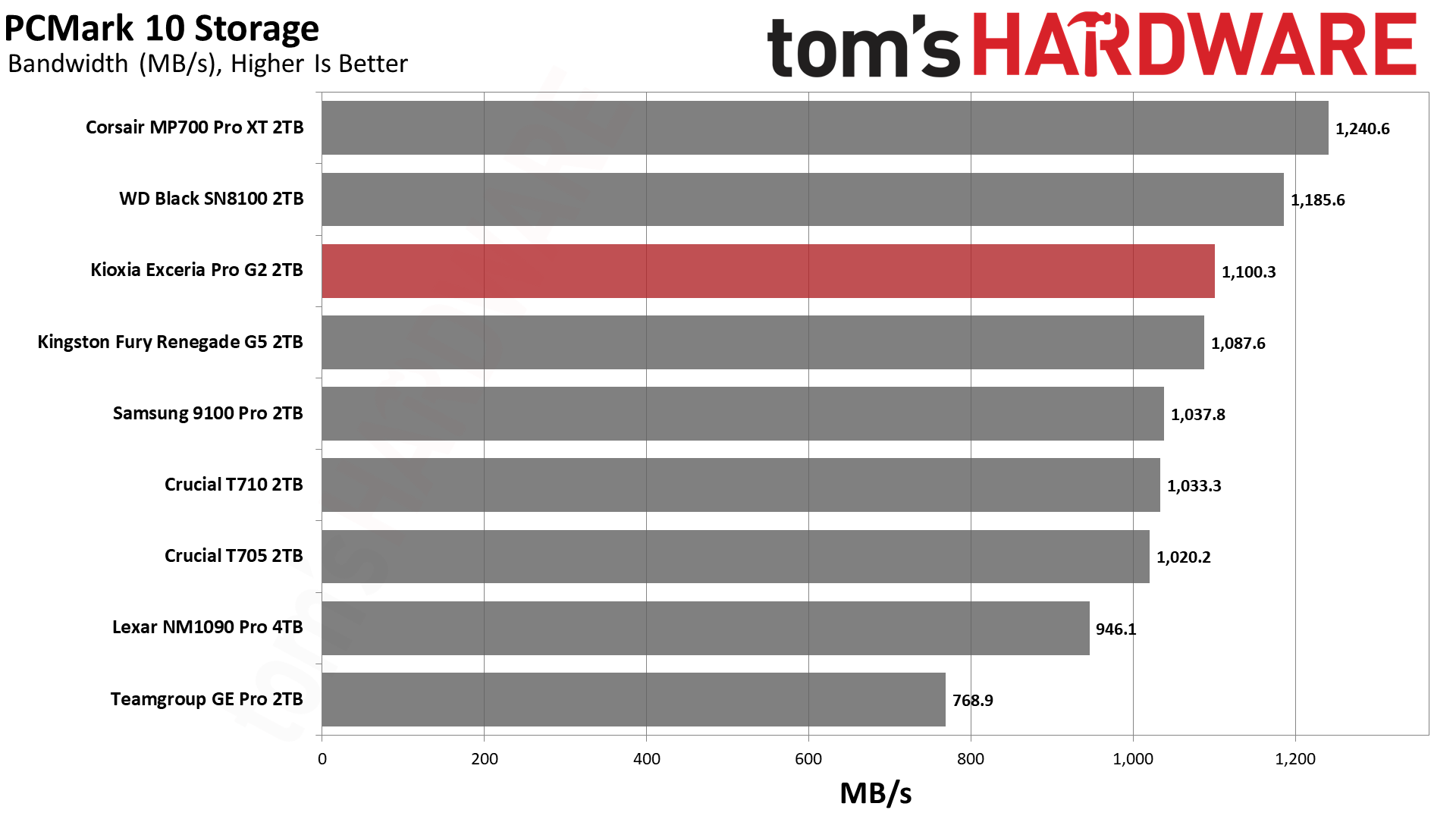
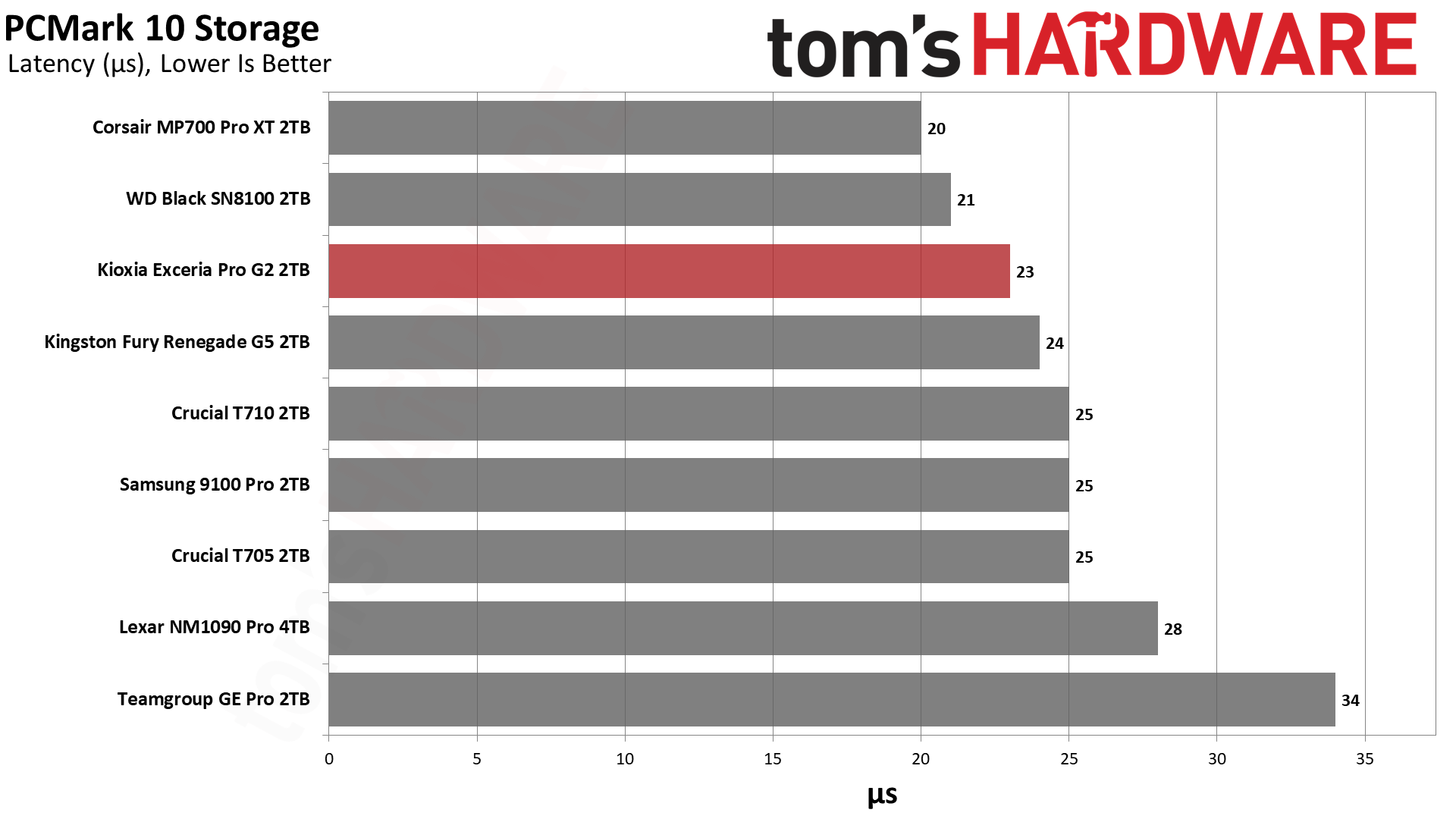
Trace Testing — PCMark 10 Storage Benchmark
PCMark 10 is an industry standard trace-based benchmark that uses a wide-ranging set of real-world traces from popular applications and everyday tasks to measure the performance of storage devices. The results are particularly useful when analyzing drives for their use as primary/boot storage devices and in work environments.
Tom's HardwareTom's HardwareTom's Hardware
In PCMark 10, the Exceria Pro G2 lands a little bit above the Fury Renegade G5 – a good showing, considering they use the same hardware – but behind the MP700 Pro XT and Black SN8100. Performance is excellent in general, particularly for a drive that’s relatively affordable in its target regions. These numbers dwarf decent last-gen drives, with the Exceria Pro G2 scoring about 75% higher than something like the Crucial P5 Plus, for instance. That’s to be expected to some extent, as you have about twice the bandwidth with PCIe 5.0, but this drive also has significant improvements in latency.
Console Testing — PlayStation 5 Transfers
The PlayStation 5 is capable of taking one additional PCIe 4.0 or faster SSD for extra game storage. While any 4.0 drive will technically work, Sony recommends drives that can deliver at least 5,500 MB/s of sequential read bandwidth for optimal performance. Based on our extensive testing, PCIe 5.0 SSDs don’t bring much to the table and generally shouldn’t be used in the PS5, especially as they may require additional cooling. Check our Best PS5 SSDs article for more information.
Our testing utilizes the PS5’s internal storage test and manual read/write tests with over 192GB of data both from and to the internal storage. Throttling is prevented where possible to see how each drive operates under ideal conditions. While game load times should not deviate much from drive to drive, our results can indicate which drives may be more responsive in long-term use.
Tom's HardwareTom's HardwareTom's Hardware
A PCIe 5.0 drive for the PS5 is overkill, but it’s still important to test to make sure there are no anomalies with the drive. It’s within 1% of the fastest drive in the PS5’s internal read test, so no concerns there. Depending on the price, it can also be beneficial to use a PCIe 5.0 drive in the console. Such a drive will be running at a lower link speed and will be more efficient and cooler-running. Newer drives will use new technology and hardware, which means improved operation even in older host devices.
We generally recommend using less expensive drives for the PS5, but something like the Exceria Pro G2 remains an acceptable option. Kioxia has also validated the drive against Sony’s requirements with its own PS5 testing, relevant if you are someone who prefers to trust a drive so thoroughly tested. It’s also an acceptable use of the drive if you’re buying it ahead of a future build, whether you catch a sale or are trying to avoid future higher prices.
Transfer Rates — DiskBench
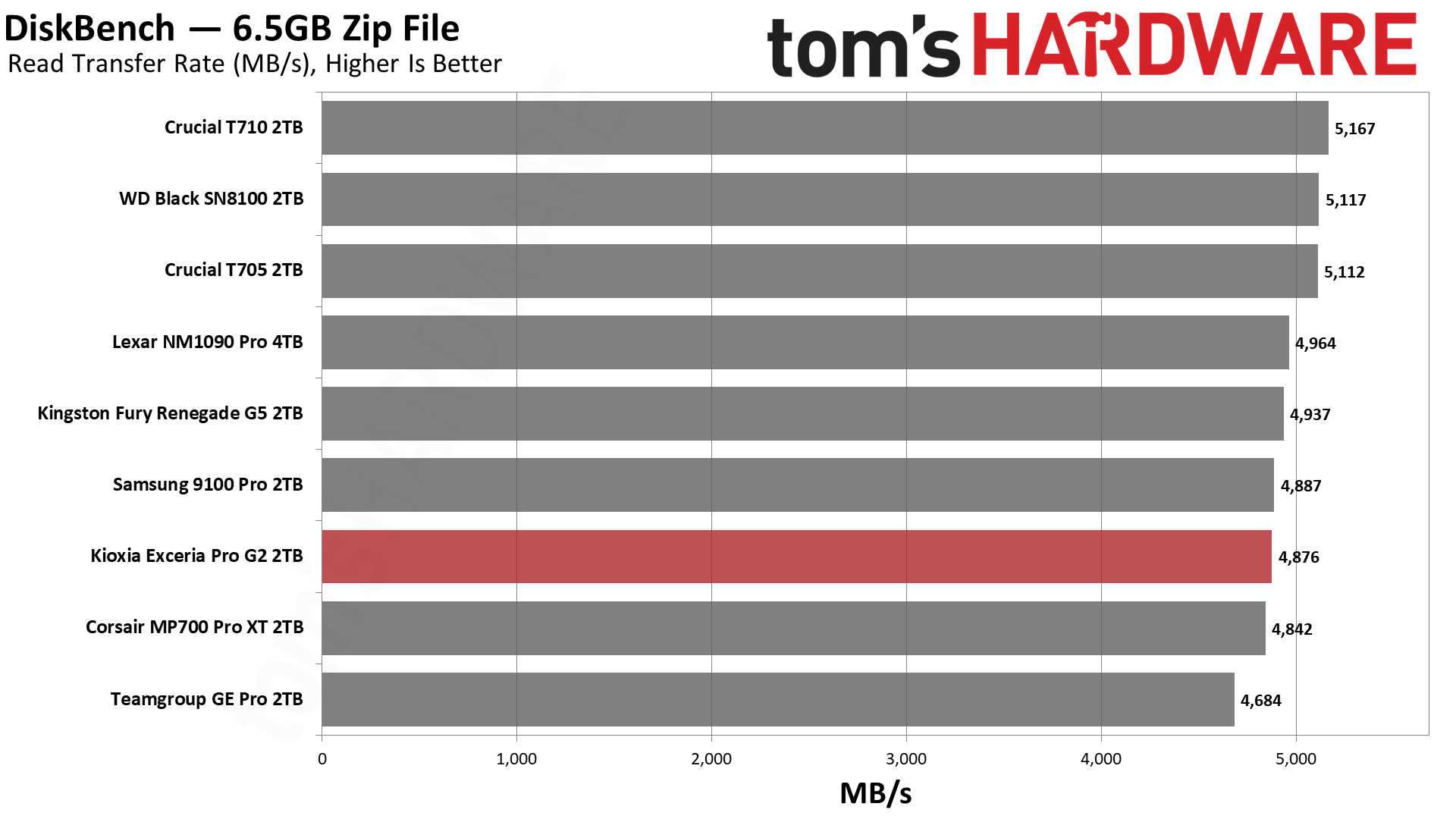
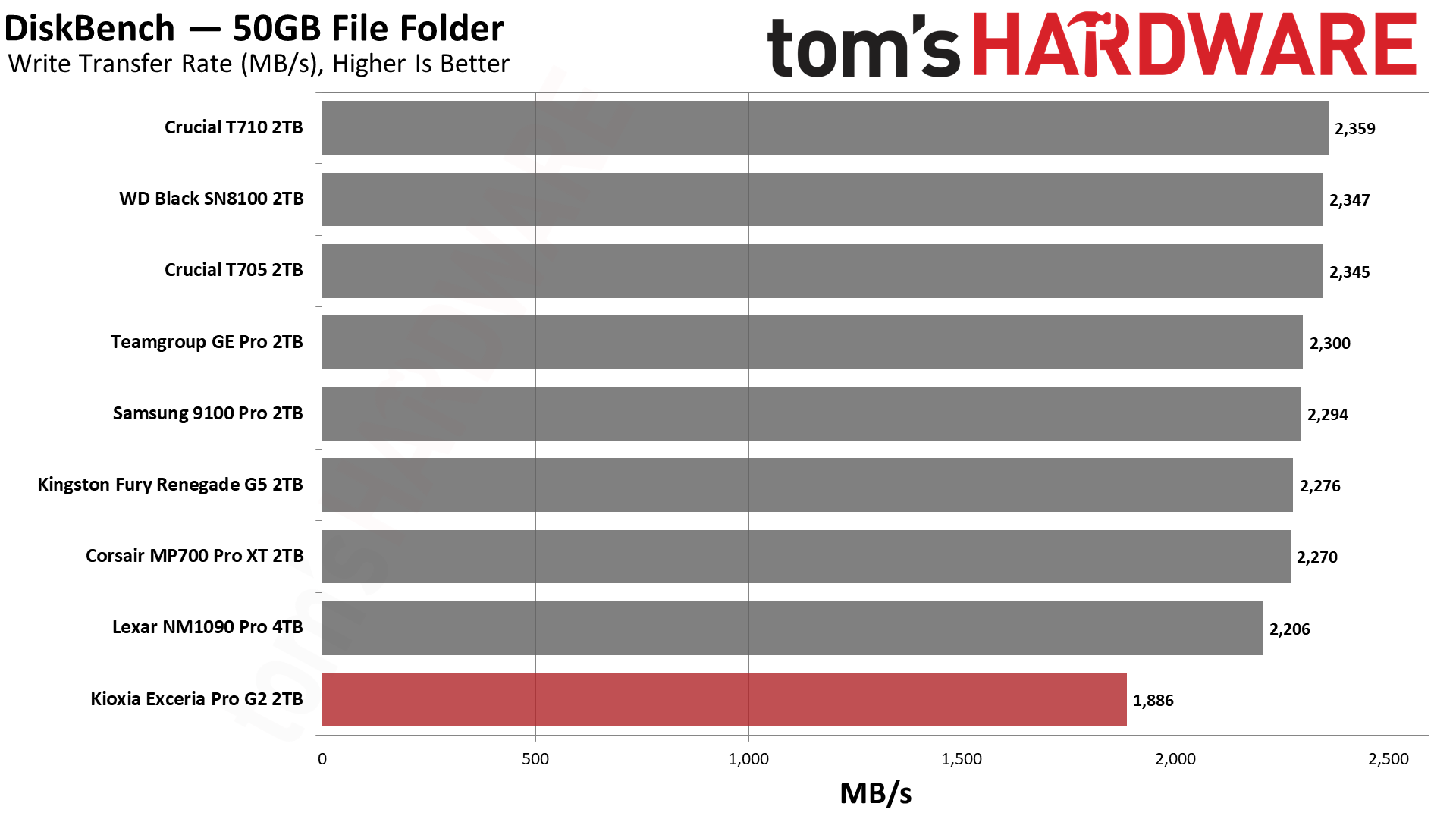
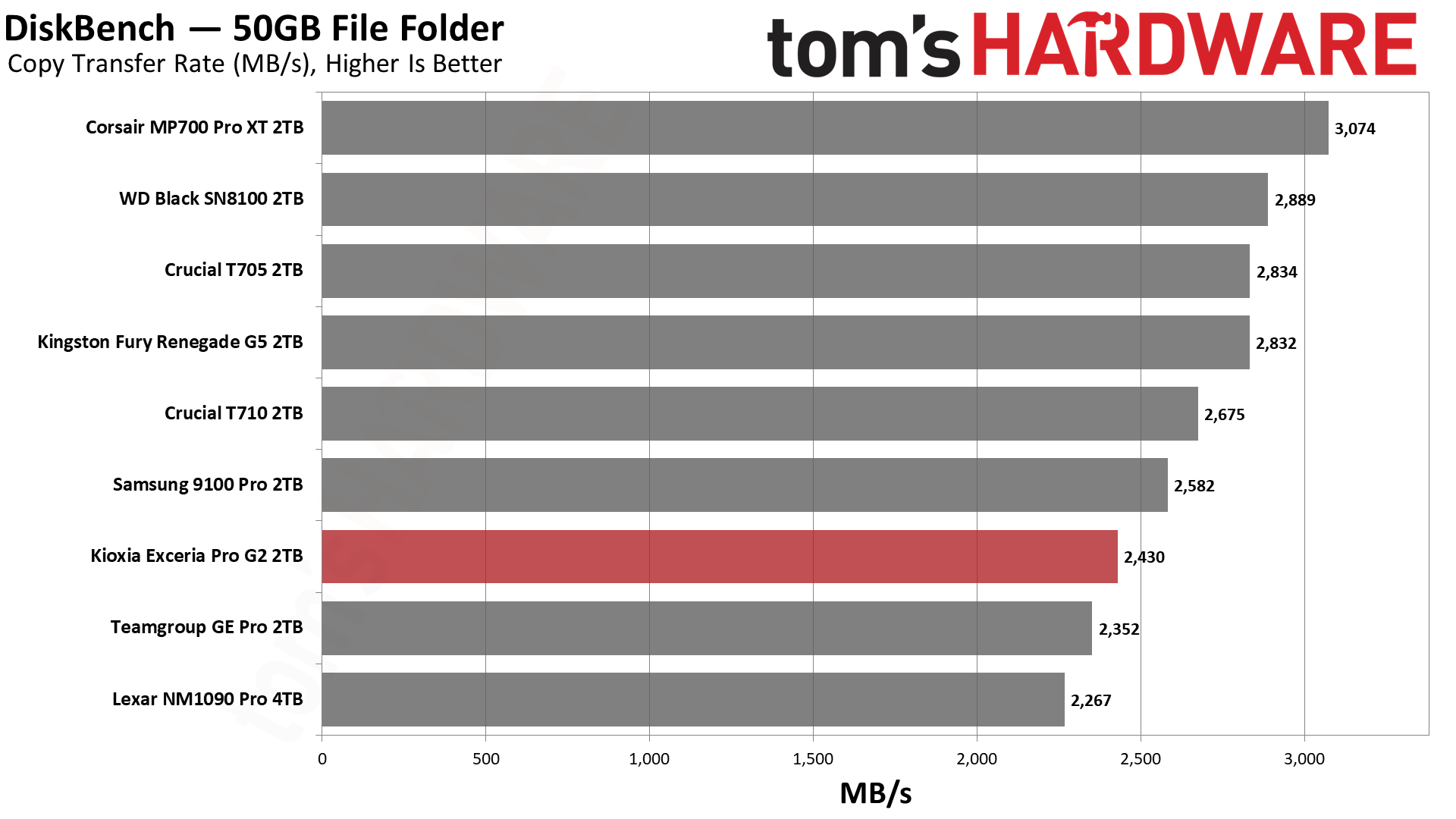
We use the DiskBench storage benchmarking tool to test file transfer performance with a custom 50GB dataset. We write 31,227 files of various types, such as pictures, PDFs, and videos to the test drive, then make a copy of that data to a new folder, and follow up with a reading test of a newly written 6.5GB zip file. This is a real-world type workload that fits into the cache of most drives.
Tom's HardwareTom's HardwareTom's Hardware
DiskBench is the Exceria Pro G2’s first misstep and worthy of further discussion since we know this hardware can do more. Read performance is reasonable – beating the MP700 Pro XT, matching the 9100 Pro, and coming close to the Fury Renegade G5 – but write performance is very weak. This also reduces the copy performance below even the 9100 Pro. This is almost certainly by design, in the sense that being conservative with writes is a trade-off. That can reduce wear and also keep thermal output to a minimum. For a retail drive with OEM/client origins, this makes a lot of sense. Obviously, you, as the user, don’t want slower writes, but we think most people would take reliability over burst write performance when push comes to shove.
This means the Exceria Pro G2 is not the drive to get if you want maximum performance, but it’s still very fast. It’s easier to put this into perspective when looking at the benchmark results as a whole. This requires you to look at write performance in our write saturation testing and also at heat output. To close out this section, though, we would point out that the drive still beats the GE Pro and NM1090 Pro in copy performance. We weigh copy performance most heavily for DiskBench as it’s a mixed workload. Those two are more budget-leaning high-end drives that may sometimes end up within a similar price range as the review drive, making any decision between them and the Exceria Pro G2 much easier.
Synthetic Testing — ATTO / CrystalDiskMark
ATTO and CrystalDiskMark (CDM) are free and easy-to-use storage benchmarking tools that SSD vendors commonly use to assign performance specifications to their products. Both of these tools give us insight into how each device handles different file sizes and at different queue depths for both sequential and random workloads.
We start by looking at ATTO, which gives an idea of how the drive performs at different block sizes. We include the results on logarithmic graphs because that often puts things into perspective. For example, on the standard graph, the Exceria Pro G2 looks fine until it flattens at 512KiB and dips at 1MiB, while on the logarithmic graph it lags the MP700 Pro XT at small I/O, and the gap at larger block sizes is minimized. This lag at small I/O isn’t unusual, as drives with the same hardware, like the Black SN8100, show the same pattern. Both that drive and the Fury Renegade G5 are a little bumpy at larger block sizes, but the MP700 Pro XT is not. Likewise, the T710 is also pretty consistent. This means that the SMI controller and BiCS8 flash combination is less consistent with bigger I/O sizes, but this is only looking at a queue depth of 1.
If we turn to CDM’s sequential results, we find agreement that the Exceria Pro G2 is a bit weak with QD1 reads at 1MB. This is a fairly realistic workload, as transferring files around this size is common and would usually be at QD1. You can see that the MP700 Pro XT, with the same flash but Phison’s controller, leads everything else here, with only the 9100 Pro coming close. It’s able to get more out of the flash and reduce the overhead – it is simply better at extracting bandwidth, even at low queue depths. To some extent, this is a function of firmware and not hardware, by which we mean the Exceria Pro G2 is not likely physically deficient in any way. It may instead be optimized to provide a slower but reliable experience, perhaps in the interest of inducing less wear on the drive. Reads don’t directly wear flash, but you’re also reducing heat output with this sort of optimization. It’s often said that flash prefers heat, but that only applies to writes. You generally want a lower temperature during reads.
The one place the drive clearly trails its Fury Renegade G5 twin is with high QD random reads. This feels like the firmware may be holding something in reserve rather than being a strict hardware limit. The Exceria Pro G2 still has the excellent BiCS latency, though, coming in under 35µs for 4KB QD1 random reads. This is a fantastic result. It trails what WD and Phison can deliver, but it’s still exceptionally fast even by PCIe 5.0 standards. App and game load times are snappy, and there is a noticeable improvement over last-gen drives. We think this is a good trade-off as you’re more likely to be dealing with low QD random reads.
Sustained Write Performance and Cache Recovery
Official write specifications are only part of the performance picture. Most SSDs implement a write cache, which is a fast area of pseudo-SLC (single-bit) programmed flash that absorbs incoming data. Sustained write speeds can suffer tremendously once the workload spills outside of the cache and into the "native" TLC (three-bit) or QLC (four-bit) flash. Performance can suffer even more if the drive is forced to fold, the process of migrating data out of the cache in order to free up space for further incoming data.
We use Iometer to hammer the SSD with sequential writes for 15 minutes to measure both the size of the write cache and performance after the cache is saturated. We also monitor cache recovery via multiple idle rounds. This process shows the performance of the drive in various states including the steady state write performance.
Tom's HardwareTom's HardwareTom's Hardware
The Exceria Pro G2 hits over 12.6 GB/s in its fastest state, writing for over 31 seconds with a ~400 GB cache. On a 2TB TLC-based drive, this is only a moderately sized cache, not the largest it could be, but certainly larger than what was common a generation or two ago. The cache is smaller than what the Black SN8100 and Fury Renegade G5 use and more in line with the T710. It’s also larger than the MP700 Pro XT’s, unsurprisingly the fastest steady state drive on the list. Once the cache is exhausted, the drive settles down to 2.0 GB/s or so, engaging a mixed state where it’s writing to TLC and also copying data over from the cache. It holds there for roughly 13 minutes before recovering to a steady 2.96 GB/s for the remainder of the run. While this is slower than other drives in its class like the Black SN8100 and T710, it needs to be taken in context. It’s almost double what the Fury Renegade G5 manages after 15 minutes, despite the shared hardware, and well ahead of the 9100 Pro. This leaves the Exceria Pro G2 in the middle of the pack but far from slow.
It may sound like we’re making excuses for the drive here, but in reality we’re trying to ram home the point that not all drives are designed equally. There are very good reasons to have a drive behave this way. Having a large pSLC cache, as some of the other drives do, has its downsides. It’s not always the best design from a wear perspective and can leave the drive more vulnerable in certain edge cases. Your drive might run faster for longer, but that’s under an unrealistic workload that’s potentially inducing unnecessary wear.
The Exceria Pro G2 is designed for performance, yes, but also to keep on working in potentially more hostile environments. It needs to be reliable, and that comes with some trade-offs. From the buyer’s perspective, we would say that a drive like this – if you’re weighing it against something like the Black SN8100 – is still a worthy buy if you’re throwing it into an always-on Linux box that needs to be responsive but not always blazing fast. Or, as is becoming more common, in an always-on laptop where you are developing or running routines with AI and don’t really care about WD’s Dashboard or Game Mode. Just be aware of the power caveats, which we cover next.
Power Consumption and Temperature
We use the Quarch HD Programmable Power Module to gain a deeper understanding of power characteristics. Idle power consumption is an important aspect to consider, especially if you're looking for a laptop upgrade as even the best ultrabooks can have mediocre stock storage in terms of capacity and performance. Desktops are often more performance-oriented with less support for power-saving features so we show the worst-case for idle.
Some SSDs can consume watts of power at idle while better-suited ones sip just milliwatts. Average workload power consumption and max consumption are two other aspects of power consumption but performance-per-watt, or efficiency, is more important. A drive might consume more power during any given workload but accomplishing a task faster allows the drive to drop into an idle state more quickly, ultimately saving energy.
For temperature recording we currently poll the drive’s primary composite sensor during testing with a ~22°C ambient. Our testing is rigorous enough to heat the drive to a realistic ceiling temperature but real-world temperatures will vary due to the environment and workload factors.
One question the spec sheet raises: why is the 1TB Exceria Pro G2 rated for more active power than the 2TB and 4TB? Our DiskBench power test fits within the pSLC cache at any capacity, so it is not hitting a slower mode, and therefore the likeliest answer is duty cycle. The SM2508 controller has eight flash channels, and with sixteen dies at 2TB it can switch between dies on each channel, giving every die time to rest. The eight dies at 1TB get no such break yet are still capable of reaching most of the drive’s peak performance, so each one works harder. This should not be taken to mean the 1TB will run hotter, not least because it will run out of pSLC cache faster and hit the slower and lower-power TLC mode. It’s just a peculiarity of having a drive this fast with dense flash.
Power efficiency, in our testing, is a measure of work per watt, but it only tells part of the story. For that part of the story, the Exceria Pro G2 is average among all drives and below expectations for a drive of its class – see the Kingston Fury Renegade G5, which has the same hardware. Yet the drive proved to run as cool as a cucumber – 52C max, more than 30C below the drive’s 83C warning threshold. There are two reasons for this. The first is that, indeed, the Exceria Pro G2 has a heat-spreading label, which can be surprisingly effective. The second is that the drive is providing less bandwidth in the DiskBench test but also not pulling more power on average. This suggests that Kioxia designed this drive for OEMs, where you tend to have tighter thermal requirements. Kioxia’s own materials list the drive’s applications simply as “client desktop and laptop,” which supports our conclusion. Trading a little performance for reliability – with the assumption that running a high-end drive hotter in general is less than ideal – is reasonable here. The secret third reason is that our temperature logging comes from the Iometer-based write saturation run, which is sequential with a larger 1MiB block size. Historically we’ve found that mixed workloads, especially with smaller and random I/O, can push a drive a few degrees hotter than that.
The drive’s high idle power consumption supports this conclusion. We test idle in the worst case, that is, for enthusiast desktops where there is no power saving. OEM systems and especially laptops are more likely to have these features enabled. That’s part of the explanation. The other side is in the drive’s advertised power states. The non-operational states have enter and exit latencies that, in comparison to drives with similar hardware, are consistent with a drive that prefers to stay in a ready state, somewhat like WD’s Game Mode. Our speculation is that it may be tuned that way for OEM machines. If we had results from a workstation-oriented drive like Kioxia’s own XG10, which is a client OEM model, we might find more clarity here. Our guess is that having a drive that can potentially wake faster is desirable.
Nevertheless, we would expect the Exceria Pro G2’s idle result to be more in line with the Black SN8100’s. It’s possible this is platform-specific – the drive might react differently on, say, an AMD system – or simply that it was more reluctant to go to a lower power state for us.
We use an Alder Lake platform with most background applications such as indexing, Windows updates, and antivirus disabled in the OS to reduce run-to-run variability. Each SSD is prefilled to 50% capacity and tested as a secondary device. Unless noted, we use active cooling for all SSDs.
Kioxia Exceria Pro G2 Bottom Line
This is a solid drive that hits all the right notes for us. It has high-end PCIe 5.0 bandwidth, excellent BiCS flash latency, good power efficiency, and good all-around performance, including reasonable sustained write speeds. While it’s not really available in the U.S., its pricing in other regions makes it extremely competitive. We also like the fact that it runs pretty cool and appears to have firmware optimization geared toward reliability, which is always welcome if you intend to run a drive like this in a laptop, an always-on system, or another challenging environment. The drive also advertises the usual NVMe low-power states, so users who want a drive that stays available should be well served, provided power management is properly enabled on their platform.
(Image credit: Tom's Hardware)
Where the drive falls flat is in comparison to some of the other fastest drives around, like the Black SN8100, which shares its hardware. Some of these drives are just plain faster and even consistently so, matching or beating it in an array of tests. The Exceria Pro G2 does out-write its hardware twin, the Fury Renegade G5, in steady state, but other contenders offer better efficiency numbers and higher sustained write speeds. It sometimes looks like the Exceria Pro G2 is being held back, which, to be fair, is probably true. The design philosophy behind this drive is closer to what you’d find in an OEM or client drive, where reliability is a big concern. In our opinion, this makes the drive a great addition and alternative in the market. Many users would value this over raw performance, especially if it’s more affordable. If you’re in a position to get this drive at a competitive price, it’s worth weighing your priorities.
Personally, we’re fond of the drive for what it does differently while still delivering an excellent user experience. A PCIe 5.0 drive is still overkill for most things, and SSDs are rather expensive at the moment. However, if you want to invest in something that will carry you for a long time, the Exceria Pro G2 is a reasonable choice. We think a lot of users will have a better time with the Black SN8100 – it may be more readily available and beats the Exceria Pro G2 in some areas – but at this performance level it’s kind of hard to go wrong. We’d lean towards the Kioxia if you want something more focused on a reliable experience with a drive that just works without ever being slow.
A Reddit user has stumbled upon a GPU jackpot by claiming two old cryptocurrency mining rigs with 12 Zotac-branded Nvidia RTX 3070 graphics cards. The machines were reportedly used during the COVID-era mining boom and had been sitting unused in a basement, probably since the day Ethereum mining became unprofitable. The discovery was shared on the r/PCMasterRace subreddit, and judging by the photos, all of the parts look surprisingly undamaged despite the long period in a basement.
Apart from the graphics cards, the setup also features an MSI MPG Z390 Gaming Plus motherboard, a 1000W Gold-rated Rosewill power supply, two 4GB sticks of DDR4 RAM, and a pair of 120GB solid-state drives. Upon closer inspection of the GPUs, the Reddit user noticed minor silicone bleeding across most of the cards, which is a common occurrence caused by thermal pads breaking down and releasing oil over time. Commenters pointed out that while the cards might require a clean-up with isopropyl alcohol, as well as new thermal pads and thermal paste, the hardware is very likely salvageable.
Launched in 2020 as an upper mid-range graphics card, the RTX 3070 is based on Nvidia’s Ampere architecture with 5,888 CUDA cores and 8GB of GDDR6 memory. It was designed to deliver strong 1440p gaming performance and became one of the more popular GPUs of its generation. The card also arrived during the cryptocurrency mining boom, where its combination of performance and power efficiency made it attractive to miners.
GPUs used for mining aren't necessarily a bad proposition for gaming. Mining rigs were often configured to run GPUs at reduced core voltages and power levels to lower temperatures as well as electricity costs. This also helped in reducing stress on the silicon itself when compared to standard gaming.
For now, the Reddit user does not plan to keep all 12 graphics cards for themselves. Their first step is to test the RTX 3070s individually to find out how many are still in working condition. If most of the cards pass testing without issues, the user says they plan to sell 10 or 11 of the GPUs and keep at least one for themselves. With each RTX 3070 carrying 8GB of VRAM, the haul represents 96GB of VRAM in total, which in today's economy is a valuable amount of graphics memory, particularly due to the soaring prices of newer GPUs.
Architectural enhancements and significantly higher clock speeds enable Apple's A20 Pro application processor (AP), used in the company's latest iPhones, to deliver not only a substantial generation-to-generation performance boost but also to outperform leading desktop CPUs from AMD and Intel by up to a whopping 32% in the single-thread Geekbench 7 benchmark, setting the record for the highest single-thread performance. While high-end PC CPUs still have more oomph for multi-threaded workloads, the tiny A20 Pro is still faster than mainstream laptop CPUs even when many threads are involved.
Fastest smartphone SoC
A20 Pro
A19 Pro
A18 Pro
A17 Pro
A16 Bionic
General specifications
2P+4E, up to 4.93 GHz
2P+4E, up to 4.26 GHz
2P+4E, up to 4.0 GHz
2P+4E, up to 3.77 GHz
2P+4E, up to 3.46 GHz
Single-Thread
4006
3249
3082
2641
2405
Multi-Thread
11460
9016
8185
7050
6600
Apple's A20 Pro system-on-chip (SoC) delivers 4,006 points in single-thread and 11,460 points in the multi-thread Geekbench 7 benchmark, which represents a 23.3% higher ST performance and 27.1% higher MT performance compared to the immediate predecessor, the Apple A19 Pro, according to an early submission (which may or may not demonstrate performance of actual A20 Pro-based products, so take the results with a grain of salt).
Generation
Single-thread
Improvement
Multi-thread
Improvement
A16 Bionic
2,405
—
6,600
—
A17 Pro
2,641
9.80%
7,050
6.80%
A18 Pro
3,082
16.70%
8,185
16.10%
A19 Pro
3,249
5.40%
9,016
10.20%
A20 Pro
4,006
23.30%
11,460
27.10%
The new SoC delivers the highest generation-over-generation performance improvement for Apple's smartphone processors in years and is currently the highest-performing mobile AP. Furthermore, the A20 Pro beats AMD’s 16-core Ryzen 9 9950X3D by 26% and Intel’s Core i9-14900KS by 32% in single-thread performance.
A20 Pro
Snapdragon 8 Elite Gen5 (SM8850)
Xring O3
Exynos 2600 (S5E9965)
Dimensity 9400 (MT6991)
Tensor G5 (GS501)
Kirin 9050 Pro
General specifications
2P+4E, up to 4.93 GHz
2P+6E, up to 4.74 GHz
2X+4P+4E, up to 4.36 GHz
1X+3P+6E, up to 3.80 GHz
1X+3P+4A, up to 3.62 GHz
1X+5P+2E, up to 3.78 GHz
1X+2P+4E+2LP, up to 3.10 GHz
Single-Thread
4006
3047
2996
2694
2273
2011
1028
Multi-Thread
11460
10212
11777
10580
7745
5859
4794
When it comes to the single-thread Geekbench 7 benchmark, Apple's A20 Pro outperforms its closest rivals — Qualcomm's Snapdragon 8 Elite Gen5 (SM8850) and Xiaomi's XRing O3 — by 31.5% - 33.7%. In fact, both SM8850 and XRing O3 perform on par with Apple's two-years-old A18 Pro. The six-core A20 Pro also beats the eight-core SM8850 by 12.2% in multi-thread workloads in Geekbench 7 and offers roughly similar multi-thread performance to the 10-core XRing O3.
SoC
Single-thread
A20 Pro advantage
Multi-thread
A20 Pro advantage
A20 Pro
4,006
—
11,460
—
Snapdragon 8 Elite Gen 5
3,047
31.50%
10,212
12.20%
Xring O3
2,996
33.70%
11,777
−2.7%
Exynos 2600
2,694
48.70%
10,580
8.30%
Dimensity 9400
2,273
76.20%
7,745
48.00%
Tensor G5
2,011
99.20%
5,859
95.60%
Kirin 9050 Pro
1,028
289.70%
4,794
139.00%
Compared with other flagship smartphone processors, Apple's A20 Pro holds a commanding lead in Geekbench 7. It is 76% faster in single-thread and 48% faster in multi-thread performance than MediaTek's eight-core Dimensity 9400, while it nearly doubles the performance of Google's eight-core Tensor G5, with advantages of 99% and 96%, respectively. But the most striking gap of A20 Pro is with Huawei’s Kirin 9050 Pro: Apple's flagship is 290% faster in single-thread and 139% faster in multi-thread Geekbench 7 workloads.
A great laptop CPU
While Apple's A20 Pro continues to feature 'only' six cores like many generations before it, this time around the processor packs two 'super' desktop-class general-purpose cores running at up to 4.93 GHz, four efficiency cores running at lower clocks, and a memory interface that delivers +50% higher memory bandwidth compared to its predecessor (allegedly using a 96-bit memory I/O).
The architectural enhancements of advanced CPU cores running at nearly 5 GHz, along with a more capable memory subsystem, not only enable a massive generational performance uptick, but also allow the chip to offer unbeatable single-thread performance and massive multi-thread performance that is comparable to that of laptop CPUs, including previous-generation laptop CPUs from Apple.
A20 Pro
A19 Pro
M5
M4
M3
Ryzen 9 9950X3D
Core i9-14900KS
Core Ultra X9 388H
Core Ultra 5 325
Core Ultra 5 332
General specifications
2P+4E, up to 4.93 GHz
2P+4E, up to 4.26 GHz
4S+6E, up to 4.6 GHz
4P+6E, up to 4.40 GHz
4P+4E, up to 4.05 GHz
16P/32T, 4.30 GHz - 5.75 GHz
8P+16E/32T, 3.20 GHz - 6.0 GHz
4P+8E+4LP/16T, up to 5.1 GHz
4P+0E+4LP, up to 4.6 GHz
2P+0E+4LP, up to 4.40 GHz
Single-Thread
4006
3249
3739
3351
2808
3182
3024
2694
2297
2134
Multi-Thread
11460
9016
18671
15806
12061
30428
21145
18121
11107
6976
Indeed, Apple's A20 Pro is 7% faster than M5, 20% faster than M4, and 43% faster than M3 in single-thread performance. Its six-core design cannot match its multi-thread performance, trailing the 10-core M5 by 39% and the 10-core M4 by 27%. Yet, it is only 5% behind the eight-core M3.
Processor
ST score
A20 Pro ST advantage
MT score
A20 Pro MT advantage
A20 Pro
4,006
—
11,460
—
A19 Pro
3,249
23.30%
9,016
27.10%
Apple M5
3,739
7.10%
18,671
−38.6%
Apple M4
3,351
19.50%
15,806
−27.5%
Apple M3
2,808
42.70%
12,061
−5.0%
Ryzen 9 9950X3D
3,182
25.90%
30,428
−62.3%
Core i9-14900KS
3,024
32.50%
21,145
−45.8%
Core Ultra X9 388H
2,694
48.70%
18,121
−36.8%
Core Ultra 5 325
2,297
74.40%
11,107
3.20%
Core Ultra 5 332
2,134
87.70%
6,976
64.30%
When compared to Intel's Panther Lake, the A20 Pro is 48.7% faster in single-thread performance than the flagship Core Ultra X9 388H, yet the 16-core Panther Lake processor is 63% faster in multi-thread workloads. Against lower-end Panther Lake parts, the A20 Pro is 74% – 88% faster in ST workloads and even leads the Core Ultra 5 325 and Ultra 5 332 by 3% and 64%, respectively, in multi-thread benchmarks.
The particularly striking results of Apple's A20 Pro are the 26% – 33% single-thread advantage over flagship AMD and Intel desktop CPUs, though the desktop processors remain dramatically faster in multi-thread workloads.
First 2nm smartphone SoC
When Apple transitioned to TSMC's N3B (3nm-class) process technology from N4 (4nm-class) with its A17 Pro SoC back in 2023, the new processor was barely 9.8% faster in ST and 6.8% faster than its predecessor A16 Bionic. By contrast, with its first 2nm smartphone SoC made on TSMC's N2 node, Apple offers a massive performance boost over the A19 Pro produced on N3P.
(Image credit: Apple)
Indeed, Apple's A19 Pro packs two 'desktop-class' 'super cores' whose design is 'driven in part by increased front-end bandwidth, a new cache hierarchy, and enhanced branch prediction,' as Apple described its 'super cores' inside the M5 processor earlier this year. Such architectural enhancements obviously massively increase performance in single-thread workloads at the cost of increased die size, transistor count, and power. Apparently, N2 enabled Apple's designers to squeeze two desktop-grade CPU cores into a smartphone SoC.
Speaking of M5, it is noteworthy that A20 Pro delivers 7.1% higher single-thread performance than M5 while running at a clock speed that is 7.1% higher than that of M5, which is probably a good indicator that Apple's A19 Pro uses the same 'super cores' as M5.
While some may consider using PC-grade general-purpose CPU cores in a smartphone chip an overkill, Apple is known for using and supporting PC technologies in its mobile SoCs (NVMe, PCIe, DisplayPort-over-USB-C, hardware virtualization, etc.). Keeping in mind that Apple also uses A-series SoCs inside iPads and inexpensive laptops, it makes a great sense to have these technologies in its smartphone application processors. With desktop-grade cores inside the A20 Pro, the company greatly expands use cases of these CPUs while also solidifying their position in traditional segments that they will address in the coming quarters.
Without any doubts, Apple's transition to TSMC's N2 starts with a massive general-purpose performance increase, driven by 'fat' super cores and a memory subsystem featuring 50% more bandwidth compared to the A19 Pro. Over the next few weeks, we are also going to learn how Apple upgraded the GPU, NPU, and other aspects of the A20 Pro, and we are going to find out whether the upgrades are as impressive or incremental. In any case, so far, the A20 Pro looks very good.
The GeForce RTX 5090 is already at the pinnacle of the best graphics cards. However, Shenzhen Suqiao Intelligent Technology Co., Ltd., a Chinese OEM/ODM, has reportedly made it even more powerful by outfitting the Blackwell flagship with 96GB of memory, 3X more than the original. The company is already selling these modified GeForce RTX 5090 96GB on Alibaba for $3888, 35% less than the vanilla GeForce RTX 5090 in the U.S.
You can say whatever you want about China, but you cannot deny that factories there have produced some of the most interesting modified graphics cards, including the GeForce RTX 5080 32GB, the GeForce RTX 4090 48GB, and the GeForce RTX 3090 48GB. While some of these projects are fueled by pure curiosity, most of them are a result of the recent AI boom that has stimulated Chinese factories to think outside the box and give existing and even past graphics cards a memory upgrade so consumers can repurpose them for AI workloads. While we have seen a fair share of absurd rumors, such as the GeForce RTX 5090 128GB, the conjuration of the GeForce RTX 5090 96GB seems more plausible from a technical standpoint, and there is precedent for a Blackwell-based graphics card with 96GB of memory.
Before diving into the GeForce RTX 5090 96GB, it is worth noting that the Alibaba listing is from Suqiao, a Chinese manufacturer with over 10 years of experience making graphics cards, motherboards, and servers. So it is not a random Chinese chop shop but rather an established OEM/ODM, which lends some credence to the existence of the GeForce RTX 5090 96GB. Needless to say, the Alibaba listing is full of questionable specifications, such as GDDR6X memory or memory speeds of 14 Gbps.
The RTX Pro 6000 Blackwell, which has 96GB of GDDR7 memory, uses the same GB202 silicon as the GeForce RTX 5090, but with more enabled Streaming Multiprocessors (SMs). Therefore, a 96GB configuration is possible on GB202; however, the GeForce RTX 5090 96GB likely uses a custom PCB, allowing the manufacturer to install the memory chips in clamshell mode, which doubles the total memory on the PCB. The vendor could either procure the GB202 silicon individually or extract it from mainstream GeForce RTX 5090 graphics cards and reball it onto the custom PCB.
Even in clamshell mode, with memory pads on both sides of the PCB, there are only 32 of them. The RTX Pro 6000 Blackwell has 32 GDDR7 chips, each 24Gb (3GB) in capacity. The problem we have with the GeForce RTX 5090 96GB that raises a red flag about its authenticity is the mention of GDDR6X. Micron only produced GDDR6X memory chips in 16 Gb (2GB), so the maximum capacity would be 48GB in clamshell mode. Plus, GDDR6X operates between 19 Gbps and 24 Gbps, much higher than the listed 14 Gbps, which corresponds to standard GDDR6.
Modified firmware and software-level hacks are necessary to run Nvidia graphics cards with modified memory capacity. For instance, the GeForce RTX 4090 48GB was possible because modders modified Nvidia's firmware to get these graphics cards running. However, rumors on the street suggest that a leaked firmware for the GeForce RTX 5090 has been available for a few months, which could explain why we are starting to see these GeForce RTX 5090 96GB graphics cards surface.
Suqiao listed the GeForce RTX 5090 96GB for $3,888, significantly lower than other Alibaba merchants who have it closer to $5,900. For reference, custom GeForce RTX 5090 graphics cards start at $6,000 in the U.S. market. After the latest price hikes, Nvidia is selling the RTX Pro 6000 Blackwell for $16,000, although it can go up to $17,999, depending on which variant you pick up. If the GeForce RTX 5090 96GB is real, even at $6,000, it would be a steal for anyone running AI models.
Thermalright is a CPU cooling company that happens to sell power supplies. Established in Taipei in 2001, it spent its first two decades building a reputation on air coolers - the Ultra-120 eXtreme and the HR series were enthusiast reference points long before the current wave of tower coolers - then drifted out of the conversation for years before the Peerless Assassin 120 dragged it back to the top of every budget build list in 2021. Its catalog has expanded aggressively since: case fans, all-in-one liquid coolers, thermal compounds, chassis, and, since 2022, power supplies. That last category deserves a different kind of scrutiny than the rest. Much like most brand names, Thermalright does not build power supplies; it commissions them, and a heatsink company's engineering credibility transfers to a PSU exactly as far as the OEM behind it allows. Every Thermalright power supply has to be judged on its platform rather than its badge.
The KG series occupies the value end of Thermalright's power supply range, and the TR-KG750 reviewed here is its 750W entry. How does it hold up against the best power supplies on the market? On paper, the specification is current, with ATX 3.1 and PCIe 5.1 compliance, a native 12V-2x6 connector, full modularity, 80 PLUS Gold certification at 115 VAC, a 120 mm fan inside a 140 mm-deep chassis, and a five-year warranty. The label on the PSU itself answers the platform question without much digging. The manufacturer of record is Somore Tech Co., Ltd., the production is credited to Jiushouyangguang Power Supply (Shenzhen), and the internal designation printed beside the 80 PLUS badge is HKCMAX-750 - this is an HKC platform, and the silkscreen on the main board dates the design to April 2023. There is no Cybenetics entry for the model at the time of writing, so the 80 PLUS report is the only third-party data available on it. At a retail price of $91, it undercuts essentially every name-brand 750W Gold unit on the US market, which is the whole of its pitch.
Specifications and Design
Thermalright TR-KG750 Power specifications ( Rated @ 40 °C )
RAIL
+3.3V
+5V
+12V
+5Vsb
-12V
MAX OUTPUT
20A
20A
62.5A
3A
0.3A
100W
100W
750W
15W
3.6W
TOTAL
750W
AC INPUT
100 - 240 VAC, 50 - 60 Hz
MSRP
$91
In the Box
The TR-KG750 arrives in a compact cardboard box wrapped in a black-to-bronze gradient sleeve, with a three-quarter render of the unit dominating the front and the wattage set in large gold type beside it. The badge strip along the bottom edge is short: 80 PLUS Gold, ATX 3.1, PCIe 5.1, and the model number.
(Image credit: Tom's Hardware)
The bundle is as thin as they come. Under the protective packaging the supply is accompanied by a multilingual user’s guide, the AC power cord, a small bag of mounting screws, and four zip ties. That is the entire accessory list: no Velcro straps, no cable combs, no storage pouch. Four zip ties for an eight-cable modular supply is a token rather than a provision, and it is one of the few places where the price makes itself felt before you take the lid off.
(Image credit: Tom's Hardware)
The cables are all-black flat ribbon types throughout, with no sleeving anywhere in the set. They are all uniform, adding points to the aesthetics of the unit. The 12V-2x6 cable is native - a single run from the modular panel to the graphics card, with no adapter or splitter involved - but its plug does not use the dual-color keying the ATX 3.1 specification encourages, which makes an incompletely seated connector easy to spot at a glance.
(Image credit: Tom's Hardware)
Thermalright TR-KG750
Connector type
Hardwired
Modular
ATX 24 Pin
-
1
EPS 4+4 Pin
-
2
PCI-E 5.1
-
1
PCI-E 8 Pin
-
2
SATA
-
6
Molex
-
3
Floppy
-
-
External Appearance
At 150 x 86 x 140 mm, the TR-KG750 is a standard-width ATX unit with a short 140 mm body, which is about as compact as a 750W supply practically gets and leaves useful slack for cable management even in a mid-tower. The chassis is finished in a matte black with a fine texture, and the top panel carries a stamped fan grille in a diamond-and-chevron pattern - four angled spokes radiating from a central square, framed by long slotted vents - with the Thermalright wordmark pressed into a raised panel at the edge. Four exposed screws sit at the corners, one of them beneath the warranty-void sticker.
(Image credit: Tom's Hardware)
The rear face is a large square perforated exhaust panel with the AC receptacle and a rocker. The front face hosts the modular connector bay, cleanly silkscreened into four labeled groups: MOTHERBOARD for the split 24-pin, SATA/PATA for the peripheral cables, CPU/PCIe for the four eight-pin sockets, and a dedicated 12V 2x6 socket in the bottom corner. A scratch-off authenticity tag with a QR code sits alongside the panel.
Tom's HardwareTom's Hardware
The specification label occupies the top face rather than a side panel, which is the more useful placement for a bottom-mounted supply sitting under a windowed case, and both side panels are given over to a large bronze-gradient decal carrying the wattage, model number, and 80 PLUS Gold badge. That decal is the only decoration, and the finish underneath it is unremarkable but honest - evenly applied, no orange peel, no sharp edges. The label repeats the rail ratings, the CCC certificate number, and the internal model designation, and it is where the platform gives itself away. Build quality overall is what the price suggests: the steel gauge is adequate, the panels line up, nothing rattles, but there is none of the extra finishing that separates a $90 unit from a $150 one.
Tom's HardwareTom's Hardware
Internal Design
Cooling is handled by a 120 mm Yate Loon D12SH-12 rated for 12V at 0.30A. Yate Loon is a long-established Chinese fan maker, and the D-series is its bread-and-butter sleeve-bearing line, which makes this the single most consequential cost-saving in the unit. Sleeve bearings are quiet, like fluid-dynamic alternatives at equivalent speed, but wear faster and are more sensitive to heat and mounting orientation - all three of which matter in a supply that, as the test results show, runs its fan constantly and pushes it hard as soon as ambient temperature rises. The five-year warranty covers the fan, but it is not a part most owners will enjoy chasing a replacement for.
(Image credit: Tom's Hardware)
The platform is HKC’s, supplied to Thermalright under the internal designation HKCMAX-750, and the main board is silkscreened as ATX32 Main BD Rev1.2. A row of wattage selection pads along the board edge runs from 500W to 850W, with the 750W position populated, confirming this is a single design scaled across a whole product family rather than a layout drawn for 750W specifically. Component density is fair, the soldering is tidy, and some black silicone anchors the larger parts. Only two heatsinks are fitted - a small one carrying the input bridges and a taller, simple finned unit shared by the APFC and primary switching stages - and everything on the secondary side relies on the PCB and a tiny sheet heatsink soldered to it.
Tom's HardwareTom's Hardware
The transient filtering stage starts at the back of the AC receptacle and continues on the main PCB. In total, there are four Y capacitors, two X capacitors, and two filtering inductors, with an MOV and an NTC thermistor also present - a complete filter with nothing omitted, if not a generous one. Two input rectifying bridges follow on their own small dedicated heatsink. The APFC stage uses two MOSFETs and a boost diode sharing the tall heatsink, paired with a large open-frame filtering coil, and the bulk capacitor is a Nichicon 450V/560 uF part from the 105C-rated GN(M) series. That capacitor is comfortably the best component in the unit and practically the only one sourced from a manufacturer with a genuine reliability record. The primary inversion stage is a half-bridge arrangement built from two 65R160FR MOSFETs on the shared heatsink, feeding the main transformer.
(Image credit: Tom's Hardware)
The secondary side is where the cost engineering becomes plain. The 12V rail is rectified by six Perfertway PWC012N04ES MOSFETs mounted directly on the main PCB with no heatsink of their own, and the 3.3V and 5V rails are derived from DC-to-DC converters that also live on the main board rather than a vertical daughterboard. As a layout, this is conventional and modern. The problem is provenance: essentially every active device in the conversion path - the bridges, the APFC and primary MOSFETs, the six synchronous rectifiers - comes from manufacturers with no established track record in this application. Secondary filtering is a mix of Teapo parts and capacitors branded NICON that, despite carrying a series designation borrowed from Nippon Chemi-Con’s catalog, do not appear to be a genuine Nippon Chemi-Con nor a Nichicon product, and polymer capacitors handle high-frequency filtering on the modular board. None of this is unusual at the price. It is worth stating plainly, though, that the "all Japanese" capacitor language attached to some retail listings for this model describes the bulk capacitor and nothing else.
Tom's HardwareTom's Hardware
Cold Test Results (25°C Ambient)
Cold Test Results (25°C Ambient)
For the testing of PSUs, we are using high-precision electronic loads with a maximum power draw of 2700 Watts, a Rigol DS5042M 40 MHz oscilloscope, an Extech 380803 power analyzer, two high-precision UNI-T UT-325 digital thermometers, an Extech HD600 SPL meter, a self-designed hotbox, and various other bits and parts.
At 25°C ambient, the TR-KG750 averaged 89.5% at 230 VAC and 88.5% at 115 VAC across the nominal load range, peaking at 91.2% and 90.3%, respectively, at 50% load and settling to 89.2% and 87.9% at a sustained 750W. The curve is well shaped, with the usual broad plateau between 40% and 70% load and no collapse at the top end. What it does not have is margin. Against the 80 PLUS Gold thresholds at 115 VAC - 87% at 20% load, 90% at 50%, and 87% at 100% - our measured 87.2%, 90.3%, and 87.9% clear the bar by 0.2, 0.3, and 0.9 percentage points. The unit’s own 80 PLUS report reads slightly kinder at 90.2%, 91.4% and 88.3%, but the conclusion does not change: this is a Gold unit by a narrow margin.
Acoustically, there is no great news. The Yate Loon spins whenever the supply is powered but remains quiet across the first half of the load range. The ramp through the middle of the range is gentle enough, but it steepens past 70% load, reaching 42 dB(A) at 600W and almost 51 dB(A) at a sustained 750W. That is loud for an efficient 750W unit at room temperature. Thermally, the platform is comfortable at 25°C. The primary and secondary heatsinks stabilized at around 60°C. Those are unremarkable numbers, with the small heatsinks and mediocre efficiency being the obvious culprits.
Hot Test Results (~45°C Ambient)
Hot Test Results (~45°C Ambient)
Inside the hotbox at roughly 45°C ambient - five degrees beyond the unit’s own 40°C rating - efficiency averaged 87.6% at 230 VAC and 86.6% at 115 VAC, an almost uniform 1.9-point loss against the cold run. Full load is where the degradation concentrates: 85.8% at 230 VAC and 84.5% at 115 VAC, both 3.4 points down on the 25°C figures. A drop of that size is larger than we like to see, and it puts the unit well outside Gold territory under heat, although it is being measured beyond its rated envelope and the shape of the curve essentially holds throughout. The supply completed every load step without shutting down.
Heat turns the fan from merely constant into genuinely intrusive. The floor rises to 37 dB(A), which is audible but not dramatic. It maintains reasonable noise figures up to 525W and then the curve breaks: between 525W and 600W the fan jumps almost ten decibels to 56 dB(A), settling at 58 dB(A) at a sustained 750W. A step that abrupt points to a coarse thermal control scheme rather than a tuned curve, and at 58 dB(A) the power supply is likely to be the loudest component in almost any system. The internal readings explain the urgency: the primary heatsink reached well over 100°C at full load. Those are very high figures for parts of uncertain pedigree and for a 750W PSU, and while the unit held together for the duration, sustained full load at 45°C is not an environment we would ask this platform to live in.
PSU Quality and Bottom Line
Power Supply Quality
Voltage regulation is adequate rather than tight. Between 20% and 100% load, the 3.3V rail moved 1.2%, the 5V rail 1.4%, and the 12V rail 1.8%. The 12V figure is the one that matters, and it is the loosest of the three, sliding from 12.11V at 151.5W to 11.89V at 744.5W. That sits comfortably inside the ±5% ATX window and will not trouble any component, but it is roughly double what a well-tuned modern LLC platform delivers, and most of the drop arrives between 50% and 75% load rather than being spread evenly across the range.
Ripple suppression follows the same pattern of simple adequacy. On the 12V rail we measured 24 mV at 20% load rising to 62 mV at full load, against the 120 mV ATX limit - a comfortable pass with roughly 48% headroom, though the jump from 38 mV at 75% load to 62 mV at 100% is steeper than the rest of the curve. The minor rails run closer to their ceilings: 34 mV on 3.3V and 38 mV on 5V against a 50 mV limit, leaving 32% and 24% headroom respectively. Cross-load behavior was unremarkable, with 60 mV on 12V under the 12V-heavy test and 34 mV on 5V under the minor-rail test. None of this is a problem for the hardware a 750W supply will realistically feed, but the minor rails have less room than we would expect from a DC-to-DC design.
During our thorough assessment, we evaluate the essential protection features of every power supply unit we review, including Over Current Protection (OCP), Over Voltage Protection (OVP), Over Power Protection (OPP), and Short Circuit Protection (SCP).
All protection mechanisms were verified and triggered correctly during testing. With the unit hot, OCP tripped at 140% on the 3.3V rail (28A), 142% on the 5V rail (28.4A), and 136% on the 12V rail (85A), with OPP shutting the supply down at 134% of rated output, or approximately 1005W. Those are generous thresholds, more generous than most mainstream 750W units carry, and they mean the platform will ride out the transient excursions a modern graphics card throws at it without any complaint - which is precisely what ATX 3.1 compliance is meant to guarantee.
Main Output
Load (Watts)
151.52 W
377.76 W
558.95 W
744.47 W
Load (Percent)
20.2%
50.37%
74.53%
99.26%
Amperes
Volts
Amperes
Volts
Amperes
Volts
Amperes
Volts
3.3 V
1.8
3.38
4.5
3.37
6.75
3.36
9
3.34
5 V
1.8
5.11
4.5
5.10
6.75
5.05
9
5.04
12 V
11.25
12.11
28.14
12.07
42.2
11.90
56.27
11.89
Line
Regulation
Voltage Ripple (mV)
(20% to 100% load)
20% Load
50% Load
75% Load
100% Load
CL1 12V
CL2 3.3V + 5V
3.3V
1.2%
22
26
30
34
24
30
5V
1.4%
20
26
32
38
24
34
12V
1.8%
24
30
38
62
60
32
Bottom Line
What the TR-KG750 is, stated plainly, is an HKC platform wearing a Thermalright badge at a $91 price, and most of what follows from that is predictable. The specification sheet is current - ATX 3.1, PCIe 5.1, a native 12V-2x6 connector, full modularity, a compact 140 mm chassis - and the engineering is competent in the sense that nothing is missing or obviously wrong. The transient filter is complete, the topology is a modern half-bridge LLC with DC-to-DC minor rails, and the Nichicon bulk capacitor is a real Japanese part. Measured performance is broadly consistent with the class: regulation within 2% on every rail, ripple with meaningful headroom on 12V, and protection thresholds more generous than most.
(Image credit: Tom's Hardware)
The problems concentrate in two places. The first is efficiency, where the unit clears its 80 PLUS Gold thresholds at 115 VAC by a small margin. Certification is a floor, and this unit sits on it. Under heat, the margin vanishes entirely - 84.5% at 115 VAC and full load - and with no Cybenetics listing, there is no other independent data to weigh against ours. The second is acoustics, and the fault there is part control, part hardware. The Yate Loon is quiet enough through the first half of the load range, but the curve steepens past 70%, and the supply reaches almost 51 dB(A) at a sustained 750W at room temperature. In a warm case, it is worse: a ten-decibel step between 525W and 600W, and 58 dB(A) from there to full load. That is a coarse fan profile rather than a tuned one, and there is no fanless mode to fall back on at idle. It was little choice, as the heatsinks are too small to combat such thermal needs. Builders who care about a perfectly quiet machine can stop reading here.
Underneath those sit the component choices. The Nichicon bulk capacitor aside, the secondary filtering is Teapo and NICON, and every active device in the conversion path - bridges, APFC and primary MOSFETs, the six synchronous rectifiers - comes from manufacturers with no track record to point at. That is not automatically a defect; plenty of anonymous silicon runs happily for a decade. But it is unverifiable, and heatsink temperatures well over 100°C at 45°C ambient leave less comfort than we would like, as does a sleeve-bearing fan if asked to run continuously in that heat. The five-year warranty is doing real work in the value case here, and it is the correct length for this class rather than a generous one.
(Image credit: Tom's Hardware)
At $91, the TR-KG750 is around $30 cheaper than the Cooler Master MWE Gold 750 V4, and that comparison is the instructive one. The Cooler Master is quieter by a wide margin, holds tighter regulation, runs a cooler secondary side under heat, and carries a ten-year warranty; the Thermalright answers with a lower price, and concedes almost everything else. Set against the Thermaltake Toughpower GX3 850W or the MSI MAG A850GLS, the picture is similar - more wattage and better-documented platforms, for more money. The TR-KG750 earns its place on price alone. If the budget is fixed near $90 and the machine lives under a desk rather than on it, this is a defensible purchase with a current feature set and adequate measured performance behind it. If there is $30 of headroom, or if noise matters substantially, have a look at higher price tags.
With its built-in USB / HDMI hub and a small fan to keep temperatures in check, Sharge's Disk Pro SSD is one of the more interesting (and generally useful) external storage drives in recent memory, easily earning a spot on our Best External SSD list. And the company is following that success up with a more DIY-focused Disk Pro 2, which lets you install your own M.2 drive (supporting 2230, 2242, and 2280 sizes and capacities up to 8TB), while adding greater fan flexibility, media card slots, and an HDMI port that's capable of more bandwidth – depending on the model you choose.
Sharge is offering the Disk Pro 2 in two varieties. There's the Lite model, with HDMI 2.0 (4K@60 Hz) and a 5W minimum operating power, and the Disk Pro Ultra (which we have in for testing) with HDMI 2.1 (4K@144 Hz or 8K@30 Hz), a lower 1.5W minimum power draw, and a faster card reader. Below is the full list of differences, according to the product page. The company even lists the internal chips, some of which you can see through its transparent top.
Disk Pro Ultra
Disk Pro Lite
HDMI
HDMI 2.1, 4K@144 Hz, 8K@30 Hz
HDMI 2.0, 4K@60 Hz
Minimum Operating power
1.5W
5W
Chips
VL822, VL605, RTL9210, SM2705
GVS2201S, VL822, GL3231, RTL9201
SD speed
Read 180 MB/s, Write 120 MB/s
Read 100 MB/s, Write 90 MB/s
(Image credit: Tom's Hardware)
The Ultra model is likely to appeal more to professionals and gamers, offering faster card transfers and higher monitor refresh rates. But the main limitation here is the overall bandwidth, as both models are capped at a 10 Gbps interface, just like the original Disk Pro. That makes either model better as kind of a travel-friendly Swiss Army hub than something you'd want to use as your primary hub / dock all the time. Because any modern M.2 drive can saturate all available throughput by itself, before you connect any video or USB devices. But there's no denying the utility of carrying around a pocket-friendly SSD that also lets you connect to a monitor or TV, plug in a couple extra peripherals, and empty your SD cards without an extra hub, adapters, or cables.
(Image credit: Tom's Hardware)
At 3.65 x 2.33 x 0.531 inches (92.6 × 59.2 × 13.5 mm) without the cable, the Disk Pro 2 is slightly thicker and longer than the original Disk Pro, but still smaller than some standalone drives. Again, with its size and transparent top, it reminds me of an old-school cassette tape.
(Image credit: Tom's Hardware)
One thing that has definitely improved over the original Disk Pro is that Sharge has made the USB-C cable removable. This is good in part because you don't have to worry about the cable breaking over years of use. But also, particularly if you're going to use the drive's hub capabilities, you might want something longer than the included cable's sub-nine-inch length. And when necessary, you might want to plug the drive into a USB-A port. So having the option of using different cables is a big plus.
The cable is also designed to function as a lanyard, which can be handy. But it's held in place solely by the USB-C connection, so I wouldn't trust it for much more than hanging the hub up somewhere at home, so you know where it is when you need it.
(Image credit: Tom's Hardware)
In terms of ports, starting from the bottom edge, you get the main USB-C port, capable of passing through up to 80W of power, a full-size HDMI port (2.1 on the Ultra model we're testing or 2.0 on the lite model), a USB 3.0 Type-A port, and a 10 Gbps USB-C port that can handle up to 100W of power input (and pass through up to 80W for charging a laptop or other device). The previous Disk Pro included a second USB-A 2.0 port here as well, but it's been ditched in favor of the removable USB-C cable, which I think is well worth the sacrifice.
(Image credit: Tom's Hardware)
On the opposite (top) edge, Sharge has added an SD card slot and a microSD card slot. These are capabilities the original Disk Pro didn't have, which make the newer model a lot more versatile for content creators. Just remember the Ultra model offers up faster read and write speeds for the card slots.
(Image credit: Tom's Hardware)
Around back, there's not a lot to see save for the fan intake, but the back is also magnetic, letting you snap the drive onto smartphones that support MagSafe devices or Qi2 magnetic peripherals — it's just a physical mount, though, not receiving power. I've also found this feature handy for sticking the drive to a refrigerator or other iron surface so I always know where it is when I need it.
(Image credit: Tom's Hardware)
It's also worth pointing out that the fan in the Disk Pro 2 is smaller than on the Disk Pro. But there are larger cutouts for air intake on the sides for when the hub is lying on a table or desk, and the Pro offers a three-mode switch (off, on, and turbo), whereas the original's switch had two settings (auto and on). I appreciate the active cooling, and it will certainly be helpful if you're using most of the hub's ports and the SSD at the same time. But if you're mostly using the Disk Pro 2 solely for basic, bursty storage tasks, the 10 Gbps interface and an efficient SSD aren't likely to get warm enough to require active cooling. Of course, that will heavily depend on which drive you install in the enclosure, as well.
Testing with Lexar's 710 SSD
Sharge sent along its Disk Pro 2 Ultra with a Lexar 710 M.2 SSD (a PCIe 4.0 drive that's capable of about 5x the bandwidth of the hub itself), and installing it is about as straightforward as you'd expect. Use the small included screwdriver to remove a tiny screw on the side, and the SSD cover lifts off. Loosen the drive anchor post, install the SSD, tighten the post, put the cover back on, and reinstall the cover anchor screw on the side.
You can, of course, install your SSD of choice, and below the 10 Gbps interface cap, your performance will vary by drive. Still, since the company sent along the Lexar drive, we ran a couple of our external storage benchmarks, and the Disk Pro 2 Ultra performed well for an SSD in this class, just like the original Disk Pro.
Trace Testing - PCMark 10 Storage Benchmark
PCMark 10 is a trace-based benchmark that uses a wide-ranging set of real-world traces from popular applications and everyday tasks to measure the performance of storage devices.
(Image credit: Tom's Hardware)
The Sharge Disk Pro 2 Ultra does exceptionally well here, beating everything save for Corsair's USB4-based EX400U. Impressively, the 10 Gbps drive even beat the 10 Gbps X10 Pro on this test, proving available bandwidth isn't everything when it comes to drive responsiveness.
(Image credit: Tom's Hardware)
In this real-world bulk transfer test, Sharge's Disk Pro 2 Ultra lands in a comfortable fourth place, behind 40 Gbps and 20 Gbps drives, and one spot behind the 10 Gbps Crucial X9 Pro drive on reads. But on writes, Sharge's enclosure, running the Lexar SSD, again beats everything in this chart save for Corsair's USB4 drive.
Synthetic Testing CrystalDiskMark
CrystalDiskMark (CDM) is a free and easy-to-run storage benchmarking tool that SSD companies commonly use to assign product performance specifications. It gives us insight into how each device handles different file sizes. We run this test at its default settings
(Image credit: Tom's Hardware)
Lastly, in this best-case-scenario synthetic test, the Disk Pro 2 lands in fifth place when it comes to reads, but fourth place on writes.
Again, the Disk Pro 2's performance on benchmarks will depend largely on what drive you put inside it. But it's clear that the SSD enclosure is capable of performing well, despite its 10 Gbps bandwidth limitations.
Pricing and Bottom Line
(Image credit: Tom's Hardware)
If all you really care about is dropping in a drive and moving some files around, there are plenty of cheap 10 Gbps enclosures, often on sale for $20 or less. But if you travel a lot with tech and like the idea of a drive enclosure that includes a data and video hub with PD power passthrough, the Disk Pro 2 offers a lot to like, with the Ultra version we tested capable of handling video output bandwidth as high as 8K at 30 Hz (or 4K at 144 Hz). And the inclusion of card reader slots makes the enclosure even more useful for creators on the go.
It's far from cheap, at $109 for the Ultra version we tested or $79 for the Lite version, which is still capable of 4K video at 60 Hz, but won't play as well with phones, due to a higher minimum power draw. But Sharge's devices often go on sale, and when this was written, the Late model was selling for $66.51 and $80.91, directly from the company. This is technically a pre-order price, as the enclosures are expected to start shipping on October 15th.
There are also enclosure / hub combos on Amazon and Newegg that promise similar functionality for less. But the ones I saw have generally poor reviews, are larger than the Disk Pro 2, and none of them look as pleasing or are as feature-packed as Sharge's design, with its transparent cover, active cooling, and MagSafe-compatible back. For those looking for portable connectivity and up to 8TB of storage in one device on the go, the Sharge Disk Pro 2 is in a class of its own, and easily earns a spot on our best SSD and hard drive enclosure list.
Discrete graphics card shipments for desktop PCs in Q2 2026 totaled 12.5 million units, the highest number since Q1 2022 despite record-high prices and cratering shipments of desktop CPUs, according to findings from Jon Peddie Research. The result highlights a broader trend that shows that unit sales of standalone GPUs for gaming have so far remained immune to rising prices, perhaps because gamers are expecting even higher prices in the coming quarters.
The industry shipped 12.5 million standalone graphics cards for desktop PCs in the second quarter of 2026, up around 5.9% sequentially and 7.8% year-over-year. 12.5 million add-in boards (AIBs) is the highest number of graphics cards sold in one quarter since the first quarter of 2022, when the industry shipped 13.38 million AIBs.
It is particularly noteworthy that 2026 is shaping up to be better for unit sales of desktop graphics boards than 2025 despite raising prices. For the first half of 2026, 24.3 million desktop AIBs were shipped, up significantly from 20.8 million graphics cards supplied in the first half of 2026. JPR analysts also note that only around 14 million desktop PCs were sold during the quarter, which — given an unusually high 89% attach rate — largely means that the majority of AIBs shipped during the quarter were aimed at gamers buying in retail and not at PC makers.
"Defying common wisdom, high-end AIB sales spiked as prices increased," said Jon Peddie, president of JPR. "Our theory is consumers rushed to buy AIBs before the prices went any higher, as the war in Iran is driving prices up in all segments."
(Image credit: Data by Jon Peddie Research, compiled by Tom's Hardware)
Having shipped about 11.25 million discrete GPUs for desktop computers in Q2 2026, Nvidia remained the undisputed leader of the market with around 90% market share. AMD controlled roughly 8% of the market, shipping about one million discrete desktop GPUs, while Intel's share increased to 2% on shipments of several hundred thousand units. Meanwhile, Jon Peddie Research notes that market share changes were negligible during the quarter: AMD’s overall AIB market share decreased by -0.16% from the previous quarter, Intel's market share increased by 0.3%, and Nvidia's market share decreased by -0.1%.
(Image credit: Data by Jon Peddie Research, compiled by Tom's Hardware)
For Nvidia, the quarter was particularly good as it sold the highest quantity of discrete GPUs for desktop PCs in a single quarter since Q3 2017, when it sold approximately 11.72 million units. By contrast, sales of AMD's standalone graphics cards have been floating below or around one million units per quarter for nearly four years now, with only three quarters being exceptions (Q3 2023, Q4 2023, Q4 2024). Still, one million is higher than the around 700 thousand discrete desktop GPUs the company sold in Q2 2025.
(Image credit: Data by Jon Peddie Research, compiled by Tom's Hardware)
In total, Nvidia shipped approximately 17.365 million discrete graphics processors in the second quarter: roughly 11.25 million units went to desktops, and around 6.115 million units were installed into notebook and compact PCs. Since both AMD and Intel have quietly quit the market for standalone GPUs for mobile PCs, their shipments to this market segment were essentially zero.
Data by Jon Peddie Research, compiled by Tom's HardwareData by Jon Peddie Research, compiled by Tom's Hardware
 登录
登录