❌

阅读视图

发现新文章,点击刷新页面。
✇Tomshardware

Police Chief physically unplugs Flock cameras after the company ignores contract cancellation

Plymouth City Council unanimously voted to end its Flock contract in September 2026, but the company failed to respond to demands to remove its cameras installed around the city. According to The Drive, the city informed Flock immediately about the cancelation, but it failed to respond even after a week. Because of this, Plymouth Police Chief Eric Fadden was forced to take matters into the city’s hands and physically disconnected the cameras’ power cords to ensure that they are non-functional.

“As you’re well aware, the City Council voted to discontinue the use of Flock ALPRs at the Sept. 22 meeting. On the morning of Sept. 23, we suspended all Plymouth user Flock accounts and notified Flock Safety of the Council’s decision. We followed up with a formal letter of cancellation via US Mail and email after consulting with our City Attorney’s Office. We did not hear any reply from Flock Safety Corporate or Legal, other than some communication with our local representative,” Fadden told The Drive. “After hearing nothing for more than a week, I directed our staff to disconnect the power cords from the cameras in order to be sure that they are not functioning or recording plates.”

Flock has been hit by multiple controversies in recent months, including the arrest of officers for misusing the system and the mistaken “ambush” of a car reviewer by Plymouth City Police in Minnesota over an administrative error made in California. There have even been reports that police have been pulling motorists over because an AI algorithm deemed their travel history as “suspicious.” Dayton, another city in Minnesota located just 10 miles north of Plymouth, has also paused its Flock program and disabled the two devices in the area. The Dayton police became aware that the company intended to replace these cameras and told Flock not to proceed with the work order. However, it moved forward with the replacement anyway despite being instructed otherwise.

There are over 300,000 Flock cameras installed nationwide, with the network's widespread coverage making it quite effective at tracking vehicles. Although its cameras are marketed as automated license plate readers (ALPRs), Flock’s system goes beyond reading plates and uses AI to identify vehicles using other markings like stickers, paint color, and the vehicle's make and model. Because of these various issues, critics have been asking their city councils to remove the cameras citing privacy concerns. While Flock remains silent on the issue of demands for the removal of its cameras, moves like this would reduce its coverage area while also costing labor, whereas just keeping them in place likely costs the company nothing.

✇Tomshardware

Cisco gives 27-year-old engineer unlimited AI tokens to rewrite 98% of the company's legacy code in 24 months

作者 Ben Stockton

In a world where youth unemployment is growing as AI replaces more and more entry-level jobs, Cisco president and chief product officer Jeetu Patel is going for a different approach. According to a report by Fortune, he's given a 27-year-old ex-startup founder — brought into the company by an earlier acquisition, and previously languishing in a role five levels below — a new job to refactor 98% of the company's legacy code within 24 months.

The employee, Padmanabhan Krishnamurthy, joined Cisco after it acquired EzDubs, a translation startup that Krishnamurthy helped build in 2023. While having executive experience, Patel found that "Paddy" was left "buried away in the organization doing something unstrategic."

According to the report, Patel spoke to Krishnamurthy in Cisco's office in San Francisco, where Krishnamurthy told him that he could rewrite Cisco's legacy code in a team of just two people, and that "even the most AI-forward people on [Patel's] own team weren't thinking that way."

As a result, he's now been tasked with rewriting 98% of Cisco's legacy code within 24 months, with four weeks as a proof of concept. "I've given him unlimited tokens because he's going to refactor code," according to Patel, telling him "you can go nuts."

AI coding has skyrocketed in recent months, with GitHub forced to deploy 4 million extra CPU cores and 160 petabytes of storage to cope. However, the practice is not without its pitfalls, with rogue AI agents notorious for taking unsolicited actions including deleting entire company databases, TV show edits, and production setups.

Patel hopes that there are more young hires in the Krishnamurthy mould that he can find, both in the company and externally to hire. He's looking for hires to "challenge the system and the status quo," to be "an energizer bunny that just goes and kind of revs everyone up."

Patel believes that current corporate structures work against this kind of thinking. "If you don't hire the early-in-career [workers], and you just let your workforce continue the way that they were, where do fresh ideas get injected? How do you challenge the status quo?"

He acknowledges that this will create friction, putting Gen Z employees among decades-old employees. "Tension is good.... I actually try to create tension in the teams because you want to have enough friction on the ideas. You don't want to have friction with the people and personalities."

Patel believes that a combination of experienced, scale operators at Cisco, alongside external hires and "entrepreneurial founders, CEOs and engineers who are AI-native" will bring results. "Either of these groups by themselves aren't nearly as potent as when all three work together. It's what creates magic."

✇Tomshardware

Flock ignores Minnesota city’s orders not to reinstall AI surveillance cameras

Flock's AI surveillance cameras are continuing to cause controversy, this time in Dayton, Minnesota, where it is alleged that the company reinstalled two cameras despite express orders from the city not to do so. The city's local government posted on Facebook to explain, claiming that the Police Department was made aware of a maintenance work order on September 17, to which Dayton responded the next day, stating the program had been put on hold and no work orders were to be completed. However, Flock went ahead and reinstalled them anyway without authorization from the city.

Dayton’s city council had already voted to suspend the automatic license plate reader program and Flock cameras on August 25, following community concerns over privacy and data misuse, The Drive reports. Flock is infamous nationwide, with instances of its cameras being used for unjust purposes, such as a car reviewer mistakenly being pulled over because one of its cameras misread the tags. In another case, Flock’s chief information security officer also falsely assured the Oshkosh City Council that Flock did not create a heat map of individual license plates, when it in fact does have a heat map feature in the Flock system.

Flock cameras in the city had already been broken and vandalized, leading police to disable and remove the cameras to prevent further damage on August 20, before the program’s suspension became official, local media reports. Despite the suspension, almost a full month later, on September 17, Flock submitted the offending work order, which led to this latest controversy.

We don’t know when Flock reinstalled the cameras, but Dayton citizens had already complained and reported spotting the two Flock cameras, leading to the September 29 Facebook post. The local government further stated that the Dayton Police Department had been informed and ordered to remove the cameras.

It is unclear what happened in the chain of communication from when the license plate reader program was suspended and canceled its contract to notify Flock to cease work orders; either Flock defiantly ignored the orders or instructions had not reached the people responsible for installing the cameras; either way, this could be another blow to Flock's reputation.

✇Tomshardware

60,000 Microsoft employees offered voluntary buyouts as AI buildout costs bite

作者 Oliver Haslam

Microsoft has offered voluntary buyouts to around 60,000 employees across the United States, Canada, India, and the United Kingdom. The employees, who must have an experience level of 70 or below, make up around 27% of the company's total workforce of 223,000 people, a CNBC report notes. This move comes hot on the heels of a similar move in April when the company announced its first-ever voluntary retirement program. That program was open to around 7% of the company's U.S.-based workforce, but it pales in comparison to this latest move. That time around, more than 30% of those eligible for the program took advantage of it.

The "Voluntary Exit Offer" was announced via a post on the Microsoft blog, penned by Amy Coleman, Microsoft's executive vice president in charge of people. "The Voluntary Exit Offer reflects an important part of how we’re evolving our approach to change: creating greater flexibility and, where possible, more ways for employees to shape their next chapter," Coleman explained, going on to say that the move "builds on what we learned" following the retirement program that was launched earlier in the year. Operationally, Coleman added that those who are eligible for the new program will receive an email with all of the relevant details today.

While the blog post points out that the Voluntary Exit Offer is a time-limited, voluntary program, the fact that it comes so soon after April's retirement program is notable. Companies run programs like this when they are looking for ways to slash their wage bills, something that Microsoft knows all about. The company is in the midst of an Xbox "reset" that includes a plan to cut 3,200 jobs by the end of the year. The company has also seen some studios close, with others merging and yet more being cut adrift to pursue life as independents.

As for why Microsoft has chosen now to make cuts, all fingers point to its ongoing AI data center plans. Last year, it announced plans to open the "world's most powerful" AI data center. Fairwater, in Mount Pleasant, Wisconsin, is now operational, with Microsoft lauding its closed-loop cooling system amid ongoing concern over the impact of data centers on local communities. Since 2023, Microsoft, Amazon, Google, and Meta have spent more than $1 trillion on AI infrastructure. AI data center investment is expected to skyrocket to $32 trillion by 2050, with Microsoft among those spending big.

All of this money has to come from somewhere. For Microsoft, at least some of that looks set to come from global salaries. It's unlikely this will be the last cost-cutting measure put forth by Microsoft execs, with Coleman adding that this voluntary exit program is just one "of the ways we’re trying to meet different business needs while continuing to create opportunities for our own people to grow and contribute."

Google Preferred Source

✇Tomshardware

Data center gear is being hijacked in transit to the tune of hundreds of millions

Have you been watching many heist movies lately? Here's a Hollywood-ready script for a new one: Organized crime teams have taken to stealing data center gear off or with their transport trucks, to the tune of tens of millions per shipment. They employ hacking and phishing, vehicular ramming, GPS signal spoofing, and have ties to international crime networks. An extensive report on NBC sheds light on this new trend, remarking that over $100 million dollars of computing and related gear were stolen via transit interception in various guises since June 2026 alone.

This type of heist has been growing over the past couple of years, but just this year the one incident in Reno made $38 million in gear disappear. In the same city, $15m of semiconductors and Apple products got nabbed in July 2025, according to Fortune. The month of June 2026 was particularly profitable for thieves, as they made off with $13m of gear around the Mojave Desert area, and $10m worth of server rack components headed to Texas.

The stolen gear includes servers, fiber-optic and copper cabling, RAM modules, drives, routers, and other miscellaneous gear. Although NBC doesn't mention GPUs by name, stolen data center servers headed for AI buildouts are likely to have some.

Even copper wire is worth a lot these days, as one snagged trailer had $300,000 worth of the now-precious metal. As Keith Lewis from Verisk Cargonet puts it, "it's like stealing pure gold bars [...] it's so much easier to steal [data center shipments] than to rob a bank."

The methods used employ technological smarts and brutality in equal amounts. Each heist is unique, but broad patterns are apparent. Thieves gain access to online accounts of freight brokers and carriers, and from there on they can look up cargo manifests and shipping schedules, as well as impersonate shipping companies. Then they track a shipment or issue a false one, and eventually collect the truck with the precious cargo.

In a few recent cases, the heists involved thieves literally ramming escort cars so that the truck executes a trouble-free getaway. In those cases, the truck driver was likely in on the play, and probably got in the driver's seat thanks to the prevalence of AI-generated IDs coupled with poor personnel vetting practices.

And as for GPS trailer tracking, the malfeasants thought of that too: in one case, they seemingly used GPS beacon impersonation and broadcast fake coordinates so that neither human nor automated system believed anything was amiss.

The first instinct is to assume that all of the gear would end up on the second-hand market. But in an additional twist to the story, the thieves already have overseas buyers ready before the heist actually takes place.

Law enforcement officials believe that the gear is slurped up by entities operating in countries under the U.S.' tight AI export controls, including China. Verified Carrier, a platform for vetting carriers, says that this year, it's seen suspicious activity linked with U.S. cargo theft in India, Uzbekistan, Pakistan, Colombia, and Moldova. Scott Cornell of TAPA Americas estimates that six to seven out of 10 stolen cargo shipments (data center gear or otherwise) end up overseas.

David Warrick, of supply management firm Overhaul, describes the scale of the problem: "These are international syndicates. They run like big corporations…They have penetrated the supply chains at all levels, in terms of drivers, in terms of warehouse operators. They know where all the high-value goods are; they know who transacts them, and they look for the weak points in the supply chain to be able to exploit those."

✇Tomshardware

Qualcomm to cut jobs globally in "performance-based" layoffs, as company pivots to AI data center and edge computing markets

作者 Etiido Uko

Qualcomm has told employees it will cut jobs worldwide after its annual performance reviews, and it expects to begin informing affected employees in November. According to a Reuters report, CEO Cristiano Amon framed the move as a “performance-focused reduction” intended to build a “stronger performance culture,” stating that the company will consider organizational needs, business priorities, and employees’ skills and expertise when determining affected positions.

“The reduction will address employees who have consistently fallen short of expectations,” said Amon. The memo did not specify which departments would be affected or how many jobs would be cut. The company had roughly 52,000 employees at the end of its 2025 fiscal year, typically in late September.

Qualcomm, one of the world’s largest smartphone chip manufacturers with customers including Apple, Xiaomi, and Samsung, has been hit by an industry-wide decline in consumer electronics sales as rising memory costs reduce demand. Its shares have risen just 1.5% in 2026, compared to gains of almost 60% for the Philadelphia Semiconductor Index.

As a result, Qualcomm is strategically pivoting to AI infrastructure and edge computing, following a broadening trend across the semiconductor industry. The company unveiled its AI200 and AI250 AI inference accelerators in October 2025. After its latest earnings report projected lower quarterly profits than initially estimated, the company said that growth in its data center business would offset any lost revenue by fiscal year 2027.

Qualcomm’s layoff decision comes as it tries to position itself for future growth. While mobile chips remain its core business, its best future opportunities might lie in data center silicon, automotive platforms, personal computing, and edge computing, and all those fields require specialized engineering talent. A performance-based reduction could let the company retain its most valuable employees in those fields while cutting duplicated roles, lower-performing teams, and positions that no longer fit its strategy.

"As we have expanded the business, so have the competencies ⁠and skills ​we require," Amon wrote. "We must have the right ​people in the right roles so they can perform at their best and the company can continue ​to succeed." The move comes on the back of Q3 2026 financial results that included a 4% year-on-year decline in revenue and 25% lower net income. The core handset business recorded a 20% decline in revenue on the year, too. The company reportedly recorded $97 million in severance-related restructuring charges in the first nine months of its fiscal year.

Qualcomm’s move is part of a larger industry transition, largely driven by AI. After several years of aggressive hiring, many tech companies are now trimming their workforce to fund AI ambitions. Meta announced plans to cut 8,000 jobs to fund AI infrastructure. Even as companies are cutting jobs that don’t fit their AI roadmap, they're fiercely competing for process engineers, chip designers, and AI software developers. McKinsey and the SEMI Foundation estimate that the United States could face a shortage of up to 157,000 semiconductor workers by 2030, while 73% of chip companies report difficulty filling engineering roles.

✇Tomshardware

US restarts three shut-down nuclear reactors to feed AI data centers

The current and expected power draw of AI data centers has been the subject of strong discussion, but today, there appears to be some good news. Three U.S. nuclear reactors are being restarted after many years offline, expected to bring 2.25 GW total to the grid. According to a report, the Palisades Nuclear Plant in Michigan, the Crane Clean Energy Center on Three Mile Island (Pennsylvania), and the Duane Arnold Energy Center in Iowa are getting a fresh set of proverbial tires to get rolling again.

The Palisades plant was under active decommissioning, apparently marking this event as the first time a nuclear reactor is being put back to work after dismantling had begun. Despite what sounds like a tough starting point, this plant is the one that's furthest along, as it was loading fuel in August 2026 and is expected to generate 800 MW around March 2027.

Much like the other projects mentioned here, the Holtec Palisades firm running the reactor took a loan from the U.S. Department of Energy. Palisades borrowed from the DoE under the Biden administration's 2024 investment in nuclear energy, while the others were issued under the purview of the Trump administration's 2025 push.

The second reactor is the Crane Clean Energy Center on Pennsylvania's Three Mile Island, repurposing the facility's Unit 1. The project started in 2024, with Constellation Energy saying it would spend $1.6 billion total for the reactor. The firm then took a $1 billion loan from the Department of Energy in 2025. Microsoft is set to be the main customer, with a 20-year contract. This facility is projected to bring 835 MW online sometime in 2027.

This facility was famous in 1979 for the partial meltdown of its Unit 2, although mercifully the event had relatively tame environmental consequences. Constellation's ongoing project is restoring and refurbishing Unit 1, which didn't show significant issues until its 2019 decommissioning and has undergone a safety inspection from the Nuclear Regulatory Commission. This entity still needs to grant its blessing before the reactor starts loading fuel.

The Duane Arnold Energy Center in Iowa is the third unit being brought back to the grid, in a collaboration between NextEra Energy and Google. The predicted output is 615 MW, with the juice expected to start flowing in 2029. Next Energy CEO John Ketchum stated that the firm was happy with its cooperation contract with Google, as it meant that "none of the costs are being paid by residential customers in Iowa."

All three facilities had previously been shut down at various points as they were deemed too expensive to run, as labor and maintenance costs made nuclear-generated watts pricier than alternative means of production.

But the financial landscape for power has shifted, plus with such overwhelming demand and grid connections being a primary blocker for data center buildouts, their operators are likely willing to pay for premium power as long as they get it now instead of in a few decades.

Some quick browsing indicates that Michigan is going to need somewhere between 1.2 and 2.3 GW for data centers alone around 2030. Pennsylvania's forecast has a wide range of 0.8 to 3.4 GW, while Iowa's range is 1.55 to 2.8 GW. These figures are loose, as they include planned capacity for data center projects that may or may not end up being built, and whose timetables may slip due to economic conditions, hardware availability, and public resistance against expansive buildouts.

✇Tomshardware

AI sector wipeout risks global financial contagion, IMF report warns

Watchers and reporters in the AI space have long pointed out how its circular economy could implode, potentially taking associated investments with it. The IMF has examined those fears in its latest Global Financial Stability Report, and its conclusions are stark. In the IMF's view, the global economy is becoming increasingly dependent on capital flows to the AI world, and a crash could result in harm to global GDP, investment, and consumption by 2028.

The report makes a distinction between "core" AI firms and others in the space. Presumably, core firms include companies like TSMC, Nvidia, and AMD, memory makers like SK hynix and Micron, and storage vendors like Western Digital. Those firms are seeing historical windfalls, and most of their production is currently spoken for years in advance. In other words, in this gold rush, these are the companies making bank selling the shovels.

In theory, if non-core players fail, only their investors would suffer harm, but according to the report, there's still risk to worry about. Hedge funds have increased leveraged positions and margin borrowing, further exposing themselves to the blast radius of a potential bubble pop. Adding to that, the IMF states that the share of single stocks in leveraged ETFs increased to 28%, likely fueled by demand for AI and tech stocks. By our reckoning, a sharp drop in those equities could trigger a massive sell-off by the ETF issuers and lenders, triggering a feedback loop.

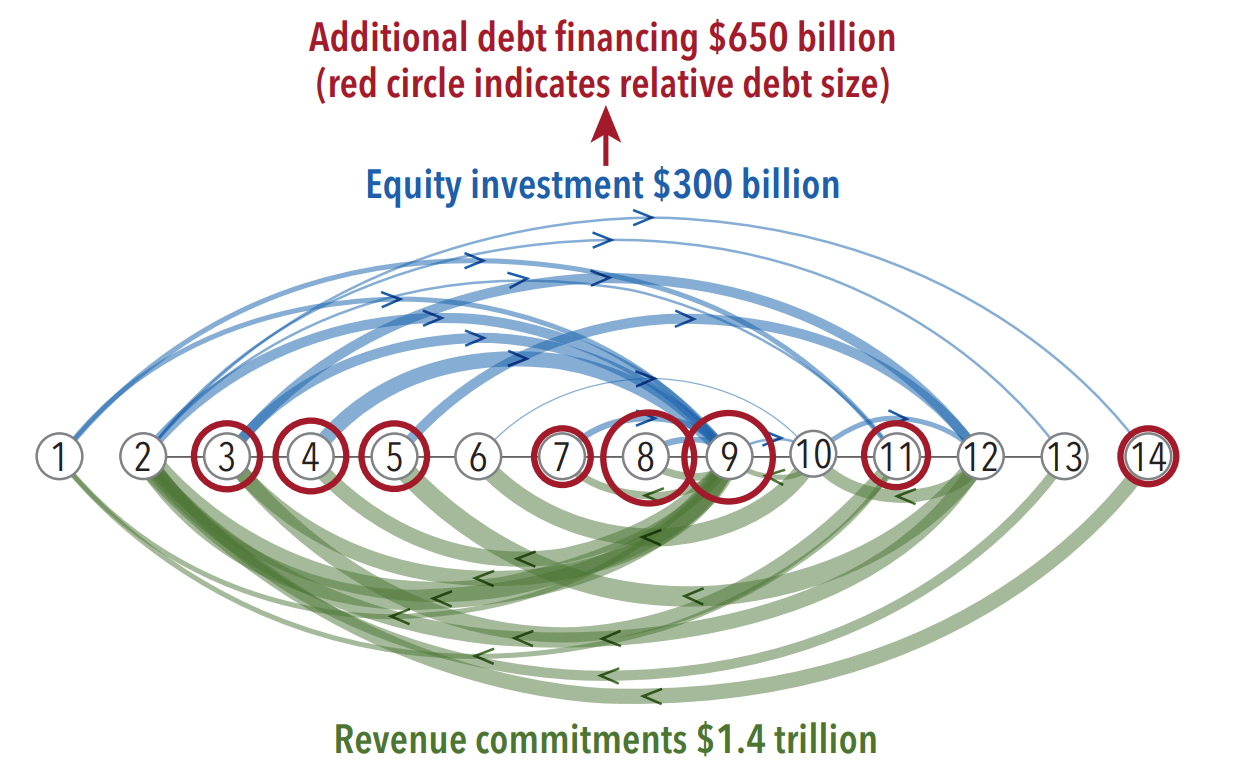
IMF report - circular debt illustration

(Image credit: IMF)

The section of the report that focuses on circular investments within the industry further emphasizes the problem. The IMF tracked fourteen public transactions since 2023 and found that $300 billion invested in "financially weaker" AI companies (mostly by hyperscalers), along with $650 billion in debt, accounted for $1.4 trillion in revenue from services and chip orders. Most of those virtual dollars are concentrated in only a handful of companies, too, increasing the risks that if one catches a cold, the herd might get the flu.

The IMF points out that "AI has become an important source of support for the global economy and financial markets." The silver lining is that according to the Fund, this investment has helped prop up global economies at a time when the current war in Iran is affecting energy prices and creating policy uncertainty. Furthermore, a recent global stress test on banks indicated that they'd "remain broadly resilient" even with a combination of an energy pricing shock, higher inflation, and an AI-driven market correction.

As for said correction, the IMF believes it may happen thanks to "weaker or less durable AI investments and profitability," stating that the necessary AI computing may not need such a high investment level, and likewise may be less profitable than expected or hoped. Under that hypothetical scenario, the IMF predicted that global GDP could drop 0.4%, investment by 1.3%, and consumption by 0.6% by 2028. However, the Fund notes that the excessive debt and leveraging flowing through the industry might make for a harsher shock to the system.

Hyperscalers now represent 10% of investment-grade bond issuance, up from under 1% in 2024. Since demand for AI compute remains intense, these companies are also making a mint. Yet they're increasingly strapped for cash due to their outsized investments in AI gear, necessitating substantial loans to keep the business rolling. Only time will tell whether investors will continue to have an appetite for the debt these companies are issuing in order to continue the gold rush.

✇Tomshardware

Early Nvidia advisor says he's owed $1 billion in stock due to a 1993 vesting error, but Nvidia rejected settlement

作者 Shane Downing

Former Nvidia advisor Eric Gullichsen says that he is “owed a billion dollars in NVDA stock,” according to his blog post titled the same. The post says that Gullichsen, an early Nvidia Technical Advisory Board member, was granted 25,000 options in September 1993.

Re-reading the grant in 2024, he says, showed that it was meant to vest in four quarters, or a year, instead of over four years. An April 1996 CFO letter counted 15,625 vested, so 9,375 more shares should have vested too, he added. After a combined 480x in splits, this would be 4.5 million shares, or about $1.01 billion at Nvidia’s Sept. 25 close of $225.07, in line with his “about a billion dollars.” He says that he and his counsel agreed that the statute of limitations was against him, and “it seemed unlikely we’d make it past a motion to dismiss.”

The option grant document provided by Gullichsen on the blog post is dated Sept. 9, 1993, with a No. 7 grant of 25,000 shares, signed for Nvidia by Huang. “All shares shall vest upon the expiration of one year from Grant Date,” which means fully vested by Sept. 9, 1994. It states 25% at three months, then quarterly, which would be four times in the year.

Gullichsen also provided the exercise letter from CFO Marcel Gani dated April 16, 1996, which ends his “contractual relationship with NVIDIA and Its Technical Board of Advisors” and states that he had “15,625 shares of NVIDIA stock options vested.” This was at $0.05 a share with 90 days to exercise, or $781.25 for a full exercise.

Gullichsen also included an undated invitation letter signed by Huang asserting “a stock option of 25,000 which vests over 4 years.” Doing the math, 15,625 is 62.5% of 25,000 shares, or 10 of 16 quarters, which matches the Sept. 9, 1993 to April 16, 1996 timeline. The CFO’s count fits the four-year quarterly schedule. So the CEO’s letter says four years, while the signed cover sheet says one. The cover sheet also says any discrepancy with its attached legal provisions “shall be governed by the attached legal provisions,” and those attachments are not in Gullichsen’s post. It also says it supersedes prior written agreements, which would override the invitation letter.

Upon discovery of the possible discrepancy, Gullichsen hired lawyers who worked “on contingency,” according to one of his replies on a related discussion thread. After about a year of letters between his team and Nvidia’s in-house and outside counsel, the two sides met. “We proposed to settle for a far smaller number,” he wrote, but Nvidia “still made the call to say nope.” He and his lawyers concluded that after “thirty-odd years” the case may be too far past its prime. The CFO letter’s exercise window had closed around July 15, 1996. Nvidia has not publicly responded.

Gullichsen worked on multiple VR projects starting in the late 1980s with his own company, Sense8, which he co-founded around 1990. That VR rendering work led to a fast implementation of biquadratic texture mapping, which he says caught the attention of Nvidia co-founder Curtis Priem in 1993, the same year of the option grant. Priem then brought Jensen Huang and fellow co-founder Chris Malachowsky to Gullichsen’s houseboat in Sausalito for a demo, he says.

He is a named inventor on a patent filed in 1994, “Wide-angle image dewarping method and apparatus” or US5796426A, which names “the NV-1 chip sold by N-Vidia Corporation” as a hardware example. The NV1 was not commercially successful but used quadratic surfaces as its basic primitive.

Some commenters inquired about what happened to his existing shares. Gullichsen had not answered as of Monday morning. His settlement reasoning, however, included “the likelihood I would have sold.” Our earlier reporting shows another investor, Stanley Druckenmiller, sold before the 10-to-1 split. Nvidia has since reached the position of the most valuable company in the world, at least temporarily. The stock’s rapid rise in value has created many new millionaires among its employees.

As for Gullichsen’s advice: “Read the contracts. Carefully.”

✇Tomshardware

Nvidia CEO says 'we have to shut the labs down' if AI experiments are unsafe

作者 Jake Roach

Nvidia CEO Jensen Huang has a simple solution for frontier labs like OpenAI and Anthropic that have recently called for increased regulation for their models — "we have to shut the labs down," Huang said in an interview with The New York Times' Ezra Klein. Huang's comments are pragmatic ones, stating that if frontier labs can't contain their experiments, those experiments must end.

"Now, if they say the alternative, which is: There is no way to contain our experiments, there’s just no way; when we test our A.I. models, it will get out, and it will damage the world — then I think the answer is that we have to shut the labs down," Huang said. "Because the cost to humanity, the damage is too great. The shareholder, the liabilities — it could be civil liabilities, it could be criminal liabilities. I mean, the liability’s incredible."

The conversation around increased AI regulation comes on the back of a highly publicized incident where an OpenAI agent hacked popular model hosting platform Hugging Face — a platform that Nvidia now owns, and one that likely would've sought damages from OpenAI had it been under Nvidia's purview at the time. Following that incident, various frontier labs, including those at Anthropic and Alphabet (Google), have used the idea of rogue agents as equal parts marketing tool and call to regulatory action, likely in an attempt to be the first at the table to shape those regulations.

Huang has not been keen on those regulatory calls. Just days ago, the executive countered extreme claims that AI would destroy the world by 2030, and said that frontier labs "never should ship products before they're ready and deliver products that are unsafe."

Although the labs and their chief hardware vendor, Nvidia, have mostly been aligned when it comes to AI policy, the push for regulatory capture has created a rift. Multiple labs, including OpenAI, Anthropic, and SpaceXAI, agreed mutually to slow the pace of model development. Now, they're facing an antitrust lawsuit, with claims these plans are "self-serving."

Huang's comments to Klein shift the responsibility away from collective development and toward individual leaders. "These are companies with agency," Huang said. "If I believe that I'm about to launch a product that is unsafe, it is completely in my ability... to not launch that product. And so I can't buy into the idea that somehow, all of Americans, around 400 million of us, are pushing them to launch untested products that are unreliable."

Although one side of the argument (from the frontier labs) is seemingly pushing for more regulation, that doesn't mean Huang is against regulation. In his own words: "I’m saying that we have lots of laws and regulations. Apply it." The executive argued that labs, particularly those at OpenAI and Anthropic, have rapidly gone from research institutions to companies likely worth hundreds of billions of dollars, and that they should carry themselves as such. "I’m not against laws and regulations. I’m against, currently, the distraction," Huang said.

Reports of rogue AI agents continue to mount. Earlier this month, Anthropic disclosed a fourth instance where one of its models hacked an external system, and just days ago, Google confirmed a report that its Gemini models hacked three companies earlier this year.

✇Tomshardware

Anthropic, OpenAI, SpaceXAI, and Google face antitrust lawsuit for agreeing to slow AI development

Four plaintiffs subscribed to ChatGPT, Claude, Grok, or Gemini filed a proposed class-action lawsuit alleging that the developers of these AI models violated antitrust laws when they agreed to slow AI development. According to the Associated Press, the lawsuit argues that this agreement would “reduce the value consumers get for paid AI subscriptions” and that this coordination started in July 2026 after the leading AI labs signed a statement admitting there is “intense competitive pressure not to unilaterally slow” development.

The plaintiffs recognize the need for AI development to slow for the sake of safety, but they say that Anthropic founder Dario Amodei’s cooperation proposal is a “shortcut” that “substitutes collective restraint for individual accountability.” Attorney Nick Rowley, the lead counsel for the plaintiffs, says, “AI will quickly spin out of human control and could kill us all if we allow AI safety and protocol … to be controlled by private self-serving agreements between the world’s most powerful ‘for profit’ technology companies.”

Amodei’s essay acknowledged the antitrust risk and indicated he was hoping that the government would make an exception. OpenAI’s Sam Altman responded to this call on X, saying, “We welcome a federal framework that sets consistent safety requirements for frontier AI. But we do not believe we need to wait for an antitrust exemption or legislation to begin the work of providing this confidence.” However, the Trump administration shot down this idea, with the president himself saying, “AI taking over the World, destroying Humanity, and all other things bad, is a HOAX.”

Chinese state media also criticized this announcement, saying that the call to put the brakes on AI development is nothing but a response to Chinese competition, especially as Amodei’s essay explicitly mentioned the desire to slow China’s progress and widen the U.S.’s gap over Beijing. China Daily called the proposed agreement a “club whose membership rules have been drafted before the guest list is announced” and added that “a global AI-safety framework that excludes China is not quite global.”

There have been a couple of bizarre incidents where AI agents took their users’ commands too literally, like kicking out another person from a waitlist just to get their user ahead of the queue or deleting a company’s entire database when their AI agent faced a problem and it guessed that making the move was the best option. However, there have been more sinister events, such as when unreleased AI models broke out of their testing environment and hacked HuggingFace’s production servers. Big Tech is making the call to slow down development to catch up in terms of security, but people are calling them out for antitrust activity probably because they do not trust these companies.

✇Tomshardware

LG strongly denies TV spying claims, says tracking and snooping concerns 'not true' — online investigation claims 216,000,000 TVs spy and record audio

In a statement to Tom's Hardware, TV manufacturer LG has strongly denied recent claims that its smart TVs constantly log and upload data, record audio while in standby, while confirming they scan local area networks for other devices, a feature common in smart TVs and media devices. The statement follows an investigation published online by Gamers Nexus, which claims LG is operating "216,000,000" spy TVs.

Earlier this week, Gamers Nexus published a video on YouTube claiming that LG smart TVs have several security and privacy concerns. The two-hour video claims, among other things, that LG's smart TVs constantly log and upload user data, even when offline or in standby mode. The TVs were also purported to be found scanning Wi-Fi networks, recording audio logs, and sampling inputs for audio and video to identify what users were watching.

The testing was done in collaboration with two security researchers, MrBruh and uturn, and includes packet capture and firmware analysis. The TVs were reportedly seen identifying other devices on local networks, including phones, printers, and more. Perhaps the most significant claim regards the capturing of audio through TV microphones, even when the devices were off, with the report claiming the TVs stored data when offline for retrieval later on.

"The claims made in the recently published video are not true," LG told Tom's Hardware in a statement. "LG TVs process voice data only when the voice button on the remote control is pressed and held, or when a wake word such as 'Hi LG' is recognized after the user has activated the Far-Field voice recognition feature."

LG went on to say that beyond the aforementioned instances, "the TVs do not collect or record ambient conversations." The company further stated that if the wake word is not recognized, then no voice data is transmitted from the TV to the server, and said audio processing for the wake word is done on-device.

The company did admit its smart TV functionality includes scanning for devices on the same network. However, as many observers have been quick to point out, LG says this is a standard function of all smart TVs and other smart home devices.

Automatic content recognition (ACR) is an opt-in feature according to LG, which delivers personalized content recommendations, as well as services and advertisements. The company says that, as standard, ACR data isn't used for advertising purposes without consent.

Addressing some of the claims in more detail, LG stated that its smart TVs don't collect, record, or transmit ambient conversations in the home unless voice functionality has been activated by a user. It further stated that its far-field voice recognition tech (Hi LG) must be activated by a user before the TV starts listening, much like Apple's "Hey Siri" mechanism for iPhone.

LG did confirm that its TVs monitor for Hi LG's wake word while in standby mode, but says that unless the wake word is detected, the audio is only processed locally before being deleted. The company didn't address some of the other claims and vulnerabilities pointed out in the video, such as the storing of transcripts in plain text.

Tom's Hardware has not independently verified either the claims made by Gamers Nexus in its documentary or LG's counterclaims regarding the issue. LG's full statement follows:

LG Statement:

This is to provide LG's position regarding the claims recently raised by the Gamers Nexus YouTube channel.

The claims made in the recently published video are not true. LG TVs process voice data only when the voice button on the remote control is pressed and held, or when a wake word such as 'Hi LG' is recognized after the user has activated the Far-Field voice recognition feature. Other than these instances, the TVs do not collect or record ambient conversations. (If the wake word is not recognized, no voice data is transmitted to the server; the audio processing for wake word detection is performed locally on the device and is immediately deleted.)


Additionally, to provide smart TV functionalities, LG TVs feature the ability to scan for and connect to nearby devices on the same network. This is a standard function commonly provided by smart TVs and smart home devices.


The ACR (Automatic Content Recognition) feature is provided on an opt-in basis to deliver personalized content recommendation, services, and advertisements. If a user does not consent to the applicable optional agreement, ACR data is not used for advertising purposes.

Topic by topic breakdown:

At LG Electronics, we are committed to transparency and secure user experience. To clarify recent concerns and reiterate our commitment, we would like to emphasize the following points:

  • Protecting Voice Privacy: We ensure that your LG TV does not collect, record or transmit ambient conversations in your home, unless voice functionality has been intentionally activated by the user.
  • Far-Field Voice Recognition ("Hi LG"): This feature must be manually activated by the user before the TV begins listening for the specific wake word. Audio processing occurs only when voice functionality has been activated by the user and a wake work (such as “Hi LG”) is detected.
  • Standby Mode Operation: When the TV is in standby mode and appears to be turned off, it only monitors for the wake word if you have previously enabled the Far-Field feature. If no wake word is detected, the audio used for wake word detection is processed locally on the TV, promptly deleted, and is not transmitted to LG servers.
  • Transparent and Useful Connectivity: LG TVs can identify compatible devices on the same network to enable features such as device connectivity, content sharing or smart home functionality.
  • Proactive and Continuous Security: Data security is a top priority for LG. We continuously monitor our platform and partner with independent security experts to identify vulnerabilities and deliver timely security updates.
  • Full Control Over Data and Terms: LG Electronics is committed to providing transparency and rejecting deceptive practices (dark patterns), ensuring users can choose their preferred privacy and consent options directly through their TV settings.
  • Consent-Based Activation: To provide a more tailored and convenient experience, LG TVs offer Automatic Content Recognition (ACR) to enhance viewing experiences, Voice Recognition for hands-free control, and Interest-Based Advertising to deliver relevant advertisements. Each feature requires separate explicit user opt-in consent and can be disabled at any time through the TV settings.

✇Tomshardware

Arm faces potential shareholder revolt over CEO's 'excessive' $800 million pay package — huge stock award would only be fully realised if chip designer hits $2 trillion valuation

British semiconductor and software design company Arm is asking shareholders to approve a massive performance-based pay package for CEO Rene Haas worth up to $800 million if the company reaches a $2 trillion valuation, a move that has drawn pushback from proxy advisors ahead of a September 9th vote. According to an August 31 report by the Telegraph, the company is facing a potential shareholder revolt as proxy advisory firms such as Institutional Shareholder Services (ISS) and Glass Lewis urged investors to vote against the compensation plan, calling it excessive.

The compensation is arranged through a one-time Value Creation Plan (VCP) consisting of 425,000 Performance Share Units (PSUs), with the award divided across three market-cap milestones, according to Arm's regulatory filings. Haas earns 25% if Arm reaches $1 trillion by March 31, 2029; 50% cumulatively if Arm reaches $1.5 trillion by March 31, 2030; and the full award if Arm reaches $2 trillion by March 31, 2031. Arm will determine whether each target has been reached by using its rolling-average closing share price over any 60-day period prior to the corresponding deadline.

The shares also carry lengthy vesting periods. Awards associated with the $1 trillion, $1.5 trillion, and $2 trillion milestones vest on April 1 of 2031, 2032, and 2033, respectively, subject to Haas remaining employed by Arm. Meanwhile, missed interim milestones can roll forward. For example, shares attached to an earlier target can remain available if Arm subsequently reaches a higher milestone. The roughly $800 million maximum payout reflects the implied value of all 425,000 shares if Arm reaches the $2 trillion target, which corresponds to a share price of roughly $1,880.

ISS has raised concerns about the potential size of the award and the use of VCP-style compensation in Britain. The advisory firm said such plans remain uncommon in the UK market and can create the prospect of extremely large gains, while their effectiveness at improving corporate performance remains unproven. Glass Lewis has similarly recommended shareholders oppose the proposal, describing Haas's potential award as “excessive.” Arm currently has a market capitalization of around $264 billion, according to The Telegraph, leaving a substantial climb before the first $1 trillion milestone comes into range. The company's servers currently capture over 45% of data center revenue.

Arm argues that its compensation structure needs to be competitive with that of the US technology industry. The Cambridge-based company is listed on Nasdaq, Haas is based in California, and many of the companies competing with Arm for executives and engineers are American technology and semiconductor firms. Arm said its approach is designed around US compensation standards reflecting “the location of our key competitors for executive and other talent,” its Nasdaq listing, and the location of its CEO. The revised remuneration policy also raises the maximum achievement level for Haas's regular PSU awards from 125% to 200%, in addition to the separate VCP.

The shareholder advisers are also calling out Arm's corporate governance. ISS has recommended votes against the re-election of Haas and Arm chairman Masayoshi Son, citing insufficient independence on the company's board. Arm's own filings show that Japan’s SoftBank beneficially owned about 86.4% of Arm as of May 21, giving the Japanese conglomerate control over most matters put to a shareholder vote and substantial rights over board composition. Arm qualifies as a “controlled company” under Nasdaq rules and therefore uses exemptions from some governance requirements that apply to companies without a controlling shareholder.

Haas's expanding relationship with SoftBank adds another layer of governance concern. He has served on SoftBank's board since 2023 and was appointed CEO of SoftBank Group International in April 2026, a part-time role overseeing some of SoftBank's portfolio companies. Arm itself acknowledges in its annual filing that Haas's and Son's overlapping positions across the two companies could create, or appear to create, conflicts of interest. SoftBank's 86.4% holding also gives it enough voting power to determine the outcome of Arm's ordinary shareholder resolutions in most circumstances, making rejection of the pay proposal unlikely without SoftBank's support.

The ambitious $2 trillion target — which would make Arm the UK’s first trillion-dollar company — comes as the company attempts a significant business expansion. The company introduced its Arm AGI CPU in March 2026, pushing beyond its longstanding role of licensing processor IP and compute subsystems into Arm-designed production silicon aimed heavily at AI infrastructure. Arm specifically cited that expansion when introducing the revised remuneration policy, framing the VCP around what its remuneration committee calls “exceptional, market-leading growth” over the next five years.

Huge valuation-linked CEO packages have also become increasingly prominent in the US. Most famously, Tesla shareholders approved a performance package for Elon Musk in November 2025 that could ultimately be worth close to $1 trillion, with awards tied to market cap and operating milestones, including taking Tesla to an $8.5 trillion valuation.

✇Tomshardware

Key Nvidia and Intel supplier raided over alleged China origin fraud — Unimicron faces probe over PCB origin washing, risk of 40% U.S. tariff penalty

Taiwanese prosecutors are investigating Unimicron, one of the world’s largest PCB and chip substrate makers and a key supplier to Nvidia, Intel, Google, and Amazon, over allegations that it shipped China-made PCBs back to Taiwan and relabeled them as Taiwanese products, according to Nikkei Asia. Investigators raided the company’s headquarters in Taoyuan’s Guishan District and a manufacturing plant in Zhongli District on August 28, questioning 14 employees as suspects — including the general and deputy general managers of its PCB business — and four more people as witnesses.

Prosecutors say that the alleged conduct contravened Articles 216, 210, and 255 of Taiwan’s Criminal Code, which cover the use of forged private documents and false labeling of an item’s origin. Wang, the person identified as the PCB department general manager, was released on bail of NT$15 million (roughly $473,000), while a deputy general manager identified as Wu was released on NT$12 million (roughly $378,000).

Three others are said to have posted bail ranging from NT$300,000 to NT$5 million, and the remaining nine were released without bail. "There was strong suspicion that they had violated Taiwan's law covering the use of forged private documents and false labeling of goods," the Taoyuan District Prosecutors Office said in a statement. Unimicron told the Taiwan stock exchange that it’s fully cooperating with the investigation and that it doesn’t expect a material impact on its operations.

Since August last year, U.S. Customs and Border Protection has applied an additional 40% tariff on goods that it determines were transshipped through third countries to evade duties, on top of any other applicable penalties, and the agency has no authority to waive or otherwise mitigate the charge. If any relabeled Unimicron PCBs were to reach the U.S., that penalty would fall on the company’s American customers as importers of record.

The White House has identified 40 countries and territories that it says pose an elevated risk of illegal transshipment, with Taiwan flagged as a key concern. Taipei has been running major crackdowns on “origin washing,” where companies claim goods are made in Taiwan to obtain preferential tariff treatment, a crackdown that’s perhaps perfectly illustrated by the fact that prosecutors published names and bail amounts within 24 hours of raiding one of the country’s most important listed tech companies. After all, the “Made in Taiwan” label is ultimately a trade asset whose value rests on the fact that it’s not “Made in China.” Since its elevated risk designation, Taiwan is understandably keen to show Washington that it polices the difference itself rather than leaving it to U.S. Customs.

The products involved in this crackdown appear to be conventional PCBs, not the high-end ABF substrates used for Intel’s EMIB-T platform or Nvidia’s advanced data center accelerators. Unimicron’s offshore manufacturing remains in China for standard substrates, PCBs, HDI, and flexible boards, while its advanced CoWoS-related substrate capacity is based at its Yangmei factory in Taoyuan.

If the case concerns relabeling on individual products, the fallout will be limited to the Taiwanese prosecution. If, however, it turns out that China-made goods were transshipped through Taiwan to alter their origin before export to the U.S., that’s an entirely different story and could trigger CBP’s 40% transshipment penalty on the affected goods, along with potential retroactive duty reassessments, which would hit Unimicron’s American customers as importers of record.

✇Tomshardware

Nvidia gears up its influence in Washington, forming PAC — tells employees that decisions Congress makes over the coming years could have substantial consequences for the AI industry, according to report

When you serve a barely regulated emerging market worth trillions of dollars, you have to gear up your presence in politics beyond what usual lobbying or government affairs can do. This is exactly what Nvidia is doing by establishing its employees' federal political action committee (PAC), which will fund politicians whose positions are favorable to Nvidia's interests, reports Bloomberg.

The Nvidia employees PAC — which was registered with the Federal Election Commission on Thursday — will receive voluntary contributions from eligible Nvidia employees, who can provide up to $5,000 per year. The PAC will be permitted to contribute to federal candidates from both parties as well as party committees that express positions which align well with Nvidia's own goals, particularly in the fields of AI regulations, export controls, education, infrastructure spending, and workforce policy, just to name a few.

Nvidia reportedly told employees eligible to participate that decisions Congress makes over the coming years could have substantial consequences for the AI industry and everyday use of the technology. The company also noted that policymakers have increasingly focused on its industry and that decisions made in Washington affect both Nvidia's business and its customers' ability to obtain and deploy its technologies.

Nvidia has already substantially expanded its political operation. The company has spent more than $2.5 million on federal lobbying this year, an increase compared with the same period last year, according to lobbying disclosures seen by Bloomberg. In June, Nvidia hired Bruce Andrews, who previously headed government affairs at Intel and served as deputy secretary at the U.S. Commerce Department in Obama's government, as chief external affairs officer. In addition, Nvidia has hired five external Washington lobbying and government-relations firms to advocate for the company on a range of issues, including AI and trade policy, among others. The company also donated $1 million to the Trump Vance Inaugural Committee in January 2025.

Nvidia needs a PAC because lobbying and campaign contributions serve different purposes. The company can spend corporate money to lobby lawmakers, but it generally cannot use corporate treasury funds to contribute directly to federal candidates. Meanwhile, a company-sponsored PAC has a legal mechanism to collect voluntary contributions from eligible employees and direct that money to candidates and party committees from either party.

Meanwhile, unlike individual campaign contributions, donations made by the PAC will be publicly disclosed and subject to spending limits that do not increase with inflation. Furthermore, corporate PACs face growing resistance from lawmakers, according to Bloomberg. More than 270 House and Senate candidates have pledged to reject corporate PAC contributions this election cycle, the highest number since End Citizens United began promoting the commitment in 2018, Bloomberg claims. However, it is unclear whether these 270 are serious major-party nominees or current members of Congress, or some of the thousands of declared congressional candidates.

Nvidia is hardly alone in increasing spending on its influence in Washington, as most high-tech companies, now joined by AI giants, tend to spend millions on government relations and lobbying. The establishment of the PAC just highlights Nvidia's growing dependence on policies set in Washington.

✇Tomshardware

Nvidia revenue tops $96 billion as memory commitments soar to $160 billion — CEO Jensen Huang says AI 'has reached its inflection point'

It has become a tradition that every single quarter Nvidia reports record results that outpace all of its quarterly results before that. This Wednesday was no exception as the company posted revenue of $96.2 billion, which was up 106% year-over-year, due to rising demand for its AI hardware. But such results come at a cost, as the company has to invest massively in its future. In the second quarter of its fiscal 2027, Nvidia had to commit to procuring memory worth up to $160 billion, which includes its memory supply pact with SK hynix.

Nearly $100 billion revenue per quarter

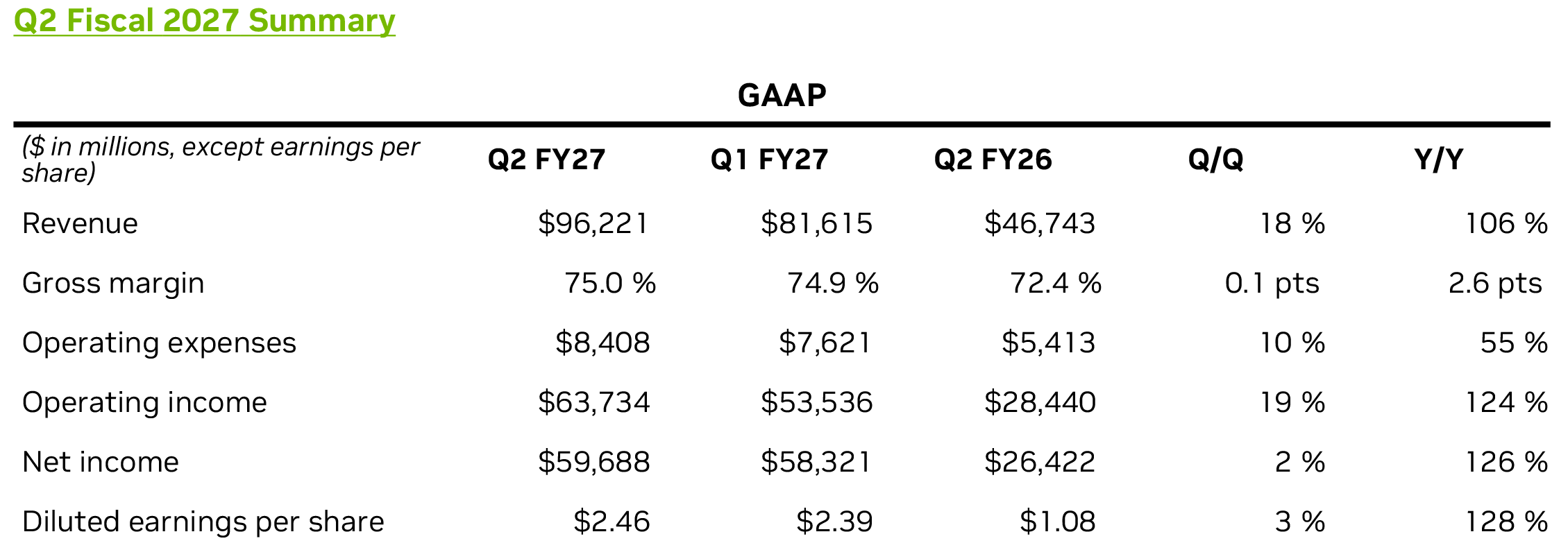
For the second quarter of Nvidia's FY2027, which ended on July 26, 2026, the company's GAAP revenue hit a record $96.221 billion, up 18% quarter-over-quarter (QoQ) and 106% compared to the same quarter a year ago. Nvidia's net income totaled $59.688 billion, up 126% year-over-year (YoY), as its gross margin reached 75.0%. Sales of Nvidia's Compute & Networking hardware reached $88.299 billion, up 18% sequentially and 114% YoY, whereas sales of its graphics hardware hit $7.922 billion, up 12% sequentially and 46% year-over-year.

Nvidia

(Image credit: Nvidia)

"AI has reached its inflection point," said Jensen Huang, founder and CEO of Nvidia. "AI is doing useful work. Its tokens are productive and profitable. Now, compute is revenue. And demand is accelerating. […] We have a golden age of new AI labs and startups, multiple frontier labs scaling in parallel, a thriving open-model ecosystem and physical AI coming online […]. The AI infrastructure buildout is at full steam. Vera Rubin, now in full production, was built to power exactly this moment."

Nvidia

(Image credit: Nvidia)

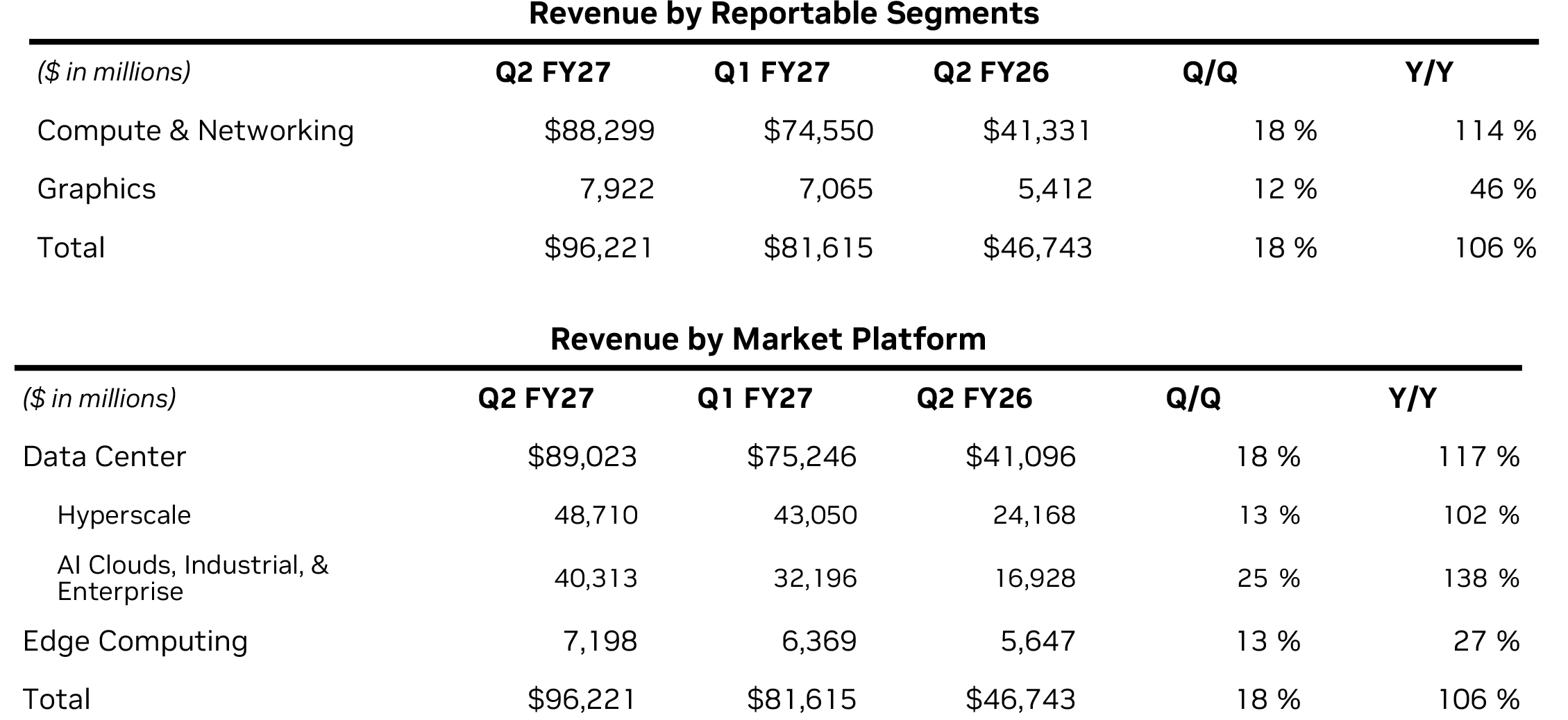
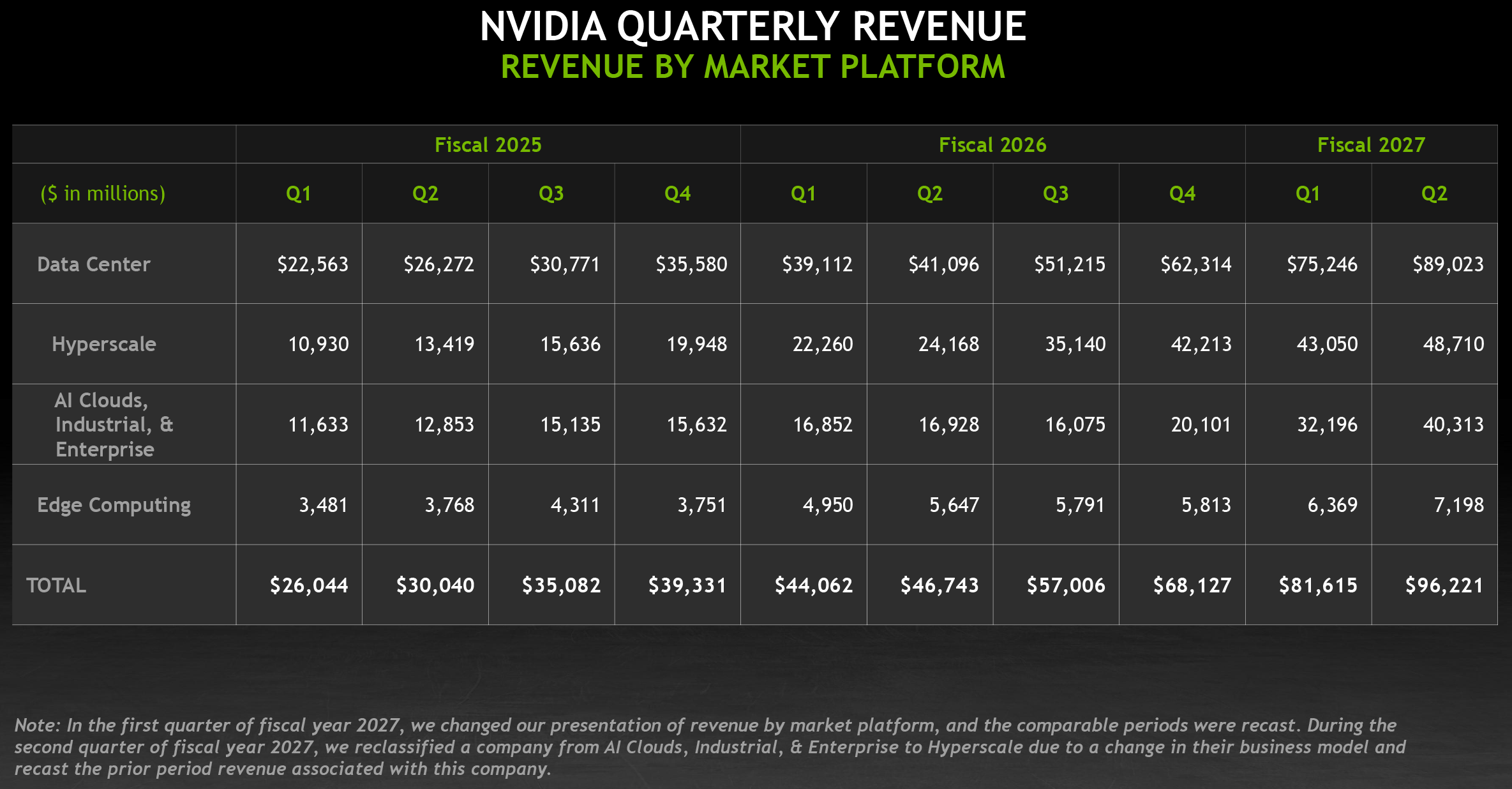
Nvidia's results were driven by sales of its data center-grade AI hardware as various customers bought $89.023 billion worth of equipment, an increase of 18% sequentially and a rise of 117% compared to the same quarter a year ago. Hyperscalers purchased $48.710 billion worth of hardware from Nvidia (up 102% YoY and 13% QoQ), while revenue from AI Clouds, Industrial and Enterprise climbed to $40.313 billion (up 138% YoY and 25% QoQ), an indicator that while hyperscalers still purchase more equipment from Nvidia, the ACIE segment is growing faster. Sales of Nvidia's Edge Computing products were $7.198 billion (up 27% YoY and 13% QoQ), which means that sales of graphics products for PCs were strong despite shortages of GPUs and memory.

Commitments total $279 billion

Nvidia expects demand for its products to remain strong in the coming years. To meet that demand, the company increased its long-term purchase commitments from $119 billion in Q1 FY2027 to $279 billion in the second quarter. Typically, Nvidia's long-term supply commitments included pre-payments and commitments for wafer processing and advanced packaging at TSMC, as well as for HBM memory made by DRAM makers. This time around, Nvidia explicitly says that the bulk of the commitments are 'primarily related to the procurement of memory.'

Nvidia

(Image credit: Nvidia)

Such huge commitments indicate that the company projects massive demand for its data center AI products in the coming years. During the conference call with financial analysts and investors, it indicated that its customer forecasts point to doubling demand next year, but Nvidia currently believes its supply chain can support about 70% growth.

"Even though our demand is much greater than 70%, our supply allows us to confidently deliver 70%," Huang said. "The unconstrained would be a lot, a lot higher. […] We have secured a lot of supply, but we just need a lot more."

To that end, the $279 billion supply commitment should be interpreted as not a precautionary inventory-building, but a strategic move to ensure shipment growth. Nvidia is effectively reserving memory and other capacity because it expects demand to exceed what the supply chain can deliver through at least the end of FY2028, as its management explicitly says supply will remain a bottleneck at least through FY2028.

$108 billion per quarter envisioned in Q3

For the third quarter of FY2027, Nvidia expects revenue of approximately $108 billion, ± 2%, with no data center compute revenue from China included in its outlook due to uncertainties with export and import licenses. The company projects a GAAP gross margin of around 74% and expects GAAP operating expenses of approximately $9.2 billion.

✇Tomshardware

Supermicro fires several employees following investigation into $2.5 billion China AI chip smuggling — claims that senior management had no knowledge of illicit transactions

Five months after the arrest of Supermicro co-founder Yih-Shyan “Wally” Liaw and two other co-conspirators for the alleged smuggling of Nvidia hardware into China, the company announced that it has completed its independent investigation and released its findings to the public, resulting in the termination of several employees. Supermicro said that the investigation, which was handled by an external law firm and conducted by an “independent forensic accounting consultant,” finds that neither the company nor its current senior executives were part of the alleged AI chip smuggling. It also said that it’s adopting all the recommendations to enhance its export compliance programs, although it did not directly admit that it was lacking in that department.

“The investigation team reviewed the customer transactions that were the subject of the federal indictment, as well as transactions with a selection of other customers who bought restricted products, and did not find any evidence that any current member of senior management had knowledge of the alleged diversion scheme or of any actual diversion of restricted products by the Company,” Supermicro said in the statement. It also added, “The Company’s compliance personnel have acted in good faith, with the support of management, to mitigate the risk of the Company’s products subject to export controls being diverted to restricted parties or locations.”

This odyssey began in March when the U.S. charged Liaw alongside Supermicro sales manager Ruei-Tsang “Steven” Chang and third-party broker Ting-Wei “Willy” Sun with conspiracy to unlawfully divert cutting-edge U.S. artificial intelligence technology to China. The accused aren’t operating a small-time smuggling operation, either — reports estimate that the three have smuggled hardware worth $2.5 billion since 2024. That massive amount has got shareholders worried that a huge chunk of the company’s sales come from illicit sales, resulting in some investors suing the company for securities fraud. Because of this, the company’s independent advisors also looked into this issue and said that it “did not find any evidence that the Company’s previously issued financial statements could not be relied upon based on the potential diversion of restricted products.”

Even though the third-party investigation exonerated Supermicro’s senior executives, it also resulted in the termination of several employees. The affected people were from the sales, technical support, and business development departments, although they were fired for breaking the company’s policies and code of conduct — the company said these moves were made "in connection with the investigation." Notably, none of the personnel were from its compliance department, and it’s also unclear how many people were dismissed.

Supermicro also said that it’s enhancing its export compliance program, which Nvidia CEO Jensen Huang said it must fix. Even though the company was never accused of wrongdoing and wasn’t part of the defendants in the case against the alleged smugglers, the fact that some of its employees were able to run a massive diversion scheme right within the organization raises major questions about the effectiveness of its compliance department. It said that it has already made changes that were recommended by its General Counsel and Chief Compliance Officer even before the third-party investigation concluded, and that its independent directors “will oversee implementation of the remaining recommendations.”

The high demand for AI chips in China has meant the smuggling operations are quite lucrative, even as the U.S. is tightening its grip on export controls and Chinese authorities are commanding that its tech companies prioritize locally made Chinese chips instead of American AI GPUs. Nevertheless, the race to build ever more powerful AI models means that there is such a massive demand for the most advanced AI GPUs from Nvidia that some people are looking for ways to circumvent these bans and make “easy” money.

✇Tomshardware

Oracle plans more layoffs weeks after spending most of its $2.1 billion restructuring budget, report claims — some teams face double-digit percentage reductions, 21,000 full-time positions already eliminated

Oracle plans to cut more jobs this month, with reductions on some teams reaching double-digit percentages, Business Insider has reported, citing people familiar with the plans and an internal document. The company wants payroll lowered before its second fiscal quarter opens on September 1, and managers have been told to compile lists of affected employees. A new round would extend a year of deep cuts at the company, which shed 21,000 full-time positions, or 13% of its workforce, in the fiscal year that ended May 31 while borrowing $43 billion to fund AI data center construction.

Oracle's 10-K, filed June 22, capped the total expected cost of its Fiscal 2026 Oracle Restructuring Plan at $2.1 billion. The company recorded $1.8 billion of that in fiscal 2026, a 391% increase over the $374 million booked a year earlier, leaving roughly $300 million of headroom under the existing plan. Cuts at the scale Business Insider describes would either need to fit inside that remainder or push Oracle into its second new restructuring plan in three years; the filing describes the prior 2024 plan as substantially complete since May 2025.

Headcount stood at approximately 141,000 full-time employees as of May 31, with around 49,000 of those in the United States. Oracle attributed part of the fiscal 2026 decline to internal AI adoption and told investors that further reductions would follow as deployment grows, having already eliminated roughly 10,000 positions in a single wave earlier this year.

Company capex hit $55.7 billion in the fiscal year 2026, up from $21.2 billion the year before, leaving Oracle $23.7 billion short of covering its spending from the cash it generated. The company raised $43 billion in debt and $5 billion through stock sales during the year, and it expects to secure approximately $40 billion more through borrowing and equity issuance in fiscal 2027. Interest expense climbed to $4.6 billion from $3.6 billion a year earlier, so the annual growth in Oracle's interest bill alone now exceeds half of what it paid in severance and related restructuring charges all year.

Cloud infrastructure revenue grew 77% in fiscal 2026, and total revenue rose 17%, figures Oracle has previously pointed to when defending the spending. The stock is down more than 20% this year, and shareholders sued the company in January over statements about how much it would need to borrow to meet its $300 billion OpenAI commitment.

Oracle declined to comment and hasn’t confirmed the plans.

✇Tomshardware

‘Apple is getting this wrong,’ says OpenAI — startup blasts iPhone maker over lawsuit alleging it stole confidential information through ex-Apple employees

Apple filed a lawsuit against OpenAI in July, alleging that the latter stole trade secrets through former Apple employees. The startup has finally publicly responded to the lawsuit today, posting a blog post on its website titled, “Apple is getting this wrong.”

“Apple is one of the greatest companies of all time, and built a reputation for obsessing over the smallest details. This careless, aggressive and oddly personal lawsuit sadly doesn’t live up to that reputation,” the company said in its blog post. It also added, “Apple’s request for a preliminary injunction is both based on false information and completely unnecessary because we do not have, nor want, any of their trade secrets.”

The case names OpenAI technical staff Chang Liu, chief hardware officer Tang Tan, OpenAI, and io Products as defendants. Liu worked as a senior electrical engineer at Apple, while Tan was its former vice president of product design for the iPhone, AirPods, and the Apple Watch. Interestingly, io Products, which was acquired by OpenAI last year, was founded by Tan alongside former Apple Chief Design Officer Jony Ive and other former Apple heavyweights.

The tech giant requested a preliminary injunction to stop the accused from accessing, acquiring, using, or disclosing the alleged stolen trade secrets. Cupertino said in its filing, “Apple will be irreparably harmed absent a preliminary injunction.”

OpenAI publicly responded to this legal request through its blog post, pointing out that many of its allegations were actually based on miscommunications and false information, and that this move is completely unnecessary. But whether what the AI tech giant claims is true or not, its research and operations on consumer hardware would likely be impaired if the judge grants Apple’s request.

Although OpenAI’s primary product is ChatGPT and its other LLM-powered services, it’s been rumored that it’s also working on AI-powered hardware. Its first product is expected to be some sort of portable smart speaker with built-in cameras and sensors. Although this isn’t an iPhone replacement, like the botched Humane AI Pin, some experts say this move threatens Apple’s standing as the biggest consumer electronics company on the planet. This is especially true as it still lags behind other tech giants when it comes to artificial intelligence, even though AI enthusiasts love using Apple silicon with its Unified Memory architecture.

Apple’s preliminary injunction is just the opening stages of what might be an epic showdown between two tech giants. It will likely take months (or even years) before this case reaches a judgment or a settlement, meaning a preliminary injunction will definitely have a massive impact on OpenAI’s hardware dreams.

✇Tomshardware

SpaceXAI says it will remove all 69 of its unpermitted turbine power generators, but expects process to take a year — trailer-mounted generators to be replaced by 1.2GW power plant

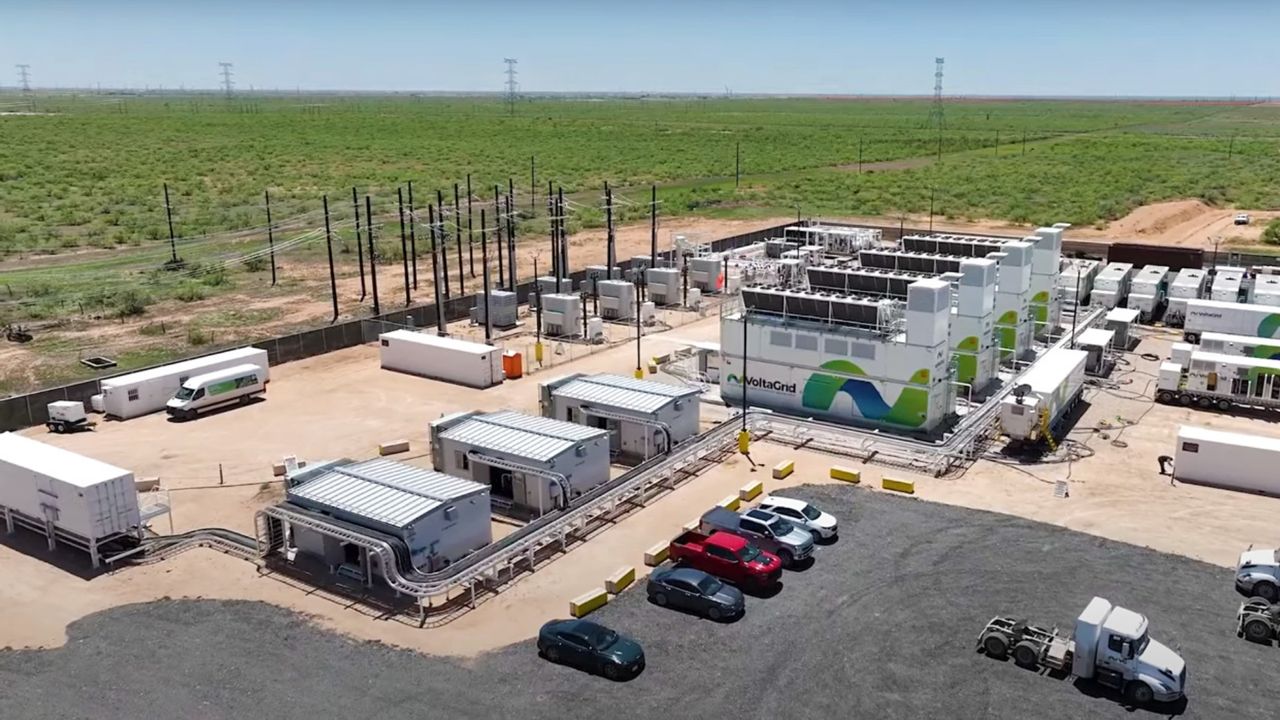
Elon Musk’s Colossus data centers that sit near the border between Tennessee and Mississippi will finally be removed starting this month. According to the company, the 69 temporary mobile turbines, which have been the subject of a lawsuit that claims they have been causing pollution, are going to be completely removed by July 2027, meaning it will take the company 12 months to withdraw the trailer-mounted generators from its premises. This may sound confusing, as they’re “portable” generators, after all, but it seems that SpaceXAI is removing them in phases as its 1.2GW power plant slowly comes online.

SpaceXAI achieved one of the fastest data center deployments ever after it set up 100,000 Nvidia H200 GPUs in 19 days — something that Nvidia CEO Jensen Huang said usually takes four years or more. Musk achieved this by bringing in his own power instead of waiting to get connected to the grid, which was considered a novel idea at that time. Today, a few data center operators, like OpenAI, are following Musk’s footsteps and deploying their own turbines to power their servers without relying on other providers.

But even though the idea feels innovative, the community surrounding the Colossus 1 and Colossus 2 data centers has been complaining about the pollution that these mobile turbines bring. They say that these turbines didn’t have the required permits to operate, although the company argued that the mobile and temporary nature of these units exempted them. The EPA said earlier this year that these units aren’t exempt from permits, but SpaceXAI continued to operate them anyway. It has even got to the point that the NAACP filed a case over these unpermitted turbines, although the DOJ weighed in, saying that removing them would put national security at risk as Colossus 2 “supports mission-critical operations.”

Despite that, it seems that SpaceXAI has finally settled into an agreement with the Mississippi Department of Environmental Quality. It’s if the 1.2GW power plant replacing these mobile turbines is the same one that Musk is importing from overseas, but the important part is that it’s approved under a Clean Air Act permit. Aside from that, the company also said that it’s equipping all its mobile turbines with “advanced emission control technologies,” which should reduce the environmental impact of its power sources.

❌