Last week, Anthropic published its prediction of what the economic impact of AI on the U.S. economy is going to be for the next few years. The company thinks the U.S. can reach a $44.4 trillion GDP or higher by 2030, provided, of course, it conveniently adopts AI at a rapid pace. Having said that, Anthropic admits "the challenge is making sure that the gains are broadly shared."
The interactive post has a simulator where readers can plug in their estimates on key factors and get their own future predictions, within the firm's analysis and perspective. That's definitely interesting to play around with, but perhaps the most relevant piece of information is the lens through which Anthropic views the world.
Anthropic establishes its reasoning by first placing tasks in broad categories and using a nurse's workday as an example. They removed tasks, including those that will disappear naturally as technology progresses, like collecting data on paper or physically visiting the patient to collect basic vitals — neither happens anymore as remote monitoring becomes commonplace. However, some new tasks are added, like keeping an eye on dashboards for the aforementioned AI-powered monitoring.
Then, there are naturally the tasks that a bot can't perform, like bathing a patient. Augmented tasks include those that require a human, but can be made more efficient with AI: helping with triage, planning schedules, and assisting with dashboard data. Some tasks may be fully automated, like keeping supply closets full or scheduling follow-up patient visits. Finally, AI usage can introduce some tasks of its own, like reviewing automated triaging or double-checking dashboard alerts — perhaps even impromptu data recovery.
The company's predictions broadly hinge on how ubiquitous AI usage becomes, and therefore, the number of tasks transitioning into fully or partially automated. Unsurprisingly, Anthropic believes that the more entrenched AI gets, the more value the country creates, though at greater risk — and on an exponential scale, no less
Three models are presented, from "modest" economical impact to "extreme." The modest model establishes a 1.6% GDP rise to $34.1 trillion, an impact Anthropic says is in line with that of new technologies like the internet, and crucially, doesn't imply tectonic shifts to unemployment rates or wages.
For the "substantial impact" scenario, although AI is predicted to be able to do half of "knowledge work," mostly without intervention, adoption remains limited. This scenario foresees twice the normal economic growth, this time +8.3% to $36.3 trillion.
This future marks the inflection point at which Anthropic believes knowledge workers see their wages remain steady instead of growing, though it's not clear if the firm accounts for inflation. Additionally, the firm states that "knowledge workers may see a lot of automation and displacement [...] coders and call service center agents may have to switch to jobs like electrician and nurse", a statement some might argue is already true. In that sense, Anthropic expects other workers to start seeing more cash.
The eyebrow-raising prediction for both the above scenarios, though, is that Anthropic expects unemployment to "stay within ranges history has seen before," an odd statement given modern U.S. history contains events like the Great Depression. The company does note that it expects job churn to increase, but also that while "this process can be painful, [it] works relatively well from a macroeconomic perspective." Average wages are expected to rise across all three scenarios, though the increase is expected to go towards workers outside of knowledge areas.
In the "extreme" scenario, Anthropic expects significant changes. Should AI be super-widely adopted, the GDP can increase by 32.4%, corresponding to a cool $44.4 trillion, a "profound economic transformation." This is the point at which the firm expects that AI becomes more productive than humans for most knowledge work, and does so with near-autonomy. Equally worryingly, it's expected that there will be "essentially no" new knowledge tasks created.
Anthropic notes that to reach this kind of stage, the country would "likely require" recursively self-improving AI (using the AI to make better AI). There's a significant catch, however, as though the U.S. would be "far richer than [it's] ever been," knowledge workers would be the hardest hit with a 10% wage drop, plus overall unemployment would climb "beyond typical recessionary levels." Manual labor would be prized, though, given that "as AI increases productivity within knowledge work, the demand for manual work that benefits from that productivity will increase."
Scenarios aside, the one big question is: How would all that GDP money land in people's pockets? Anthropic admits this problem is a "challenge" and offers little solution for it. Such a high amount of future AI penetration might prove a hard sell, considering wealth inequality in the U.S. already sits at its highest level for the last few decades and is trending in that direction in most developed nations. Others might argue with Anthropic's assessment that unemployment levels would remain somewhat in the less extreme scenarios, seeing as job cuts are rampant across many sectors and have hit technology-related fields the hardest.
To its credit, Anthropic clearly highlights part of the wealth-inequality issue. The company admits that more AI automation might skew the current 60/40% balance between labor and capital, respectively, strongly tilting the scale in favor of capital ownership and increasing inequality. Many argue that's already happening today. There's also the matter that the prediction appears to assume little competition from other countries, nor does it offer insight as to what would happen to "AI-less" nations.
The interactive blog post and its simulator are worth a good read and fiddling with, regardless. Anthropic published the technical details on the mathematical model used in a separate article and published its Economic Policy Framework last June.
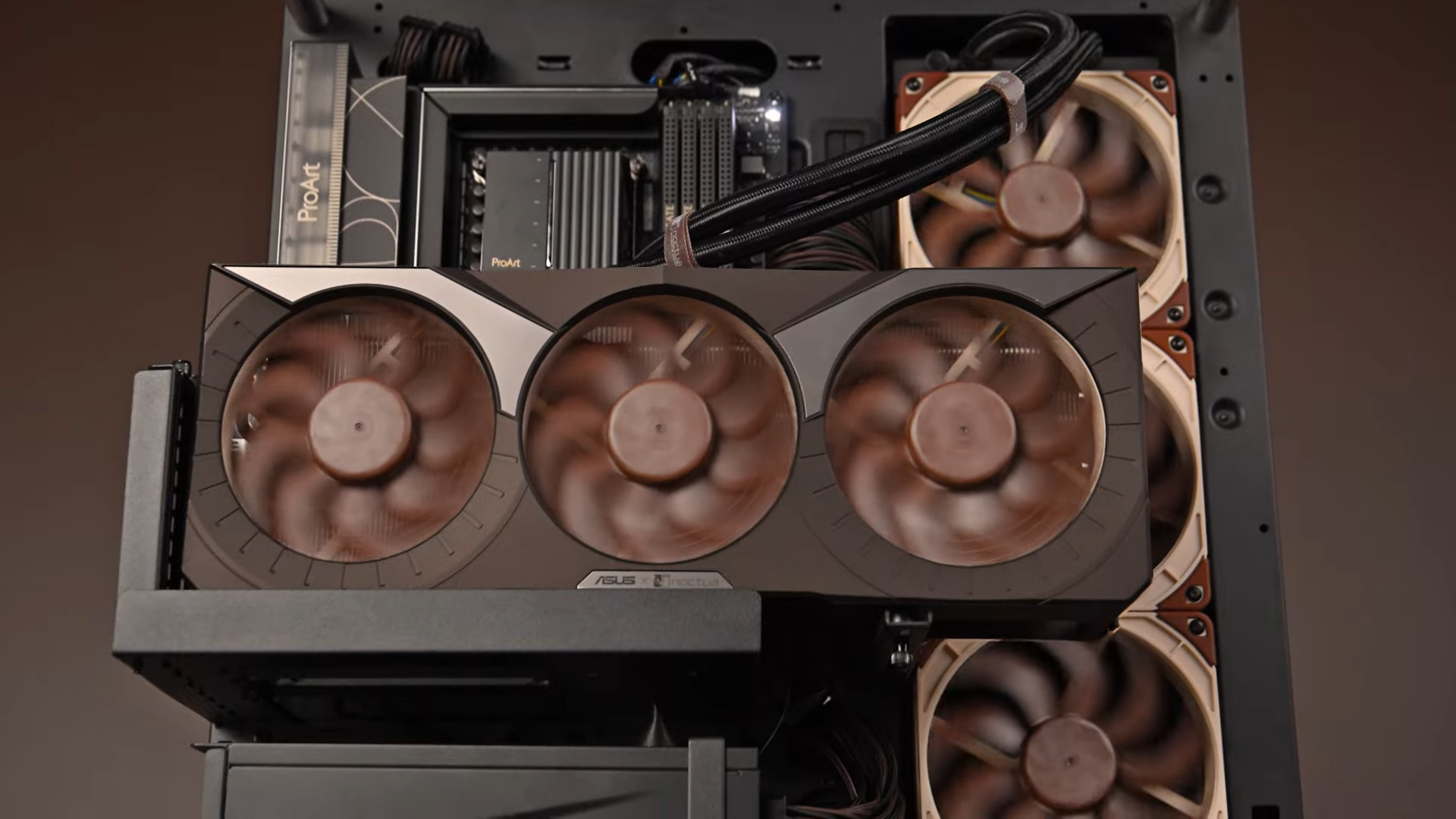
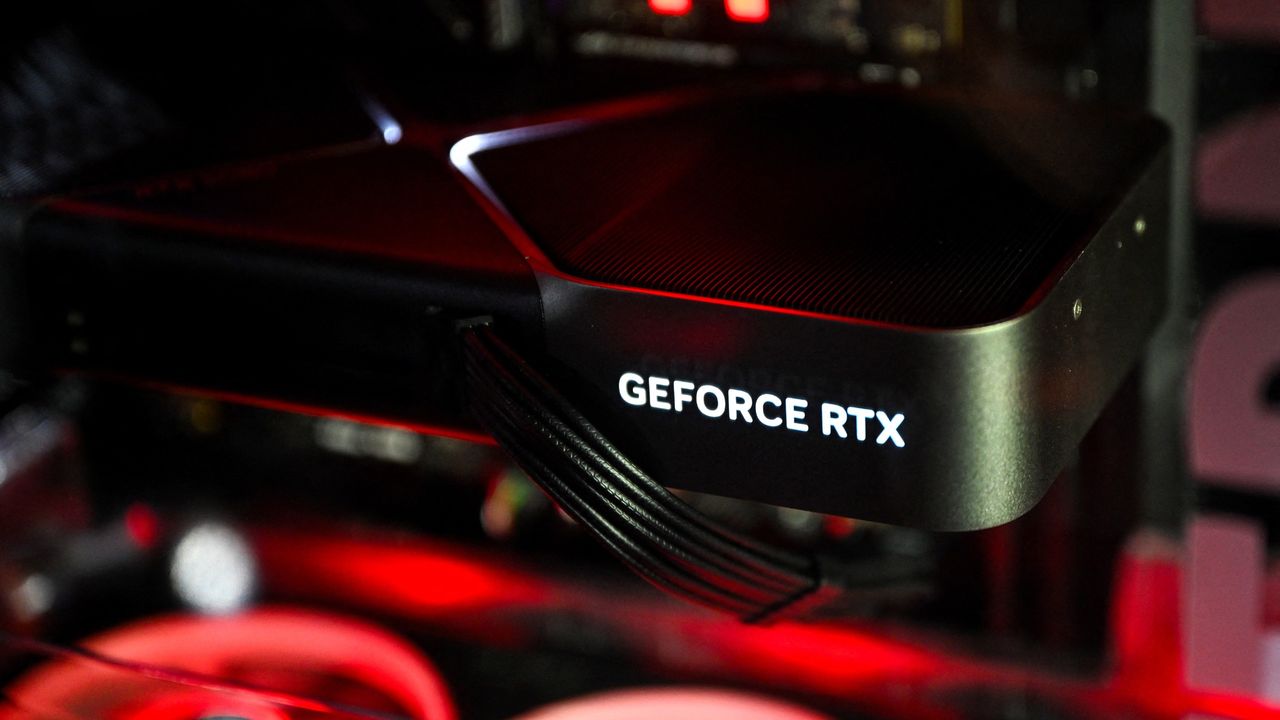
Nvidia's fastest gaming graphics card, the RTX 5090, has been on a tear of price increases over the past several weeks. However, over the past week, the available inventory has dwindled. Now, you can only find the RTX 5090 from third-party sellers at online retailers like Newegg and Amazon, commanding anywhere from $6,500 to $9,500 (or even higher) for Team Green's best GPU.
At Newegg, the cheapest RTX 5090 is the MSI Ventus 3X that's available from Slava Computers (a relatively new seller with 239 ratings and a 2.8 out of 5 rating at the time of writing) for $6,449. On Amazon, you can get the Asus TUF Gaming OC for $6,395 from Joes Tech Shop, a seller with an 81% positive rating. However, among the most recent reviews are a string of one-star reviews about orders never being fulfilled. The cost goes much higher, as well. The first result for "RTX 5090" on Newegg, for example, surfaces the MSI Ventus 3X OC for $8,699.
In June, the median price for an RTX 5090 was $4,299. At the beginning of September, we logged the lowest online price at $5,199 in our GPU price tracker. Now, in less than two weeks, the available stock has completely disappeared online, and the options available from third-party sellers have ballooned in price once again.
Naturally, we don't recommend buying from one of these third-party sellers. The RTX 5090 is selling at a vastly inflated price, but more importantly, we've seen no shortage of scams around high-ticket items like the RTX 5090. In January, 42 Amazon customers were duped into a scam involving a $999 RTX 5090, instead receiving a fanny pack in place of the GPU. Earlier this month, an online seller scammed two buyers with the RTX 5090, selling phantom graphics cards with the core and memory removed on the secondhand market for prices near MSRP.
The one exception to RTX 5090 inventory is Micro Center, which still has cards available around the average selling price. At a local Micro Center we checked, the cheapest in-stock option was $4,299. Micro Center has exclusively sold graphics cards in-person for several years, insulating it from online buyouts like what appears to be going on right now.
As usual, the reason why there's so much demand for the RTX 5090 is fairly obvious: AI. The RTX 5090 holds the GB202 GPU and 32GB of GDDR7 memory. For context, Nvidia's RTX Pro 5000 48GB comes with the same GPU with a third fewer shader units enabled, and lower memory bandwidth compared to the RTX 5090, and sells for between $7,000 and $9,000. In that context, the RTX 5090 starts to look attractive for building an AI server, even at $5,000 (or more) apiece.
At the same time, the RTX 5090 remains the fastest gaming graphics card on the market according to the testing in our GPU benchmark hierarchy. That's even more true now with Nvidia's launch of DLSS 5 Neural Rendering, which the RTX 5090 can fully capitalize on (though, thankfully, we've found playable performance on lower-end cards in our extensive DLSS 5 testing).
We've reached out to Nvidia for comment on whether it has any plans to stabilize inventory. We'll update this story when we hear back.
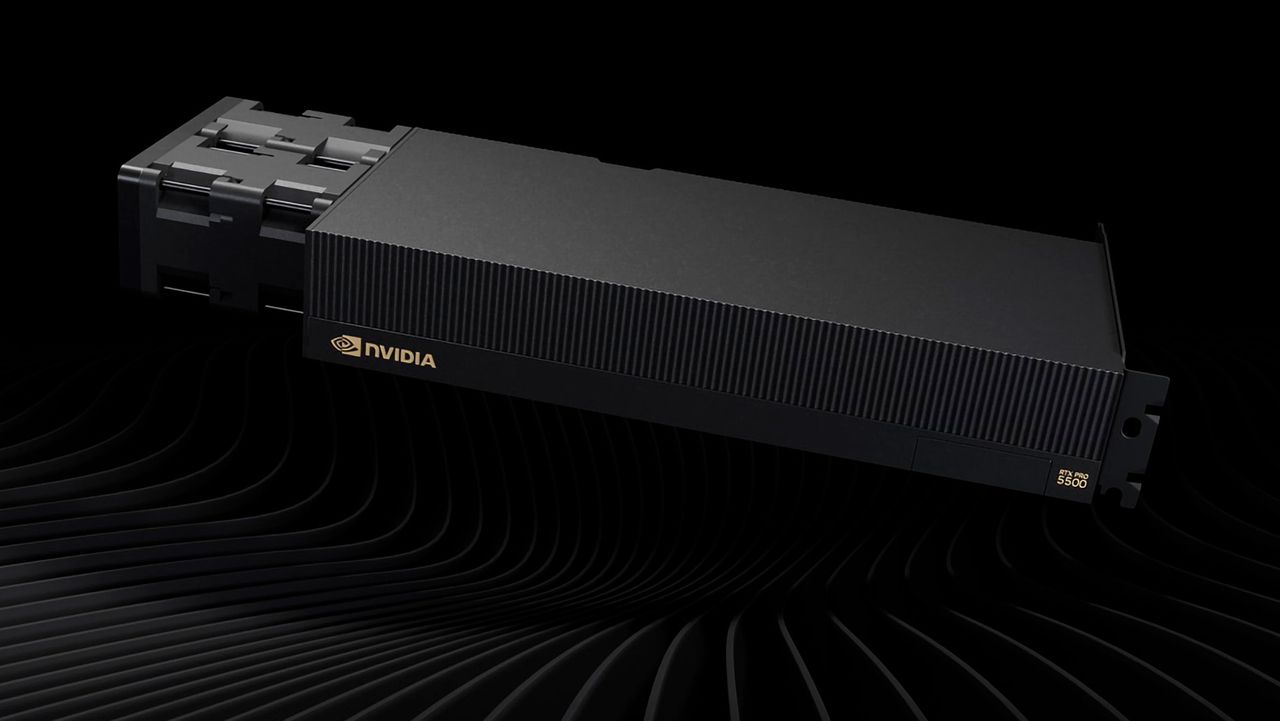
The GeForce RTX 5090 is undeniably one of the best graphics cards money can buy. Banking on the fact that many already use it for AI, Nvidia has bolstered it with even more memory and launched it as the new RTX 5500 Pro Blackwell Workstation Edition. It offers comparable specifications to the GeForce RTX 5090 but distinguishes itself with 84GB of GDDR7 memory, 2.6X more than the Blackwell gaming flagship.
The RTX Pro 5500 features the GB202 silicon, the powerhouse die that powers other high-end mainstream and professional Blackwell graphics cards, including the GeForce RTX 5090, RTX Pro 6000, and RTX Pro 5000. In fact, the RTX Pro 5500 uses the same die as the GeForce RTX 5090, which means 170 Streaming Multiprocessors (SMs) are enabled out of a possible 192. As a result, the RTX Pro 5500 has 21,760 CUDA cores and offers performance comparable to the GeForce RTX 5090. The differentiator is the memory subsystem, where the RTX Pro 5500 excels.
Nvidia equipped the RTX Pro 5500 with 84GB of GDDR7 memory. This is the second time Nvidia has launched a graphics card with 84GB of memory, with the first being the China-exclusive RTX Pro 6000D. The RTX Pro 5500's memory capacity lets the Blackwell graphics card sit comfortably between the RTX Pro 5000 and the upgraded RTX Pro 6000, with 72GB and 96GB of GDDR7 memory, respectively.
Nvidia RTX Pro 5500 Workstation Edition Specifications
Graphics Card
RTX Pro 6000
RTX Pro 6000D
RTX Pro 5500
RTX 5090
RTX Pro 5000
Architecture
GB202
GB202
GB202
GB202
GB202
Process Technology
TSMC 4N
TSMC 4N
TSMC 4N
TSMC 4N
TSMC 4N
Transistors (Billion)
92.2
92.2
92.2
92.2
92.2
Die size (mm^2)
750
750
750
750
750
SMs
188
156
170
170
110
CUDA Cores
24,064
19,968
21,760
21,760
14,080
Tensor Cores
752
624
680
680
440
Ray Tracing Cores
188
156
176
176
110
Boost Clock (MHz)
2,617
2,430
?
2,407
2,617
VRAM Speed (Gbps)
28
25
25
28
28
VRAM (GB)
96
84
84
32
48 / 72
VRAM Bus Width
512
448
448
512
384
L2 Cache
128
128
96
96
96
Render Output Units
192
192
192
176
176
Texture Mapping Units
752
624
680
680
440
TFLOPS FP32 (Boost)
126.0
97.04
?
104.8
73.69
Bandwidth (GB/s)
1,792
1,400
1,398
1,790
1,344
TBP (watts)
600
600
600
575
300
Nvidia achieved the 84GB memory capacity by outfitting the RTX Pro 5500 with 28 GDDR7 memory chips in a clamshell configuration. Each side of the PCB houses 14 24Gb (3GB) GDDR7 memory modules. They run at 25 Gb/s across a 448-bit memory interface, delivering up to 1,400 GB/s of bandwidth, which aligns with Nvidia’s official specification of 1,398 GB/s. In other words, the RTX Pro 5500 shares the same memory subsystem as the RTX Pro 6000D.
Samsung, Micron, and SK hynix only produce standard 28 Gb/s memory packages. Therefore, Nvidia downclocks the RTX Pro 5500's GDDR7 chips for its own reasons, whether to meet thermal and power targets or avoid cannibalizing higher-tier SKUs. From a memory-bandwidth perspective, the RTX Pro 5500 is not particularly impressive. Its bandwidth is only 4% ahead of the RTX Pro 5000, and it lags 22% behind both the flagship RTX Pro 6000 and the GeForce RTX 5090, which fully leverage 28 Gb/s GDDR7 memory chips.
To sum it all up, if RTX Pro 6000D and GeForce RTX 5090 had a child, it would be the RTX Pro 5500. Nvidia's main motivation was to launch the RTX Pro 5500 to fill the large performance and pricing gap between the RTX Pro 6000 and RTX Pro 5000. Also, the chipmaker makes substantially more profit by putting recycled GB202 into an RTX Pro 5500 than into a GeForce RTX 5090. By giving the former more memory with similar core specifications as the latter, Nvidia seemingly hopes to win more customers over to the RTX Pro 5500.
We reached out to both Nvidia and PNY for official pricing on the RTX Pro 5500, but neither company has responded. For reference, the flagship RTX Pro 6000 retails for $15,599, while an RTX Pro 5000 72GB starts at $9,209. Given the RTX Pro 5500's role as a bridge between the two models, it is reasonable to expect its launch price to fall somewhere within this range.
I spoke with Valve software developers Pierre-Loup Griffais and Jeff Leinbaugh about the Steam Frame launch, why the company is taking a two-pronged strategy with streaming and standalone support, and how the global memory/storage crunch affected development. You can read our review of the Steam Frame here, and the full transcript of our interview at Tom's Hardware Premium.
Nearly a year after first revealing the Steam Frame VR headset, Valve is now ready to deliver the finished product to paying customers. Reservations for the headset have opened today, three months after the launch of the Steam Machine.
Like the Steam Machine, the Steam Frame is launching amid absolute chaos in the tech industry. We're seeing higher prices across a wide range of PC hardware, especially memory and storage. Valve isn't operating in a vacuum, so those realities are reflected in the Steam Frame's pricing, which starts at $1,059.
I began by asking about the headset's genesis and the team's goals for creating a next-generation VR headset. "Work started on Steam Frame basically as soon as we shipped the Index," explained Leinbaugh. “And so we did a lot of exploration into technologies and features and use cases to try to answer that question. And the goals that we aligned on for what became the Steam Frame was to make [it] much easier to use, which to us meant a lighter, more comfortable, easier to get into and out of VR headset."
He added that with the previous Index headset, Valve was so laser-focused on making the best VR headset possible at the time that they made a lot of compromises to achieve those goals. And in many ways, those compromises were worth it to achieve their end goal. However, that strategy shifted with the Steam Frame.
"But this time around we thought we could achieve something that was a lot more comfortable, a lot more accessible. And so streaming technology was a big part of that. So the headset can be wireless so that there's not a lot of complicated setup to get to the game, whether that's playing on the headset or streamed," Leinbaugh continued. "So what we want to be possible is for somebody to put on the headset, browse their Steam library, and then just pick something that they want to play and not worry about too much else."
Standalone gaming on the Steam Frame
One of the biggest changes with the Steam Frame is that it can work with a robust wireless link to your PC, or as a standalone device using the onboard Qualcomm Snapdragon 8 Gen 3 SoC. I asked about the challenges in developing such a lightweight headset that can easily switch between operating modes.
"Yeah, a lot of the engineering challenges were around making sure that we had the right kind of compute and enough compute on the headset to both support a really good streaming experience, but also to be able to run games on the headset," said Leinbaugh. "So we picked the Qualcomm 8650 chip. It had a lot of capability, but in order to make use of that, we had to solve a lot of engineering challenges around thermal management and power delivery. So really treating this like making a really capable PC that just happens to run this particular mobile hardware was how a lot of the engineers approached that problem."
He added that Valve has taken a lot of the know-how from the Steam Deck and Steam Machine to give users the same SteamOS, but this time leveraging the Arm hardware along with Proton for emulation.
However, the Steam Frame has limits when playing games directly on-device, given its mobile-centric SoC. “Sure, games that are trying to push the boundaries on the AAA stuff that's very graphically intensive," explained Griffais. "Most of those recent ones won't run very well because it's a smaller compute envelope, right?"
"But there's a ton of stuff that is coming out that is a great experience on the Steam Frame. For example, I think last week the Metal Gear Solid Collection Part 2 released. And, you know, MGS4 is a game that I haven't played in, I don't know, 20 years at this point, but it's great from there."
He added that many indie games will run just fine on the Steam Frame, along with older back-catalog AAA games (which are still enjoyable) that don't require the compute of more modern titles.
"So I think the point is that you're able to engage with your whole library, right?" said Griffais. "And then have kind of a similar thing as the Deck where you're going to try and figure out if some games are maybe a little bit below the bar in terms of what you would like for performance."
Half-Life Alyx has been the poster child for VR gaming in recent years, and Valve has taken steps to ensure that Steam Frame users can have a proper native gaming experience. “And we're doing the same for Half-Life Alyx, where we're doing a lot of work to support the Frame more natively and trying to remove performance barriers that are induced by some of the translation, the emulation there that you get on normal and modified PC games.,” said Griffais.
Streaming on the Steam Frame
While standalone gaming on the Steam Frame is possible, Valve designed the headset first and foremost as a streaming device. To that end, Valve has taken steps to optimize the networking stack and improve performance. One of those steps is implementing foveated streaming to reduce strain on network resources.
“So the Steam Frame has eye-tracking cameras on the inside of the headset that know where your eyes are looking. And when you have that, there's a lot of potential use cases, but the one that we're using most consistently is foveated streaming, which really means when you're streaming, especially VR content, there's a lot of video data that you have to send," Leinbaugh explained.
"But because we know with eye-tracking cameras what part of the image you're looking at at any time, we can refocus some of those resources to make sure that the important parts of the image are treated as like first-class bits. And then the rest gets kind of the last part of the resource pool, which is the part of the image that you can't see and you won't notice the image degradation."
By not treating every bit delivered to the headset the same, Valve can reap performance and image quality gains. "So it's the best analogy really is it's almost as if the part that you're looking at is using about 10 times as much bandwidth and encoding bit rate as it actually is for the entire image, because we just squished it all into that part that follows where you're looking."
(Image credit: Tom's Hardware)
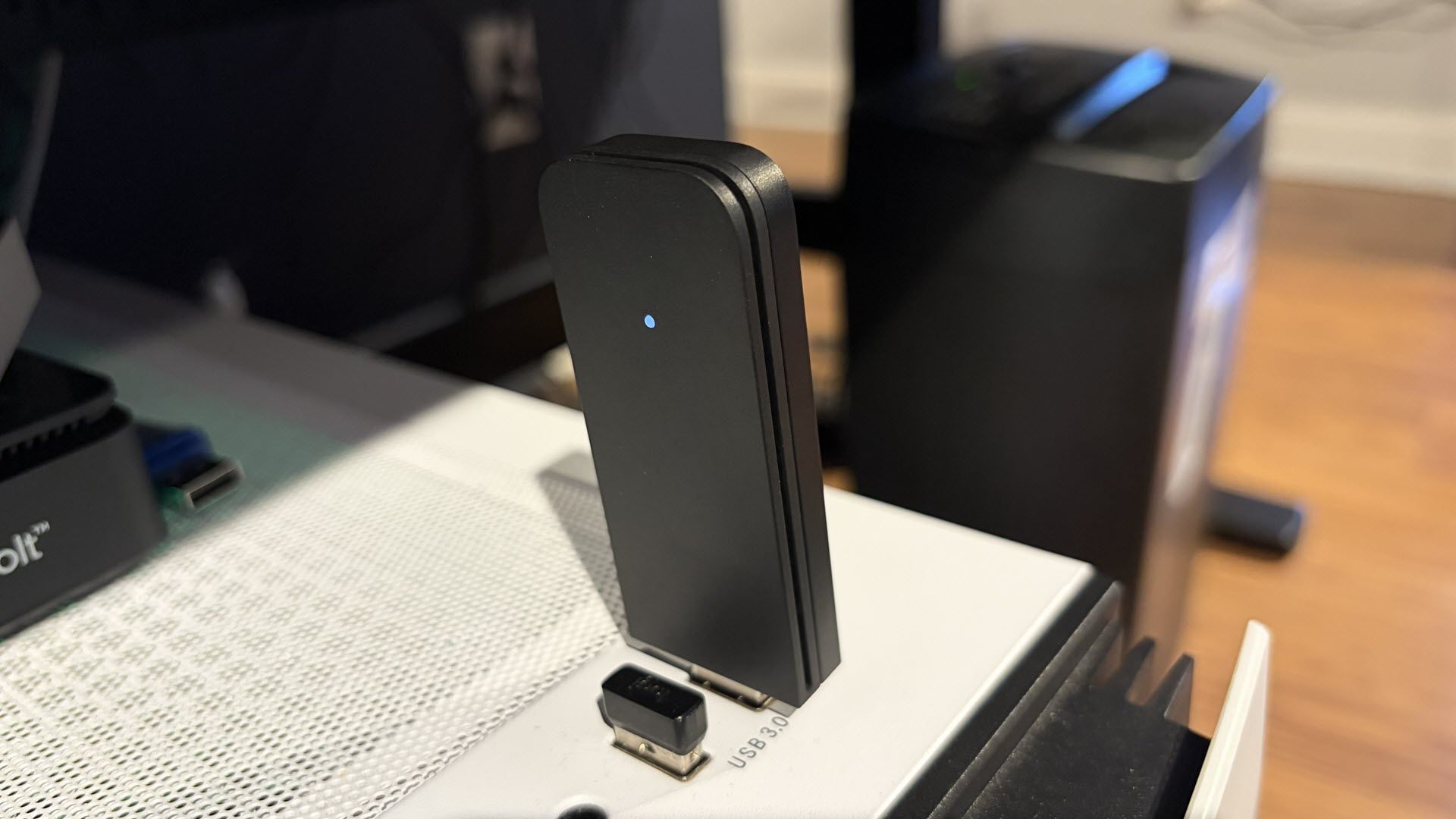
The Steam Frame communicates with your PC wirelessly using a dedicated Wi-Fi 6E USB dongle. Data transfers between the two happen over the 6 GHz channel for optimal performance. I inquired about how any disruptions/interference with that wireless link would affect gameplay.
“So there's a fallback mechanism built into that, which, if you have two links active and one of them drops out because of interference, or you walked out of range, or all the many reasons that wireless interference can happen," said Leinbaugh. "If something happens to one of those links, the other one will immediately pick up and cover the gap. And it's just very unlikely that a lot of those sources of interference will hit both links at the exact same time."
Other strategies can also step in; for example, if you have a latency spike, a previous frame can be "reprojected and replayed" to cover small gaps. For extended dropouts, there's no recovery method; the stream will fail, and you'll be booted to the default environment.
There are also other strategies that can step in; for example, if you have a latency spike, a previous frame can be "reprojected and replayed" to cover small gaps. For extended dropouts, there's no recovery method; the stream will fail, and you'll be booted to the default environment.
Pricing and availability
Pricing, of course, will be a big sticking point with the Steam Frame. Consumers got a bit of sticker shock with the Steam Machine given its hardware specs, and the Steam Frame will likely be no different. The Steam Frame starts at $1,069 for the 256GB SKU and costs $1,299 for the 1TB SKU.
"I think as far as memory prices and those kinds of conditions, we're really in it like everyone else," Griffais explained. "We've been working hard on trying to get the parts that we can get at the best price possible."
While all of us would love for memory and storage prices to fall to sane levels again, it will be a while before we see any relief. "It's an unfortunate situation all around. We wish that gaming hardware was cheaper, but we're definitely trying to be on the cheapest side that we can get despite all those conditions," Griffais explained.
But price increases aren't just limited to the likes of memory, as Griffais added, “Even just things like motherboards, copper, anything, even shipping anything worldwide right now is way more expensive than it was last year and two years ago. So every part of the sticker price is affected there."
The Steam Frame will be available starting September 14, and it will use a reservation system similar to that of the Steam Machine to cut down on scalpers.
Prior to the official launch of the Steam Frame, Tom's Hardware Premium had a chance to talk with Valve software developers Jeff Leinbaugh and Pierre-Loup Griffais. We discussed the development process behind the Steam Frame, the standalone and streaming modes, networking strategy, and pricing, which you can read in its entirely here. You can read our review of the Steam Frame here.
Like previous Valve launches, you can also read transcripts of our interviews with the company on the Steam Machine and Steam Controller.
The transcript below has been lightly edited for clarity.
Brandon Hill, Tom's Hardware: What were your goals in creating the Steam Frame and providing the framework necessary to support it, compared to legacy hardware like the Index?
Jeff Leinbaugh, Software Developer, Valve: Yeah, so the work started on Steam Frame basically as soon as we shipped the Index. And so we did a lot of exploration into technologies and features and use cases to try to answer that question. And the goals that we aligned on for what became the Steam Frame was to make [it] much easier to use, which to us meant a lighter, more comfortable, easier to get into and out of VR headset.
That was a better way to interact with your whole Steam library than the goals we had for the Index. Where the Index was just: we wanted to make the best possible VR headset that we could make. And that came with a lot of compromises, which were worth it because they allowed us to have this really great VR headset and see what that was capable of.
But this time around we thought we could achieve something that was a lot more comfortable, a lot more accessible. And so streaming technology was a big part of that. So the headset can be wireless so that there's not a lot of complicated setup to get to the game, whether that's playing on the headset or streamed.
And then the other big part of that accomplishing that goal was making it possible to interact with Steam just like you would on a Steam Deck and to be able to play games that don't even support VR in a virtual display. So what we want to be possible is for somebody to put on the headset, browse their Steam library, and then just pick something that they want to play and not worry about too much else.
And that's kind of where all the user experience goals, at least, came from around this. And then there's a lot of other technical goals that support that we can get into if you're interested in any of those.
Hill: So, that leads into my next question: what were the engineering challenges in making the Steam Frame a standalone device and one that can also stream? And I know you've got the wireless dongle to help with the networking offload.
Leinbaugh: Yeah, a lot of the engineering challenges were around making sure that we had the right kind of compute, and enough compute on the headset to both support a really good streaming experience, but also to be able to run games on the headset.
So we picked the Qualcomm 8650 chip. It had a lot of capability, but in order to make use of that, we had to solve a lot of engineering challenges around thermal management and power delivery.
So really treating this like making a really capable PC that just happens to run this particular [...] mobile hardware was how a lot of the engineers approached that problem.
And then from there, we kind of tied that into a lot of the work that we did for Steam Deck and Steam Machine running Steam OS now on ARM, but it's the same Steam OS.
So at some point we got to kind of meet in the middle and leverage Proton and Steam OS and a lot of things there to start getting games running.
(Image credit: Tom's Hardware)
Standalone mode & software support
Hill: And what kind of performance levels are you targeting for games using the Steam Frame when it's in the standalone mode?
Pierre-Loup Griffais, Software Developer, Valve: I guess it's hard to pinpoint a specific segment there because there are so many games on Steam that keep coming out that are running great on there, right? Sure, games that are trying to push the boundaries on the AAA stuff that's very graphically intensive. Most of those recent ones won't run very well because it's a smaller compute envelope, right?
But there's a ton of stuff that is coming out that is a great experience on the Frame. For example, I think last week the Metal Gear Solid Collection Part 2 released. And, you know, MGS4 is a game that I haven't played in, I don't know, 20 years at this point, but it's great from there.
And even at the higher resolution, 60 FPS is locked. So it's really cool to see games that are coming out right now that are great experiences on there. I think there's a ton of indie games and things that run really well too. And if you go down the back catalog, there's a ton of stuff from a little bit ago, even AAA stuff that runs great as well.
So I think the point is that you're able to engage with your whole library, right? And then have kind of a similar thing as the deck where you're going to try and figure out if some games are maybe a little bit below the bar in terms of what you would like for performance. And then off to stream those from another PC instead, or the Steam machine.
Hill: And building on that, how's the reception been to the Steam Frame Verify program from developers for the standalone games?
Griffais: I mean, I think we have a lot of developers that are pretty eager to get their games working well. And so we've seen it approached from different ways. Some folks do tweaks to their existing PC version and then get to a very good point with that.
But just the same kind of tweaks as you would expect from Steam Deck, where some surface-level tweaks for the user experience, like changing controller bindings a little bit or changing default settings in a way that really makes the game better for everyone and not just for Steam Frame.
And we're doing the same for Half-Life Alyx, where we're doing a lot of work to support the Frame more natively and trying to remove performance barriers that are induced by some of the translation, the emulation there that you get on normal and modified PC games.
And that's yielding great results to get to the next level of performance there. And so we expect that some developers will be doing some of that work or maybe adapting some of that existing work that they've already done on an Android version of their game and then adapting that through Lepton as well. So I think everyone's kind of engaging with it at a different pace there. But overall, I think like we're talking to a bunch of VR devs that are excited to get their games to be labeled as verified or playable.
Foveated streaming and technical hurdles
Hill: Could you go into a little more detail on foveated streaming and how it enhances the gaming experience with Steam Frame?
Leinbaugh: Yeah, so the Steam Frame has eye-tracking cameras on the inside of the headset that know where your eyes are looking. And when you have that, there's a lot of potential use cases, but the one that we're using most consistently is foveated streaming, which really means when you're streaming, especially VR content, there's a lot of video data that you have to send.
And so you're therefore very sensitive to how much available bandwidth that you have available for not just transmitting it over a wireless link, or whatever kind of link, but also just encoding and decoding that data. All of that takes from a pool of finite resources and your network stack or your graphics card.
But because we know, with eye-tracking cameras, what part of the image you're looking at at any time, we can refocus some of those resources to make sure that the important parts of the image are treated as first-class bits. And then the rest gets the last part of the resource pool, which is the part of the image that you can't see, and you won't notice the image degradation.
So instead of kind of evenly focusing all of the encoding and network resources around this entire immersive, all-encompassing VR image where you're not seeing most of it, we make sure that the part that you're looking at is encoded differently in a way that's a much, much higher equivalent bit rate.
So the best analogy really is [that] it's almost as if the part that you're looking at is using about 10 times as much bandwidth and encoding bit rate as it actually is for the entire image, because we just squished it all into that part that follows where you're looking.
(Image credit: Tom's Hardware)
Hill: Switching gears slightly, how are you compensating for temporary losses in connection or signal strength when gaming wirelessly? Is there a fallback mechanism?
Leinbaugh: Yeah, there are a few different levels of what we'll do, and we've made sure to do something in response to all these things happening. So the first thing is if you're using the wireless adapter, if you also are connected to your home WiFi, for example, which a lot of people just naturally will be, then the streaming, VR streaming will take advantage of both of those connections.
And so you'll have the adapter and your WiFi both active at the same time; we call it multi-link streaming. And what that means is that those two connections are competing against each other constantly, every single packet.
So there's a fallback mechanism built into that, which, if you have two links active and one of them drops out because of interference, or you walked out of range, or all the many reasons that wireless interference can happen. If something happens to one of those links, the other one will immediately pick up and cover the gap. And it's just very unlikely that a lot of those sources of interference will hit both links at the exact same time. So that's kind of the first line of defense that we have.
If you still don't, if you still have an interruption or maybe you only have one link active, then the headset has strategies to fill in those gaps. So if you have a short interruption, just like a latency spike or something, then a previous frame will get reprojected and replayed. And that works pretty convincingly for covering small gaps like that.
A lot of people won't even notice that it's happened. If you have an extended dropout where the video is just not arriving at all for whatever reason, then at that point, the video stream is not going to recover.
If it's a very extended dropout, but the headset will fade you back into the construct environment so that you're at least not getting stuck with a really unexpected experience or something that might confuse you or disorient you.
So the worst-case scenario is you'll just kind of fall back to the default environment and have a chance to either wait for it to recover or do something. Maybe you unplugged your Wi-Fi router or something that you need to go do.
Pricing and market conditions
Hill: When the Steam Machine arrived, there was a little bit of sticker shock with the price when it launched. And the Steam Frame is also around $1,000, close to $1,300 bucks in top trim. Surely Valve is sensitive to the realities of the marketplace with RAM and storage prices. How do you appease the gamers out there that are begging for some relief in hardware pricing?
Griffais: Oh, yeah, I think as far as memory prices and those kinds of conditions, we're really in it like everyone else. Like, there's not really anything special that we can do.
We've been working hard on trying to get the parts that we can get at the best price possible. But I think everyone's affected. [...] The fact that our price was affected by that compared to what we were hoping for is definitely true. But I'd say that it's trending along the reality of the market. And there's not really any sort of the kind of distortion compared to just the price of the parts in there.
And it's an unfortunate situation all around. We wish that gaming hardware was cheaper, but we're definitely trying to be on the cheapest side that we can get despite all those conditions.
It's not just memory and all that too, right? Even just things like motherboards, copper, anything; even shipping anything worldwide right now is way more expensive than it was last year and two years ago. So every part of the sticker price is affected there.
Hill: Final question: Are you planning to implement the same reservation system that you used for the Steam Machine with Steam Frame?
Valve has been ramping up its hardware releases during 2026, with the Steam Controller launching this past spring, followed by the Steam Machine earlier this summer. The 2026 hardware onslaught is now culminating in the Steam Frame, the company’s latest headset aimed at VR and non-VR gaming.
Rather than being a streaming-only platform, like the preceding Valve Index, the Steam Frame has a powerful onboard Qualcomm Snapdragon 8 Gen 3 and up to 1TB of internal storage to play standalone games without the need for a PC. It’s an ambitious headset, which comes with an equally ambitious $1,000+ price tag.
Design and Comfort of the Valve Steam Frame
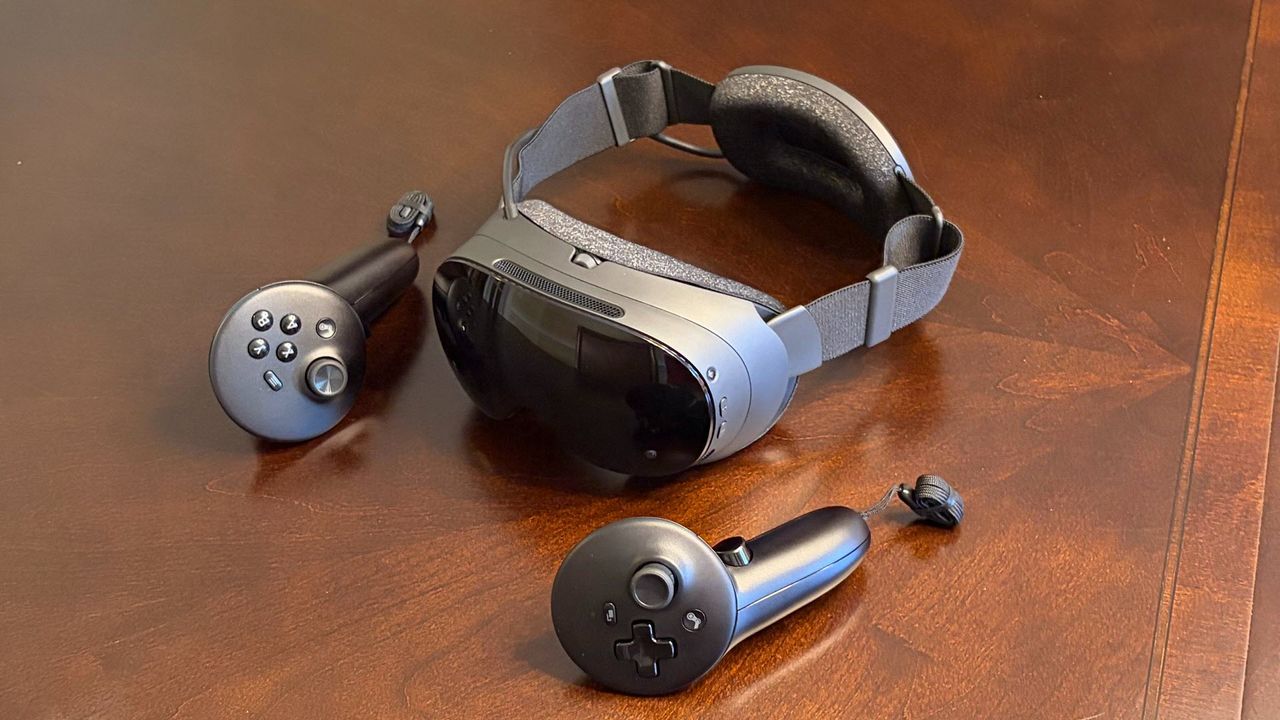
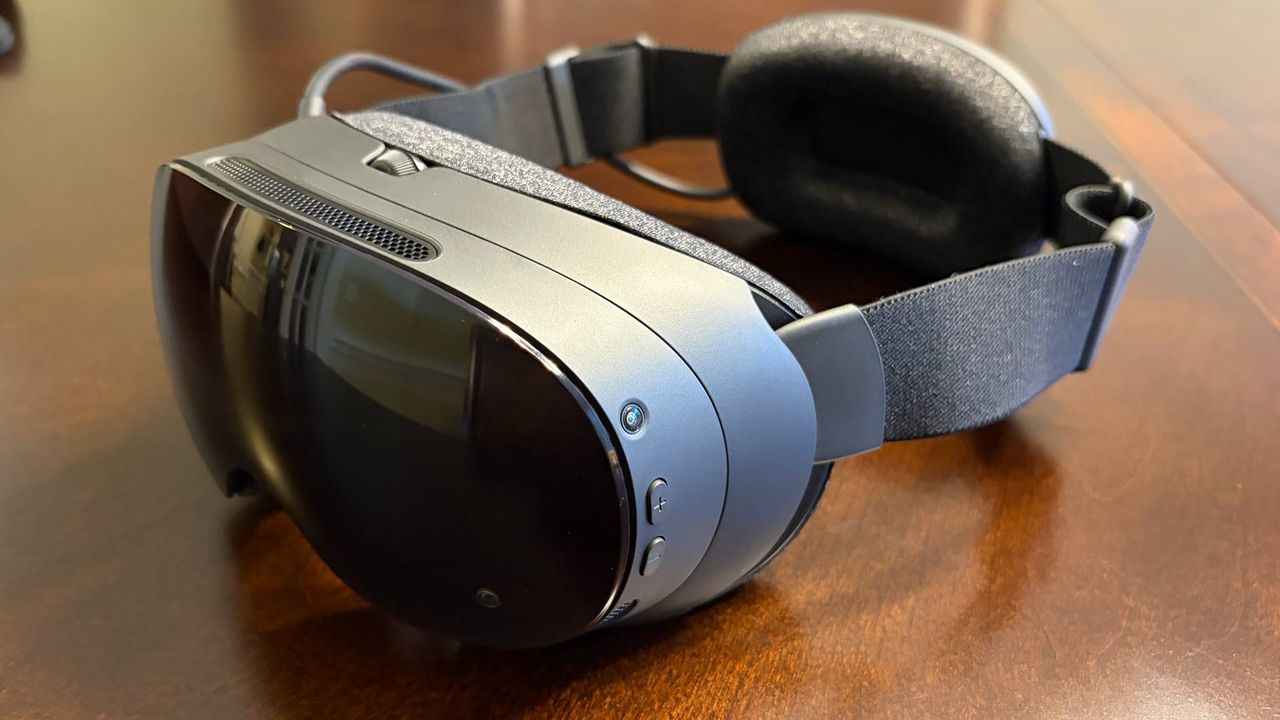
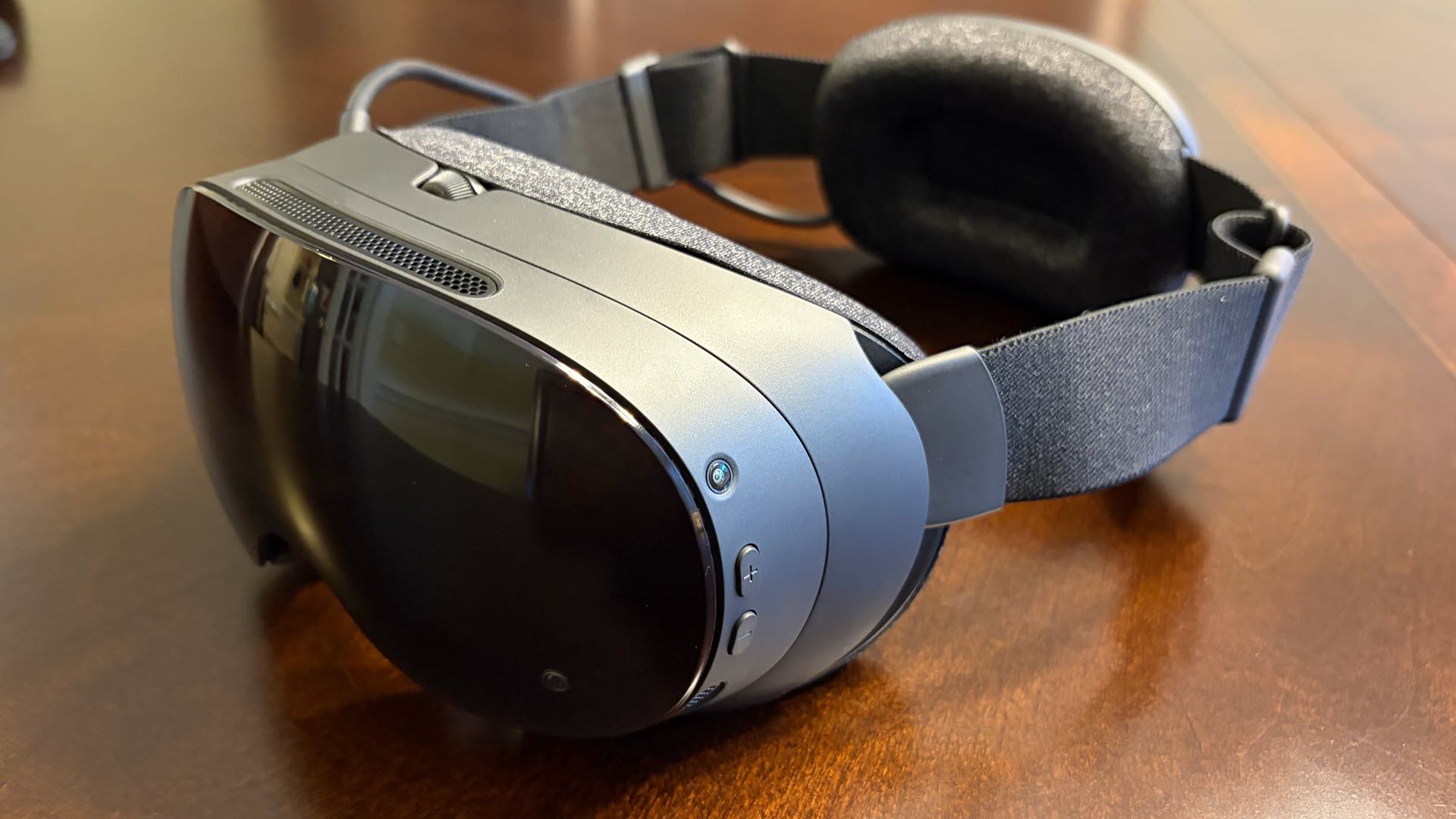
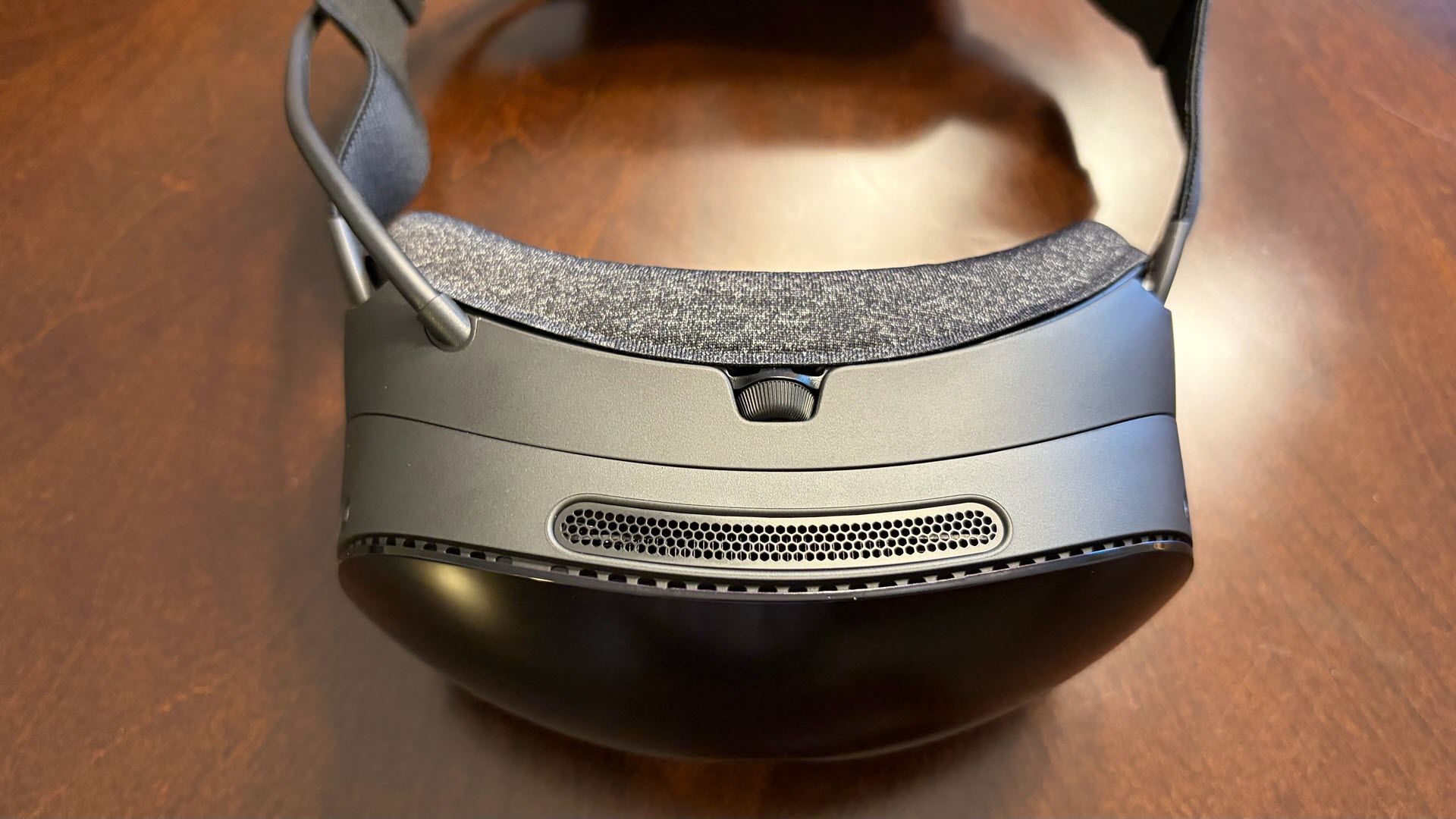
At first glance, the Steam Frame reminds me of oversized ski goggles, compared to the Daft Punk style of the preceding Valve Index headset. The overall design feels very organic, with soft curves and thin plastic to keep weight down. The thinner plastic drastically reduces weight compared to the Index (440 grams with the headstrap versus 809 grams for the Index).
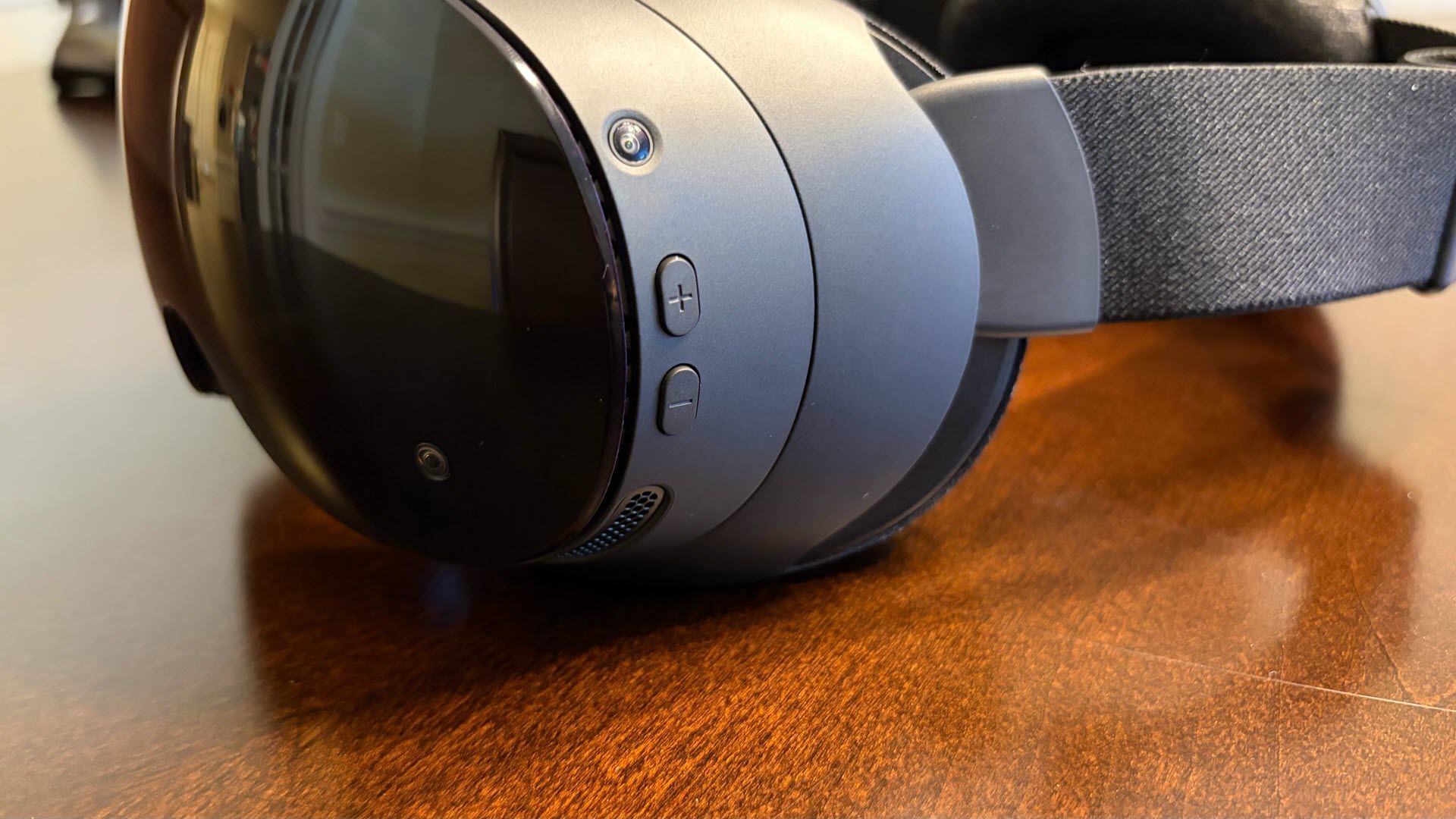
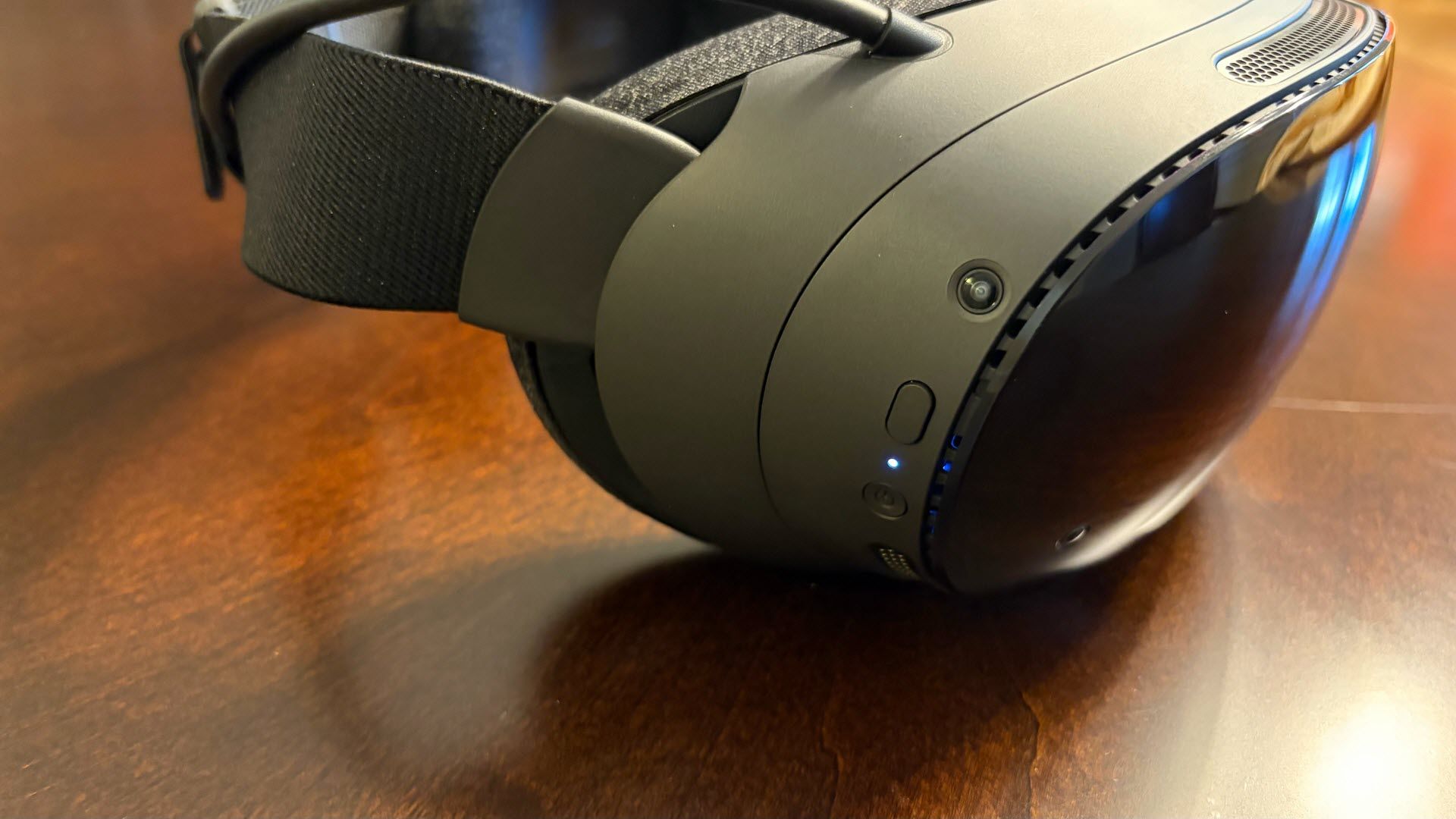
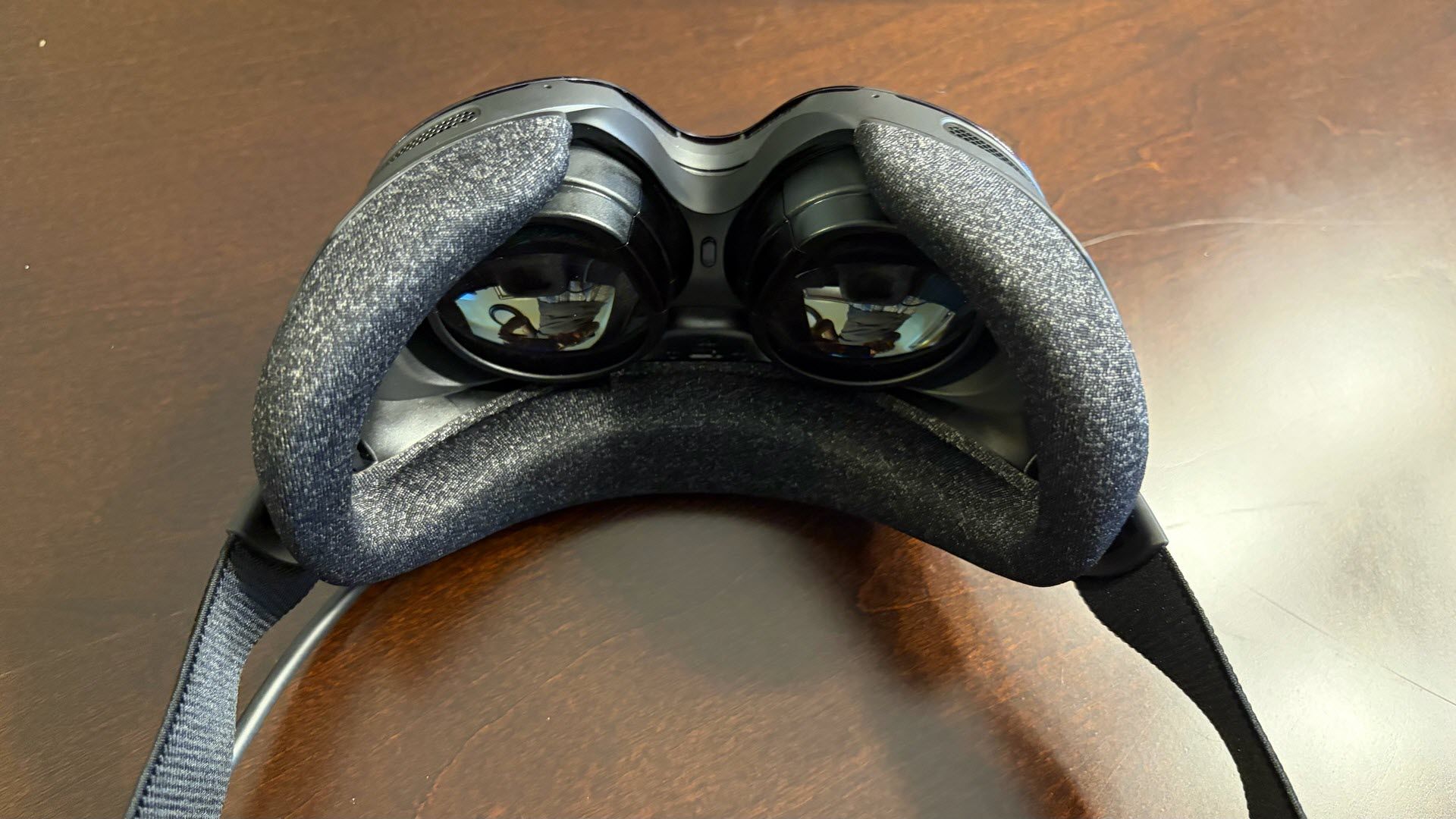
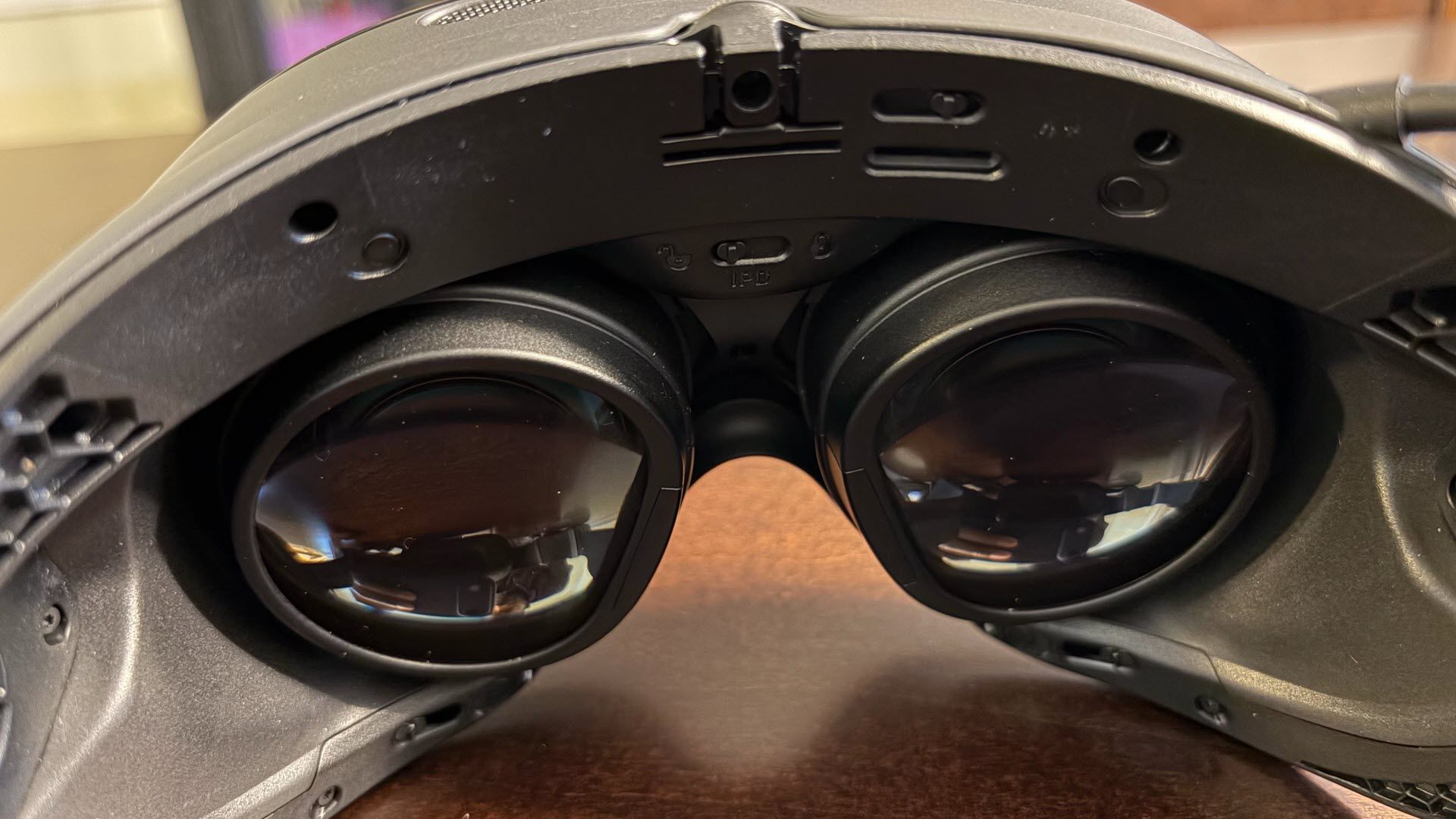
Two forward-facing cameras (which provide a monochrome passthrough of your environment) sit near the bottom of the front cover, while two additional cameras sit on the side of the Steam Frame, facing sideways and slightly upward. Together, the four cameras provide headset and controller tracking. The final two cameras are internal for eye-tracking purposes. The main unit also houses a cooling fan that helps remove warm air from the Snapdragon SoC and keeps your head from sweating during extended gaming sessions.
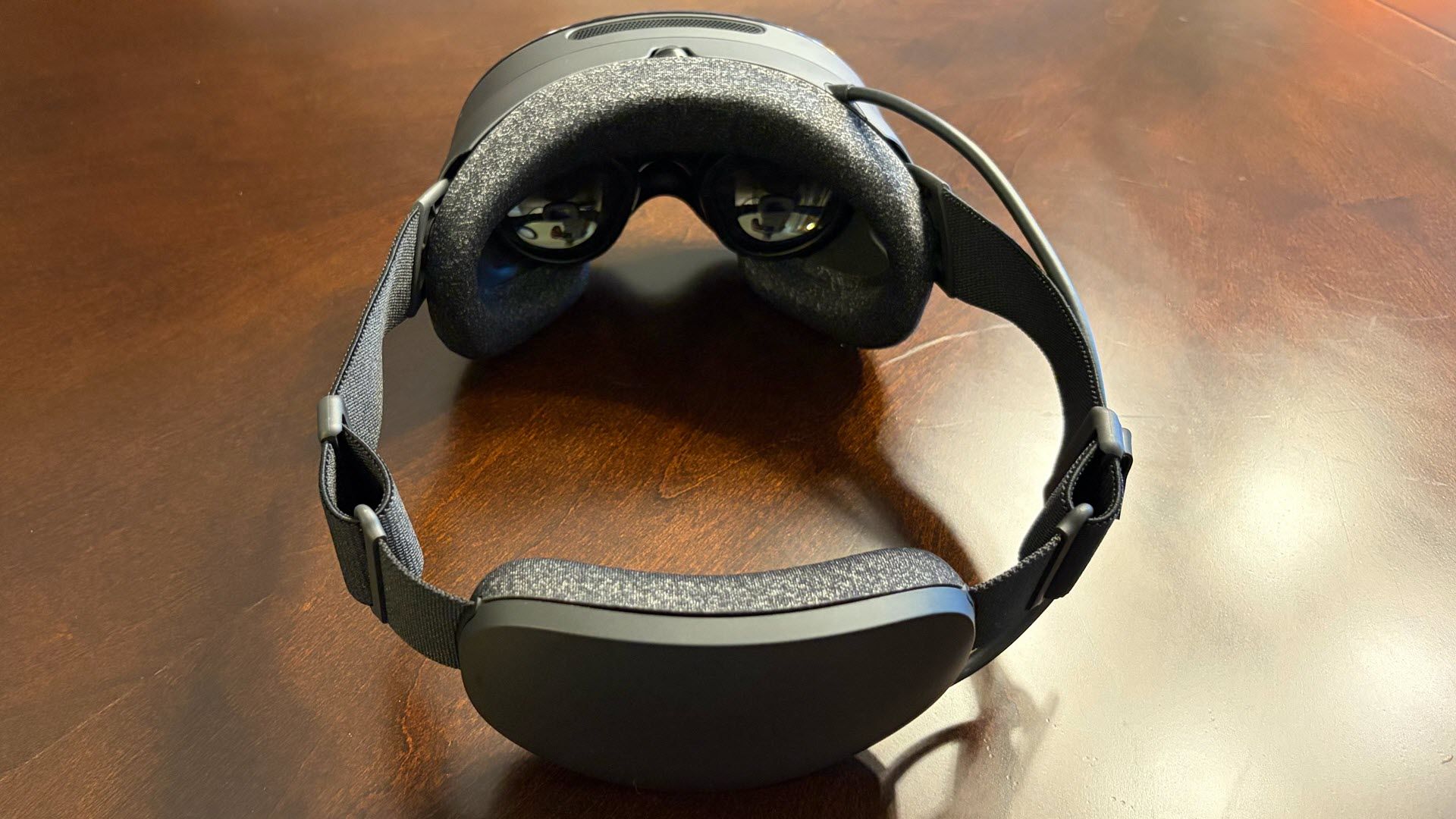
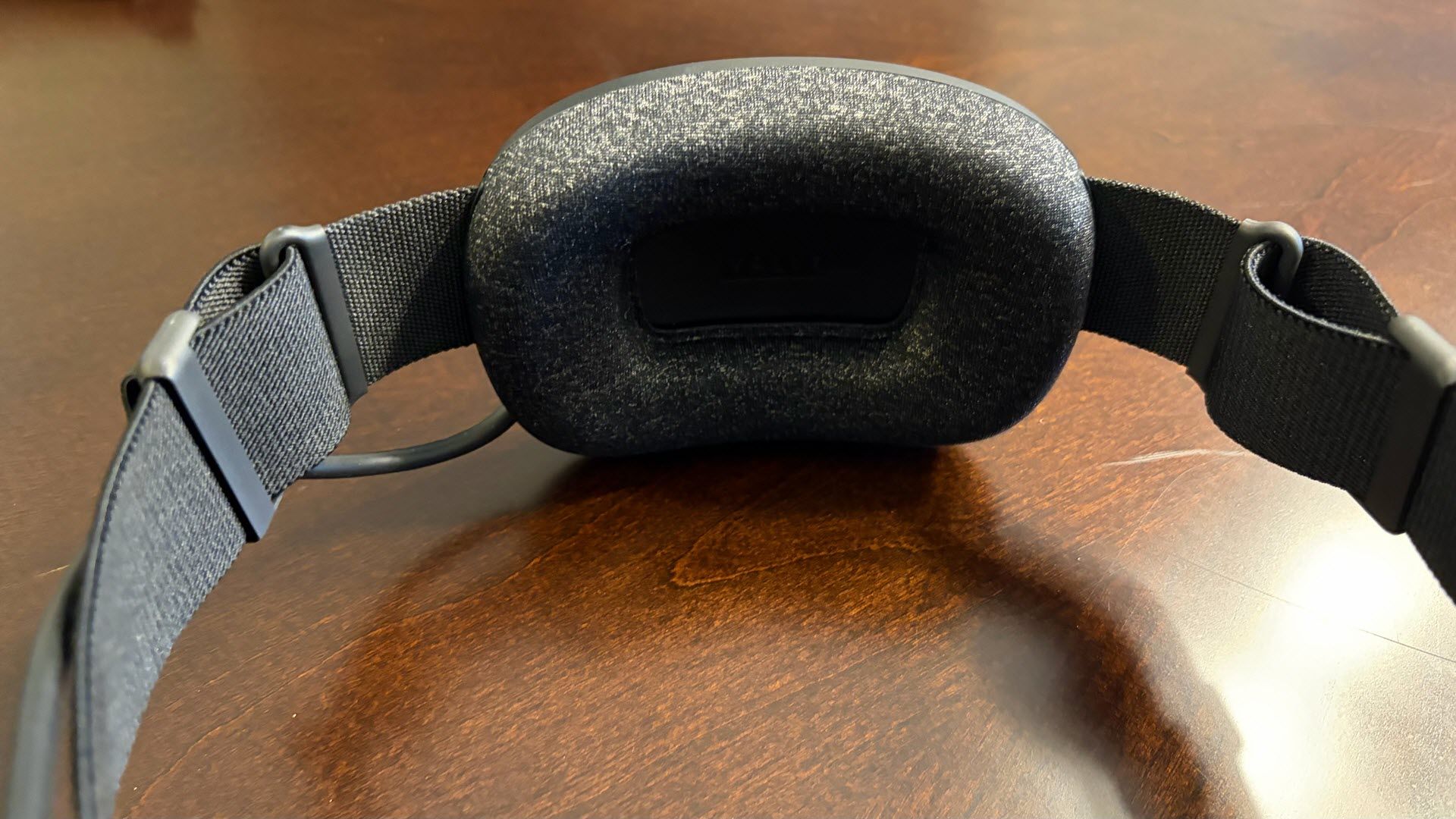
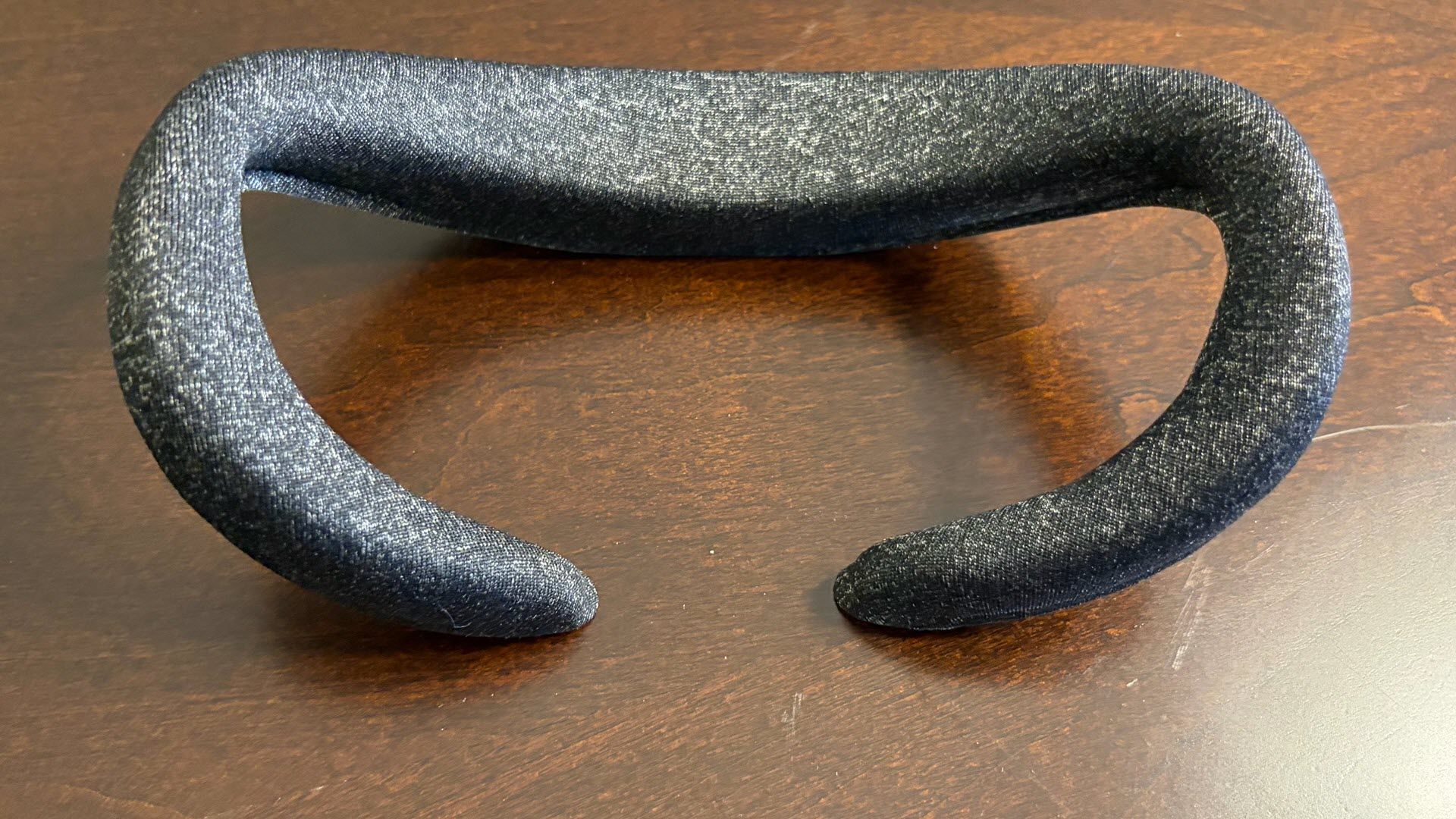
An expansion port for future features sits at the bottom front of the Steam Frame, just ahead of where the headset rests on your nose. An interpupillary distance (IPD) adjustment knob sits at the top of the headset (ranging from 57.6 to 69.6 mm), while an IPD lock switch (to prevent accidentally hitting the dial when putting on or taking off the headset) is located inside the Steam Frame, directly above the proximity sensor. Although our review unit came with 1TB of internal storage, a microSD slot is available for further expansion behind the fabric-covered foam gasket that attaches magnetically.
On the right side of the Steam Frame, there are two buttons: Aux and Power. On the left side are volume up and volume down. The Steam Frame has four speakers, two on each side of the headset, positioned low just below the arm pivots for the adjustable strap. You can also use Bluetooth headphones/ear buds if you prefer.
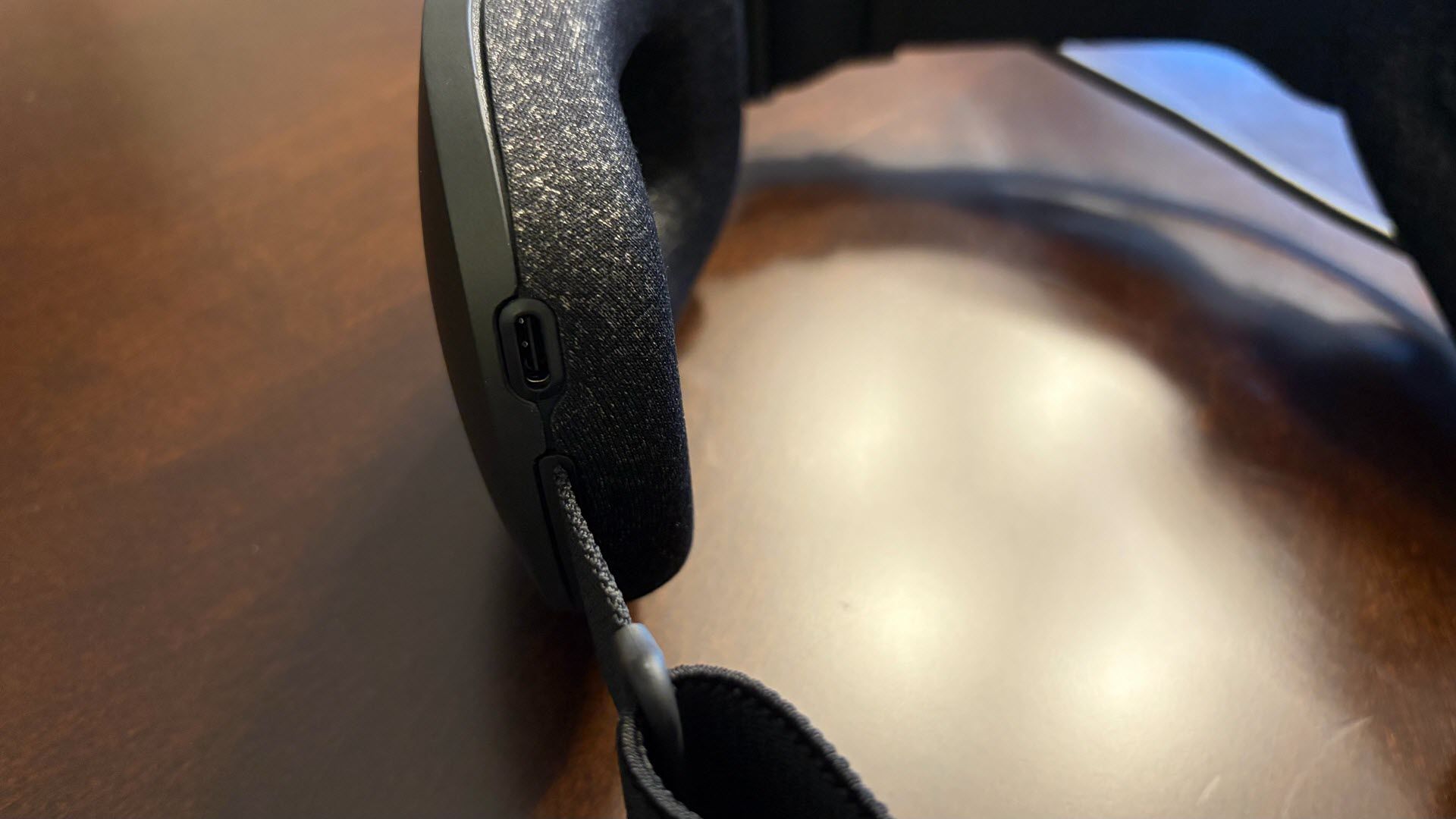
Speaking of the strap, I found it to be comfortable and highly adjustable. The straps attach to a padded restraint (which houses the 21.6 Whr battery) that cradles the back of your head. The Stream Frame's lightweight design, combined with the pressure-relieving front gasket and rear cradle, helped reduce fatigue after extended sessions (particularly with Half-Life: Alyx). Speaking of the rear cradle, I appreciate that the USB-C port for charging the Steam Frame is located here instead of on the front of the headset. This leaves the dangling cord behind, out of the way (if you want to charge the device while wearing it).
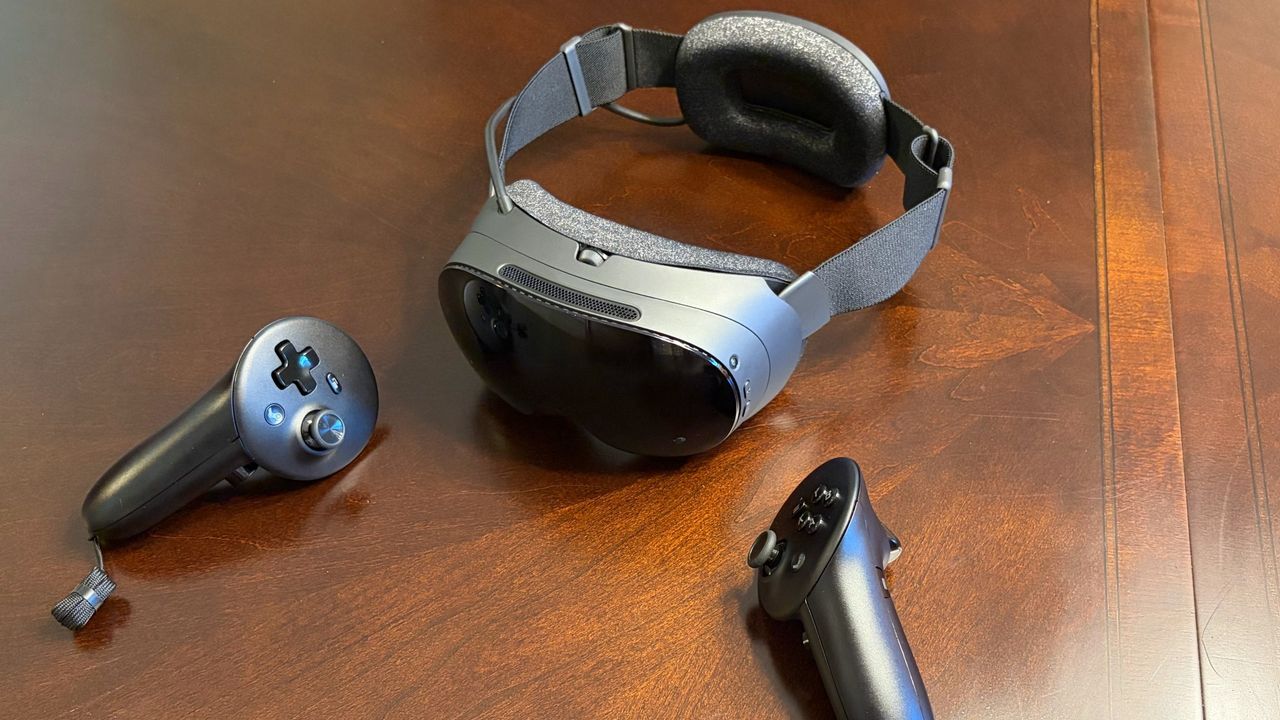
Our review unit came with the Steam Frame, two wireless hand controllers, a USB-C to USB-C cable, and the headstrap. Our kit also included a USB-C power adapter ($29). We also received the Ergonomic Accessories Kit ($59), which contains a headstrap for the Steam Frame, two hand straps for the controllers, and an extended light blocker gasket that fits on the underside of the headset to further reject ambient light. I personally didn’t feel that any of the additional items in the Ergonomic Accessories Kit were necessary to enhance my experience with the Steam Frame.
Valve Steam Frame Specifications
Display
2160 x 2160 per eye
Display Type
LCD
Refresh Rate
72 Hz to 120 Hz, 144 Hz (experimental)
Processor
Qualcomm Snapdragon 8 Gen 3
RAM
16 GB LPDDR5X
Storage
256GB or 1TB, microSD slot
Operating System
SteamOS 3 (Arch-based), KDE Plasma
Field of View
110 degrees horizontal
IPS Range
57.6 to 69.6 mm
Degrees of Freedom
6 DoF
Audio
Dual drivers per ear
Wireless Connectivity
Wi-Fi 7, Bluetooth 5.4 (Steam Frame), Wi-Fi 6E (Dongle)
Battery Life
1 to 4 hours
Weight (Headset + Strap)
15.52 ounces (440 grams)
Price
$1,299 as tested ($1,059 base)
Valve Steam Frame Controllers
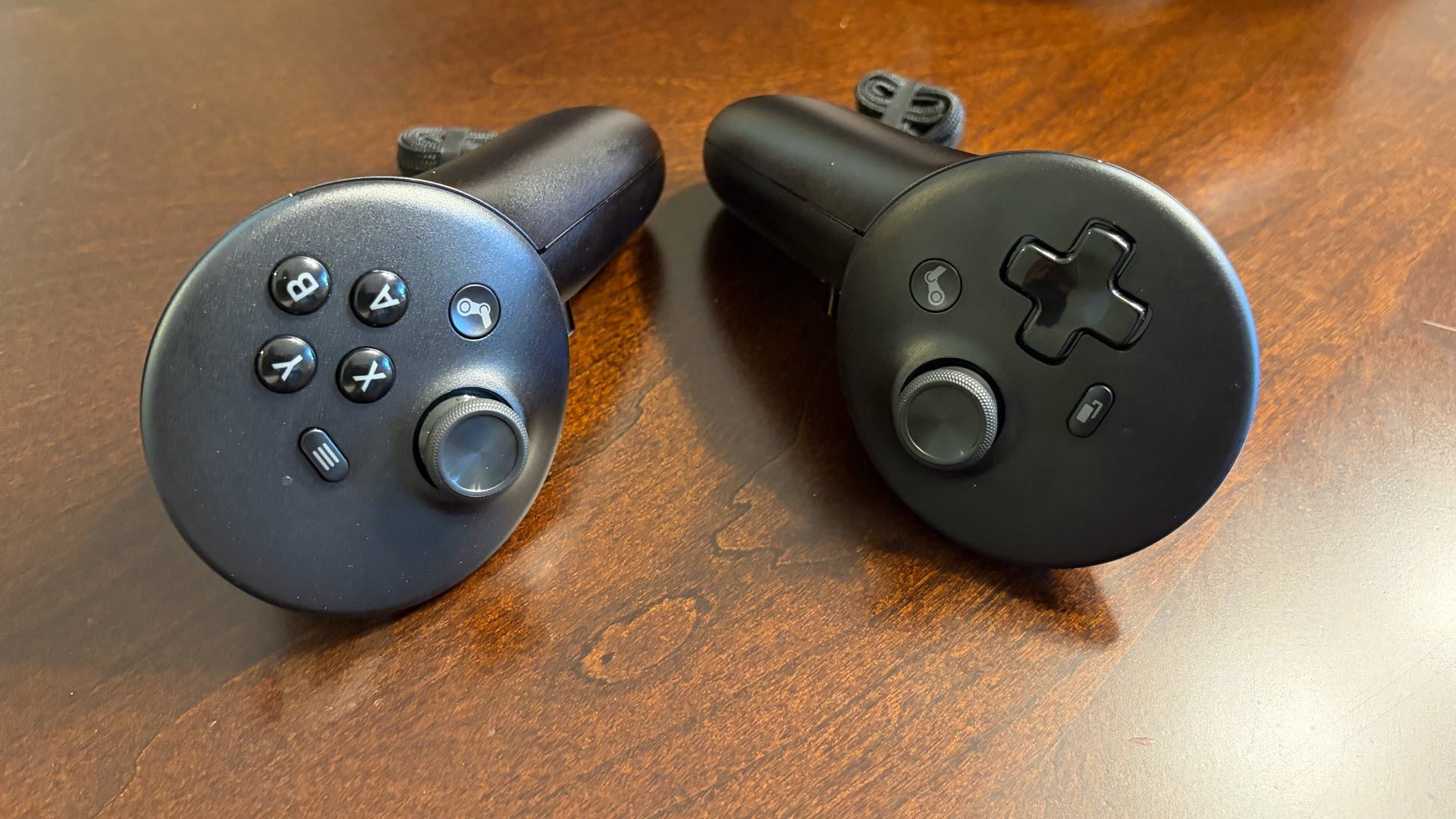
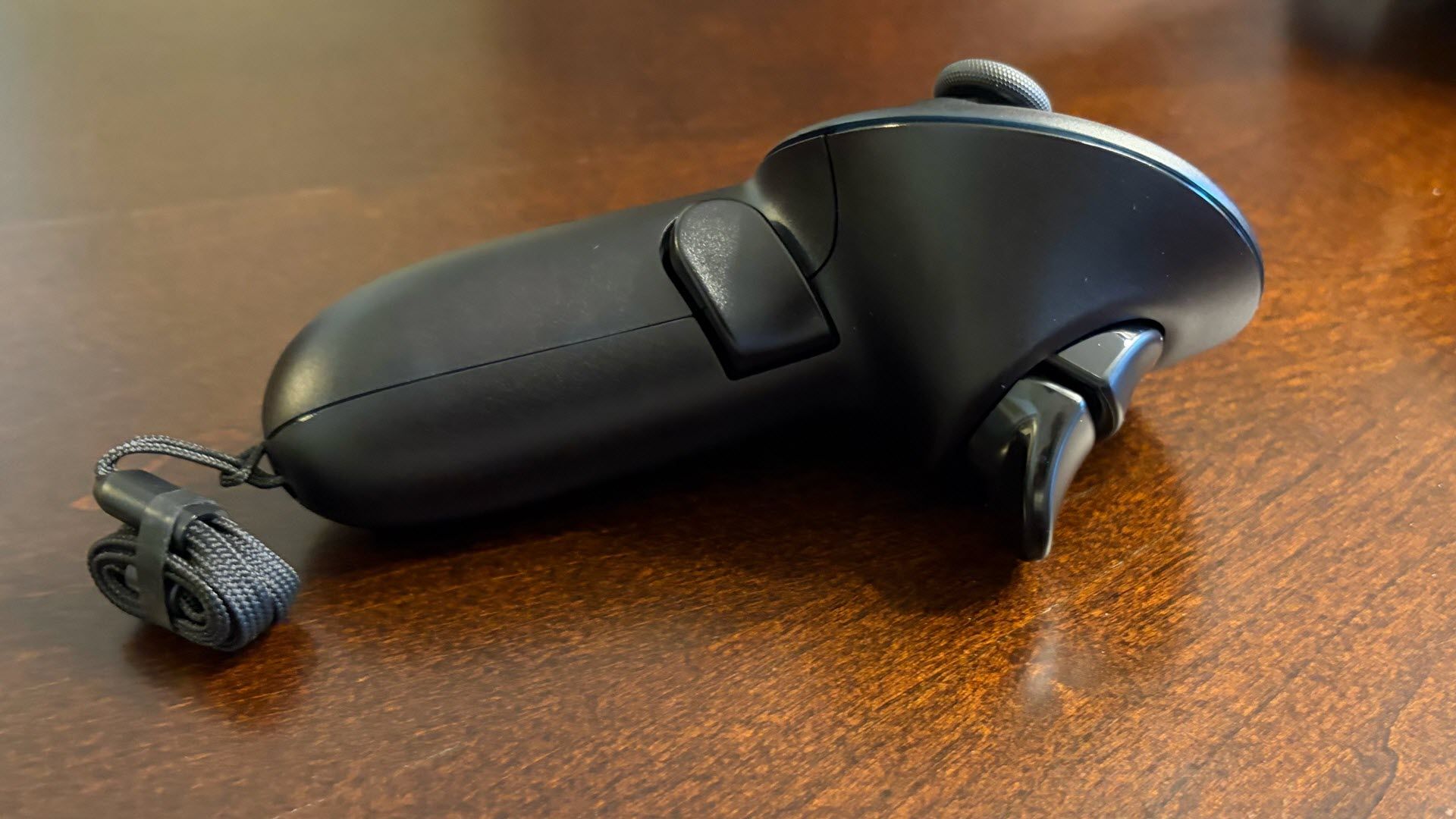
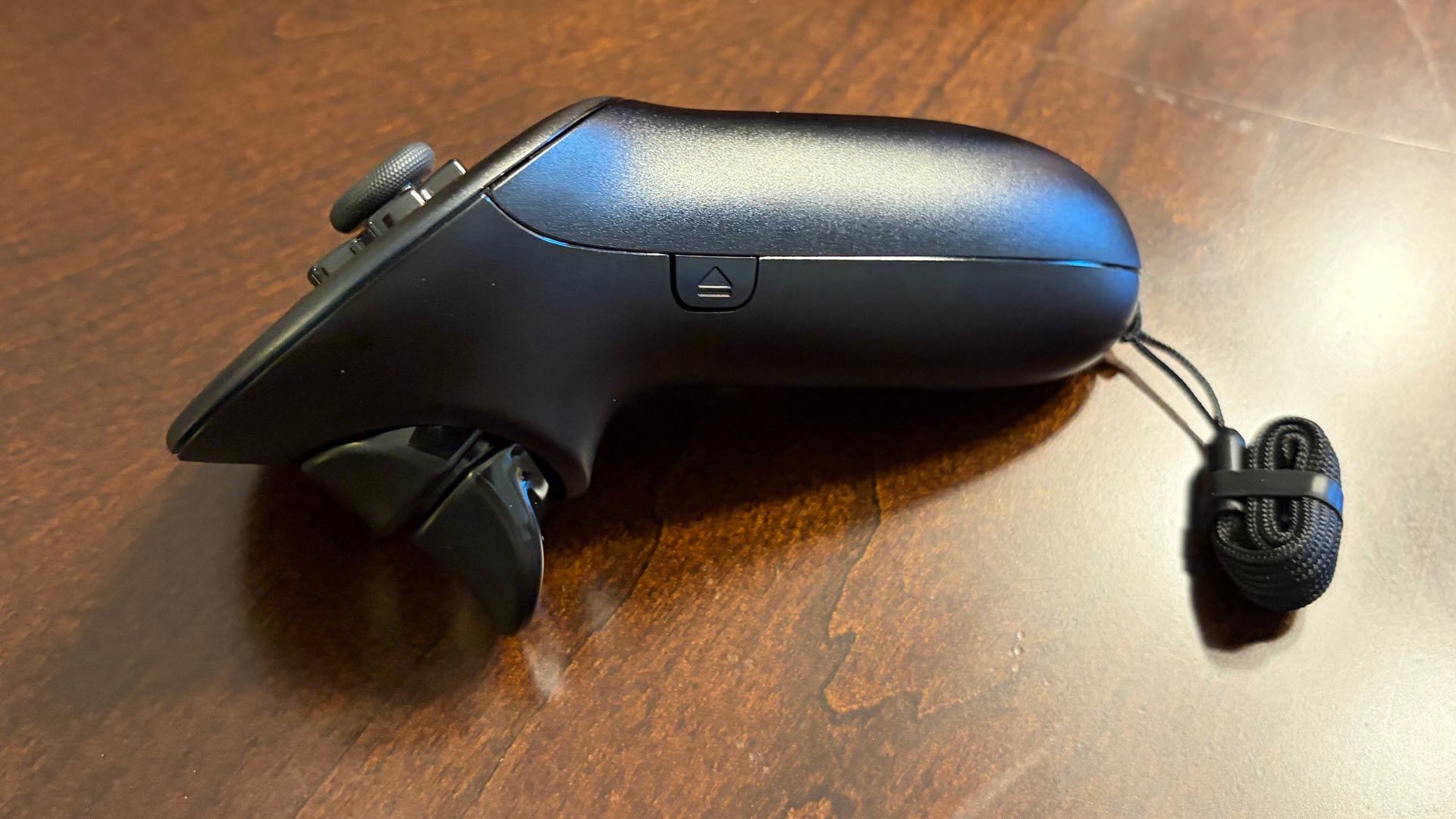
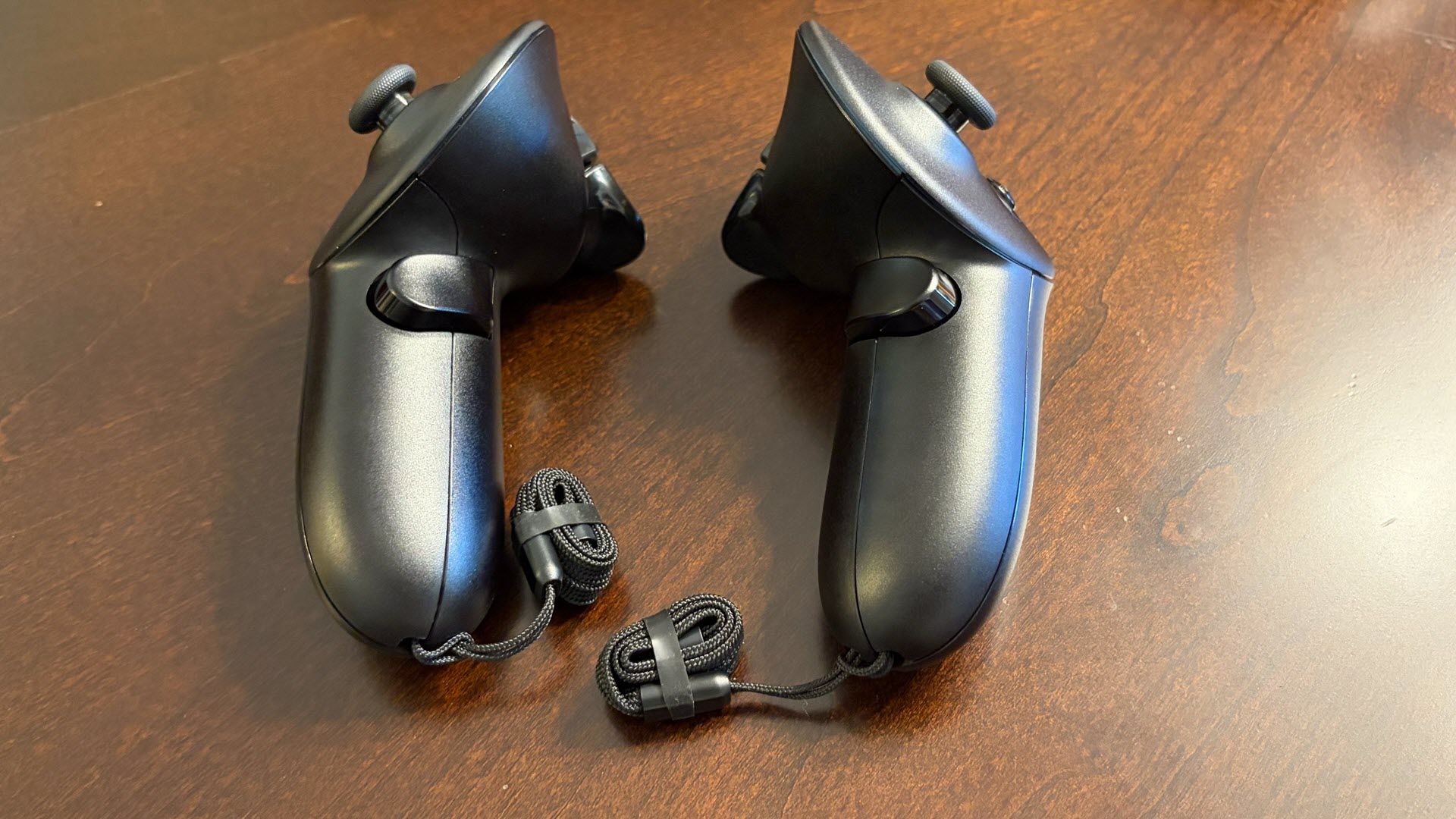
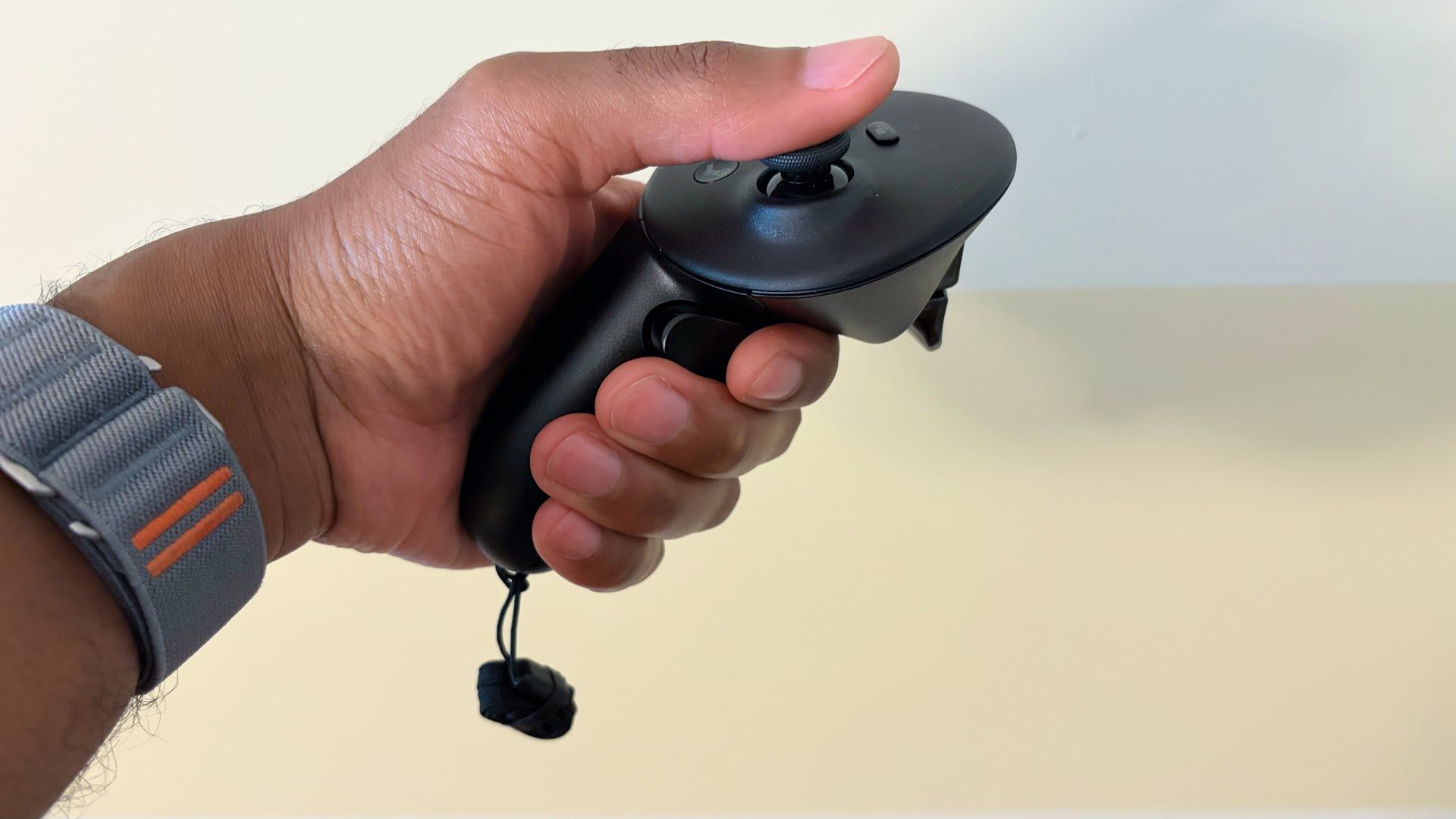
The Steam Frame comes with two wireless controllers that fit nicely in my hands. While the main body of the Steam Frame has a matte grey plastic finish, the controllers are made of shiny, textured black plastic. Each controller (which supports six degrees of freedom) features a dual-stage grip button, an analog trigger, a bumper, a Steam button, and a magnetic thumbstick with capacitive finger sensing. This is the same thumbstick that you’ll find on the Steam Controller used with the Steam Machine.
The right controller also has AXBY and Menu buttons. The left controller adds a View button and a D-pad. Both controllers feature a haptic motor and capacitive finger tracking. The controllers communicate directly with the Steam Frame using a dedicated Bluetooth wireless link.
Each controller is powered by a single AA battery, which Valve says lasts roughly 40 hours (a pair of AA alkaline batteries are preinstalled).
Valve Steam Frame Hardware
Valve designed the Steam Frame as a dual-purpose VR headset. It can stream games directly from your high-powered gaming PC, or it can work as a standalone headset (think Meta Quest series), thanks to its Qualcomm Snapdragon 8 Gen 3 Arm SoC and 16GB of unified LPDDR5X RAM. Although our review unit came equipped with 1TB of UFS onboard storage (further augmented by a microSD slot), a cheaper SKU with just 256GB of internal storage is available.
In standalone mode, the Stream Frame uses FEX emulation along with Proton to run x86 Windows games on ARM64 hardware.
However, for the best performance, you’re going to want to leverage your desktop PC and wireless connectivity for streaming games from Steam. The Steam Frame includes an integrated 2x2 Wi-Fi 7 radio, plus a standalone Wi-Fi 6E dongle that plugs into a free USB 3.0 port on your desktop or laptop. The dongle provides a low-latency link between your PC and the Steam Frame. Instead of clogging your wireless router’s bandwidth or adding unwanted lag, the direct wireless connection improves performance and reduces latency.
So, in essence, the Steam Frame takes a multi-pronged approach. The 5 GHz band primarily connects to your home network for internet, firmware updates, and software updates. The 6 GHz link, however, connects only to the wireless dongle. With that link, Valve can implement technologies like foveated streaming, which is an interesting (and much-needed) way to optimize data streaming across the network.
In short, foveated streaming uses the internal eye-tracking cameras to determine what part of a scene you’re viewing at any given time. Whatever is in your direct field of view gets full-resolution, full-priority data to improve image quality. Whatever is in your periphery, or not seen at all, gets lower priority and therefore comes through at a lower resolution. This saves bandwidth and helps to preserve as much performance as possible when streaming.
Just as important as the processing and networking hardware underlying the Steam Frame is its optics system. In this case, the headset uses dual LCDs, offering 2160 x 2160 resolution per eye. Valve opted for LCDs over micro-OLEDs to meet its design, performance, and cost targets. From what I've seen after spending over two weeks with the Steam Frame, it was a wise decision. Micro-OLEDs would have no doubt pushed the starting price of the Steam Frame even higher, as we’re certain that many folks will likely already be wary of the $1,059 base price ($1,299 as tested).
The displays can run as low as 72 Hz and as high as 144 Hz, though the latter mode is experimental right now. All of the games that I played on the Steam Frame defaulted to 72 Hz. The headset uses pancake lenses designed specifically for this use case, and offers a horizontal field of view (FoV) of up ot 110 degrees (a slight improvement over the 108 degrees on the Index).
Setting up the Valve Steam Frame
Setting up the Steam Frame was honestly about as low-impact as you can get with a VR headset. I first plugged the headset into the included wall charger and let it charge for about an hour. Once that was done, I ran through the initial setup, which involved logging into the Steam app on my smartphone to identify the Steam Frame. With that step complete, the setup process commenced, culminating in me installing the latest SteamOS update on the headset from the Stable channel.
(Image credit: Tom's Hardware)
On the desktop side, I plugged the Wi-Fi 6E dongle into a free USB port on my Windows 11 desktop, and it was automatically recognized and ready to use.
Valve Steam Frame Streaming Mode
I tried several games, streaming them to the Steam Frame. The perennial favorite, Half-Life: Alyx, was my go-to game to experience the full power of VR immersion from the headset. The PC rig that I used features a Core Ultra 7 265K processor, 32GB of DDR5-5600 memory, and a GeForce RTX 4060 Ti GPU. I had no trouble maintaining consistently high frame rates without dropping frames, which would be a serious hindrance in VR gaming.
Gunman Contracts “Stand Alone” was another game I tried; it offers quick, furious gunplay and sharp graphics. The game's concept reminded me of old-school arcade shooters from the 80s and 90s, where you used physical gun models to shoot at a display. However, Gunman Contracts “Stand Alone” advances that genre with total immersion and true hand/finger manipulation of objects. My only issue with the game is that the default smooth controls to move your character in the virtual environment physically made me feel sick. My body had a hard time adjusting to the movement because my physical body wasn’t moving forward or backward to match.
I also streamed non-VR games like Batman: Legacy of the Dark Knight, which played fine in Theater Mode. The game played on what vaguely resembled a movie theater screen, with a calming background filling the rest of the dead space around it. However, I couldn’t use the included Steam Frame controllers with a non-VR game, so I grabbed my trusty Xbox Series X wireless controller.
Other non-VR games I tried included BeamNG and Forza Horizon 6. Both games played without issue. The experience wasn’t nearly as all-encompassing as being dropped into a full VR environment, but it was preferable to sitting in front of a smaller physical monitor on my desk.
Valve Steam Frame Standalone Mode
Since the Steam Frame offers a standalone mode without needing a wireless “tether” to a PC, I tried three games promoted to work with the handset. The first game was a repeat of one I tried in streaming mode: Half-Life: Alyx. The game runs great on-device using ARM64 emulation, though I did notice some stutters and slight performance lags compared to streaming. Valve admits that there is a performance hit with x86-to-Arm translation, but it will vary depending on the game.
Two other standalone games tested were Stellar Café and Dungeons of Eternity. The former is a cartoonish game set in a cafe, where you can use your voice to interact with the in-game robots/characters who serve you beverages. The back-and-forth conversational flow is fun and engaging. In fact, the conversations almost seemed a little too real, with human-like responses and realistic commentary.
Valve Steam Frame Battery Life
The Steam Frame's battery life varies greatly depending on whether you’re streaming from your PC or playing games natively on the headset. For example, when I played Half-Life: Alyx directly on the Steam Frame at 72 Hz, I got about an hour of runtime before it died. However, when streaming, I could easily get more than double that amount at the same refresh rate, since the Arm processor isn’t taxed nearly as heavily.
I also saw a little over an hour of runtime with Gunman Contracts “Stand Alone” when running natively. Non-3D games like Forza Horizon 6 lasted for well over two hours when streaming from a PC.
However, even with the shorter runtimes with standalone play, battery life wasn’t an issue for me. I like to take a break from VR games at least every hour or so to have a reality “reset” and to give my brain a rest.
Bottom Line
I found the Steam Frame to be a versatile, enjoyable headset during my time with it. Weighing in at less than a pound, the headset is low-impact and comfortable to wear for hours on end. The foam padding around the headset provides a good seal against your forehead, and the weight is well balanced, partly because the battery sits at the back of your head.
Performance while streaming from a PC was excellent, while standalone gaming takes a hit due to the emulation required for the Snapdragon 8 Gen 3 Arm SoC. However, Valve is billing the Steam Frame as a streaming-first platform, so that shouldn't surprise you. Consider standalone gaming an added bonus if you want to have a quick VR gaming session when you’re away from your PC.
Valve also made some smart design choices, including wireless links between the Steam Frame and your PC via the Wi-Fi 6E dongle, monochrome passthrough to help you orient yourself when wearing the headset, and adjustable IPD to accommodate a wide range of faces.
However, what will make or break the Steam Frame is its price, which starts at $1,059. That’s a tall order in this economic climate, when gamers are already being assaulted from multiple fronts with rising memory, storage, and GPU prices. The $1,059 price gets you only 256GB of internal storage, and opting for 1TB costs $1,299. You could always get the cheaper model and add your own microSD card, but you also have to contend with the inflated costs of portable storage.
But if you’re willing to ignore the price and have your mind set on a lightweight VR gaming experience, and you have the PC hardware to fuel it, you can’t go wrong with the Steam Frame.
Anthropic and OpenAI are both facing uncomfortable questions from some large AI customers over concerns about how proprietary data may be used to train AI models. Some companies are so worried that they have begun demanding assurances about how their data is handled or going so far as to place limitations on which models their employees can use, and for which tasks, The Information reports. They fear that models may be trained on their intellectual property and information.
The issue can be traced back to a June change by Anthropic. Following the change to its flagship Fable model's policies, Anthropic can now retain customer data. The company argues that it only does so to ensure that Fable isn't being misused. But some companies have raised concerns that it means sensitive business data will be caught up in the sweep.
While both OpenAI and Anthropic point out that they don't train their models on the information given to them by companies with specific enterprise contracts by default, that doesn't tell the full story. Both companies do collect metadata from the same corporate customers, and while information on exactly what that metadata contains is hard to come by, OpenAI notes that it's only used “to better understand how our services are used." Anthropic also argues that any data it collects about how customers use its products is aggregated and anonymized. And that metadata isn't used to train models.
Regardless, there are still concerns over a perceived lack of clarity about what is collected. Telecoms outfit C Spire has agreements with both OpenAI and Anthropic that prevent either from using its data to train models, the report says.
However, the contracts do allow both OpenAI and Anthropic to collect C Spire technical usage data. C Spire believes that includes information about what applications AI models are connected to as well as usage data. It also worries that the AI companies may collect information about what their models get up to between generating responses.
For its part, OpenAI says that it does not use this "chain-of-thought" data to train its models. But C Spire still believes it needs a better understanding of what data is being collected, the report adds. It argues that neither AI company is being clear in its explanations.
Taking the private approach
One solution to any privacy concerns could be to use air-gapped servers, something aerospace company Northrop Grumman has already chosen to do. The Information reports that the company runs open-source AI models on its own air-gapped servers rather than trusting the likes of OpenAI and Anthropic.
Alternatively, Microsoft is already trying to take advantage of any data privacy concerns by tempting OpenAI and Anthropic customers to its own secure AI platforms. Microsoft's isolated cloud environments run AI models on private servers that don't send any data to external AI companies. But this approach is costly, and the report notes that at least one customer is still considering Microsoft's alternative approach.
Pharmaceutical company Novo Nordisk has taken a slightly different approach. While it continues to use Anthropic's Claude for some tasks, it has a ban on allowing any proprietary data to be used by the model.
It's clear that a lack of trust has the potential to cost AI companies real money, and in one instance, it already has. The same report notes that a large U.S. utility company has already canceled its plans to test Anthropic's Fable. The utility company wanted to know if Fable could run its core power infrastructure but ultimately pulled the plug over Anthropic's refusal to agree to a nonrevocable zero data retention (ZDR) policy.
Nvidia has also decided to use Fable for tasks that don't require it to gain access to sensitive data. The company points to the same lack of ZDR guarentees as the reason. Instead, Nvidia uses its own in-house AI solution for tasks that it deems too sensitive for Anthropic's model. Nvidia CEO Jensen Huang has famously remarked that its employees should use AI tokens worth half their annual salary every year.
Toms Hardware reached out to Nvidia for comment but did not receive one by publication.
With the latest ROCm updates, AMD finally brought robust, official PyTorch and HIP SDK support to Windows for consumer GPUs, fully supporting the Radeon RX 7000 and the RX 9000 series. For native, supported frameworks, AMD on Windows is finally a viable reality, but what happens when you want to run a proprietary application, an older repository, or a specialized AI tool that absolutely refuses to support anything but NVIDIA's CUDA? That's where a new project, Speedstu's "CUDA-for-AMD-Windows," could save the day. It proves that running rigidly CUDA-exclusive workloads on AMD hardware in Windows is possible without virtualization or dual-booting.
To be clear, this project is not a brand-new runtime. Instead, it is a highly automated and reproducible PowerShell setup that bridges the gap between ZLUDA, the well-known, formerly AMD-funded translation layer, and AMD's native HIP/ROCm SDK for Windows. Through a series of clever scripts, the toolkit automatically detects the user's GPU architecture, grabs a specifically pinned version of ZLUDA (v6-preview.69), and, at least in theory, seamlessly maps it to the ROCm math libraries already present in Windows.
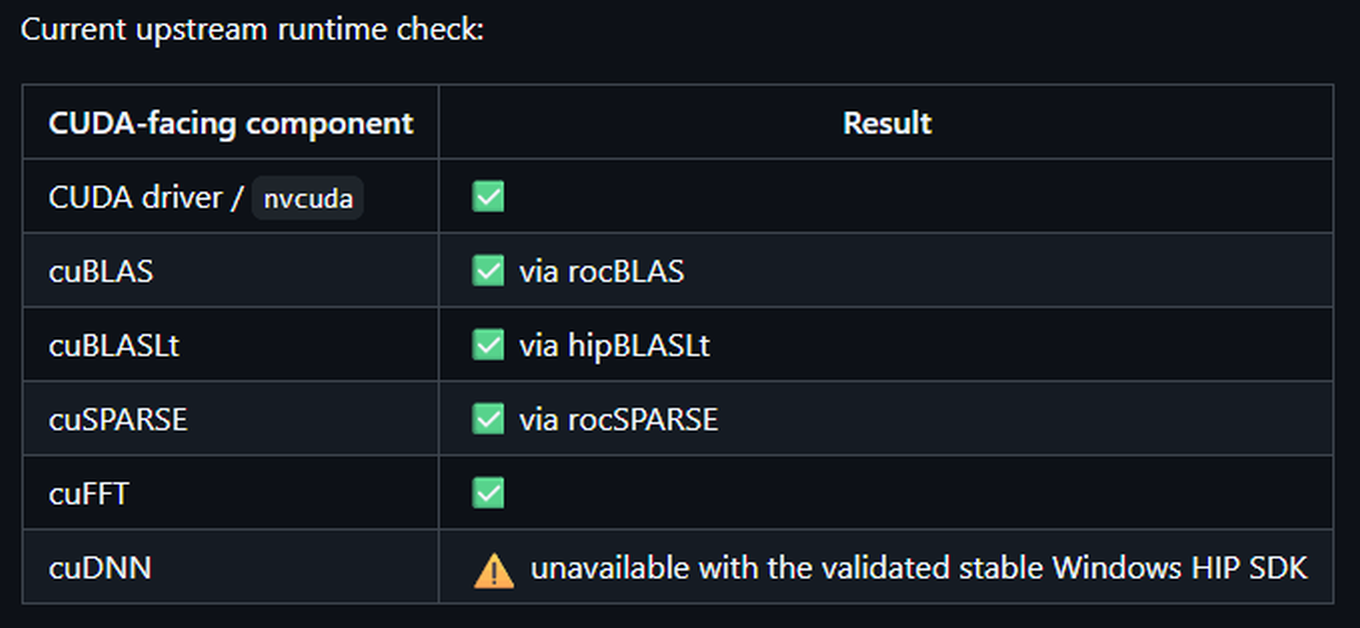
Several important CUDA libraries link up, but the important cuDNN doesn't work yet. (Image credit: Speedstu/GitHub)
The result is that the developer successfully intercepted and mapped the CUDA driver API as well as the cuBLAS, cuSPARSE, and cuFFT libraries directly over to their AMD equivalents. As a proof-of-concept, the author even trained a 2.2-million-parameter PPO reinforcement-learning network end-to-end using unmodified CUDA libraries on an AMD Radeon RX 9060 XT, which happens to be the only officially supported GPU at this time.
Even with AMD's official ROCm support on Windows, the local developer community frequently runs into dependency hell when trying out experimental GitHub repos or specialized AI tools that hardcode CUDA as a requirement. For developers who want to experiment with these CUDA-only tools natively on their Windows daily driver machines without dealing with WSL2 passthrough issues or waiting for the original author to write a HIP port, this project offers a highly desirable translation pipeline. It acts as a sort of hacky adapter for software that stubbornly demands an NVIDIA card.
Benchmark testing included in the project's documentation offers some interesting findings. In a controlled A/B test running a 2.2M-parameter reinforcement learning workload on a Radeon RX 9060 XT, the "public upstream path," which relies purely on official ZLUDA releases and AMD's stock HIP SDK 6.4, achieved a median throughput of 13,278 steps per second (SPS). By contrast, an optional "recovered custom overlay" apparently built from salvaged legacy ZLUDA binaries ran slightly worse at 12,876 SPS, making it roughly 3% slower. While the clean official setup is faster, the author notes that "a later rewrite removed LibTorch/ZLUDA from PPO and achieved substantially higher throughput," indicating that there is still a performance hit for this stack of translators.
CUDA for AMD Windows Official benchmarks (BENCHMARKS.md)
Metric
Public upstream
Recovered custom
Custom delta
Overall SPS, median
13,278.46
12,875.80
-3.03%
Overall SPS, mean
13,172.49
12,649.83
-3.97%
Collection SPS, median
63,306.00
59,360.67
-6.23%
Consumption SPS, median
16,806.36
16,445.66
-2.15%
Inference time, median
0.5863 s
0.6293 s
+7.33%
PPO learn time, median
3.2076 s
3.2958 s
+2.75%
Now, before anyone declares the CUDA moat officially drained, it is crucial to set realistic expectations. First, this is a solo open-source project, not an enterprise-grade solution. The author is extremely transparent about its narrow scope, as crucial machine learning libraries like cuDNN, TensorRT, and NCCL do not resolve yet. This means compatibility is strictly workload-dependent; if your specific AI tool relies heavily on cuDNN, this setup will fail. Furthermore, it's worth pointing out that ZLUDA itself is currently being maintained as a "weekend hobby project" after losing its commercial backing a second time. Relying on this pipeline for production-level work remains a massive risk. This repository is a tinkerer's tool, not a corporate IT deployment strategy.
Despite these limitations, "CUDA-for-AMD-Windows" is pretty exciting, as it proves that the barrier to entry for running CUDA-exclusive software on AMD GPUs isn't an insurmountable hardware flaw, but a relatively tractable translation tooling problem. Because the project is entirely open-source, its potential extends far beyond this initial proof-of-concept. With community contributions, we could see expanded hardware detection and clever patches to get more stubborn CUDA libraries resolving properly.
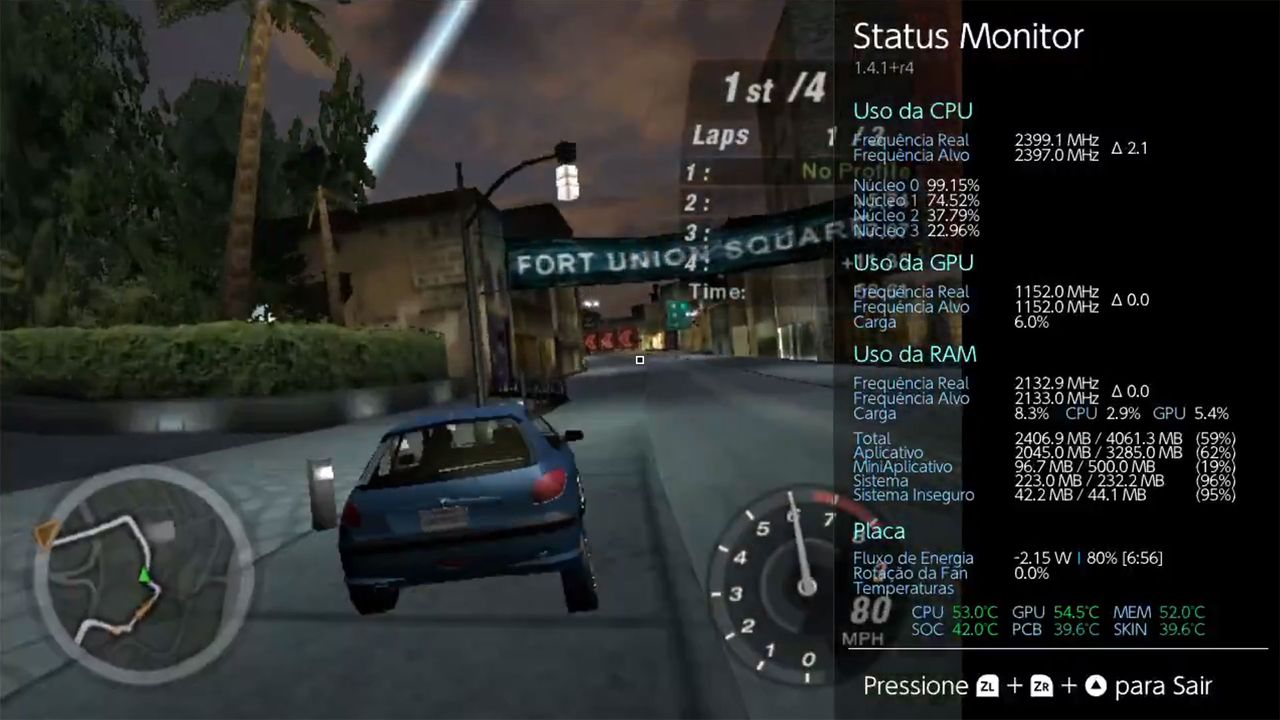
Retro gaming fans who own Nintendo Switch consoles now have several classic Windows titles they can now enjoy. A video shared on Twitter/X shows the well-loved Need for Speed Underground 2 running pretty smoothly on Nintendo’s hybrid device. Meanwhile, a forum about Wine-NX says that Quake III and OpenTTD are also playable, with WarCraft III nearly ready, too. It's early days for this 'experimental' software, but things look very promising.
Windows x86 games are now running directly on Nintendo Switch homebrewNeed for Speed Underground 2 on capture 😀 pic.twitter.com/SD0sugV4DsSeptember 13, 2026
In the embedded video you can see NFSU2 runs rather well on Nintendo’s hardware. Older PC games are perhaps a good fit for what many consider to be the rather anemic specs of the Switch. A status panel shows CPU and GPU usage. According to the forum post “Races run at roughly 20–45 fps at default detail with the CPU overclocked.”
Other games that Wine-NX can handle well at this time include OpenTTD (Transport Tycoon Deluxe), which runs at up to 60 fps. Quake III Arena is also capable of running at around 37 fps at 1,280 x 720 pixels, according to the source. The last PC game mentioned as being compatible, almost, is WarCraft III, and specifically this work in progress has working “menus, campaigns, and now cutscenes.”
The Wine-NX forum page linked to helpfully explains what exactly this is, and how it works. In brief, Wine-NX is a port of Wine 11 to the Switch’s native Horizon OS. It comes as a homebrew package in the NRO format Horizon expects games to be in, but that allows it to run Windows programs and games with Box64's ARM64 dynarec translating the x86 code. Graphics are handled through Mesa 20.1's nouveau driver. It supports audio and touchscreen, and the Switch controllers can also handle mouse / keyboard duties – as well as doubling as an Xbox 360 controller.
You can’t use any Nintendo Switch to load Wine-NX and Windows PC games. You’ll need to have a console that can boost custom firmware, and run homebrew NROs. That means an older unpatched Switch or one with a hardware mod.
Micron has announced a one-time cash appreciation bonus of NT$1 million (US$31,650) as part of a broader compensation/reward package for its employees based in Taiwan. According to a Reuters report, the full package — which comes amidst ongoing disputes between the U.S. memory giant and its Taiwanese workforce — will see each employee earn a minimum of NT$1.7 million ($53,809.39).
The company called the payouts the largest rewards package in company history, confirming that more than 60,000 employees globally will receive scaled rewards for fiscal year 2026, “following an extraordinary year for the company.” Across the last four quarters, Micron’s cumulative net income from sales of high-demand memory chips has crossed a staggering $50.47 billion, with its Q3 earnings representing a 346% year-over-year increase. After the announcement, the union representing workers at Micron's Taoyuan plant officially rejected the company's bonus proposal, calling the package a distraction.
Under the announced payout, every Taiwan-based employee who joined the company on or before August 29, 2025, is eligible for the flat NT$1 million cash bonus. Those hired during fiscal year 2026 will receive a prorated amount. For direct manufacturing and production-line workers, the total bonus rewards are equivalent to 35 to 68 months of basic salary. Direct labor employees will receive a minimum total cash compensation of NT$1.7 million (US$53,809), while the average total compensation for junior engineers is projected to reach NT$3.4 million (roughly US$106,250), comprising NT$2.9 million in cash and the remainder in equity grants.
The announcement — which mirrors bonus payouts by Samsung and SK Hynix amid the soaring profits from the AI boom — comes after local unions in Taoyuan and Taichung, representing 10,000 of Micron's 15,000 Taiwan workforce, began threatening a strike on September 1, demanding packages similar to the payouts that will see Samsung employees receive over $300,000 in bonuses. The Taiwanese government stepped in to force a mediation. However, unlike in Samsung's case, which also involved government intervention that narrowly averted a potential strike, the talks fell through on September 4 after both parties failed to reach a consensus, leading Micron to announce the NT$1 million bonus package a week later.
In an official statement following Micron's announcement, the union said the new package "sidestepped" the real discussion about a transparent bonus system. The union is pushing for structural change, including a permanent profit-sharing model in which 15% of the company's operating profits are allocated directly to workers and distributed quarterly. They are also demanding a larger one-off payment equivalent to roughly 83 months of salary for fiscal year 2026. Last September, South Korea’s SK Hynix reached a settlement with its union to allocate 10% of annual operating profit directly to employees as performance bonuses for the next decade, eliminating bonus caps.
Similar incidents have played out across the semiconductor industry as companies continue to pull in unprecedented profits from the AI boom. Workers in these industries believe they should share in profits and are requesting concrete institutional safeguards to ensure they are fairly compensated during high-profit AI booms, rather than relying on arbitrary, opaque bonuses decided solely by management. Samsung's unions were ready to strike before reaching an agreement with the company and even held a demonstration attended by over 30,000 Samsung union members.
In the case of Micron — which announced a record-breaking GAAP net income of $28.24 billion in just Q3 2026 — the threat of a strike continues to loom following the Union’s rejection of its proposed payout. A critical second round of mediation is officially scheduled for September 21, 2026. If that upcoming meeting falls apart, the union plans to hold a vote allowing members to strike. In an earlier internal survey, 80% of union members voted in favor of a strike.
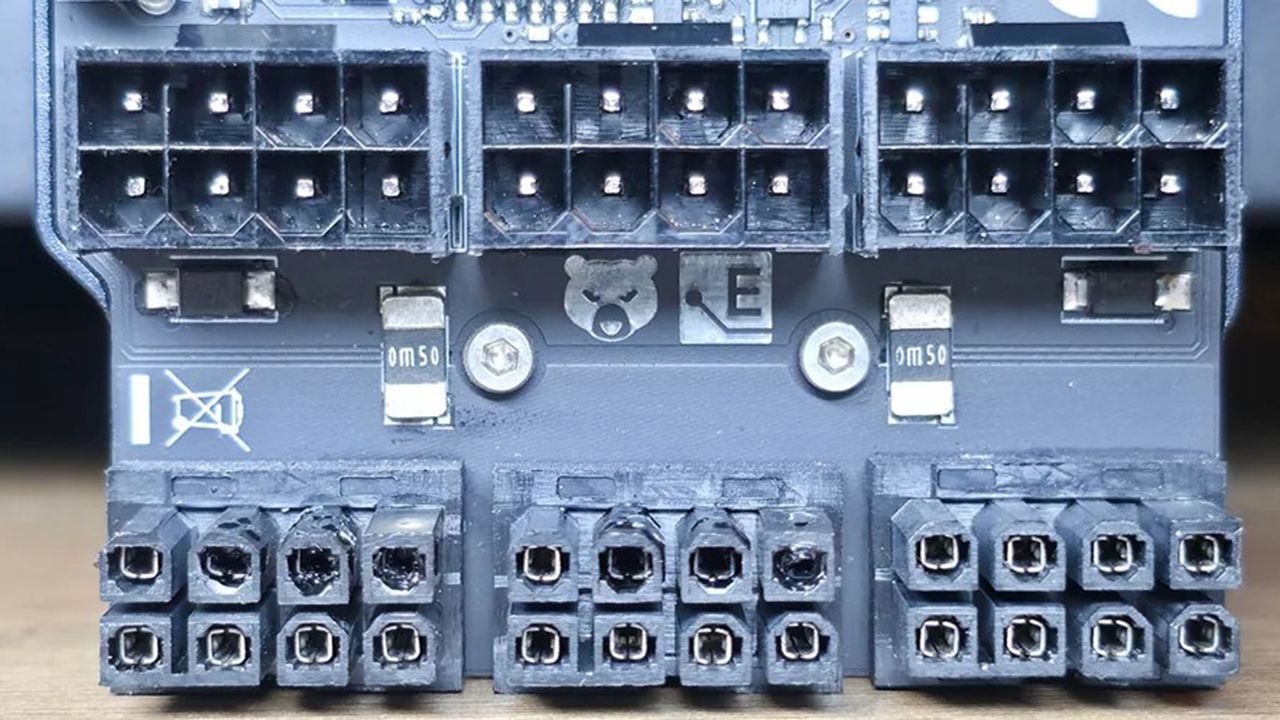
If you believe that the 8-pin PCIe power connector is entirely immune to the problems that have plagued the newer 16-pin connector, think again. A recent incident suggests that even the humble 8-pin is not entirely immune to failure. According to a Radeon RX 7900 XTX owner on Reddit, the 8-pin connectors on a Thermal Grizzly WireView monitoring device suffered overheating damage while connected to the graphics card.
The user said that they experienced frequent freezes and black screens before discovering the damage. The affected connectors were the 8-pin connectors on the GPU side of the monitoring device, with visible signs of burning and melted plastic. The user also confirmed that the connectors were fully inserted, although the exact cause of the failure is still unknown.
WireView is essentially an adapter that sits between a graphics card and the power cables, allowing users to monitor various values like power consumption, voltages, current in amperes, minimum and maximum power consumption, and more. Rather than connecting the PSU cables directly to the GPU, the power passes through the monitoring device, thus adding another set of connectors and electrical contacts to the power delivery path. A poor electrical connection, increased contact resistance, a damaged connector, or an issue with the adapter itself could have caused the overheating damage.
Thermal Grizzly previously pointed to improper seating, backplate interference, or incorrectly aligned or soldered contacts as possible causes of connector damage, although the company is yet to identify the cause of this particular incident. The company has reportedly contacted the affected user and asked them to get in touch with its support team so the company can investigate the damaged WireView adapter. The investigation could potentially help determine whether the failure originated from the adapter, the connectors, the GPU, or a combination of factors.
While we are on the subject of 8-pin power connectors, just days ago we saw a heavily modified RTX 5090 successfully running on traditional 8-pin connectors. The modders replaced the card's original 16-pin connectors with three 8-pin connectors soldered directly to the PCB, using heavy-gauge cables and modified sense pins. The card reportedly pulled as much as 900W and reached 3,400 MHz, demonstrating how capable 8-pin connectors can be when properly implemented. However, this was an extreme hardware modification, not a stock configuration.
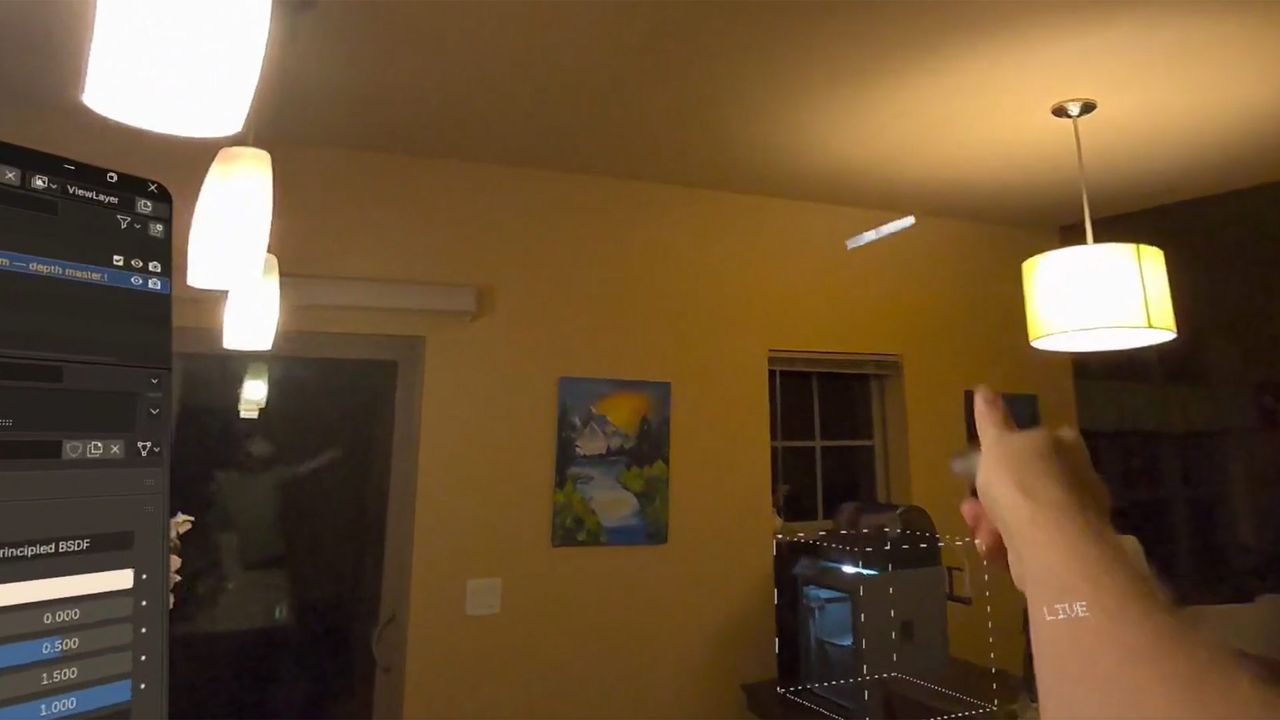
A software engineer and creative tinkerer has shown off a futuristic Meta Quest plus 3D printer workflow in a video shared on social media. Hank on X demonstrates modeling a 3D object on his computer, which he then picks up and throws to his 3D printing system across the room. “I've never felt more like Tony Stark,” joked the tech enthusiast.
I've never felt more like Tony Stark than I do now. Using my Meta Quest, I can just throw 3D models at my 3D printers to have them start printing it😂 pic.twitter.com/xNTe4KAVM2September 13, 2026
Let’s look more closely at the hardware in use before talking about the integration in play. The demonstration video clearly shows that Hank has a Bambu Lab P2S 3D printer with an AMS 2 multi-material system on top. We reviewed the Bambu Lab P2S with AMS2 last October, and gave it a pretty glowing 4.5/5 review score thanks to lots of features and factors in its favor. Hank has integrated this 3D printer with his Meta Quest 3 headset. We last reviewed one of these HMDs back in December 2024 when we tested the Quest 3S, and it was also a 4.5/5 star winner.
So, these two great pieces of hardware don’t usually work together, but that didn’t deter Hank. Not much anyway. Later in the tweet thread, Hank reveals that “The Bambu Lab printers have an API that you can use to control them locally! [So I] Spun up a quick web server on my PC that glued everything together! (Android app -> PC -> 3D printer).”
Of course, other Bambu Lab 3D printer users with Meta Quest headsets were interested in following in Hank’s footsteps. The software engineer said that the integration was finessed with the help of OpenAI’s GPT-6 Astra model (so, yes, it’s vibe coded), but wasn’t available on GitHub as yet. However, our 3D printing-in-VR hero indicated that they would be happy to share the code online if there was enough interest (and after a bit of code polishing).
We've entered the golden era of gaming. I had GPT-6 Astra reverse engineer Super Smash Bros Melee to work on my Meta Quest 3 with VR controls. I'll post my first real battle in the replies https://t.co/vDHsPTPOmM pic.twitter.com/abJvxHU5KfSeptember 9, 2026
Hank’s tweets are full of interesting projects mixing VR and vibe coding. In another noteworthy post (embedded above), he shows he used Astra to get the recently released Super Smash Bros Melee decompilation to work on the Meta Quest 3 with VR controls.
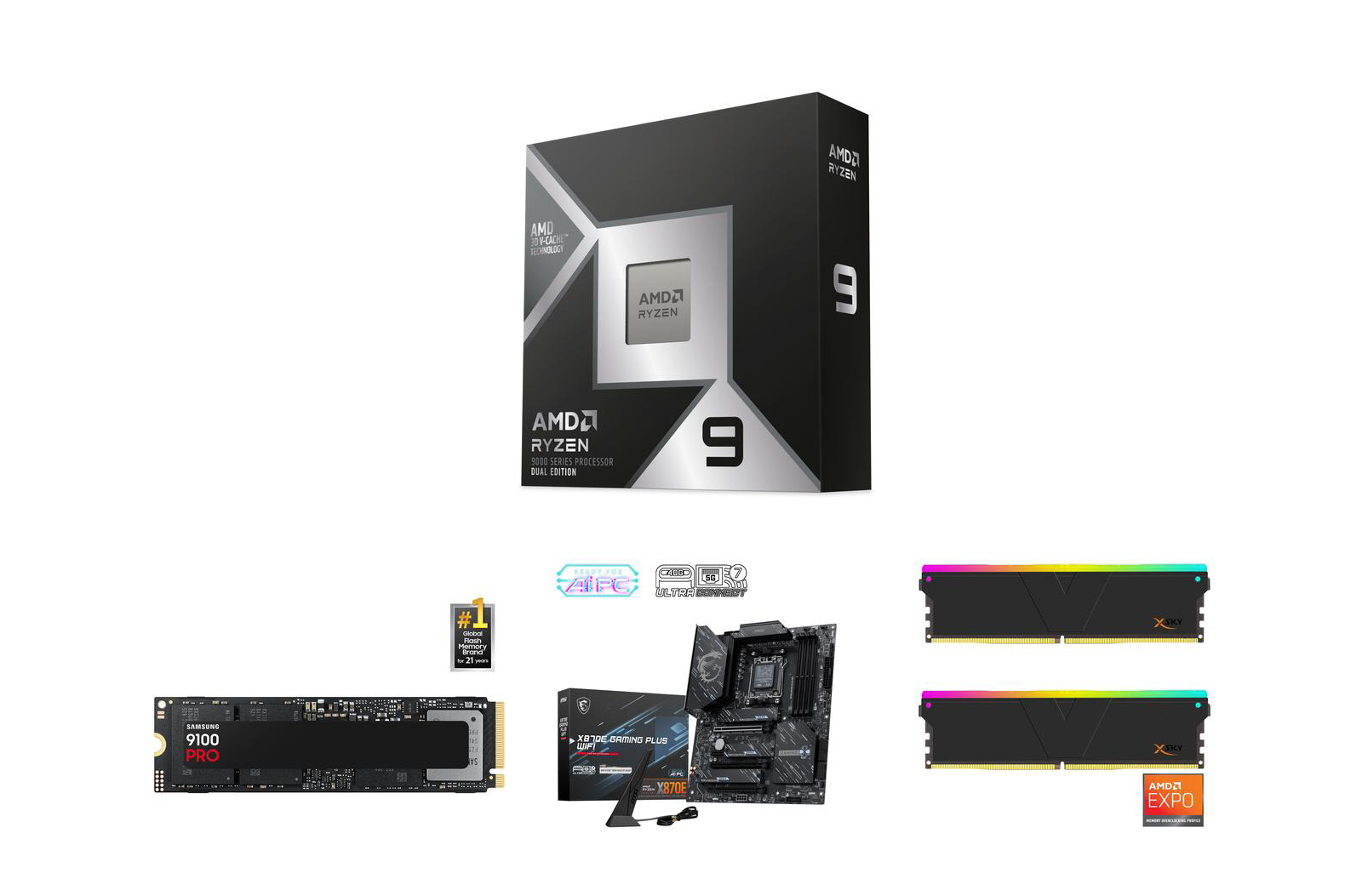
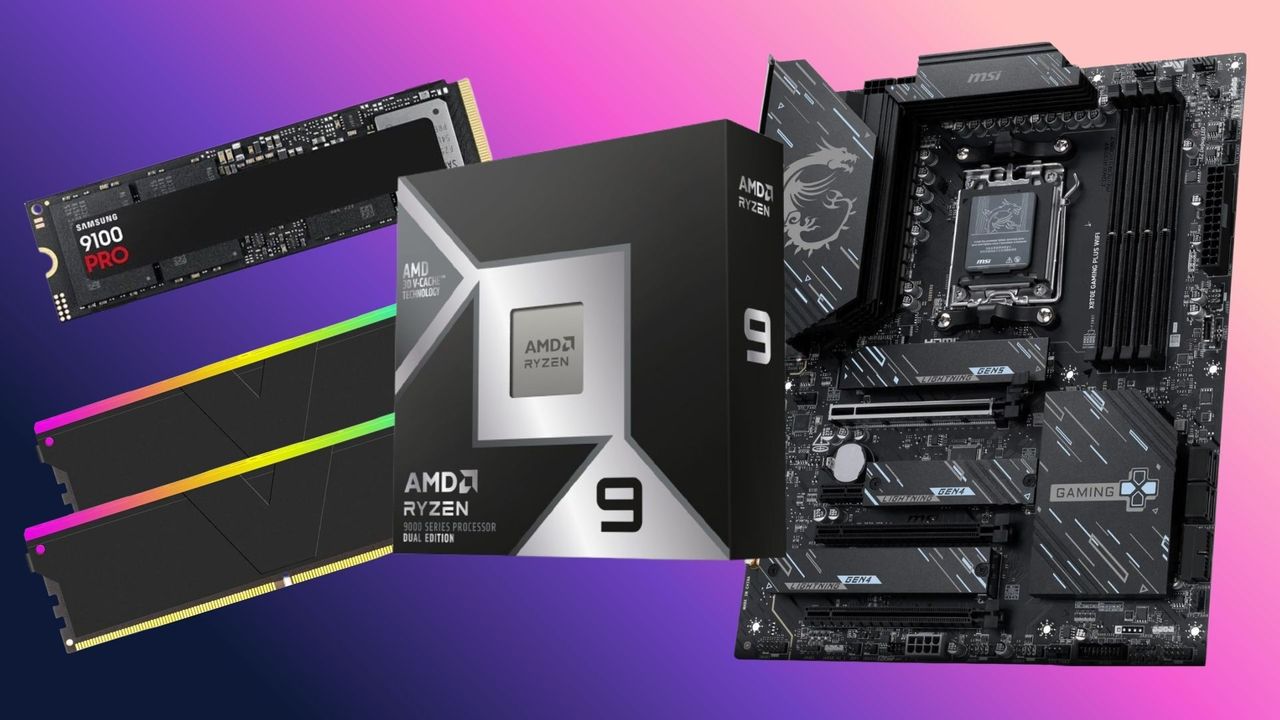
When money is no object, but you still want to be slightly frugal, combo bundles like today's Newegg offering might pique your interest. Featuring some of the most powerful and extreme consumer PC components on the market, this selection of parts will make for a very powerful gaming machine and an even more powerful productivity workhorse. Right now, you can save $1,289 when you spend $2,999 on an AMD Ryzen 9 9950X3D2 processor along with an 8TB Samsung 9100 Pro SSD, MSI X870E Gaming Plus WiFi motherboard, and 32GB of V-Color Manta XSkyDDR5-6000 memory at Newegg. The normal price for all of these components reaches $4,288, plus Newegg also throws in a free Cooler Master Elite Liquid 240mm AIO CPU cooler, and you get a copy of Capcom's latest Onimusha hitgame with the purchase of select AMD products (Ryzen 9 9950X3D2).
This bundle includes most of the components you'll need to build a mightily impressive gaming and productivity PC. You'll still need to source a PC case, power supply, and graphics card to complete the build, though. This Newegg bundle includes AMD's halo processor - the Ryzen 9 9950X3D2 - stacking 3D V-cache on both the CCDs of the processor for some extreme cache memory performance.
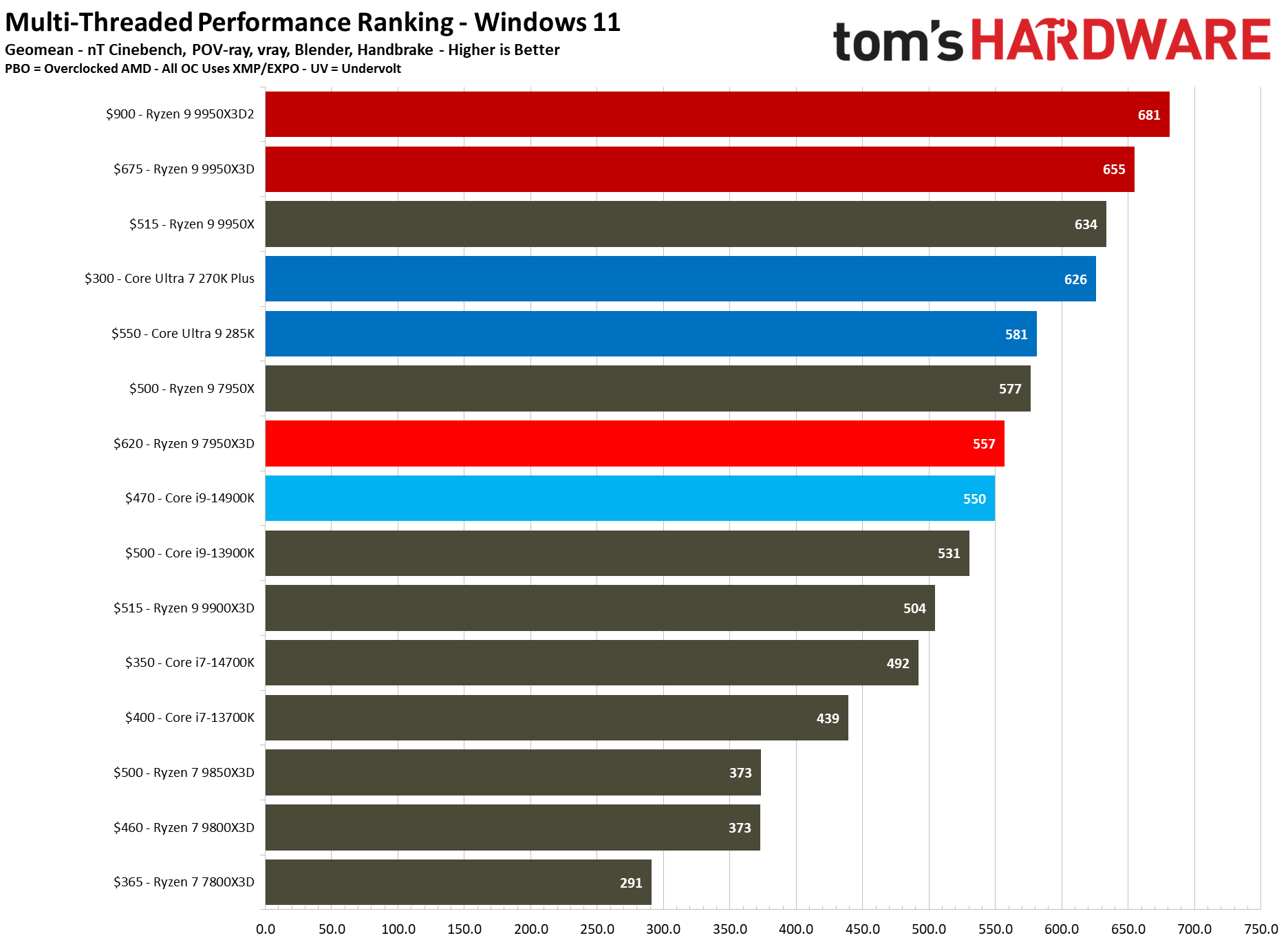
In our testing of the Ryzen 9 9950X3D2 processor, we found the 16-core and 32-thread monster to match the 9800X3D in gaming performance, but excel in multi-threaded application performance. You can see below from our multi-threaded performance chart that the 9950X3D2 tops the table, but at a price. The 9950X3D2 is also very power-hungry and costs more than the other CPUs on the list.
(Image credit: Tom's Hardware)
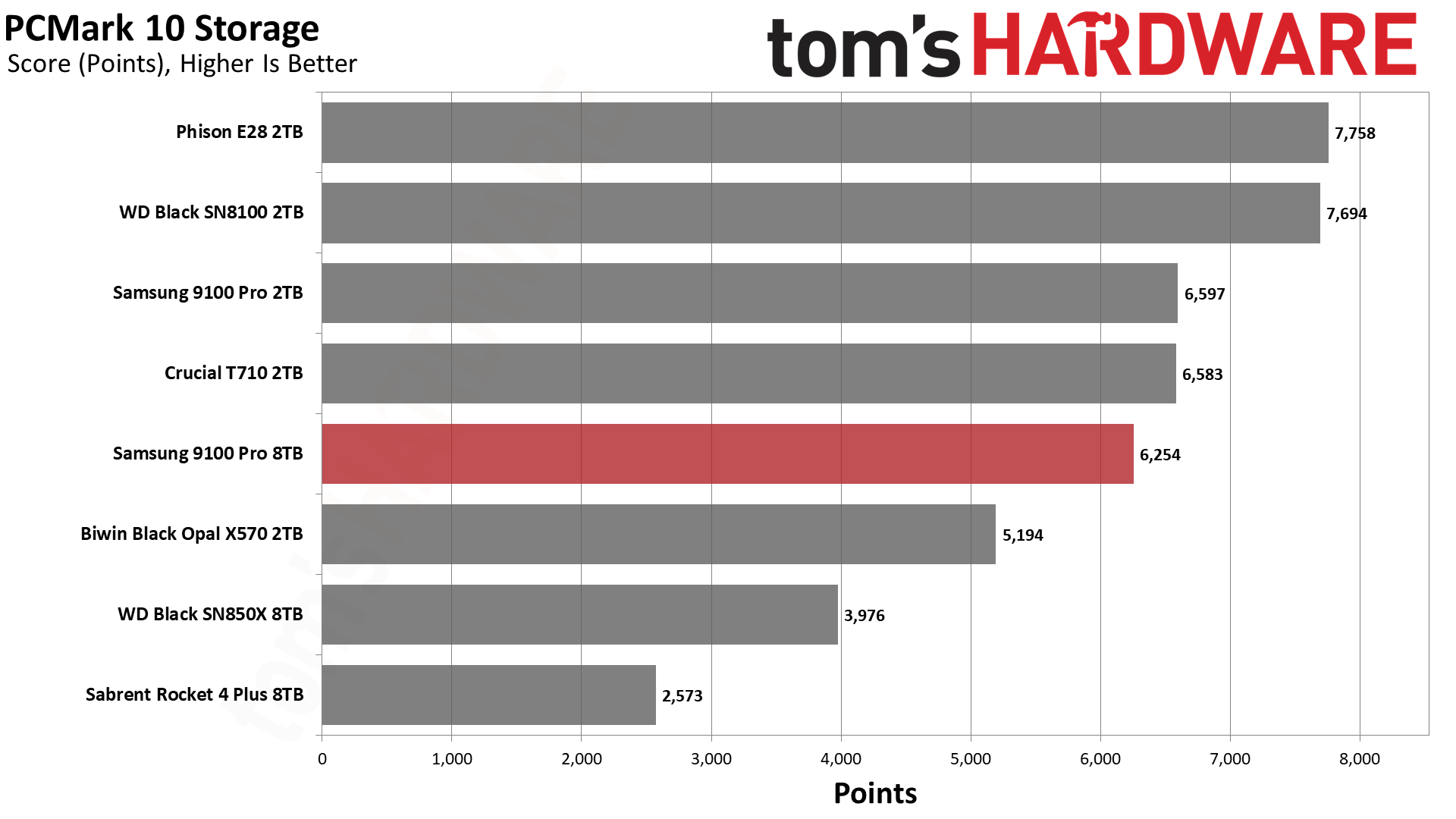
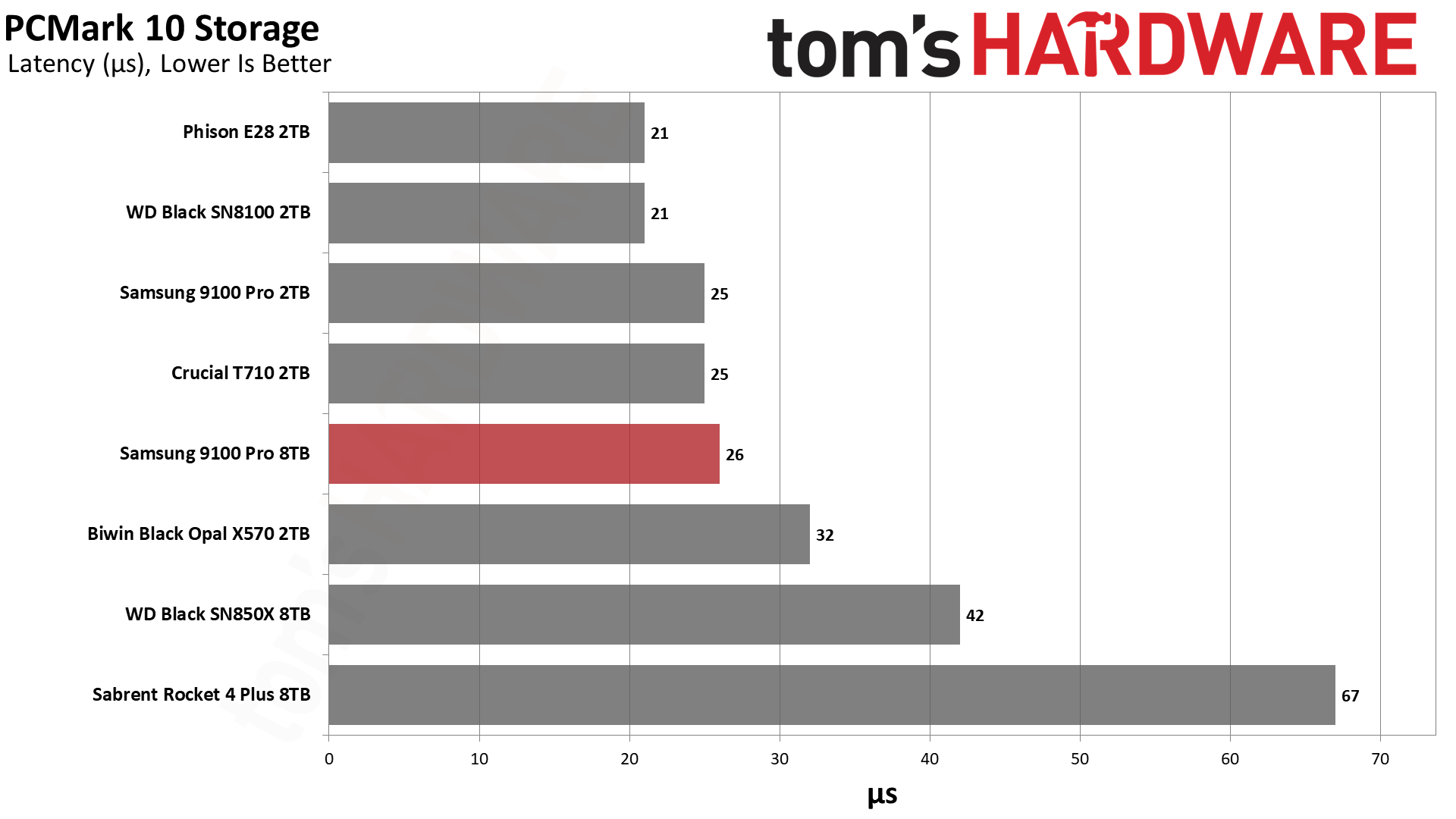
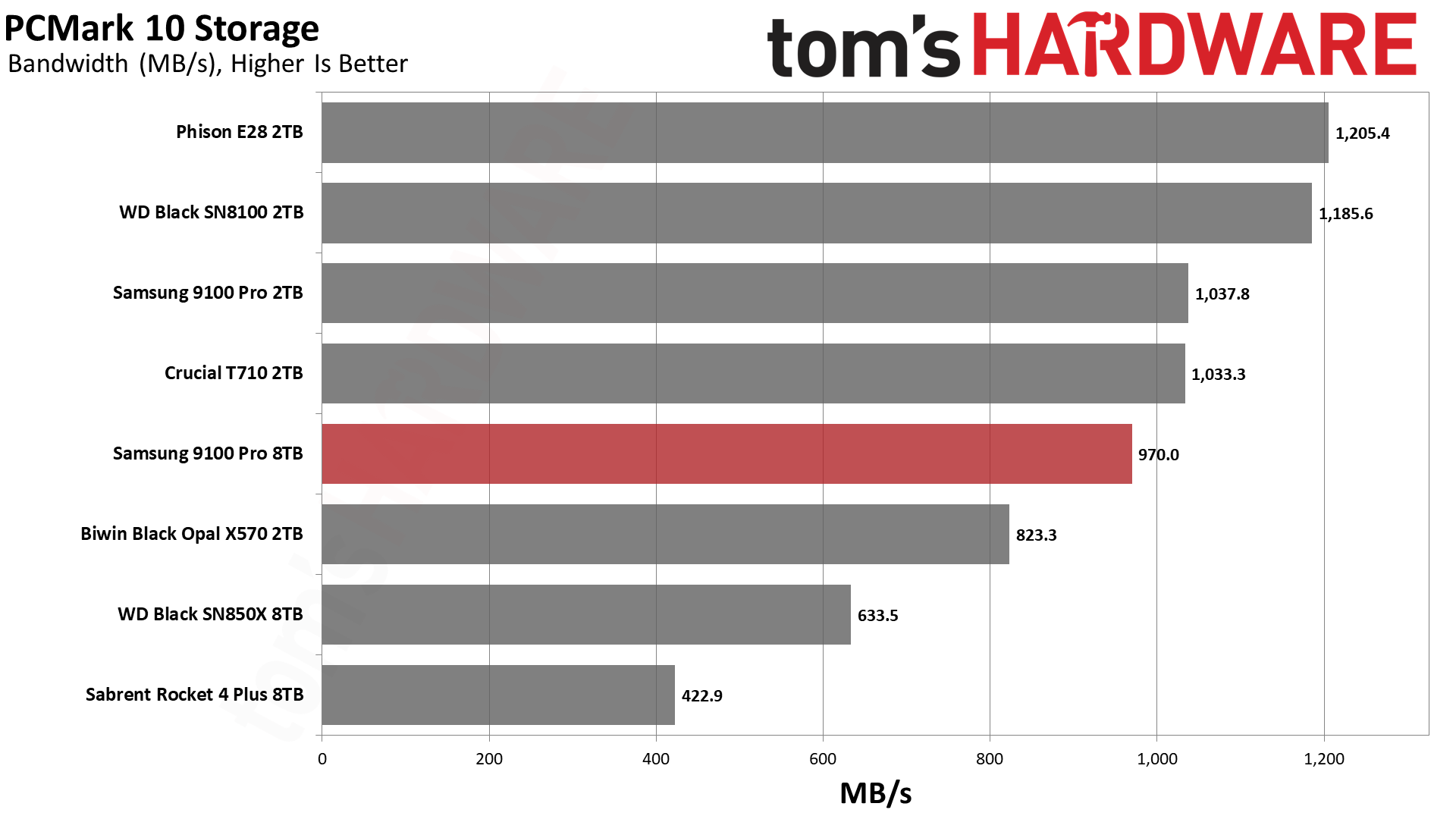
The component bundle also features a massive 8TB Samsung 9100 Pro PCIe Gen 5.0 SSD. This is the most extreme size for a superfast SSD in both capacity and price. In our testing, the 8TB 9100 Pro beats the other 8TB competition in our PC Mark 10 storage tests, but isn't as fast as smaller 2TB capacity drives, as its controller is designed to operate optimally with up to thirty-two dies at 4TB. See our review for more details.
Tom's HardwareTom's HardwareTom's Hardware
On its own, the 8TB 9100 Pro retails for a jaw-dropping $2,719.99, almost the cost of this entire bundle. So if you want superfast transfer speeds with 8TB of space, then this is the best way of getting one at a reduced price, especially in the current climate of storage pricing.
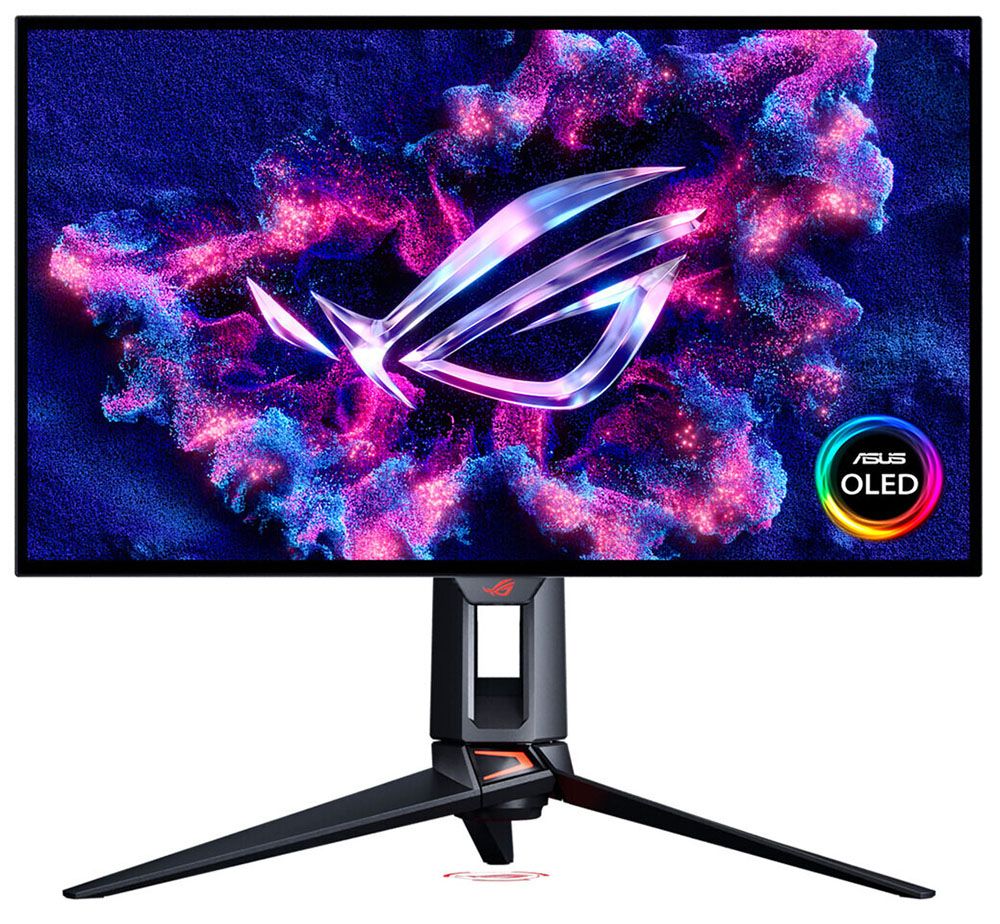
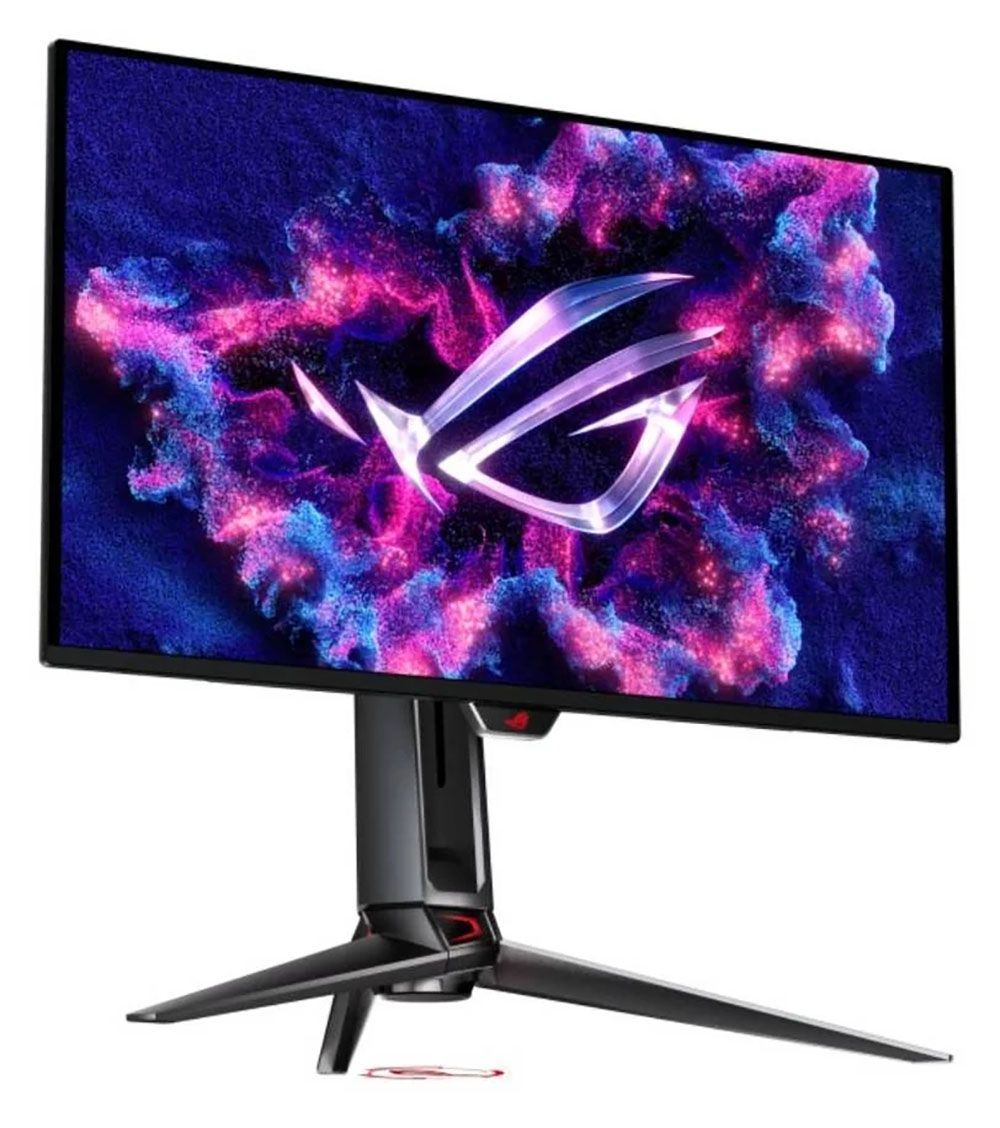
Asus has introduced some of the best OLED gaming monitors in recent years, and with each generation, it makes incremental improvements in performance, features, and technology. Its latest panel type is Tandem RGB Stripe, bringing higher brightness, a wide color gamut, sharper imagery, and lower power consumption.
The latest ROG Swift display to hit my test bench is the PG27UCWM. It’s a 27-inch 4K panel with 240 Hz (480 Hz in FHD), HDR10, Dolby Vision, DisplayHDR 400, and Adaptive-Sync. Let’s take a look.
Asus ROG Swift PG27UCWM Specs
Panel Type / Backlight
Tandem RGB Stripe OLED
Screen Size / Aspect Ratio
27 inches / 16:9
Max Resolution and Refresh Rate
3840x2160 @ 240 Hz
1920x1080 @ 480 Hz
FreeSync and G-Sync Compatible
Native Color Depth and Gamut
10-bit / DCI-P3
DisplayHDR 400, HDR10
Dolby Vision
Response Time (GTG)
0.03ms
Brightness (mfr)
250 nits full screen
1,000 nits 3% window
Contrast
Unmeasurable
Speakers
None
Video Inputs
1x DisplayPort 2.1
2x HDMI 2.1, 1x USB-C
Audio
3.5mm headphone output
USB 3.2
1x up, 3x down
Power Consumption
48w, brightness @ 200 nits
Panel Dimensions
WxHxD w/base
23.9 x 17.1-21.5 x 10.1 inches
(607 x 434-546 x 257mm)
Panel Thickness
2.5 inches (64mm)
Bezel Width
Top/sides: 0.35 inch (9mm)
Bottom: 0.43 inch (11mm)
Weight
17.86 pounds (8.1kg)
Warranty
3 years
I’ve reviewed a few Tandem RGB Stripe OLEDs of late, most recently, Asus’ 32-inch version of this screen, the PG32UCWM. There’s no denying the extra sharpness that this tech brings. Though I never saw much color fringing around text as discussed online, these new panels are clearly sharper than single-layer OLEDs. By sandwiching two layers and making the pixels’ physical shape narrower, you get more clarity, more color, and more brightness at a given wattage. And by driving the panel less aggressively, its lifespan is extended.
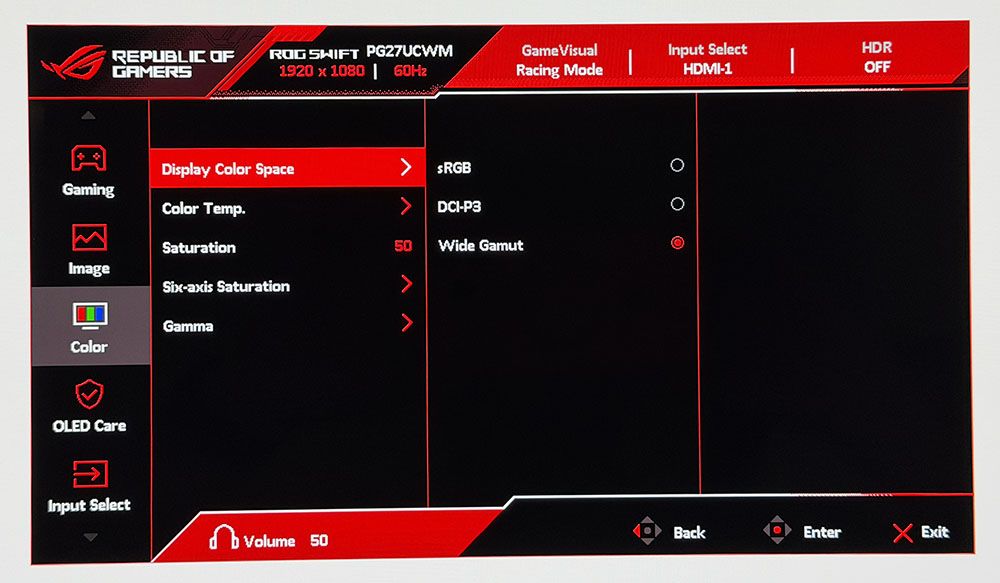
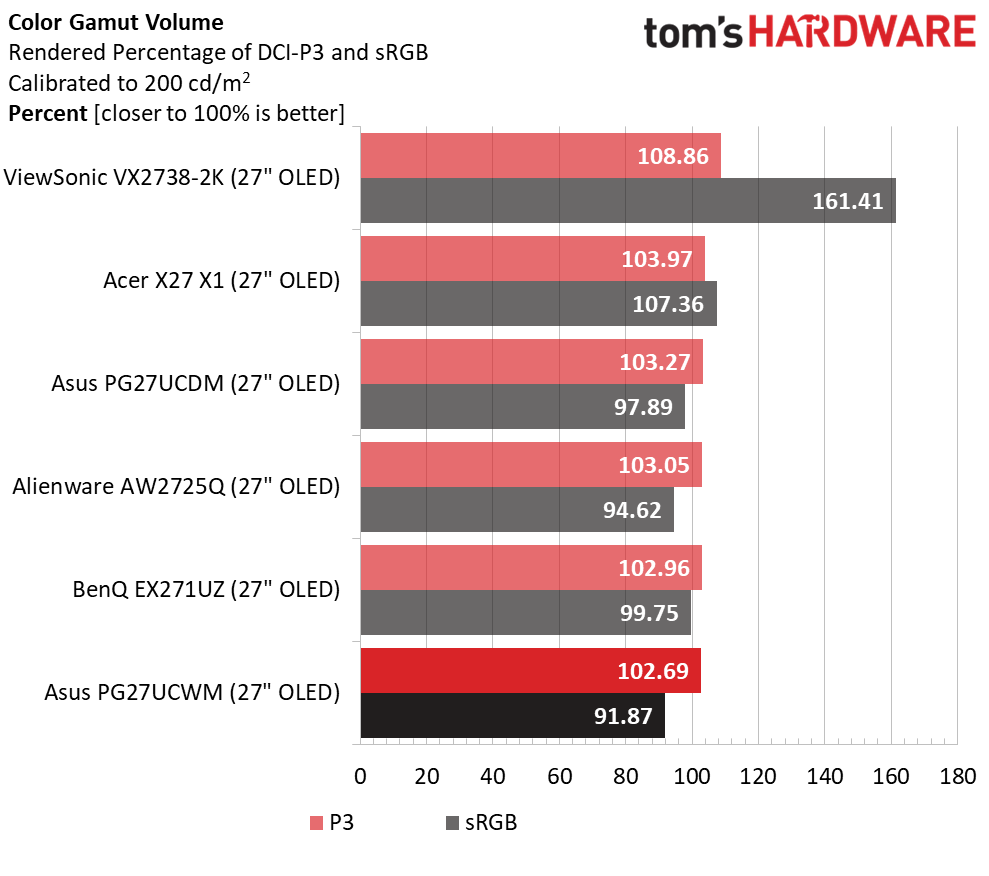
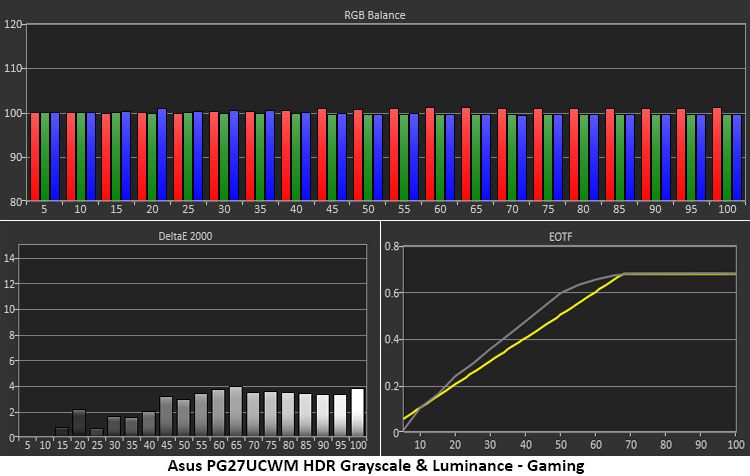
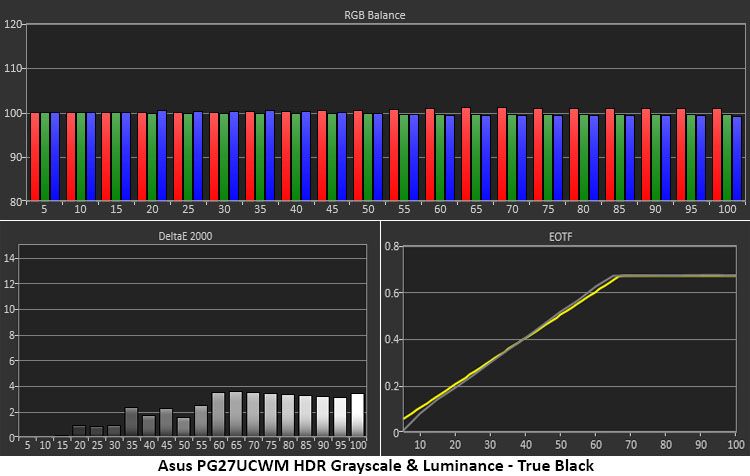
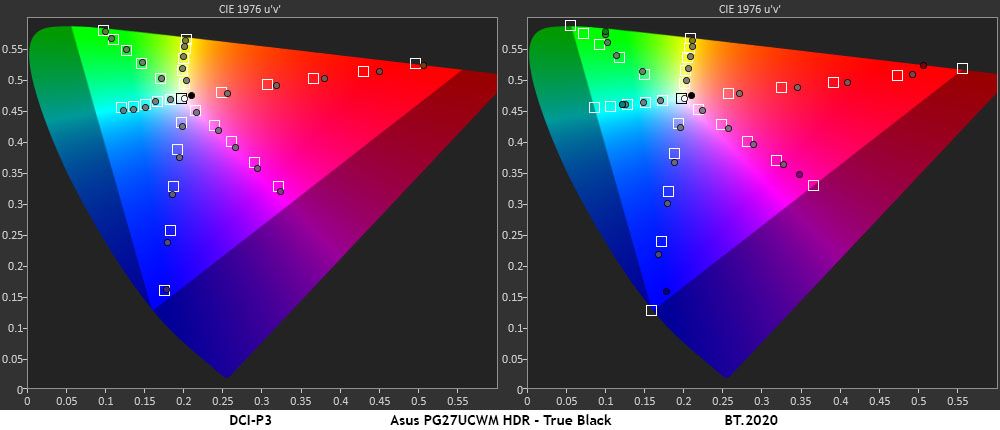
The PG27UCWM’s color volume is greater than that of single-layer OLEDs but not quite as large as that of Quantum Dot displays. I measured just over 102% coverage on my sample, whereas you’ll get closer to 110% with a QD monitor. Asus includes factory calibration with each monitor, and you can find that stored in firmware and accessed through the comprehensive OSD.
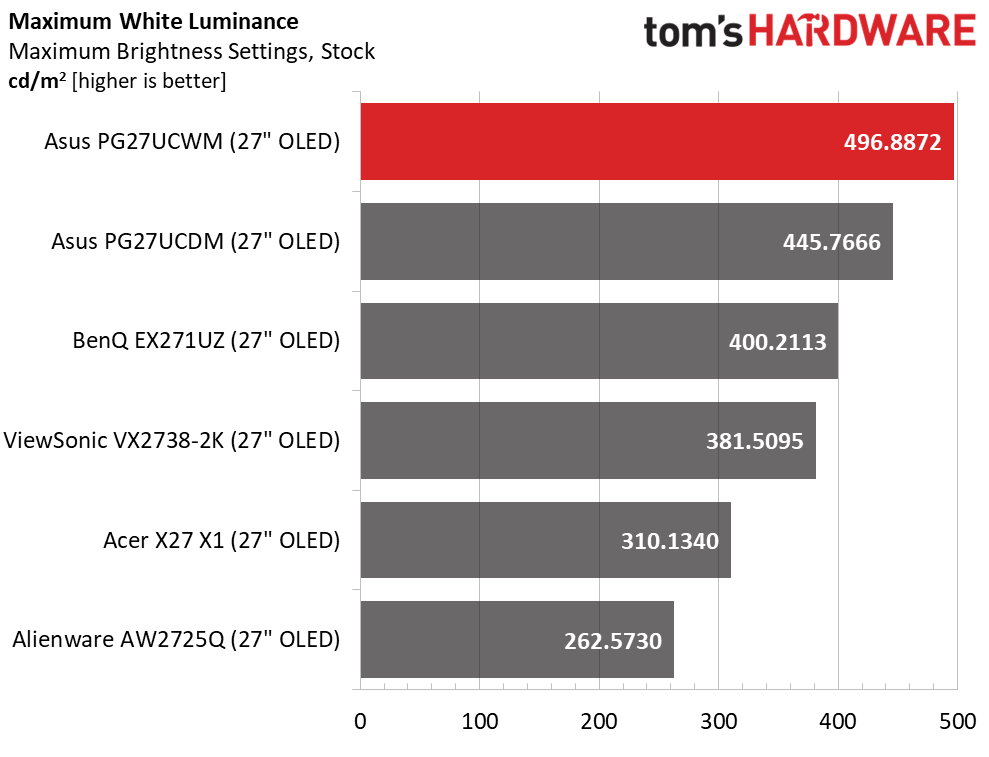
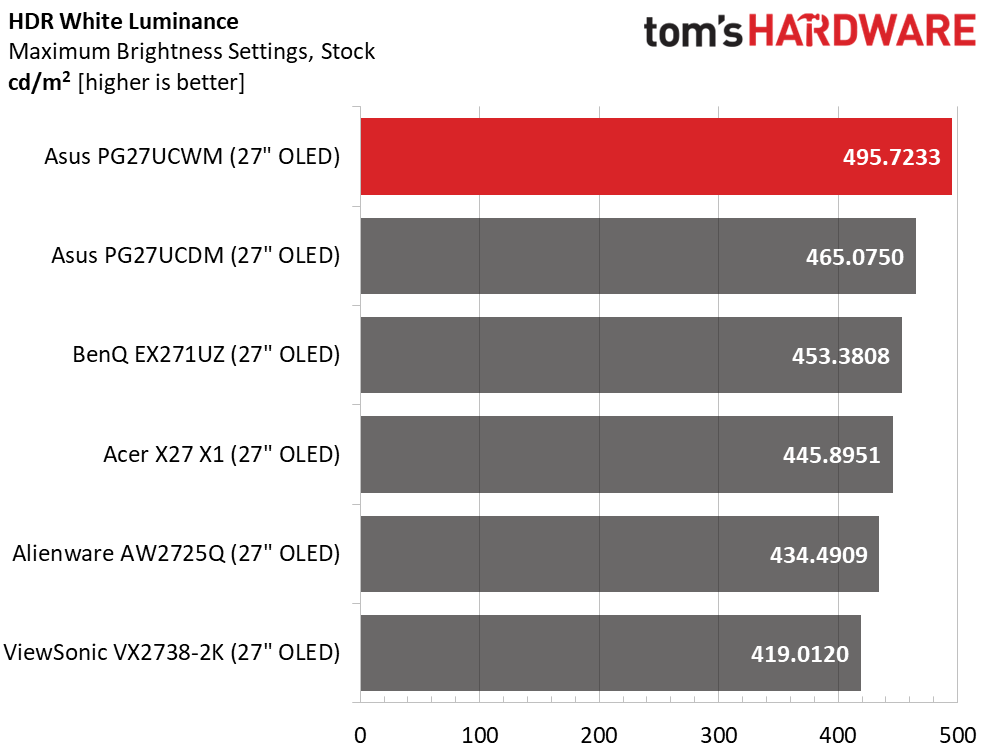
Peak brightness is just under 500 nits when measuring a 25% window pattern with uniform brightness turned off. That number holds for both SDR and HDR content. The PG27UCWM supports HDR10 and Dolby Vision, with VESA DisplayHDR 400 certification. Asus’ TrueBlack Glossy screen coating keeps reflected light from spoiling those deep black levels.
In the video processing department, Asus includes a dual-refresh feature called Frame Rate Boost that switches between 4K/240 Hz and Full HD/480 Hz. You can change modes with a single button press. Also in the mix is Adaptive-Sync, with certifications from both Nvidia (G-Sync) and AMD (FreeSync Premium Pro). And you can augment lower frame rate capable systems with ELMB (Extreme Low Motion Blur).
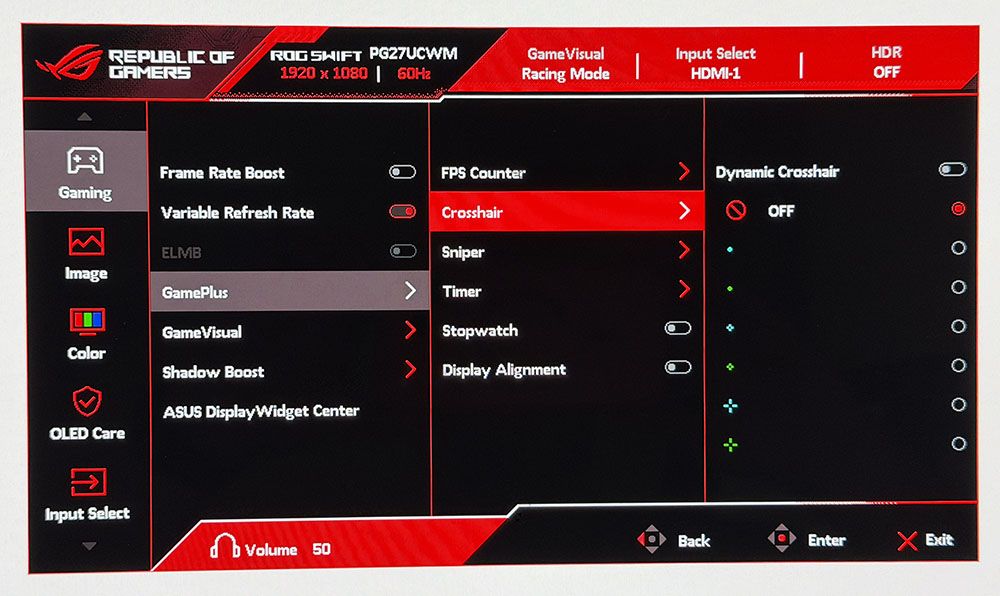
The PG27UCWM, like all ROG Swift products, is feature-rich. You get Asus’ GamePlus enhancements, including multiple aiming points, sniper modes, frame rate counters, timers, and alignment marks. The quick menu and joystick clicks are fully customizable for quick access to many functions. And you can download Asus’ DisplayWidget Center app for full control on Windows or Mac desktops. A full array of inputs includes DisplayPort 2.1 with 80 Gbps bandwidth, HDMI 2.1, USB-C, and a USB 3.2 hub with KVM options.
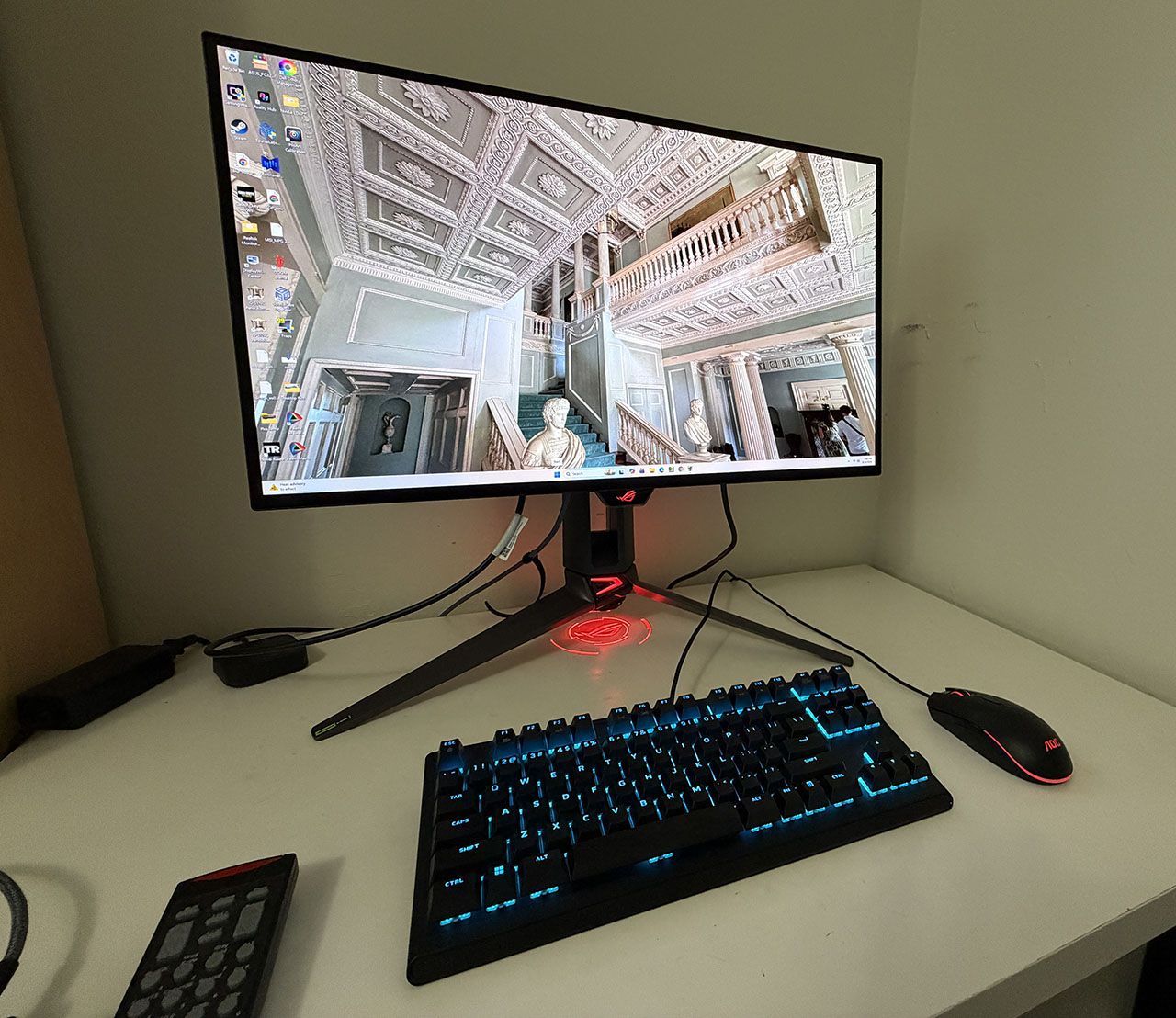
There are plenty of cables included, along with Asus’ signature LED lighting and graphics. The PG27UCWM is firmly in the premium segment at a starting price of $1,099. I would expect greatness for that sum, and if you read on, we’ll see if it delivers.
Assembly and Accessories
The PG27UCWM arrives in a well-adorned carton with colorful graphics and secure, recyclable packaging. The base, upright, and panel are separate, as is the lens for the ROG logo projector that shines symbols on your desk. It includes multiple lenses. The ROG pouch reveals cables for USB, HDMI, and DisplayPort, plus IEC for the internal power supply. There’s also a heavy stamped steel bracket that snaps onto the panel to create a 100mm VESA mount.
Product 360
AsusAsusAsusTom's Hardware
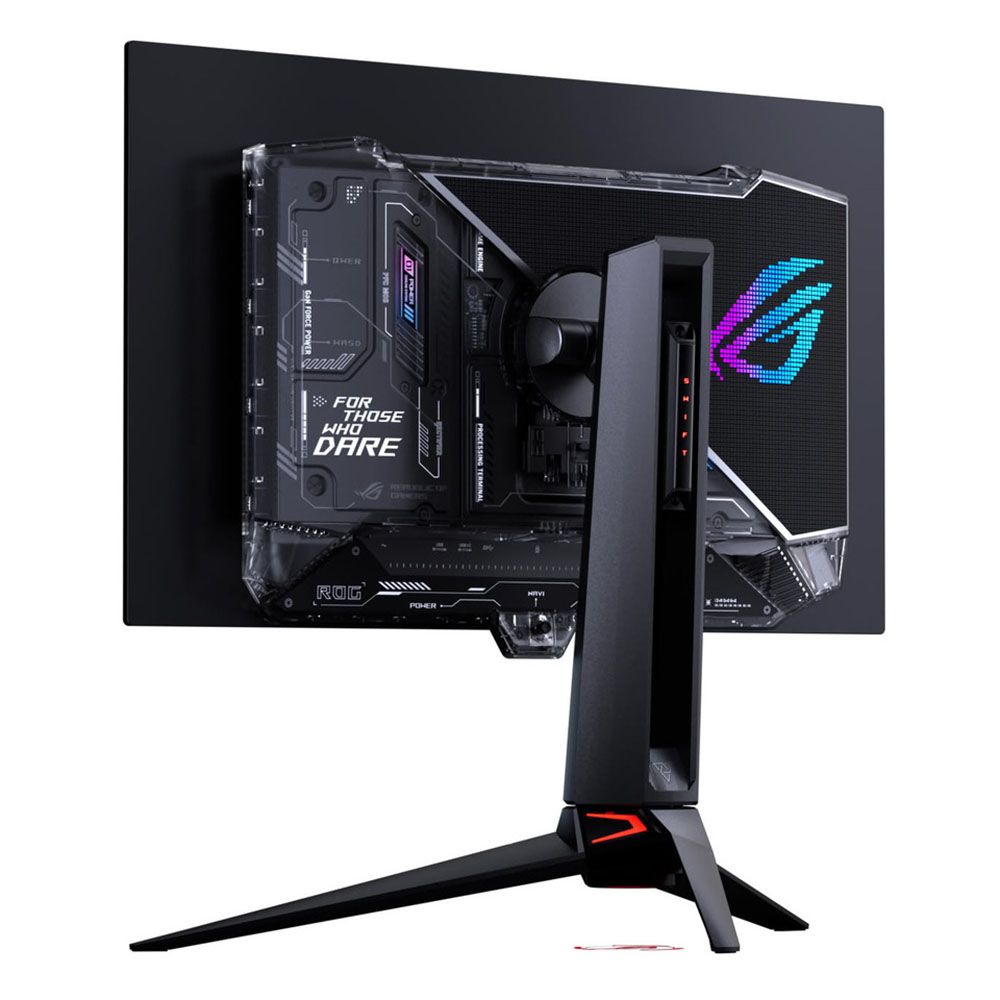
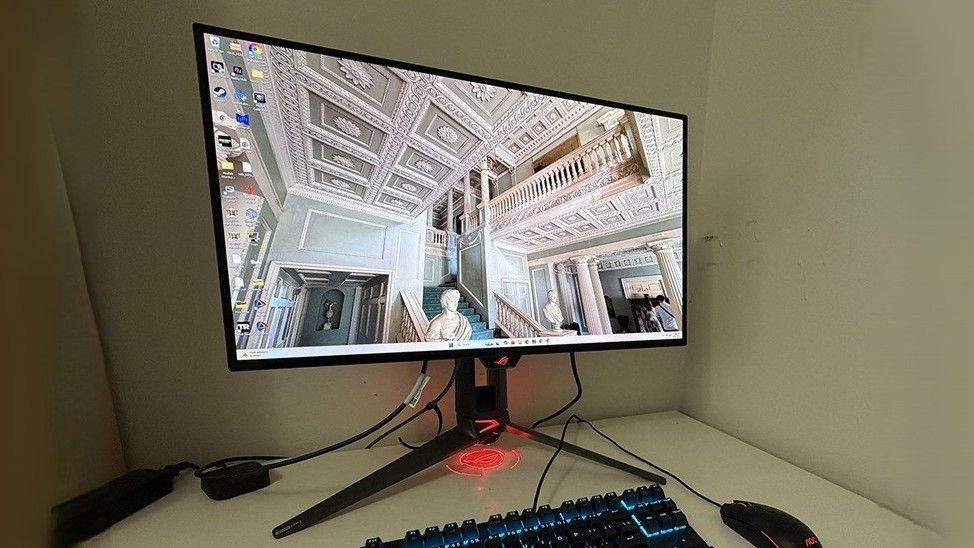
The PG27UCWM features Asus’ latest ROG Swift styling cues, with clear plastic on the back that reveals some of the monitor’s internal components. Opposite that is the Lite Brite ROG graphic that can light up in a multitude of colors and effects. More LEDs can be found on the front, on the small protrusion beneath the screen, as well as on the base and even the sliding bit on the stand’s upright. All this fun can be controlled in the OSD and by DisplayWidget Center.
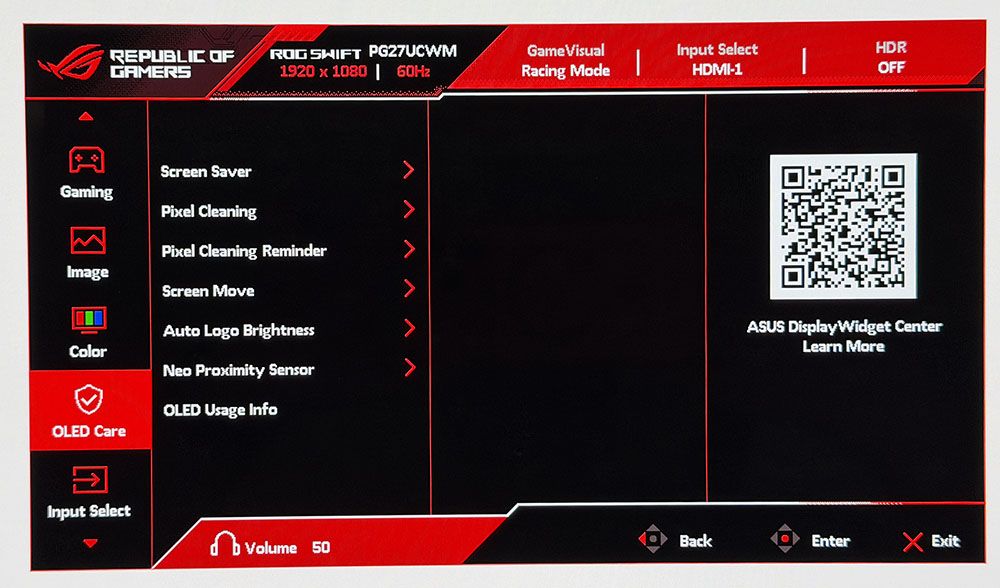
In front, the bezel is very narrow on all sides, just 9-11 millimeters, with a small protrusion at the bottom center for the joystick and control buttons. It also contains a sensor that works with the OLED care features to shut off the panel when you leave your desk.
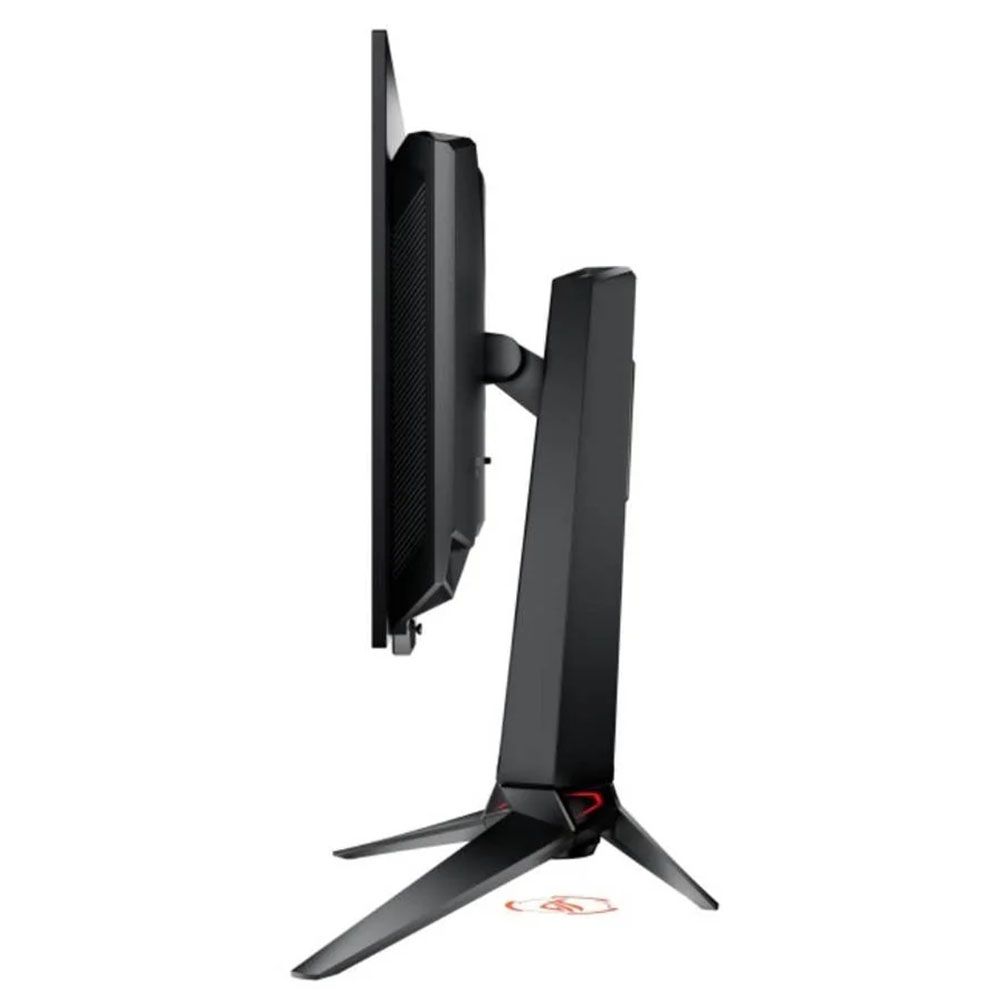
From the side, you can see the panel-on-box design that is common to many OLEDs. This not only looks nice but aids in cooling. The OLED is backed by a metal plate that helps dissipate heat, along with a graphene layer inside, heatsinks on the internal circuit boards, and a heat-efficient power module. The PG27UCWM is fanless and always ran cool during my time with it.
The stand is very solid with a cast aluminum base that is both wide and deep. The upright features full ergonomics with a 4.4-inch height range, 5/20-degree tilt, 30-degree swivel, and a 90-degree portrait mode. Movements are firm and smooth with no wobble or play. The stand also has a threaded tripod socket on top for things like webcams.
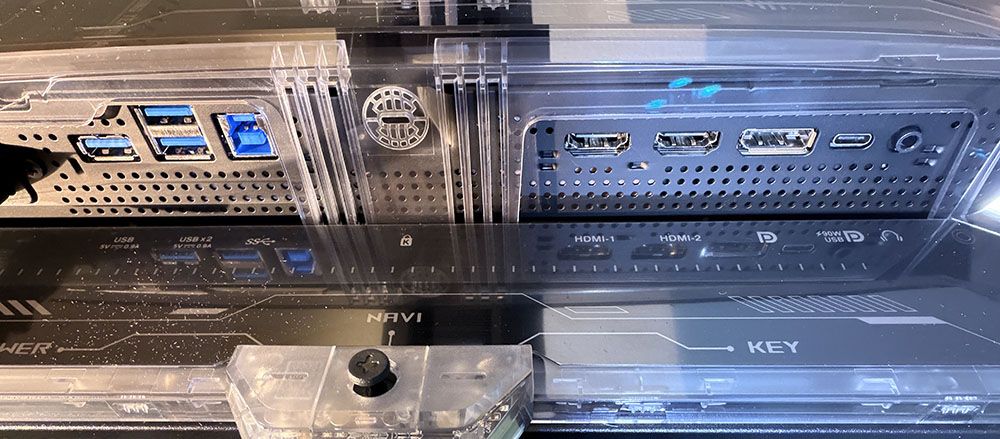
The I/O panel is well-appointed with a single DisplayPort 2.1 (UHBR20, 80 Gbps), two HDMI 2.1, a USB-C, and a USB hub with one upstream and three downstream. The hub has full KVM functionality, along with version control and power for the USB-C up to 90 watts. There are no internal speakers, but you do get a 3.5mm headphone jack.
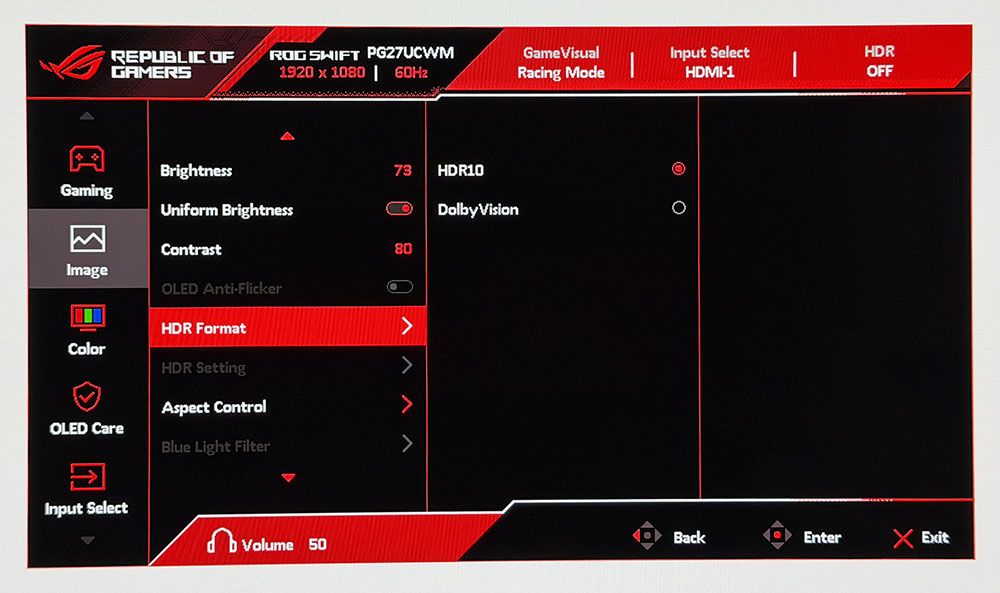
OSD Features
The PG27UCWM has two buttons and a joystick to cover all monitor functions. Pressing the left button switches the refresh rate between 240 Hz and 480 Hz. The right button is a power toggle. Pressing the joystick brings up a quick menu which is fully programmable. A second press reveals the full OSD.
The quick menu has four slots for any function you might want quick access to, like picture mode, brightness, and the like. The full OSD starts with Gaming, and there, you’ll find the GamePlus suite with a large selection of aiming points, sniper modes, frame counters, timers, a stopwatch, and display alignment marks. GameVisual refers to the nine picture modes, each aimed at different game types or tasks. Racing is the default and best choice there.
The PG27UCWM is one of the few monitors to support Dolby Vision in addition to HDR10. Dolby Vision uses dynamic tone mapping from the content metadata to tailor its luminance curve for each individual display. This renders the content more faithfully and with more impact than the fixed tone curve from HDR10 material. For that format, you get four more modes with the option to adjust brightness and other parameters.
To adjust color, the PG27UCWM includes a gamut selector, gamma presets, and color temps arranged by Kelvin value. You can also adjust RGB sliders for finer control. My sample was nearly perfect out of the box, and I could only make a tiny difference with calibration.
OLED Care includes many toggles for screen savers, logo detection, and more. Pixel Cleaning is a panel refresh feature that takes about six minutes to complete. When I first powered up the PG27UCWM, it prompted me to do this. I’ve found this to improve screen uniformity with brand-new panels, so I make it a habit for every review. A front-mounted sensor can be configured to shut off the monitor when you leave your desk.
To view two video sources simultaneously, use the PIP and PBP options. Each can have its own color settings, and you can size the PIP window. Aura RGB is the lighting feature, and it offers a wide range of effects and colors. Light In Motion works with the DisplayWidget Center app to create light shows that mimic what’s happening on the screen.
The quick menu and joystick are fully programmable, so you can access up to 9 functions quickly. This is great for switching inputs, adjusting brightness, changing the refresh mode or what have you. Also included are two memory settings.
The System Setup menu can be left alone in most scenarios, but one option you must address is the Power Setting. It’s on Power Saving by default, and that limits brightness. Switch to Performance Mode to unlock the PG27UCWM’s full potential.
Asus ROG Swift PG27UCWM Calibration Settings
The PG27UCWM measured close to spec out of the box for grayscale and color, but I noted a slight gamma shift. To improve this metric, I selected the 2.4 preset, which made it a tad darker in a good way. I also adjusted the RGB sliders for a tiny gain in grayscale accuracy. For gaming, calibration is completely unnecessary. My suggested settings are below and include brightness values for Uniform Brightness on or off.
For HDR10 content, I recommend the Gaming HDR mode even though its EOTF tracking is lighter than spec. You can read more about this on page five. For spot-on HDR, True Black mode is the winner.
Picture Mode
Racing
Uniform Brightness
Off / On
Brightness 200 nits
73 / 56
Brightness 120 nits
39 / 38
Brightness 100 nits
31 / 30
Brightness 80 nits
23 / 22
Brightness 50 nits
11 / 10 (min. 25 / 25 nits)
Contrast
80
Gamma
2.4
Color Temp User
Red 100, Green 97, Blue 95
Gaming and Hands-on
I have yet to game on an Asus OLED that wasn’t addictive in its imagery and responsiveness. The PG27UCWM was no exception. It’s super quick with no perceptible input lag and perfectly smooth motion resolution. For frame rates, I tried both modes, 240 and 480, and had excellent results. With a GeForce RTX 4090 in my test PC, I kept the action at 220-230fps in 4K with HDR enabled. This was awesome, to say the least, with every detail rendered sharply whether static or moving. I knew my system was working hard because the fans ran fast and there was a good bit of warm air circulating about my legs as I dispatched enemies in Doom Eternal.
To switch refresh modes, I had to exit to the Windows desktop to prevent the game from crashing. This is typical of the dual-refresh monitors I’ve reviewed and has nothing to do with their operation. At 480 Hz in FHD resolution, the picture was softer but not tremendously so. Games were just as playable and addictive. I kept the frame rate locked at 480 fps across all scenarios. It didn’t make play better for me, but I can see the advantage for users with slower PCs. Or if you just want to brag about frame rates.
HDR color and contrast were exemplary, and I toggled between two HDR picture modes: Gaming and True Black. You’ll see the technical differences between them on page five, but visually, Gaming provided a bit more brightness while True Black had better midtone contrast. It came down to game type for me. Bright outdoor scenery looked better in Gaming while dark imagery looked better in True Black. As with the frame rate boost feature, switching HDR modes should be done on the Windows desktop rather than in a game.
I noted light gamma during testing, which in SDR mode manifested as a slight flattening of the image. I fixed this by upping the gamma setting to 2.4 and raising the brightness value a few points. This added more texture to the picture, which was easy to see in a side-by-side comparison. For a more scientific explanation of the PG27UCWM’s gamma performance, see my test results on page four.
Like all Asus ROG Swift displays, the PG27UCWM is premium in every respect. It looks great just sitting on a desk with its clear back and extensive but not garish lighting. I turned on all the Aura RGB elements and enjoyed the show without distraction from games or work. The accents are well-balanced, even down to the logo projector, a feature unique to Asus ROG Swift monitors.
The Tandem RGB Stripe panel was visibly sharper than last year’s Quantum Dot-based PG27UCDM. The difference is small, but it is there. Text was rendered with perfect edges, free of artifacts such as fringing or jaggies. I could also see a difference in photos, especially when zooming in to the pixel level. This is a great monitor for content creation and writing. I also appreciated the inclusion of Dolby Vision for watching movies and TV shows. There is a lot of DV content on disc and through streaming services like Netflix, Disney+, and HBO Max.
The PG27UCWM has plenty of convenience features, such as USB ports with KVM and a tripod thread on the stand. But I missed internal speakers. Game sound had to come through headphones plugged into the provided 3.5mm jack.
Takeaway: The PG27UCWM is a supremely versatile monitor with lots of features, premium styling, excellent build quality, and top-level game performance. Competitive gamers will appreciate its advanced video processing, low input lag, and smooth response. Image quality is also top-shelf with accurate and saturated color, high luminance, and a variable brightness option. The Tandem RGB Stripe tech delivers a sharper picture than Quantum Dot or single-layer OLEDs.
Click here to read up on our pixel response and input lag testing procedures.
Tom's HardwareTom's Hardware
My data on the BenQ, Alienware, and Asus PG27UCDM predates my LDAT tests, so they are not included in the response results. Thus far, I haven’t seen much variation in OLED panel times. They range from 0.12 to 0.24ms, which is a tiny difference that can’t be seen with the naked eye. That’s why OLEDs all look smooth at 200fps or more. I noted that the PG27UCWM was quicker at 480 Hz than 240, but not by half: 0.12 versus 0.20ms.
In the lag test, the frame rate boost doesn’t provide an advantage in input lag. Even a Jedi Knight won’t be able to tell a 0.6ms difference. Either way, the PG27UCWM has the lowest input lag of any 27-inch 4K OLED I’ve tested, by a small margin over the Acer and ViewSonic screens. Gamers will want to check one of these out for their competition kit.
Test Takeaway: The PG27UCWM is the quickest 27-inch 4K OLED panel I’ve tested to date. It has very low input lag, and panel response is smooth in either frame rate mode. 480 Hz provides a boost in frame rates and is useful for slower systems, but it does not provide lower input lag. If you have enough video card power, the 240 Hz mode is more than adequate for instant control response and smooth motion resolution.
Viewing Angles
(Image credit: Tom's Hardware)
In my experience, the one weakness of Tandem RGB Stripe OLED panels is their slight color shift in the horizontal plane. There is no reduction in brightness or gamma, but there is a reddish-green (greenish-red?) tint, a bit like an IPS monitor. For a 27-inch panel like the PG27UCWM, this isn’t a big deal. Just don’t share it with another user who is picky. The vertical photo shows reduced gamma and the same color shift.
Screen Uniformity
To learn how we measure screen uniformity,click here.
(Image credit: Tom's Hardware)
The PG27UCWM’s screen uniformity is in line with other OLEDs. I have yet to find a bad one. I recommend that anyone buying an OLED run the pixel refresh routine when you first unpack it. This often yields a 5-10% improvement in uniformity.
I measured the PG27UCWM in its Racing mode with the Power mode set to Performance and the brightness slider maxed. With Uniform Brightness (UB) off, a 25% window came up just short of 500 nits, and a full field was 278 nits. UB on kept that same 278 nit value for both window and field patterns. I noted that the PG27UCWM was a tad brighter than last year’s PG27UCDM, which had a Quantum Dot panel. Black levels and contrast could not be measured.
After Calibration to 200 nits
Tom's HardwareTom's HardwareTom's Hardware
Calibration made no difference to contrast or black levels. When switching between UB modes, I noted that the PG27UCWM saved the brightness value for each mode. That means you can equalize brightness by using a full field for UB on and a 25% window for UB off. As is typical for OLEDs, I could not measure the intra-image (ANSI) contrast.
Test Takeaway: The PG27UCWM delivers contrast and black level performance identical to other OLED monitors. It nearly hits 500 nits for a 25% window pattern with Uniform Brightness switched off. Leaving it on delivers around 278 nits peak.
In the PG27UCWM’s Racing picture mode, there is no need for calibration, but you have the option to change color space, gamma, and white balance if you wish.
Grayscale and Gamma Tracking
Our grayscale and gamma tests use Calman calibration software fromPortrait Displays. We describe our grayscale and gamma tests in detail here.
In the first chart, grayscale tracking is visually perfect with no error exceeding 2dE. The accepted visible threshold is 3dE. Gamma is a bit skewed, though. It’s too light in the darkest parts of the image, and midtones are also a little under. This flattens the image a little. At 90% brightness, it is slightly dark, which also lessens the picture’s impact.
I calibrated the RGB sliders for a tiny improvement in grayscale. For gamma, I could only pick a different preset, so I opted for 2.4, which was a good compromise. Since OLEDs have such high contrast, it’s easier to get away with dark gamma because you can just click up the brightness a bit to compensate. A perfect trace on the 2.2 reference would be better, but I don't expect anyone to complain about the PG27UCWM.
For sRGB, you can either pick the sRGB Cal mode or select sRGB from the color space options in the Color menu. I chose the latter because it leaves the RGB and gamma controls available. Gamma is still a bit light but also more consistent.
The PG27UCWM wins the out-of-box grayscale comparison with an excellent 0.94dE score. Calibration only improves that to 0.91dE. The two Asus and the Alienware screens can be used without calibration, but the Acer, ViewSonic, and BenQ should get some attention for top performance. Once adjusted, the six monitors are visually equal.
In the gamma test, the PG27UCWM runs mid-pack with a 0.25 range of values and a 4.09% deviation from 2.2. I made a compromise here, setting gamma to 2.4. If you leave it on 2.2, the value range is the same and the deviation is 3.18%. But I preferred the look of the darker gamma setting. Try both to see which works best for you.
Color Gamut Accuracy
Our color gamut and volume testing usePortrait Displays’ Calman software. For details on our color gamut testing and volume calculations,click here.
Asus’ latest crop of Tandem RGB Stripe OLEDs all come within a whisker of 100% coverage of DCI-P3 and display near-perfect accuracy. In the default chart, the PG27UCWM is a tad undersaturated in the primary colors, but not by a visible amount. My grayscale calibration adds just a little verve to the palette. You can barely see a difference, but it’s there when comparing screens side-by-side. This is excellent performance.
The sRGB gamut is also a bit undersaturated, coming up short in red, magenta and blue. This is a minor issue, but users needing the nth degree of accuracy might want to consider a color lookup table for their applications.
Comparisons
Tom's HardwareTom's Hardware
A 1.05dE color gamut error is impressive, but all the screens perform as well as the PG27UCWM in this test. OLED is an accurate monitor category, and you’ll be hard-pressed to find a bad one.
I’ve commented that Quantum Dot OLEDs have greater color volume than Tandem RGB Stripe panels, but in the 27-inch category, the differences are quite small. Asus’ own PG27UCDM has less than 1% more volume, an invisible amount. The ViewSonic will look a bit more colorful in a side-by-side comparison, but only slightly. The PG27UCWM delivers vivid and bold hues for both SDR and HDR. The sRGB mode is slightly undersaturated in red, magenta, and blue, hence the 91.87% score.
Test Takeaway: The PG27UCWM is very color-accurate out of the box but needs some attention in the gamma department. I had to compromise for the best picture because none of the presets are exactly on the 2.2 reference. The sRGB mode is slightly undersaturated and has light gamma. Color volume is high and nearly equals that of many Quantum Dot displays. The PG27UCWM is a very colorful monitor.
The PG27UCWM adds extra HDR brightness and Dolby Vision to its feature list over last year’s PG27UCDM. It switches automatically when an HDR10 signal is detected and offers four picture modes with an adjustable option.
HDR Brightness and Contrast
Tom's HardwareTom's HardwareTom's Hardware
To get the brightest HDR, I opted for the Gaming mode with the Adjustable toggle turned on. This delivered almost 500 nits from a 25% window pattern. Asus claims 1,000 nits for a 3% window, and there is no reason to doubt this. If you’re considering an upgrade from last year’s PG27UCDM, you can expect an extra 30 nits of peak brightness, about 6%. The Gaming HDR mode comes with a compromise, which I’ll tell you about below. If you choose the most accurate mode, True Black, it peaks at around 470 nits. Black levels and contrast could not be measured.
The first two charts illustrate the difference between Gaming and True Black modes. Gaming is a little brighter, not only because it peaks higher, but also because it rides above the EOTF reference. This gives the image a little more impact but also a little less texture. The difference is small and will come down to user preference. For games with bright scenery and color, I preferred Gaming HDR. But more subdued tones benefitted from True Black and its deeper shadows. Either way, you get excellent grayscale accuracy.
In the HDR color tests, the PG27UCWM makes full use of its large gamut in all content. The DCI-P3 is fully covered with a little extra verve in red, magenta, and blue. By emphasizing the warmer tones, it gives the picture more punch without becoming unnatural. This is an approach shared by many HDR monitors, LCD and OLED. In the BT.2020 test, the PG27UCWM runs out of color at 90% red, 75% green, and 95% blue, which is comparable to many Quantum Dot screens.
Test Takeaway: The PG27UCWM delivers a lot of HDR impact and is a little brighter than its predecessor and the other 27-inch 4K OLEDs I’ve tested. It has excellent grayscale and color accuracy in either Gaming or True Black modes. For the best luminance tracking choose True Black and for the brightest image, choose Gaming. Either way, it renders HDR content beautifully.
Though OLED prices in general have crept downwards, it is still a premium category. New panel variants keep the technology moving forward and create more choices for buyers. It’s also a product category that embodies the concept that you never regret buying the best. With stunning images, bold color, and lightning-fast reflexes, OLEDs are the go-to display for gamers of all skill levels.
(Image credit: Asus)
Asus has remained at the forefront of OLED technology by being early out of the gate with each new panel tech. It has fully embraced Tandem RGB Stripe with the ROG Swift PG27UCWM. Though relatively expensive for a 27-inch monitor, it is richly featured and capable of truly addictive gameplay. With 240 Hz in 4K and 480 Hz in Full HD, it can pair well with just about any gaming system from console to bleeding-edge PC. In my tests, it proved faster than all the other 27-inch 4K OLEDs I’ve reviewed.
(Image credit: Tom's Hardware)
Tandem RGB Stripe also delivers a visible improvement in sharpness. OLEDs were sharp already, but I could easily see the difference when comparing the PG27UCWM to a single-layer monitor. Color is also a highlight here. Though a Quantum Dot screen will get you a little more color volume, the PG27UCWM is still in the mix at over 102% DCI-P3 coverage. And its HDR prowess is substantial with the addition of Dolby Vision.
If you have the budget, currently $1,099, for a premium 27-inch OLED gaming monitor, the Asus ROG Swift PG27UCWM is sitting nicely atop the performance heap. Gamers looking for a premium experience should definitely check it out.
Hit hard by sanctions and lacking resources, Russia is left to rely on foreign advanced technologies to compensate. Russia-linked agents appear to use Claude for a broad range of activities, from propaganda and espionage to the procurement of military/dual-use equipment and the development of autonomous drone swarms, according to Anthropic's September 2026 threat report.
Anthropic identified a small team of Russia-based freelance developers who used Claude to build software for an autonomous combat-drone swarm called DronDoc or Serafim. Claude helped develop swarm coordination, computer vision, terminal guidance, and other software that enabled drones to select targets—including people—and issue detonation commands without a human in the loop. The developers trained their computer-vision system on Ukrainian combat footage and used locations in Ukraine for simulated missions. Meanwhile, they loaded software onto real development boards for hardware-in-the-loop testing, though it is unclear whether they field-tested it.
The developers used Claude Code extensively to build and test the swarm software, and they circumvented Anthropic's geographic restrictions by routing traffic through commercial VPNs. Once Anthropic identified the activity as suspected weapons development, it banned the accounts associated with the group and incorporated what it learned into additional safeguards. Meanwhile, the key distinction is that the safeguards did not stop the project immediately, and based on the disclosure, Claude Code clearly helped advance the autonomous drone swarm program.
Anthropic gathered enough information about the people/accounts and their activity to assess what kind of group they were, so it claims that they were not a Russian state entity. Meanwhile, although Anthropic likely identified the company or organization, it did not publicly name it.
In addition, Anthropic discovered a Russian state-linked cyberespionage operation that used Claude to automate everything from infrastructure setup and phishing to malware development and data exfiltration. The campaign targeted more than 20 organizations, including Ukrainian and European government, military, intelligence, and defense entities.
Last but not least, Russia-linked actors also used Claude for propaganda operations, including a Russian state-directed campaign in the Central African Republic that produced pro-Russian and pro-Wagner content for radio, local media, and Telegram.
Most alarming, the report shows AI is now doing work that previously required teams of software engineers, intelligence analysts, and security specialists. While Anthropic's safeguards block many malicious requests, the company admits they cannot block all of them.
'Biological misuse of AI'
Anthropic admits that 'biological misuse' — a term that it uses to soften activities involving biological weapons, dangerous pathogens, poisons, and toxins — is one of the most serious risks of frontier AI models. While older models such as Claude Opus 4 and Sonnet 4.5 were demonstrably below the threshold for meaningfully assisting sophisticated biological research, Anthropic can no longer make the same assurance about today's models.
In its report, Anthropic identified five cases in which researchers, some associated with state-backed programs and military institutions, used Claude for biological research that could potentially assist biological-weapons development. Anthropic does not identify the countries, organizations, or individual researchers behind its five biological-misuse case studies. Furthermore, it deliberately withholds these details, so the report does not attribute any of them to China, Iran, Russia, or any other specific country. Furthermore, it does not outright allege that researchers are building bioweapons.
Residents of Frederick County, Maryland, could be the beneficiaries of what is purported to be the biggest residential benefits package yet to be offered by data center developers, in a move a new report claims is a sign of a growing trend that Big Tech is trying to get ahead of fears and community pushback surrounding AI infrastructure. The $110 million deal includes new schools, water reclamation, and more, The Informationreports.
According to the report, the Frederick Digital Campus offering could be a sign that data center developers like Amazon, Microsoft, and Oracle are wising up to growing residential pushback and concerns around the building of large AI data centers in their communities, with developers "sweetening financial offers to municipalities and regulators to gain approval for new facilities" while "getting smarter" about ensuring they shoulder the cost of utilities like electricity. The report says AI builders are turning towards tangible benefits, rather than rhetoric, to get their projects approved.
The Maryland site, if approved, would see residents of Frederick County benefit from a $110 million investment in total, including a $30 million elementary school, $40 million of recreational facilities, a $14.5 million workforce training center, and a further $10.5 million for "agricultural preservation." That comes on top of a purported $215 million in annual property taxes the campus would pay upon completion, a 40% uptick in tax revenue.
It appears the developers have also offered concessions regarding construction, reducing the square footage by almost 20%, and reducing potable water (water safe for human consumption and use) usage by 80%, with up to $100 million also proposed for a water reclamation system.
The proposal is yet to be approved, but if passed, the campus would boast Amazon and Aligned Data centers amongst its tenants. The report reiterates the deal "reflects a rapidly emerging consensus by both tech companies and host governments to eliminate giveaways to developers and to accelerate benefits to towns in the vicinity of the facilities."
A further cited example from Pennsylvania claims AWS announced it would not seek any economic incentives to reduce the tax burden on its 4.5GW, 36-building data center campus in Homer City.
The report further cites occasions where big tech companies are taking the side of consumers and residents over power rate debates, with Microsoft recently said to have challenged an American Transmission Co. and We Energies’ proposal for its Wisconsin data center, claiming the plan wasn't robust enough to protect retail customers from footing the bill if demand was lower than expected. In another case, Google and Amazon are said to have lobbied Virginia regulators to ensure they would fund transmission upgrades required for their infrastructure, rather than let an energy company cover the cost by marking up customer bills.
With concerns around data center buildouts impacting local water supplies, energy rates, and even contributing to noise pollution, it's clear that Big Tech companies appear to be trying to grease the wheels on a local level by investing more directly in some local communities. Big Tech has reportedly now spent more than $1 trillion on AI infrastructure, so even local investments to the tune of hundreds of millions of dollars are a drop in the ocean for companies.
Regulators are trying to pump the brakes on data center buildouts, with some 500 data centers on hold in the US because of various moratoriums and legal pauses.
Modders have slashed the cost of running FSR 4 on AMD’s RDNA 2-powered BC-250 by nearly half, with a new implementation cutting the upscaler’s processing time from 11.51 ms to 5.92 ms at 1440p. Detailed in a VideoCardz post, the latest work builds on the community’s ongoing effort to turn AMD’s unusual PlayStation 5-derived crypto-mining board into a capable Linux gaming machine, while moving the FSR 4 optimizations from a custom Mesa modification into a portable FidelityFX DLL.
According to testing shared by the developer, FSR 4.1.1 running at 2560 x 1440 with a 1706 x 960 Quality input required 11.51 ms using the original shaders, compared with 5.92 ms using the latest v4.0.0-rc9 release. At 4K, processing time reportedly dropped from 25.72 ms to 12.08 ms, while 1080p fell from 7.13 ms to 3.93 ms. The developer also reports that the optimized implementation produced byte-identical images to the original shaders in controlled testing, suggesting that the performance improvement comes from executing the same workload more efficiently, and not reducing image quality.
The BC-250 is particularly interesting in this context because it is based on much older RDNA 2 graphics hardware. FSR 4 relies heavily on machine-learning workloads and accelerated low-precision integer operations that are far better suited to newer AMD architectures. On the BC-250, those operations have to be handled through alternative instruction paths.
Earlier community work tackled the problem in Mesa, optimizing the INT8 dot-product operations used by FSR 4. Instead of relying on a much more expensive fallback sequence, the modified implementation used a more efficient mathematical path based around signed 24-bit integer operations. One representative shader reportedly fell from 64,269 instructions to 37,613.
The latest fork takes that work a step further by shifting the optimizations into a FidelityFX DLL. This removes the requirement to run a specially modified Mesa build, potentially making the optimized path easier to use with an existing OptiScaler installation or games with compatible native FidelityFX implementations.
Native Windows support, other GPUs, and frame generation have not yet been qualified, as the developer tested the BC-250 on Linux using standard Mesa and GE-Proton. The practical upper target for the board is roughly 1440p, as FSR 4 still consumes 12.08 ms at 4K even after the optimization.
The achievement is the latest chapter in the BC-250's unusual story. ASRock built the board for cryptocurrency mining systems around PlayStation 5-class AMD silicon, with six Zen 2 CPU cores and 24 RDNA 2 compute units enabled by default. With the mining market's collapse, individual boards began filtering onto the second-hand market for well under $150, and enthusiasts have since assembled a mature Linux gaming ecosystem around them, complete with custom firmware, GPU governors, CU unlock tools, cases, cooling solutions, and distro-specific fixes.
The ecosystem still comes with limitations. In our testing, the BC-250’s aging Zen 2 CPU became a substantial bottleneck at 1080p and 1440p in some games, even with the GPU fully unlocked. The board also has only 16GB of shared GDDR6 memory, which caused some titles to crash due to memory issues at 4K and made frame generation harder at higher resolutions. While FSR 4 will not erase those limitations, halving the upscaler's per-frame cost gives a once-discarded mining board significantly more headroom to spend elsewhere.
A tech enthusiast says that they managed to put together a home lab-worthy Proxmox server using PC parts scavenged from the nearby county landfill. Furthermore, Tsuto told fellow Redditors that they now routinely raid the dump’s separate electronics recycling area once a week. We can’t blame them; their gallery of liberated hardware includes plenty of valuable trinkets like SSDs, HDDs, GPUs, even RAM, complete laptops, and more.
‘It’s wild what people throw away these days,’ says the successful tech scavenger. Tsuto seems to admit that many of the bits and pieces are “on the older end,” but even folks paying cold, hard cash at retail in 2026 are competing for components like RTX 3060s, AM4 motherboards/CPUs, and DDR4. That’s how hard the components shortage is hitting folks.
Tsuto also seems rather pleased with an Asus ROG laptop found at the landfill site. “The Asus ROG laptop just needed a $25 battery off Amazon and still has decent enough specs for casual gaming for my son,” they comment. Pixel peeping Tsuto’s gallery indicates that this portable gaming laptop packs an Intel Core i7-4710HQ (4C/8T) supported by 16GB of RAM, and allied with a GeForce GTX 860M 2GB GPU. It will be playing less demanding titles such as Stumble Guys, we see.
In a follow-up post, the Redditor explains that one of their home lab projects that has been built from the dumpster finds includes a Proxmox server. It’s a dusty-looking machine (it’s a shame Tsuto hasn’t found an air duster yet?), but it is ample for their needs. The ‘new’ Proxmox machine is said to pack in “Two mirrored 256GB SSDs for the OS, one extra 1TB SSD for fast storage, and three 2TB HDDs in RAID1 for ZFS storage.”
Despite the lavish tech finds from this landfill, Tsuto says they actually bought some key components off Amazon to finalize the system – a Core i7-7700 and 64GB of RAM. We hope the RAM wasn’t bought in recent months, with the prices as they are.
Where I live, you might as well rob a bank as try and swipe electronics from the local council recycling centers. There’s security and cameras around these trash = treasure hoards, which can be particularly appealing to folks who appreciate retro computing.
The unstoppable team at Gentler Stories is out today with updates to both of its exercise-tracking apps, taking advantage of the new Siri AI and other capabilities introduced with iOS 27. Here are the details.
 登录
登录