普通视图

发现新文章,点击刷新页面。
昨天 — 2026年9月15日Tomshardware

Solo dev enables running CUDA on AMD hardware in Windows, getting multiple CUDA libraries running on a gaming Radeon RX 9060 XT GPU in Windows — CUDA-exclusive workloads on AMD hardware in Windows possible without virtualization or dual-booting

作者 Zak Killian
2026年9月14日 22:23

With the latest ROCm updates, AMD finally brought robust, official PyTorch and HIP SDK support to Windows for consumer GPUs, fully supporting the Radeon RX 7000 and the RX 9000 series. For native, supported frameworks, AMD on Windows is finally a viable reality, but what happens when you want to run a proprietary application, an older repository, or a specialized AI tool that absolutely refuses to support anything but NVIDIA's CUDA? That's where a new project, Speedstu's "CUDA-for-AMD-Windows," could save the day. It proves that running rigidly CUDA-exclusive workloads on AMD hardware in Windows is possible without virtualization or dual-booting.

To be clear, this project is not a brand-new runtime. Instead, it is a highly automated and reproducible PowerShell setup that bridges the gap between ZLUDA, the well-known, formerly AMD-funded translation layer, and AMD's native HIP/ROCm SDK for Windows. Through a series of clever scripts, the toolkit automatically detects the user's GPU architecture, grabs a specifically pinned version of ZLUDA (v6-preview.69), and, at least in theory, seamlessly maps it to the ROCm math libraries already present in Windows.
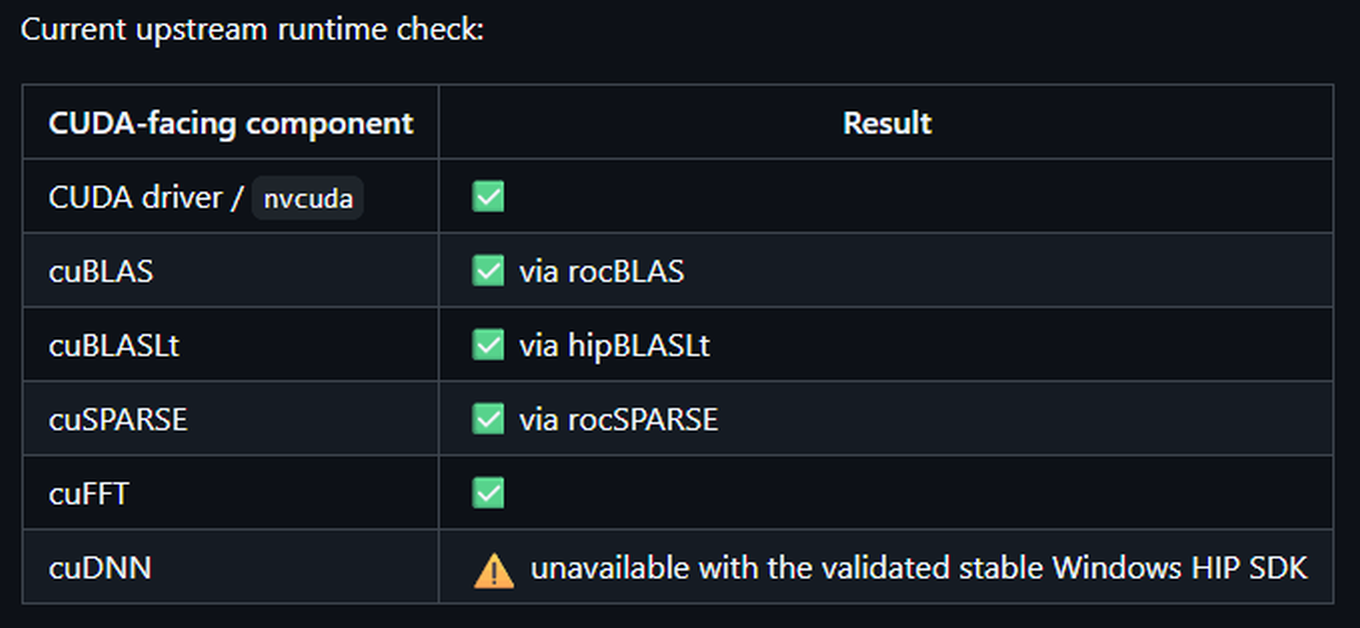
A screenshot of the CUDA for AMD Windows GitHub documentation.

Several important CUDA libraries link up, but the important cuDNN doesn't work yet. (Image credit: Speedstu/GitHub)

The result is that the developer successfully intercepted and mapped the CUDA driver API as well as the cuBLAS, cuSPARSE, and cuFFT libraries directly over to their AMD equivalents. As a proof-of-concept, the author even trained a 2.2-million-parameter PPO reinforcement-learning network end-to-end using unmodified CUDA libraries on an AMD Radeon RX 9060 XT, which happens to be the only officially supported GPU at this time.

Even with AMD's official ROCm support on Windows, the local developer community frequently runs into dependency hell when trying out experimental GitHub repos or specialized AI tools that hardcode CUDA as a requirement. For developers who want to experiment with these CUDA-only tools natively on their Windows daily driver machines without dealing with WSL2 passthrough issues or waiting for the original author to write a HIP port, this project offers a highly desirable translation pipeline. It acts as a sort of hacky adapter for software that stubbornly demands an NVIDIA card.

Benchmark testing included in the project's documentation offers some interesting findings. In a controlled A/B test running a 2.2M-parameter reinforcement learning workload on a Radeon RX 9060 XT, the "public upstream path," which relies purely on official ZLUDA releases and AMD's stock HIP SDK 6.4, achieved a median throughput of 13,278 steps per second (SPS). By contrast, an optional "recovered custom overlay" apparently built from salvaged legacy ZLUDA binaries ran slightly worse at 12,876 SPS, making it roughly 3% slower. While the clean official setup is faster, the author notes that "a later rewrite removed LibTorch/ZLUDA from PPO and achieved substantially higher throughput," indicating that there is still a performance hit for this stack of translators.

CUDA for AMD Windows Official benchmarks (BENCHMARKS.md)

Metric

Public upstream

Recovered custom

Custom delta

Overall SPS, median

13,278.46

12,875.80

-3.03%

Overall SPS, mean

13,172.49

12,649.83

-3.97%

Collection SPS, median

63,306.00

59,360.67

-6.23%

Consumption SPS, median

16,806.36

16,445.66

-2.15%

Inference time, median

0.5863 s

0.6293 s

+7.33%

PPO learn time, median

3.2076 s

3.2958 s

+2.75%

Now, before anyone declares the CUDA moat officially drained, it is crucial to set realistic expectations. First, this is a solo open-source project, not an enterprise-grade solution. The author is extremely transparent about its narrow scope, as crucial machine learning libraries like cuDNN, TensorRT, and NCCL do not resolve yet. This means compatibility is strictly workload-dependent; if your specific AI tool relies heavily on cuDNN, this setup will fail. Furthermore, it's worth pointing out that ZLUDA itself is currently being maintained as a "weekend hobby project" after losing its commercial backing a second time. Relying on this pipeline for production-level work remains a massive risk. This repository is a tinkerer's tool, not a corporate IT deployment strategy.

Despite these limitations, "CUDA-for-AMD-Windows" is pretty exciting, as it proves that the barrier to entry for running CUDA-exclusive software on AMD GPUs isn't an insurmountable hardware flaw, but a relatively tractable translation tooling problem. Because the project is entirely open-source, its potential extends far beyond this initial proof-of-concept. With community contributions, we could see expanded hardware detection and clever patches to get more stubborn CUDA libraries resolving properly.
昨天以前Tomshardware

Wiki documents at least 44 instances in which Sony says you own your games as digital games ownership lawsuit progresses — project is direct assault on Sony's claim in recent ownership lawsuit

作者 Zak Killian
2026年9月12日 18:30

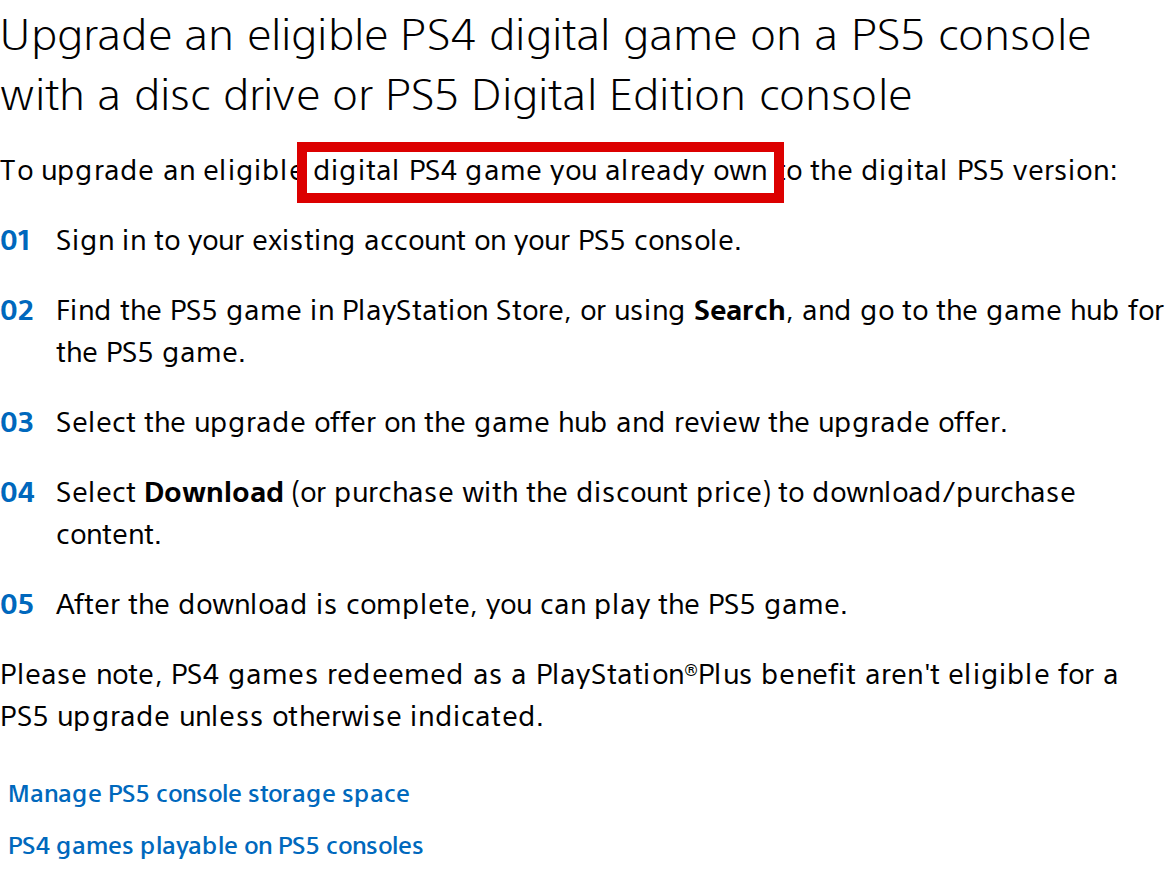
In a recent lawsuit against Sony, the firm argued that "reasonable consumers would not be misled" into believing they own digital games that they "purchased" on the PlayStation Store. Folks on the Consumer Rights Wiki have now compiled a humongous list of specific instances in which Sony currently states that users do, in fact, own their digital PS4 and/or PS5 games. The list is currently up to 44 specifically documented statements, but actually notes hundreds of examples where Sony explicitly states that users do, in fact, "own" their games across its various services and pages.

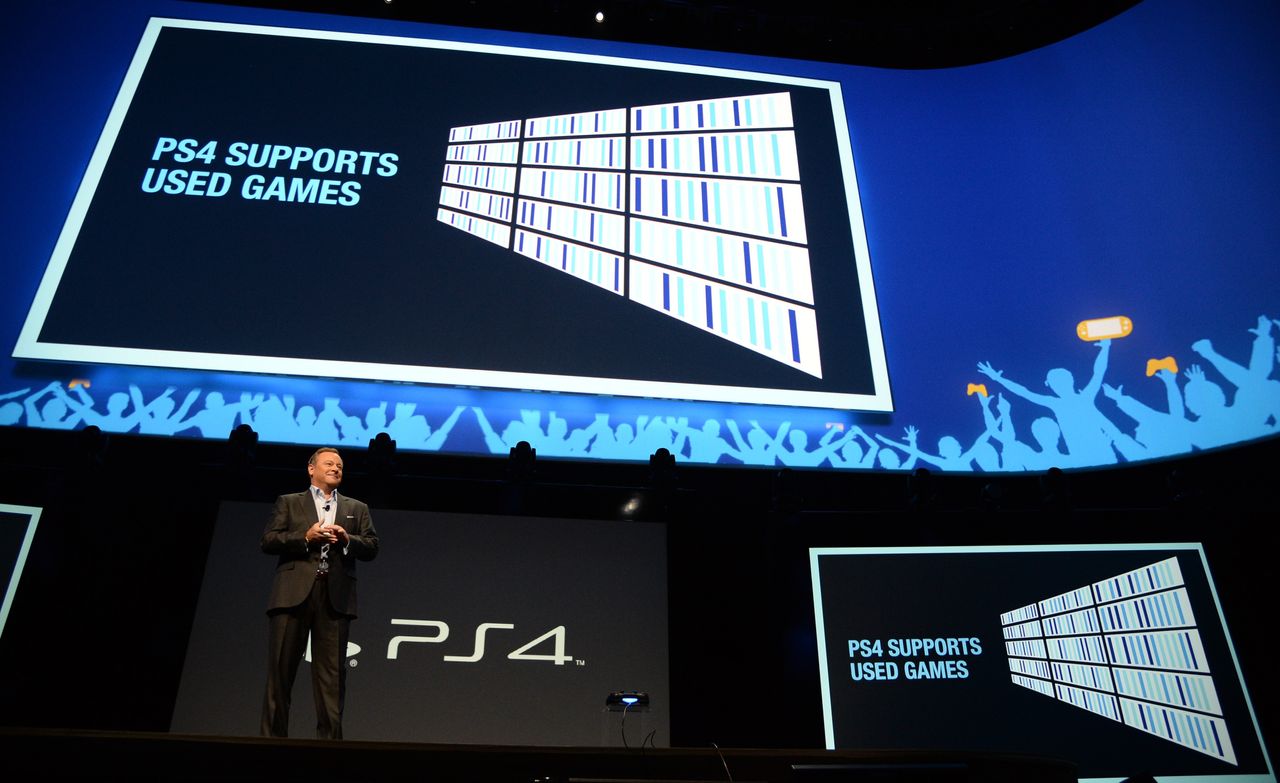
In this case, Sony says that no "reasonable person" would believe that, when they add a game to their cart and click "Purchase" on the PlayStation Store, they are entering a contract that entitles them to ownership of the digital goods in question. Instead, Sony believes it's obvious that what you're paying for is a limited, revocable license for a service that only remains available as long as Sony offers it, which is quite different from ownership in a legal context.

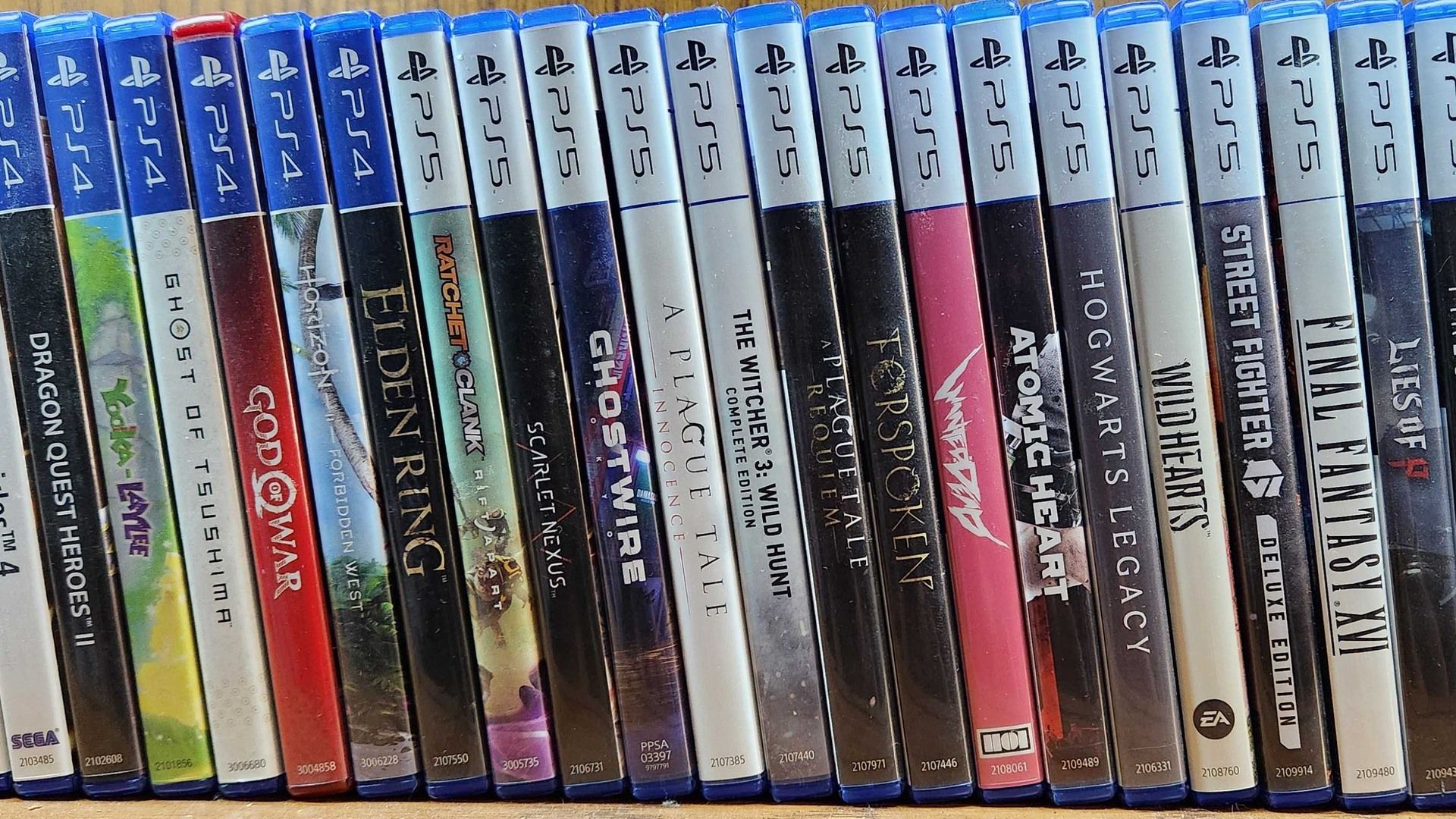
A photograph of PlayStation 4 and PlayStation 5 games in their cases.

Whose games, exactly? (Image credit: Zak Killian/Future)

The case isn't exactly about ownership, though; it's really about consumer disclosure and product representation. The plaintiffs aren't arguing that buying a digital game somehow transfers ownership of Sony's underlying intellectual property, but rather that Sony's use of words such as "buy," "purchase," and "own" could reasonably lead consumers to believe that they were acquiring a durable right to use the game, rather than merely obtaining a revocable license. That distinction matters because Sony's defense depends in part on the claim that no reasonable consumer would interpret the transaction that way. At the same time, the plaintiffs have produced a substantial body of evidence showing that Sony itself routinely uses precisely that ownership language when describing the digital games its customers have purchased.

This issue is in particularly sharp relief now that Sony's digital store is confirmed to be the only way to purchase new PlayStation games from next year. The publisher's announcement that it would stop producing game discs in January of 2028 caused quite an uproar among gamers who value physical copies of games as a token of ownership. It's worth noting that most players do purchase games digitally (as much as 85% of PlayStation games, by some reporting), and also that disc production and usage become less practical as the manufacturing of both disc drives and discs slowly winds down.

The gamer outrage isn't really about the end of discs, though. This fury has been simmering for a good while now, as gamers resent perceived anti-consumer practices. The realization that discs are going away simply forced a lot of gamers outside the enthusiast sphere to confront the reality that they do not own their digital purchases and that they can be taken away at any time, just as Sony has already done in the past. This is especially pointed in light of the price increases asked by game publishers in the last few years, where games have gone from a typical ceiling of $60 USD up to $70 and now, more recently, $80 (with Mario Kart World, Zelda: Tears of the Kingdom, and now Grand Theft Auto VI), despite often struggling to provide the same level of satisfaction and enjoyment as older titles.

A screenshot of a Sony website showing the language

There are many more examples like this on the Consumer Rights Wiki page about the lawsuit. (Image credit: Screenshot of Sony Interactive Entertainment website — source: Consumer Rights Wiki, licensed under CC BY-SA 4.0. Screenshot by unknown author. No modifications.)

And so we come back around to the Consumer Rights Wiki and its list of times that Sony has explicitly used ownership language on its website and on its digital storefront. The Wiki catalogs these quotes with both links to live pages as well as archived snapshots and screenshots with the relevant text highlighted. The Consumer Rights Wiki was of course founded by consumer rights advocate and YouTuber Louis Rossmann, but much of the work was done by the community that has sprung up around the site as people rebel against the continuous erosion of their consumer rights, particularly by technology companies that argue against their own responsibility.

It's unfortunately still not clear if this case is actually going to trial yet. Sony is attempting to have the case moved to private arbitration, citing that all four plaintiffs agreed to such when signing up for the PlayStation Network; in that case, Sony will likely pay a small cash award to each plaintiff and the matter will be settled, legally speaking. If the case goes to trial, there's a possibility for real legal precedent to be set by a public ruling, at least in California. For the sake of consumer transparency on the PlayStation Store, let's hope that the court agrees to hear this one.

Nvidia app update fails to block unofficial DLSS multi-frame generation mod on RTX 40 series gaming GPUs — modders restore support across multiple games within hours

作者 Zak Killian
2026年9月4日 22:56

When NVIDIA launched the GeForce RTX 50 series, a major part of the hype surrounding the new GPU family was its support for DLSS Multi-Frame Generation. This feature was officially locked to the new RTX 50 "Blackwell" GPUs, but modders have been working on unlocking it for RTX 40-series cards for a while now. NVIDIA is clearly aware of these efforts, as it recently pushed an over-the-air update via the NVIDIA App that seemed targeted at blocking them due to its odd changes. Yet, as pointed out by Sebastian Castellanos on X, enterprising hackers had already found a workaround just hours later.

At the launch of Blackwell, NVIDIA explained that bringing Multi-Frame Generation to previous-generation RTX 40-series cards wasn't possible because those GPUs relied on a hardware optical flow generator incapable of producing multiple interpolated frames per rendered frame. Instead, Blackwell introduced a software-based optical flow method executed directly on the GPU shader cores without requiring the hardware unit. To tech-savvy gamers, the obvious question arose: why not use that same software method on Ada Lovelace GPUs and bypass their hardware optical flow units? NVIDIA showed no interest in enabling this, leading many to assume it was technically impossible.

I uploaded a video on how to enable DLSS Multi-Frame Generation on my RTX 4060 GPU.I tested RE9 and Forza Horizon 6. To be honest apart from the oblivious latency increase, it works extremely well!Thanks to @Sebasti66855537 for notifying me about this mod!Video linked below pic.twitter.com/Tldr9JZIxJSeptember 4, 2026

Put simply, it's possible. There are apparently various roadblocks within NVIDIA's software, but the strength of the PC platform lies in its openness; users can freely modify software running on their own hardware. And so, at least three distinct mods have emerged to unlock DLSS Multi-Frame Generation across multiple titles. It began with a Cyberpunk 2077 mod by creator "dashdogy" that relied on game-specific modding frameworks, but the technique has since been adapted into a broader ReShade plugin applicable to almost any game, and that's just one of at least three different multi-game unlock mods I found.

It's obviously in the company's best interest to protect its marketing narrative, and the narrative is that Multi-Frame Generation doesn't work on GeForce RTX 40 series graphics cards. However, user reports across X and Reddit tell a different story. Users report that the mods not only work, but also deliver surprisingly smooth frame pacing. NVIDIA had previously warned that Blackwell's specialized hardware flip metering was mandatory for proper frame pacing with multi-frame generation, but dashdogy noted that his mod backports "Blackwell-specific frame timing instructions to allow Ada to place the frames in the correct positions," suggesting that MFG's purported hardware dependency was greatly exaggerated.

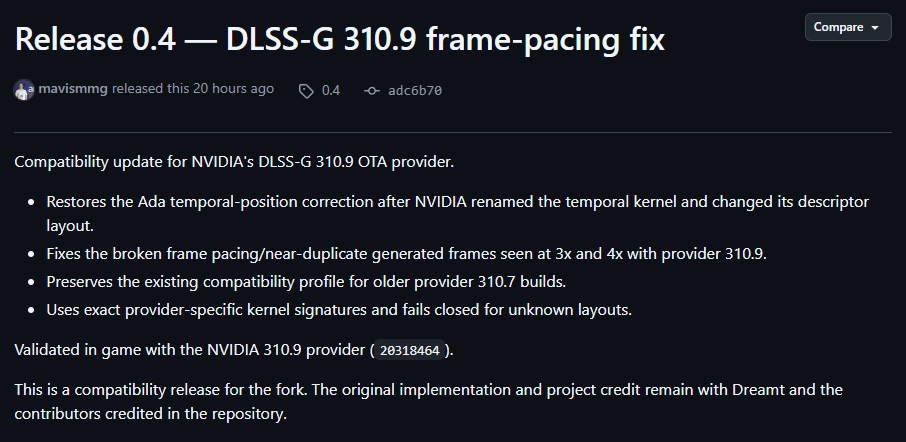
A screenshot of the MFGAdaUnlock-RenoDx GitHub project showing the patch notes for Release 0.4.

There are already two more updates after this, both fixing major bugs. (Image credit: Future)

Earlier attempts to enable multi-frame generation on Ada Lovelace relied on GPU spoofing or hybrid solutions, like combining standard 2x DLSS Frame Generation with AMD's FSR 3 or Lossless Scaling's software frame generation. Those workarounds were significantly clunkier than native game mods that utilize NVIDIA's own DLSS-G framework. While I couldn't get this latest mod working in the limited time before publication, community developers have not only bypassed the latest roadblocks thrown up by Mean Green, but in fact, they've released at least two more updates for the mod in the last ten hours since Castellanos' X post.

All of this coincides rather neatly with the contentious rollout of DLSS 5 "Neural Rendering," which is another technology originally pitched as an RTX 50-series exclusive before NVIDIA made a last-minute reversal to promise it for RTX 40-series cards as well. That shift may well have been driven by hackers porting DLSS 5 Neural Rendering not just to older NVIDIA architectures, but even to AMD Radeon GPUs. Once it became common knowledge that DLSS 5 runs on non-Blackwell hardware, continuing to claim hardware exclusivity risked a major loss of consumer trust. It'll be fascinating to see if NVIDIA will pivot on DLSS Multi-Frame Generation in the same way. While it would be a nice bone to throw the company's loyal previous-generation customers, we wouldn't bet on it.

❌
❌