Perplexity has released Portable Computer for Windows, in partnership with Nvidia, via the existing Perplexity app for Windows. Previously, this functionality was only available on Linux-based operating systems. The hardware requirements remain, meaning the host system must have at least 24GB of VRAM with a GeForce RTX or RTX PRO GPU. Likewise, a Pro or Max Perplexity subscription is required. Portable Computer was originally launched on the DGX Spark as a fully local AI agent platform.
Portable Computer, launched originally for Linux on Aug. 25, is a local version of Perplexity Computer, which is the company’s agent for multistep tasks. Perplexity Computer can plan, run subtasks through connectors and tools, and produce a result other than a simple chat response. This runs in Perplexity’s cloud and consumes Computer credits. Portable Computer is the same agent but with features running on your local PC instead of in the cloud. Local work does not consume credits, but the agent can send tasks to cloud models with explicit permission if necessary, the company said. Nvidia said on Sept. 3 that Windows support was coming soon.
(Image credit: Perplexity)
Portable Computer for Windows comes with some new features. These include scheduled recurring tasks and local MCP servers for desktop apps, according to Perplexity. Nvidia listed connectors for Microsoft Word, Google Drive, Gmail, Slack, and GitHub. The app also includes a dropdown for downloading a local model with one click. Nvidia named Qwen 3.8 27B as an example local model. DGX Station support is expected soon, Nvidia said.
Aravind Srinivas, CEO of Perplexity, wrote on X on Sept. 14 that with this release comes “unmetered local intelligence on every Windows PC running on Nvidia hardware and Perplexity harness.” The 24GB requirement is a VRAM gate more than a generation gate, cutting across Nvidia’s consumer lineup. Cards that meet the stated 24GB+ VRAM requirement include the RTX 3090 and 3090 Ti (24GB), the RTX 4090 (24GB), and the 5090 (32GB). The RTX 5090 Laptop GPU at 24GB has not explicitly been mentioned by either company. RTX PRO Blackwell cards that qualify are the 4000 (24GB), 4500 (32GB), 5000 (48GB or 72GB), and 6000 (96GB).
We're expanding our work with @nvidia to bring fully local AI to Microsoft Windows PCs with RTX GPUs. Unmetered local intelligence on every Windows PC running on NVIDIA hardware and Perplexity harness. Enjoy!September 14, 2026
In a Sept. 3 post ahead of IFA, the consumer electronics trade show in Berlin, Nvidia indicated more plans along these lines. The post stated that RTX Spark Windows PCs from Lenovo and Acer are expected in October and that two local agents, Hermes Agent and OpenClaw, are getting the same simplified local setup. For users who already own a qualifying RTX PC, the Windows release removes the need to buy a separate system. Upgrading a compatible desktop with a used qualifying card could also cost less than buying the DGX Spark Founders Edition at its $4,699 price.
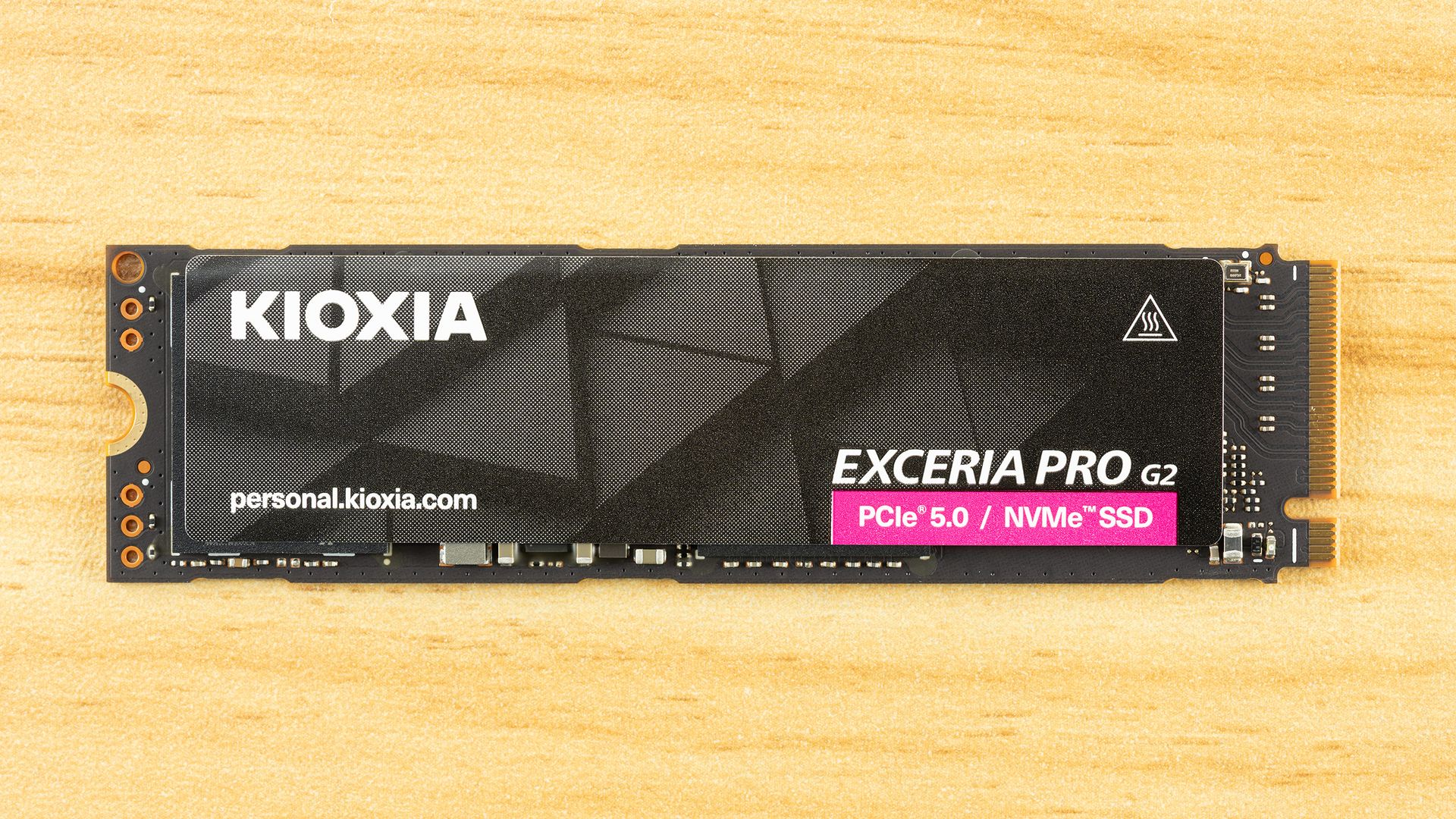
We always like to review Kioxia drives because they usually provide the perfect marriage of performance and reliability. We certainly wish they were more readily available in retail in the U.S., but we can still appreciate a good design when we see it. The Exceria Pro G2 continues in that lineage with all-new levels of performance you can only get with the newest hardware and a PCIe 5.0 interface. It’s like a Kingston Fury Renegade G5 made for OEMs, providing most of the performance you expect from this class of drive with reliability-minded firmware built in.
The important bit is that this drive still delivers what you’d expect. That means high performance, including sustained write performance, good power efficiency, and very low random read latency. These are the hallmarks of a drive that offers an excellent user experience. This is a very fast drive, just not the very fastest, but we make the argument that this is a deliberate trade-off for a drive with roots in an area where reliability is a bigger priority. For some, that might otherwise tip things in its favor. Regardless of your stance, though, its price in areas where it is available is competitive, and we can judge it by that.
The Kioxia Exceria Pro G2 is available in 1TB, 2TB, and 4TB capacities. These are the most popular capacities, with 8TB yet again out of reach due to rising prices. The drive can reach up to 14,900 / 13,700 MB/s and 2,300K / 1,950K random read and write IOPS at the highest capacity. Most of this performance is achievable at 2TB, which is likely the sweet spot.
The drive has the usual five-year warranty with up to 600TB written per terabyte. Encryption support is not explicitly mentioned, and for a model in this line, we would expect TCG Pyrite and software encryption support only.
For pricing, we are making estimates based on pre-tax listings in the EU. Kioxia does not officially distribute the drive at U.S. retail, and the Amazon.com listings you find may be imports. These come in at ~$190, ~$340, and ~$650. These estimates make it look downright affordable, with the 1TB and 2TB models well under the WD Black SN8100, and the 4TB is roughly at parity at the time of review. It would be more expensive to import the drive, of course. One reason Kioxia can keep the price of the drive down is that it manufactures the flash it’s using, and its competition there – Crucial dropped out of the market, for one – is reduced.
Kioxia Exceria Pro G2 Software and Accessories
Kioxia supports its SSDs with SSD Utility Management Software, or SSD Utility for short. This SSD toolbox includes a summary of the drive and system, a firmware update feature, drive health monitoring, a secure erase function, password protection, and a section for troubleshooting. For data backup, we recommend MultiDrive for Windows – there is a portable version available, as well as a bootable WinPE image – or Clonezilla for other operating systems.
Kioxia Exceria Pro G2: A Closer Look
Tom's HardwareTom's Hardware
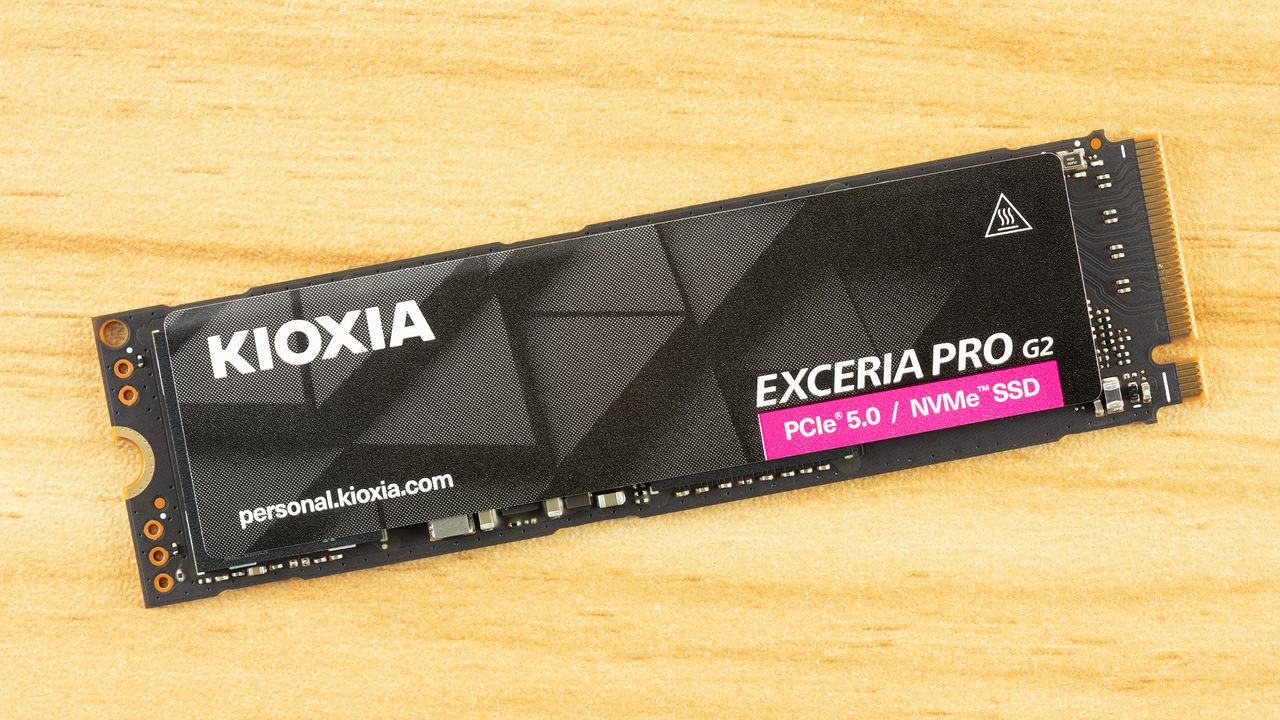
This is a single-sided drive in the M.2 2280 form factor. Specifically, the 1TB and 2TB conform to 2280-S3-M, while the 4TB is 2280-S4-M. These are all single-sided, but the 4TB is slightly thicker at 2.63mm versus 2.38mm. This is because it needs 16-die, rather than 8-die, NAND flash packages to achieve 2TB per package. The resulting extra height should not be an issue in most cases but is worth noting for devices with specific limitations.
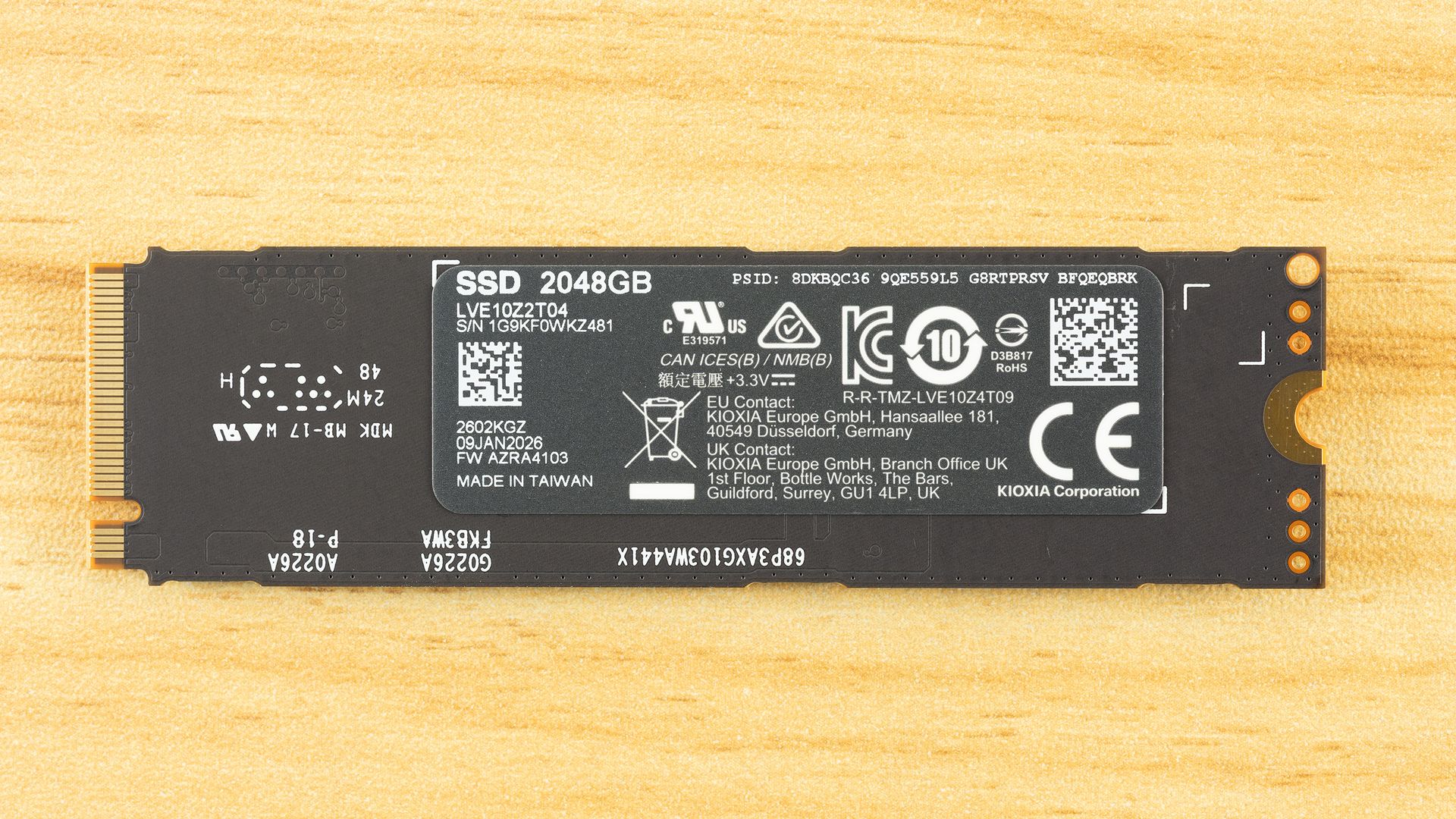
The rear label has the Physical Presence Security ID (PSID), which allows a security reset to the factory state with an unlocked drive. This fits in with our expectation above that this drive is TCG Pyrite 2.01 compliant. The drive reports support for commands that TCG relies on, but Kioxia does not explicitly advertise hardware encryption.
Tom's HardwareTom's HardwareTom's Hardware
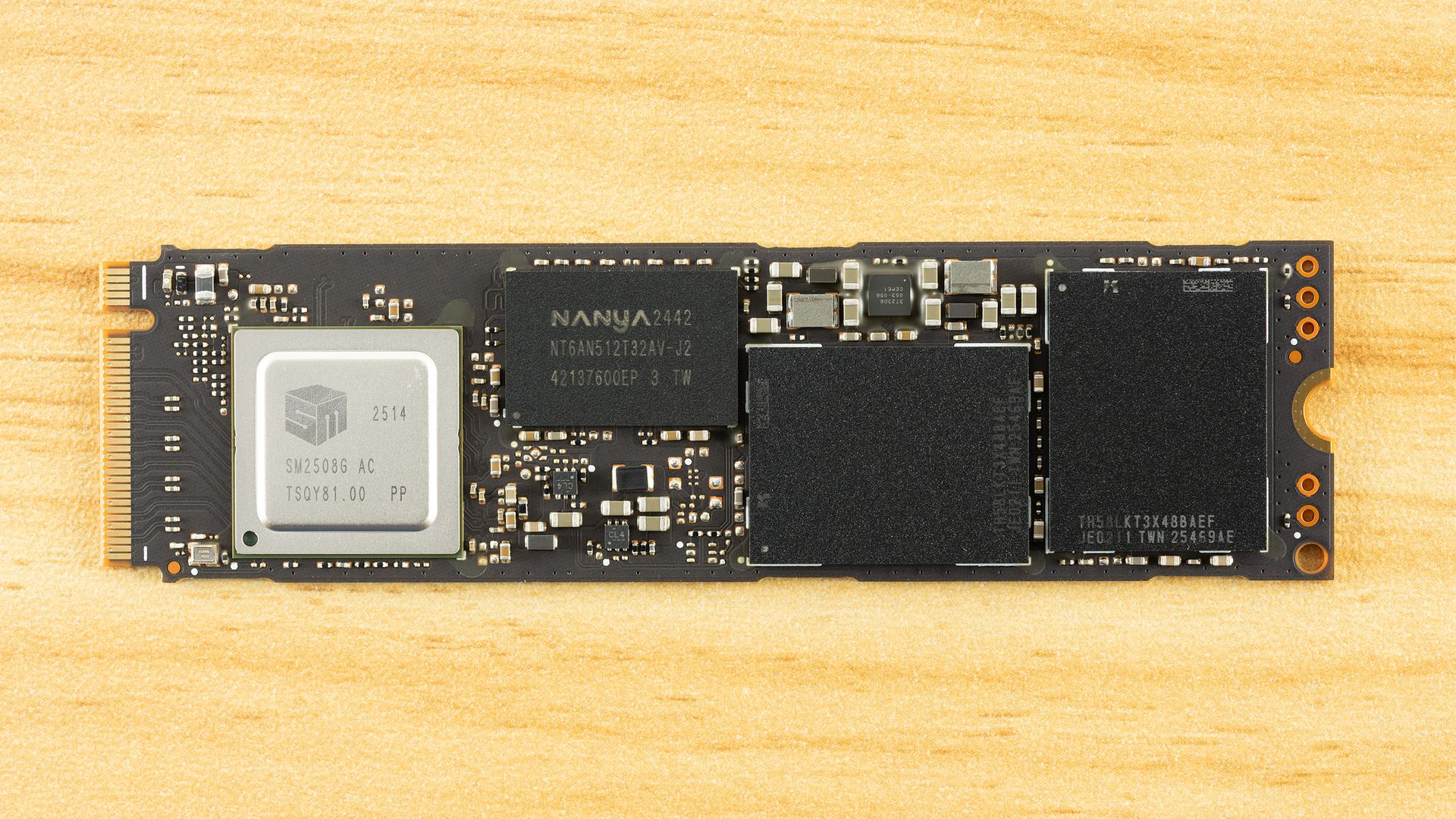
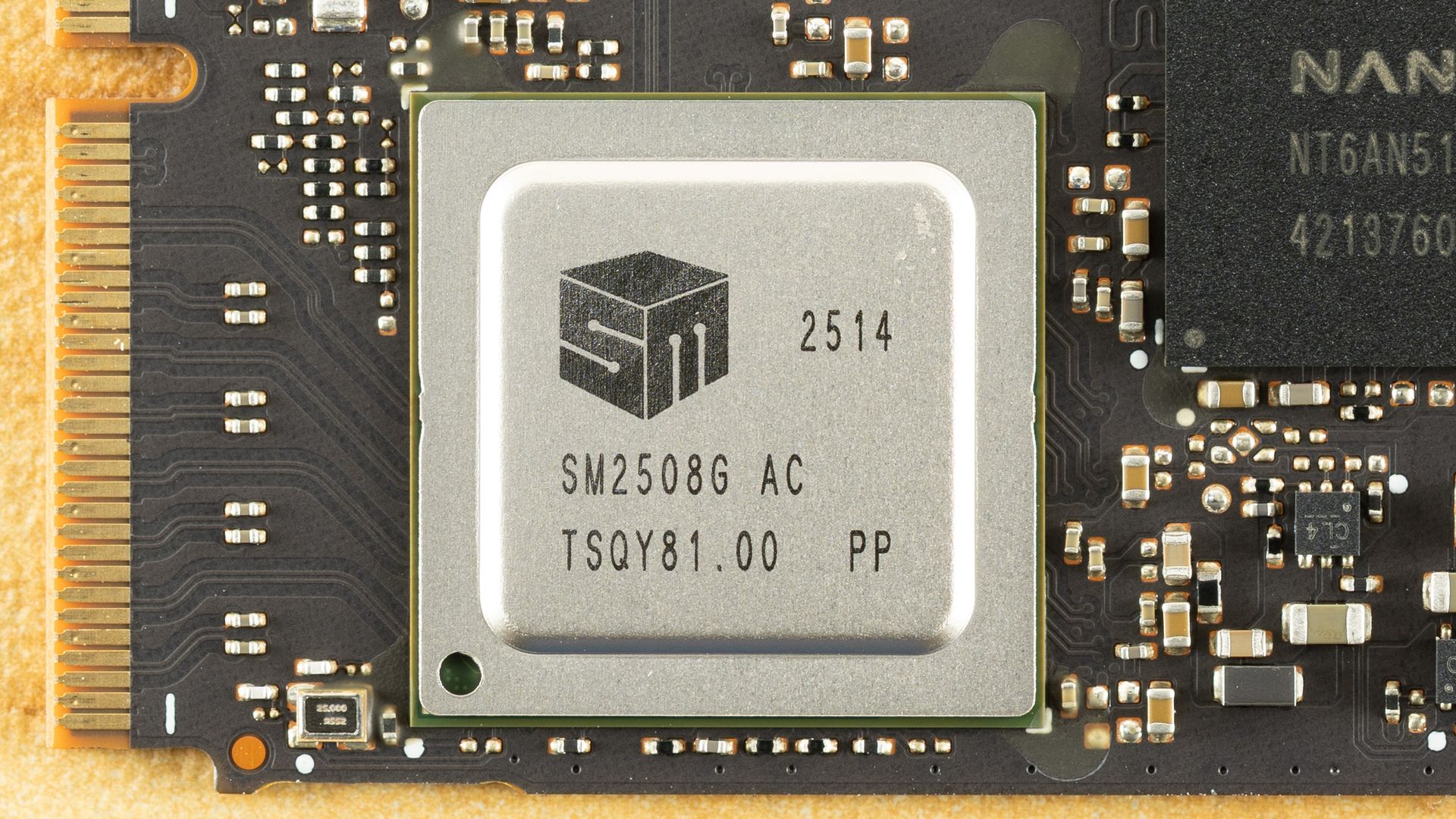
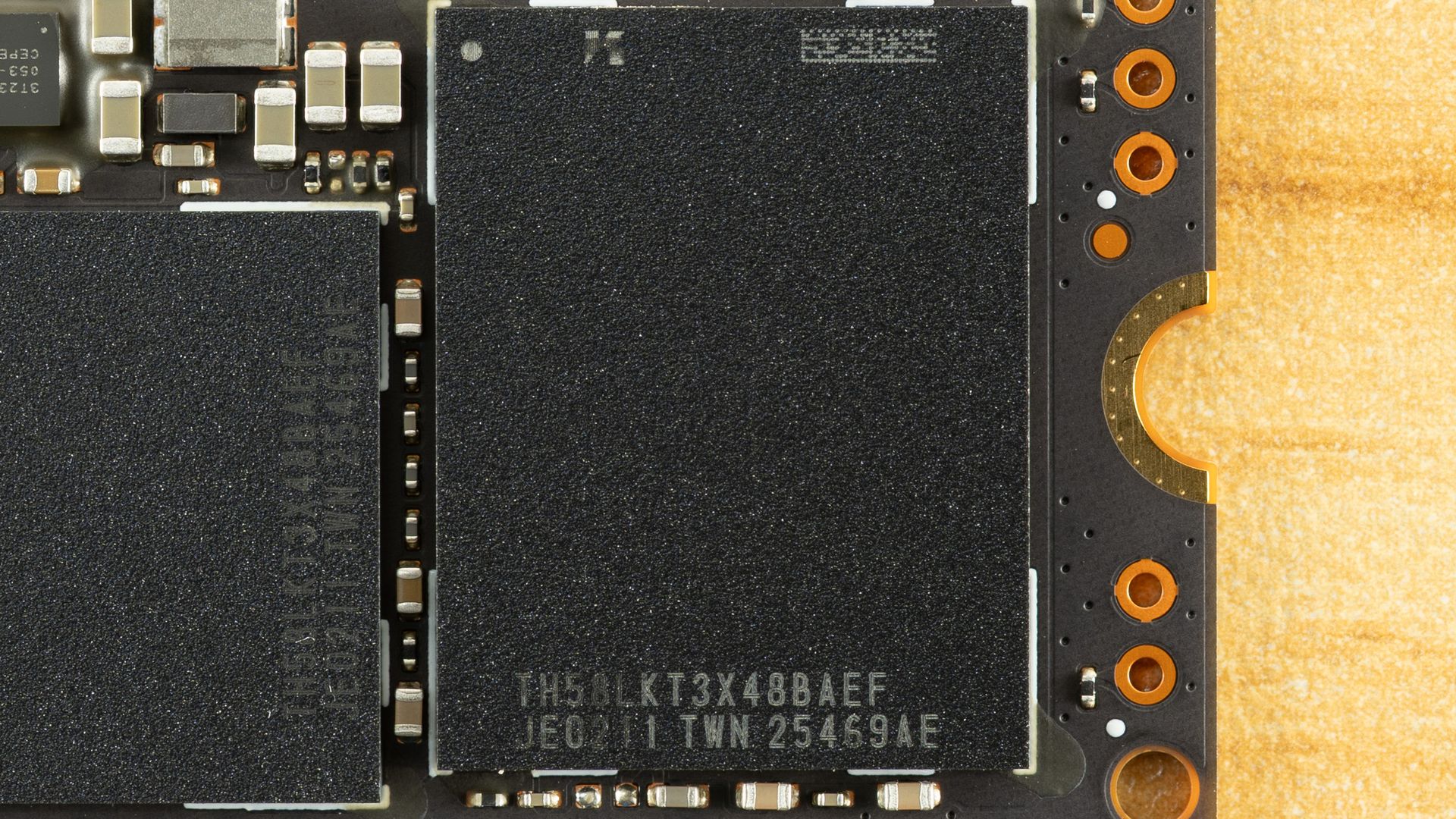
On the top of the drive, we see the Silicon Motion SM2508 SSD controller, a single DRAM package, and two NAND flash packages. We have covered the controller multiple times, and it has been paired with a range of flash, although the best-known model to use it is probably the WD Black SN8100. Both the Black SN8100 and Exceria Pro G2 are using 218-Layer BiCS8 TLC flash, but the former uses Sandisk BiCS while the latter uses Kioxia’s instead.
When we reviewed the Corsair MP700 Pro XT with Phison’s E28 controller, we noted that the E28 was supplied at one time or another with both types of BiCS. Our understanding is that there is at least one subtle difference between the two – in packaging, or so we’ve heard – and Sandisk has made it a point to emphasize its own flash on its drives. The launch E28 was faster than the prototype we previewed, but we expect firmware maturation was the most significant element. We would rather more carefully say that while Sandisk and Kioxia co-develop and share wafer output, downstream elements – die sorting, binning, package design, and possibly also how I/O speed is maintained – can differ. We wouldn’t lean towards one drive or another based on something like this, but must also point out that WD, Sandisk, and Kioxia all have their own firmware optimizations at play, which are generally more influential.
As for the DRAM, our sample has 2GB of LPDDR4X, but the exact memory will vary from drive to drive. This is not a huge consideration, but we do prefer LPDDR4/4X over DDR4 for even small power savings. The drive does have the correct 1GB-per-TB ratio of DRAM to NAND.
The Kioxia Exceria Pro G2, as a high-end drive, faces the stiffest competition we have on hand. This includes the fastest drives we’ve ever tested, the Corsair MP700 Pro XT and WD Black SN8100. We also have drives with the same hardware as the Exceria Pro G2, namely the Kingston Fury Renegade G5. The Crucial T710 uses the same controller but with Micron-made flash rather than BiCS. The T705 slots in as an example of an older high-end Gen 5 design. We also have the proprietary Samsung 9100 Pro, the more budget-oriented Lexar NM1090 Pro with older flash, and an InnoGrit-based offering from TeamGroup in the GE Pro. We are not comparing any DRAM-less drives like the Biwin Black Opal X570, as they are not in this class of drive.
Trace Testing — 3DMark Storage Benchmark
Built for gamers, 3DMark’s Storage Benchmark focuses on real-world gaming performance. Each round in this benchmark stresses storage based on gaming activities including loading games, saving progress, installing game files, and recording gameplay video streams. Future gaming benchmarks will be DirectStorage-inclusive and an evaluation for future-proofing is included where applicable.
Tom's HardwareTom's HardwareTom's Hardware
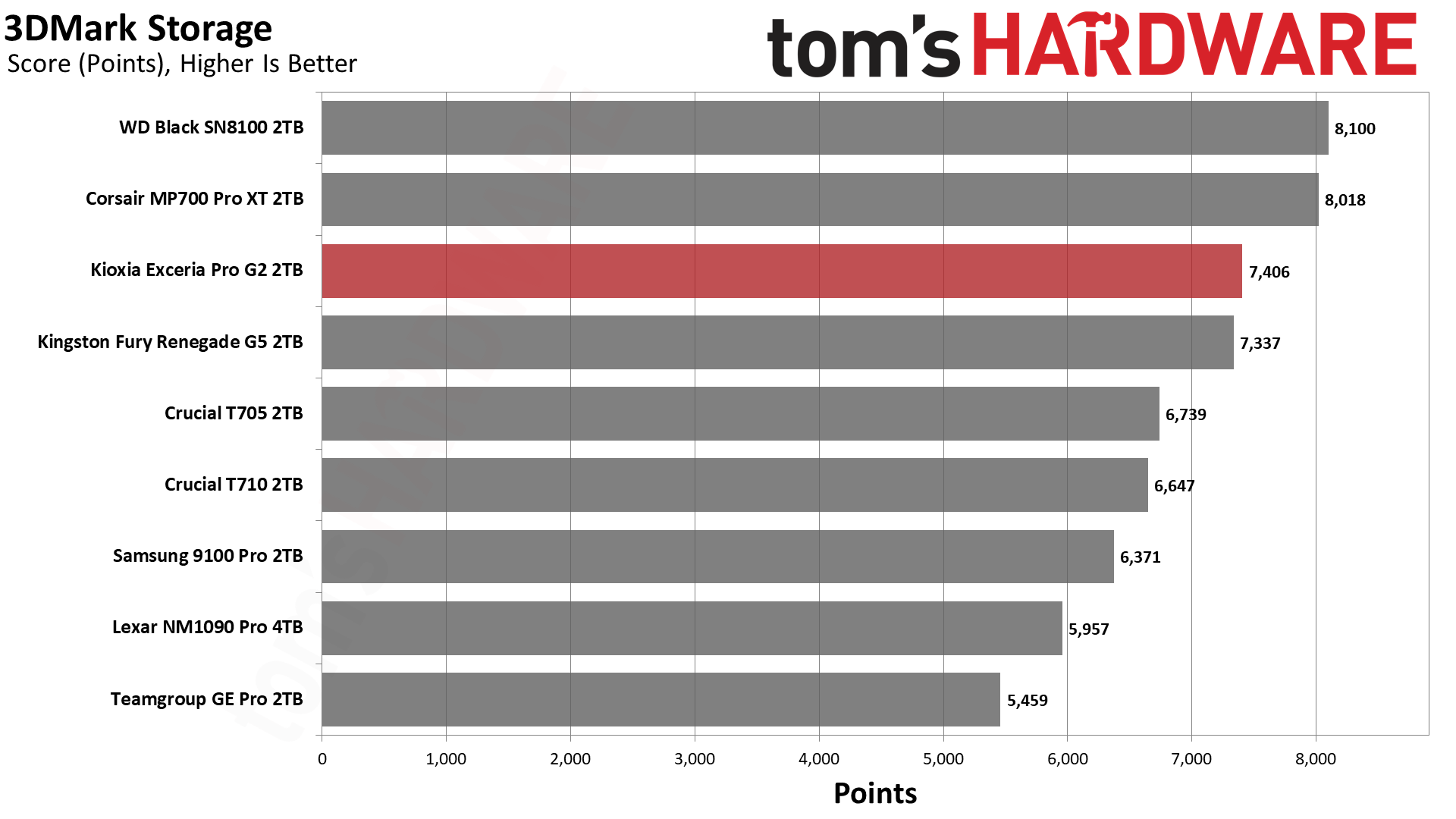
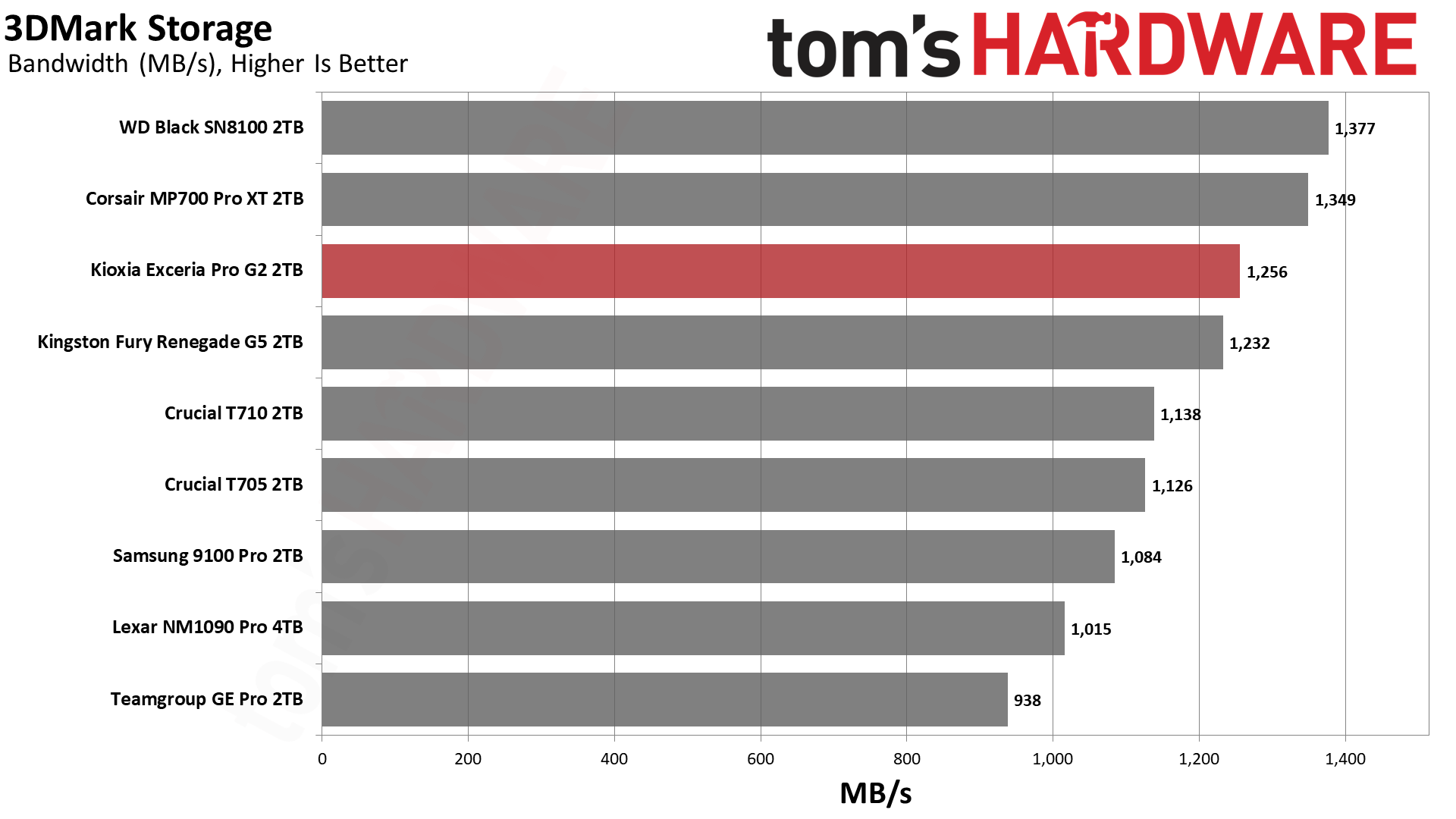
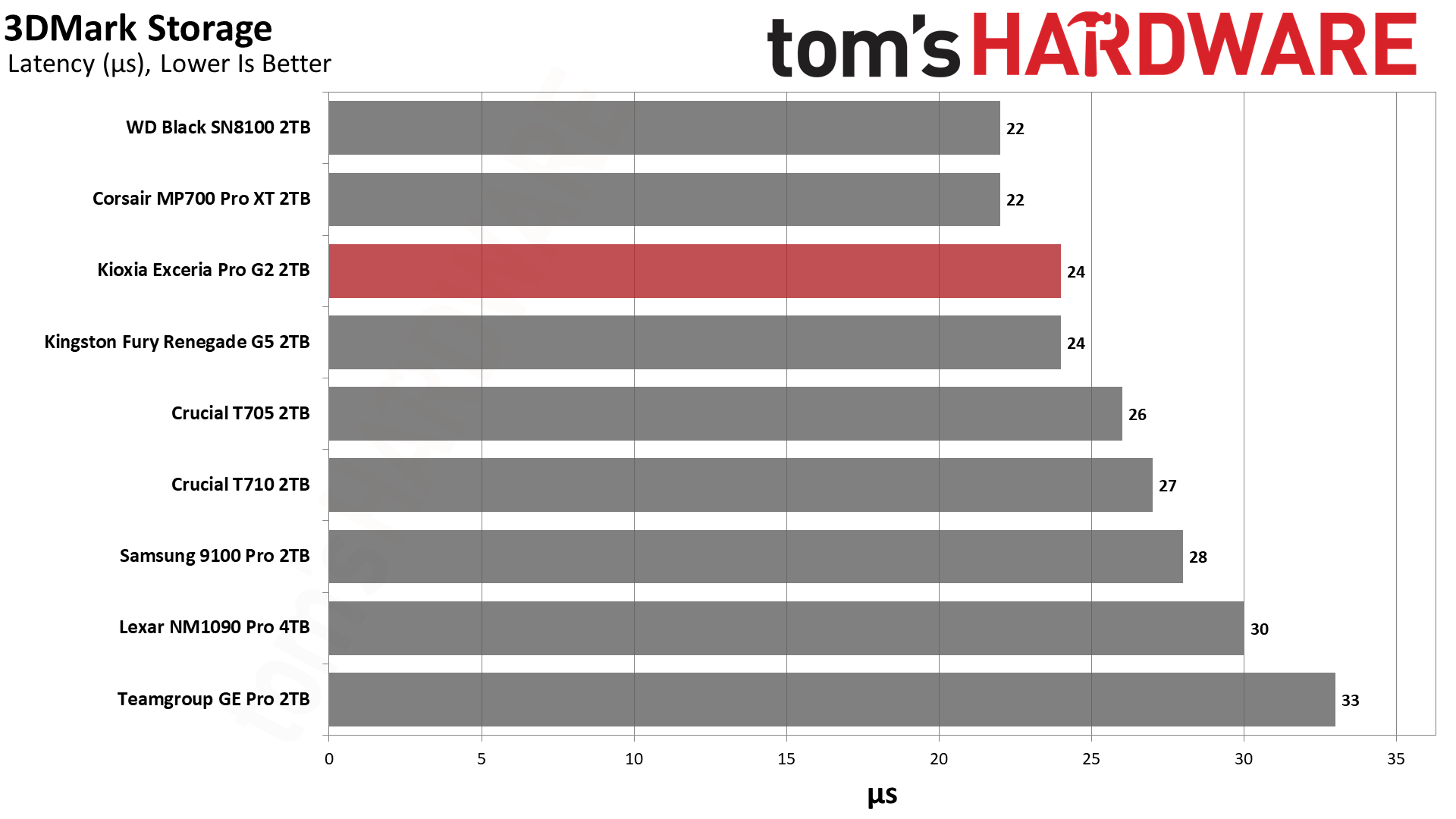
The Exceria Pro G2, being a high-end PCIe 5.0 SSD, is bound to be an excellent gaming drive. High bandwidth paired with the newest hardware is a win-win. Still, we like to qualify this with a 3DMark pass. Our finding is that the Exceria Pro G2 scores exactly where we would expect it to – right next to the Fury Renegade G5. These two drives have the same hardware, so no surprise there. The WD Black SN8100, which also has the same hardware, remains tied at the top with the Phison-controlled MP700 Pro XT. As we explained in the Black SN8100 review, this is because WD/Sandisk put some special magic in the firmware. Phison no doubt wanted to match that performance level, and actually did, but we have more than one SM2508-controlled drive to compare, which makes the SMI side of things more interesting.
Let’s look at the T710, for example. Same SM2508 controller but with Micron rather than Sandisk or Kioxia BiCS TLC flash. It’s a good performer, but clearly not as fast in 3DMark. The BiCS8 flash used on all of the fastest drives here has very low latency, which brings excellent results in many of our tests. Latency is, in fact, probably the number one thing enthusiasts look at with SSDs, with dreams of Optane-like performance. Consumer NAND flash, however, is simply not designed with that kind of ultra-low latency in mind. You are also usually bottlenecked elsewhere, to the point that improvements here lead to very little real-world value. Games load faster, sure, but there will be no improvement in FPS. That said, the Exceria Pro G2 will deliver a very good experience even in suboptimal circumstances, such as when the drive is very full.
Trace Testing — PCMark 10 Storage Benchmark
PCMark 10 is an industry standard trace-based benchmark that uses a wide-ranging set of real-world traces from popular applications and everyday tasks to measure the performance of storage devices. The results are particularly useful when analyzing drives for their use as primary/boot storage devices and in work environments.
Tom's HardwareTom's HardwareTom's Hardware
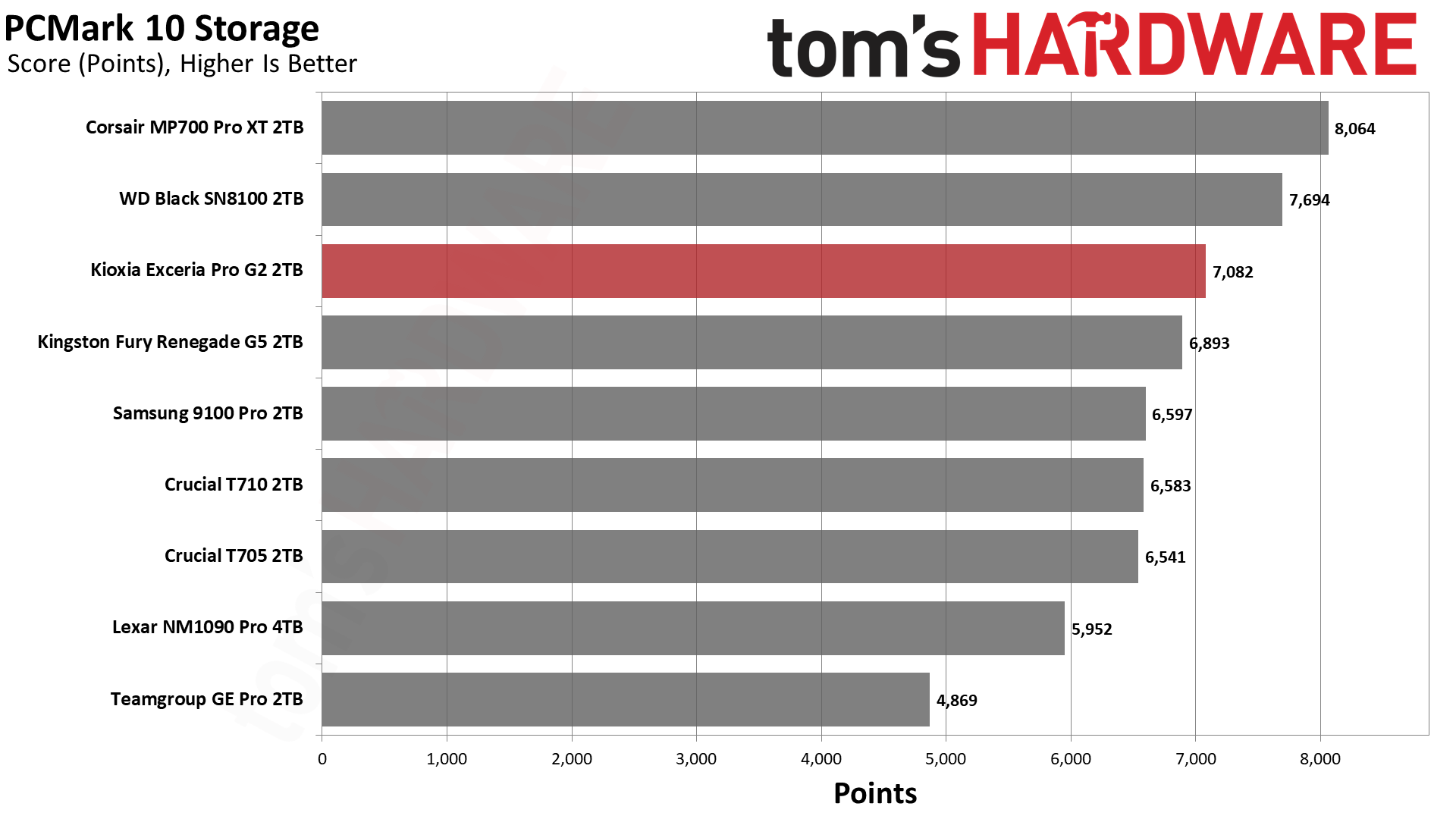
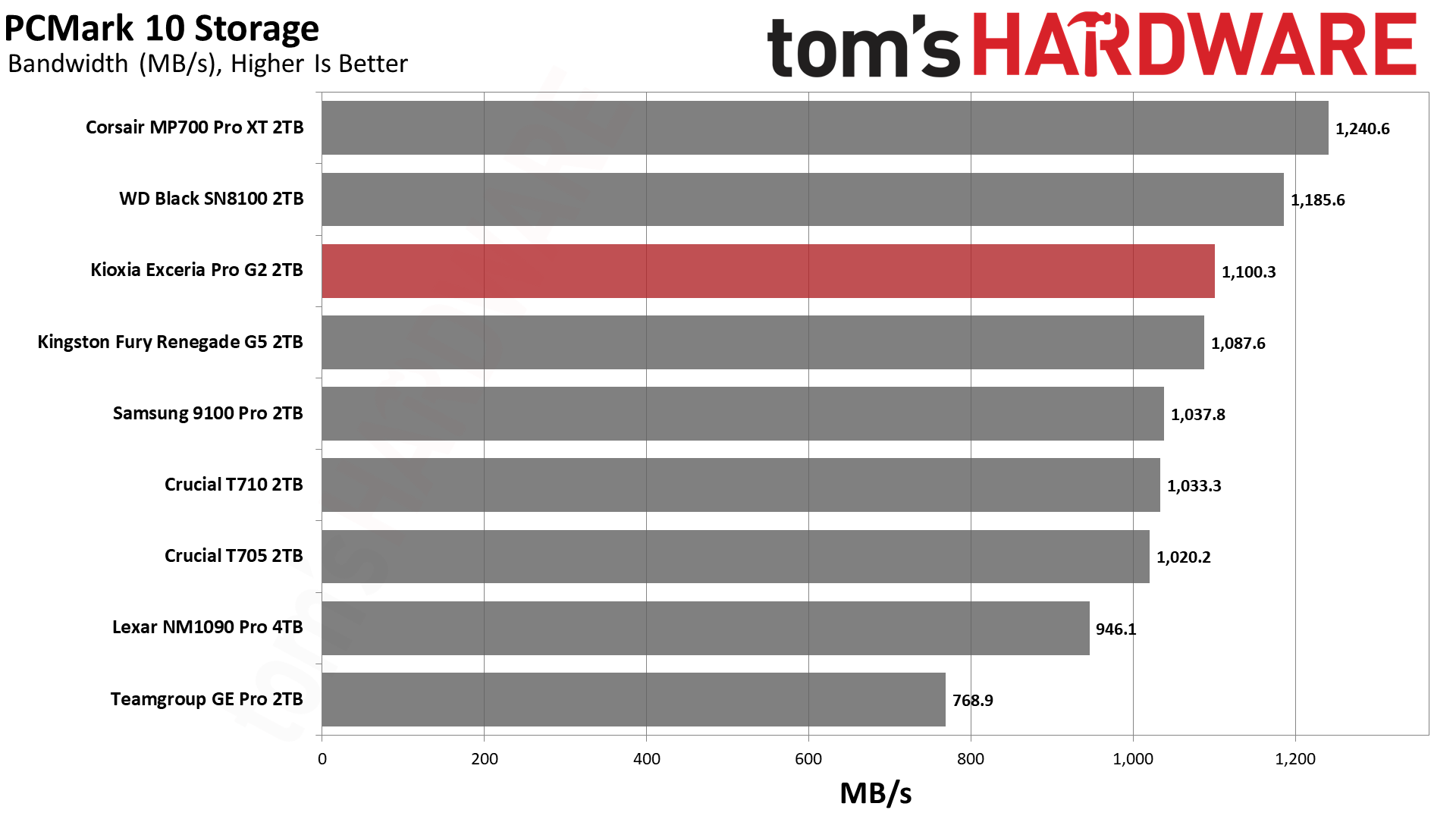
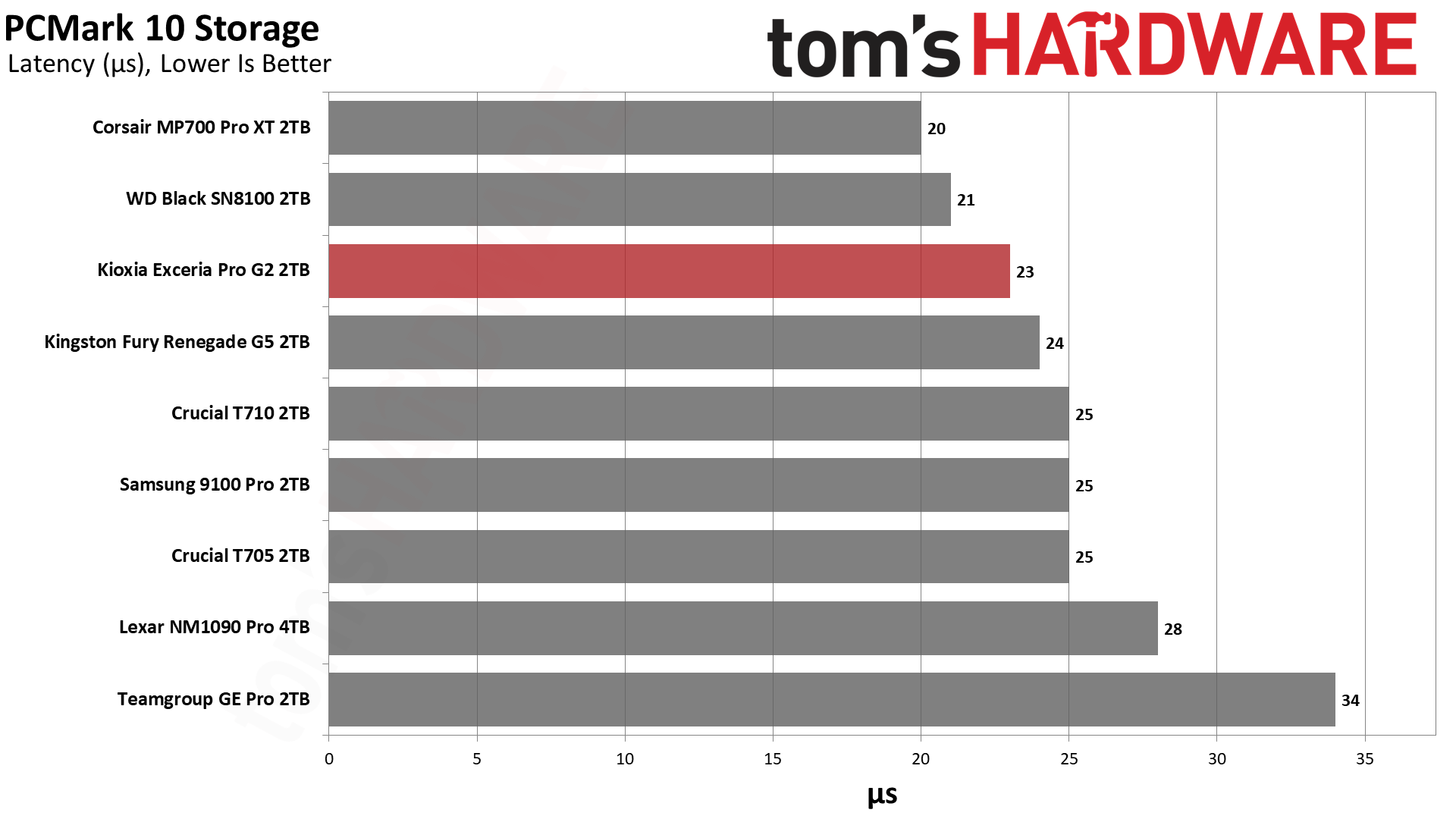
In PCMark 10, the Exceria Pro G2 lands a little bit above the Fury Renegade G5 – a good showing, considering they use the same hardware – but behind the MP700 Pro XT and Black SN8100. Performance is excellent in general, particularly for a drive that’s relatively affordable in its target regions. These numbers dwarf decent last-gen drives, with the Exceria Pro G2 scoring about 75% higher than something like the Crucial P5 Plus, for instance. That’s to be expected to some extent, as you have about twice the bandwidth with PCIe 5.0, but this drive also has significant improvements in latency.
Console Testing — PlayStation 5 Transfers
The PlayStation 5 is capable of taking one additional PCIe 4.0 or faster SSD for extra game storage. While any 4.0 drive will technically work, Sony recommends drives that can deliver at least 5,500 MB/s of sequential read bandwidth for optimal performance. Based on our extensive testing, PCIe 5.0 SSDs don’t bring much to the table and generally shouldn’t be used in the PS5, especially as they may require additional cooling. Check our Best PS5 SSDs article for more information.
Our testing utilizes the PS5’s internal storage test and manual read/write tests with over 192GB of data both from and to the internal storage. Throttling is prevented where possible to see how each drive operates under ideal conditions. While game load times should not deviate much from drive to drive, our results can indicate which drives may be more responsive in long-term use.
Tom's HardwareTom's HardwareTom's Hardware
A PCIe 5.0 drive for the PS5 is overkill, but it’s still important to test to make sure there are no anomalies with the drive. It’s within 1% of the fastest drive in the PS5’s internal read test, so no concerns there. Depending on the price, it can also be beneficial to use a PCIe 5.0 drive in the console. Such a drive will be running at a lower link speed and will be more efficient and cooler-running. Newer drives will use new technology and hardware, which means improved operation even in older host devices.
We generally recommend using less expensive drives for the PS5, but something like the Exceria Pro G2 remains an acceptable option. Kioxia has also validated the drive against Sony’s requirements with its own PS5 testing, relevant if you are someone who prefers to trust a drive so thoroughly tested. It’s also an acceptable use of the drive if you’re buying it ahead of a future build, whether you catch a sale or are trying to avoid future higher prices.
Transfer Rates — DiskBench
We use the DiskBench storage benchmarking tool to test file transfer performance with a custom 50GB dataset. We write 31,227 files of various types, such as pictures, PDFs, and videos to the test drive, then make a copy of that data to a new folder, and follow up with a reading test of a newly written 6.5GB zip file. This is a real-world type workload that fits into the cache of most drives.
Tom's HardwareTom's HardwareTom's Hardware
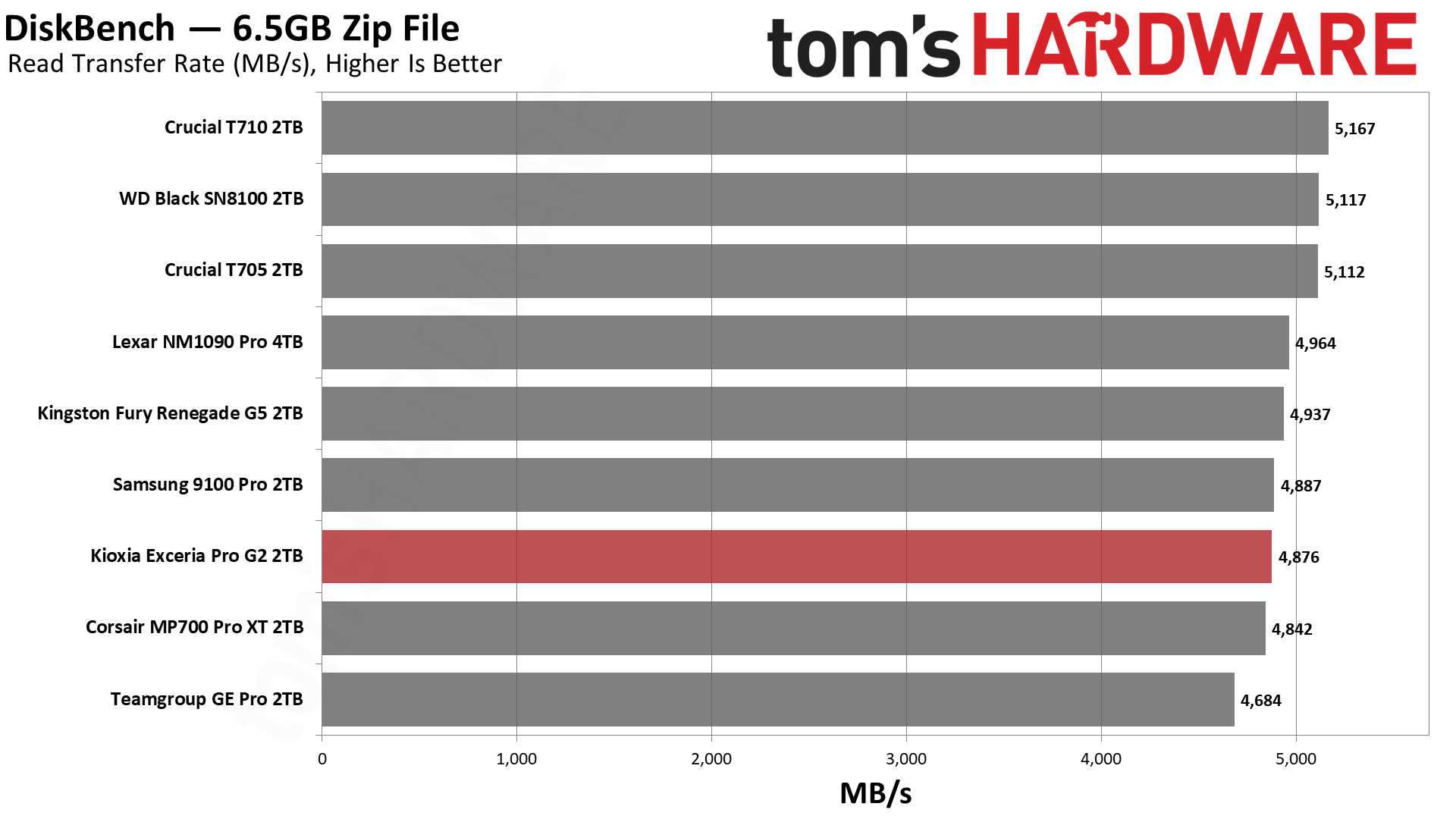
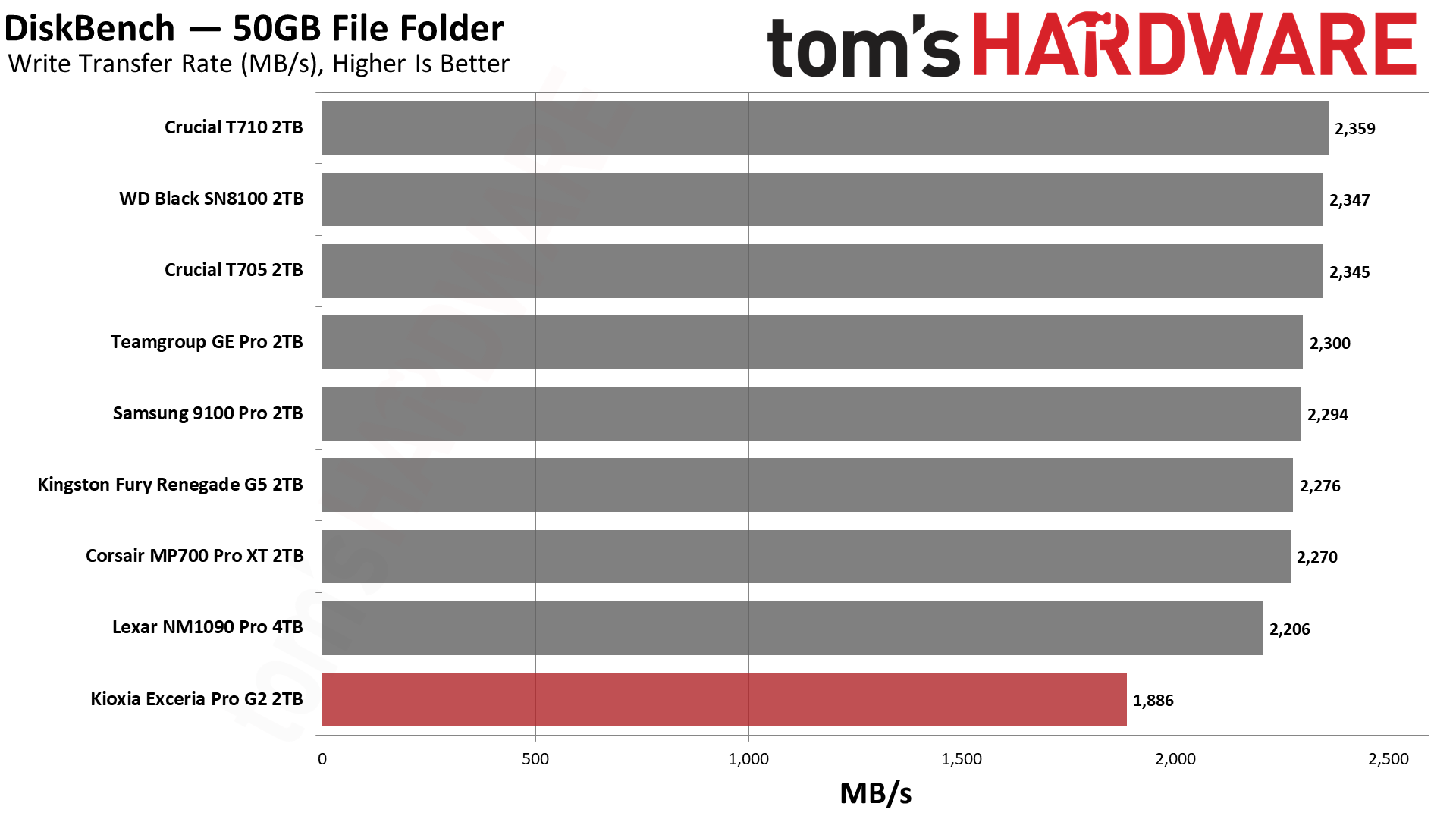
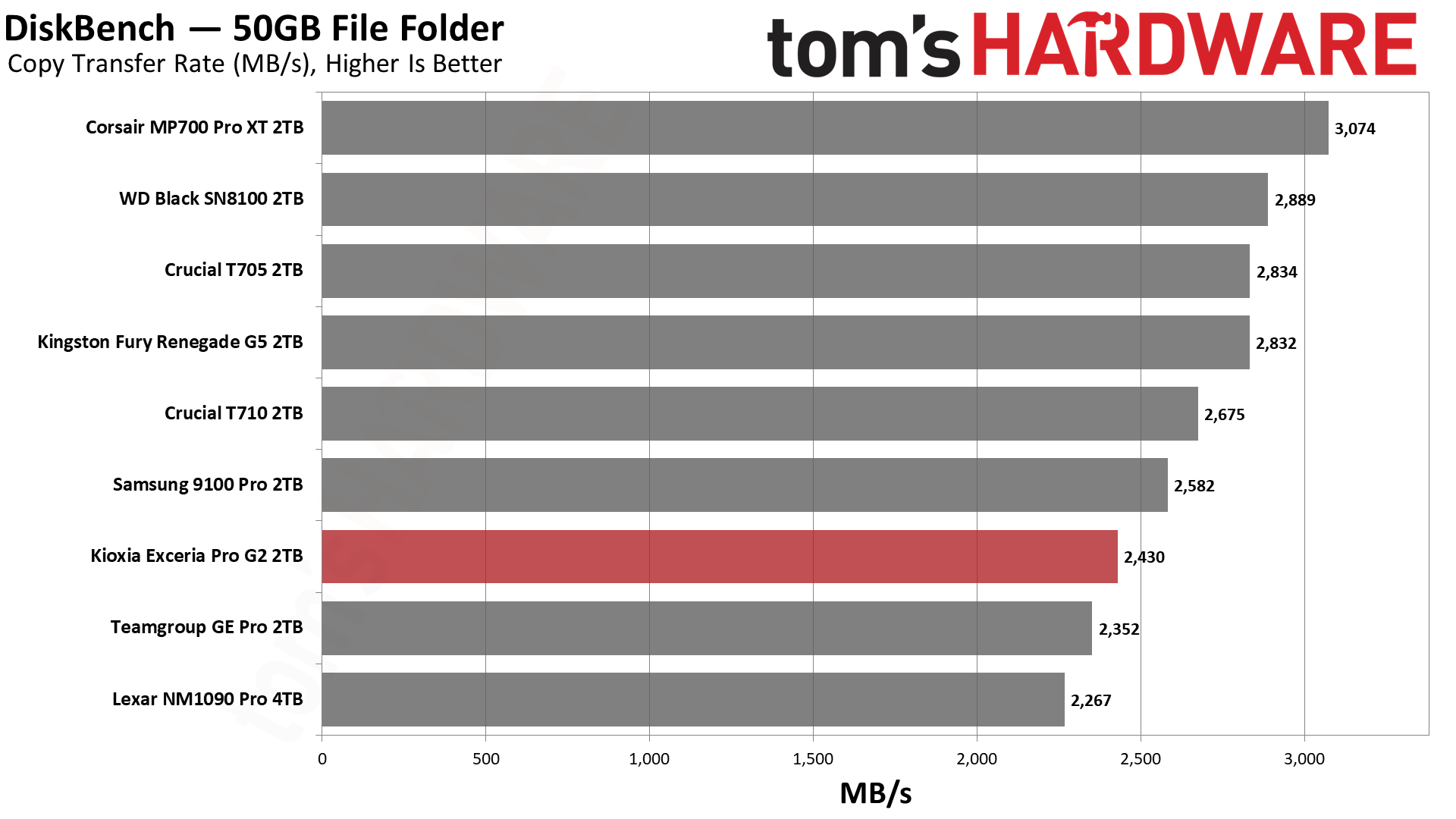
DiskBench is the Exceria Pro G2’s first misstep and worthy of further discussion since we know this hardware can do more. Read performance is reasonable – beating the MP700 Pro XT, matching the 9100 Pro, and coming close to the Fury Renegade G5 – but write performance is very weak. This also reduces the copy performance below even the 9100 Pro. This is almost certainly by design, in the sense that being conservative with writes is a trade-off. That can reduce wear and also keep thermal output to a minimum. For a retail drive with OEM/client origins, this makes a lot of sense. Obviously, you, as the user, don’t want slower writes, but we think most people would take reliability over burst write performance when push comes to shove.
This means the Exceria Pro G2 is not the drive to get if you want maximum performance, but it’s still very fast. It’s easier to put this into perspective when looking at the benchmark results as a whole. This requires you to look at write performance in our write saturation testing and also at heat output. To close out this section, though, we would point out that the drive still beats the GE Pro and NM1090 Pro in copy performance. We weigh copy performance most heavily for DiskBench as it’s a mixed workload. Those two are more budget-leaning high-end drives that may sometimes end up within a similar price range as the review drive, making any decision between them and the Exceria Pro G2 much easier.
Synthetic Testing — ATTO / CrystalDiskMark
ATTO and CrystalDiskMark (CDM) are free and easy-to-use storage benchmarking tools that SSD vendors commonly use to assign performance specifications to their products. Both of these tools give us insight into how each device handles different file sizes and at different queue depths for both sequential and random workloads.
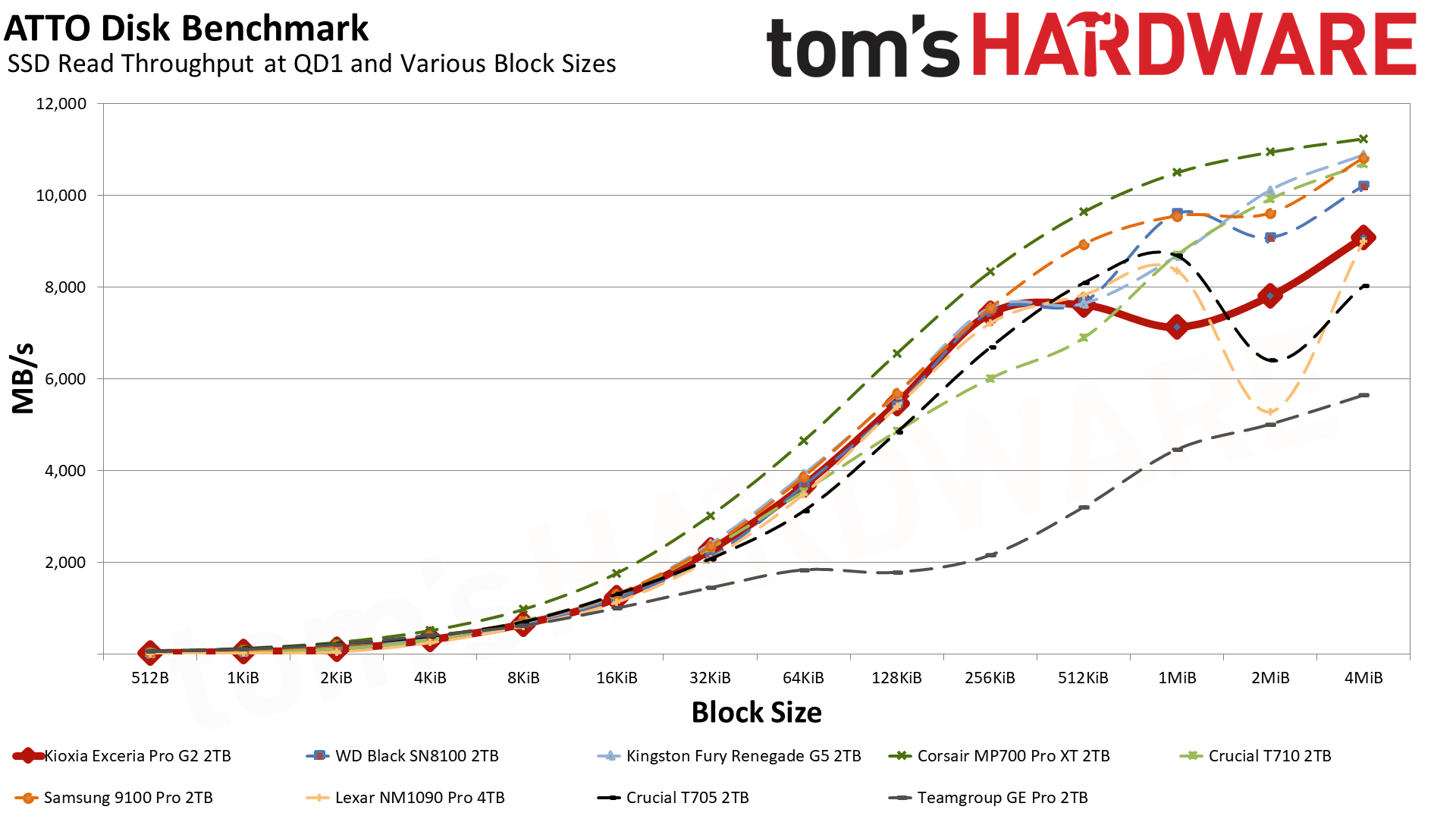
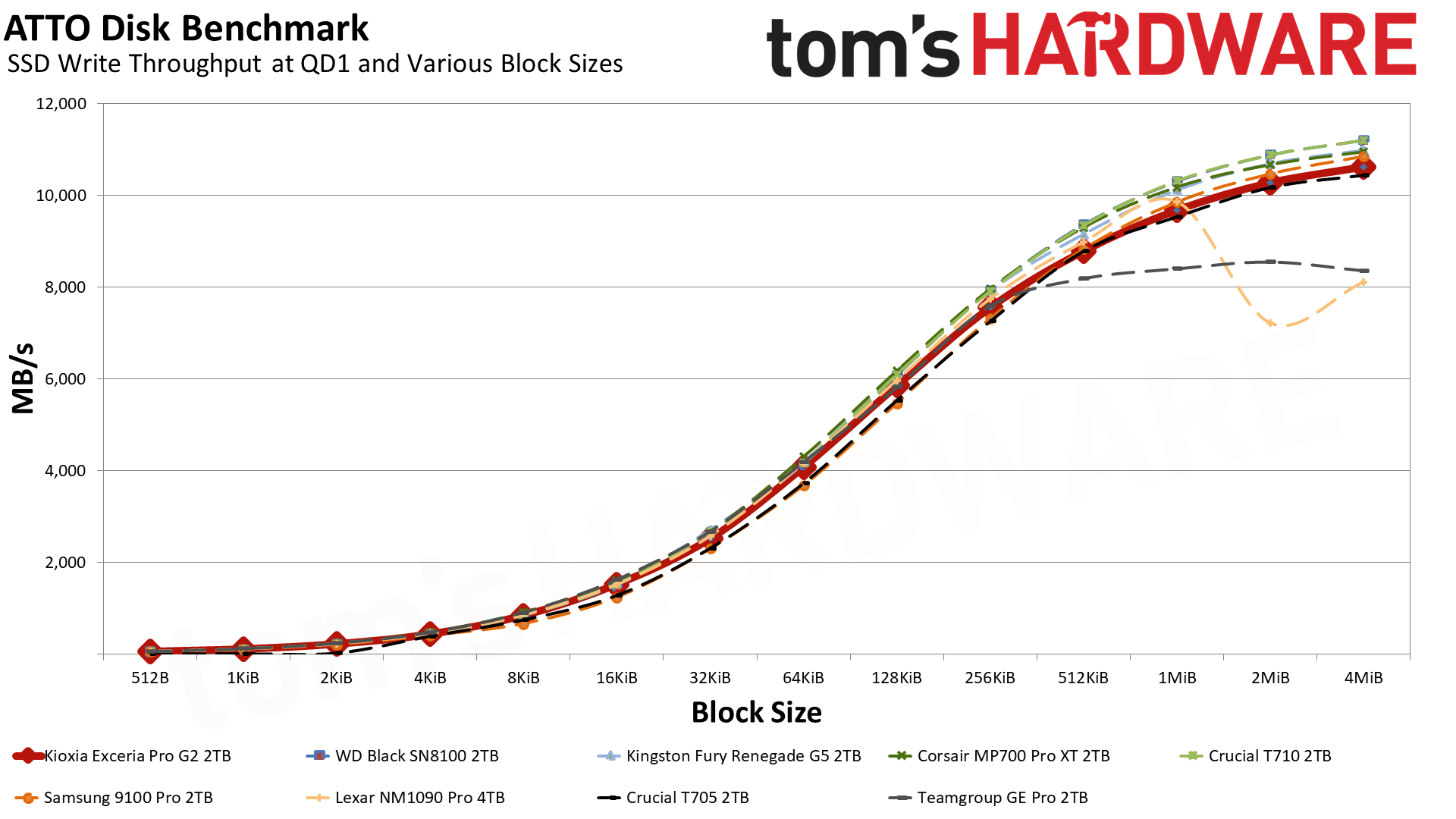
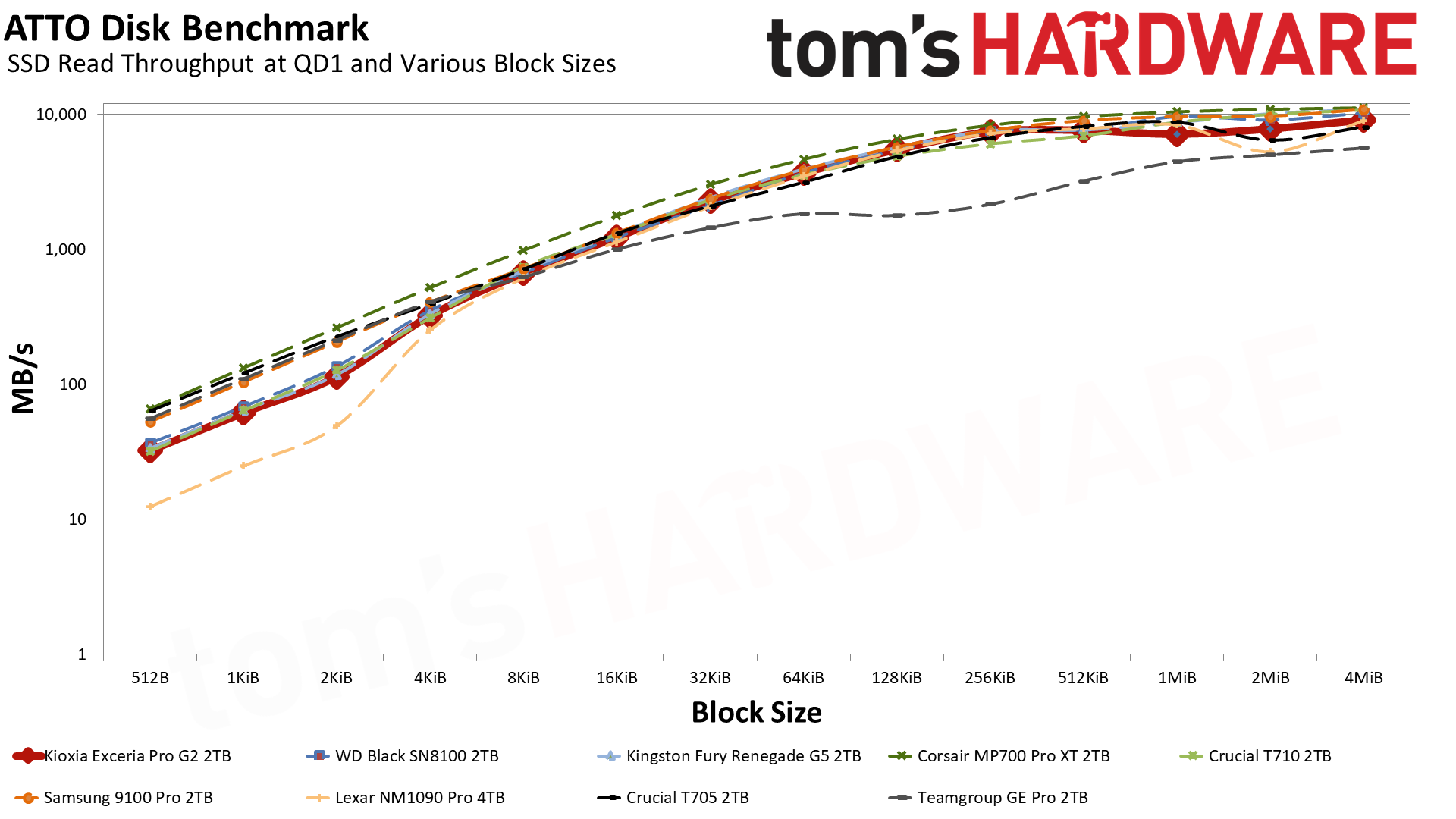
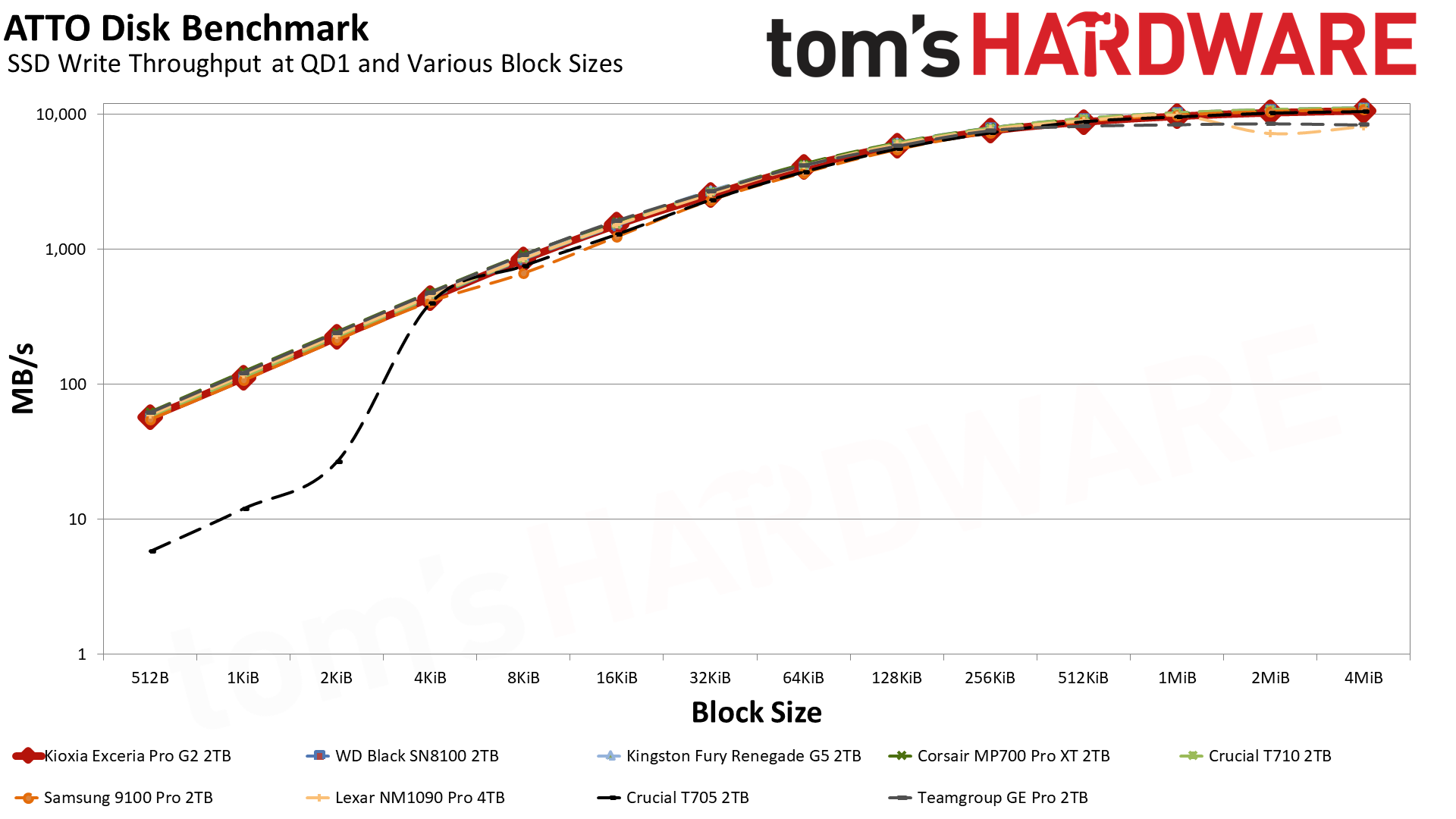
We start by looking at ATTO, which gives an idea of how the drive performs at different block sizes. We include the results on logarithmic graphs because that often puts things into perspective. For example, on the standard graph, the Exceria Pro G2 looks fine until it flattens at 512KiB and dips at 1MiB, while on the logarithmic graph it lags the MP700 Pro XT at small I/O, and the gap at larger block sizes is minimized. This lag at small I/O isn’t unusual, as drives with the same hardware, like the Black SN8100, show the same pattern. Both that drive and the Fury Renegade G5 are a little bumpy at larger block sizes, but the MP700 Pro XT is not. Likewise, the T710 is also pretty consistent. This means that the SMI controller and BiCS8 flash combination is less consistent with bigger I/O sizes, but this is only looking at a queue depth of 1.
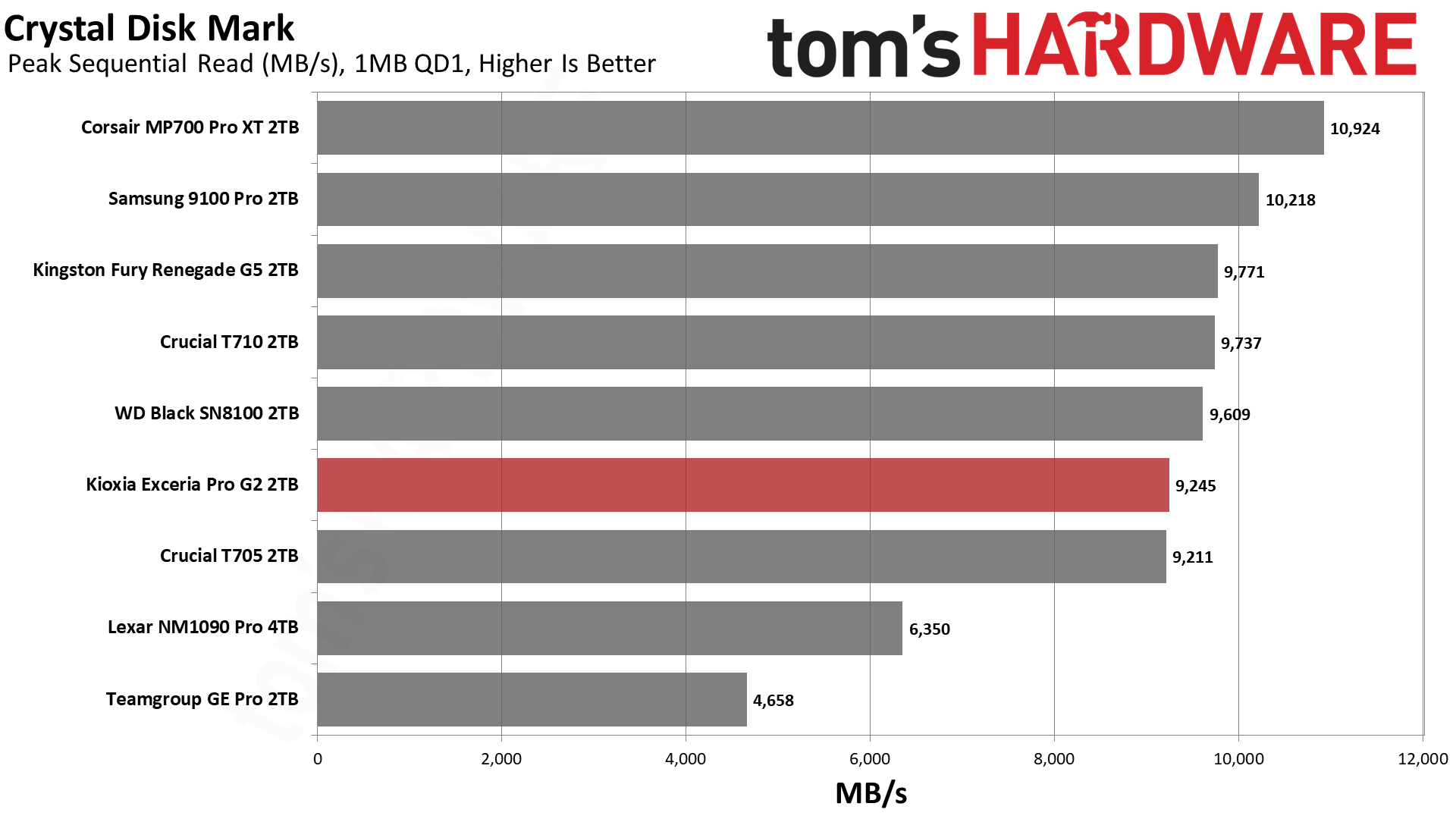
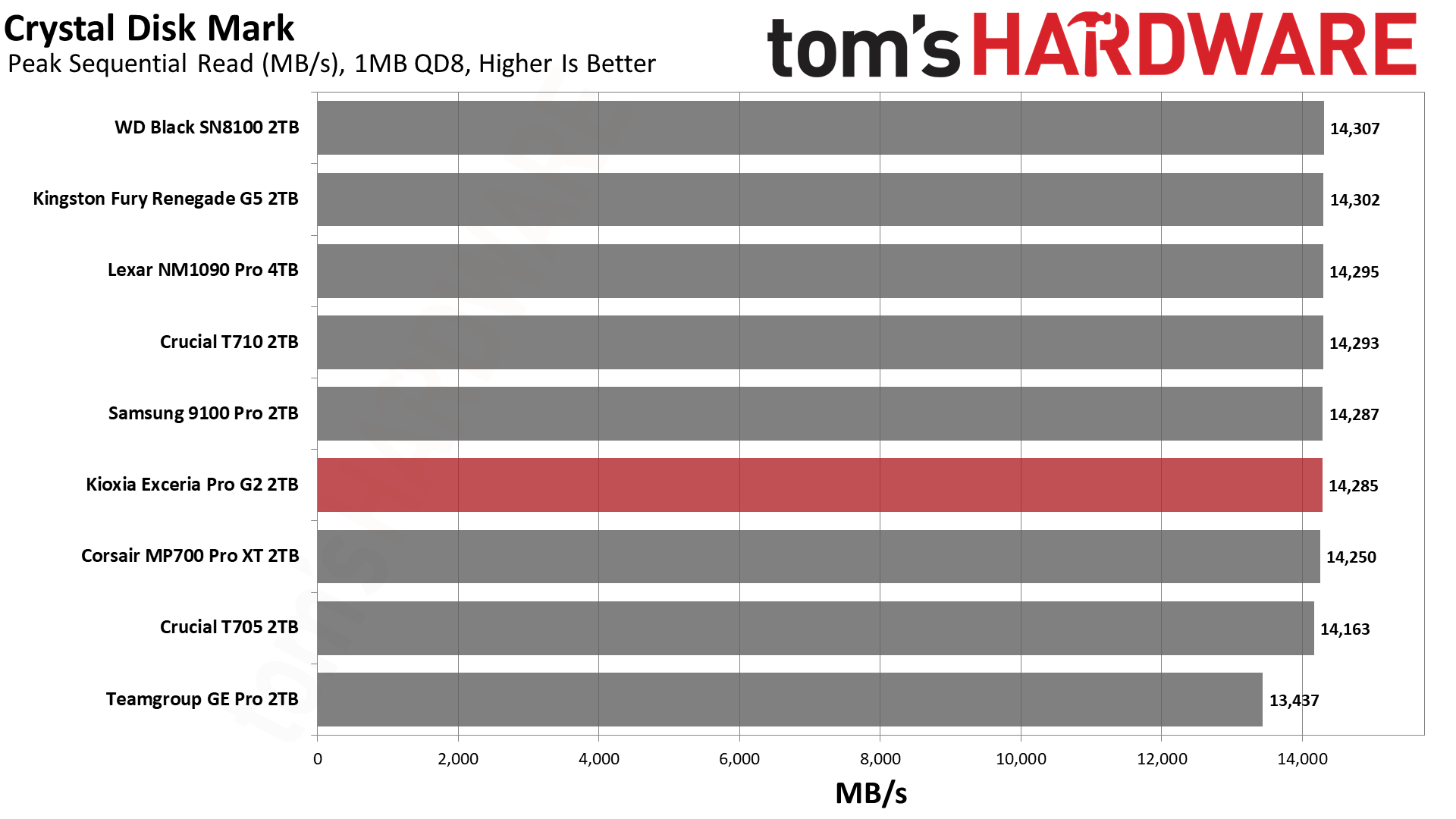
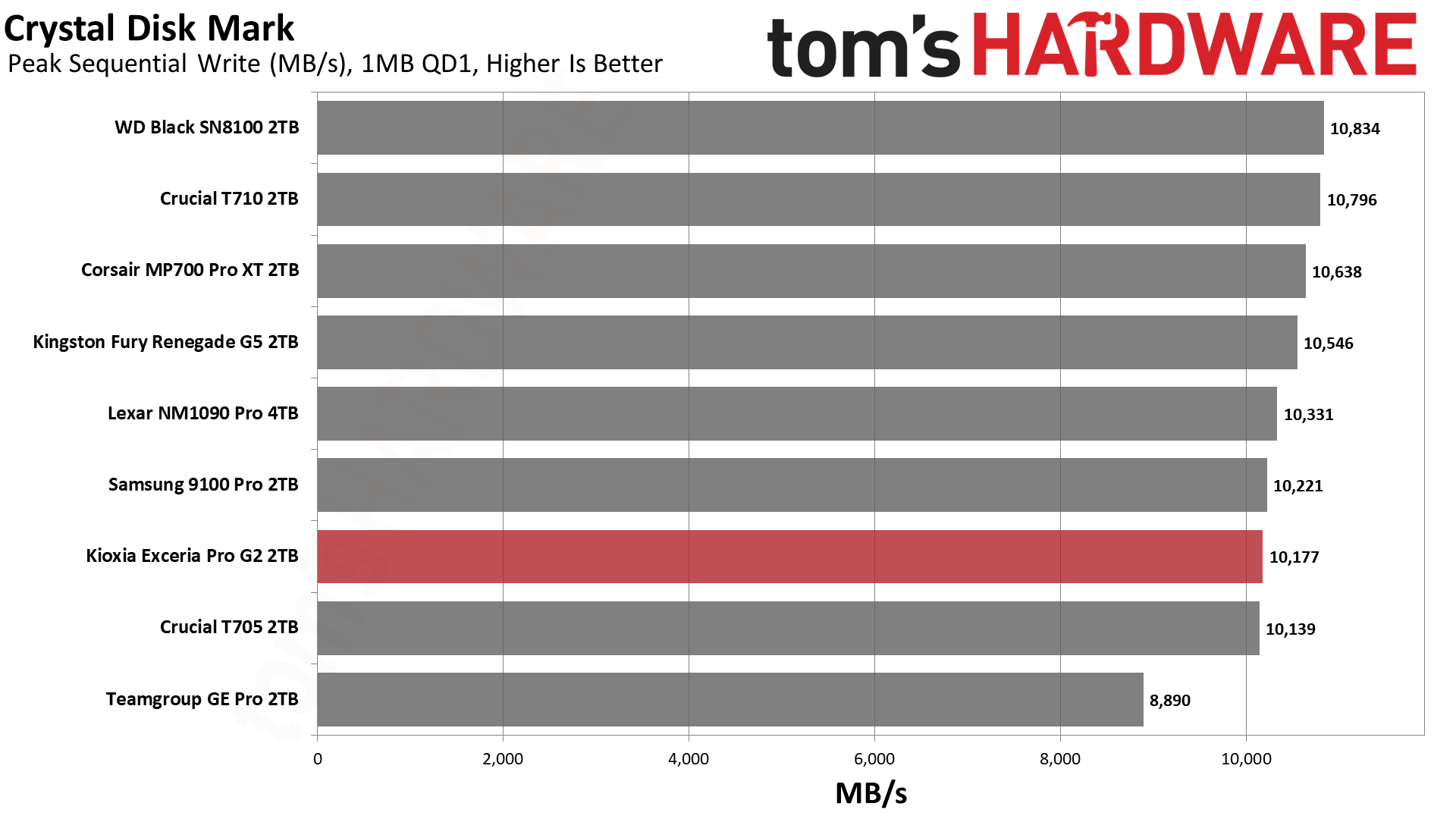
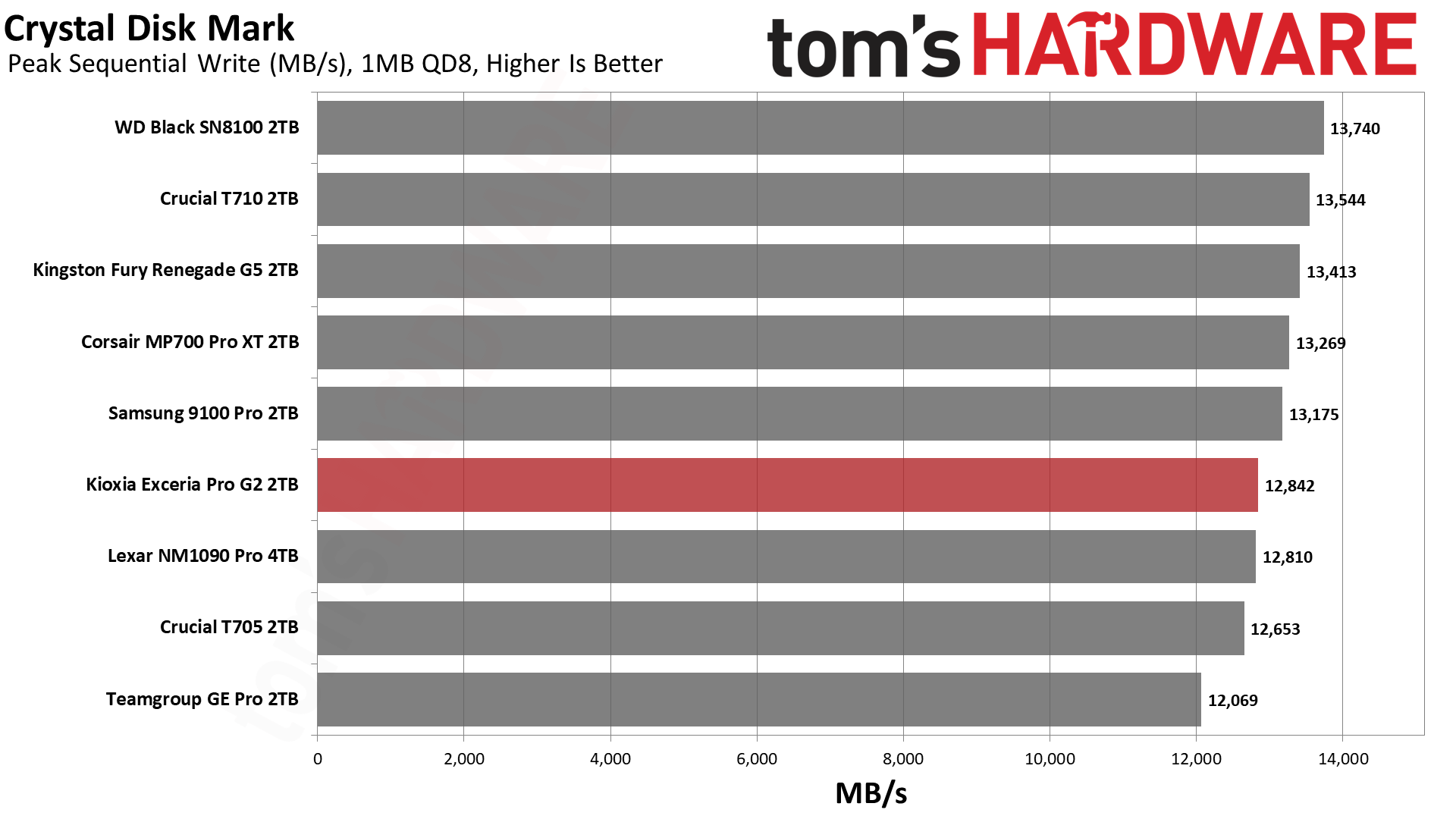
If we turn to CDM’s sequential results, we find agreement that the Exceria Pro G2 is a bit weak with QD1 reads at 1MB. This is a fairly realistic workload, as transferring files around this size is common and would usually be at QD1. You can see that the MP700 Pro XT, with the same flash but Phison’s controller, leads everything else here, with only the 9100 Pro coming close. It’s able to get more out of the flash and reduce the overhead – it is simply better at extracting bandwidth, even at low queue depths. To some extent, this is a function of firmware and not hardware, by which we mean the Exceria Pro G2 is not likely physically deficient in any way. It may instead be optimized to provide a slower but reliable experience, perhaps in the interest of inducing less wear on the drive. Reads don’t directly wear flash, but you’re also reducing heat output with this sort of optimization. It’s often said that flash prefers heat, but that only applies to writes. You generally want a lower temperature during reads.
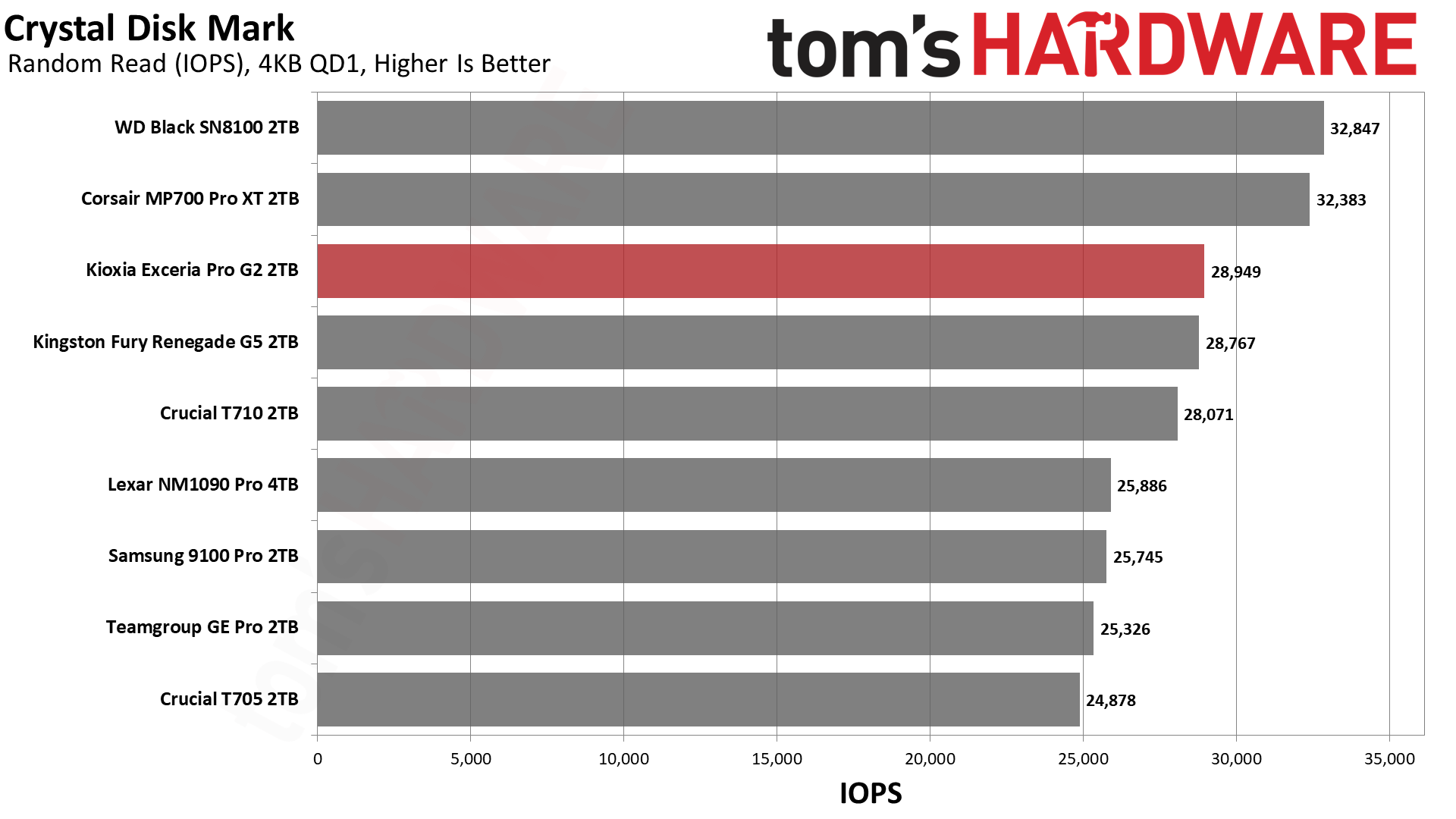
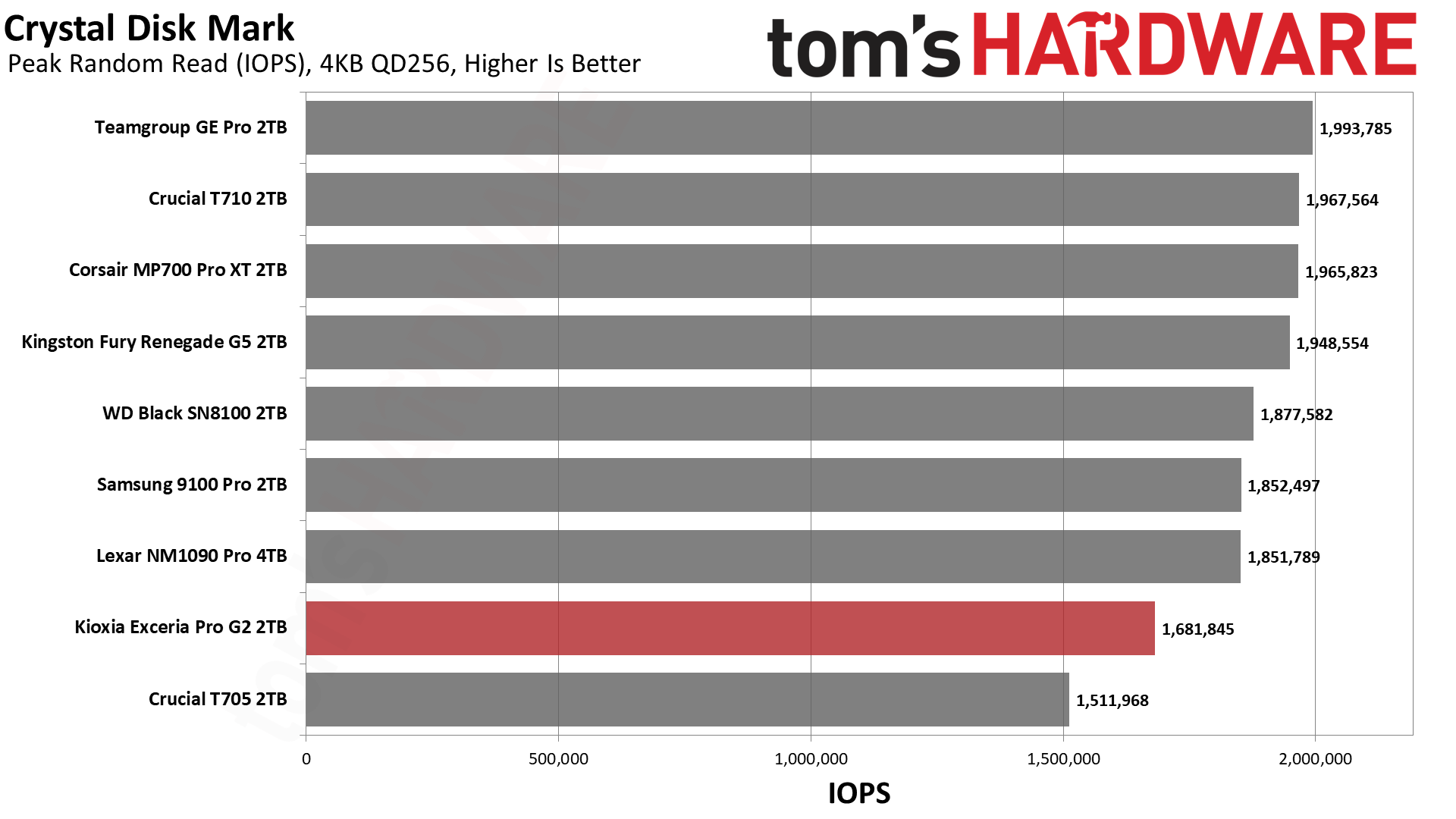
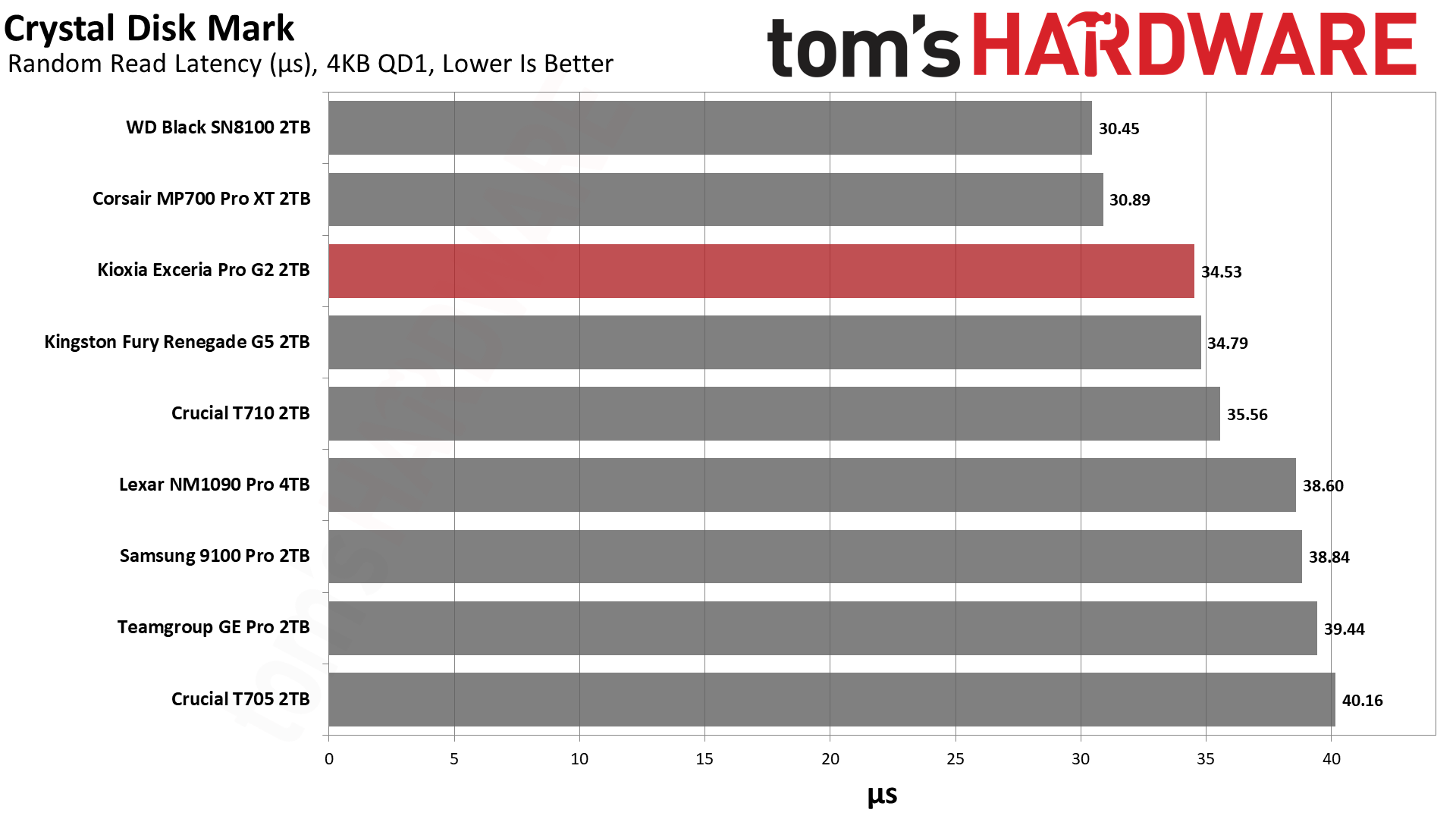
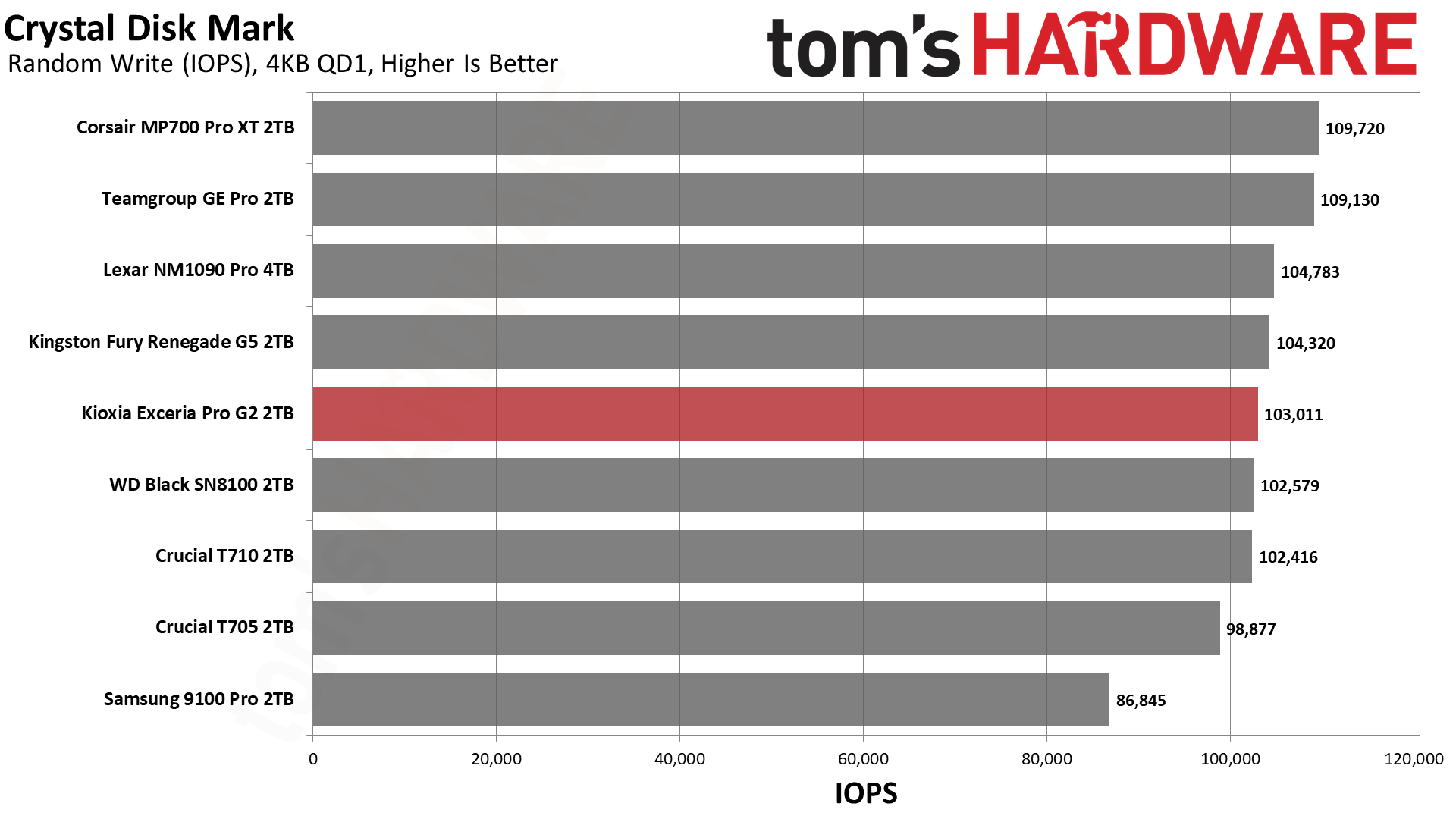
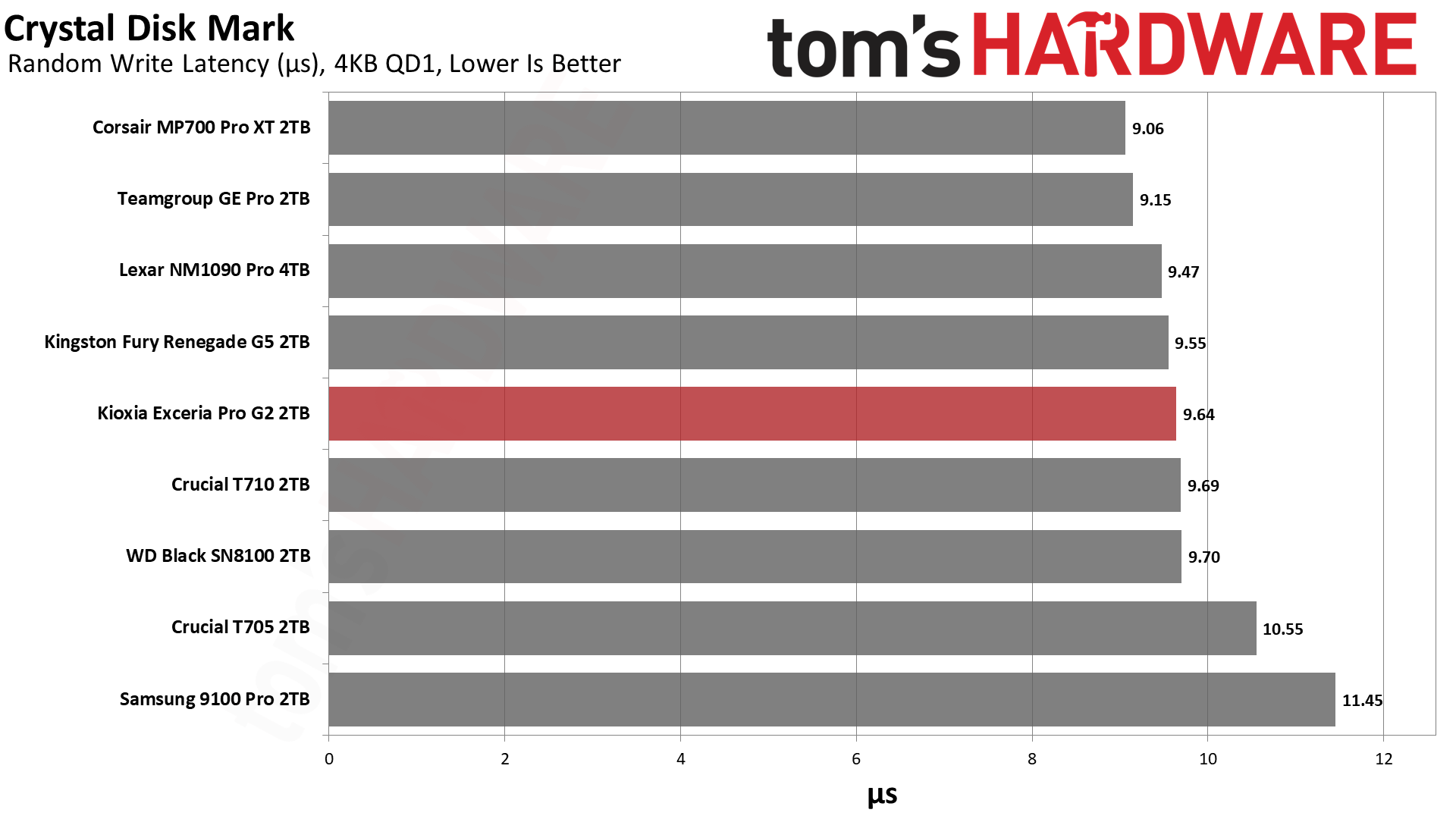
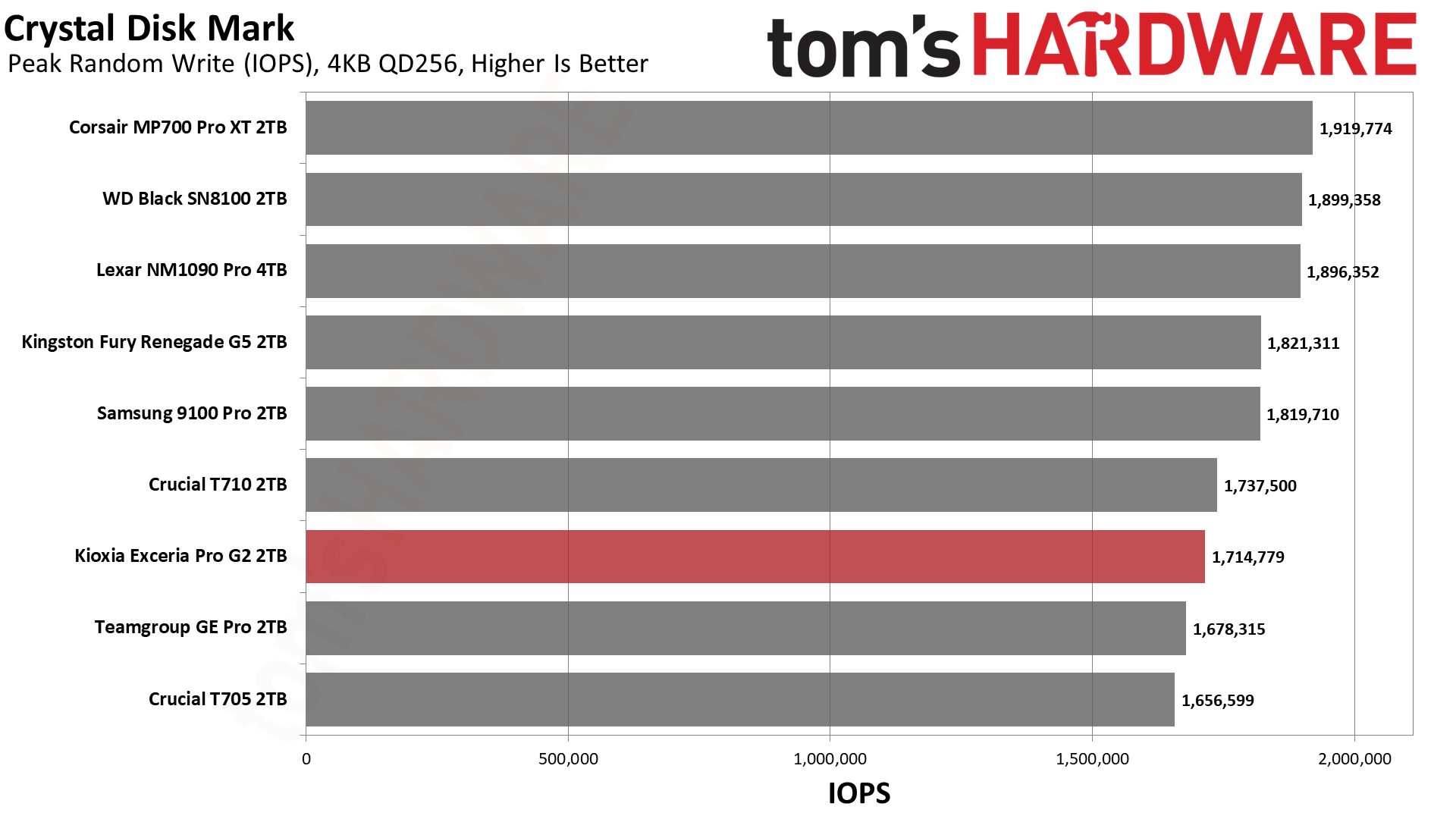
The one place the drive clearly trails its Fury Renegade G5 twin is with high QD random reads. This feels like the firmware may be holding something in reserve rather than being a strict hardware limit. The Exceria Pro G2 still has the excellent BiCS latency, though, coming in under 35µs for 4KB QD1 random reads. This is a fantastic result. It trails what WD and Phison can deliver, but it’s still exceptionally fast even by PCIe 5.0 standards. App and game load times are snappy, and there is a noticeable improvement over last-gen drives. We think this is a good trade-off as you’re more likely to be dealing with low QD random reads.
Sustained Write Performance and Cache Recovery
Official write specifications are only part of the performance picture. Most SSDs implement a write cache, which is a fast area of pseudo-SLC (single-bit) programmed flash that absorbs incoming data. Sustained write speeds can suffer tremendously once the workload spills outside of the cache and into the "native" TLC (three-bit) or QLC (four-bit) flash. Performance can suffer even more if the drive is forced to fold, the process of migrating data out of the cache in order to free up space for further incoming data.
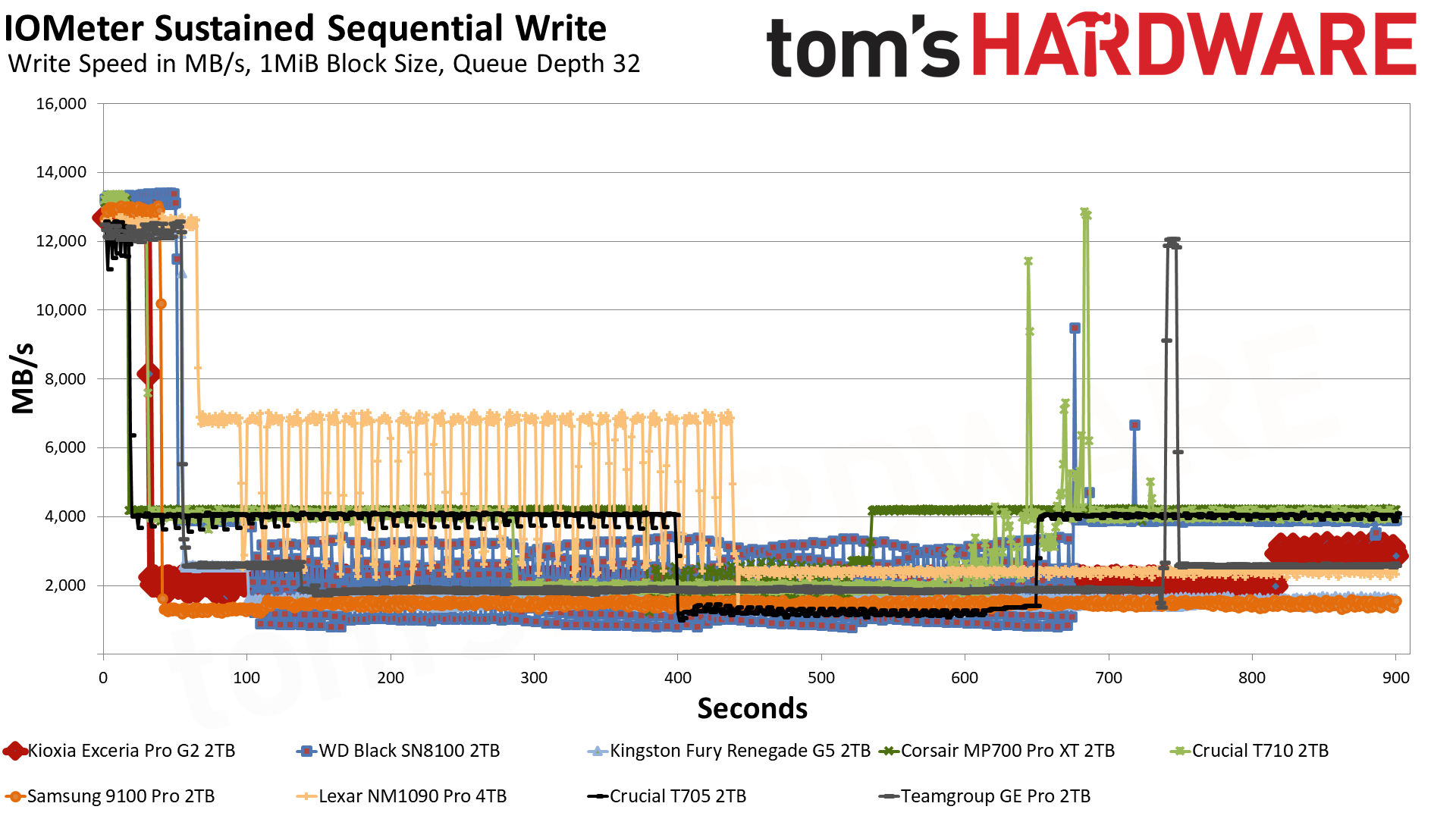
We use Iometer to hammer the SSD with sequential writes for 15 minutes to measure both the size of the write cache and performance after the cache is saturated. We also monitor cache recovery via multiple idle rounds. This process shows the performance of the drive in various states including the steady state write performance.
Tom's HardwareTom's HardwareTom's Hardware
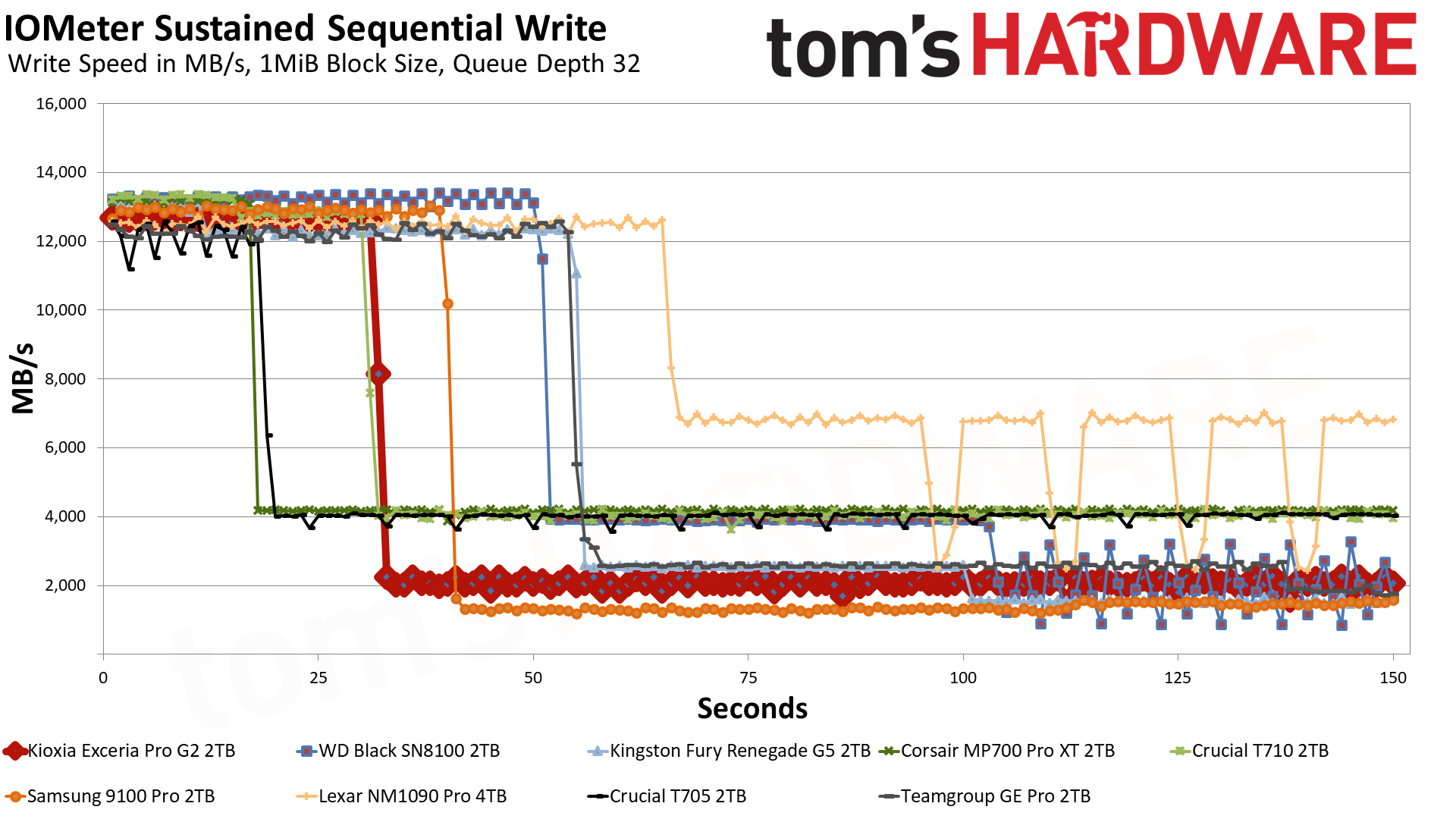
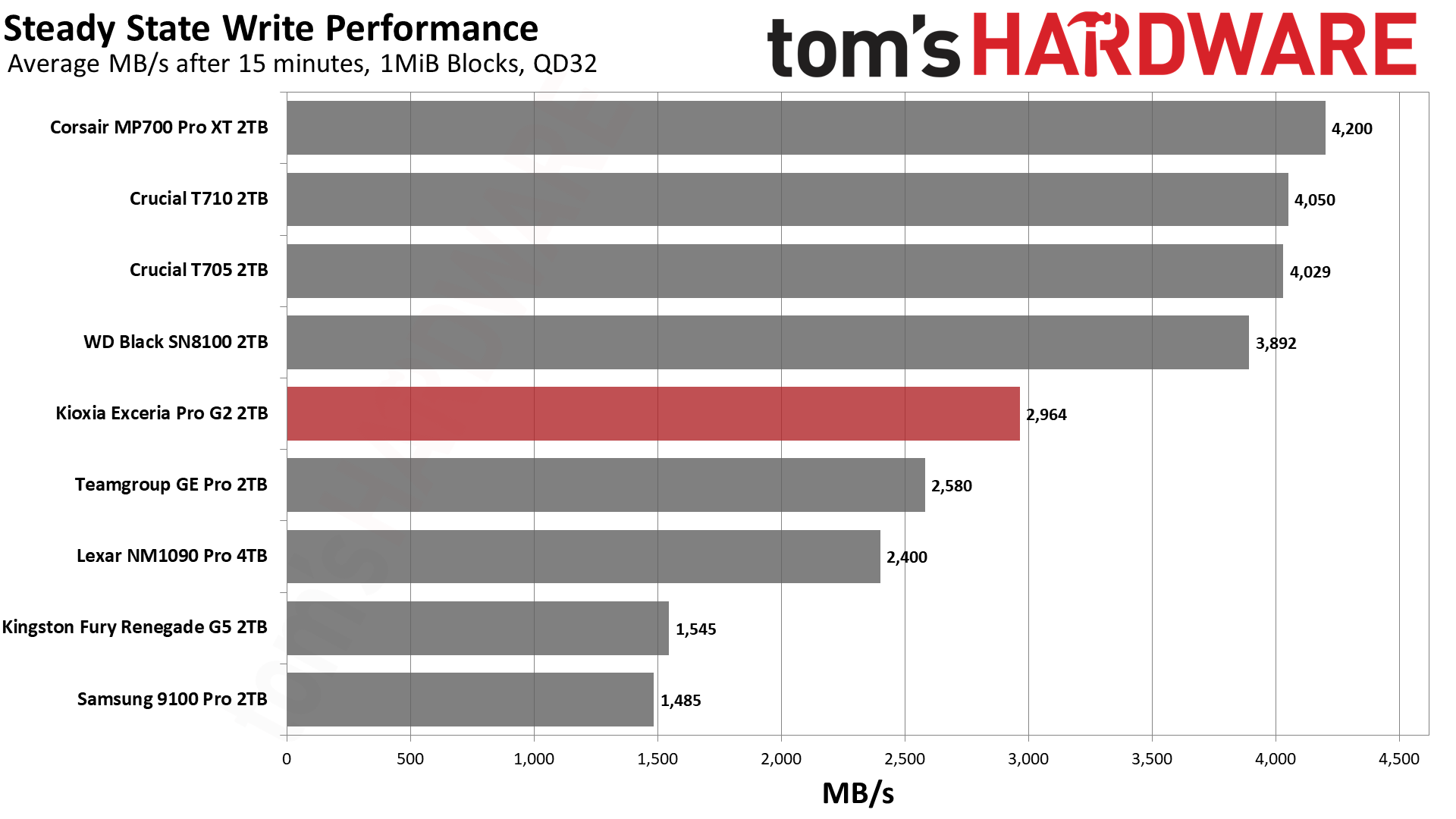
The Exceria Pro G2 hits over 12.6 GB/s in its fastest state, writing for over 31 seconds with a ~400 GB cache. On a 2TB TLC-based drive, this is only a moderately sized cache, not the largest it could be, but certainly larger than what was common a generation or two ago. The cache is smaller than what the Black SN8100 and Fury Renegade G5 use and more in line with the T710. It’s also larger than the MP700 Pro XT’s, unsurprisingly the fastest steady state drive on the list. Once the cache is exhausted, the drive settles down to 2.0 GB/s or so, engaging a mixed state where it’s writing to TLC and also copying data over from the cache. It holds there for roughly 13 minutes before recovering to a steady 2.96 GB/s for the remainder of the run. While this is slower than other drives in its class like the Black SN8100 and T710, it needs to be taken in context. It’s almost double what the Fury Renegade G5 manages after 15 minutes, despite the shared hardware, and well ahead of the 9100 Pro. This leaves the Exceria Pro G2 in the middle of the pack but far from slow.
It may sound like we’re making excuses for the drive here, but in reality we’re trying to ram home the point that not all drives are designed equally. There are very good reasons to have a drive behave this way. Having a large pSLC cache, as some of the other drives do, has its downsides. It’s not always the best design from a wear perspective and can leave the drive more vulnerable in certain edge cases. Your drive might run faster for longer, but that’s under an unrealistic workload that’s potentially inducing unnecessary wear.
The Exceria Pro G2 is designed for performance, yes, but also to keep on working in potentially more hostile environments. It needs to be reliable, and that comes with some trade-offs. From the buyer’s perspective, we would say that a drive like this – if you’re weighing it against something like the Black SN8100 – is still a worthy buy if you’re throwing it into an always-on Linux box that needs to be responsive but not always blazing fast. Or, as is becoming more common, in an always-on laptop where you are developing or running routines with AI and don’t really care about WD’s Dashboard or Game Mode. Just be aware of the power caveats, which we cover next.
Power Consumption and Temperature
We use the Quarch HD Programmable Power Module to gain a deeper understanding of power characteristics. Idle power consumption is an important aspect to consider, especially if you're looking for a laptop upgrade as even the best ultrabooks can have mediocre stock storage in terms of capacity and performance. Desktops are often more performance-oriented with less support for power-saving features so we show the worst-case for idle.
Some SSDs can consume watts of power at idle while better-suited ones sip just milliwatts. Average workload power consumption and max consumption are two other aspects of power consumption but performance-per-watt, or efficiency, is more important. A drive might consume more power during any given workload but accomplishing a task faster allows the drive to drop into an idle state more quickly, ultimately saving energy.
For temperature recording we currently poll the drive’s primary composite sensor during testing with a ~22°C ambient. Our testing is rigorous enough to heat the drive to a realistic ceiling temperature but real-world temperatures will vary due to the environment and workload factors.
One question the spec sheet raises: why is the 1TB Exceria Pro G2 rated for more active power than the 2TB and 4TB? Our DiskBench power test fits within the pSLC cache at any capacity, so it is not hitting a slower mode, and therefore the likeliest answer is duty cycle. The SM2508 controller has eight flash channels, and with sixteen dies at 2TB it can switch between dies on each channel, giving every die time to rest. The eight dies at 1TB get no such break yet are still capable of reaching most of the drive’s peak performance, so each one works harder. This should not be taken to mean the 1TB will run hotter, not least because it will run out of pSLC cache faster and hit the slower and lower-power TLC mode. It’s just a peculiarity of having a drive this fast with dense flash.
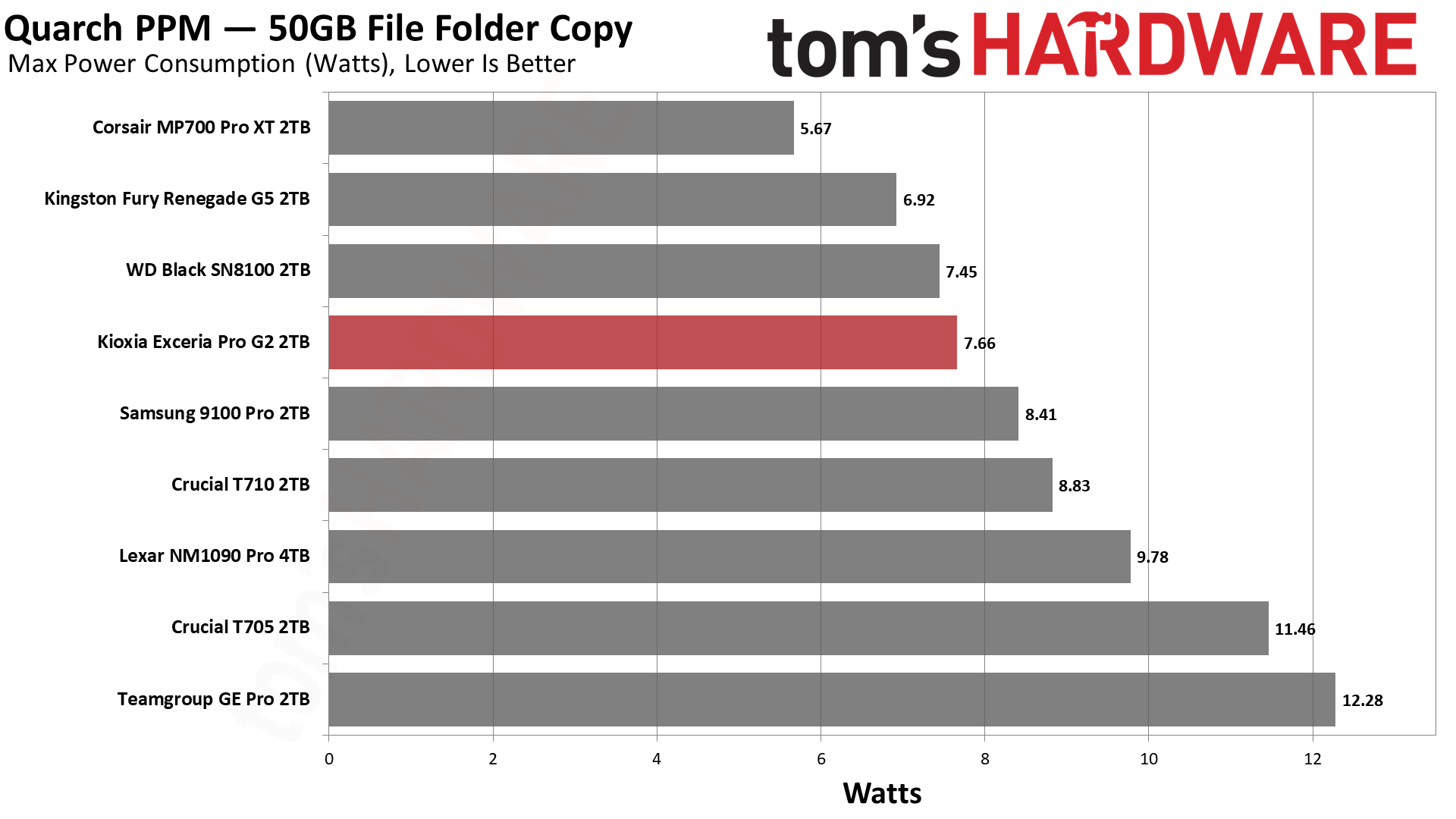
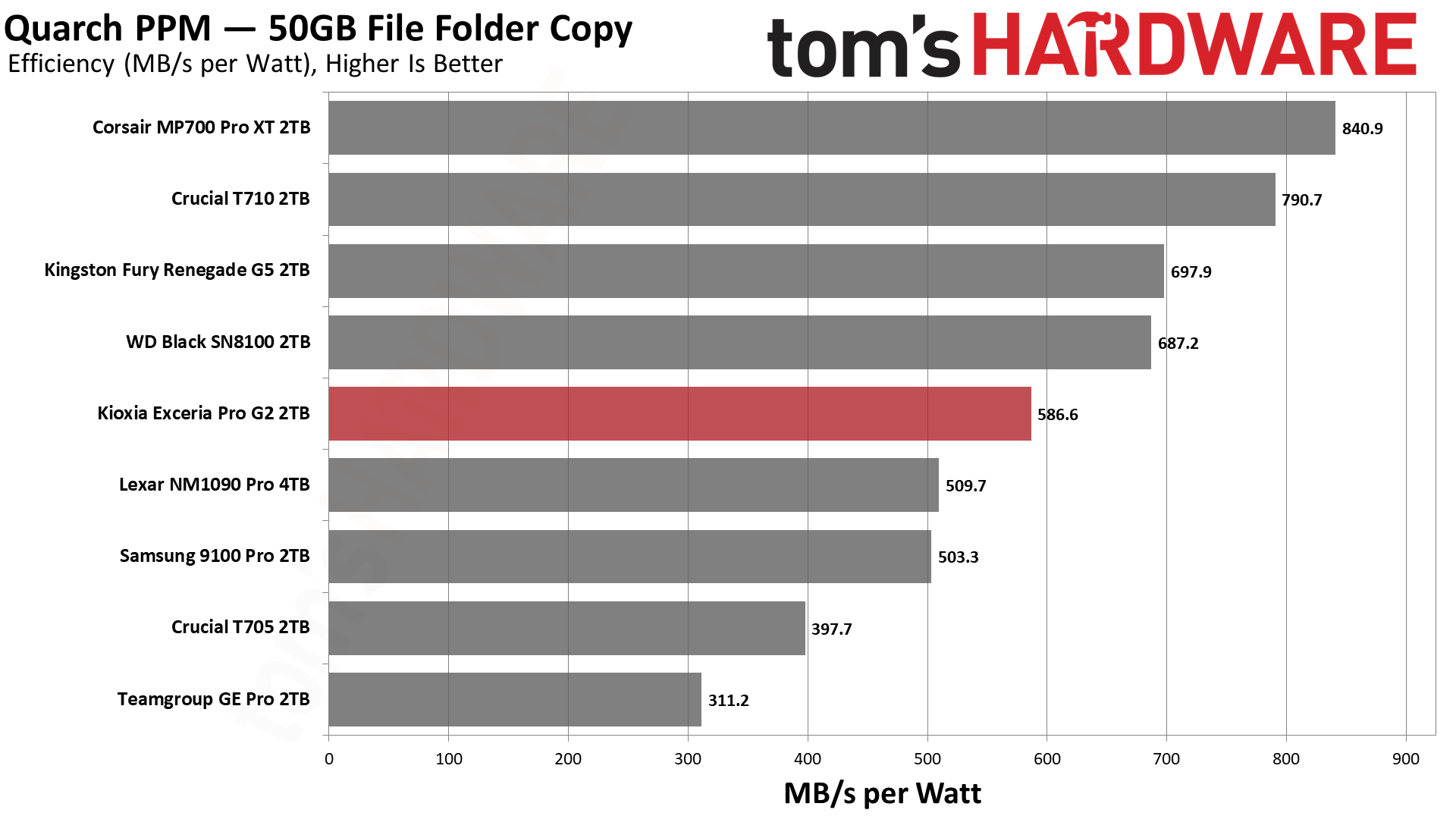
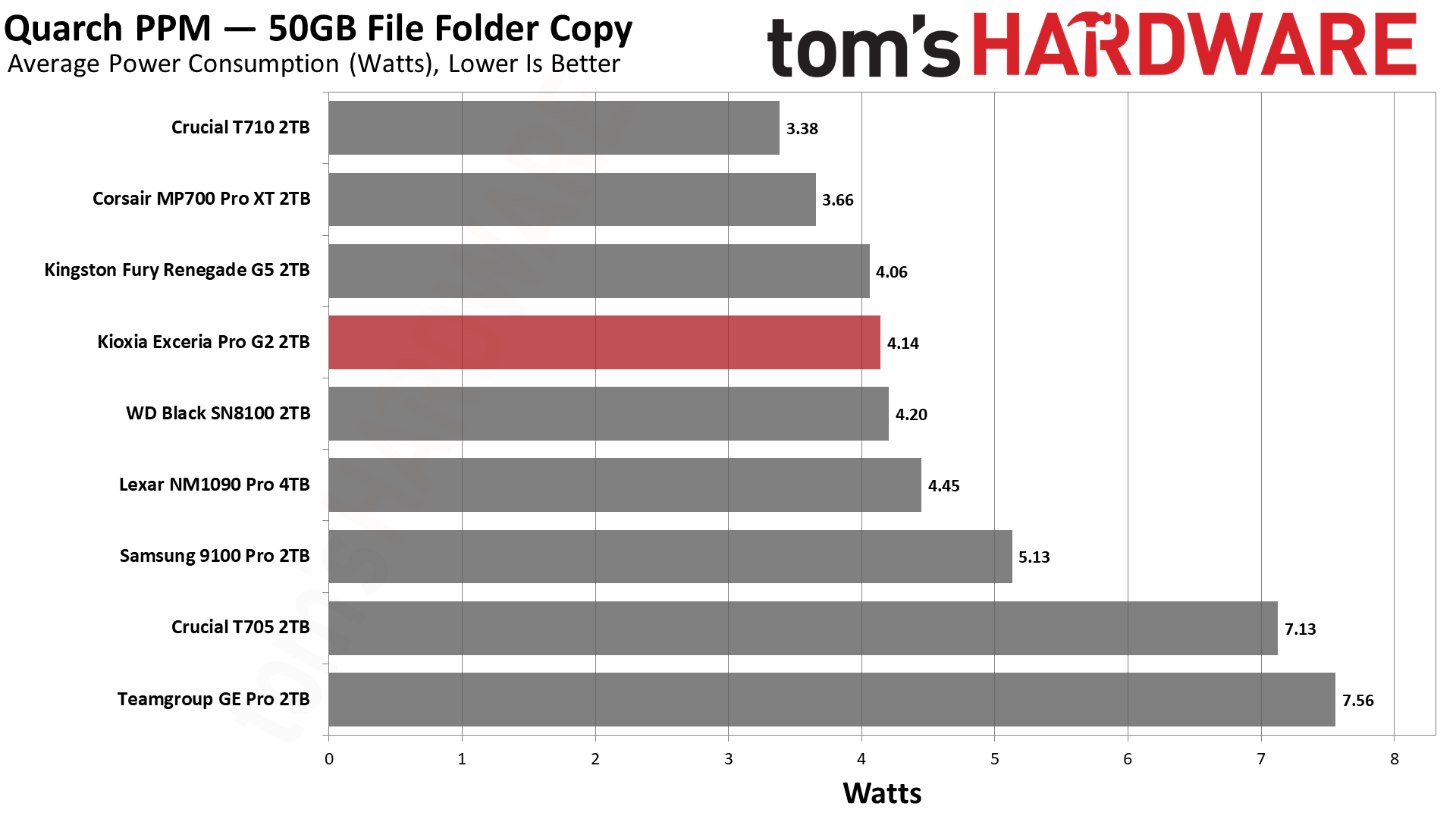
Power efficiency, in our testing, is a measure of work per watt, but it only tells part of the story. For that part of the story, the Exceria Pro G2 is average among all drives and below expectations for a drive of its class – see the Kingston Fury Renegade G5, which has the same hardware. Yet the drive proved to run as cool as a cucumber – 52C max, more than 30C below the drive’s 83C warning threshold. There are two reasons for this. The first is that, indeed, the Exceria Pro G2 has a heat-spreading label, which can be surprisingly effective. The second is that the drive is providing less bandwidth in the DiskBench test but also not pulling more power on average. This suggests that Kioxia designed this drive for OEMs, where you tend to have tighter thermal requirements. Kioxia’s own materials list the drive’s applications simply as “client desktop and laptop,” which supports our conclusion. Trading a little performance for reliability – with the assumption that running a high-end drive hotter in general is less than ideal – is reasonable here. The secret third reason is that our temperature logging comes from the Iometer-based write saturation run, which is sequential with a larger 1MiB block size. Historically we’ve found that mixed workloads, especially with smaller and random I/O, can push a drive a few degrees hotter than that.
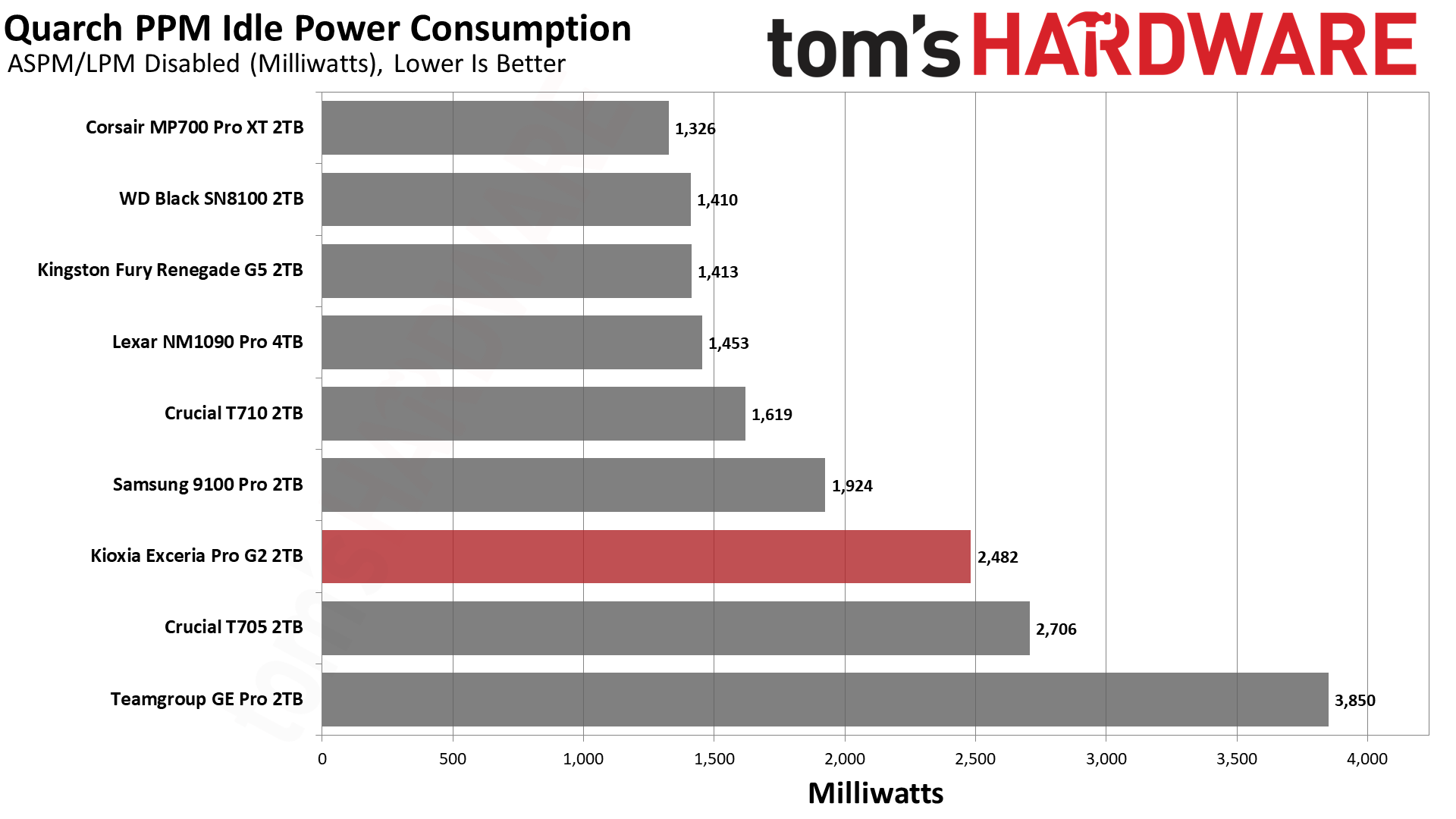
The drive’s high idle power consumption supports this conclusion. We test idle in the worst case, that is, for enthusiast desktops where there is no power saving. OEM systems and especially laptops are more likely to have these features enabled. That’s part of the explanation. The other side is in the drive’s advertised power states. The non-operational states have enter and exit latencies that, in comparison to drives with similar hardware, are consistent with a drive that prefers to stay in a ready state, somewhat like WD’s Game Mode. Our speculation is that it may be tuned that way for OEM machines. If we had results from a workstation-oriented drive like Kioxia’s own XG10, which is a client OEM model, we might find more clarity here. Our guess is that having a drive that can potentially wake faster is desirable.
Nevertheless, we would expect the Exceria Pro G2’s idle result to be more in line with the Black SN8100’s. It’s possible this is platform-specific – the drive might react differently on, say, an AMD system – or simply that it was more reluctant to go to a lower power state for us.
We use an Alder Lake platform with most background applications such as indexing, Windows updates, and antivirus disabled in the OS to reduce run-to-run variability. Each SSD is prefilled to 50% capacity and tested as a secondary device. Unless noted, we use active cooling for all SSDs.
Kioxia Exceria Pro G2 Bottom Line
This is a solid drive that hits all the right notes for us. It has high-end PCIe 5.0 bandwidth, excellent BiCS flash latency, good power efficiency, and good all-around performance, including reasonable sustained write speeds. While it’s not really available in the U.S., its pricing in other regions makes it extremely competitive. We also like the fact that it runs pretty cool and appears to have firmware optimization geared toward reliability, which is always welcome if you intend to run a drive like this in a laptop, an always-on system, or another challenging environment. The drive also advertises the usual NVMe low-power states, so users who want a drive that stays available should be well served, provided power management is properly enabled on their platform.
(Image credit: Tom's Hardware)
Where the drive falls flat is in comparison to some of the other fastest drives around, like the Black SN8100, which shares its hardware. Some of these drives are just plain faster and even consistently so, matching or beating it in an array of tests. The Exceria Pro G2 does out-write its hardware twin, the Fury Renegade G5, in steady state, but other contenders offer better efficiency numbers and higher sustained write speeds. It sometimes looks like the Exceria Pro G2 is being held back, which, to be fair, is probably true. The design philosophy behind this drive is closer to what you’d find in an OEM or client drive, where reliability is a big concern. In our opinion, this makes the drive a great addition and alternative in the market. Many users would value this over raw performance, especially if it’s more affordable. If you’re in a position to get this drive at a competitive price, it’s worth weighing your priorities.
Personally, we’re fond of the drive for what it does differently while still delivering an excellent user experience. A PCIe 5.0 drive is still overkill for most things, and SSDs are rather expensive at the moment. However, if you want to invest in something that will carry you for a long time, the Exceria Pro G2 is a reasonable choice. We think a lot of users will have a better time with the Black SN8100 – it may be more readily available and beats the Exceria Pro G2 in some areas – but at this performance level it’s kind of hard to go wrong. We’d lean towards the Kioxia if you want something more focused on a reliable experience with a drive that just works without ever being slow.
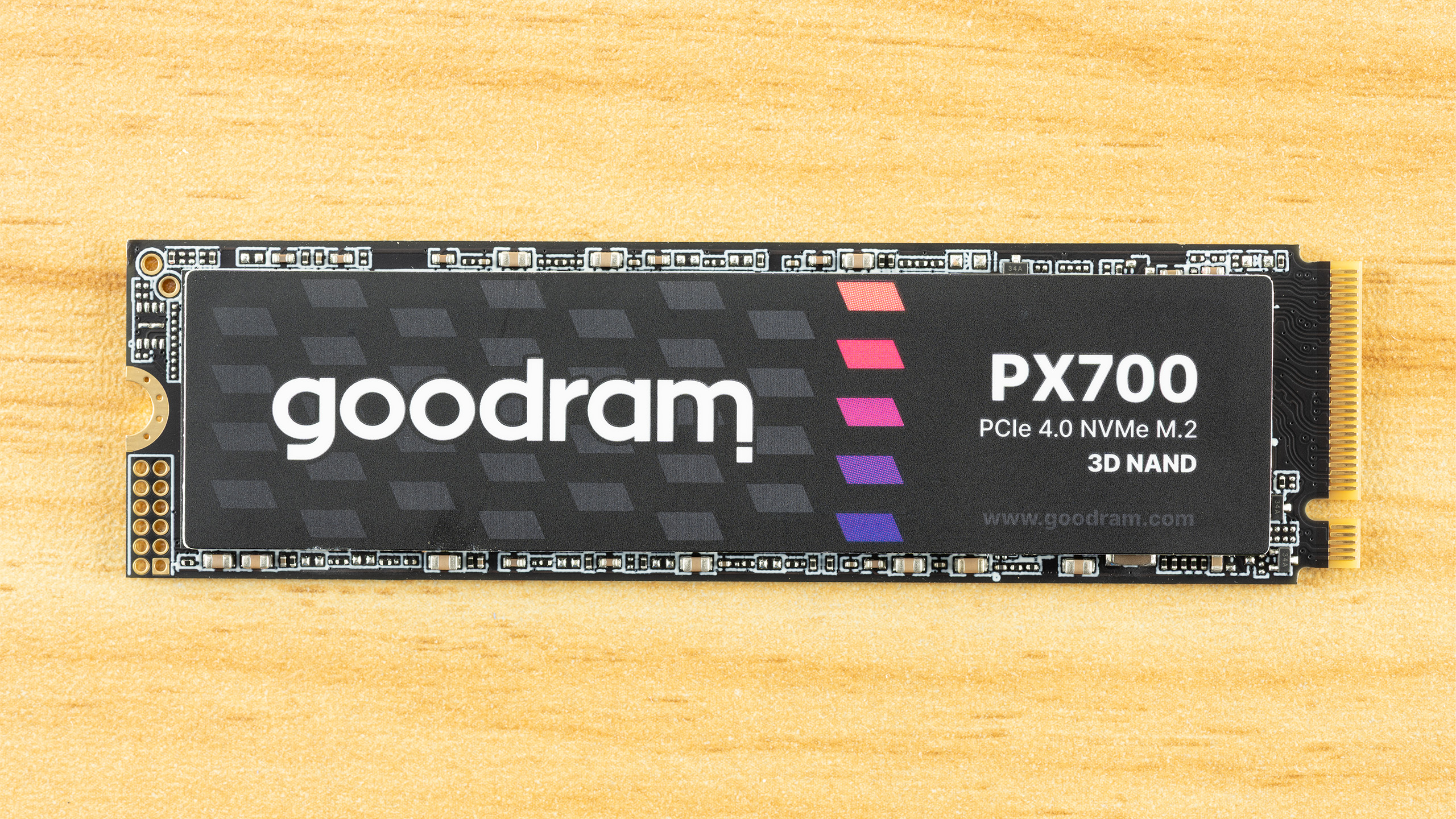
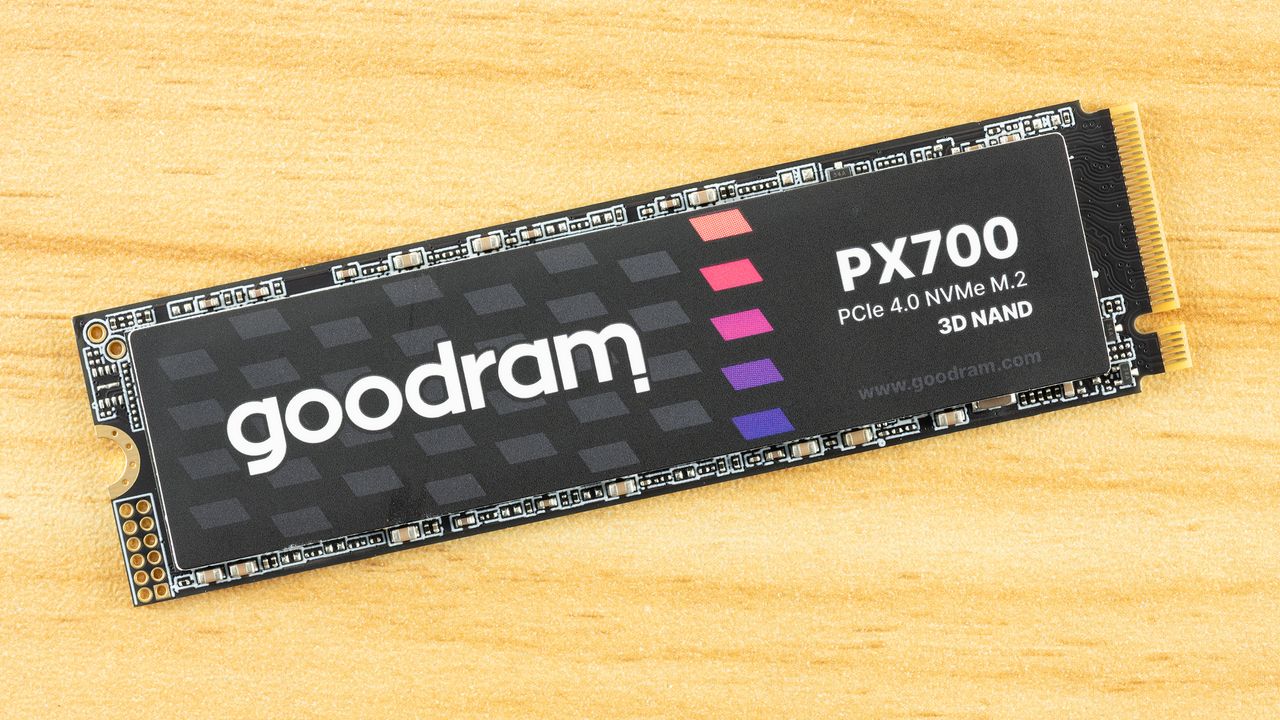
The Goodram PX700 is a budget PCIe 4.0 drive that delivers everything you need: good performance, great power efficiency, and all in a single-sided package that runs cool. Sometimes it really is as simple as picking one drive to meet whatever your storage needs are at the moment. It’s not the first model that comes to mind for this segment, but in our testing it performed better than expected as a good drive that may otherwise run under the radar.
Goodram is not a new or no-name company, even if the “good RAM” moniker seems a little too on the nose. Instead, it’s a memory assembler in the EU with quite some history. This, in fact, makes it more approachable in comparison to a lot of the new names we have seen on AliExpress and increasingly on Amazon. We expect reliability or at least good support from the company, and the TBW on this one seems to reflect that this isn’t an ultra-budget drive.
On the contrary, performance was not just what we expected – considering we’ve reviewed many drives in this segment, many with the same or comparable hardware – but above. Sometimes only by a small amount, but the gaps are real. Anywhere performance mattered, it delivered. One expects trade-offs for that, but in fact the PX700 is very power-efficient, and the drive provides an excellent storage experience. The only downsides are sustained write performance – which is of little importance in most cases – and, unfortunately, the price. At the right price point, this would be a great pick for any device.
The Goodram PX700 covers the most popular capacities of 1TB, 2TB, and 4TB. Smaller drives can be popular for upgrades and basic boot usage, especially with how prices are now, but modern flash scales best at 1TB and up. 8TB drives are great as a larger storage solution but require a significant investment. The PX700 sticks to what will sell, predominantly 1TB and 2TB. At the time of review, these are priced at $346 and $418, respectively. These prices are high and probably point to a lack of stock more than anything else. While the 1TB price is double what it should be, at 2TB a drive of this type should be closer to $300. Naturally, one has to take into account the pricing volatility in an SSD market besieged by a NAND shortage, but we recommend looking in that range for this drive or one comparable to it with similar or the same hardware.
The drive is full-fledged Gen 4 with performance up to 7,400 / 6,500 MB/s for sequential reads and writes and up to 1 million random read and write IOPS at 4TB with only 820K write at 1TB/2TB. This is standard for the class and is more than enough performance for everyday tasks, gaming, productivity workflows, and more. The drive has the standard five-year warranty with up to 600TB of writes for every TB. The last part of that is worth a second glance because it indicates this drive can come with TLC rather than QLC flash, since TLC, aside from being faster, has better endurance than QLC. However, we have reasons to believe our sample has QLC, which we will point out where the evidence supports that reasoning. We want to emphasize that you should not assume what flash a drive uses based on TBW alone.
Goodram PX700 Software and Accessories
Goodram does not offer any specialized or custom software for its SSDs. You will have to rely on third-party solutions. Software for SSDs essentially falls into three categories: health management, performance, and data backup. SSD toolbox applications from manufacturers will usually cover the first two, with, typically, an OEM version of Acronis True Image for the last. For free alternatives, we recommend CrystalDiskInfo for health information, CrystalDiskMark for basic benchmarking, and MultiDrive for data backup and imaging. MultiDrive is made for Windows and has a bootable WinPE image, so for other operating systems you can opt to use Clonezilla instead.
Goodram PX700: A Closer Look
Tom's HardwareTom's Hardware
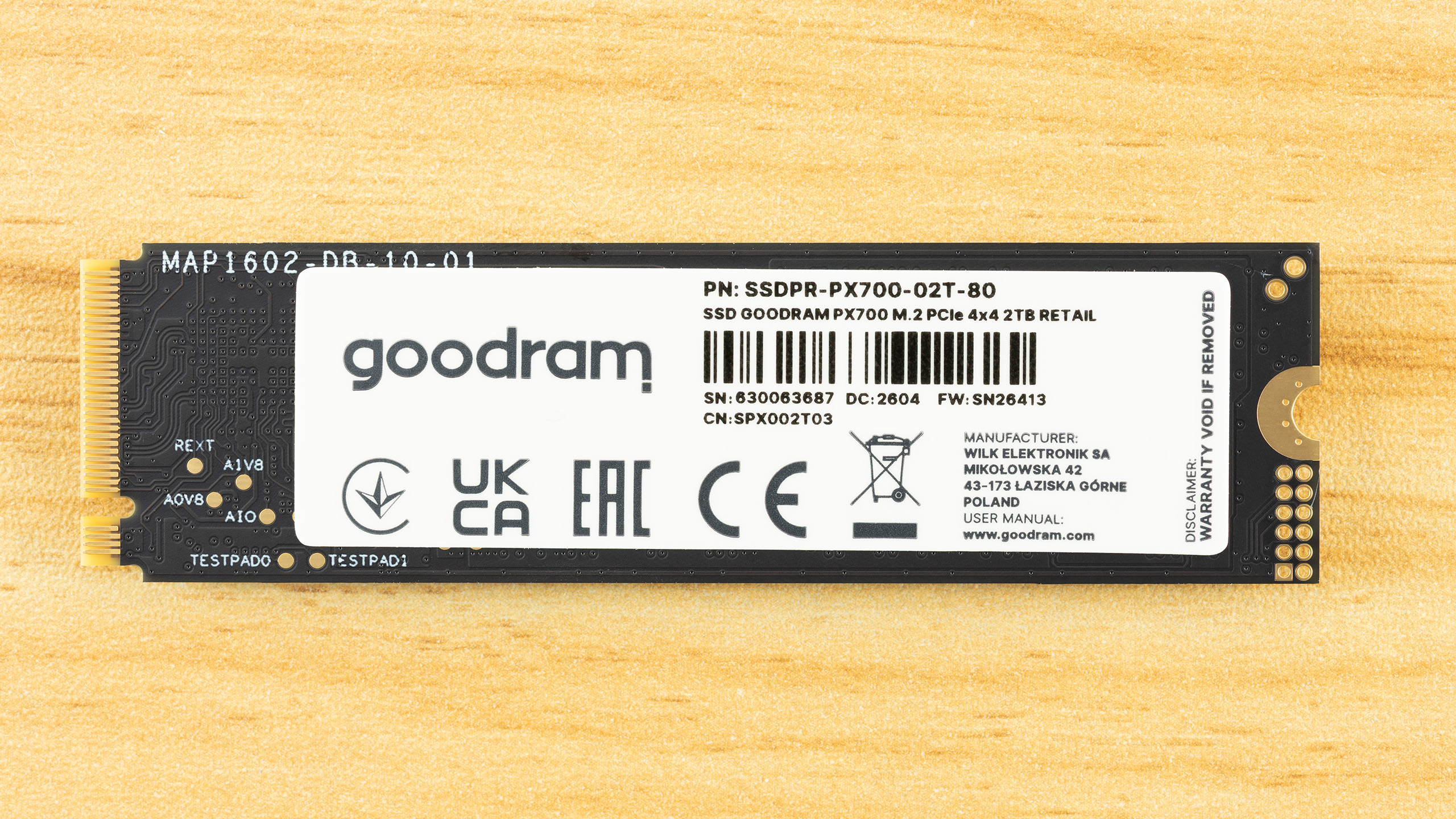
The PX700 is a single-sided drive at all capacity points. This makes it compatible with a wider range of systems and, if you need to cool the drive, it’s easier to tackle just one side of components. As it turns out, the drive runs cool enough that you probably don’t have to worry about this – check the Power Consumption and Temperature section below – but it’s still worth pointing out. The data on the rear label is standard, but we do want to say a little bit more about the listed manufacturer.
Wilk Elektronik is a Poland-based memory company, which makes this interesting, as that means the PX700 is a European-assembled SSD. Goodram covers the mainstream parts and IRDM enthusiast, although this is the first SSD from them that we’ve reviewed. As we are going to dig into the hardware in this section, we will say that the drive's silicon is sourced from Asia, as with virtually every SSD. If we say a drive is made in Poland, this means the drive is assembled, tested, and covered by warranty in Poland with an EU anchor. For some, that might be a positive factor in any purchasing decision.
Tom's HardwareTom's HardwareTom's Hardware
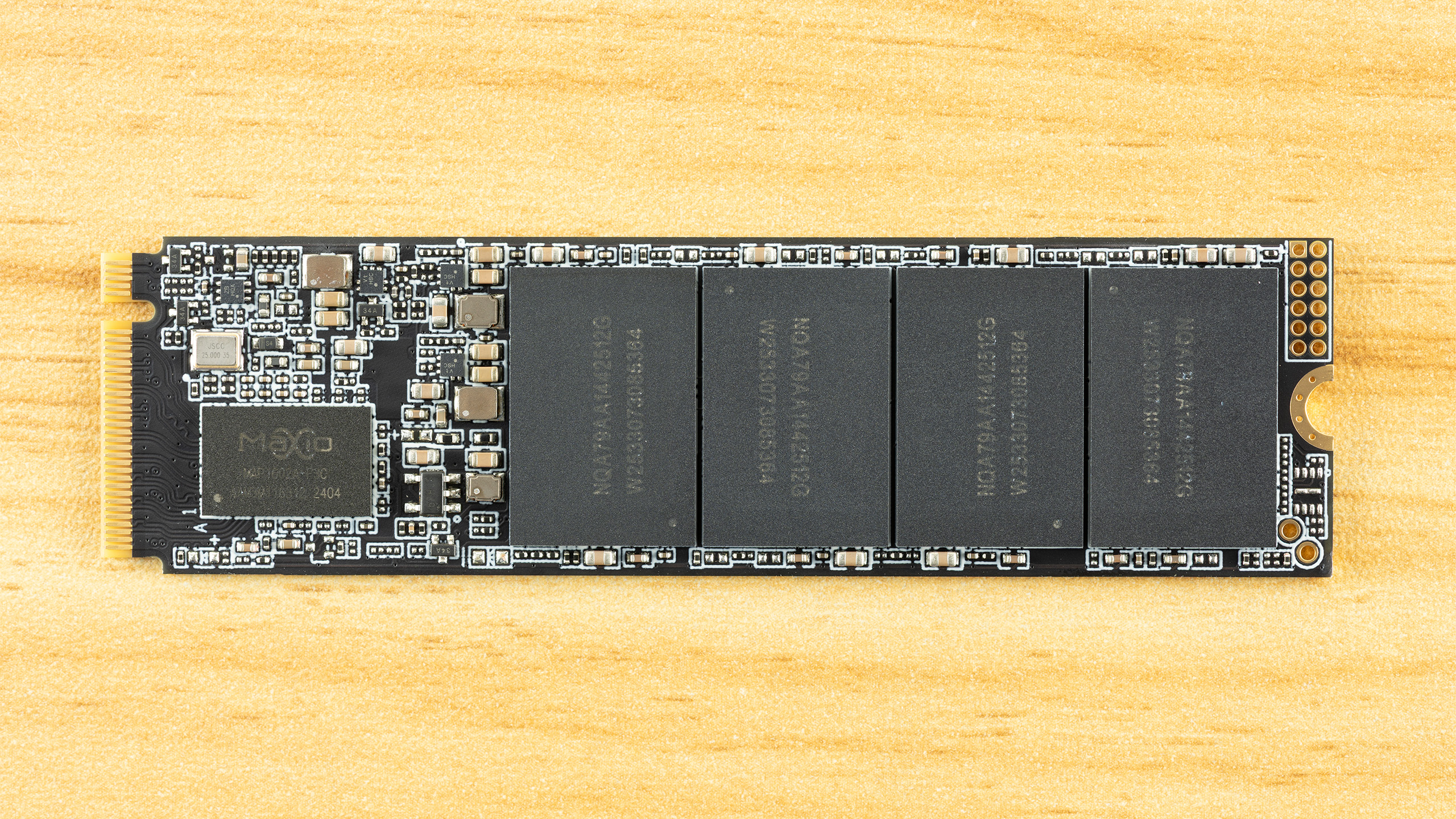
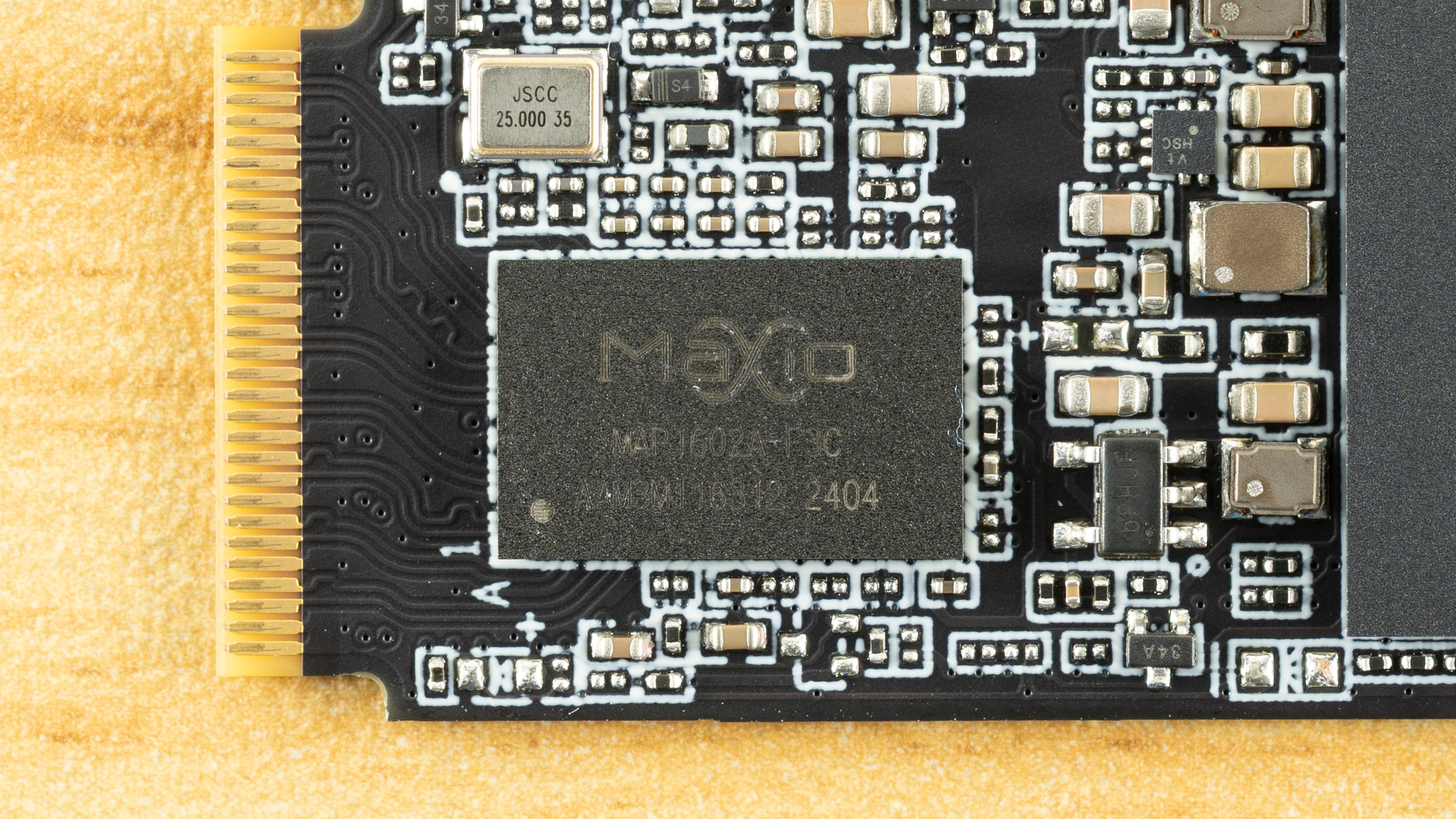
Identifying the hardware here is half simple and half challenging. The controller is clearly the Maxio MAP1602, a four-channel, DRAM-less part that’s been a budget champion for quite some time. There is not much mystery there aside from maybe this being a later revision, typically used for higher capacities.
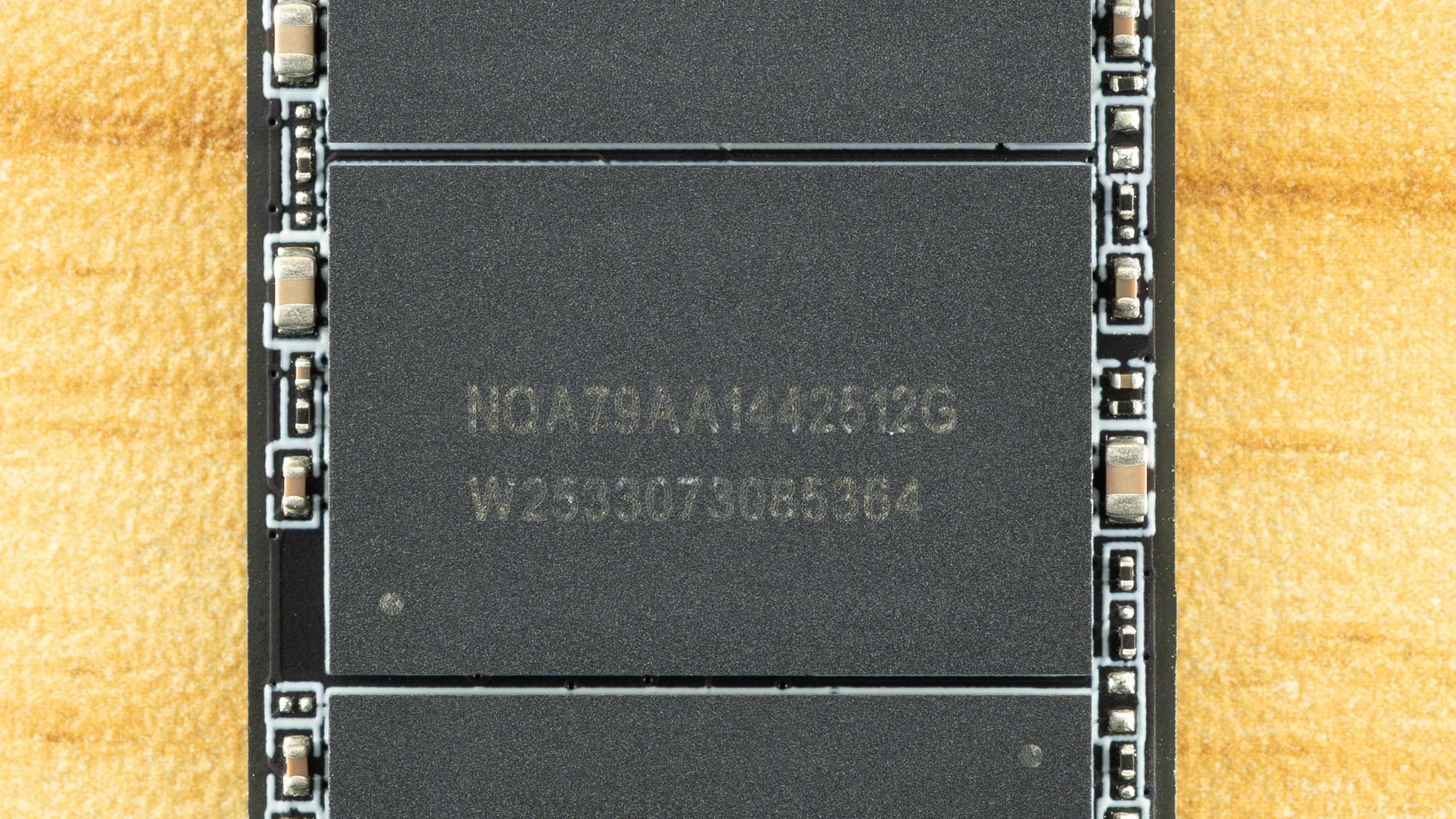
The flash is more difficult. We can ascertain that these are 512GB NAND flash packages from the “512G” – given modern flash is 1Tb or 128GB, four dies per package for a total of sixteen dies. That’s perfect for maximizing performance out of this controller. The “W2533” is likely the manufacture date of week 33, year 2025. All this indicates is that this is, at least, not older flash, although we already know it has to be 2,400 MT/s at a minimum to hit the specified performance.
It makes a lot of sense for the PX700 to use TLC flash, though, given the TBW and the fact that we’ve been seeing this controller with 232-Layer Micron TLC more frequently lately. The Biwin Black Opal NV7400 comes to mind. However, Goodram has access to YMTC flash, and that includes QLC. YMTC rather than Micron QLC is more likely, given the latter is in high demand in enterprise. Normally, you could use certain utilities to identify the flash, but firmware for this controller is often encrypted to avoid revealing the flash ID. It’s still possible to get around this with leaked MP tools, but otherwise the best way to identify it is simply to look at the performance. We’ll be doing that in this review with comparison drives to help back up the investigation.
The Goodram PX700 is in a tight spot with ample competition in today’s market. This has been true for some years now, but some more recent releases have turned up the heat. These would include the Sandisk WD Blue SN5100 with its fantastic random read latency, the Crucial P310 with surprisingly good all-around performance, and even the Samsung 990, which was a very late arrival. Existing drives with comparable hardware to the PX700 include the Acer FA200 with QLC flash plus the Biwin Black Opal NV7400, Addlink A93, and Inland TN470 with TLC. The last of these also uses a Phison controller rather than the more common Maxio MAP1602. Lastly, we have the budget-minded Kingston NV3, which is always looming in the background.
Trace Testing — 3DMark Storage Benchmark
Built for gamers, 3DMark’s Storage Benchmark focuses on real-world gaming performance. Each round in this benchmark stresses storage based on gaming activities including loading games, saving progress, installing game files, and recording gameplay video streams. Future gaming benchmarks will be DirectStorage-inclusive and an evaluation for future-proofing is included where applicable.
Tom's HardwareTom's HardwareTom's Hardware
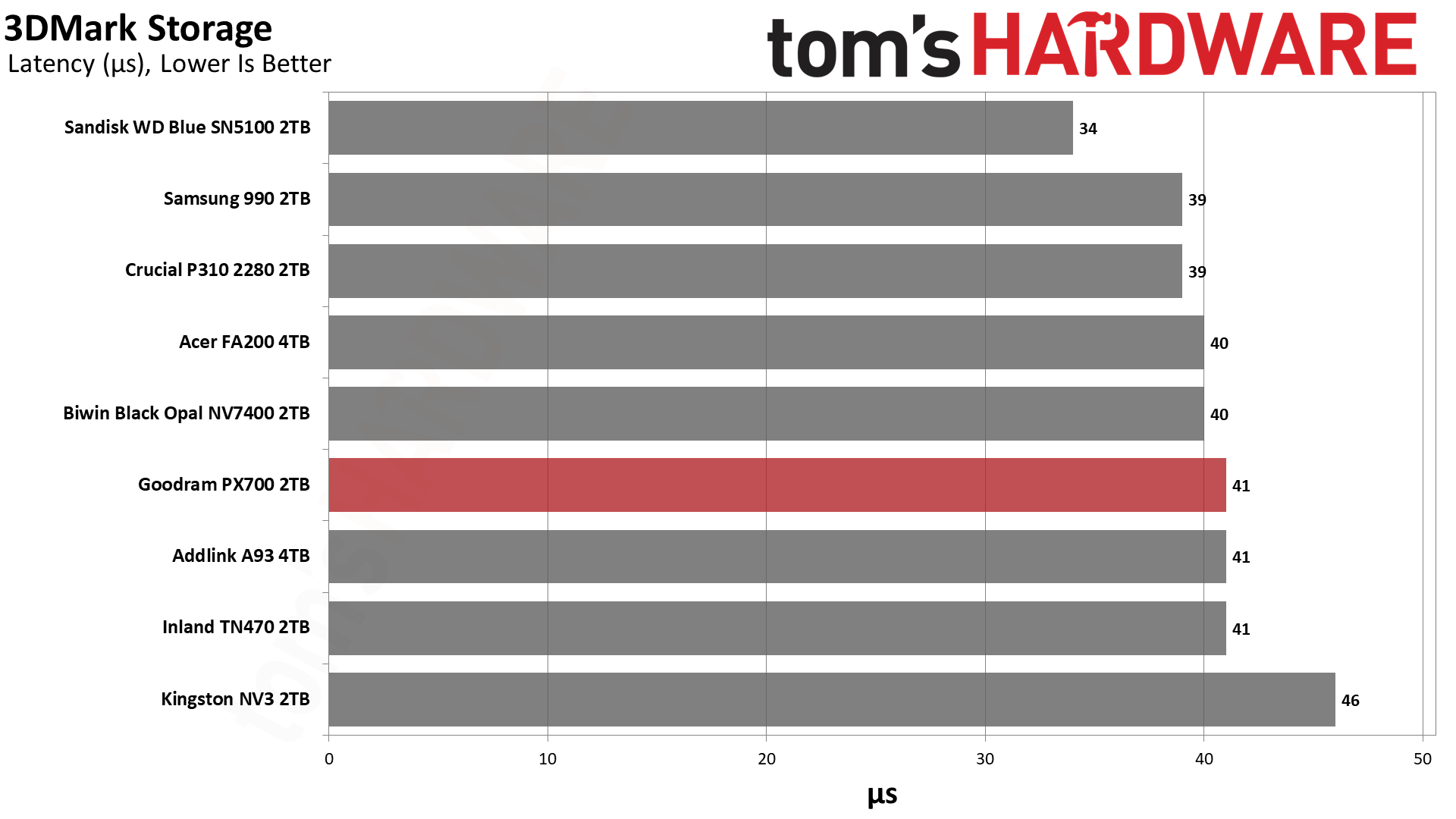
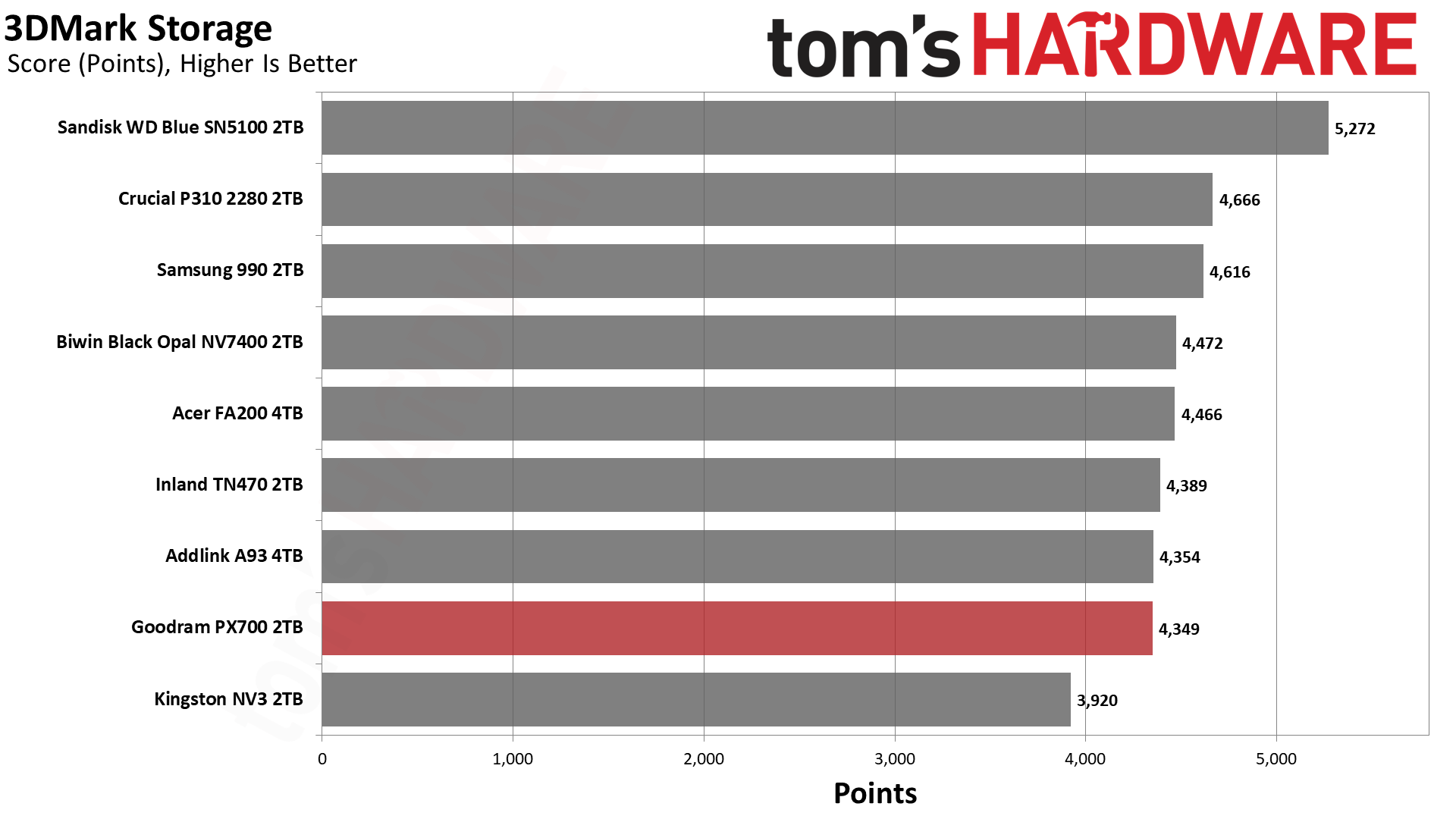
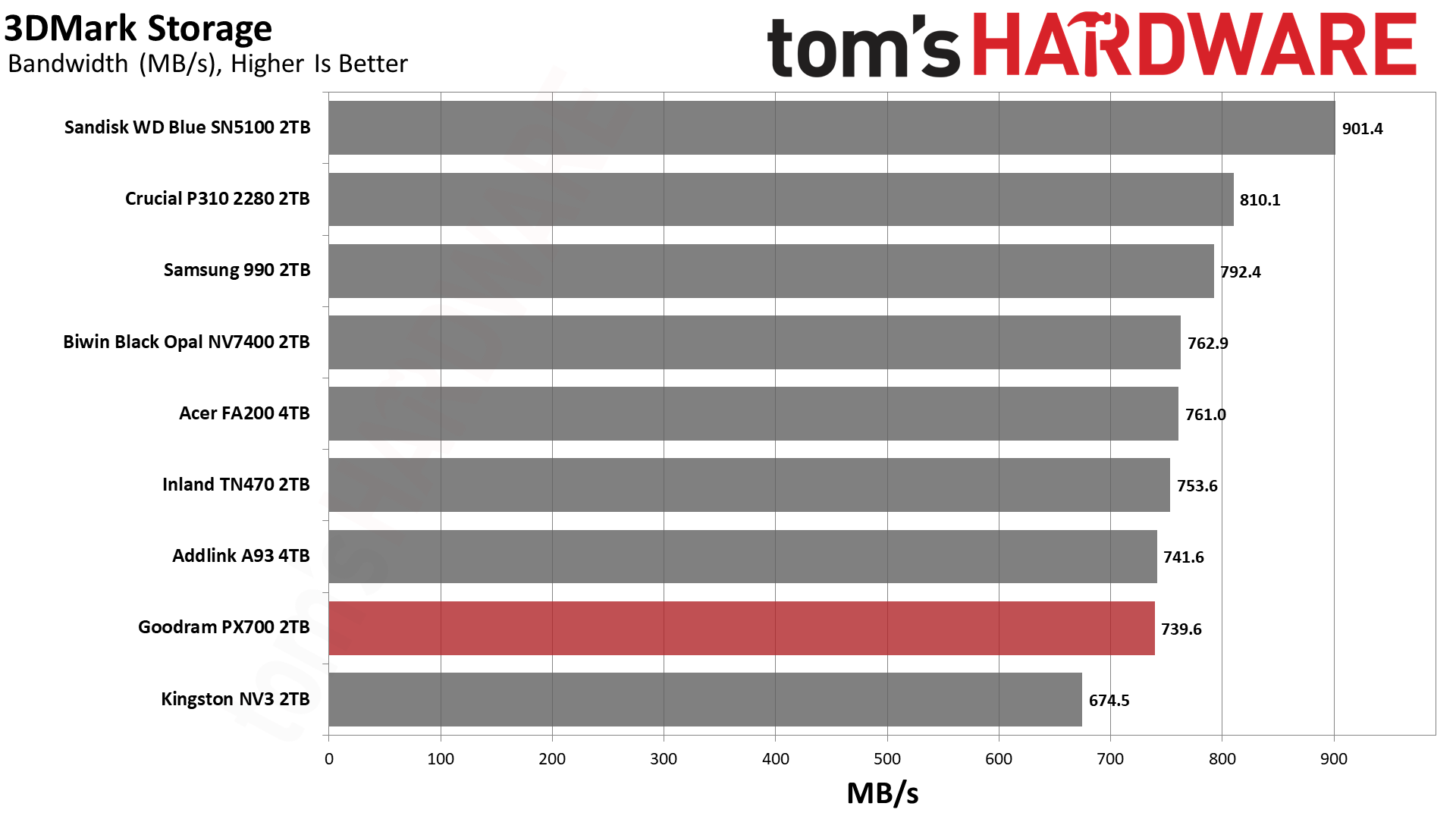
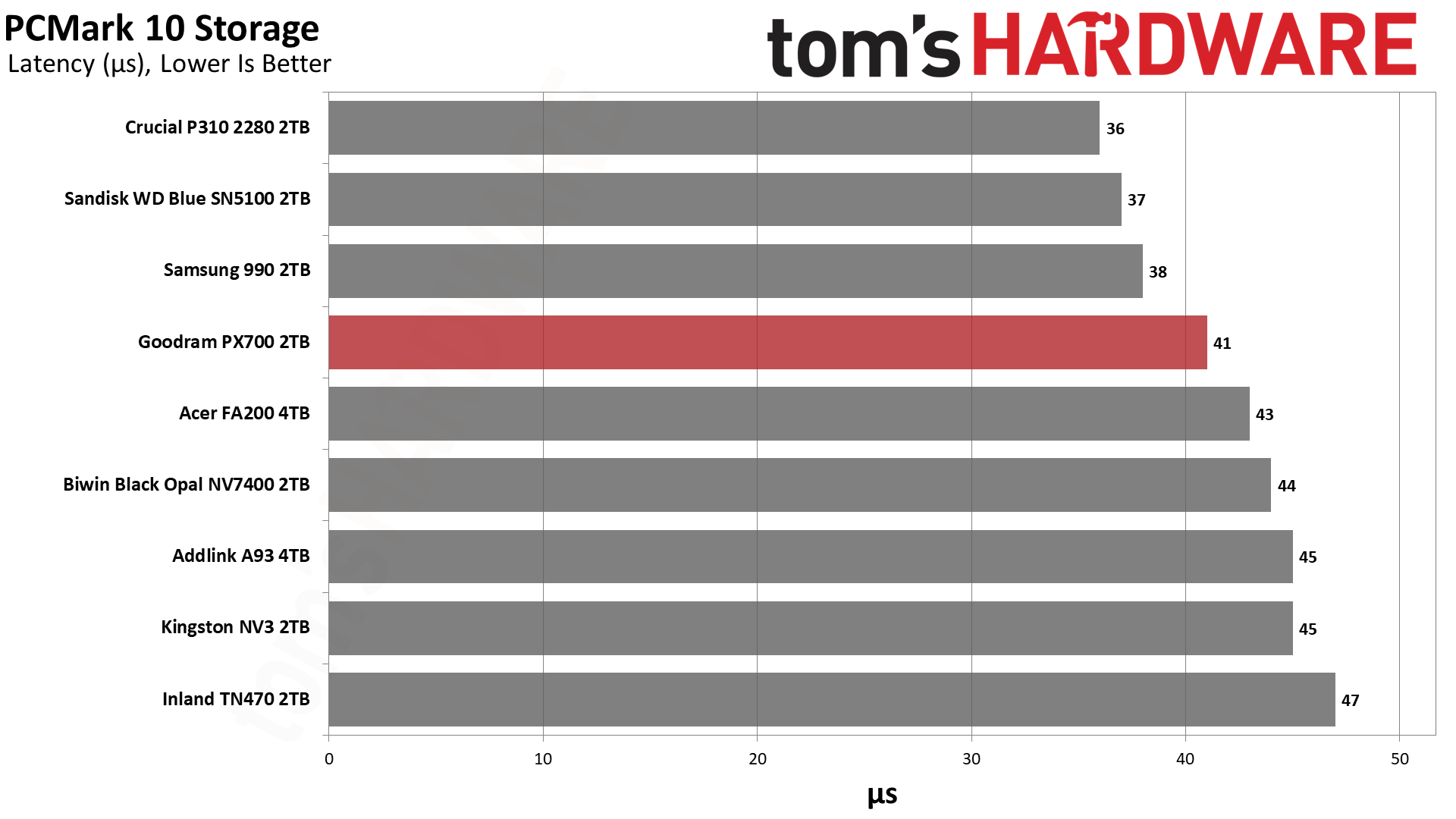
The PX700’s 3DMark results are spot-on for a drive of this caliber, hanging out at around 40µs for latency with bandwidth over 700 MB/s. This level of performance is excellent for gaming, and the only drive that wouldn’t fall into that category is the NV3. The NV3 is still fast enough for a games drive and remains a good budget choice, but there are faster options like the PX700. We want to emphasize that the PX700 is better than it looks in this lineup because it’s effectively within range of all drives but one, the WD Blue SN5100.
Among the QLC-based drives, the WD Blue SN5100, 990, and P310 all notably score near the top. The BiCS flash in the first drive is known for its responsiveness and, yes, it will give you a small edge with game load times. However, the 990 is right up there with the P310, which means there is no shortage of viable options. Most slower drives, from a gamer’s perspective, will be last-generation or slower PCIe 4.0, which means it’s not hard to find drives that are very fast for games. This means that the deciding factor might lie outside of 3DMark performance, such as drive reliability.
Trace Testing — PCMark 10 Storage Benchmark
PCMark 10 is an industry standard trace-based benchmark that uses a wide-ranging set of real-world traces from popular applications and everyday tasks to measure the performance of storage devices. The results are particularly useful when analyzing drives for their use as primary/boot storage devices and in work environments.
Tom's HardwareTom's HardwareTom's Hardware
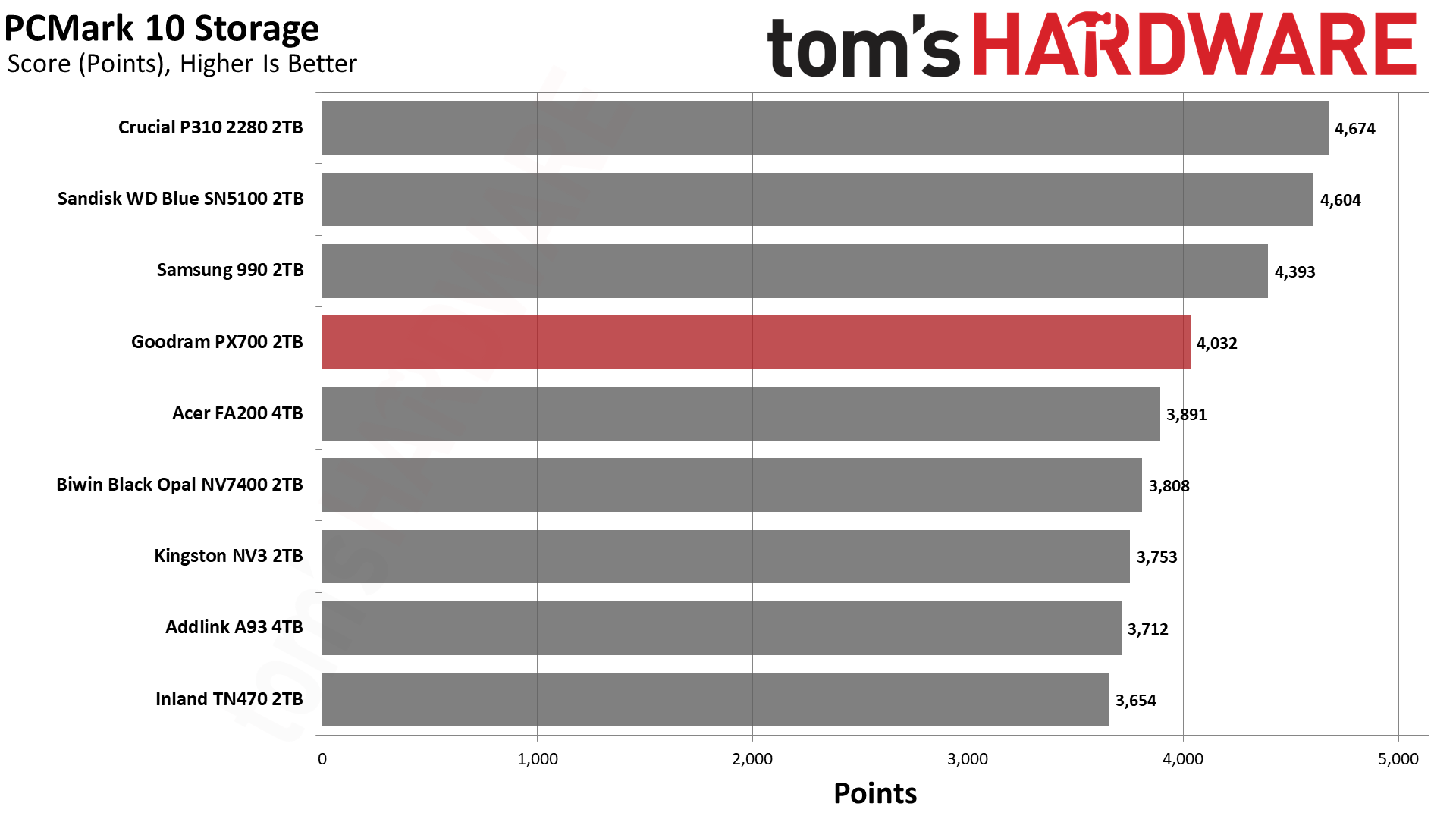
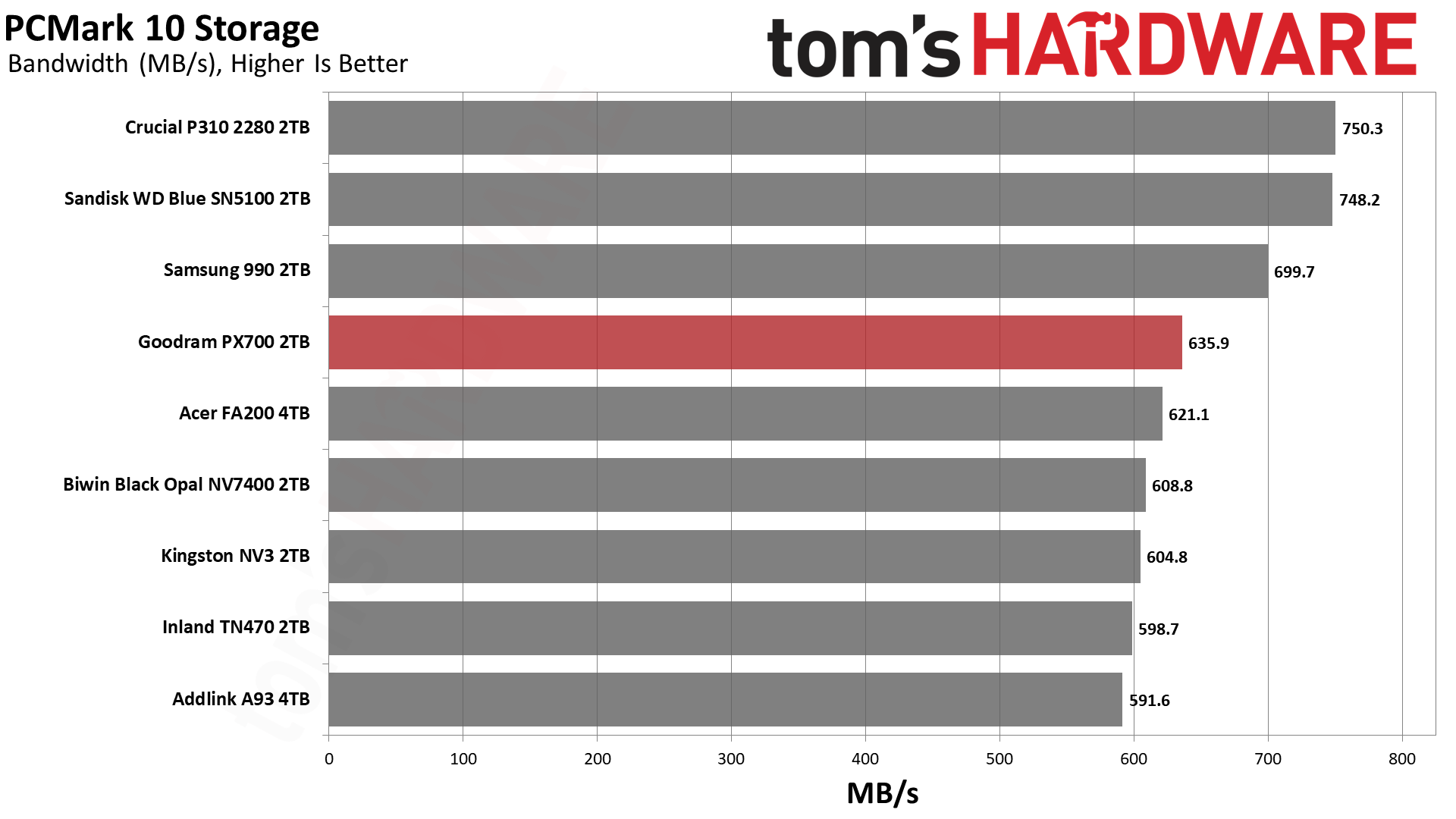
While the PX700 is merely mediocre against the competition in 3DMark – its absolute performance is quite good, though – its showing in PCMark 10 is better. This is again a scenario where the drives with TLC flash, including the TN470 with Phison’s controller, are underwhelming. This can be confusing to buyers who have relied on the mantra that TLC is better than QLC. There are reasons for the surprise here, although the general idea that benchmarking is often looking at ideal scenarios is perhaps the easiest answer.
These drives, whether TLC or QLC, rely on pSLC cache as much as possible to give you the best performance. This pSLC mode is not equivalent to native pSLC and is generally the same speed regardless of the flash type. QLC, however, tends to lead TLC in some ways and follow it in others. For example, QLC gets larger benefits from optimizations, so it may see advanced techniques first. This includes improvements to 4K latency. On the other hand, QLC has four planes when TLC has advanced to six. As we’ve seen with BiCS flash, which is four-plane against six-plane TLC from Micron and YMTC, fewer planes can lead to lower effective latency. The advantage of a higher plane count is in bandwidth but does not come without costs and drawbacks.
The PX700 is also faster than a QLC-based drive with the same controller, like the FA200. In that case, the FA200 uses twice as many dies – thirty-two – which puts more load on the controller. This can increase latency. In general, the idea has been that bigger drives are faster, which is certainly true in many cases. Larger drives will have more bandwidth and can reach higher IOPS due to improved parallelization. However, past four dies for each channel – this is where the PX700 falls, and the FA200 exceeds – you are increasing power consumption and overhead. So, the PX700 is in a sweet spot for how this benchmark tests.
We would go on to say that the P310, WD Blue SN5100, and 990 all beat the PX700. These are all QLC-based drives with a range of controllers. We’ve already explained the BiCS factor. Samsung’s newer QLC is also very good. The P310 has always been a bit of an outlier, as on paper its hardware shouldn’t perform as well as it does. Considering Crucial used to rely at least partially on proprietary controllers, we think this is a situation where they did a lot of optimization. WD and Sandisk also did this with the Black SN8100/Optimus Pro GX 8100 so there’s some “special sauce” at play. The PX700 being the best of the rest is a point in its favor, as those are the drives it’s competing with in the real market.
Console Testing — PlayStation 5 Transfers
The PlayStation 5 is capable of taking one additional PCIe 4.0 or faster SSD for extra game storage. While any 4.0 drive will technically work, Sony recommends drives that can deliver at least 5,500 MB/s of sequential read bandwidth for optimal performance. Based on our extensive testing, PCIe 5.0 SSDs don’t bring much to the table and generally shouldn’t be used in the PS5, especially as they may require additional cooling. Check our Best PS5 SSDs article for more information.
Our testing utilizes the PS5’s internal storage test and manual read/write tests with over 192GB of data both from and to the internal storage. Throttling is prevented where possible to see how each drive operates under ideal conditions. While game load times should not deviate much from drive to drive, our results can indicate which drives may be more responsive in long-term use.
Tom's HardwareTom's HardwareTom's Hardware
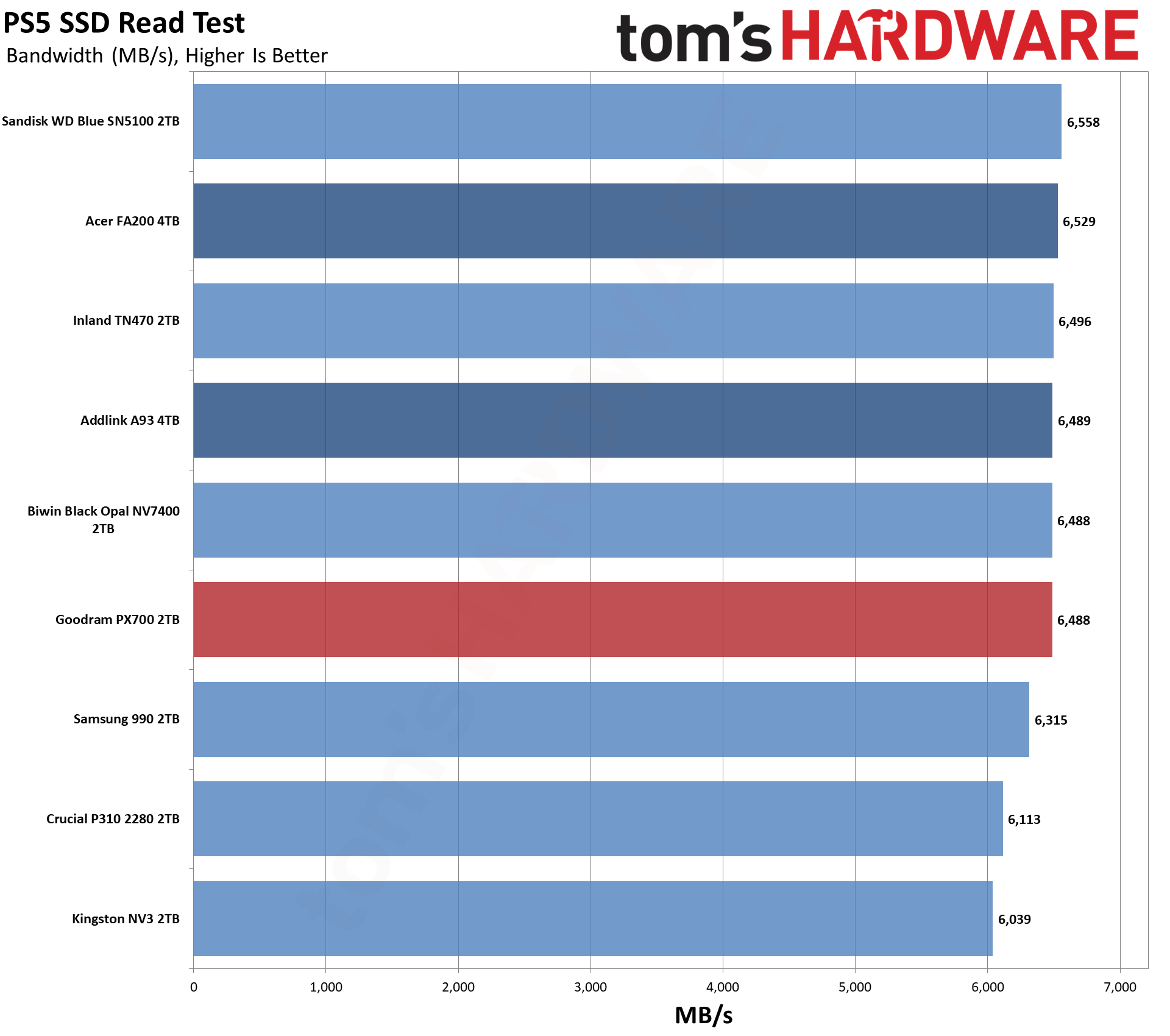
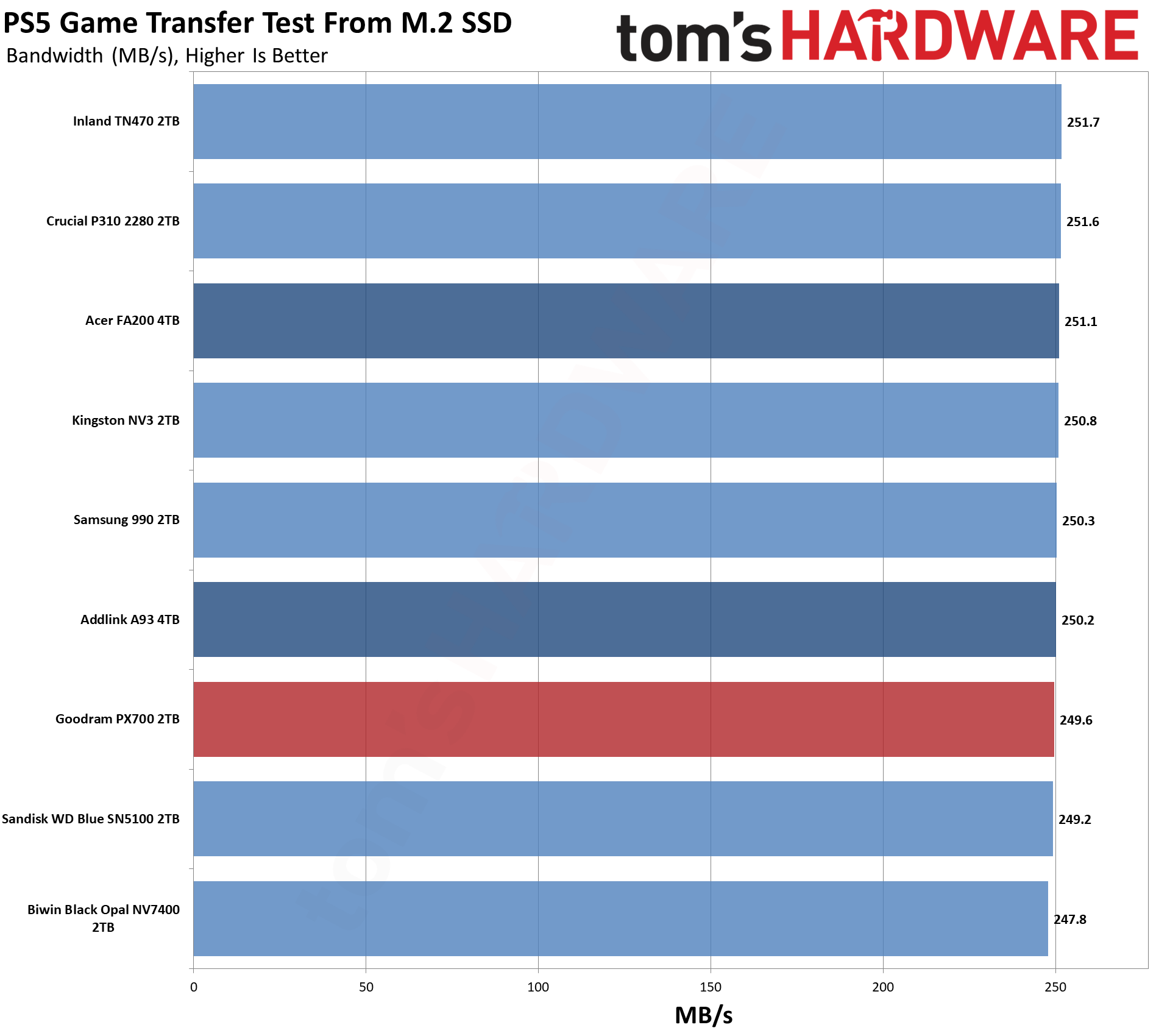
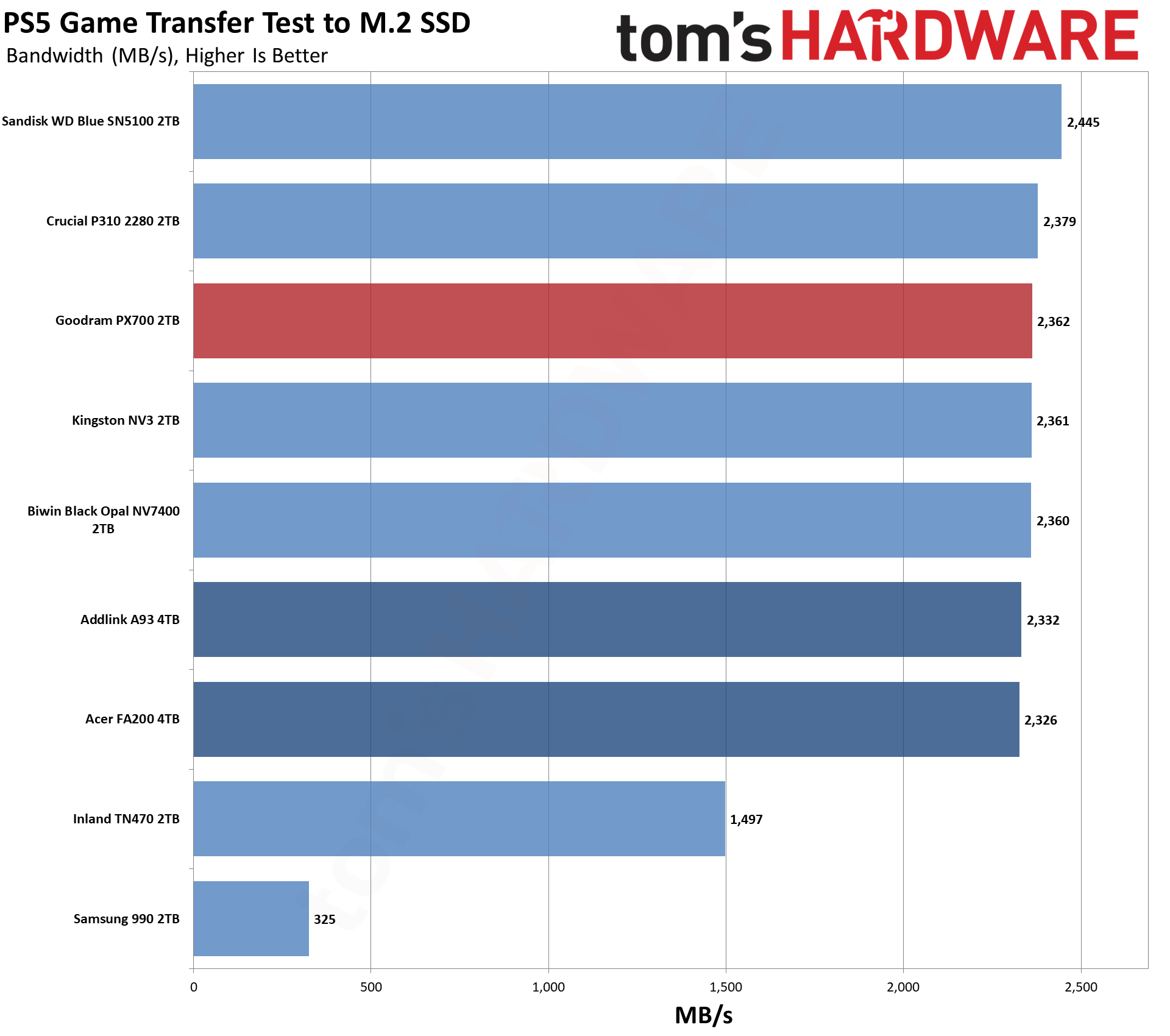
For the PS5, we can recommend almost any drive if it meets the PS5’s minimum requirements in any real way. The PX700 significantly exceeds that, so the question is more about value. What does this drive offer that others don’t? For this category, this often means leaning towards drives with heatsinks and/or higher reliability. Reliability is a difficult quality to measure, although a warranty gives some peace of mind. As for heatsinks, you can always add your own. So drawing lines here becomes more difficult.
We would point to our Power Consumption and Temperature section below for some additional support. The PX700, as we will see, runs coolly, which is a big positive for the PS5. Performance-wise, it’s right up there with the other drives and only really behind the Blue SN5100. You don’t have to go with a big brand to get good results here, and the PX700 will serve you well.
Transfer Rates — DiskBench
We use the DiskBench storage benchmarking tool to test file transfer performance with a custom 50GB dataset. We write 31,227 files of various types, such as pictures, PDFs, and videos to the test drive, then make a copy of that data to a new folder, and follow up with a reading test of a newly written 6.5GB zip file. This is a real-world type workload that fits into the cache of most drives.
Tom's HardwareTom's HardwareTom's Hardware
The PX700 does very well here, and we wanted to give some background on this test and what it means to put that into perspective. Whether you’re copying between drives or copying to and from the same drive, there are some universal principles. One is that there will be a bottleneck, and usually this will be on the write side of things, as drives write slower than they read. Flash memory, in particular, has to erase cells before they can be written again, which leads to some curious behavior under certain workloads. More generally, though, a write has higher latency – with flash again, this is due to the technology and how multi-bit cells usually need multiple write passes – and writes must be acknowledged, while reads just come from usually static media.
If you have drives that are of different classes – NVMe and SATA, or PCIe 4.0 and PCIe 3.0 – then you would expect the slower class of drive to be the bottleneck even if it’s on the read side. This is also universal, going back to the days when HDDs got faster as they got bigger. SSDs also generally get faster with capacity, but flash is so fast that these rules are no longer absolute. This is complicated by other facets of the technology like pSLC caching and TLC versus QLC flash, where with sustained writes you can have dramatic changes in performance. This is a problem because many people buy drives thinking mostly about transfer performance, and when they hit a low that’s nowhere near the box-rated speed, they panic.
Our DiskBench testing takes all of this into account as it’s closer to a real-world workload, including using different file sizes. Transferring a bunch of large files is fast. Copying lots of small files – and any veteran of hard drives will know this from backing up Windows or documents manually – can be very slow, even on SSDs. So we do a mix. Moreover, we’re doing an on-drive copy, which helps rule out external factors. Much of what you do on your system can be cached in system memory, which can give misleading metrics depending on what you’re doing.
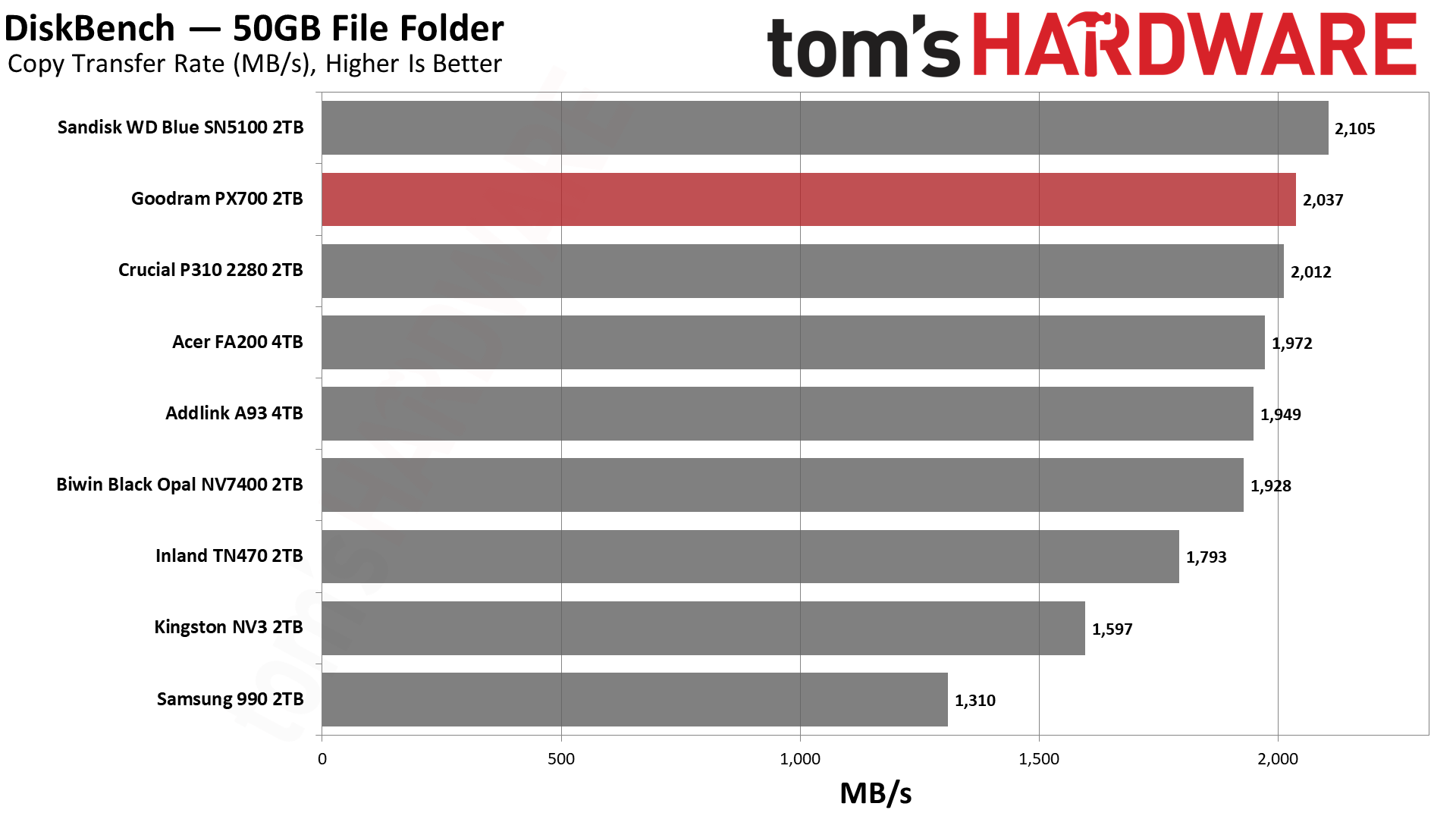
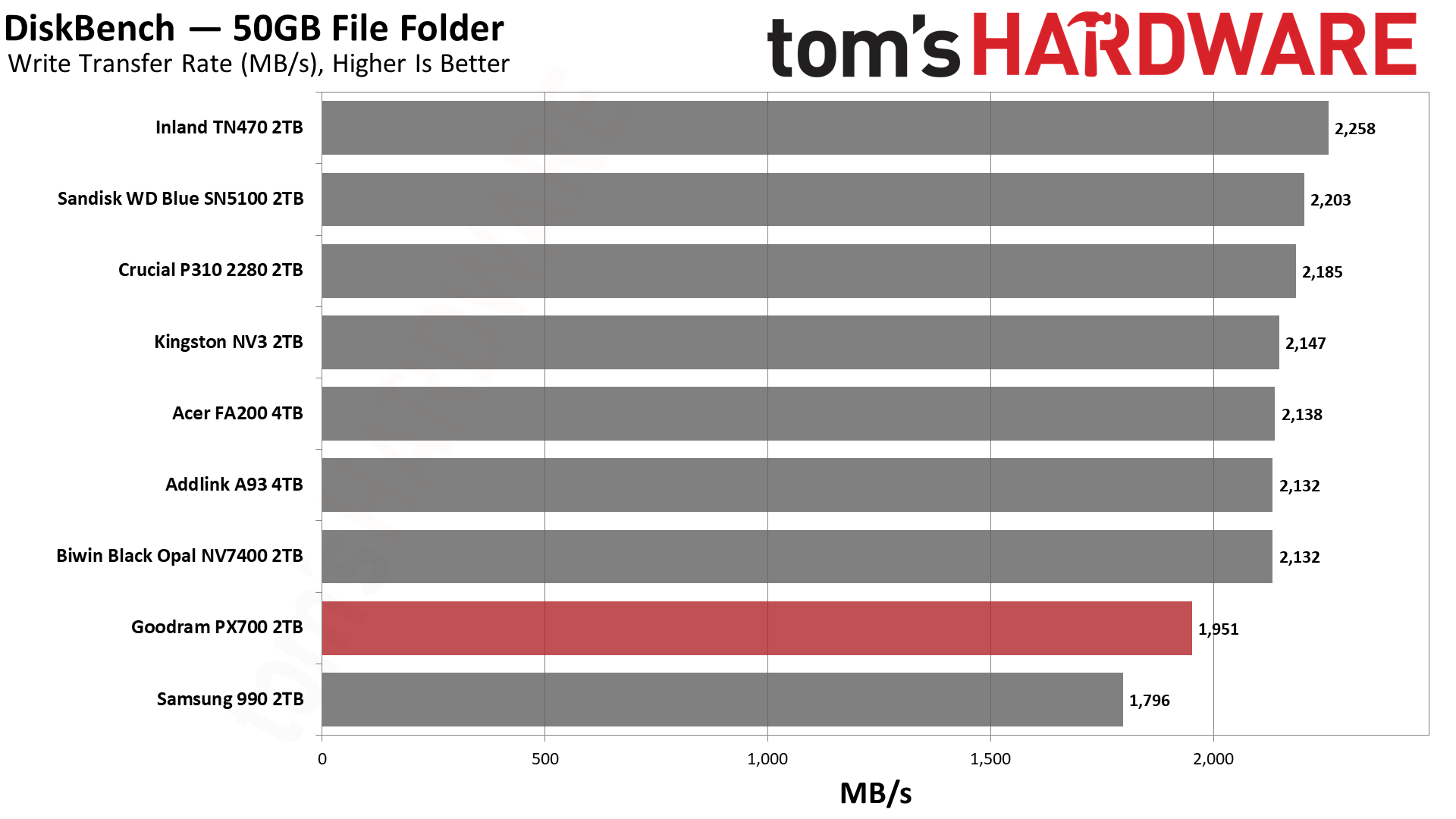
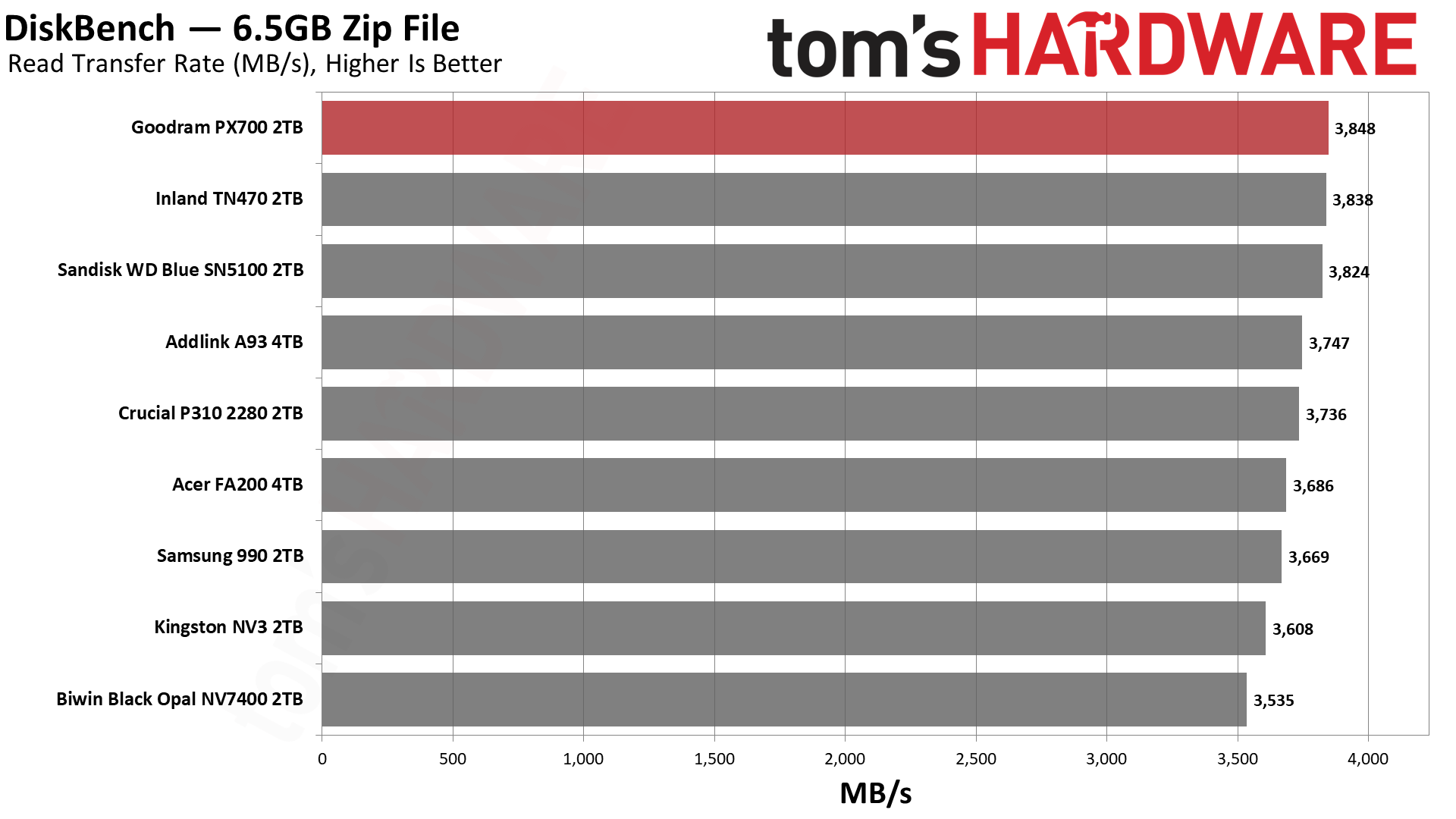
What we’re leading up to here is that the PX700 is the fastest drive on the list for reads and not far off first place for copying. Considering it’s up against some of the best budget drives out there, that’s no mean feat. This is, again, a real-world workload and probably more meaningful than something like 3DMark is for game load times.
Yes, the difference between the best and the worst drive for reads is under 10%, but nobody wants to buy a drive and feel bad about how fast it feels. The PX700 feels like a premium drive – the weaker write performance here is real, but most of what you’re doing will be read-heavy – and if you’re building a PC for someone with it over, say, the Samsung 990, they won’t know the difference. That is a common refrain regardless, but it helps underline the value of reliability. People buy Samsung and WD/Sandisk for a reason. Given Goodram’s European basis, there is some reason to celebrate the performance here while also acknowledging it’s not a no-name brand from AliExpress.
Synthetic Testing — ATTO / CrystalDiskMark
ATTO and CrystalDiskMark (CDM) are free and easy-to-use storage benchmarking tools that SSD vendors commonly use to assign performance specifications to their products. Both of these tools give us insight into how each device handles different file sizes and at different queue depths for both sequential and random workloads.
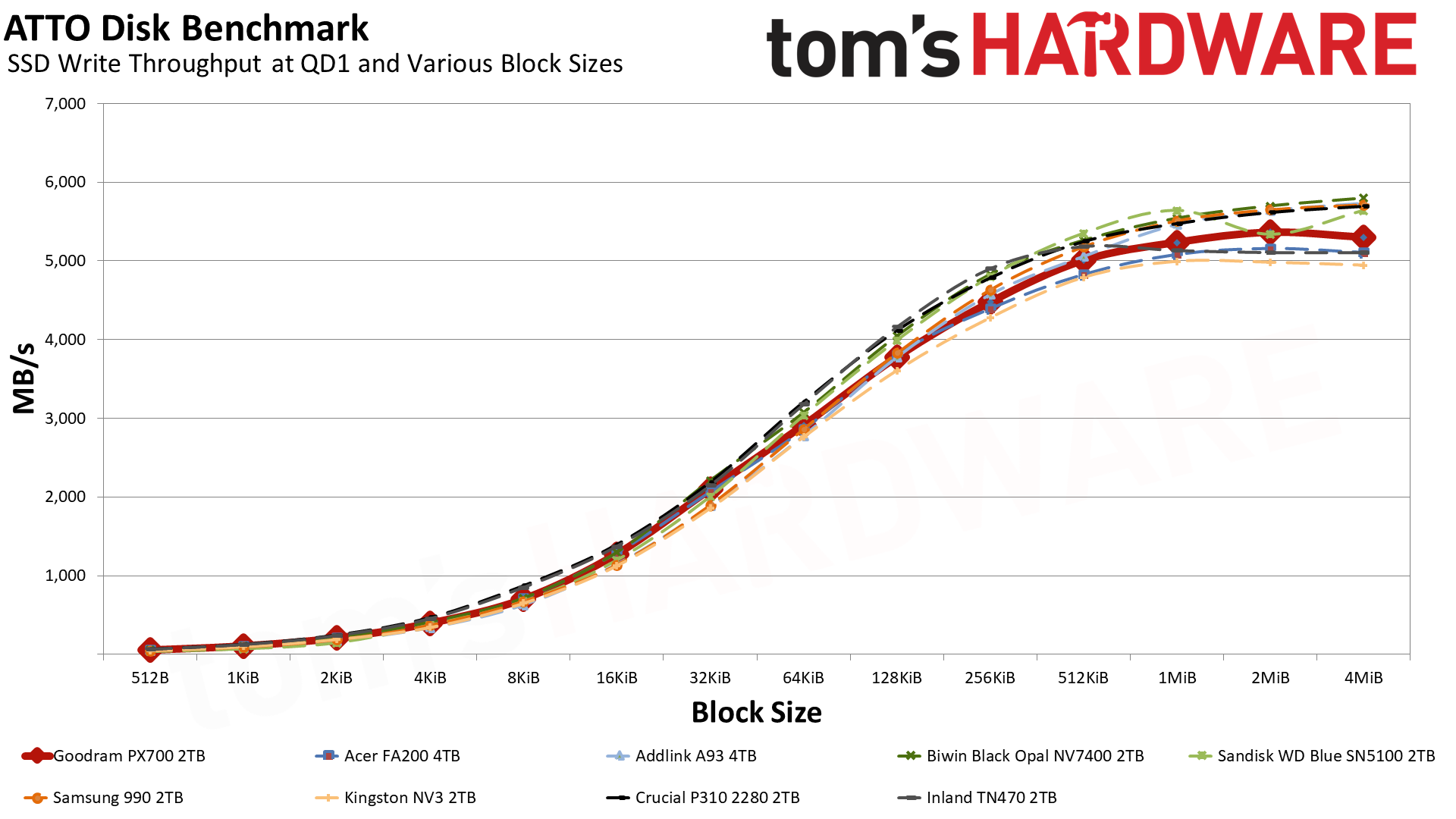
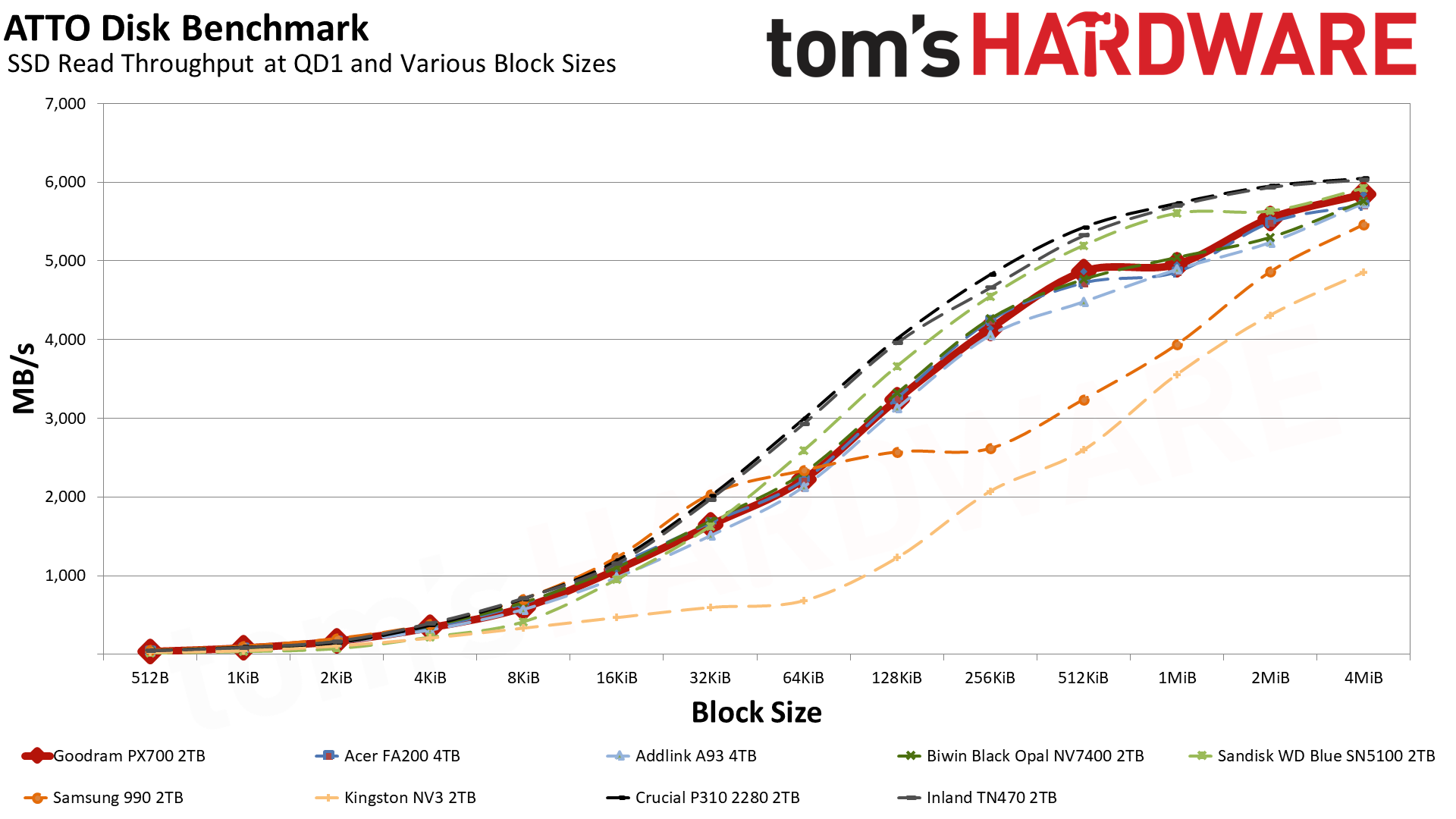
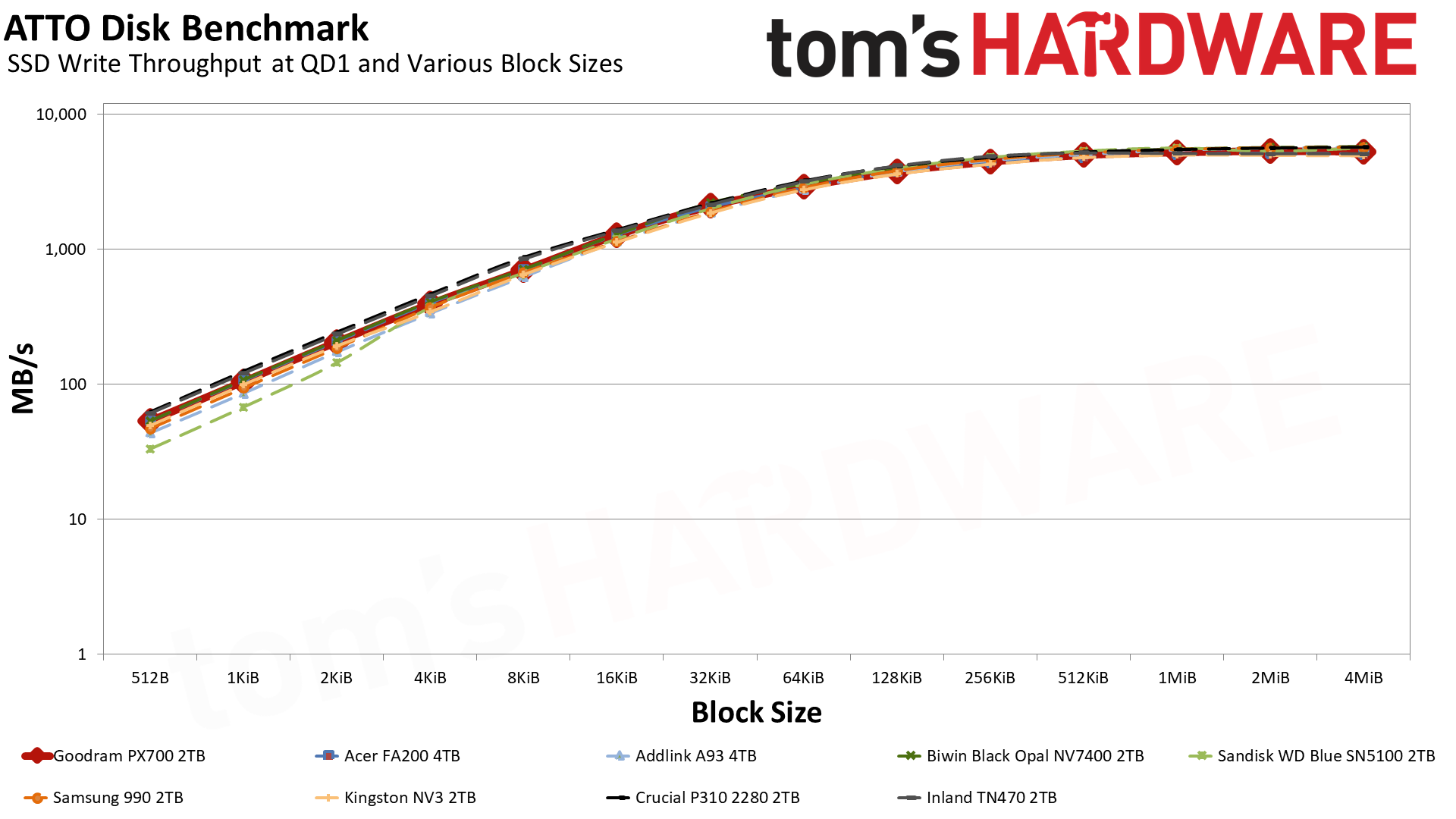
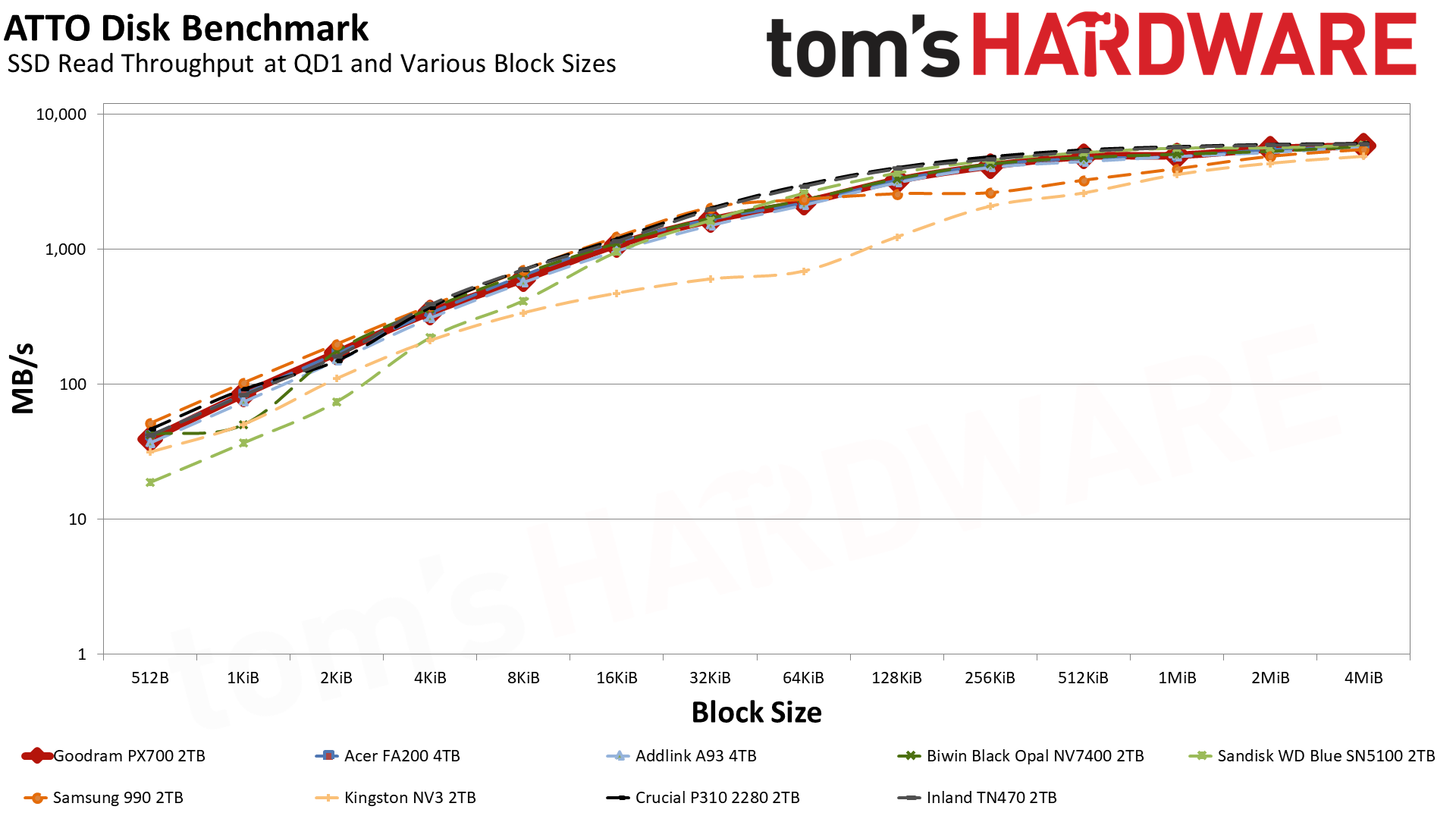
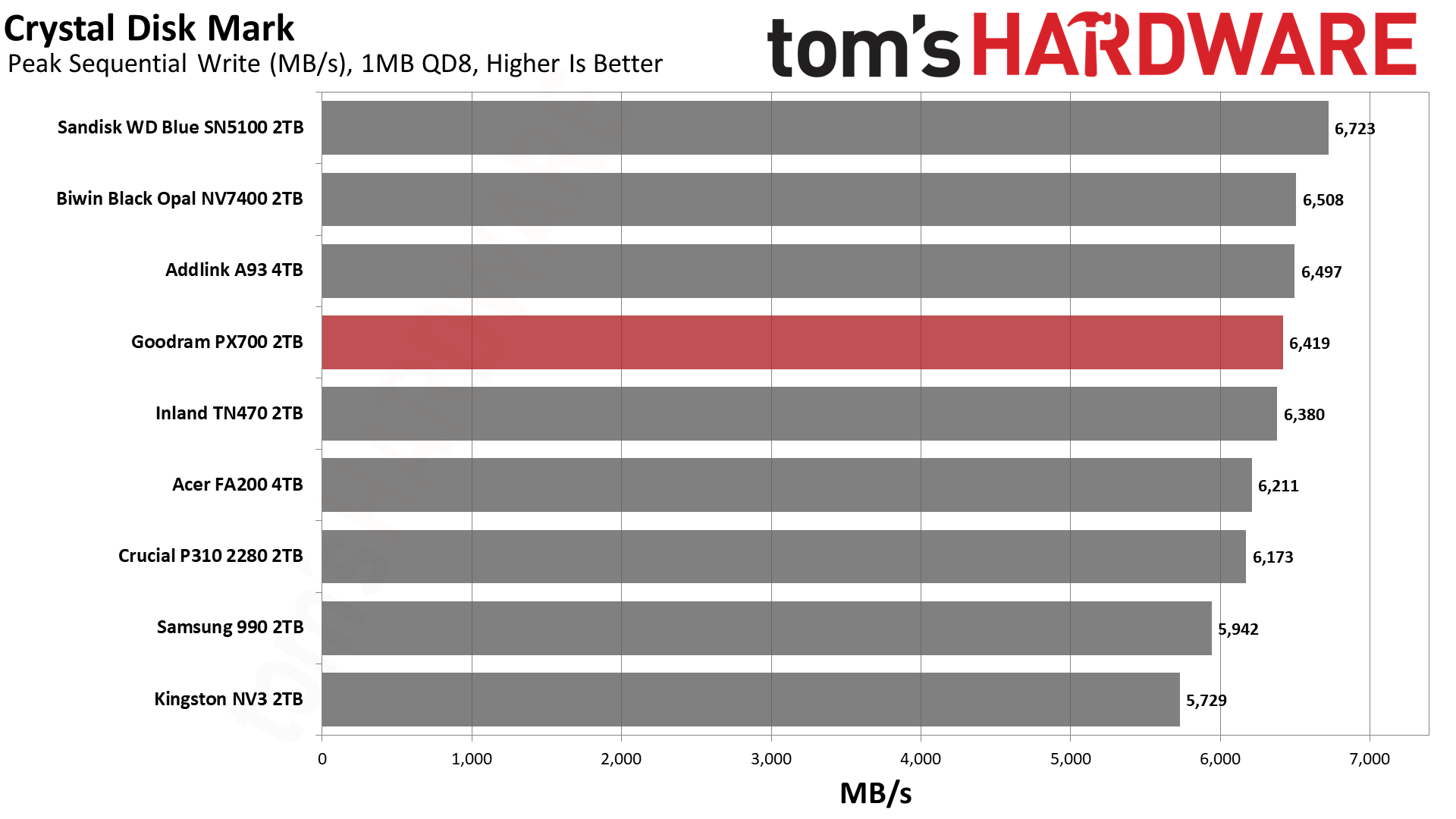
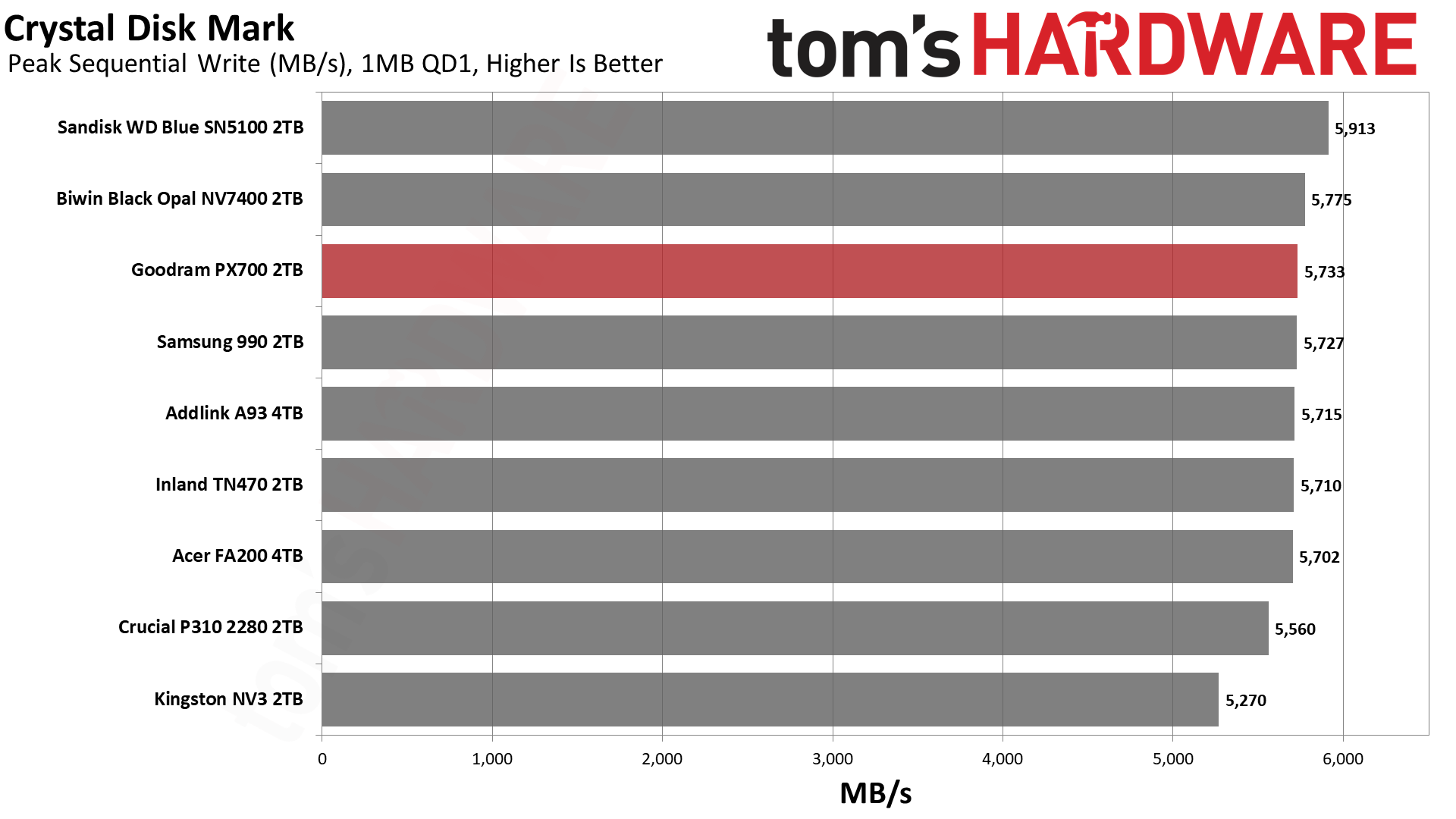
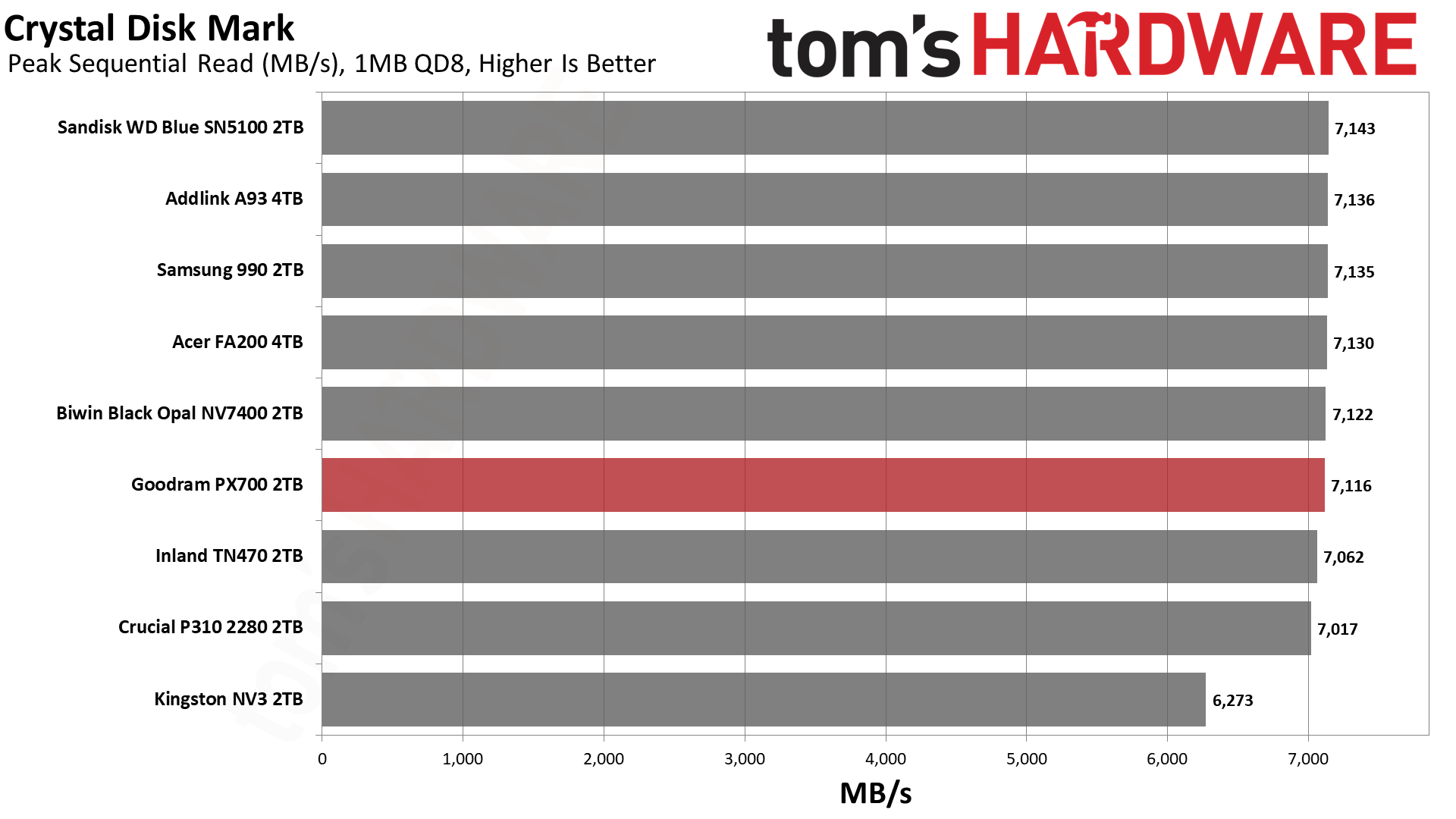
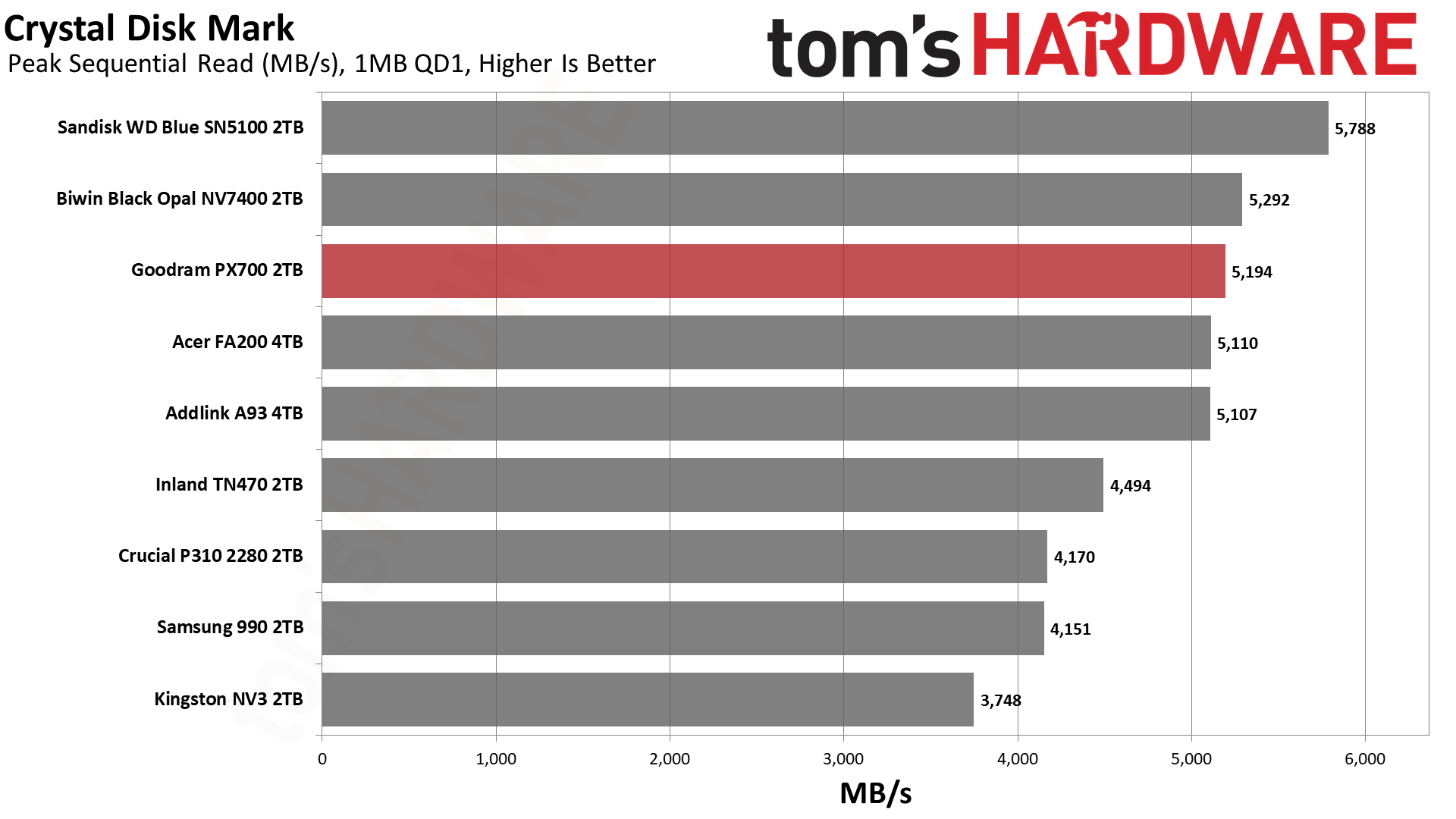
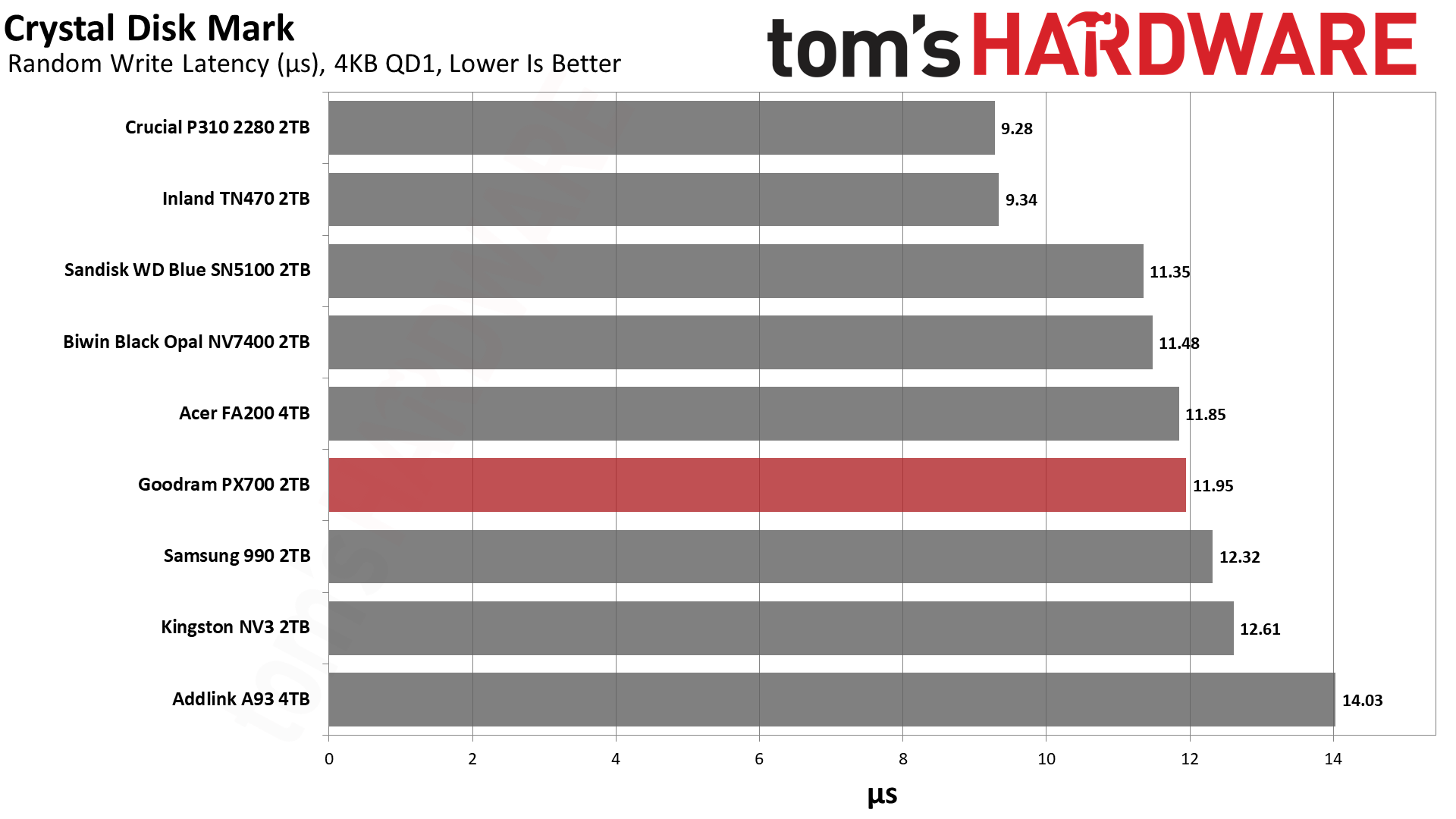
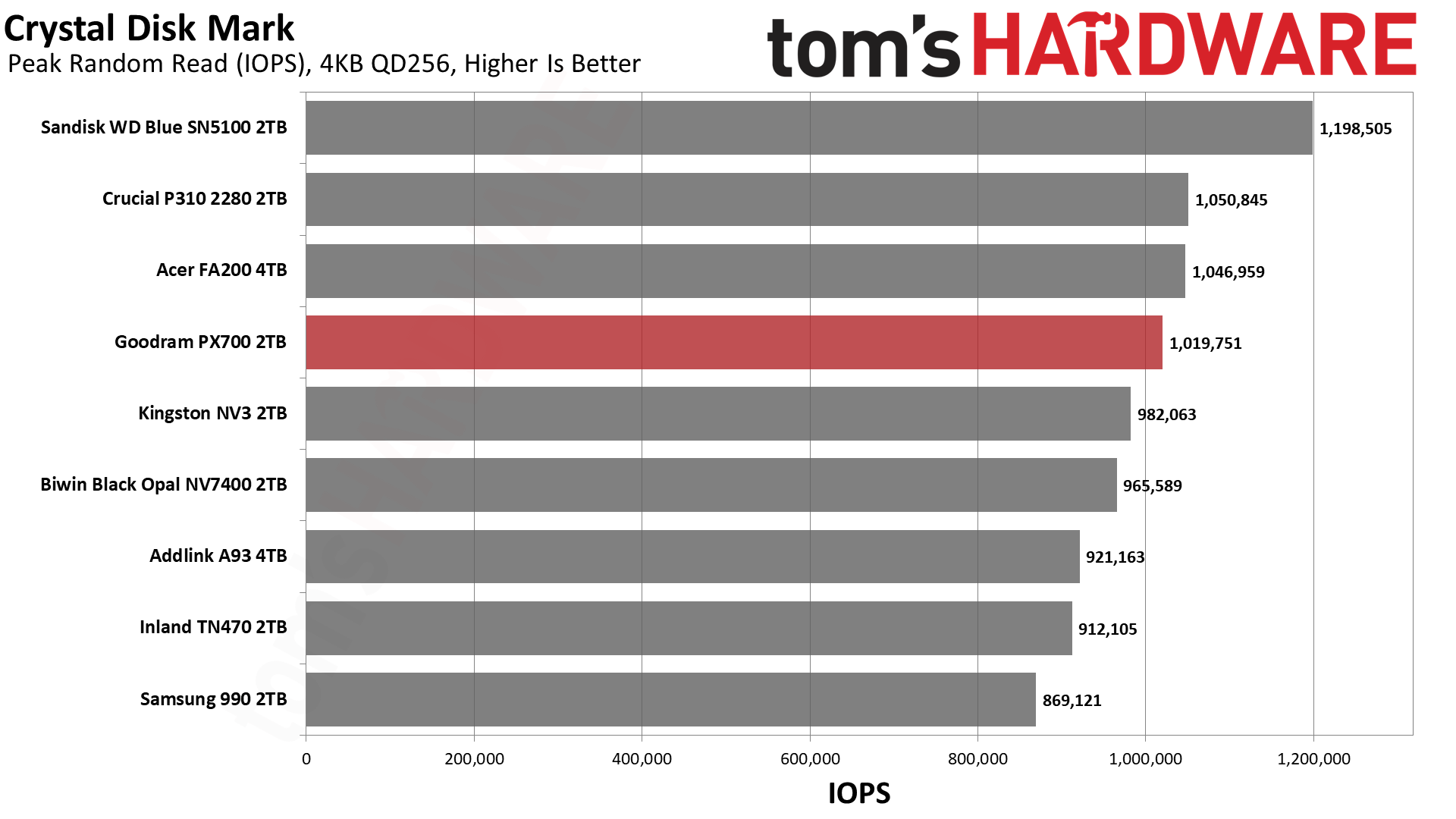
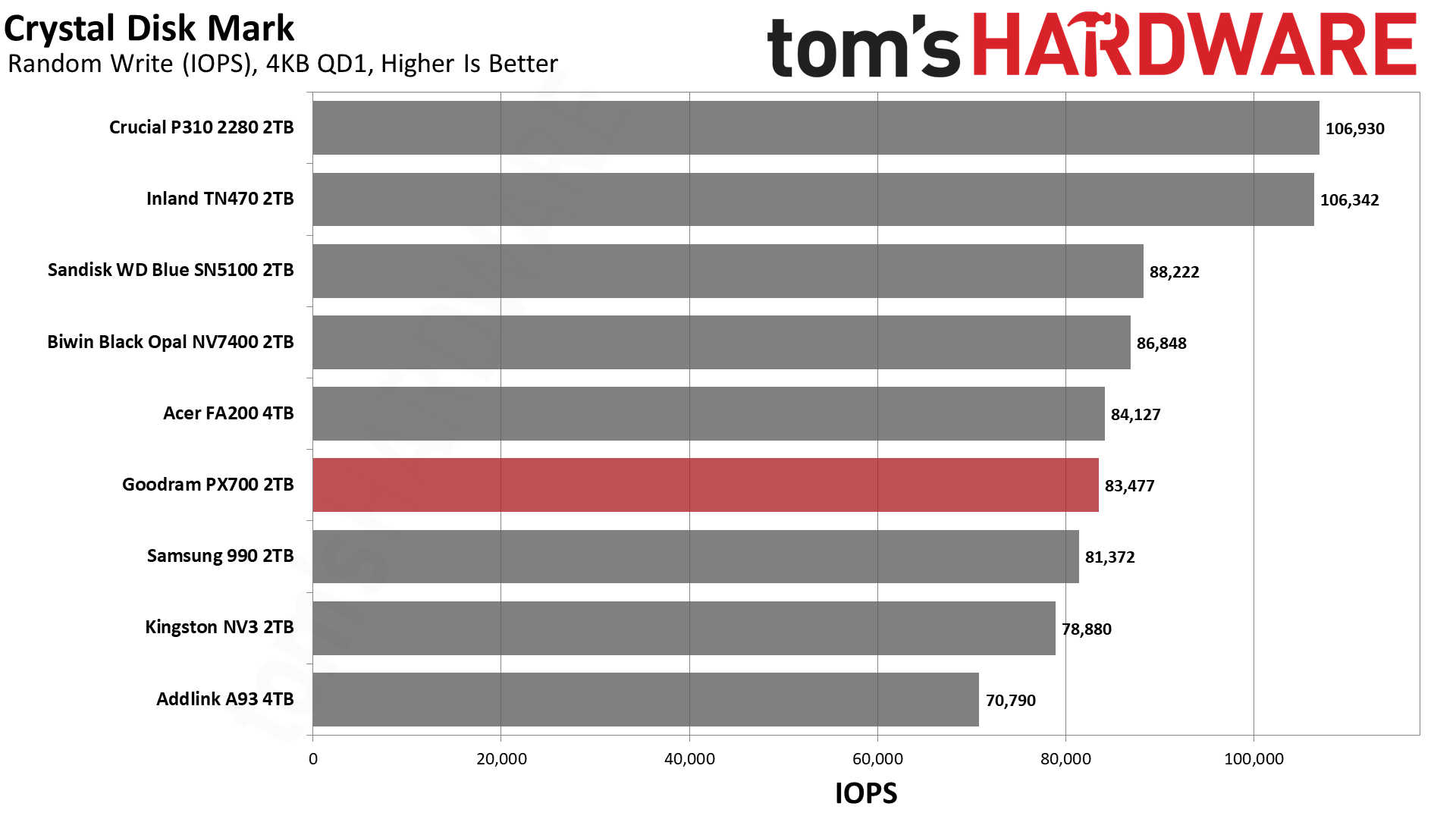
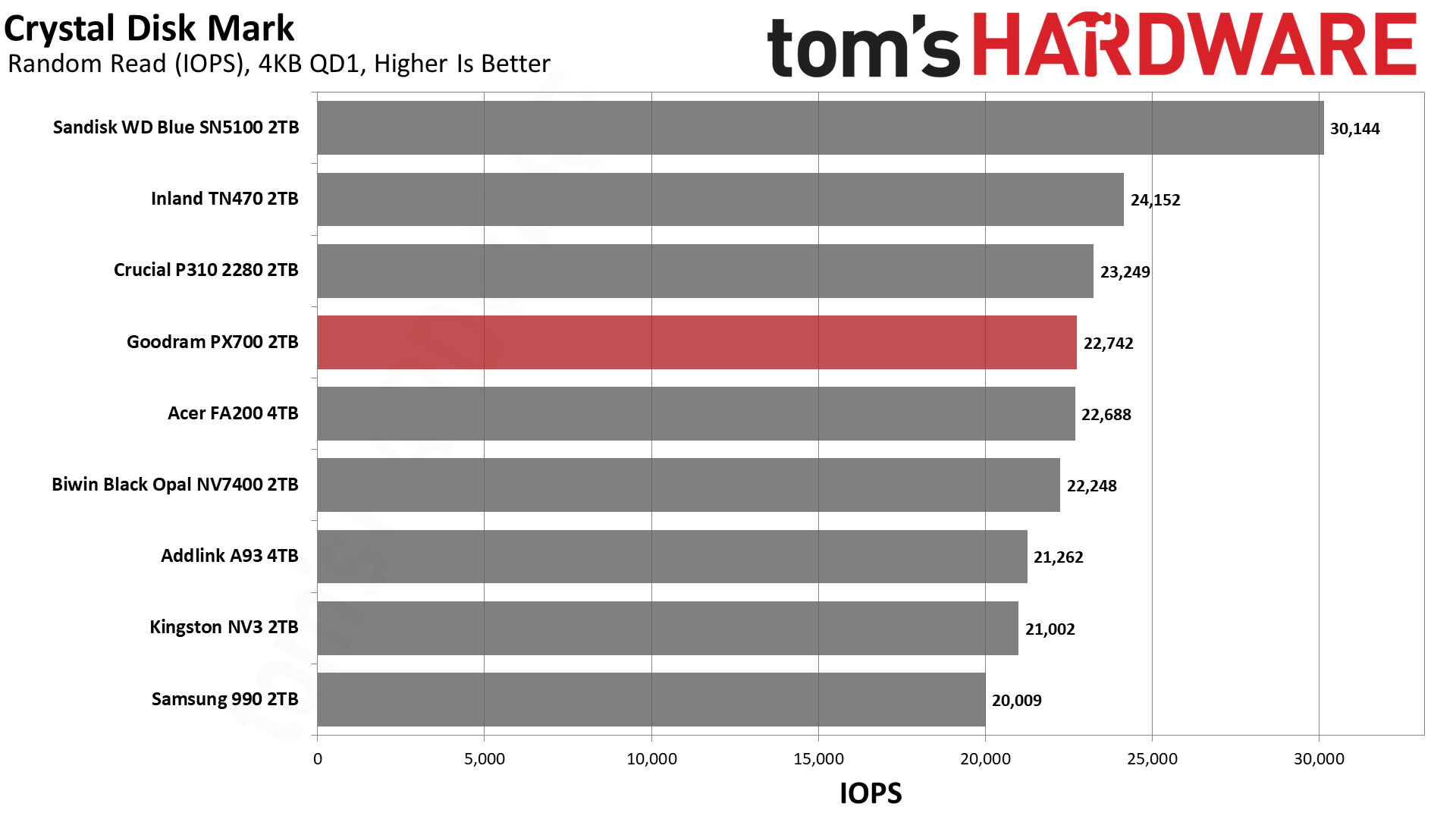
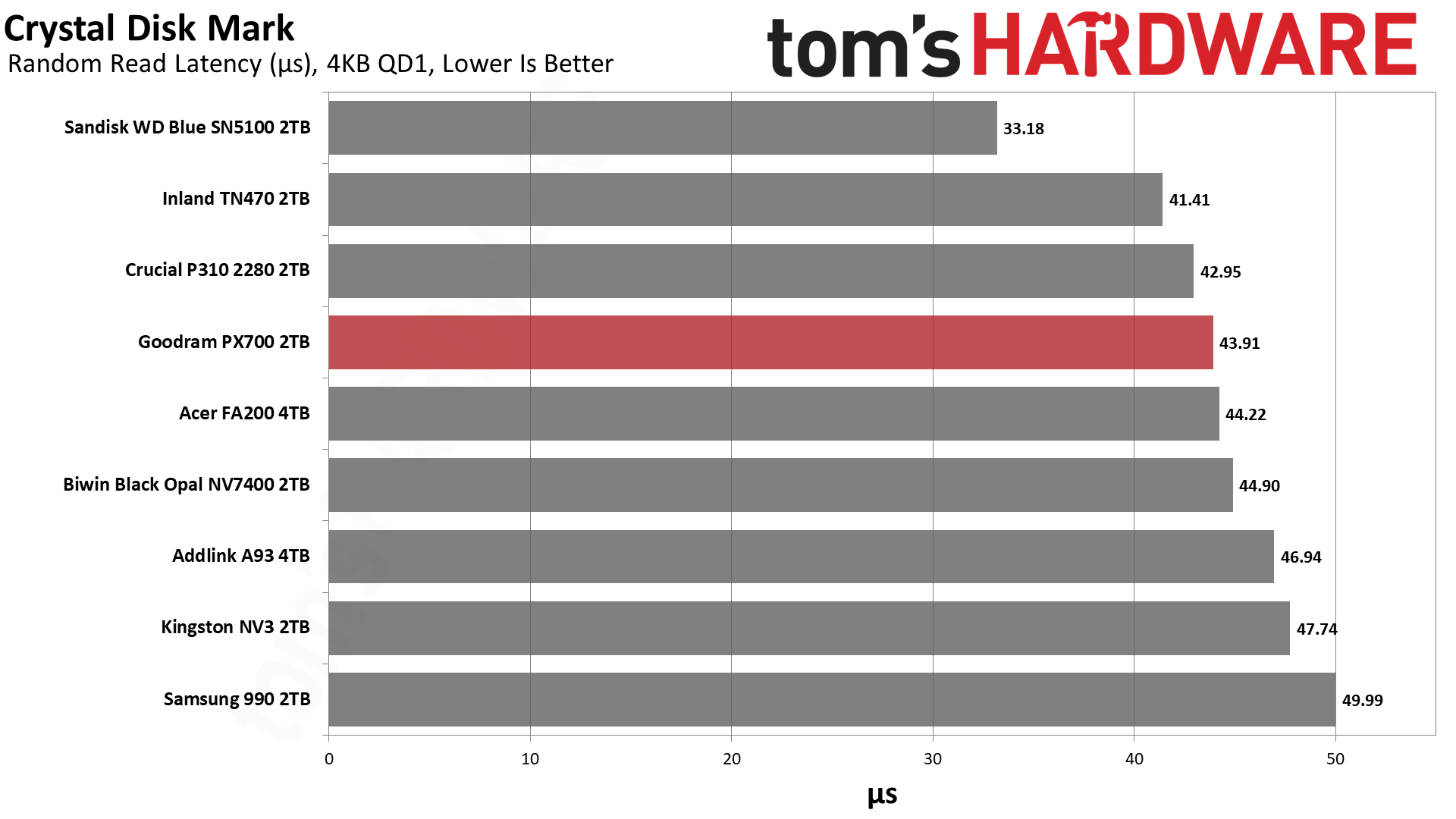
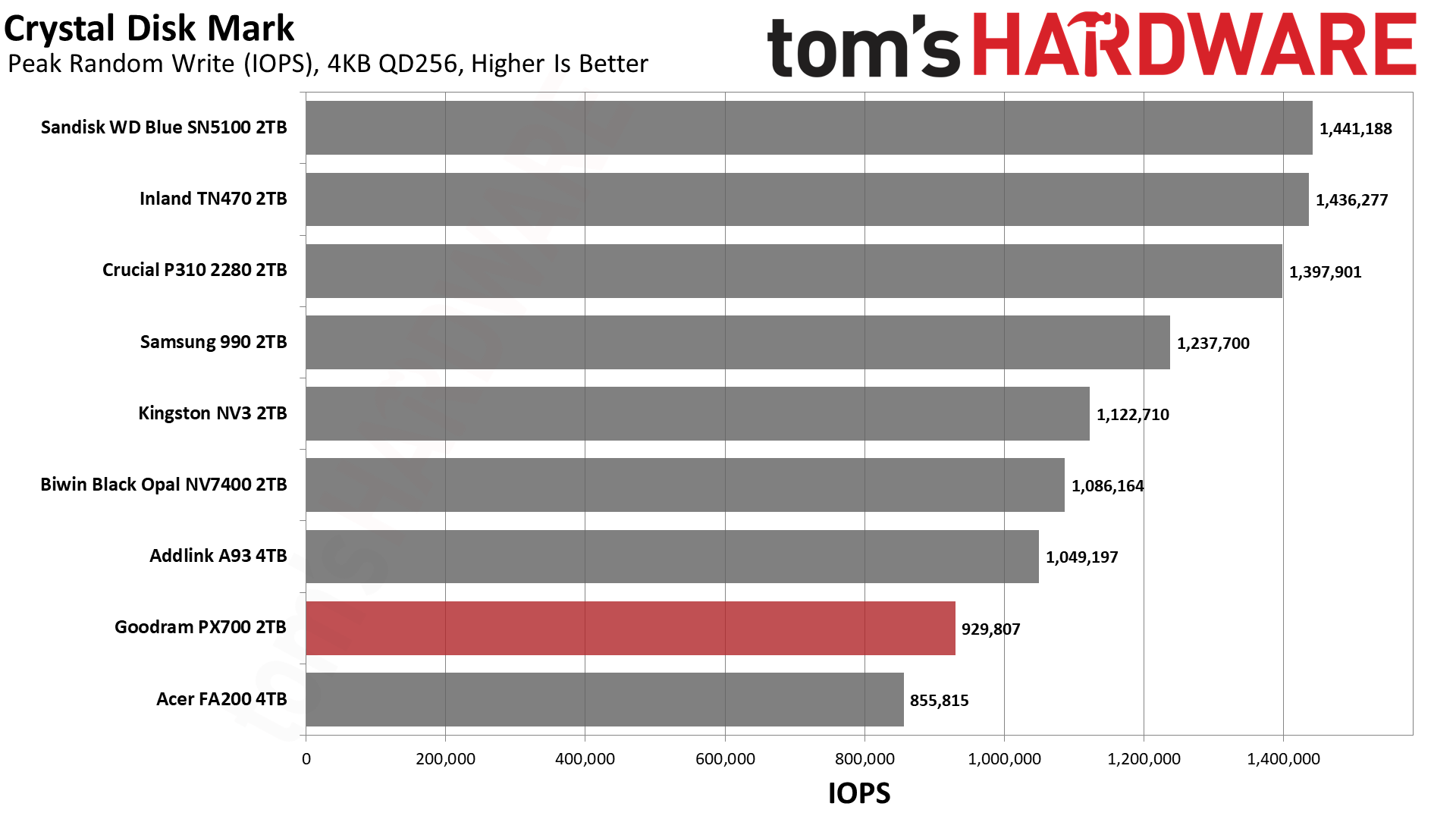
The PX700 has very steady performance in ATTO. We have no real complaints there. If we turn to sequential performance in CDM, we see more of the same. We would mostly look at QD1 reads for that, being a real-world metric, and it’s roughly on par with the NV7400 there. If we turn to random 4KB read performance at QD1, it’s a little bit further down the list but still hangs with excellent drives like the P310. Anything below about 45µs here is solid in our book. This drive should be quite responsive. If we were forced to be critical, we would point out that high QD 4KB write performance is low. Luckily, this is not a real-world workload for a drive of this type.
Sustained Write Performance and Cache Recovery
Official write specifications are only part of the performance picture. Most SSDs implement a write cache, which is a fast area of pseudo-SLC (single-bit) programmed flash that absorbs incoming data. Sustained write speeds can suffer tremendously once the workload spills outside of the cache and into the "native" TLC (three-bit) or QLC (four-bit) flash. Performance can suffer even more if the drive is forced to fold, the process of migrating data out of the cache in order to free up space for further incoming data.
We use Iometer to hammer the SSD with sequential writes for 15 minutes to measure both the size of the write cache and performance after the cache is saturated. We also monitor cache recovery via multiple idle rounds. This process shows the performance of the drive in various states, including the steady-state write performance.
Tom's HardwareTom's HardwareTom's Hardware
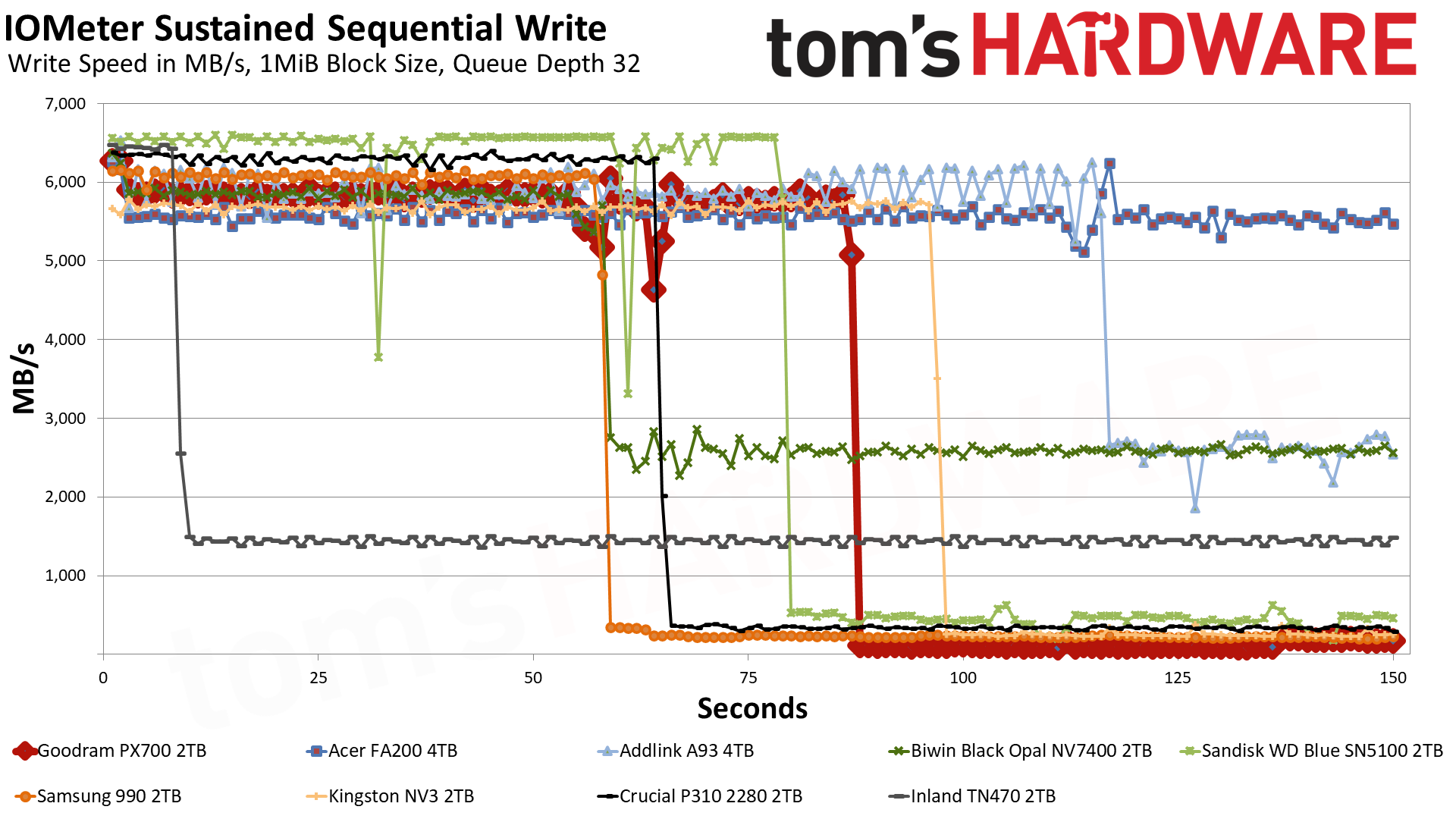
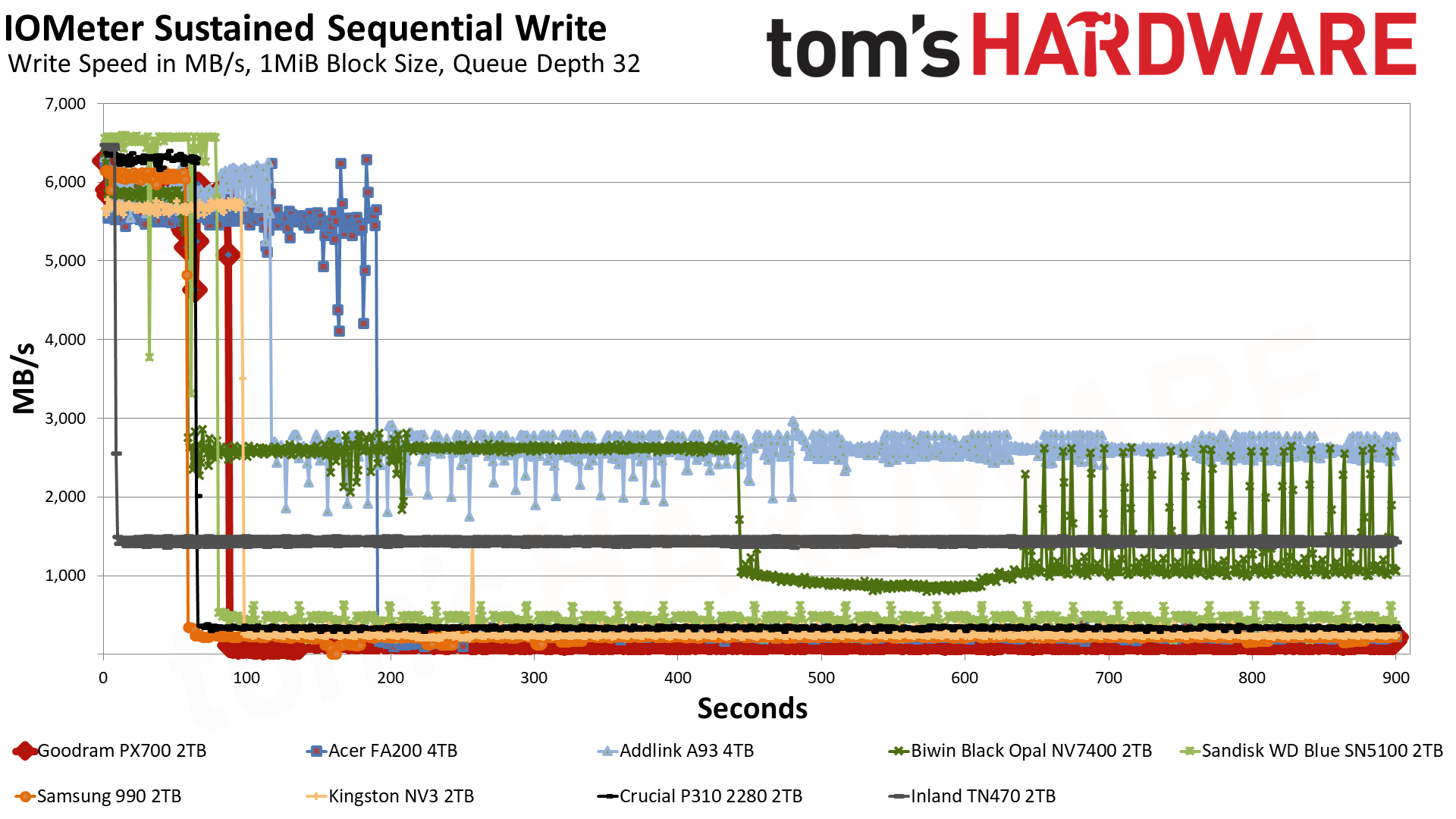
The PX700 starts off in the pSLC cache mode, writing at 5.8 GB/s for over 86 seconds. Speeds are slightly higher for the first two seconds, something we have seen before with this controller, but ultimately we’re looking at a 500GB cache. This is Exhibit A of why we would identify the flash as QLC. 4-bit QLC flash operating in a 1-bit pSLC mode is trading four times the capacity for performance, which means a 2TB drive will generally have a 500GB cache at most. A 3-bit TLC drive could have a larger cache, although there is nothing precluding it from having 500GB, even if this seems hard to be coincidental.
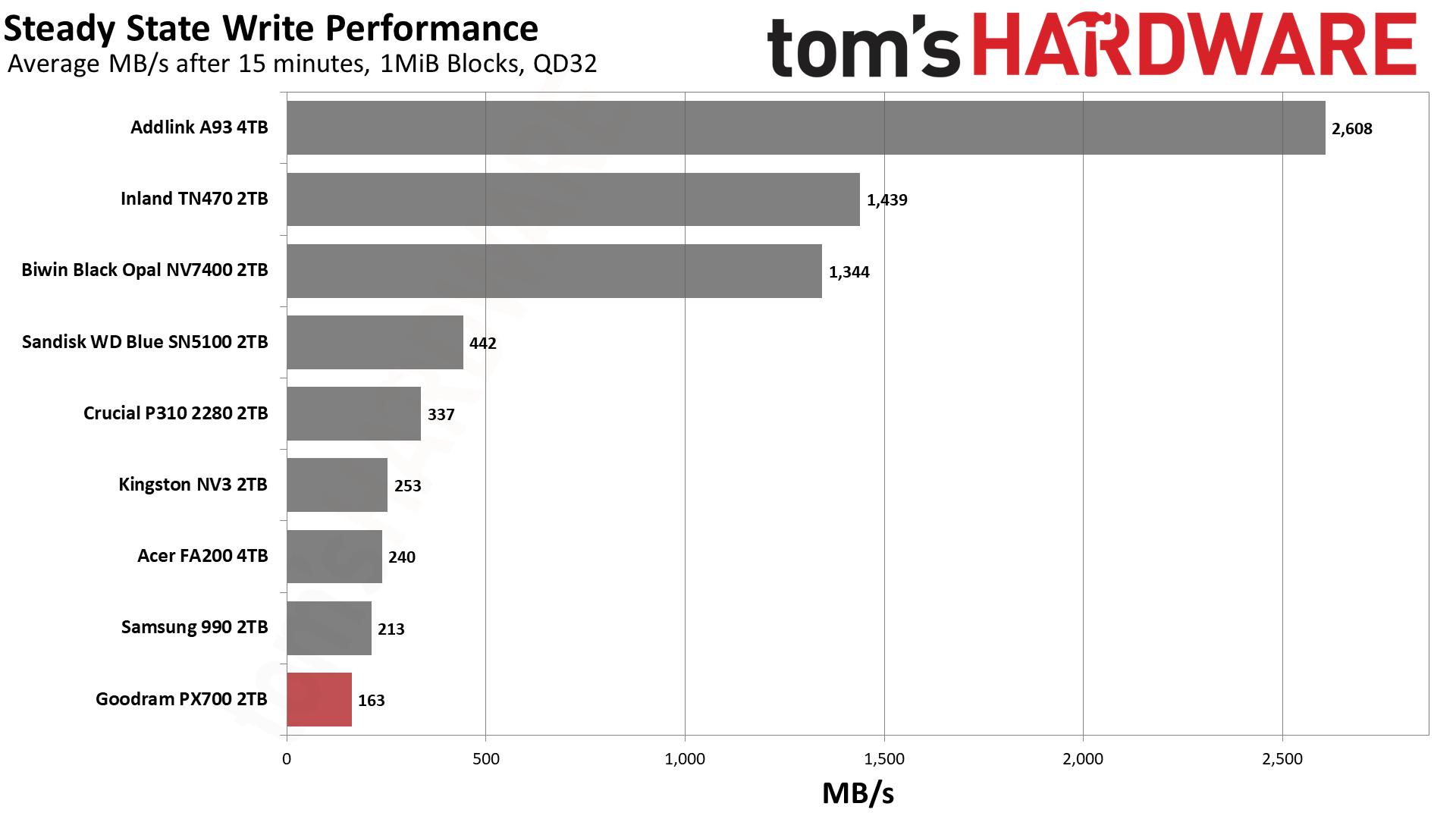
A TLC drive with a smaller-than-maximum-sized cache would probably be able to maintain some speed, though. The PX700 immediately falls into a folding mode – it’s waiting for data to be moved from pSLC to the native flash – with an average speed of 163 MB/s. TLC flash can at times be this slow, but it’s less likely, and especially less likely if it has space to spare. Even the FA200, with the same hardware, is faster. The FA200 does have twice the flash, of course, but the controller is essentially saturated. Rather, the FA200’s cache speed of 5.54 GB/s is slower than the PX700’s – and this could be from having more flash – which means the post-cache speed will be higher. This reinforces the position that the drive is using QLC. Of course, we could have thrown the 2TB HP FX700 into the mix to further prove this point, but we think comparing a 4TB drive is a more valuable approach.
It goes without saying that this is the first real failing of the PX700 in our review. However, it’s expected of a QLC SSD with a massive cache. We don’t consider it disqualifying. You are not buying a budget SSD to hammer it with writes. On the other hand, the 600TBW per TB warranty makes you assume you could do that to some extent. Also, the lower performance here could creep up in a fuller-drive experience. We also can’t exclude the fact that some PX700s come with TLC flash. Which means, taken as a whole, you should assume QLC will perform like the TLC competition 99% of the time.
Power Consumption and Temperature
We use the Quarch HD Programmable Power Module to gain a deeper understanding of power characteristics. Idle power consumption is an important aspect to consider, especially if you're looking for a laptop upgrade as even the best ultrabooks can have mediocre stock storage in terms of capacity and performance. Desktops are often more performance-oriented with less support for power-saving features so we show the worst-case for idle.
Some SSDs can consume watts of power at idle while better-suited ones sip just milliwatts. Average workload power consumption and max consumption are two other aspects of power consumption but performance-per-watt, or efficiency, is more important. A drive might consume more power during any given workload but accomplishing a task faster allows the drive to drop into an idle state more quickly, ultimately saving energy.
For temperature recording we currently poll the drive’s primary composite sensor during testing with a ~22°C ambient. Our testing is rigorous enough to heat the drive to a realistic ceiling temperature but real-world temperatures will vary due to the environment and workload factors.
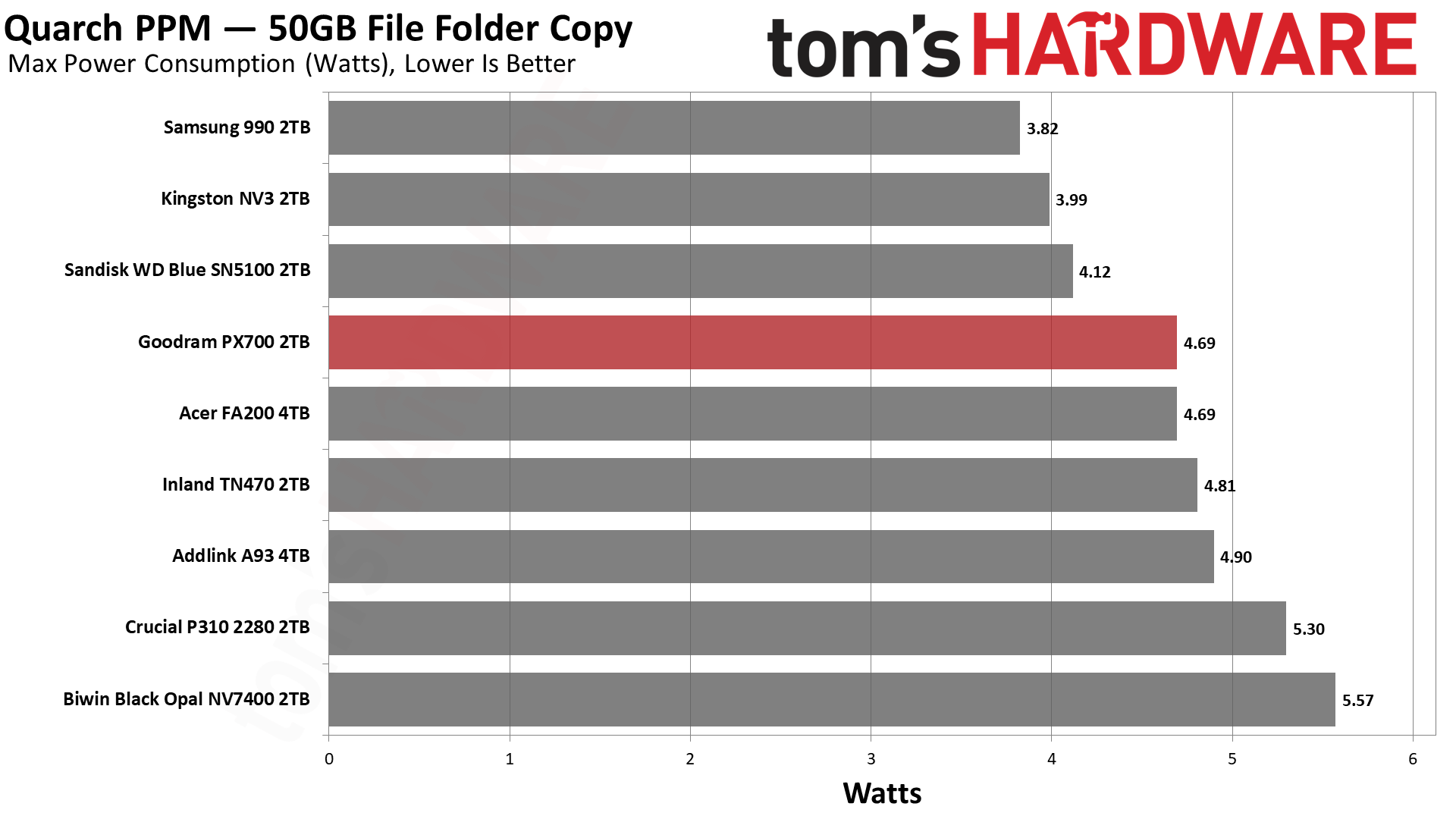
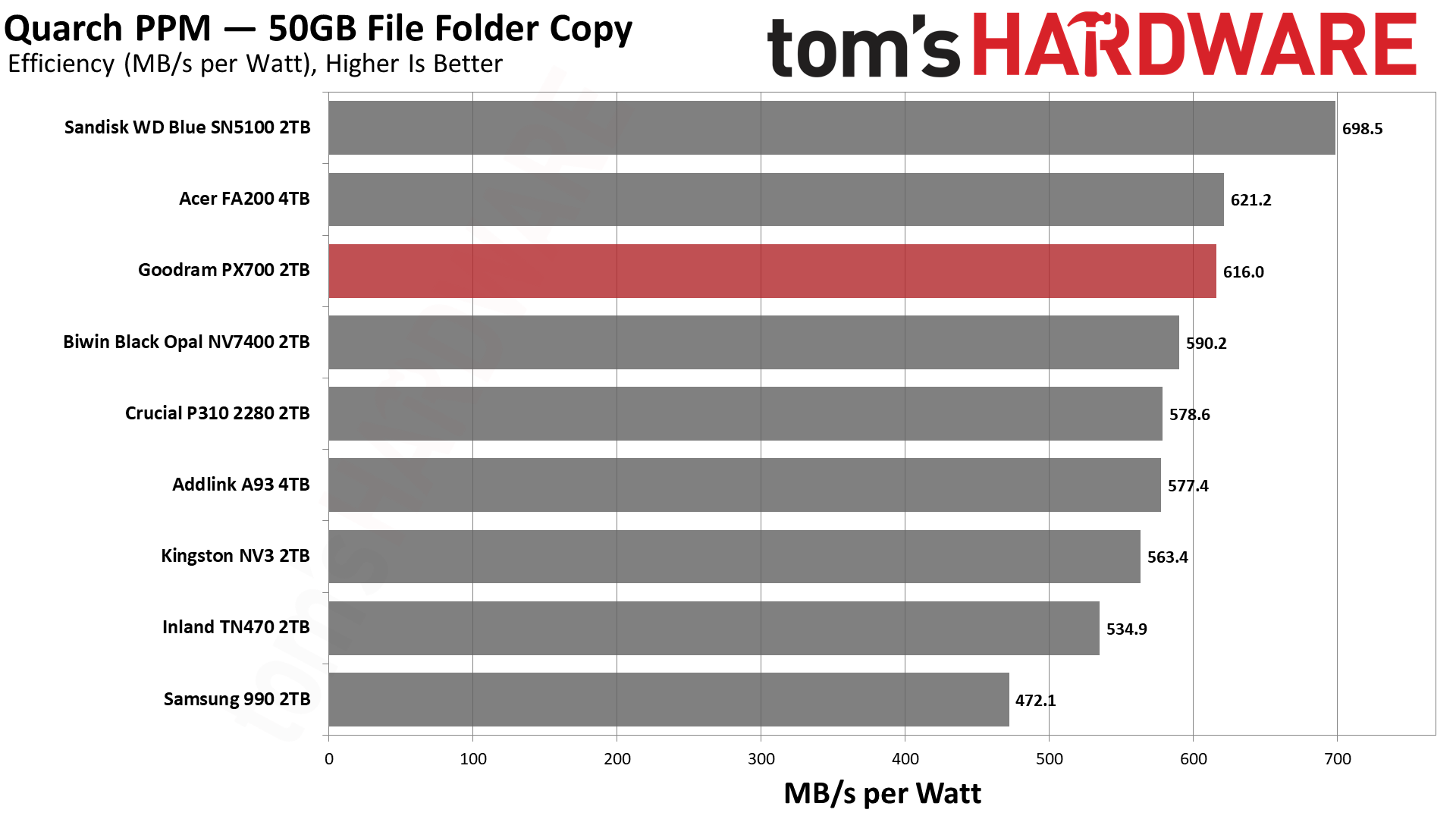
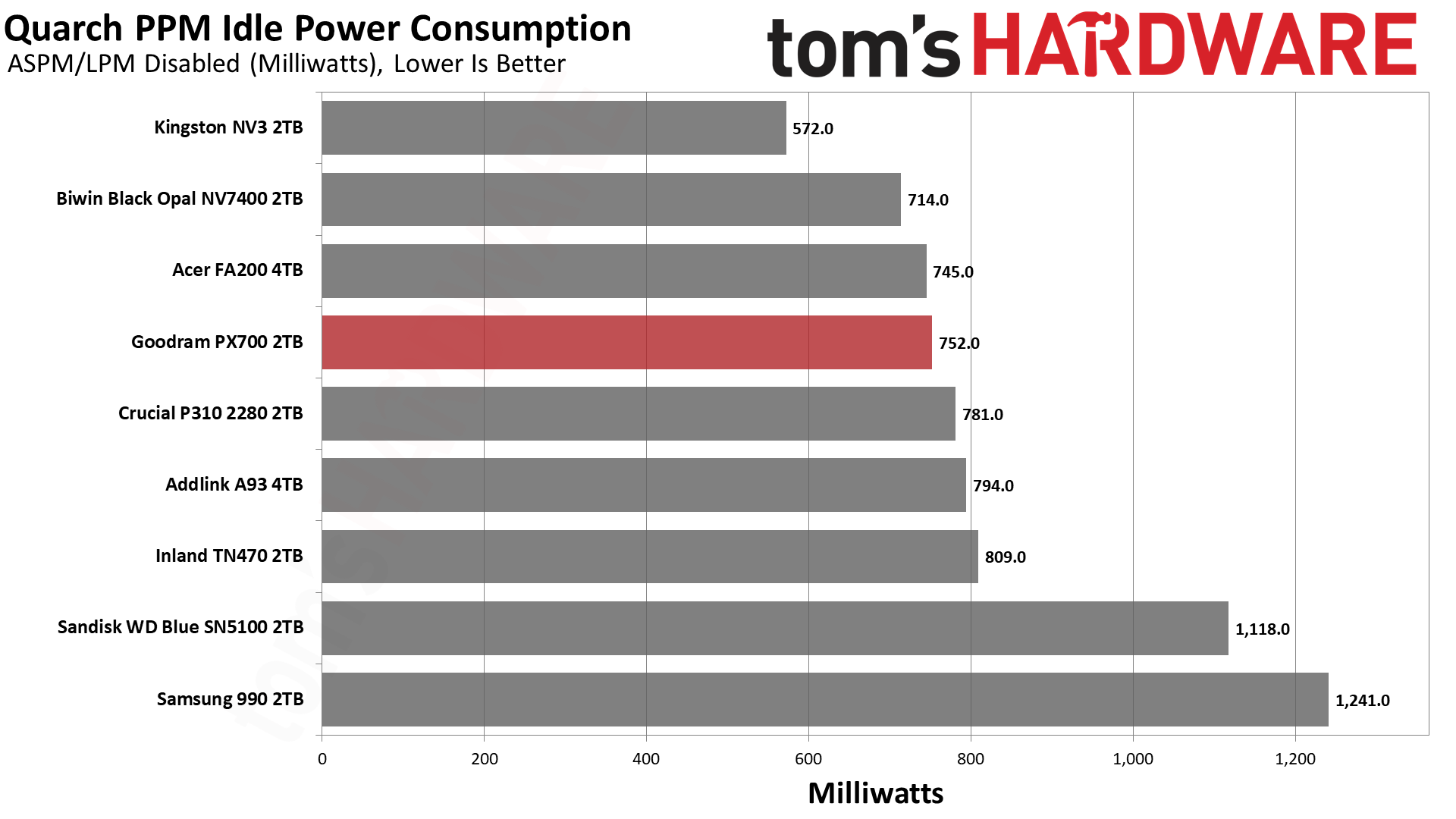
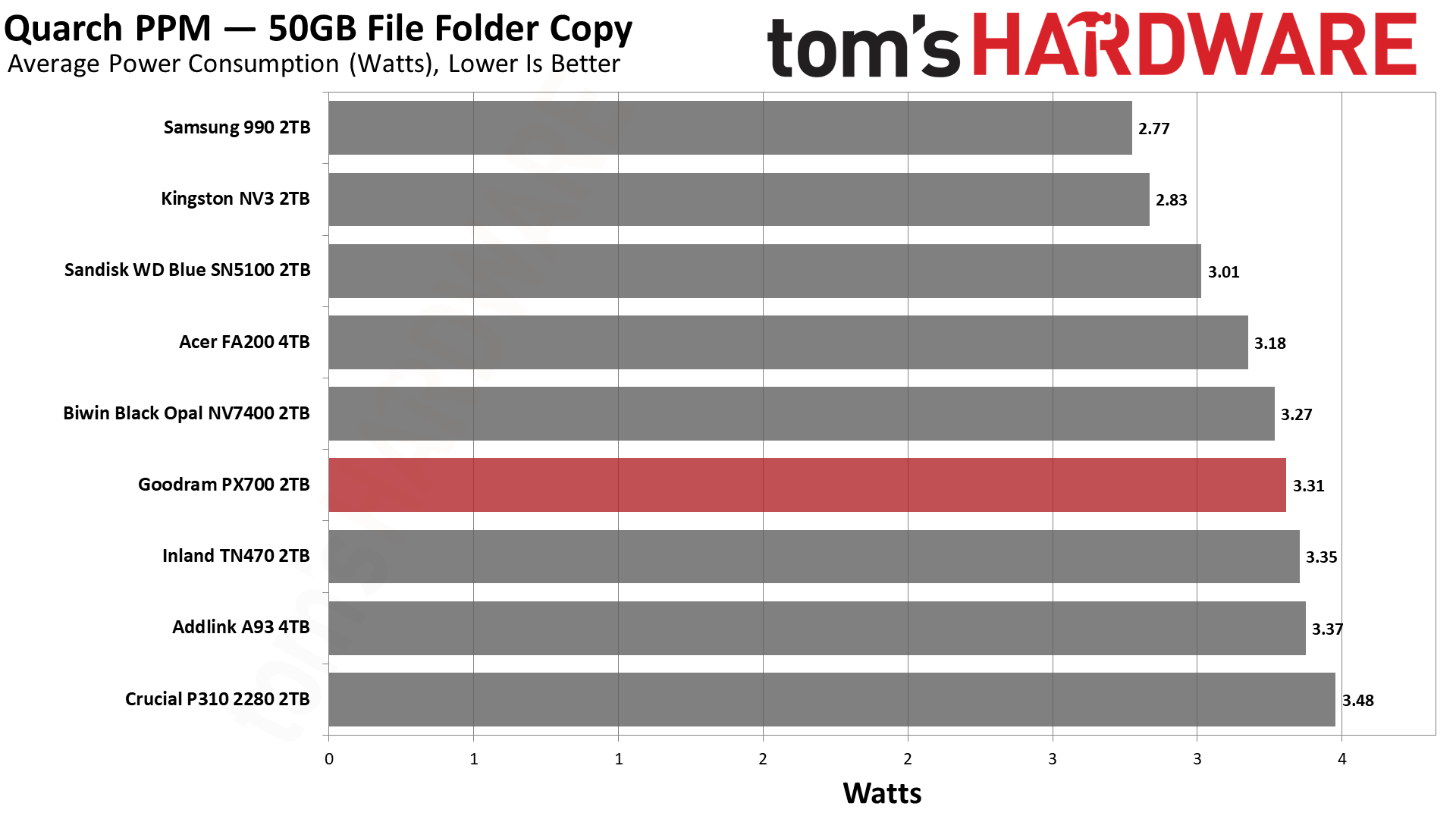
The PX700 comes back into our good graces with very good results in our power testing. It’s essentially tied for second with the FA200, which is hardly surprising given the hardware similarity. Only the BiCS8-based WD Blue SN5100 pulls away from the pack. We would consider every drive on this list to be sufficiently power-efficient for laptop use, although the 990 is closer to the lower end of that range. Certainly 550 MB/s per watt or higher is an excellent result and indicates a drive that can be run without a heatsink most comfortably. As for idle pull – we test under desktop conditions, which can also match poorly-optimized power settings – the PX700 is not unusually power-hungry and, in fact, better than the WD Blue SN5100. That’s a bonus.
Temperature-wise, we have good news. Goodram touts the graphene label on this drive, which, in our experience, does actually help with cooling, especially on a drive with four flash packages. The PX700 in our testing peaked at 61°C, nearly 30°C below the initial throttling point, well beyond the 20°C of headroom we like to see. The MAP1602 does tend to be a hotspot more than alternatives like the Phison E27T on the P310 and TN470, but a heat-spreading label does help. In our estimation, this is a cool-running drive that would be great anywhere.
We use an Alder Lake platform with most background applications such as indexing, Windows updates, and antivirus disabled in the OS to reduce run-to-run variability. Each SSD is prefilled to 50% capacity and tested as a secondary device. Unless noted, we use active cooling for all SSDs.
Goodram PX700 Bottom Line
The Goodram PX700 is a model budget PCIe 4.0 SSD. It matches or exceeds all of the expected performance points; it's power-efficient, and it uses a simple single-sided design without a heatsink. The only problem is that a “budget” drive has to be affordable. Current prices in the U.S. for this drive leave something to be desired. However, if it can match or beat the prices of other drives in this class, it’s probably one of the better choices available. In part, this is because we’d be liable to trust Goodram over non-names – the TBW alone shows it means business – and, on the other hand, the drive actually outperformed our expectations. Aside from the sustained write performance, this drive really feels premium. You don’t need a Samsung, WD, Sandisk, or even Crucial drive to feel like you have next-gen storage.
(Image credit: Tom's Hardware)
Let’s look at what we mean by that for your use. Game and app loading times are heavily reliant on random and sequential reads at low QD. The PX700 does well there. You also may be transferring files a lot, and the DiskBench results are mighty. For your laptop or HTPC, you might want something that’s power-efficient and, if space is a concern, something that stays cool without a heatsink, and this applies to PS5 use as well. The PX700 ran cool in our test with just the graphene label and was very efficient. You’re not getting a shorter warranty with lower TBW, as with Samsung’s 990 or some QLC-based drives, and we know where this drive is assembled. It’s hard to look at this combination and not feel like it’s a stellar drive if you can find it at a normal price.
Aside from price, our only complaint would be sustained write performance. It’s pretty dissapointing, although we should point out that it’s also expected. The drive also has trade-offs here. Namely, its standard pSLC write performance is better than the 4TB FA200, and in the 2TB HP FX700’s ballpark, so you’re not getting nothing for that later drop. The PX700, in fact, is faster folding than the FX700, too. In the grand scheme of things, this isn’t a big deal, as you should never hit that state – this drive should effectively be fast enough for a 1GbE network, if that’s a bottleneck – and having a bit faster peak performance does translate to better marks on some of our benchmarks. The drive could take a hit in some cases, such as when it's very full, in which case getting a drive with DRAM and guaranteed TLC flash could assuage your fears.
For most use cases, though, the PX700 is more than good enough and, in fact, punches above its weight in our opinion. It would be a good option for just about any type of machine. PS5, laptop, HTPC, desktop, you name it. Primary or secondary drive, just fine. You don’t even need a heatsink. The capacity range is solid – you’re not going to find 8TB on a drive like this – and you can bring your own software. Performance is good enough to overlook any QLC flash use, so our main problem remains the price. Get it down to the same ballpark as the other drives in our list, and you have a contender. We hesitate to put an exact dollar amount for that because SSD prices are volatile, to say the least, so compare it to comparable drives such as the ones we matched it against today.
 登录
登录