Intel won't launch a Nova Lake-S SKU with 12 Xe3P graphics cores, according to tipster Jaykihn, who originally flagged a beefed-up APU design with the Nova Lake architecture. The original SKU was said to come with 4 P-cores, 8 E-cores, and 4 LPE-cores, along with the 12 Xe3P cores, presumably offering an inexpensive onramp to a gaming desktop without a discrete GPU. Now, the leaker says that design is cancelled, and Intel intends to pick it back up with Razor Lake, the generation that will follow Nova Lake.
Nova Lake -S 12Xe has been changed to Razor Lake -S 12XeSeptember 14, 2026
Originally, Intel's 12 Xe3P Nova Lake SKU was said to require 65W of dedicated power to drive the iGPU, necessitating the use of two VCCGT phases on the motherboard for integrated graphics. Intel's Arc B390 GPU, which is the 12 Xe3-core model available in Panther Lake and Arc G-series processors, has a thermal design that can sustain up to 80W. However, it's currently being used in Panther Lake machines and handhelds like MSI Claw 8 EX AI+ that have lower power targets.
The Xe3P architecture is slotted for use in Intel's Crescent Island AI accelerator, but it hasn't been announced for any other products yet. Xe3P supports a wide deployment of Xe cores (up to 32), a deeper XMX engine with support for low-precision data types like FP8 and FP4, an increased 512KB L1 cache per Xe core, and a new unified L2 cache (32MB on Crescent Island).
Even by desktop APU standards, an 80W iGPU is a beefy accelerator to have on the same package. In addition, Intel's Nova Lake stack is said to extend up to a 175W TDP with the rumored top-end 52-core SKU, meaning the full 12 Xe3P iGPU would likely only be possible lower down the stack (and maybe only in the 4 + 8 + 4 + 12 Xe design originally suggested).
Earlier in the year, rumors suggested Intel was working on a mobile APU to counter AMD's Strix/Gorgon Halo products, featuring a large pool of unified memory and a large iGPU, dubbed Nova Lake AX. Now, the rumor mill suggests Intel will recycle the Nova Lake CPU cores for Razor Lake AX on mobile while pushing a larger iGPU.
Nova Lake-S rumored specifications
SKU*
Core Config (P+E+LPE)*
bLLC*
TDP (Unlocked/Locked)*
52 Cores (dual-tile)
(8+16)+(8+16)+4
288MB
175W
44 Cores (dual-tile)
(8+12)+(8+12)+4
264MB
175W
28 Cores
8+16+4
144MB
125W
28 Cores
8+16+4
-
125W / 65W
24 Cores
8+12+4
132MB
125W
24 Cores
8+12+4
-
125W / 65W
22 Cores
6+12+4
108MB
125W / 65W
22 Cores
6+12+4
-
125W / 65W
16 Cores
4+8+4
-
65W / 35W
12 Cores
4+4+4
-
65W / 35W
8 Cores
4+0+4
-
65W / 35W
6 Cores
2+0+4
-
65W / 35W
*Specs rumored, unconfirmed by Intel
Intel has told us that Nova Lake is one of the most important desktop CPU launches for the company ever, following on the heels of the mediocre Arrow Lake rollout. Perhaps the biggest addition to the lineup is rumored to be bLLC, or big last-level cache, which is said to show up on select SKUs to counter AMD's X3D assault among the best CPUs for gaming. The company has yet to confirm that bLLC is even possible with its current packaging capabilities, though enthusiast channel VP Robert Hallock hinted to Tom's Hardware that Intel has plans to address X3D in the next generation.
The main stack is rumored to climb up to 28 cores, with two additional dual-tile SKUs that can go as high as 52 cores. The dual-tile models look like a bid for HEDT, perhaps competing with AMD's Threadripper CPUs, though it's not clear how Intel will position its dual-tile models yet.
Alongside Nova Lake, Intel will introduce the new LGA1954 socket, along with the flagship Z990 chipset. We've already seen multiple Z990 motherboards in the flesh, suggesting Intel is preparing for a Nova Lake release in short order.
Nvidia's fastest gaming graphics card, the RTX 5090, has been on a tear of price increases over the past several weeks. However, over the past week, the available inventory has dwindled. Now, you can only find the RTX 5090 from third-party sellers at online retailers like Newegg and Amazon, commanding anywhere from $6,500 to $9,500 (or even higher) for Team Green's best GPU.
At Newegg, the cheapest RTX 5090 is the MSI Ventus 3X that's available from Slava Computers (a relatively new seller with 239 ratings and a 2.8 out of 5 rating at the time of writing) for $6,449. On Amazon, you can get the Asus TUF Gaming OC for $6,395 from Joes Tech Shop, a seller with an 81% positive rating. However, among the most recent reviews are a string of one-star reviews about orders never being fulfilled. The cost goes much higher, as well. The first result for "RTX 5090" on Newegg, for example, surfaces the MSI Ventus 3X OC for $8,699.
In June, the median price for an RTX 5090 was $4,299. At the beginning of September, we logged the lowest online price at $5,199 in our GPU price tracker. Now, in less than two weeks, the available stock has completely disappeared online, and the options available from third-party sellers have ballooned in price once again.
Naturally, we don't recommend buying from one of these third-party sellers. The RTX 5090 is selling at a vastly inflated price, but more importantly, we've seen no shortage of scams around high-ticket items like the RTX 5090. In January, 42 Amazon customers were duped into a scam involving a $999 RTX 5090, instead receiving a fanny pack in place of the GPU. Earlier this month, an online seller scammed two buyers with the RTX 5090, selling phantom graphics cards with the core and memory removed on the secondhand market for prices near MSRP.
The one exception to RTX 5090 inventory is Micro Center, which still has cards available around the average selling price. At a local Micro Center we checked, the cheapest in-stock option was $4,299. Micro Center has exclusively sold graphics cards in-person for several years, insulating it from online buyouts like what appears to be going on right now.
As usual, the reason why there's so much demand for the RTX 5090 is fairly obvious: AI. The RTX 5090 holds the GB202 GPU and 32GB of GDDR7 memory. For context, Nvidia's RTX Pro 5000 48GB comes with the same GPU with a third fewer shader units enabled, and lower memory bandwidth compared to the RTX 5090, and sells for between $7,000 and $9,000. In that context, the RTX 5090 starts to look attractive for building an AI server, even at $5,000 (or more) apiece.
At the same time, the RTX 5090 remains the fastest gaming graphics card on the market according to the testing in our GPU benchmark hierarchy. That's even more true now with Nvidia's launch of DLSS 5 Neural Rendering, which the RTX 5090 can fully capitalize on (though, thankfully, we've found playable performance on lower-end cards in our extensive DLSS 5 testing).
We've reached out to Nvidia for comment on whether it has any plans to stabilize inventory. We'll update this story when we hear back.
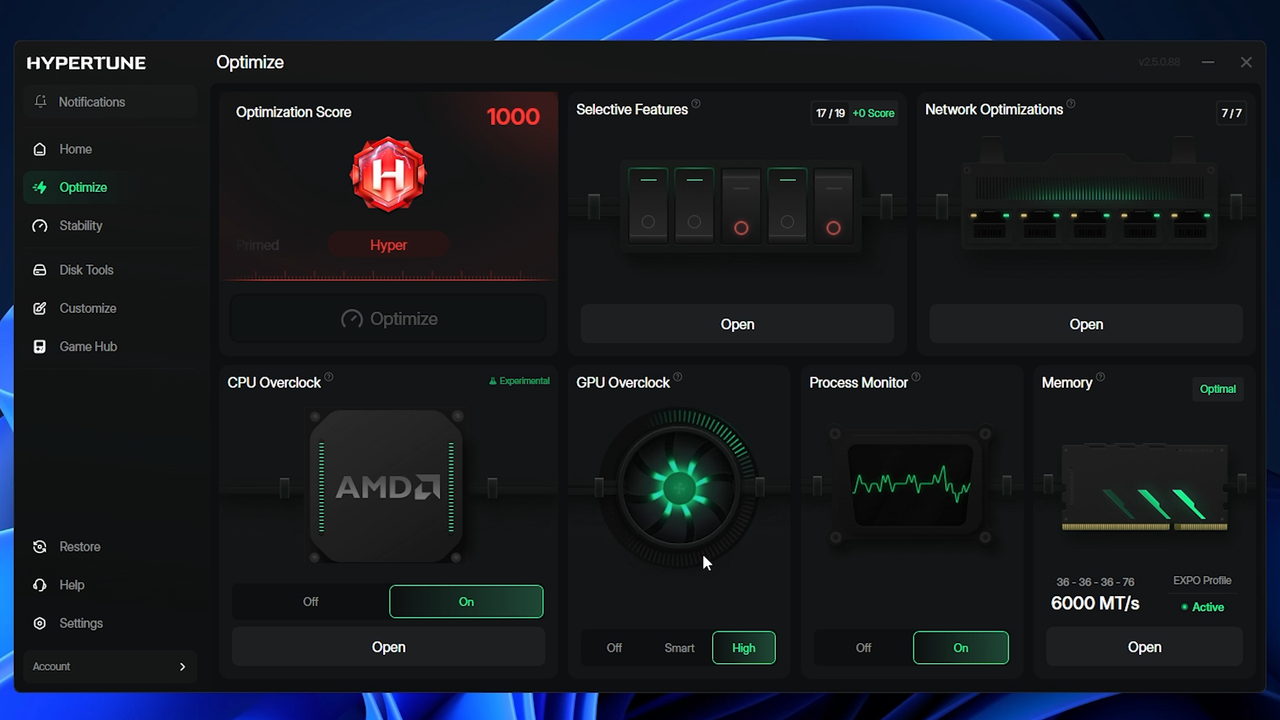
Following an early access period that included over 60,000 participants, auto-overclocking tool Hypertune has released its Gaming Performance Engineering platform, which is built on top of Intel's Extreme Tuning Utility (XTU) SDK and developed in partnership with Intel. The company claims the utility can boost frame rates by up to 60%, though you shouldn't expect that as the norm. The tool includes automated CPU and GPU overclocking, as well as customizable Windows features, network optimization, and game-specific optimizations.
Hypertune partnered with Intel to build the tool, which the company says "evaluates each supported system individually" before optimizing rather than relying on generalized profiles. In its press release, Hypertune says it collaborated with famed overclocker SkatterBencher (Pieter Plaisier) to refine the software. We've reached out to Plaisier to confirm their involvement.
Automated tuning programs usually don't work as well as advertised, and we haven't had the chance to test Hypertune ourselves yet. Especially on more recent hardware, expect performance gains to be minor. Hypertune shared some of its internal benchmarks to back up the claim, showcasing the actual test systems it used, the numbers it gathered, and what each step of Hypertune contributed to the performance increase.
(Image credit: Hypertune)
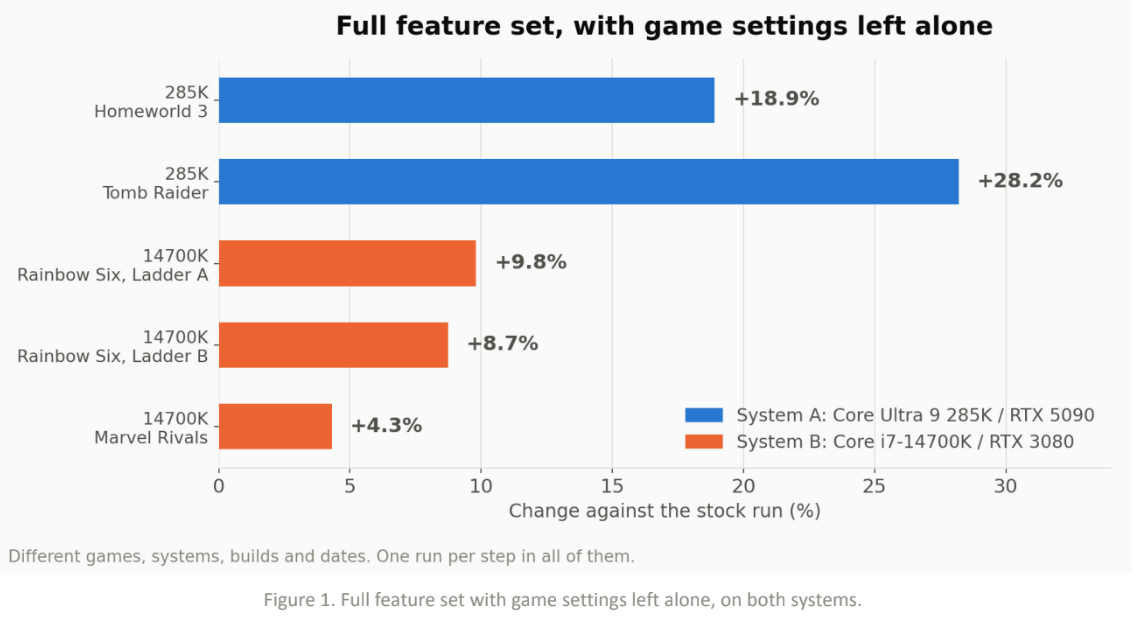
Hypertune tested two systems: one with a Core Ultra 9 285K and an RTX 5090, and another with a Core i7-14700K and an RTX 3080. For the 285K system, the team saw an 18.9% improvement in Homeworld 3 and a 28.2% improvement in Tomb Raider. For the 14700K system, the boost was up to 9.8% in Rainbow Six Siege and 4.3% in Marvel Rivals.
Notably, these results are with Hypertune's Game Hub disabled. Game Hub automatically applies a graphics settings profile to select games, leading to massive increases in performance. Naturally, tweaking your own graphics settings in the same way leads to the same result.
(Image credit: Hypertune)
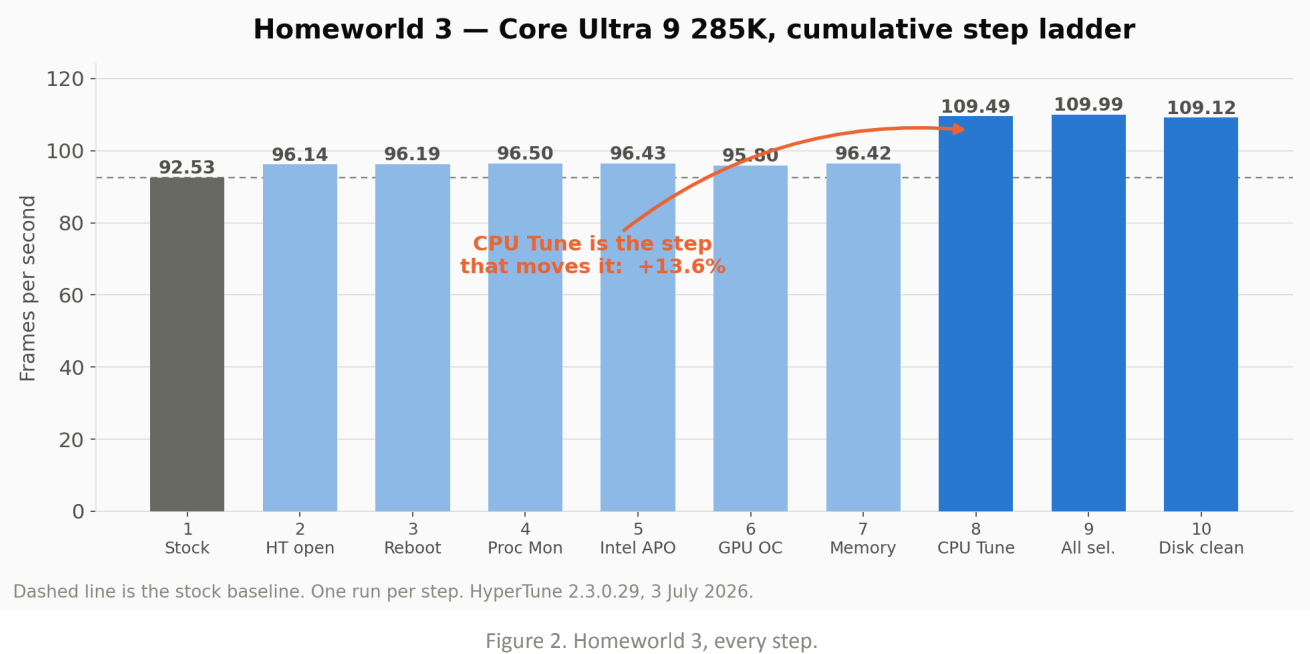
In Homeworld 3, you can see how each step in the process impacted performance, with CPU tunning contributing the single biggest increase in performance. As shown by Marvel Rivals in Hypertune's data, some games will see little to no benefit from Hypertune, though select titles with certain hardware may see a significant performance increase. In this case, the Core Ultra 9 285K has plenty of room for overclocking, and Homeworld 3 is particularly sensitive to the CPU, so the uplift makes sense.
(Image credit: Hypertune)
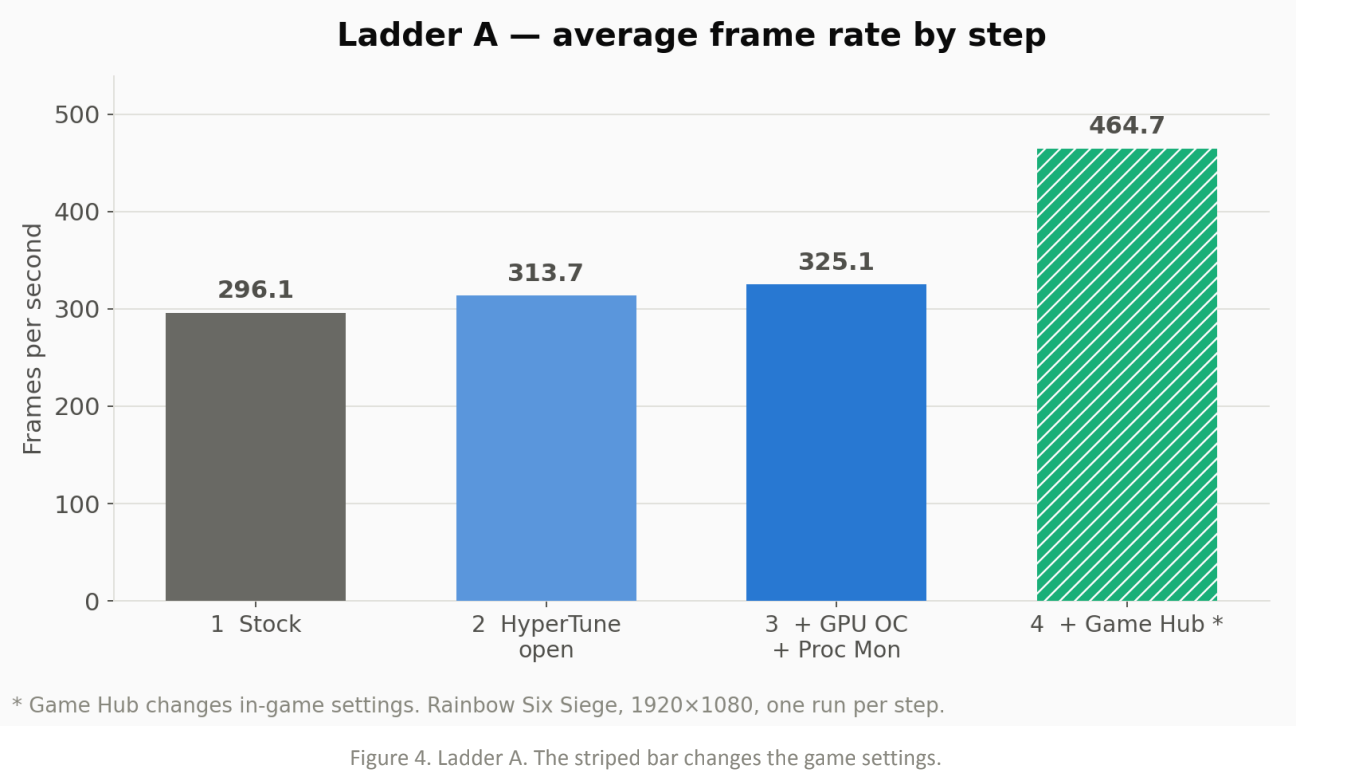
Elsewhere, the gains aren't as pronounced. In Rainbow Six Siege, you can see that Hypertune contributed about a 9.8% jump in performance, though the vast majority of the improvement comes through Game Hub, where Hypertune changes in-game settings.
In a press release, Hypertune founder Austin Copeland wrote that the team was "not trying to build a tool for overclockers," suggesting it's aimed toward users who may not know about specific settings (i.e., the Balanced power plan on dual-CCD X3D CPUs, or HAGS for DLSS Frame Generation). Copeland was previously a coach for eSports organization TSM, coaching Valorant teams under the name "Apex."
(Image credit: Hypertune)
Hypertune works through Intel's XTU SDK, and the company says its optimizations are non-destructive and fully reversible. The software is mainly targeted toward competitive titles (naturally, given Copeland's background), but it can apply optimizations globally across the system. Hypertune says it's safe to use with anti-cheat software, including Riot Vanguard, Easy Anti-Cheat, and BattlEye.
Although there are plenty of free tools that claim to optimize your system, Hypertune isn't among them. It's a subscription service, available for either $9.99 per month or $59.99 per year. In addition to software, Hypertune offers its "expert tuning" service for $80, where a technician will remote into your machine and manually tune it. On the subscription front, Hypertune offers a 7-day free trial.
Hypertune looks like one of the more robust automated overclocking tools we've seen, but it's worth highlighting that, in most cases, these tools don't do anything you can't accomplish yourself. If you're looking for a starting point, make sure to read our guides on how to overclock your graphics card and how to overclock your CPU.
Intel is reportedly set to hike CPU prices by 10%, according to a new Digitimes report. Citing supply chain sources, the outlet says the increase follows two others, one in the first quarter of 2026 and another in July, among some server and client CPUs. Notably, the sources didn't say which products the price increase applies to, though presumably, the increases would come through Intel's mobile and server businesses before desktop client. Citing industry sources, DigiTimes also reports that Intel is set to launch "major annual products" in March 2027, with AMD following up with launches of its own between June and July.
The increases come on the back of Intel seeking higher gross margins for its products as the PC market shrinks. This is a story we've heard directly from Intel in the past. In its most recent earnings call in July, Intel chief financial officer David Zinsner attributed a 13% YoY increase in Intel's client revenue to higher average selling price, not a higher volume of sales.
Although the Digitimes report doesn't clarify which products will see a price increase, server and mobile seem like the most likely candidates. Intel's most recent Panther Lake calls for high-speed LPDDR5X-7467 memory as a minimum, and last-gen Lunar Lake CPUs have on-package memory. Naturally, higher memory prices put more pressure on fully built systems like laptops more so than socketed, standalone desktop processors.
On the server end, there's been an unprecedented increase in demand for server CPUs on the back of agentic AI workloads. That demand led to several consecutive records for Intel's share price, even without any major product announcements. Earlier in the year, Wall Street estimated the server CPU market would rise to around $120 billion by 2030 (currently around $30 billion). Now, those projections go up to as high as $220 billion.
According to the report, Intel is set to launch a major new annual product in March 2027, followed by AMD between June and July. Last week, a leaked Intel roadmap showed the company's next-gen Nova Lake desktop CPUs entering mass production in Q4 2026 with a release in Q1 2027, lining up with DigiTimes' report.
Although the timelines line up, the rumor mill has suggested an early Q1 launch for Nova Lake. It's worth noting that the DigiTimes report doesn't make mention of which product Intel will launch in March. This year, for instance, Intel launched its Xeon 600 CPUs for HEDT in March.
Perhaps more interesting is the AMD timeline. We already know of one major AMD product launch in the second half of 2027, which is Venice-X. Those are Zen 6 server CPUs with AMD's 3D V-Cache, packing up to 1,152 MB of L3 cache on the chip. Otherwise, that timeframe seems to point to AMD's next-gen desktop CPUs with the Zen 6 architecture, codenamed Olympic Ridge.
AMD launched its Venice server CPUs earlier this year, the first sporting the Zen 6 architecture. We haven't heard anything official about Zen 6 in the desktop yet. That's strange given AMD's last several releases. There was about a two-year gap between Zen 3 and Zen 4, as well as Zen 4 and Zen 5, on desktop. We've just crossed the two-year mark for Zen 5, so assuming AMD keeps a similar launch cadence, we'd expect to hear something sooner than June or July or next year.
That same explosive demand in server CPUs could have changed AMD's launch plans, however. Given that we haven't heard anything official about Olympic Ridge at this point, a launch in June or July isn't out of the question.
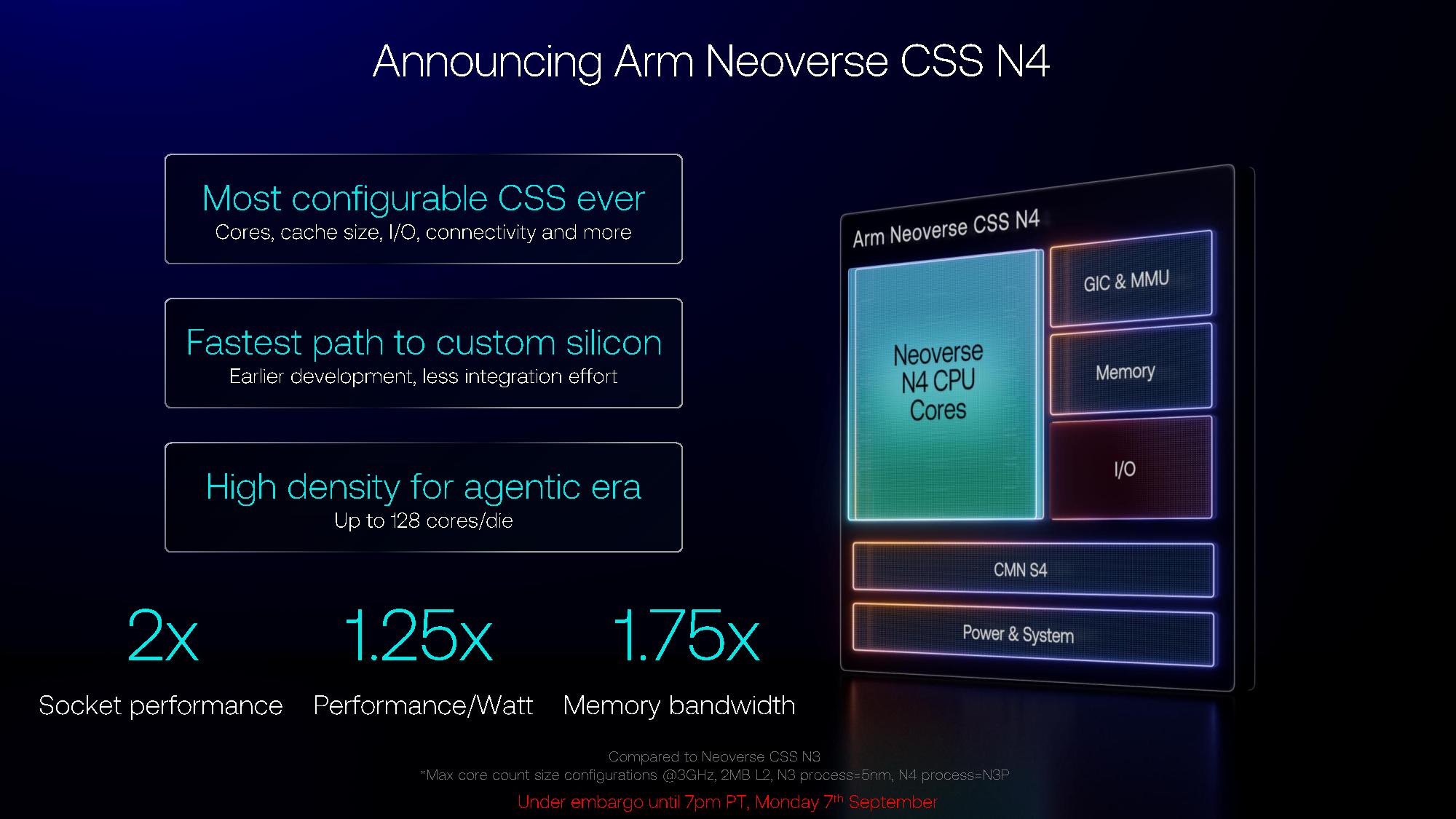
Arm is bringing its next-gen Neoverse CSS N4 platforms to the cloud, sporting up to 128 cores per die, built on TSMC’s N3P process. Arm’s Compute Subsystem, or CSS, is a semi-custom program that allows customers to design a chip based on Arm’s IP, configuring components like core count, cache size, I/O, and connectivity to fit their specific needs. It’s the same platform we’ve seen at work everywhere from CPUs at Azure and Google Cloud to DPUs at Nvidia and Intel.
Arm says Neoverse CSS N4 supports between eight and 128 Neoverse N4 cores, running up to 3.8 GHz. Presumably, the clocks drop as the core count rises; Arm didn’t clarify the maximum clocks for each possible configuration. At a system level, Neoverse CSS N4 can scale beyond 128 cores, with support for multi-chiplet and multi-socket designs, and with support for UCIe through chip-to-chip interconnects, as well as “partner-specific PNYs.”
The platform supports either DDR5 or LPDDR6, and features up to 256 MB of L3 cache per die. For local cache, Arm includes up to 2 MB of L2 per core, as well as 64 KB of L1 instruction cache and 64 KB of L1 data cache per core. For I/O, Arm supports up to 128 lanes of PCIe 7/6 and CXL 4.0.
It’s a significant upgrade over the Neoverse CSS N2 platform, which topped out at just 64 cores, 1 MB of L2 cache per core, and 64 MB of L3 cache, paired with either DDR5 or LPDDR5 and 64 PCIe 5.0/CXL lanes.
(Image credit: Arm)
With 128 cores running at 3GHz and 2MB of L2 cache per core, Arm says Neoverse CSS N4 delivers twice the socket performance of Neoverse N3, 1.25x performance per watt, and 1.75x the memory bandwidth.
Arm’s N-series cores are optimized for performance per watt, while its V-series cores are targeting maximum performance. For instance, Arm used the Neoverse CSS V3 building blocks for its own AGI CPU, and Nvidia used Neoverse V2 for its last-gen Grace CPU (the Vera CPU uses a custom core). AWS has also used Neoverse V-series cores for its own Graviton chips, as does Google Cloud for Axion.
N-series cores aren’t usually deployed in high-performance CPUs. Rather, they fit into less-performant accelerators, such as Intel’s IPU Adapter E2100, which is built on Neoverse N1 cores. We’ve also seen it deployed in less-demanding, cloud-based workloads, such as through Microsoft’s Azure Cobalt 100, which is built on Neoverse N2. Cobalt 200 moved onto Neoverse V3.
We don’t know much about the Neoverse N4 cores, codenamed Dionysus. Arm’s 2024 roadmap indicated we’ll see Arm Neoverse CSS V4, as well, codenamed Vega.
Unlike a traditional announcement from Intel, AMD, or the various partners that build on Arm, we won’t see Neoverse N4 cores in the wild for a while. The announcement Arm is making is for those who are building on the CSS platform, leveraging Arm’s validated building blocks to create semi-custom silicon quickly. Arm has yet to announce any partners, though traditionally, only a few large CSS contracts are needed.
Additional Arm AGI CPU deployments
(Image credit: Arm)
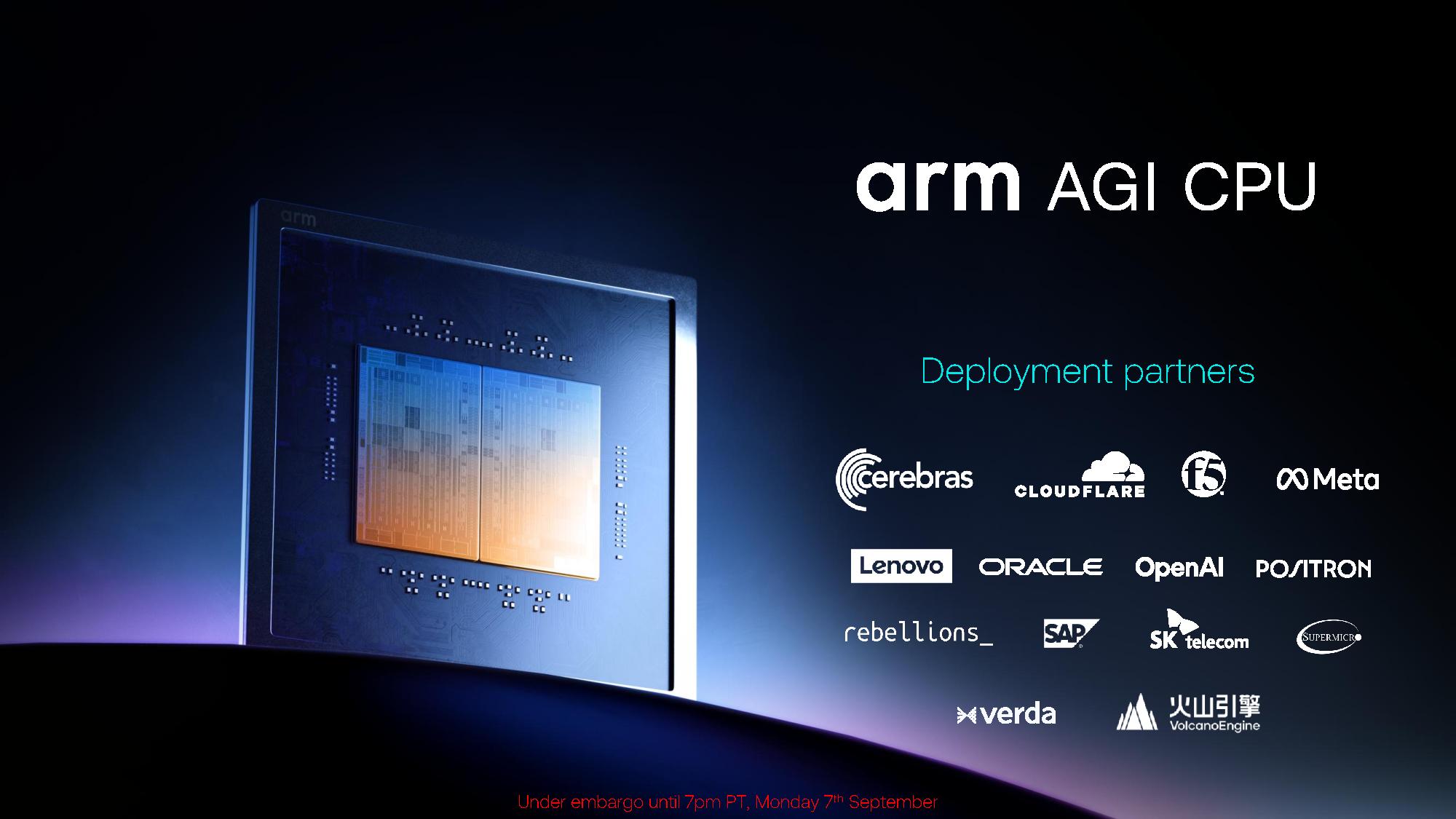
Alongside the announcement of Arm Neoverse CSS N4, the company revealed additional deployments of its own AGI chip, which is built with Neoverse V3 cores. The company revealed that Oracle and ByteDance will deploy AGI chips, alongside previously announced deployments at Meta, Lenovo, SAP, OpenAI, Cloudflare, and others.
Although Arm has talked a lot about AGI, including a deep dive into the chip’s architecture at Hot Chips, we’ve yet to see real-world performance numbers. That’s not uncommon, especially among more recent Arm-based chips. For instance, we only have gen-on-gen comparisons for Microsoft’s Azure Cobalt 200 and AWS’ Graviton5. Arm has vaguely referenced performance by saying AGI offers “more than 2x the performance per rack compared to the latest x86 systems,” though those claims are based on internal estimates, not real benchmarks.
AGI is a dual-die CPU with up to 136 Neoverse V3 cores and up to 272 MB of L3 cache that can clock up to 3.7 GHz. It has the specs to match any high-end x86 design currently on the market, built on a 3nm node and packing up to 6TB of memory capacity per chip, running at up to DDR5-8800. Perhaps the biggest difference compared to AMD and Intel was Arm’s decision to include the memory and I/O on the same die as compute, which it says leads to sub-100ns memory latency.
It’s Arm’s first attempt at its own production silicon, though it’s also been positioned so far as a vehicle for the broader applications of Arm in the data center. Microsoft, Nvidia, Meta, Google Cloud, and others build custom chips based on Arm IP, which still seems to be the primary goal, even with AGI in the mix.
PAX West is underway at the Seattle Convention Center in Seattle, Washington, and Nvidia is offering a selection of its Founder's Edition GPUs at MSRP. Nvidia has RTX 5070, RTX 5080, and RTX 5090 models available while supplies last, along with packs of GeForce Trading Cards Series 1. Jacob Freeman, GeForce Evangelist at Nvidia, shared the announcement on X, telling interested gamers to "come find me" if they want a GPU.
Nvidia's Verified Priority Access (VPA) is a lottery program for Founder's Edition cards that the company launched in 2022 for RTX 40-series GPUs. It returned in 2025 for RTX 50-series GPUs, and although you can still sign up for the program online, Nvidia has seemingly shifted to offering MSRP GPUs during live events. Last month, the company did something similar at QuakeCon in Austin, Texas.
Over the past month, we've seen a sharp rise in the price of Nvidia's highest-end graphics cards in our GPU price tracker, with the $1,999 RTX 5090 now regularly listed for above $5,000. The RTX 5090 has been a particular flashpoint due to its plentiful 32GB of GDDR7 memory, making it ideal not only for flagship gaming performance but also (relatively) low-cost local AI inference.
Hello PAX West! VPA IRL is here! Come find me if your looking for a GeForce RTX 5090, 5080 or 5070 AT MSRP! While they last 😁 pic.twitter.com/PLsUhFWxZMSeptember 4, 2026
Earlier this month, however, we saw increases as large as 39% in median list price for RTX 50-series GPUs, following a series of reports about regional price increases outside of the U.S. The increases hit the middle of Nvidia's Blackwell stack the hardest, with the RTX 5060 Ti 16GB jumping by 29% and RTX 5070 jumping by 36%.
The RTX 5090 has continued to rise in price, even after the hike we saw early last month. At the time, the median price was $4,699.99, but now, you'll spend at least $5,000 on a GPU online. Deals, if you can call them that, are available on the RTX 5090 if you have a Micro Center nearby, with models going down as low as $4,200.
Although Nvidia doesn't have a booth at PAX West 2026, many of its partners do, including Starforge Systems, Razer, and Lenovo. Freeman says he'll be posting updates on X on where and when attendees can find him.
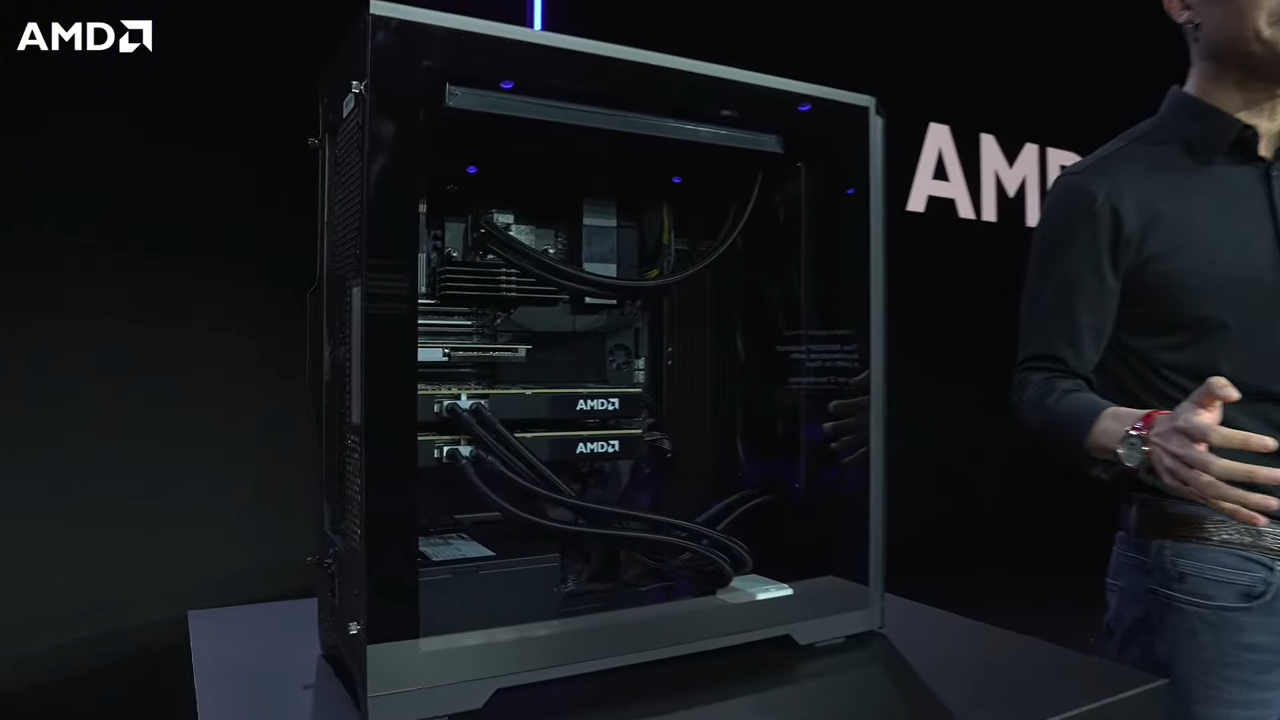
AMD announced what it calls "the most powerful workstation in the world" at IFA 2026, dubbed the Threadripper Halo Station. The machine includes a Threadripper Pro 9995WX with 96 Zen 5 cores, dual liquid-cooled Instinct MI350P accelerators "with a path to four," 2TB of DDR5, and 288GB of HBM3E with up to 576GB supported. AMD claims the workstation is capable of running trillion-parameter models.
Taking all of the components together, the street price should come out to over $100,000 with just the core components: memory, CPU, and dual GPUs. Configured higher, and with supporting storage, power, and cooling, the workstation could very easily climb over $150,000.
It's essentially a server tray reconfigured into a tower, with an EPYC host replaced with a 96-core Threadripper. AMD didn't share many details about the machine outside of the specs, though it appears to be a system design that AMD's OEM partners will ultimately build and ship. AMD has yet to announce any partners supporting the machine.
The Threadripper Pro 9995WX at the heart of the machine is a 96-core, 192-thread Zen 5 chip that can boost up to 5.4 GHz. It ships with 384 MB of L3 cache and has a TDP of 350W. It's hard to find Threadripper Pro standalone chips in general, but the 9995WX clocks in at around $11,000 to $12,000.
CPU Host
Threadripper Pro 9995WX, 96 cores, 5.4 GHz boost
GPU
2x Instinct MI350P
System memory
2TB DDR5
Cooling
Liquid-cooled CPU and GPUs
GPU memory
144GB HBM3E per accelerator, up to 576 HBM3E
CPU TDP
350W
GPU TBP
600W (per accelerator)
The MI350P accelerators come with 128 CDNA 4 compute units built on TSMC N3. Each accelerator packs 144GB of HBM3E memory, giving the system 288GB of HBM3E. AMD says there's a "path to four," opening up the possibility of two more accelerators bringing 576GB of HBM3E to the system. You'll need plenty of power to feed the GPUs, as each accelerator is rated for up to 600W.
Although AMD says it can support up to four accelerators, the workstation shown off at IFA only has room for two, both of which are liquid-cooled, alongside the Threadripper host. AMD doesn't sell MI350P accelerators on their own in traditional consumer channels, but the estimated price is somewhere around $20,000 per accelerator.
At a system level, the Threadripper Halo Station includes 2TB of DDR5 memory, which is the maximum capacity supported across the eight-channel memory configuration of the Threadripper Pro 9995WX. AMD supports up to DDR5-6400 on the Threadripper, though it made no mention of speed during its IFA presentation. Regardless of speed, 2TB of DDR5 costs about $50,000 right now.
AMD has yet to set a price or release date for the Threadripper Halo Station, though we'll likely hear more about the design from AMD's partners in the near future. An extremely expensive workstation isn't out of the question. The Lenovo ThinkStation P8, for instance, which uses Threadripper Pro CPUs as a host, clocks in at $334,463 right now, maxed out with 2TB of DDR5 and dual Blackwell accelerators.
Onimusha: Way of the Sword closes out an incredible year for Capcom, following hot on the heels of both Resident Evil Requiemand Pragmata earlier in the year. Like those titles, the game is built on Capcom’s proprietary RE Engine, which has proven to be a remarkably scalable engine that can accommodate a wide range of hardware. We put some of the best CPUs for gaming through the game’s free benchmark to see how it scales on the CPU.
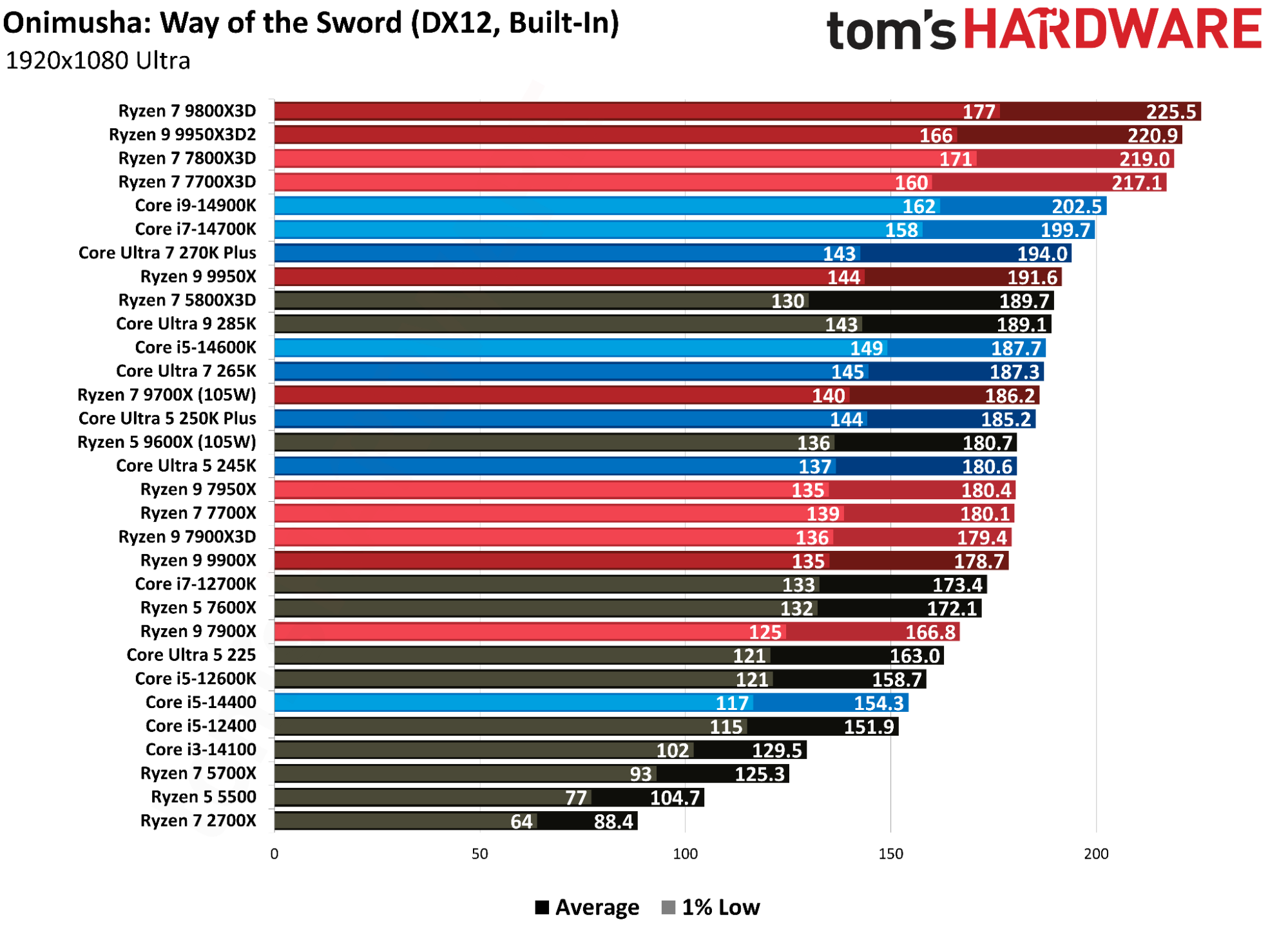
RE Engine is heavier on the GPU than the CPU, but still, we saw scaling across the 31 CPUs we tested, ranging from new releases like the Core Ultra 7 270K Plus, reaching back to relics of the past decade like the Ryzen 7 2700X. Largely, performance falls as you’d expect, but there were a few odd results that showed up in our testing, namely for AMD’s newer 12-core Ryzen 9 models, which struggle to keep pace in this game.
Regardless, the game runs well on a wide range of hardware. Even with the RTX 5090 Founder’s Edition we tested with the Ryzen 7 2700X, completely binding performance to the CPU, we neared 90 FPS at 1080p with Ultra settings and no ray tracing.
This is a cursory look at Onimusha: Way of the Sword using the in-game benchmark available (we’ll go over how we tested a bit later). As usual, performance will vary from scene to scene, and we’ve yet to reach the latest areas of the game, which may have an adverse impact on performance (though we don’t expect one). We are looking at how CPUs scale in the game more so than the raw frame rate of any individual chip.
CPU scaling in Onimusha: Way of the Sword
The Onimusha: Way of the Sword benchmark is about five minutes long, primarily consisting of two in-engine cutscenes rendered in real time. The back half of the benchmark features gameplay, which shows considerably lower performance and taxes the CPU far more than the cutscenes. We chose to benchmark during the gameplay section, naturally.
We tested with the Ultra preset without ray tracing enabled. We didn’t use DLSS or FSR, either. As usual, we tested at 1080p with the RTX 5090 Founder’s Edition to isolate CPU performance as much as possible. We’ll go deeper into the specific system configuration for each platform later in this article if you’re interested. For each CPU, we ran the benchmark three times and took the median result, discarding and rerunning any outliers.
(Image credit: Tom's Hardware)
Out of the 31 CPUs we tested, the obvious ones to call out first are AMD’s 12-core Ryzen 9 offerings, because they perform poorly in this game. The Ryzen 9 7900X is actually 3% slower than the Ryzen 5 7600X, and similarly, the Ryzen 9 9900X is 1% behind the Ryzen 5 9600X. There’s clearly some issue with the 12-core parts, specifically, that doesn’t show up in the single-CCD Ryzen CPUs, nor the full, 16-core, dual-CCD models.
Great evidence of that is the Ryzen 9 7900X3D, which I only chose to run to see if 3D V-Cache would be able to overcome the 12-core penalty. It wasn’t able to. Every other X3D chip we tested sits at the top of the charts, while the Ryzen 9 7900X3D ended up in lockstep with the Ryzen 7 7700X. It’s possible this is a performance issue that either Capcom will address through a patch, or AMD through a firmware update. Regardless, the 12-core Ryzen 9 performance in this game is rough right now.
Elsewhere, things are great. X3D chips top the charts, though with less of a margin than we see in other titles, and virtually no margin in comparison to one another. The Ryzen 7 7700X3D is 7.2% ahead of the Core i9-14900K, Intel’s strongest CPU in this game, while the Ryzen 7 9800X3D extends that lead up to 11.3%. We didn’t have time to benchmark the Ryzen 7 9850X3D, though based on the negligible performance gap between the 7700X3D and 7800X3D, don’t expect any miracles.
The Ryzen 7 5800X3D doesn’t reach the heights of its DDR5-equipped siblings, falling 13.4% behind the Ryzen 7 7800X3D. It still puts on an excellent showing considering its peers, sitting among the Core Ultra 9 285K and Ryzen 9 9950X. Even four years down the road, the Ryzen 7 5800X3D delivers performance on the level of current-gen flagships, at least in this title.
In Intel’s camp, the Core i9-14900K remains the fastest chip in Onimusha, at least when equipped with DDR5 (read our DDR4 vs DDR5 Raptor Lake comparison to see the difference in performance). Unfortunately for Team Blue, even the Core i7-14700K is 2.9% faster than Intel’s latest Core Ultra 7 270K Plus in this game. Intel doesn’t have support for Onimusha with iBOT, nor any RE Engine titles, suggesting that the performance you see here is the cap for Arrow Lake Refresh. Hopefully that changes with Intel’s impending Nova Lake.
Although Arrow Lake and AL Refresh don’t scale as high as the 14th-Gen offerings, performance is still solid competitively. The Core Ultra 5 245K is in lockstep with the Ryzen 5 9600X, as expected, while the lowly Core Ultra 5 225 is nipping at the heels of the Ryzen 5 7600X.
(Image credit: Tom's Hardware)
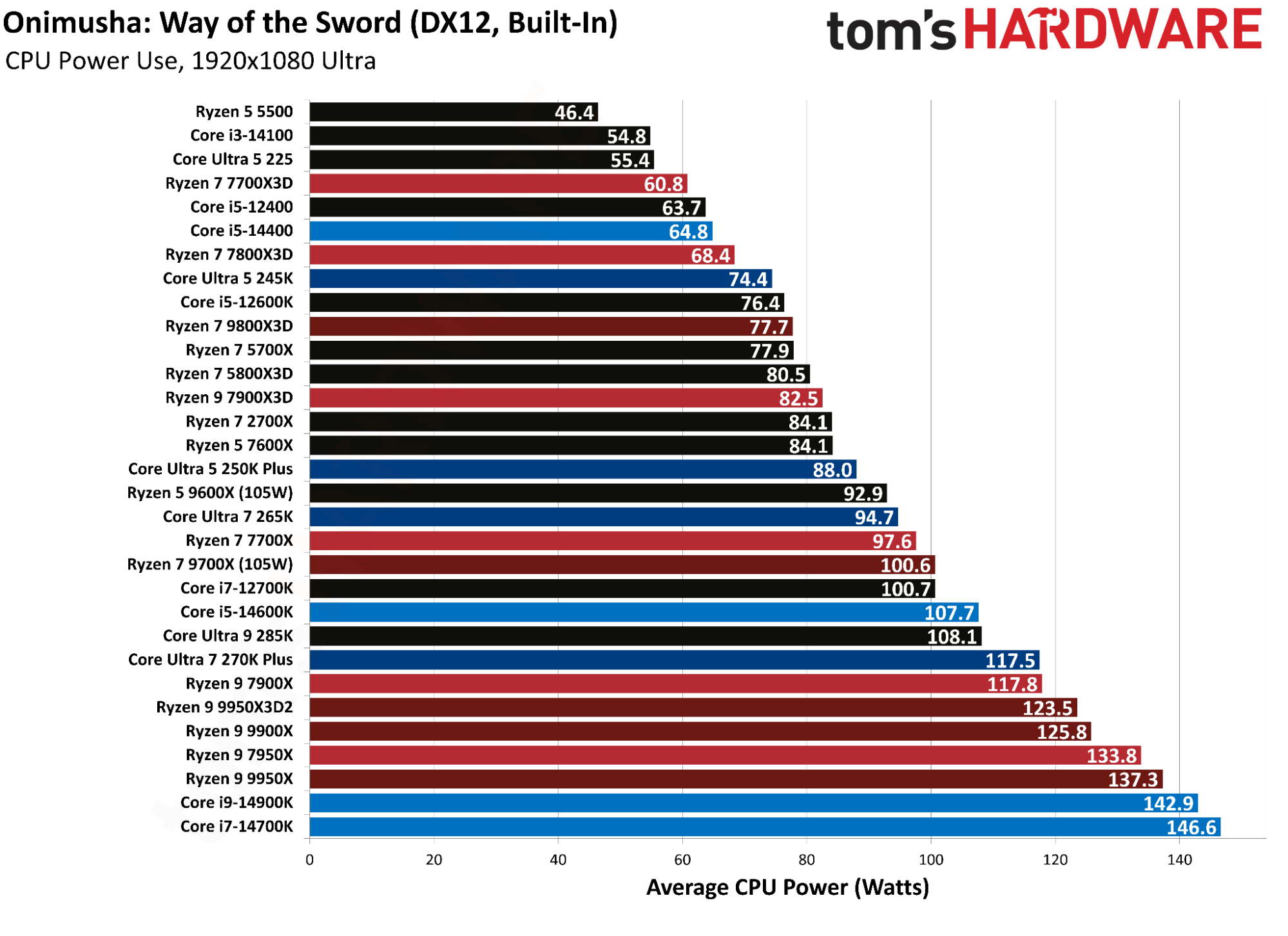
Flipping over to power, X3D chips remain well under 100W, short of the dual-CCD, dual-cache Ryzen 9 9950X3D2. Intel’s Raptor Lake Refresh chips unsurprisingly had the highest power usage out of our test pool, with the Core i7-14700K actually drawing a bit more power than the Core i9-14900K. Although we ran the test multiple times, we took the median result for average frame rate, which can sometimes push neighboring figures out of sorts when looking at other metrics. We don’t want to mix power results from one run and performance from another.
(Image credit: Tom's Hardware)
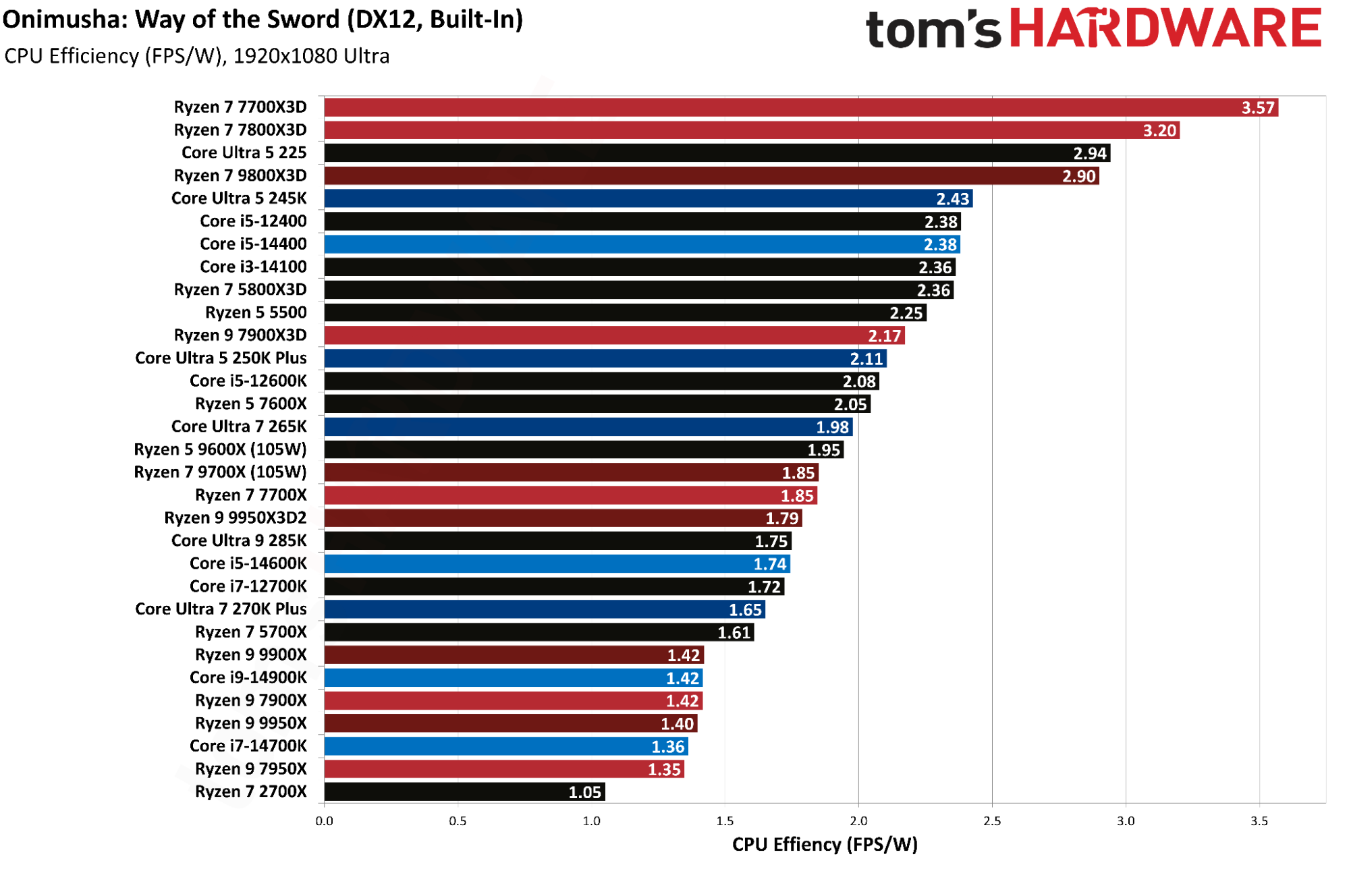
Looking directly at efficiency, the Ryzen 7 7700X3D was the most efficient chip in our testing, offering up just over 3.5 frames per watt consumed. The Ryzen 7 7800X3D barely offered a performance benefit over the 7700X3D, so its efficiency suffers as a result. Even the Ryzen 7 9800X3D falls below the 3-frames-per-watt mark.
(Image credit: Tom's Hardware)
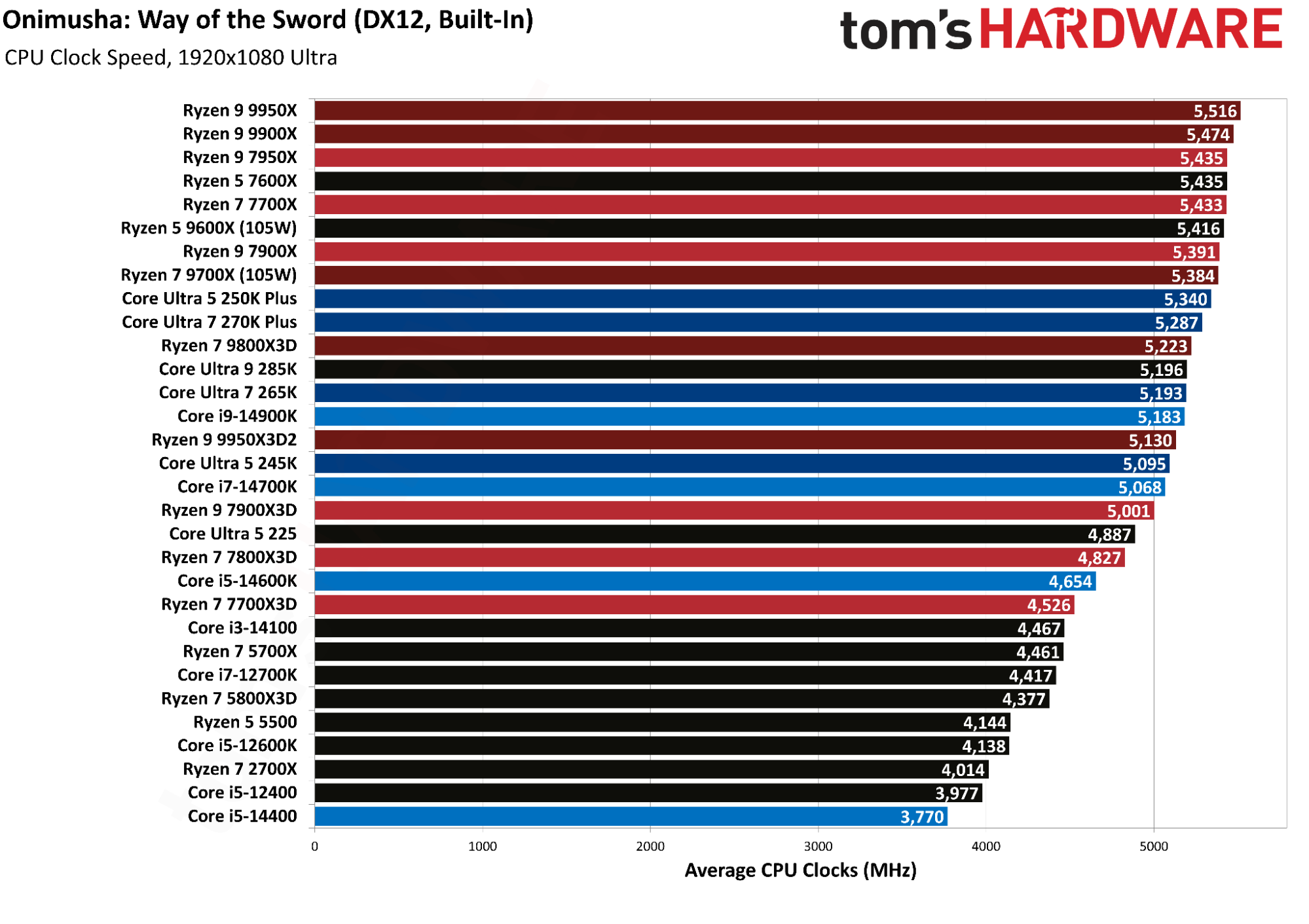
Finally, clock speed doesn’t offer a lot of surprises. The more efficient CPUs like the Ryzen 7 7800X3D ran right up against their maximum boost clock on average, while flagships that push single-core speed to the limit like the Ryzen 9 9950X and Core i9-14900K fall below their maximum boosts. Clocks don’t translate into performance here, though looking at this chart combined with our averages provides some insight into how threaded Onimusha is.
It’s lightly threaded, like the vast majority of games, though there’s a clear bump in performance beyond four cores. Combined with lower maximum boost clocks on high-core-count flagships, all-core clocks are certainly more relevant here than single-core boosts. Then again, clock speed isn’t a major factor here, regardless.
How we tested Onimusha: Way of the Sword
We used our normal test bench used for CPU reviews, as well as our CPU benchmark hierarchy testing. The hardware doesn’t change, short of the CPU and, when necessary, the motherboard and memory. We also use a frozen OS image, meaning we’re running the same versions of the same software with all the same dependencies for each test pass.
The GPU we used is the RTX 5090 Founder’s Edition, as our goal when looking at CPU scaling is to isolate the CPU’s performance as much as reasonably possible. Naturally, running a game at a low resolution like 720p and turning down all of the graphics options will put even more pressure on the CPU, but that pushes beyond isolating the performance of one component in a relatively realistic testing environment.
Although the hardware is consistent, there are BIOS tweaks we make depending on the platform. As a broad rule, anything we enable that improves performance is covered under warranty. If performance-enhancing features void the warranty, we leave them disabled. That includes AMD’s Precision Boost Overdrive and Intel’s Extreme power profile. We also don’t enable any motherboard-specific performance enhancements, such as tweaked XMP/EXPO profiles or X3D enhancements.
For this test pool, there are some features still covered by the warranty that improve performance. In Intel’s camp, we tested with Core Ultra 200S Boost enabled on all supported Arrow Lake CPUs (the 225 doesn’t support the feature). Similarly, the Ryzen 5 9600X and Ryzen 7 9700X run at a 65W TDP out of the box, but an optional, warrantied 105W TDP mode is available. We tested with that mode enabled.
We also disabled Virtualization-Based Security (VBS), as it can adversely affect gaming performance.
 登录
登录